Amoeba
Protists · Amoebozoa
Amoeba proteus
Name meaning: "The genus name *Amoeba* derives from Greek 'ἀμοιβή' (amoibe), meaning 'change.' The species epithet *proteus* refers to Proteus, the shape-shifting sea god of Greek mythology, reflecting the organism's ceaseless morphological transformation."
Discovery
Microorganism traits
Classification
Habitat
Classification history
First recorded in 1755 by Rösel von Rosenhof as 'Der Kleine Proteus.' Named Chaos protheus by Linnaeus (1758), Volvox proteus by Pallas (1766), Proteus diffluens by O.F. Müller (1786). Current binomial Amoeba proteus established by Leidy (1878). Formerly placed in Sarcodina, now classified in Amoebozoa (Tubulinea) following molecular phylogenetic revision.
Clinical significance
Non-pathogenic. Does not cause disease in humans or animals. A free-living protist of primary importance as a model organism for cell biology education and research.
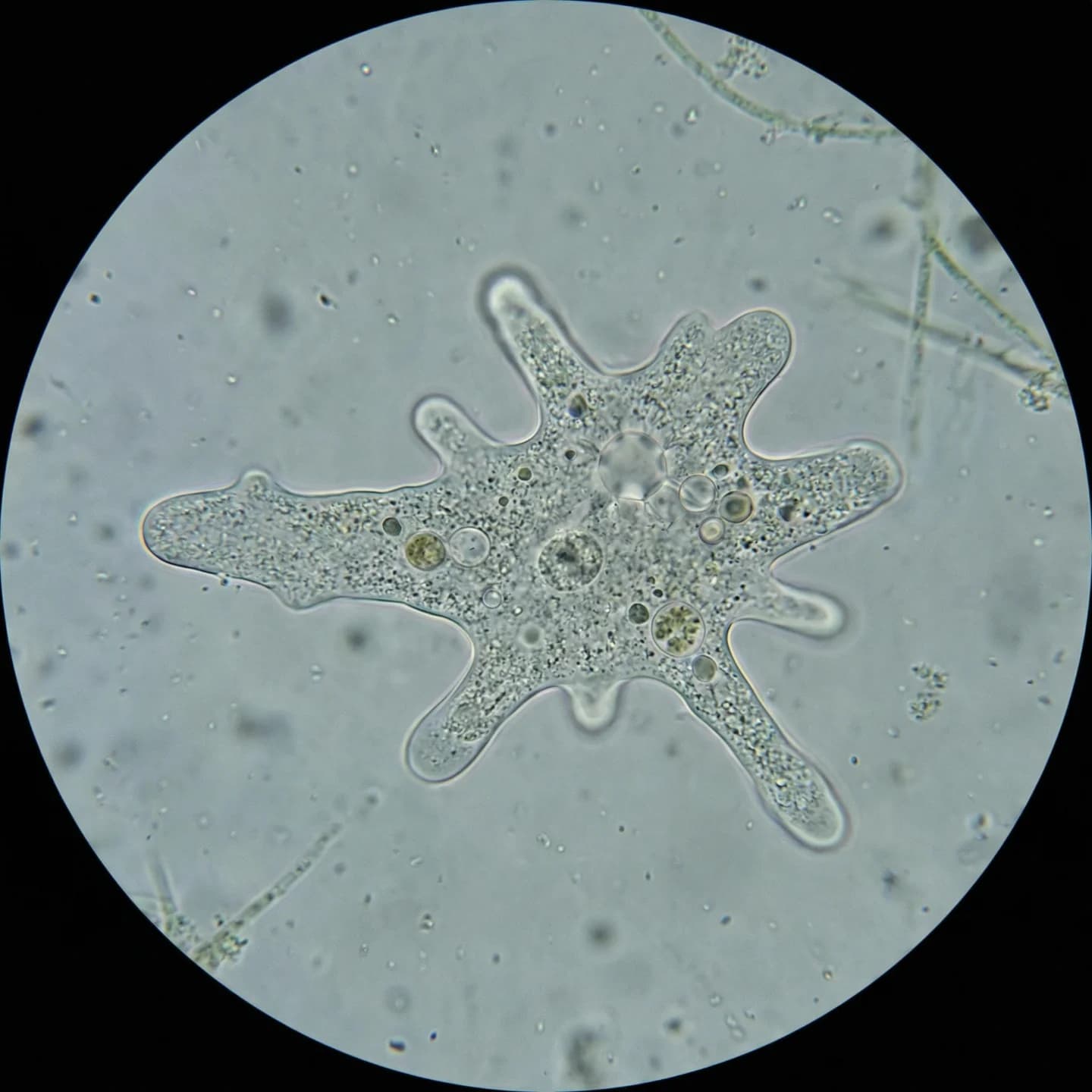
Amoeba proteus (Pallas, 1766) Leidy, 1878 is a large, free-living unicellular protist belonging to the phylum Amoebozoa, class Tubulinea, order Euamoebida, and family Amoebidae. It inhabits freshwater environments — typically the bottom sediments of ponds, lakes, ditches, and slow-moving streams — where it moves and feeds using temporary cytoplasmic extensions called pseudopodia. With a cell length of approximately 220–760 µm (mean ~425 µm), it is among the larger single-celled organisms, readily observable under a light microscope.
Since its first observation and documentation by the German naturalist August Johann Rösel von Rosenhof in 1755, who called it "Der Kleine Proteus" ("the Little Proteus"), A. proteus has served as one of the most iconic model organisms in cell biology for over 270 years. It is non-pathogenic, causes no disease in humans or animals, and is not listed on the IUCN Red List. The species is cosmopolitan, occurring in suitable freshwater habitats worldwide.
In the modern eukaryotic tree of life, Amoebozoa is the sister group to Obazoa — the clade containing animals, fungi, and their protistan relatives — placing A. proteus in a pivotal position for understanding eukaryotic evolution (Burki et al., 2020). For decades, this organism was reported to possess a genome approximately 100 times larger than that of humans, but a 2024 study by Lahr et al. demonstrated that this was a methodological artefact, re-estimating the actual genome size at roughly 24.5–28.1 Mb. A. proteus continues to be a key subject for research on cell motility, phagocytosis, nucleus–cytoplasm interactions, and endosymbiosis.
1. Overview
The genus name Amoeba derives from the Greek word 'ἀμοιβή' (amoibe), meaning 'change,' while the species epithet proteus refers to Proteus, the shape-shifting sea god of Greek mythology. Together, the binomial name elegantly captures the organism's most defining trait: its ceaseless morphological transformation as it extends and retracts pseudopodia.
The current nomenclature, Amoeba proteus (Pallas, 1766) Leidy, 1878, is taxonomically valid. The species is registered in NCBI Taxonomy (Taxonomy ID: 5775) and recognized by UniProt, GBIF, and other major biodiversity databases. Due to its close relationship with the giant multinucleate amoeba genus Chaos, the alternative name Chaos diffluens has occasionally been applied, though A. proteus remains the accepted name. The single most remarkable attribute of this organism is its ability to freely alter its cell shape via pseudopodia, enabling both locomotion and prey capture.
2. Taxonomy and Phylogeny
The taxonomic position of Amoeba proteus is as follows:
| Rank | Taxon |
|---|---|
| Domain | Eukaryota |
| Phylum | Amoebozoa |
| Class | Tubulinea |
| Order | Euamoebida |
| Family | Amoebidae |
| Genus | Amoeba |
| Species | A. proteus |
Nomenclatural History
The naming history of A. proteus is notably convoluted. The earliest record is attributed to Rösel von Rosenhof, who in 1755 published detailed illustrations of an amoeboid protozoan he dubbed "Der Kleine Proteus" in his work Insecten-Belustigung (Lorch, 1973). Subsequently, Linnaeus (1758) named it Chaos protheus, Pallas (1766) designated it Volvox proteus, and O.F. Müller (1786) called it Proteus diffluens. In 1878, the American paleontologist Joseph Leidy consolidated these names under the binomial Amoeba proteus, which has remained the accepted designation (Leidy, 1878). In 1926, Schaeffer proposed the synonym Chaos diffluens, but this has not superseded the established name.
Phylogenetic Position
Molecular phylogenetic analyses confirm Amoebozoa as a monophyletic clade and identify it as the sister group to Obazoa — the lineage encompassing Opisthokonta (animals and fungi), breviates, and apusomonads (Burki et al., 2020; Kang et al., 2017). Within Amoebozoa, two major clades are recognized: Lobosa (containing Tubulinea and Discosea) and Conosa (containing Semiconosia and Archamoebea). A. proteus belongs to Tubulinea, a group characterized by tubular or cylindrical pseudopodia.
According to Kang et al. (2017), species diversification within Amoebozoa began at least 750 million years ago during the Neoproterozoic, considerably earlier than previously assumed. This finding suggests that significant protistan diversity existed well before the emergence of multicellular life. The historical taxon 'Sarcodina,' which once encompassed all amoeboid organisms, was dismantled following molecular studies revealing it to be polyphyletic; the amoeboid body plan has convergently evolved in multiple eukaryotic lineages (Adl et al., 2019).
3. Morphology and Structure
Amoeba proteus is a large unicellular protist with no fixed shape. Cell length ranges from approximately 220 to 760 µm (mean ~425 µm), with some individuals exceeding 800 µm (Real Micro Life). The nucleus is disc-shaped or biconcave, singular, and measures roughly 22–62 µm in diameter (mean 38–47 µm). While the cell itself is colorless, ingested food particles may impart various hues to the endoplasm.
The cell lacks a cell wall and is bounded only by a phospholipid-bilayer plasma membrane, permitting unrestricted shape changes. The cytoplasm is differentiated into two distinct layers. The ectoplasm is a transparent, gel-like outer layer immediately beneath the plasma membrane, forming the exterior of pseudopodia. The endoplasm is a granular, fluid inner layer containing organelles and food vacuoles.
Pseudopodia are the most characteristic structures of A. proteus, serving as temporary cytoplasmic projections used for both locomotion and prey capture. They adopt a broad, cylindrical, blunt-tipped lobopodial morphology and are composed of both ectoplasm and endoplasm. Pseudopod formation involves actin polymerization and cortical actin network regulation by the Arp2/3 complex, although actin polymerization at the advancing tip of locomotory pseudopodia has been shown to proceed independently of the Arp2/3 complex (Pomorski et al., 2007).
The contractile vacuole is an essential osmoregulatory organelle. Because freshwater is hypotonic relative to the cell's interior, water continually enters the cell by osmosis. The contractile vacuole collects this excess water and expels it through exocytosis. A. proteus typically possesses a single contractile vacuole, often located near the posterior uroid region of the cell. During diastole, the vacuole slowly fills with water from the cytoplasm; during systole, it rapidly contracts and fuses with the plasma membrane, discharging its contents. Food vacuoles form during phagocytosis, enclosing captured prey for intracellular digestion by hydrolytic enzymes.
4. Genome and Molecular Biology
Genome Size: Debunking the Giant Genome Myth
For decades, A. proteus was widely reported to possess an extraordinarily large genome. The earliest estimate by Fritz (1968), based on DNA weight measurements, suggested approximately 147 Gb (gigabase pairs). Byers (1986) revised this downward to 34–43 pg per nucleus (~33–42 Gb) using nuclear isolation, and Afon'kin (1989) proposed a further reduction to 14 pg (~14 Gb).
However, a landmark 2024 study by Lahr et al. demonstrated that all of these historical estimates were severely inflated. The authors identified multiple methodological issues: the inherent inaccuracy of DNA weight measurements as a proxy for genome size; contamination by DNA from prey organisms (particularly the macronucleus-bearing ciliate Tetrahymena, commonly used as food in non-axenic cultures) and endosymbiotic bacteria; amplification of extrachromosomal ribosomal operons, which are present in many Amoebozoa and undergo multiple rounds of replication within the nucleus; and the failure to account for cyclic polyploidization. Using transcriptomic data to estimate the number of protein-coding genes, and applying a strong linear regression model (R² = 98.55%) derived from 15 fully sequenced amoebozoan reference genomes (ranging from 14.4 to 52.37 Mb), the authors projected the genome size of A. proteus at approximately 24.5–28.1 Mb — four orders of magnitude smaller than the historical figure of 296 Gb. As the authors concluded, "there is no longer reason to reaffirm that amoeba genomes are giant" (Lahr et al., 2024). The complete genome of A. proteus has not yet been fully sequenced.
Chromosome Number and Ploidy
The chromosome count of A. proteus was similarly controversial for decades. Liesche (1938) proposed over 500 chromosomes based on early microscopy, but Demin, Berdieva and colleagues (2017) developed improved techniques — including culture synchronization, chromosome enlargement via saline solutions, and nuclear envelope disruption for clean chromosome spreading — and determined that A. proteus strain B possesses 27 chromosome pairs (2n = 54), each displaying homologous chromomere banding patterns. The earlier exaggerated counts reflected the organism's autopolyploid nature and its passage through rounds of full-genome replication during the cell cycle (Demin et al., 2019). In 2019, the phenomenon of 'chromatin extrusion' — the discharge of excess DNA into the cytoplasm as a mechanism of depolyploidization — was documented (Goodkov et al., 2019), revealing a remarkable ploidy regulation system.
Sex-Related Genes
Comparative genomic analyses have revealed that A. proteus, along with diverse other amoebozoans, retains most of the core proteins associated with sexual reproduction and meiosis, including key double-strand break (DSB) repair genes such as Spo11, Mre11, Rad50, Rad51, Dmc1, and Msh homologs (Hofstatter et al., 2018). Despite possessing these genes, no direct evidence of meiosis or sexual reproduction has been reported in A. proteus, and the species is currently regarded as an obligate agamic (asexual) organism.
5. Ecology and Environmental Role
Habitat and Distribution
A. proteus is found worldwide in freshwater environments. It typically inhabits the bottom mud of ponds, lakes, ditches, and slow-moving streams, as well as the surfaces of submerged aquatic plants, decaying organic matter, and Sphagnum (peat moss) habitats. It favors relatively clean, oxygen-rich freshwater and thrives in ecosystems with abundant food sources — bacteria, algae, and other protists.
Locomotion and Behavior
Locomotion in A. proteus is the classic example of amoeboid movement. Cytoplasm flows toward the advancing pseudopodium, the pseudopodial membrane adheres to the substrate, and the posterior (uroid) membrane detaches, propelling the entire cell forward. This process is driven by the cooperative interaction of actin–myosin contractile machinery, cytoplasmic streaming, sol–gel transformations, and calcium-mediated signaling. Miyoshi et al. (2001) demonstrated that the locomotion pattern of A. proteus exhibits chaotic dynamics, described by a low-dimensional chaotic attractor with a correlation dimension of approximately 3–4.
Remarkably, De la Fuente et al. (2019) reported in Nature Communications that A. proteus displays a motility pattern consistent with associative conditioned behavior. When simultaneously exposed to a direct-current electric field (galvanotaxis) and a chemical stimulus (chemotaxis), 53% of conditioned amoebae demonstrated the ability to learn and retain the relationship between the two stimuli. A follow-up study by Carrasco-Pujante et al. (2021) confirmed this finding, establishing that associative conditioning is a robust systemic behavior even in unicellular organisms lacking any neural apparatus.
Feeding and Ecological Function
A. proteus is a heterotrophic predator that feeds on bacteria, algae, ciliates (e.g., Tetrahymena, Paramecium), rotifers, and smaller amoebae. It captures prey by phagocytosis — surrounding the food item with pseudopodia to form a food vacuole, within which digestive enzymes break down the prey and nutrients are absorbed into the cytoplasm.
In freshwater ecosystems, A. proteus plays several important roles. It contributes to nutrient cycling by consuming and digesting bacteria and organic matter. It regulates microbial populations by preying on bacteria, algae, and other protists. It also serves as prey for larger protists and small metazoans, forming an integral link in freshwater food webs (Shi et al., 2021).
Potential as an Environmental Bioindicator
Recent systematic reviews have evaluated A. proteus as a potential bioindicator for detecting environmental contaminants in freshwater ecosystems, noting its high sensitivity to pollutants such as heavy metals including lead, mercury, and cadmium (IJISRT, 2024).
6. Reproduction and Lifespan
A. proteus reproduces primarily by binary fission, a form of asexual reproduction. The nucleus divides by mitosis, followed by cytokinesis, yielding two genetically identical daughter cells from a single parent cell. Under favorable conditions — adequate food, water, and suitable temperature — the population grows exponentially.
The individual cell cycle duration is approximately two days. However, because binary fission splits the parent cell into two daughter cells without leaving a corpse, A. proteus does not undergo natural death in the conventional sense and may be considered biologically 'immortal.' When food is restricted, a 'life-spanning' phenomenon has been reported in which growth and division are suppressed, and this state can be transmitted to progeny.
Under adverse environmental conditions — drought, extreme temperatures, or food scarcity — A. proteus can enter a dormant state through encystment. The cell rounds up, loses most of its water content, and secretes a resistant cyst wall. The encysted amoeba can survive desiccation, temperature extremes, and starvation. When conditions improve, excystment occurs and the amoeba resumes its active trophozoite form.
7. Research History and Scientific Significance
Discovery and Naming
The earliest documented observation of A. proteus dates to 1755, when Rösel von Rosenhof published detailed drawings and descriptions in his Insecten-Belustigung, naming the organism "Der Kleine Proteus" (Lorch, 1973). Over the following century, Linnaeus (1758), Pallas (1766), and Müller (1786) each assigned different names, until Leidy (1878) unified them under the current binomial.
Value as a Model Organism
A. proteus has served as a model organism in cell biology for over 270 years. Key research areas include cell division (mechanisms of mitosis and cytokinesis), cytoskeletal dynamics (the actin–myosin system and shape change), nucleus–cytoplasm interactions (nuclear transplantation experiments), phagocytosis (mechanisms of particle ingestion), and cell motility (molecular basis of amoeboid movement). The organism's large size, simple organization, and relative ease of culture have made it particularly amenable to experimental manipulation.
The X-Bacteria Endosymbiosis: A Classic Case Study
One of the most celebrated experimental findings involving A. proteus is Kwang Jeon's X-bacteria endosymbiosis study. In 1966, the D strain of A. proteus became naturally infected with Legionella-like bacteria (X-bacteria) that were initially parasitic — severely reducing host fitness. Over time, however, the relationship evolved into obligate endosymbiosis: the infected xD strain came to harbor approximately 42,000 symbionts per cell within symbiotic vesicles, and removal of the symbionts proved lethal to the host (Jeon, 2004). The bacteria were subsequently classified by phylogenetic analysis as 'Candidatus Legionella jeonii' (Park & Yun, 2004). This remains one of the rare documented cases in which the transition from parasitism to mutualistic endosymbiosis has been observed in real time under laboratory conditions, and it carries profound implications for evolutionary biology.
Current Research Directions
Active research frontiers involving A. proteus include the completion of full genome sequencing, which remains outstanding despite the 2024 genome size re-evaluation; the elucidation of the molecular and cellular mechanisms underlying conditioned behavior in a brainless unicellular organism; the biological significance and evolutionary implications of cyclic polyploidy and chromatin extrusion; and the long-term effects of amoeba–microbe interactions (bacteria and giant viruses) on genome evolution and lateral gene transfer.
8. Comparison with Related Protists
| Feature | A. proteus | Chaos carolinense | Paramecium sp. | Acanthamoeba sp. |
|---|---|---|---|---|
| Size | 220–760 µm | 1–5 mm (multinucleate) | 100–300 µm | 15–35 µm (trophozoite) |
| Shape | Irregular, variable | Irregular, variable | Slipper-shaped, fixed | Acanthopodia |
| Nucleus | Single | Multiple (hundreds–thousands) | Macronucleus + micronucleus | Single |
| Locomotion | Lobose pseudopodia | Lobose pseudopodia | Cilia | Acanthopodia |
| Habitat | Freshwater | Freshwater | Freshwater | Freshwater, soil, seawater |
| Pathogenicity | Non-pathogenic | Non-pathogenic | Non-pathogenic | Opportunistic pathogen |
| Phylum | Amoebozoa | Amoebozoa | Ciliophora | Amoebozoa |
| Contractile vacuoles | 1 | Multiple | 2 | 1 |
| Sexual reproduction | Not observed | Not observed | Conjugation | Not observed (genes present) |
A. proteus and Chaos carolinense both belong to the family Amoebidae and share a similar gross morphology, but Chaos is distinguished by its multinucleate giant cells. Paramecium, while also a freshwater unicellular protist, belongs to the phylum Ciliophora and differs fundamentally in locomotion (cilia rather than pseudopodia), nuclear organization (nuclear dualism), and reproductive strategy (conjugation). Acanthamoeba, another amoebozoan, is notable for its clinical significance as an opportunistic pathogen capable of causing amoebic keratitis and granulomatous amoebic encephalitis.
9. Relationship with Humans
A. proteus is a non-pathogenic, free-living amoeba that causes no disease in humans or animals. This clearly distinguishes it from pathogenic amoebae such as Entamoeba histolytica (the causative agent of amoebic dysentery) and Naegleria fowleri (the causative agent of primary amoebic meningoencephalitis). A. proteus does not parasitize human tissues.
The species is widely used as an educational specimen in schools and universities around the world. Its ease of observation under a light microscope and its clear demonstration of fundamental cellular structures and processes — cell membrane, nucleus, food vacuoles, contractile vacuole, and cell motility — make it an excellent teaching tool. In popular culture, the amoeba is frequently invoked as a symbol of the 'simplest form of life,' yet the organism is in fact a sophisticated cell with a complex cytoskeletal system, precise osmotic regulation, environmentally responsive encystment, and learning-like behavior.
From an ecological perspective, amoebae are increasingly recognized as environmental reservoirs and evolutionary 'training grounds' for bacterial pathogens. Many pathogenic bacteria, including Legionella species, can survive and replicate within amoebae, and the mechanisms bacteria use to resist amoeboid phagocytosis may parallel those employed against human macrophages — a hypothesis with significant implications for understanding infectious disease (Shi et al., 2021).
Fun Facts
The species name proteus honors the shape-shifting sea god of Greek mythology. When first discovered in 1755, Rösel von Rosenhof called it 'Der Kleine Proteus' — 'the Little Proteus' — for its ceaseless morphological transformation.
A 2024 study shattered the 'giant genome' myth: the genome of A. proteus, long claimed to be ~100 times larger than the human genome (~296 Gb), was re-estimated at just 24.5–28.1 Mb — roughly 10,000 times smaller than previously believed. The old estimates were inflated by contaminating DNA from prey and symbionts.
Despite having no brain or nervous system, A. proteus can learn. A 2019 Nature Communications study showed that 53% of conditioned amoebae could learn and remember the association between an electric field and a chemical stimulus — a form of Pavlov-like conditioning in a single cell.
Amoeba proteus is biologically 'immortal.' Because it reproduces by binary fission — dividing into two genetically identical daughter cells — there is no parent 'corpse.' An unbroken genetic lineage could, in theory, persist for millions of years.
In 1966, a laboratory strain of A. proteus became infected with parasitic bacteria that, over time, evolved into essential endosymbionts — the host could no longer survive without them. This is one of the rarest documented real-time observations of the transition from parasitism to mutualistic symbiosis.
The movement of A. proteus is mathematically chaotic. A 2001 study found that its locomotion pattern is governed by a low-dimensional chaotic attractor, with a correlation dimension of approximately 3–4.
A. proteus has been a subject of scientific study for over 270 years — since its first documentation in 1755 — making it one of the longest-studied protists and an enduring icon of cell biology.
In popular culture, amoebae are often depicted as the 'simplest life forms,' but A. proteus is actually remarkably sophisticated: it possesses a complex cytoskeletal system, precise osmotic regulation, the ability to form dormant cysts, and even learning-like behavior.
Without its contractile vacuole, A. proteus would burst. Freshwater is hypotonic to its cytoplasm, causing continuous water influx by osmosis. The contractile vacuole cyclically collects and expels this excess water to keep the cell intact.
For decades, A. proteus was believed to have over 500 chromosomes. Modern karyotyping (2017) revealed the actual number is just 27 pairs (2n = 54) — the inflated historical counts reflected cyclic polyploidization, not true chromosome number.
Amoebae serve as evolutionary 'training grounds' for bacterial pathogens. Many disease-causing bacteria, including Legionella, can survive and multiply inside amoebae, and the resistance mechanisms they develop may parallel those used against human immune cells.
Under harsh conditions — drought, extreme temperatures, or starvation — A. proteus can form a dormant cyst by rounding up, losing most of its water, and secreting a tough protective wall. It can remain in this suspended state until conditions improve.
FAQ
Amoeba proteus moves using pseudopodia — temporary cytoplasmic projections driven by the actin–myosin contractile system. Cytoplasm flows toward the advancing pseudopodium while the cell membrane bulges outward. The pseudopodial membrane adheres to the substrate, and the posterior membrane (uroid) detaches, pulling the cell forward. This process involves sol–gel transformations and calcium-mediated signaling. Interestingly, the locomotion pattern has been shown to exhibit chaotic dynamics, described by a low-dimensional chaotic attractor with a correlation dimension of ~3–4 (Miyoshi et al., 2001).
Amoeba proteus is a heterotrophic predator that feeds on bacteria, algae, ciliates (such as Tetrahymena and Paramecium), rotifers, and smaller amoebae. It captures prey through phagocytosis — extending pseudopodia to surround and engulf the food item, forming an intracellular food vacuole. Within the vacuole, digestive enzymes break down the prey and nutrients are absorbed into the cytoplasm. Undigested residues are expelled at the cell surface.
Living in freshwater, which is hypotonic relative to its cytoplasm, Amoeba proteus faces continuous water influx by osmosis. It manages this using a contractile vacuole — a membrane-bound organelle that slowly fills with water from the cytoplasm (diastole), then rapidly contracts and fuses with the plasma membrane (systole) to expel the excess water. This cyclic process maintains the cell's osmotic balance. Aquaporins have been identified in the contractile vacuole membrane, facilitating water transport. Without this organelle, the cell would swell and lyse.
Evidence suggests yes. A 2019 study published in Nature Communications (De la Fuente et al.) demonstrated that A. proteus displays motility patterns consistent with associative conditioned behavior. When simultaneously exposed to an electric field (galvanotaxis) and a chemical stimulus (chemotaxis), 53% of conditioned amoebae learned and retained the association between the two stimuli. A 2021 follow-up study confirmed these findings. However, the molecular and cellular mechanisms underlying this learning-like behavior in a brainless unicellular organism remain unknown.
No. For decades, the genome was reported to be ~296 Gb — roughly 100 times larger than the human genome. However, a 2024 study by Lahr et al. proved that these estimates were severely inflated due to methodological artefacts: contaminating DNA from prey and endosymbionts, amplification of extrachromosomal ribosomal operons, and failure to account for cyclic polyploidy. Modern transcriptome-based statistical analysis estimates the actual genome size at approximately 24.5–28.1 Mb, consistent with other sequenced amoebozoan genomes (14.4–52.37 Mb range).
The cell cycle duration of an individual amoeba is approximately two days. However, since A. proteus reproduces by binary fission — splitting into two genetically identical daughter cells — there is no 'death' of a parent cell in the conventional sense. Theoretically, an unbroken genetic lineage can persist indefinitely, making the organism biologically 'immortal.' Under food limitation, a 'life-spanning' phenomenon occurs in which growth and division are suppressed, and this state can be inherited by progeny.
No. Amoeba proteus is a non-pathogenic, free-living amoeba that does not cause disease in humans or animals. It should not be confused with pathogenic amoebae such as Entamoeba histolytica (amoebic dysentery) or Naegleria fowleri (primary amoebic meningoencephalitis). A. proteus lives freely in freshwater and does not parasitize human tissues.
In 1966, a laboratory strain (D strain) of A. proteus became naturally infected with Legionella-like bacteria (X-bacteria). Initially parasitic and harmful, the bacteria gradually evolved into obligate endosymbionts over time. The infected xD strain came to harbor ~42,000 symbionts per cell, and removal of these symbionts proved lethal to the host. The bacteria were later classified as 'Candidatus Legionella jeonii' (Park & Yun, 2004). This is one of the rare cases where the transition from parasitism to obligate mutualism has been directly observed under laboratory conditions.
Both are freshwater unicellular protists, but they differ fundamentally. Amoeba moves slowly using pseudopodia with a constantly changing shape, has a single nucleus and one contractile vacuole, and reproduces exclusively by asexual binary fission. Paramecium swims rapidly using cilia, has a fixed slipper shape maintained by a pellicle, possesses two types of nuclei (macronucleus and micronucleus) and two contractile vacuoles, and is capable of sexual reproduction through conjugation. Taxonomically, Amoeba belongs to Amoebozoa while Paramecium belongs to Ciliophora.
For decades, A. proteus was reported to have over 500 chromosomes (Liesche, 1938). However, modern karyotyping by Demin and Berdieva et al. (2017) revealed that strain B possesses 27 chromosome pairs (2n = 54), each showing homologous chromomere banding patterns. The earlier inflated counts resulted from the organism's autopolyploid nature — it undergoes rounds of full-genome replication (cyclic polyploidization) during the cell cycle, temporarily increasing chromosome numbers.
📚References
Adl, S.M., Bass, D., Lane, C.E., et al. (2019). Revisions to the classification, nomenclature, and diversity of eukaryotes. Journal of Eukaryotic Microbiology, 66, 4–119. https://doi.org/10.1111/jeu.12691
Berdieva, M., Demin, S., & Goodkov, A. (2019). Amoeba proteus and ploidy cycles: From simple model to complex issues. Protistology, 13, 166–173.
Burki, F., Roger, A.J., Brown, M.W., & Simpson, A.G.B. (2020). The new tree of eukaryotes. Trends in Ecology & Evolution, 35, 43–55. https://doi.org/10.1016/j.tree.2019.08.008
Carrasco-Pujante, J., Bringas, C., Malaina, I., et al. (2021). Associative conditioning is a robust systemic behavior in unicellular organisms. Frontiers in Microbiology, 12, 707086. https://doi.org/10.3389/fmicb.2021.707086
De la Fuente, I.M., Bringas, C., Malaina, I., et al. (2019). Evidence of conditioned behavior in amoebae. Nature Communications, 10, 3690. https://doi.org/10.1038/s41467-019-11677-w
Demin, S., Berdieva, M.A., Podlipaeva, Y.I., Yudin, A.L., & Goodkov, A.V. (2017). Karyotyping of Amoeba proteus. Cell and Tissue Biology, 11, 308–313.
Demin, S., Berdieva, M.A., & Goodkov, A.V. (2019). Cyclic polyploidy in obligate agamic amoebae. Cell and Tissue Biology, 13, 242–246.
Fritz, C.T. (1968). The biochemical composition of the free-living amoebae Chaos chaos, Amoeba dubia and Amoeba proteus. Comparative Biochemistry and Physiology, 26, 81–90. https://doi.org/10.1016/0010-406x(68)90314-9
Goodkov, A.V., Berdieva, M.A., Podlipaeva, Y.I., & Demin, S. (2019). The chromatin extrusion phenomenon in Amoeba proteus cell cycle. Journal of Eukaryotic Microbiology, 67, 203–208. https://doi.org/10.1111/jeu.12771
Hofstatter, P.G., Brown, M.W., & Lahr, D.J. (2018). Comparative genomics supports sex and meiosis in diverse Amoebozoa. Genome Biology and Evolution, 10(11), 3118–3128. https://doi.org/10.1093/gbe/evy241
Jeon, K.W. (2004). Genetic and physiological interactions in the amoeba–bacteria symbiosis. Journal of Eukaryotic Microbiology, 51, 502–508. https://doi.org/10.1111/j.1550-7408.2004.tb00277.x
Kang, S., Tice, A.K., Spiegel, F.W., et al. (2017). Between a pod and a hard test: The deep evolution of amoebae. Molecular Biology and Evolution, 34(9), 2258–2270. https://doi.org/10.1093/molbev/msx162
Lahr, D.J.G., Barbosa, J.P.A., Santos, A.L.P., et al. (2024). Re-evaluating evidence for giant genomes in amoebae. Genetics and Molecular Biology, 47(suppl 1), e20240054. https://doi.org/10.1590/1678-4685-GMB-2024-0054
Leidy, J. (1878). Amoeba proteus. The American Naturalist, 12(4), 235–238. https://doi.org/10.1086/272082
Lorch, I.J. (1973). Some historical aspects of Amoeba studies. In The Biology of Amoeba (pp. 1–36). Academic Press.
Miyoshi, H., Kagawa, Y., & Tsuchiya, Y. (2001). Chaotic behavior in the locomotion of Amoeba proteus. Protoplasma, 216(1–2), 66–70. https://doi.org/10.1007/BF02680132
Park, M.S. & Yun, S.H. (2004). Phylogenetic characterization of Legionella-like endosymbiotic X-bacteria in Amoeba proteus: a proposal for 'Candidatus Legionella jeonii' sp. nov. Environmental Microbiology, 6, 1252–1263. https://doi.org/10.1111/j.1462-2920.2004.00659.x
Pomorski, P., Dulyaninova, N., Bhouri, T., et al. (2007). Actin dynamics in Amoeba proteus motility. Protoplasma, 231(1–2), 31–41. https://doi.org/10.1007/s00709-007-0243-1
Shi, Y., Queller, D.C., Tian, Y., et al. (2021). The ecology and evolution of amoeba–bacterium interactions. Applied and Environmental Microbiology, 87(2), e01866-20. https://doi.org/10.1128/AEM.01866-20
Gallery
2 images Amoeba
Amoeba
 Amoeba
Amoeba