Heterodontosaurus
Jurassic Period Herbivore Creature Type
Heterodontosaurus tucki
Scientific Name: "Heterodontosaurus = Greek heteros (different) + odous (tooth) + sauros (lizard), meaning 'different-toothed lizard'; tucki = honouring George C. Tuck, sponsor of the discovery expedition"
Physical Characteristics
Discovery
Habitat

Heterodontosaurus tucki Crompton & Charig, 1962 is a small ornithischian dinosaur from the Early Jurassic (approximately 200–190 Ma) of South Africa. It is the eponymous and best-known genus of the family Heterodontosauridae, preserving the most complete fossil record of any member of the group. The genus name derives from the Greek heteros (different) + odous (tooth) + sauros (lizard), meaning "different-toothed lizard," in reference to the animal's remarkable heterodont dentition—a feature extremely unusual among reptiles and dinosaurs, which typically possess only a single tooth type. The specific name tucki honours George C. Tuck, a director of the Austin Motor Company, who financially supported the 1961–1962 British–South African expedition during which the holotype was discovered.
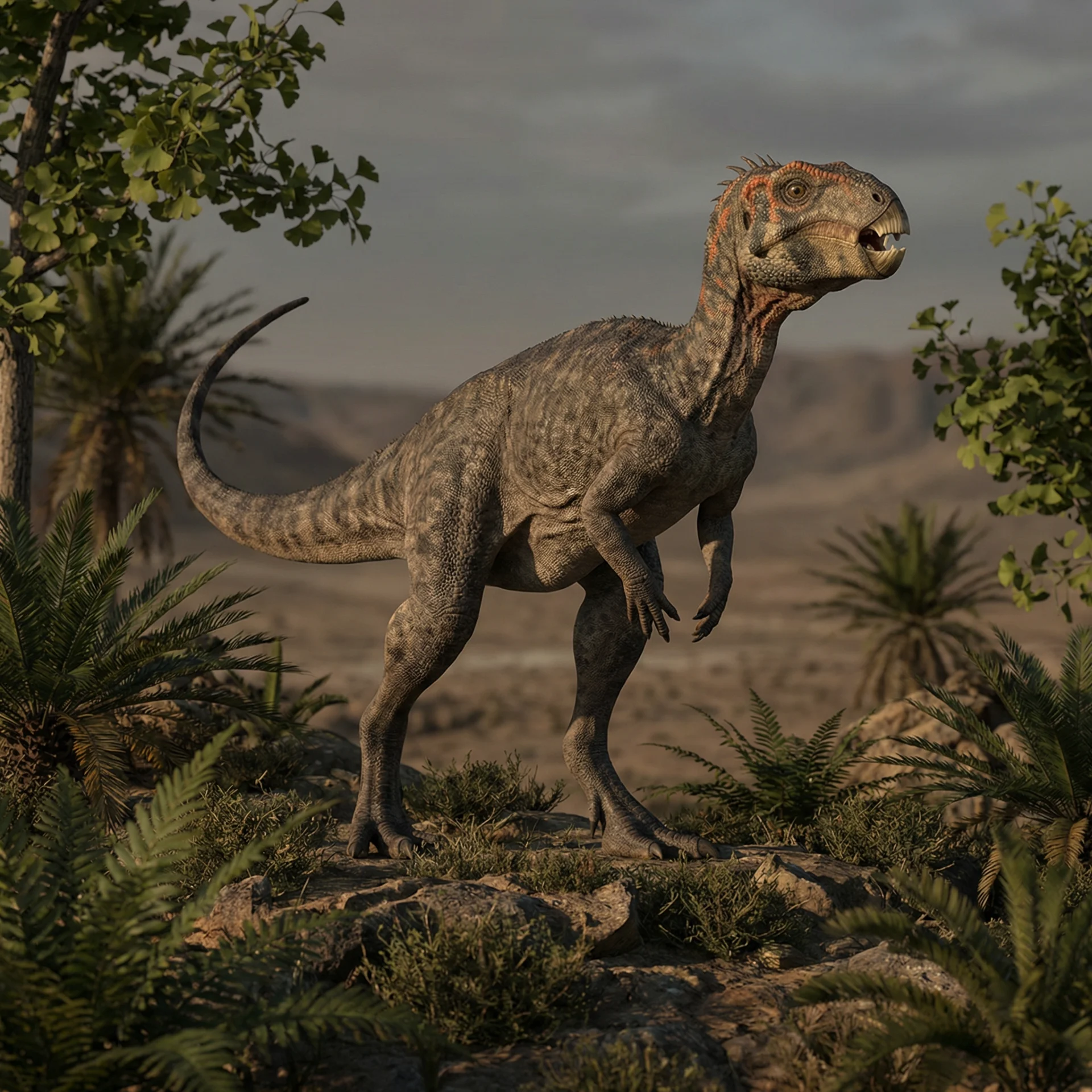
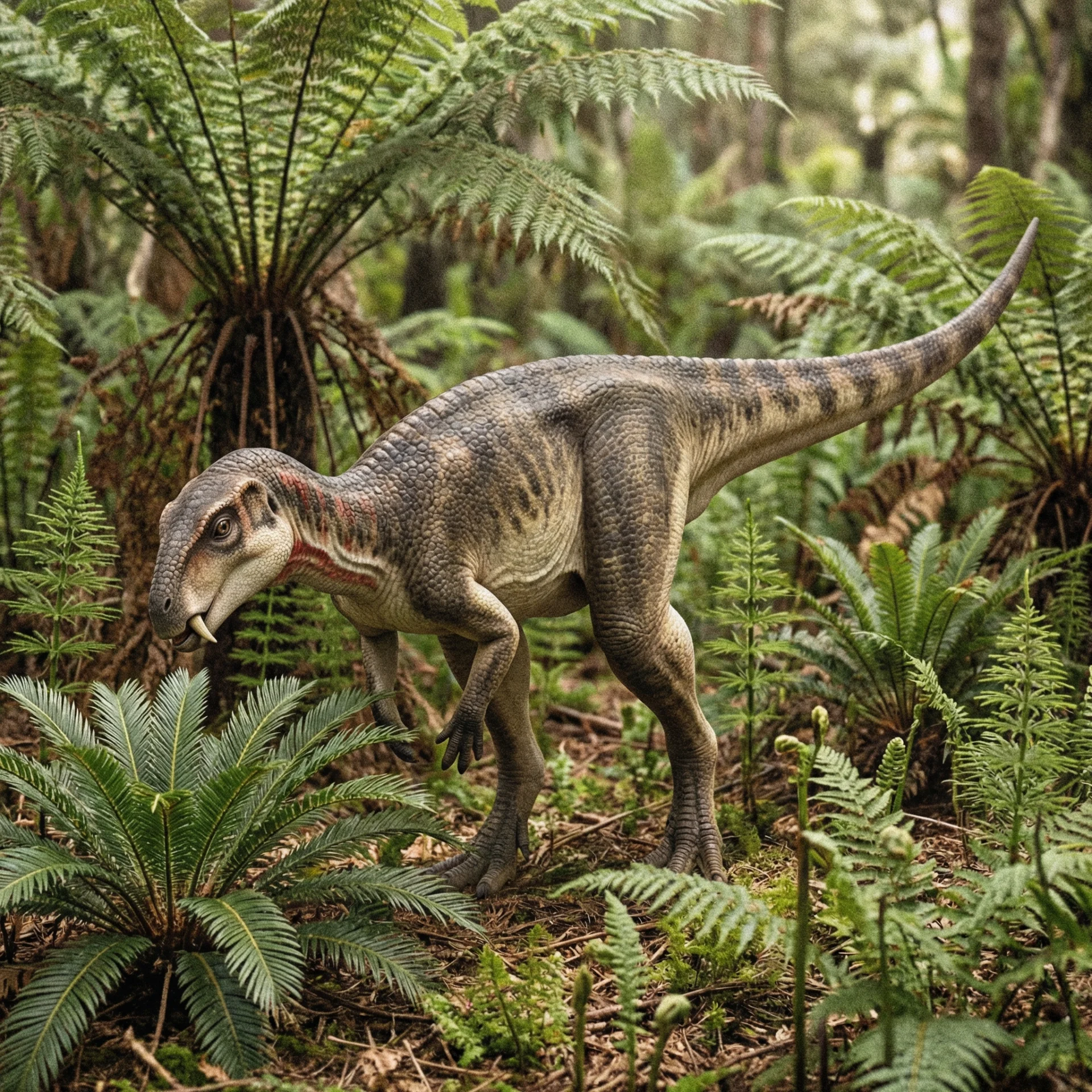
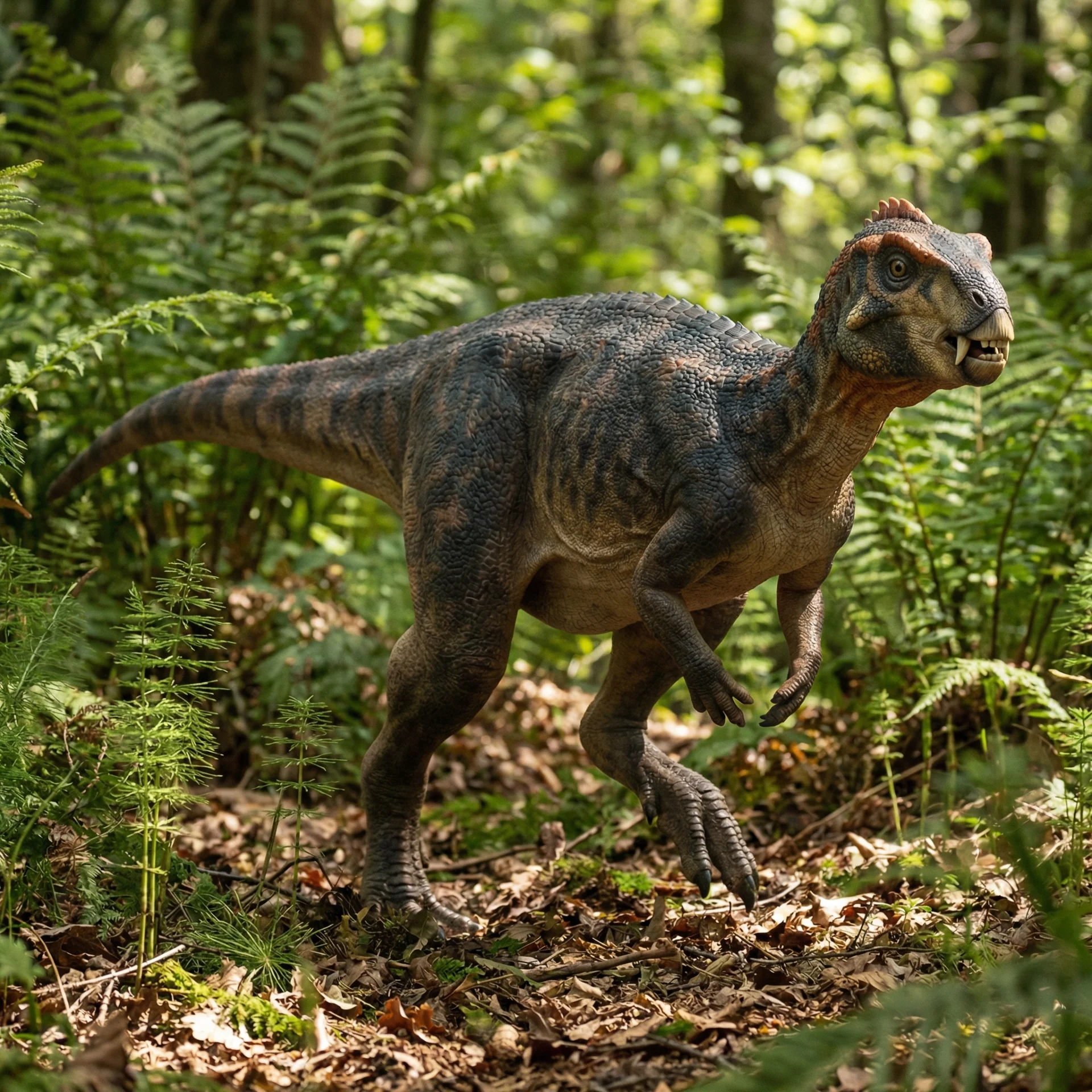
Based on the most complete skeleton, the animal measured approximately 1.18 m in total body length, with body mass estimates ranging from about 1.8 to 3.4 kg—roughly the size of a turkey. A second, incomplete specimen suggests that the species could have reached up to 1.75 m in length and nearly 10 kg in mass (Galton, 2014). The most striking feature of Heterodontosaurus is its three distinct tooth types: small incisor-like premaxillary teeth, prominent canine-like tusks, and rows of chisel-shaped cheek teeth for processing vegetation. The front of the jaws was covered by a horny beak (rhamphotheca), and the large caniniform tusks remain the subject of ongoing debate regarding their function.
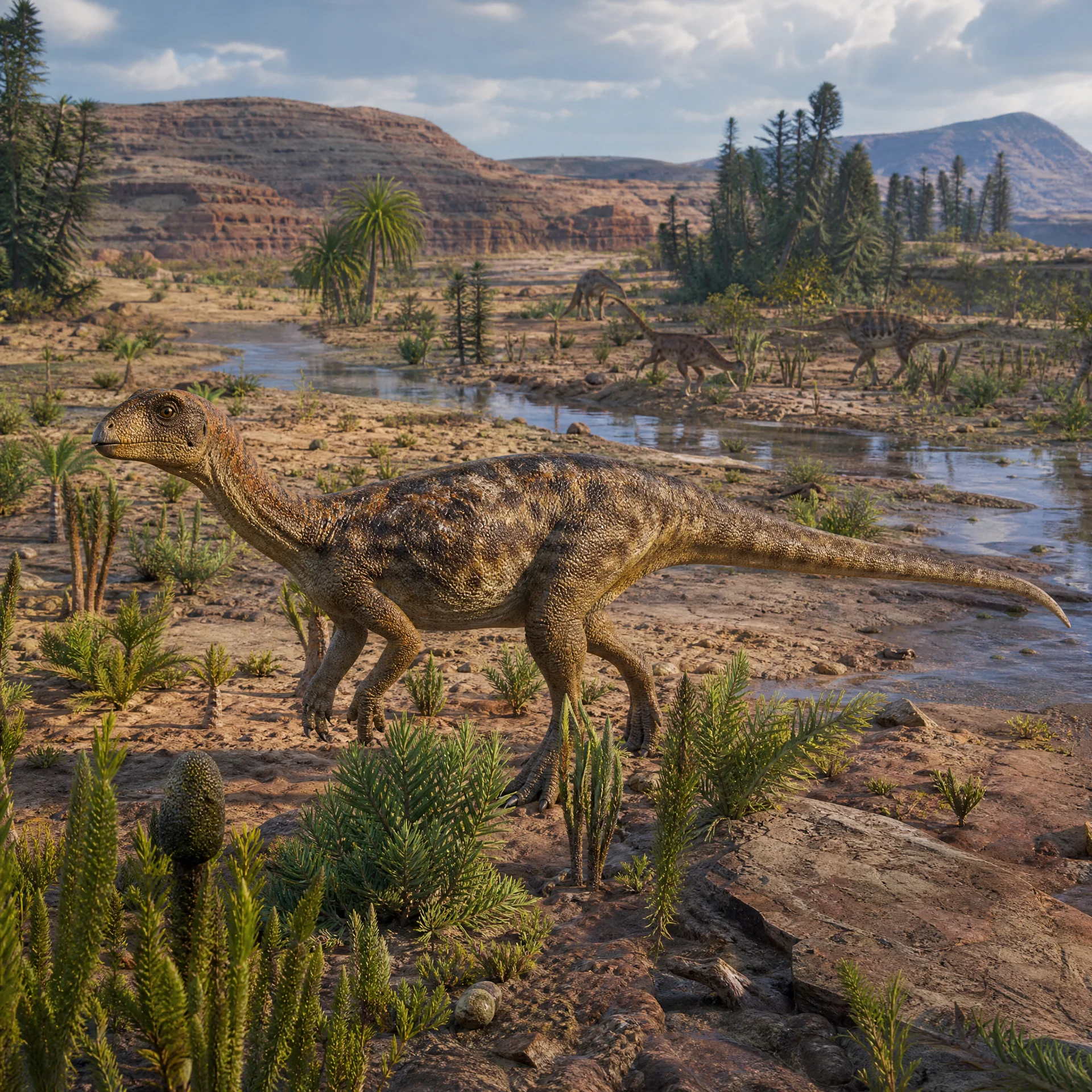
All confirmed specimens of Heterodontosaurus come from the Upper Elliot Formation and Clarens Formation of the Karoo Supergroup (Stormberg Group) in the Eastern Cape Province and adjacent regions of South Africa. These formations represent semi-arid, ephemeral fluvio-lacustrine depositional environments characterised by seasonal alternation between wet and dry periods. At least four other heterodontosaurid genera—Lycorhinus, Abrictosaurus, Pegomastax, and Geranosaurus—are known from the same or overlapping geological formations, indicating that the family achieved remarkable diversity in Early Jurassic southern Africa.
Heterodontosaurus was bipedal with long, slender hindlimbs suited for running, and relatively robust forelimbs with large, recurved claws interpreted as adaptations for foraging rather than locomotion. Its unique anatomical features, including gastralia (the only ornithischian known to possess them), fused tibiotarsus and tarsometatarsus, and a transitional respiratory apparatus, have made it a pivotal taxon for understanding the early evolution of ornithischian dinosaurs.
Overview
Name and Etymology
The genus name Heterodontosaurus is composed of the Greek words heteros (ἕτερος, "different"), odous (ὀδούς, "tooth"), and sauros (σαῦρος, "lizard"), meaning "different-toothed lizard." This reflects the animal's possession of three morphologically distinct tooth types—incisiform, caniniform, and chisel-shaped cheek teeth—a condition termed heterodonty that is typical of mammals but highly unusual among reptiles and dinosaurs, which are predominantly homodont (Crompton & Charig, 1962). The specific epithet tucki honours George C. Tuck, an executive of the Austin Motor Company who sponsored the 1961–1962 British–South African palaeontological expedition to South Africa and Basutoland (now Lesotho).
Taxonomic Status
Heterodontosaurus tucki is currently recognised as a valid monotypic genus. Its taxonomic validity has been consistently upheld since the original description in 1962. In 1970, Thulborn proposed reassigning the species to the older genus Lycorhinus as Lycorhinus tucki, but this synonymy was rejected by Charig & Crompton (1974) and Hopson (1975) on the basis of morphological differences and the fragmentary, poorly preserved nature of the Lycorhinus angustidens holotype, which precluded meaningful comparison. Heterodontosaurus serves as the type genus and principal reference taxon for the Heterodontosauridae, the family named independently by Romer and Kuhn in 1966 (Sereno, 2012).
Summary
A small Early Jurassic ornithischian from South Africa, Heterodontosaurus is the type genus of Heterodontosauridae, distinguished by its unique three-part heterodont dentition and prominent caniniform tusks.
Temporal Range, Stratigraphy, and Depositional Environment
Temporal Range and Evidence
Heterodontosaurus fossils date to the Early Jurassic, specifically the Hettangian–Sinemurian stages, approximately 200–190 Ma. Crompton & Charig (1962) originally assigned the holotype to the Upper Triassic; however, subsequent chronostratigraphic reassessment of the Stormberg Group revised the age of the Upper Elliot Formation to Hettangian–Sinemurian (Bordy et al., 2020). This dating is supported by a combination of biostratigraphy (Massospondylus Assemblage Zone), magnetostratigraphy, and radioisotopic age constraints.
Formations and Lithology
The primary fossil-bearing unit is the Upper Elliot Formation of the Stormberg Group, Karoo Supergroup. Some specimens are also attributed to the overlying Clarens Formation.
| Formation | Lithology | Approximate Age | Notes |
|---|---|---|---|
| Upper Elliot Formation | Red/purple mudstone, red/white sandstone | Hettangian–Sinemurian (ca. 200–190 Ma) | Majority of specimens |
| Clarens Formation | White/cream-coloured sandstone | Sinemurian–Pliensbachian | Some specimens (e.g., AMNH 24000) |
Palaeoenvironment
The Upper Elliot Formation is interpreted as a semi-arid, ephemeral fluvio-lacustrine environment. The alternating red mudstones and sandstones indicate episodic fluvial deposition on broad floodplains under a seasonally variable climate with distinct wet and dry periods (Bordy et al., 2016). The overlying Clarens Formation records a transition to increasingly arid, partially aeolian (wind-blown dune) conditions. These environmental conditions have been linked to the hypothesis that heterodontosaurids may have aestivated during dry seasons (Thulborn, 1978), although this idea was subsequently challenged by Hopson (1980) due to insufficient supporting evidence.
The Upper Elliot Formation preserves a diverse vertebrate fauna, including temnospondyl amphibians, turtles, lepidosaurs, aetosaurs, crocodylomorphs, non-mammalian cynodonts, and several dinosaur taxa.
Specimens and Diagnostic Features
Holotype and Key Specimens
| Specimen | Locality | Preserved Elements | Repository | Notes |
|---|---|---|---|---|
| SAM-PK-K337 (holotype) | Tyinindini, Transkei | Nearly complete skull (crushed) | Iziko South African Museum | Discovered 1961–62; original description (1962) |
| SAM-PK-K1332 | Voyizane, Elliot Formation | Articulated skull + nearly complete skeleton | Iziko South African Museum | Discovered 1966; most complete heterodontosaurid skeleton known |
| SAM-PK-K10487 | Voyizane | Anterior portion of juvenile skull | Iziko South African Museum | Collected 1966–67; identified as Heterodontosaurus in 2008 (Butler et al.) |
| SAM-PK-K1334 | Voyizane | Left maxilla with teeth | Iziko South African Museum | Replacement teeth confirmed (Norman et al., 2011) |
| NM QR 1788 | Tushielaw Farm, south of Voyizane | Partial snout | National Museum, Bloemfontein | Found 1975; originally assigned to Massospondylus, reclassified 2011 |
| AMNH 24000 | South Africa (Clarens Formation?) | Sub-adult partial skull | American Museum of Natural History | Collected by Broom, 1913; identified as Heterodontosaurus by Sereno, 2012 |
| AM 4766 | Near Grahamstown, Eastern Cape | Very complete articulated skeleton | Albany Museum | Found 2005; synchrotron-scanned at ESRF, 2016; respiratory study 2021 |
Diagnosis
Heterodontosaurus tucki is distinguished from other heterodontosaurid genera by the following combination of characters (Norman et al., 2011; Sereno, 2012):
- Three premaxillary teeth per side, with the third greatly enlarged into a caniniform tusk
- Two mandibular caniniform teeth per side, substantially larger than the upper equivalents
- Chisel-shaped, high-crowned (hypsodont) cheek teeth with very thin enamel arranged in an asymmetric pattern
- Asymmetric enamel distribution: thicker on the lingual (inner) side of upper cheek teeth and labial (outer) side of lower cheek teeth
- Episodic (non-continuous) tooth replacement, unlike other heterodontosaurids
- Laterally projecting boss on the jugal bone
- Tibia, fibula, astragalus, and calcaneus fused into a tibiotarsus
- Presence of gastralia (gastral basket)—the only known occurrence in any ornithischian dinosaur
Limitations of Specimens
The holotype (SAM-PK-K337) is a severely crushed skull; associated postcranial remains mentioned in the original description could not be located as of 2011 (Norman et al., 2011). Consequently, detailed cranial descriptions rely heavily on the referred specimen SAM-PK-K1332. Although SAM-PK-K1332 preserves a nearly complete skeleton, the tail is incomplete, so the total caudal vertebra count is estimated at 34–37 (Santa Luca, 1980).
Morphology and Functional Anatomy
Body Size
The most complete skeleton (SAM-PK-K1332) measures approximately 1.18 m in total length. Vertebral suture closure indicates this individual was a fully grown adult (Galton, 2014). Body mass estimates vary by study and methodology:
| Study | Length (m) | Mass (kg) | Method |
|---|---|---|---|
| Seebacher, 2001 | 1.0 | 1.8 | Allometric length-mass regression |
| Henderson (in Butler et al., 2010) | 1.12 | 2.59 | 3D digital body model |
| Sereno, 2012 | 1.18 | 3.4 | Femoral length proxy |
The incomplete skull AMNH 24000 suggests a considerably larger individual, with estimated maximum body length of approximately 1.75 m and mass of nearly 10 kg (Galton, 2014). The cause of this size discrepancy—whether intraspecific variation, sexual dimorphism, or the presence of a separate species—remains unresolved.
Skull and Dentition
The skull was elongated, narrow, and triangular in lateral view. The most complete skull (SAM-PK-K1332) measured 121 mm in length; the holotype (SAM-PK-K337) measured 108 mm. The front of the jaws was sheathed in a keratinous beak (rhamphotheca). The orbit was large and circular, with a spur-like palpebral bone projecting posteriorly into the upper part of the opening. The jugal bore a laterally projecting boss, and the antorbital fossa was bounded ventrally by a prominent bony ridge that would have anchored fleshy cheeks in the living animal (Norman et al., 2011).
The heterodont dentition—for which the genus is named—comprised three distinct tooth morphologies. In the upper jaw, the premaxilla bore three teeth per side: the first two were small, conical incisiforms, while the third was greatly enlarged into a caniniform tusk. A diastema (gap) separated the tusks from eleven tall, chisel-shaped cheek teeth lining each side of the maxilla. The lower jaw bore two even larger caniniform tusks. The tusks possessed fine serrations along the posterior edge; the lower tusks were additionally serrated anteriorly. Cheek teeth featured thick enamel on the lingual (inner) surface in the upper jaw and the labial (outer) surface in the lower jaw, creating an asymmetric wear pattern adapted for efficient food processing. Despite the morphological diversity, histological analysis revealed that the enamel microstructure was not complex; however, a thick band of wear-resistant dentine formed the cutting crest of the occlusal surface, a role typically filled by enamel (Norman et al., 2011; Sereno, 2012).
Postcranial Skeleton
The vertebral column comprised nine cervical, twelve dorsal, and six fused sacral vertebrae. The tail, though incompletely preserved, likely contained 34–37 caudal vertebrae. Ossified tendons stiffened the dorsal spine from the fourth dorsal vertebra onwards, a feature common in ornithischians that likely counteracted bending forces during bipedal locomotion. Unlike many other ornithischians, the tail lacked ossified tendons and was probably flexible (Santa Luca, 1980).
The forelimbs were robustly built and proportionally long, measuring approximately 70% of hindlimb length. The hand was large, approaching the humerus in length, with five digits; the first three bore large, strong claws, while the fourth and fifth were greatly reduced and possibly vestigial. The phalangeal formula was 2-3-4-3-2 (Sereno, 2012).
The hindlimbs were long and slender with four toes, the first (hallux) not contacting the ground. Uniquely among ornithischians, several leg and foot bones were fused: the tibia and fibula fused with the upper tarsals (astragalus and calcaneus) to form a tibiotarsus, and the lower tarsals fused with the metatarsals to form a tarsometatarsus—a configuration convergently evolved in modern birds (Sereno, 2012).
Gastralia and Respiratory Apparatus
Heterodontosaurus is the only ornithischian dinosaur confirmed to possess gastralia (Radermacher et al., 2021). Synchrotron scanning of specimen AM 4766 revealed a gastral basket arranged in two longitudinal rows of approximately nine elements each, along with mobile sternal ribs and a large, anteriorly projecting sternum. Radermacher et al. (2021) proposed that Heterodontosaurus represents a transitional stage in the evolution of the ornithischian respiratory system: a shift from chest-contraction-driven ventilation (aided by gastralia and sternal ribs, as in non-ornithischian dinosaurs) toward a pelvic-muscle-driven system in which a "puberoperitoneal muscle" attached to the anterior pubic process (APP) directly ventilated the lung. Heterodontosaurus possessed an incipient APP alongside reduced (but present) gastralia, suggesting that the pelvis was already becoming involved in breathing while chest contraction was diminishing in importance.
Locomotion
Most current researchers interpret Heterodontosaurus as an obligate biped and active runner (Weishampel & Witmer, 1990; Norman et al., 2004). Earlier studies proposed partial or fully quadrupedal locomotion based on the robust forelimb musculature: Santa Luca (1980) suggested slow quadrupedal walking with a shift to bipedal running at higher speeds, and Paul (1987) proposed obligate quadrupedality with galloping for rapid locomotion. However, subsequent analyses reinterpreted the robust arms as adaptations for foraging activities such as digging roots or breaking open insect nests (Weishampel & Witmer, 1990). Pontzer et al. (2009) calculated that even at moderate running speeds, Heterodontosaurus would have exceeded the maximum aerobic capacity of an ectothermic animal, providing indirect evidence for endothermy.
Diet and Ecology
Diet (Evidence-Based Assessment)
Two main hypotheses exist regarding the diet of Heterodontosaurus: predominantly herbivorous or omnivorous.
The herbivory hypothesis (Sereno, 2012) is supported by: the keratinous beak and chisel-shaped cheek teeth adapted for cropping and processing plant material; fleshy cheeks that would have retained food in the mouth during mastication; the jaw joint positioned below the tooth row level, allowing evenly distributed bite force along the entire tooth row (characteristic of herbivores, in contrast to the scissor-like bite of carnivores); and the observation that tusk size and position vary markedly among heterodontosaurids, making a specific feeding function unlikely. Sereno (2012) compared heterodontosaurids to modern peccaries, which possess similar tusks and feed on a variety of plant material including roots, tubers, fruits, and seeds.
The omnivory hypothesis draws on: the premaxillary tooth morphology and fine tusk serrations reminiscent of carnivorous animals (Barrett, 2000); and the relatively long, robust forelimbs with large, recurved claws combined with long hindlimbs for fast running, which would have enabled the capture of small prey. Norman et al. (2011) argued that omnivory would have conferred a selective advantage during dry seasons when vegetation was scarce.
The current consensus leans toward primarily herbivorous (or herbivore-dominant omnivorous) feeding, with tusk function more likely related to display and defence than feeding.
Tusk Function Debate
Thulborn (1974) proposed that tusks served non-feeding functions: intraspecific combat, display, visual threat, or active defence, analogous to the tusks of modern muntjacs and chevrotains. Butler et al. (2008) weakened the sexual dimorphism hypothesis by demonstrating that tusks were already developed in juvenile specimens (SAM-PK-K10487), a stage at which secondary sexual characteristics would not be expected. A 2016 study of ornithischian jaw mechanics found that the relative bite force of Heterodontosaurus was comparable to that of the more derived Scelidosaurus, and suggested that the tusks may have grazed against the lower beak while cropping vegetation, contributing indirectly to food processing (Button et al., 2016).
Ecological Niche
Contemporaneous dinosaurs in the Upper Elliot Formation include Lesothosaurus (a genasaurian), Massospondylus (a basal sauropodomorph), and Megapnosaurus (a theropod). Among heterodontosaurids alone, at least four genera—Heterodontosaurus, Lycorhinus, Abrictosaurus, and Pegomastax—co-occur in the same formation, suggesting niche partitioning of food resources. With its highly specialised dentition, Heterodontosaurus likely consumed tough plant material, while the less-specialised Abrictosaurus may have primarily eaten softer vegetation (Butler et al., 2012; Sereno, 2012).
Distribution and Palaeogeography
Geographic Distribution
All confirmed specimens of Heterodontosaurus originate from the Eastern Cape Province and adjacent regions of South Africa. Key localities include Tyinindini and Voyizane in the Transkei region, and a site near Grahamstown (now Makhanda) where AM 4766 was recovered. All specimens come from within the Karoo Basin, specifically the Stormberg Group.
Palaeogeographic Context
During the Early Jurassic (ca. 200–190 Ma), southern Africa was situated in the southern portion of Gondwana. Sereno (2012) recognised that by the Early Jurassic, the Heterodontosauridae had diverged into two major lineages: a Gondwanan clade with high-crowned cheek teeth (Heterodontosaurinae, including Heterodontosaurus) and a Laurasian clade with low-crowned teeth (including Echinodon, Fruitadens, and Tianyulong). Heterodontosaurus is interpreted as the most derived member of the Gondwanan lineage, with the most highly specialised tooth and jaw apparatus within the subfamily.
Phylogeny and Taxonomic Debate
Position of Heterodontosauridae
When originally described in 1962, Heterodontosaurus was classified as a primitive ornithischian and provisionally placed within Ornithopoda. Romer (1966) and Kuhn (1966) independently erected the family Heterodontosauridae. By the early 21st century, the three leading hypotheses for the family's phylogenetic position were: (1) sister group to Marginocephalia, (2) sister group to Cerapoda, or (3) one of the most basal radiations of Ornithischia, branching before the divergence of Genasauria (Norman et al., 2011).
Sereno's (2012) comprehensive phylogenetic analysis—the first monographic review of Heterodontosauridae—recovered a clade containing Echinodon, Fruitadens, and Tianyulong as successive outgroups to a subclade (Heterodontosaurinae) that includes Lycorhinus, Pegomastax, Manidens, Abrictosaurus, and Heterodontosaurus (in order of increasingly derived position).
Alternative Hypotheses
Baron et al. (2017) proposed a radical rearrangement of dinosaur phylogeny in which Ornithischia and Theropoda form a clade called Ornithoscelida, to the exclusion of Sauropodomorpha. Skeletal similarities between Heterodontosaurus and the early theropod Eoraptor constituted key evidence for this hypothesis. While stimulating considerable debate, this arrangement has not achieved consensus and remains under active investigation.
Dieudonné et al. (2020) proposed that Heterodontosauridae is not monophyletic but instead represents a paraphyletic grade of basal Marginocephalia leading progressively to Pachycephalosauria. Under this hypothesis, Heterodontosaurus, Abrictosaurus, and Lycorhinus are recovered as basal pachycephalosaurs. This would substantially reduce the ghost lineage of Pachycephalosauria and push the origin of Ornithopoda back to the Early Jurassic. Although an intriguing alternative, this hypothesis has not yet gained mainstream acceptance.
Intrafamilial Relationships (after Sereno, 2012)
| Taxon | Crown Type | Biogeography | Geological Age |
|---|---|---|---|
| Echinodon | Low-crowned | Laurasia (Europe) | Early Cretaceous |
| Fruitadens | Low-crowned | Laurasia (North America) | Late Jurassic |
| Tianyulong | Low-crowned | Laurasia (Asia) | Late Jurassic–Early Cretaceous |
| Lycorhinus | High-crowned | Gondwana (South Africa) | Early Jurassic |
| Pegomastax | High-crowned | Gondwana (South Africa) | Early Jurassic |
| Manidens | High-crowned | Gondwana (South America) | Middle Jurassic |
| Abrictosaurus | High-crowned | Gondwana (South Africa) | Early Jurassic |
| Heterodontosaurus | High-crowned (most derived) | Gondwana (South Africa) | Early Jurassic |
Reconstruction and Uncertainty
Certainty Assessment
- Confirmed: Heterodontosaurus possessed three distinct tooth types (incisiform, caniniform, chisel-shaped) and was a small ornithischian from the Upper Elliot and Clarens formations (Early Jurassic, ca. 200–190 Ma). It is the only ornithischian known to possess gastralia.
- Well-supported: Bipedal locomotion was the primary mode of movement, and the animal was likely endothermic. Diet was primarily herbivorous or herbivore-dominant omnivorous.
- Hypothetical: The maximum body length of approximately 1.75 m and mass of approximately 10 kg are based on a single incomplete specimen (AMNH 24000), the conspecificity of which is uncertain. The interpretation of Heterodontosaurus as a transitional stage in ornithischian respiratory evolution (Radermacher et al., 2021) is compelling but requires further testing. The placement of Heterodontosauridae within basal Pachycephalosauria (Dieudonné et al., 2020) remains a minority view.
- Speculative: The function of the caniniform tusks (display, defence, or feeding involvement) remains debated. The total caudal vertebra count (34–37) is an estimate based on incomplete preservation.
Popular Misconceptions
Heterodontosaurus is frequently depicted in popular media covered in long, filamentous integumentary structures, giving it a "porcupine-like" appearance. This reconstruction is based on analogy with the closely related Tianyulong, which preserves hundreds of filamentous structures from neck to tail; however, no integumentary structures have been directly observed in any Heterodontosaurus specimen (Sereno, 2012). Additionally, some older restorations show the animal in quadrupedal postures, but the current scientific consensus strongly favours obligate bipedality.
Comparison with Related and Contemporaneous Taxa
| Taxon | Body Length (m) | Mass (kg) | Formation | Age | Inferred Diet | Tusks |
|---|---|---|---|---|---|---|
| Heterodontosaurus | 1.18–1.75 | 2–10 | Upper Elliot, Clarens Fms. | Early Jurassic | Herbivore/omnivore | Present (large, prominent) |
| Abrictosaurus | ca. 1.2 | ca. 3 (est.) | Upper Elliot Fm. | Early Jurassic | Herbivore | Absent in holotype |
| Lycorhinus | Unknown | Unknown | Upper Elliot Fm. | Early Jurassic | Herbivore (inferred) | Present |
| Pegomastax | ca. 0.6 | <1 (est.) | Upper Elliot Fm. | Early Jurassic | Omnivore (inferred) | Present |
| Fruitadens | 0.65–0.75 | 0.5–0.75 | Morrison Fm. (N. America) | Late Jurassic | Omnivore | Present (small) |
| Lesothosaurus | ca. 1.0 | ca. 2 (est.) | Upper Elliot Fm. | Early Jurassic | Herbivore | Absent |
Heterodontosaurus was the largest and most dentally specialised member of its family. Compared with the contemporaneous Lesothosaurus (a genasaurian of similar body size), it shows dramatically greater dental complexity, reflecting a fundamentally different approach to food processing.
Fun Facts
FAQ
📚References
- Crompton, A. W. & Charig, A. J. (1962). A new ornithischian from the Upper Triassic of South Africa. Nature, 196(4859), 1074–1077. doi:10.1038/1961074a0
- Norman, D. B., Crompton, A. W., Butler, R. J., Porro, L. B. & Charig, A. J. (2011). The Lower Jurassic ornithischian dinosaur Heterodontosaurus tucki Crompton & Charig, 1962: cranial anatomy, functional morphology, taxonomy, and relationships. Zoological Journal of the Linnean Society, 163(1), 182–276. doi:10.1111/j.1096-3642.2011.00697.x
- Sereno, P. C. (2012). Taxonomy, morphology, masticatory function and phylogeny of heterodontosaurid dinosaurs. ZooKeys, 226, 1–225. doi:10.3897/zookeys.226.2840
- Santa Luca, A. P. (1980). The postcranial skeleton of Heterodontosaurus tucki (Reptilia, Ornithischia) from the Stormberg of South Africa. Annals of the South African Museum, 79(7), 159–211.
- Santa Luca, A. P., Crompton, A. W. & Charig, A. J. (1976). A complete skeleton of the Late Triassic ornithischian Heterodontosaurus tucki. Nature, 264(5584), 324–328. doi:10.1038/264324a0
- Galton, P. M. (2014). Notes on the postcranial anatomy of the heterodontosaurid dinosaur Heterodontosaurus tucki, a basal ornithischian from the Lower Jurassic of South Africa. Revue de Paleobiologie, Geneve, 33(1), 97–141.
- Butler, R. J., Porro, L. B. & Norman, D. B. (2008). A juvenile skull of the primitive ornithischian dinosaur Heterodontosaurus tucki from the 'Stormberg' of southern Africa. Journal of Vertebrate Paleontology, 28(3), 702–711. doi:10.1671/0272-4634(2008)28[702:AJSOTP]2.0.CO;2
- Radermacher, V. J., Fernandez, V., Schachner, E. R., Butler, R. J., Bordy, E. M., Naylor Hudgins, M., de Klerk, W. J., Chapelle, K. E. J. & Choiniere, J. N. (2021). A new Heterodontosaurus specimen elucidates the unique ventilatory macroevolution of ornithischian dinosaurs. eLife, 10, e66036. doi:10.7554/eLife.66036
- Bordy, E. M., Abrahams, M., Sharman, G. R., Viglietti, P. A., Benson, R. B. J., McPhee, B. W., Barrett, P. M. & Sciscio, L. (2020). A chronostratigraphic framework for the upper Stormberg Group: implications for the Triassic-Jurassic boundary in southern Africa. Earth-Science Reviews, 203, 103120. doi:10.1016/j.earscirev.2020.103120
- Barrett, P. M. (2000). Prosauropod dinosaurs and iguanas: speculations on the diets of extinct reptiles. In H.-D. Sues (Ed.), Evolution of Herbivory in Terrestrial Vertebrates (pp. 42–78). Cambridge University Press.
- Baron, M. G., Norman, D. B. & Barrett, P. M. (2017). A new hypothesis of dinosaur relationships and early dinosaur evolution. Nature, 543(7646), 501–506. doi:10.1038/nature21700
- Dieudonne, P.-E., Cruzado-Caballero, P., Godefroit, P. & Tortosa, T. (2020). A new phylogeny of cerapodan dinosaurs. Historical Biology, 33(10), 2335–2355. doi:10.1080/08912963.2020.1793979
- Pontzer, H., Allen, V. & Hutchinson, J. R. (2009). Biomechanics of running indicates endothermy in bipedal dinosaurs. PLoS ONE, 4(11), e7783. doi:10.1371/journal.pone.0007783
- Seebacher, F. (2001). A new method to calculate allometric length-mass relationships of dinosaurs. Journal of Vertebrate Paleontology, 21(1), 51–60. doi:10.1671/0272-4634(2001)021[0051:ANMTCA]2.0.CO;2
- Thulborn, R. A. (1974). A new heterodontosaurid dinosaur (Reptilia: Ornithischia) from the Upper Triassic Red Beds of Lesotho. Zoological Journal of the Linnean Society, 55(2), 151–175.
- Hopson, J. A. (1975). On the generic separation of the ornithischian dinosaurs Lycorhinus and Heterodontosaurus from the Stormberg Series (Upper Triassic) of South Africa. South African Journal of Science, 71, 302–305.
- Bordy, E. M., Sztano, O., Rampersadh, A. & Bumby, A. J. (2016). Palaeoclimatic conditions in the Late Triassic-Early Jurassic of southern Africa. In B. Linol & M. J. de Wit (Eds.), Origin and Evolution of the Cape Mountains and Karoo Basin. Springer.
Gallery
3 images
HeterodontosaurusHeterodontosaurus · Jurassic Period · Herbivore
🔗Related Creatures
Brachiosaurus
Brachiosaurus altithorax
Camarasaurus
Camarasaurus supremus
Massospondylus
Massospondylus carinatus
Kentrosaurus
Kentrosaurus aethiopicus
Dracopelta
Dracopelta zbyszewskii
Vulcanodon
Vulcanodon karibaensis
Miragaia
Miragaia longicollum
Apatosaurus
Apatosaurus