Barosaurus
Jurassic Period Herbivore Creature Type
Barosaurus lentus
Scientific Name: "Barosaurus (Greek βαρύς barys 'heavy' + σαῦρος sauros 'lizard' = 'heavy lizard') + lentus (Latin 'slow')"
Local Name: Barosaurus
Physical Characteristics
Discovery
Habitat
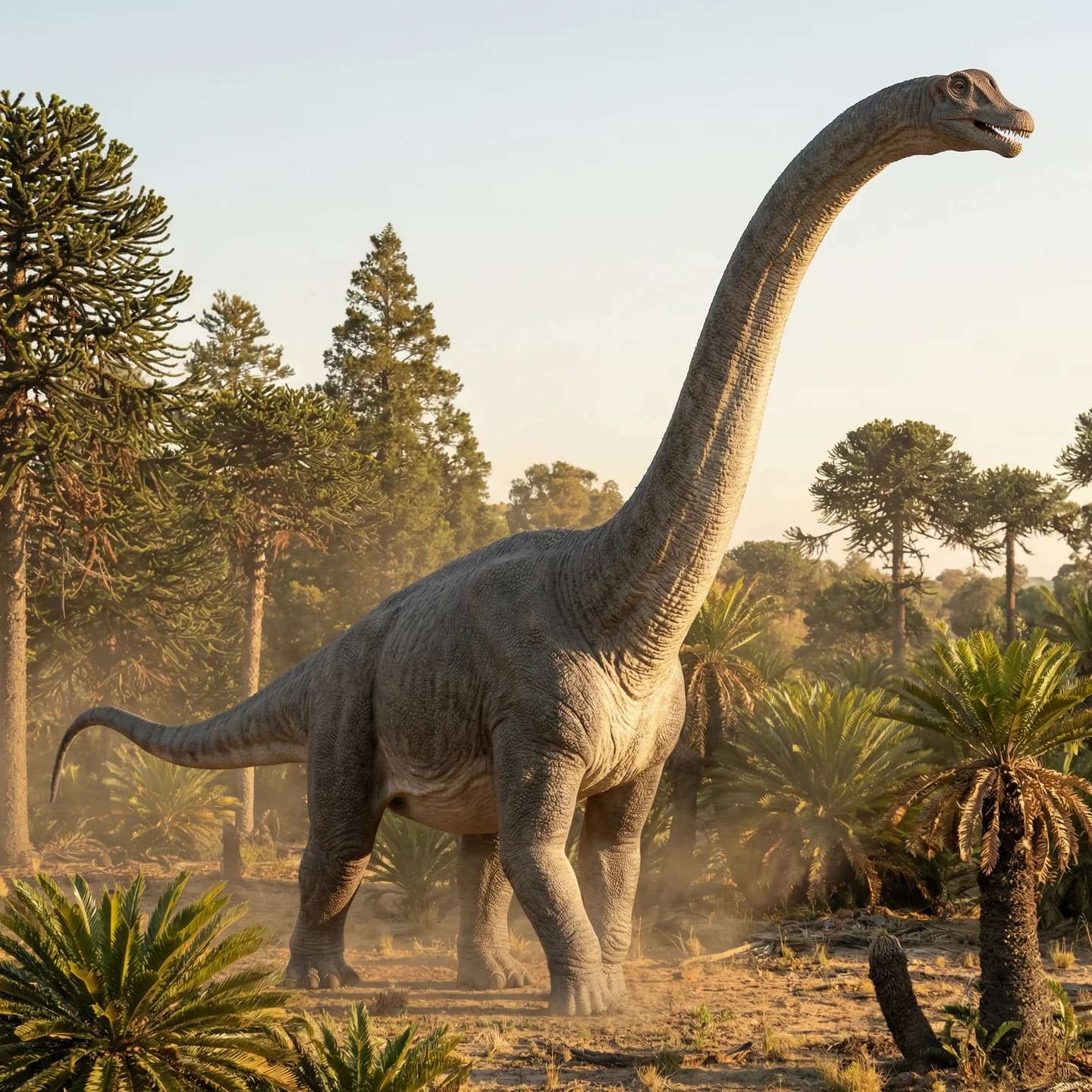
Barosaurus (Barosaurus lentus Marsh, 1890) is a large sauropod (Sauropoda) dinosaur that lived in North America during the Late Jurassic (Kimmeridgian to early Tithonian, approximately 152–150 million years ago). It belongs to the subfamily Diplodocinae within the family Diplodocidae, order Saurischia, and is consistently recovered as the closest relative (sister taxon) of Diplodocus in phylogenetic analyses (McIntosh, 2005; Tschopp et al., 2015). The generic name 'Barosaurus' derives from the Greek βαρύς (barys, 'heavy') and σαῦρος (sauros, 'lizard'), meaning 'heavy lizard,' while the specific epithet 'lentus' is Latin for 'slow.'
The most notable feature of Barosaurus is its proportionally longer neck and shorter tail compared to Diplodocus. It possessed 16 cervical (neck) vertebrae—one more than Diplodocus (15)—and some of its cervicals were up to 50% longer than the corresponding vertebrae in Diplodocus. Typical adult specimens are estimated at approximately 25–27 m (82–89 ft) in length and 12–20 tonnes in body mass (Seebacher, 2001; Paul, 2016). However, certain exceptionally large specimens (BYU 9024, BYU 3GR/20815) suggest that some Barosaurus individuals may have reached 40–48 m in length, potentially making it one of the longest dinosaurs ever known, although the taxonomic assignment of BYU 9024 remains debated between Barosaurus and Supersaurus.
Definitive remains have been recovered from the Morrison Formation in South Dakota, Utah, and Montana, with possible specimens also reported from Colorado, eastern Wyoming, and Oklahoma (McIntosh, 2005; Woodruff et al., 2026). The holotype specimen (YPM 429) was discovered in South Dakota in 1889, while the most complete specimen (AMNH 6341) was excavated from the Carnegie Quarry in Utah and is now famously displayed in the lobby of the American Museum of Natural History in a dramatic rearing posture defending its young from an Allosaurus. Notably, no Barosaurus skull has ever been found despite over 130 years of excavation, and all reconstructions use Diplodocus-based skull models.
Overview
Etymology and naming history
The genus name Barosaurus is a compound of the Ancient Greek words βαρύς (barys, 'heavy') and σαῦρος (sauros, 'lizard'), meaning 'heavy lizard.' The species name lentus is Latin for 'slow,' alluding to the presumably slow movement of this massive animal.
American paleontologist Othniel Charles Marsh named and described the new genus and species in 1890 in the American Journal of Science (Marsh, 1890). The holotype specimen was discovered in 1889 in South Dakota by Ms. Isabella R. Ellerman, a local postmistress, and was excavated by Marsh and John Bell Hatcher for Yale University. At the time, only six caudal (tail) vertebrae were recovered. The rest of the holotype skeleton was left in the ground under the protection of the landowner, Ms. Rachel Hatch, until 1898, when Marsh's assistant George Reber Wieland collected additional vertebrae, ribs, and limb bones (Lull, 1919). Marsh initially placed Barosaurus in the Atlantosauridae in 1896 but reclassified it as a diplodocid for the first time in 1898. In his last published paper before his death, Marsh named two smaller metatarsals found by Wieland as a second species, Barosaurus affinis (Marsh, 1899), but this has long been considered a junior synonym of B. lentus (Lull, 1919; McIntosh, 2005).
Systematic position
Barosaurus is classified within the family Diplodocidae, subfamily Diplodocinae (Saurischia: Sauropodomorpha: Sauropoda: Diplodocoidea). It has been consistently recovered as the sister taxon of Diplodocus in phylogenetic analyses (Wilson, 2002; Tschopp et al., 2015). Diplodocidae are characterized by long tails with over 70 vertebrae, relatively shorter forelimbs than other sauropods, and distinctive skull features. Diplodocines like Barosaurus and Diplodocus have slenderer builds and longer necks than apatosaurines, the other diplodocid subfamily.
The large-scale specimen-level phylogenetic analysis of Tschopp, Mateus & Benson (2015) placed Barosaurus in a clade with Diplodocus carnegii, Diplodocus hallorum, and Kaatedocus siberi within Diplodocinae. Barosaurus is currently a monospecific genus, containing only the type species B. lentus.
Scientific significance
Barosaurus is an important taxon for understanding morphological diversity and the evolution of neck elongation in sauropods. Its differentiated body proportions—a longer neck and shorter tail compared to Diplodocus—relative to an otherwise very similar skeletal plan suggest ecological niche partitioning among closely related species coexisting in the same environment. Taylor & Wedel (2013, 2016) demonstrated that Barosaurus cervicals were not only longer but also wider than those of Diplodocus, and that the neck's structure was better suited for lateral sweeping at ground level than for vertical elevation, implying a unique feeding strategy.
Geological setting and paleoenvironment
Temporal range
Barosaurus fossils are found in sediments dating to the late Kimmeridgian through early Tithonian stages of the Late Jurassic, approximately 152–150 million years ago. This temporal assignment is based on radiometric dating (Kowallis et al., 1998), biostratigraphy, and paleomagnetic studies of the Morrison Formation (Turner & Peterson, 2004). The Morrison Formation itself spans from approximately 156.3 ± 2 Ma at its base to 146.8 ± 1 Ma at its top (Kowallis et al., 1998). Tschopp et al. (2015) confirmed that Barosaurus occurs in late Kimmeridgian to early Tithonian horizons.
Stratigraphy and lithology
All known Barosaurus fossils come from the Morrison Formation of the western United States. Definitive specimens have been recovered from South Dakota (holotype locality), Utah (Carnegie Quarry at Dinosaur National Monument), and Montana (the northernmost occurrence, confirmed by Woodruff et al., 2026). Possible specimens have also been reported from Colorado, eastern Wyoming (including Como Bluff), and Oklahoma (McIntosh, 2005).
The Morrison Formation consists predominantly of fluvial and floodplain-derived sandstones, mudstones, and limestones. These sediments were eroded from western highlands uplifted during the earlier Nevadan orogeny and deposited in a broad, shallow basin extending from New Mexico to Montana (Turner & Peterson, 2004).
Paleoenvironment
The Morrison Formation was deposited on the floodplains that formed after the retreat of the Sundance Sea, an arm of the Arctic Ocean that had previously extended southward across the mid-continent. Paleoclimate studies indicate a semi-arid climate with only seasonal rainfall (Turner & Peterson, 2004; Engelmann et al., 2004). Warm temperatures driving significant year-round evaporation, combined with a possible rain shadow effect from western mountains, created these dry conditions (Demko & Parrish, 1998).
Atmospheric CO₂ concentrations in the Late Jurassic were far higher than today; one study estimated approximately 1,120 ppm and predicted average winter temperatures in western North America of about 20°C (68°F) and summer averages of 40–45°C (104–113°F) (Moore et al., 1992). A subsequent study suggested even higher CO₂ levels of up to 3,180 ppm (Ekart et al., 1999). Vegetation consisted of gallery forests of tree ferns and ferns lining river channels, alongside fern savannas with scattered Araucaria-like conifers (e.g., Brachyphyllum), cycads, ginkgoes, and horsetails (Carpenter, 2006; Foster, 2007).
Specimens and diagnostic features
Holotype specimen
The holotype YPM 429 (Yale Peabody Museum) was discovered in 1889 in the Morrison Formation of South Dakota. Initially, only six caudal vertebrae were collected. Additional vertebrae, ribs, and limb bones were recovered in 1898. The specimen was prepared at Yale in the winter of 1917, and a full description was published by Richard Swann Lull in 1919 (Lull, 1919).
Key referred specimens
AMNH 6341 (American Museum of Natural History) is the most complete Barosaurus specimen. It was excavated from the Carnegie Quarry at Dinosaur National Monument, Utah, in 1923 by Earl Douglass. The material was originally distributed among three institutions—the University of Utah, the Smithsonian National Museum of Natural History, and the Carnegie Museum—before Barnum Brown arranged for all of it to be consolidated at the AMNH in 1929. A cast of this specimen is mounted in the AMNH lobby in a dramatic rearing posture, with the adult Barosaurus defending its young from an attacking Allosaurus fragilis. The 'juvenile' in this display (AMNH 7530) was originally classified as a young Barosaurus but has since been reclassified as Kaatedocus siberi by Tschopp et al. (2015).
ROM 3670 (Royal Ontario Museum, Toronto) is an approximately 40% complete partial skeleton, approximately 27.5 m (90 ft) long—the largest dinosaur ever mounted in Canada. Earl Douglass excavated this specimen at the Carnegie Quarry in the early 20th century; the ROM acquired it in a 1962 trade with the Carnegie Museum. The skeleton was never exhibited and remained in storage for 45 years until its rediscovery by paleontologist David Evans in 2007. It was subsequently prepared and mounted by Research Casting International in ten weeks and debuted as a centerpiece of the ROM's James and Louise Temerty Galleries of the Age of Dinosaurs in December 2007. The specimen's nickname 'Gordo' honors Gordon Edmunds, the museum curator who originally arranged for the skeleton to be brought to the ROM.
CM 11984 (Carnegie Museum) is a partial skeleton discovered by Douglass in 1918, preserved in the rock wall at Dinosaur National Monument and fully prepared in the 1980s. CM 1198 comprises four cervical vertebrae (each approximately 1 m long) collected in 1912 near a Diplodocus specimen; William Jacob Holland identified these as belonging to a different species, later referred to Barosaurus.
Montana specimen: In 2026, Woodruff, Walker, Hunt & Schein formally identified a single cervical vertebra (approximately 62 cm long) from south-central Montana as Barosaurus, representing the northernmost known occurrence of the genus (Woodruff et al., 2026).
Giant specimens
BYU 9024 is a massive cervical vertebra measuring 1.37 m (4.5 ft) in total length, originally assigned to Supersaurus vivianae. Mike Taylor and Matt Wedel argued that this vertebra is the C9 (ninth cervical) of a gigantic Barosaurus, noting that its total length is exactly twice that of the C9 in AMNH 6341 (685 mm). If correctly assigned to Barosaurus, this would indicate an animal approximately 48 m (157 ft) long and approximately 66 tonnes in mass, with a neck length of at least 15–17 m (Taylor & Wedel, 2016). Molina-Perez & Larramendi (2020) provided a slightly more conservative estimate of 45 m and 60 tonnes. However, research presented by Brian Curtice at the 2021 SVP conference supported the previous interpretation of BYU 9024 as a Supersaurus vertebra (Curtice, 2021). Curtice's work was presented as a conference abstract and has not yet been published as a formal peer-reviewed paper.
BYU 3GR/BYU 20815 is a series of three consecutive cervical vertebrae, with the third measuring 1,110–1,220 mm in length. Taylor & Wedel compared this specimen to AMNH 6341 and estimated a neck length of 12.07–15.1 m (39.6–49.5 ft) for the BYU 3GR/20815 individual, implying a total body length of approximately 40 m (131 ft). This specimen provides independent evidence that Barosaurus could grow to enormous sizes.
Diagnostic features
The distinguishing skeletal features of Barosaurus are concentrated in the vertebral column. It possessed 16 cervical vertebrae (versus 15 in Diplodocus and Apatosaurus) and only 9 dorsal vertebrae (versus 10), interpreted as one dorsal having been 'cervicalized.' Individual cervicals were up to 50% longer than their positional equivalents in Diplodocus. The neural spines on the cervical and dorsal vertebrae were lower and less complex than in Diplodocus. Caudal vertebrae were shorter than those of Diplodocus, resulting in a shorter tail overall. Chevron bones on the ventral surface of the tail were forked with a prominent anterior projection, similar to Diplodocus. The forelimbs were proportionally longer and more slender than in other diplodocids, with metacarpals more gracile than those of Diplodocus. A single carpal bone was present in the wrist (McIntosh, 2005; Upchurch et al., 2004).
Skull
No Barosaurus skull has ever been found. Sauropod skulls are rarely preserved due to their delicate construction. All reconstructions and museum mounts use skull models based on the closely related Diplodocus. Diplodocid skulls are characteristically long and low, with peg-like teeth confined to the front of the jaws (Upchurch et al., 2004).
Morphology and function
Body form and size
Typical adult Barosaurus are estimated at approximately 25–27 m (82–89 ft) in total length and 12–20 tonnes in body mass (Seebacher, 2001; Henderson, 2013; Paul, 2016). Tail length accounts for roughly half the total body length (Baron, 2021). Barosaurus was approximately the same overall length as Diplodocus but had a longer neck and shorter tail. It was longer than Apatosaurus but had a less robust skeleton (McIntosh, 2005).
Giant specimens (BYU 3GR/20815) are confirmed as Barosaurus and suggest individuals reaching approximately 40 m in total length. If BYU 9024 also belongs to Barosaurus, some individuals may have reached 45–48 m and 60–66 tonnes, placing them among the longest dinosaurs ever known.
Lehman & Woodward (2008) estimated a minimum age of 21 years and a maximum of 39 years for sampled Barosaurus individuals, with average growth rates of 297–552 kg per year.
Neck anatomy
The neck of Barosaurus measured approximately 8.5–9 m (28–30 ft) based on the AMNH 6341 individual, and may have reached 12–17 m in giant specimens. The cervical vertebrae are elongated and internally hollowed, with well-developed pleurocoels (pneumatic cavities) that minimized the weight of the long neck.
Taylor & Wedel (2013, 2016) demonstrated that the neck of Barosaurus was not only longer but also wider than that of Diplodocus. The bifurcation of neural spines was particularly pronounced in Barosaurus, far exceeding that of Suuwassea and Kaatedocus. The cervical structure allowed high lateral (side-to-side) flexibility but restricted vertical flexibility, suggesting that Barosaurus was better adapted for sweeping its neck in wide arcs at ground level rather than raising its head high to feed on tall vegetation. This implies a feeding strategy distinct from other sauropods.
Limbs and posture
The limb bones of Barosaurus are virtually indistinguishable from those of Diplodocus (McIntosh, 2005). It was quadrupedal, with columnar limbs supporting its massive body. The forelimbs were shorter than the hindlimbs, giving the back a gentle forward slope. However, the forelimbs were proportionally longer and more gracile than in other diplodocids, and the metacarpals were more slender than those of Diplodocus (Foster, 1996). A single carpal bone was present in the wrist.
No Barosaurus feet have been discovered, but like other sauropods, it would have been digitigrade. Each foot bore five toes, with a large claw on the inner digit of the forefoot and smaller claws on the inner three digits of the hindfoot (McIntosh, 2005; Upchurch et al., 2004).
Tail
The tail of Barosaurus was shorter than that of Diplodocus but likely still terminated in a long whiplash, as is typical of diplodocids. Diplodocids could possess up to 80 caudal vertebrae. The chevron bones lining the underside of the tail were forked with a prominent anterior spike, similar to Diplodocus.
Baron (2021) proposed that the elongate whiplash tails of diplodocid sauropods may have served a tactile function.
Diet and ecology
Diet
Barosaurus was herbivorous and, based on its close relationship to Diplodocus, likely possessed peg-like teeth suited for stripping leaves and conifer needles. Because no Barosaurus skull has been found, this inference is based on comparisons with closely related diplodocids. Such teeth are adapted for raking rather than chewing, and food was likely swallowed whole.
Feeding behavior
Based on cervical vertebra analysis, Taylor & Wedel (2013, 2016) concluded that the neck of Barosaurus allowed significant lateral flexibility but restricted vertical movement. This suggests that Barosaurus swept its neck in broad arcs at ground level when feeding, a strategy first proposed for sauropods by John Martin (1987) for Cetiosaurus. The restriction in vertical flexibility suggests that Barosaurus did not primarily feed on vegetation high off the ground. David Evans, who oversaw the mounting of the ROM specimen, positioned the head at a relatively low elevation to reflect a biologically plausible blood pressure.
Functional hypotheses for the long neck
Several functional hypotheses have been proposed for the exceptionally long neck of Barosaurus. The wide-range feeding hypothesis suggests that the long neck allowed Barosaurus to access a large feeding area without moving its body, improving energy efficiency. The heat dissipation hypothesis proposes that the long neck aided in thermoregulation by increasing the surface area available for radiating excess body heat (Henderson, 2013). The sexual selection hypothesis posits that individuals with longer necks may have had a reproductive advantage (Evans, ROM exhibit commentary).
Ecological niche
Barosaurus is among the rarer sauropods in the Morrison Formation assemblage. Contemporaneous sauropods sharing the same environment included Diplodocus, Apatosaurus, Camarasaurus, and Brachiosaurus. The differentiated body proportions of Barosaurus (longer neck, shorter tail) may reflect ecological niche partitioning with these closely related genera.
Contemporaneous fauna
Dinosaurs that lived alongside Barosaurus in the Morrison Formation included herbivorous ornithischians such as Camptosaurus, Dryosaurus, Stegosaurus, and Othnielosaurus, and predatory theropods including Allosaurus, Torvosaurus, Ceratosaurus, Saurophaganax, Marshosaurus, Stokesosaurus, and Ornitholestes (Foster, 2007). Allosaurus accounted for 70–75% of all theropod specimens in the Morrison Formation and was the top predator in this ecosystem (Foster, 2003). Other contemporaneous vertebrates included ray-finned fishes, frogs, salamanders, turtles, sphenodonts, lizards, terrestrial and aquatic crocodylomorphs, several pterosaur species, and early mammals such as docodonts, multituberculates, symmetrodonts, and triconodonts.
Distribution and paleogeography
Geographic distribution
Definitive Barosaurus specimens have been found in South Dakota, Utah, and Montana. Possible specimens are also reported from Colorado, eastern Wyoming, and Oklahoma. The 2026 description by Woodruff et al. of a single cervical vertebra (approximately 62 cm long) from south-central Montana extended the known geographic range of this genus to its northernmost point.
The Morrison Formation is widespread across the western United States, stretching between the Great Plains and the Rocky Mountains from New Mexico to Montana. While Barosaurus occurs across multiple states within this formation, it is considerably rarer than Diplodocus or Camarasaurus.
Paleogeographic context
During the Late Jurassic, western North America consisted of a vast inland floodplain flanked by uplifted highlands to the west (from the Nevadan orogeny) and the retreating Sundance Sea to the north. The Morrison Formation was deposited within this broad basin. African fossils once referred to Barosaurus from the Tendaguru Beds (Tanzania) and the Kadsi Formation (Zimbabwe) are now considered to represent Tornieria africana (Remes, 2006) or remain of uncertain affinity (Goodwin et al., 2019), respectively.
Systematics and taxonomic debates
Position within Diplodocidae
Barosaurus is a member of Diplodocidae, subfamily Diplodocinae, and has long been recognized as the closest relative of Diplodocus (McIntosh, 2005; Wilson, 2002). The large-scale specimen-level analysis of Tschopp, Mateus & Benson (2015) confirmed this relationship, placing Barosaurus in a clade with Diplodocus carnegii, D. hallorum, and Kaatedocus siberi.
Diplodocinae also includes Galeamopus, Leinkupal, Supersaurus (in some analyses), and Tornieria. The other diplodocid subfamily, Apatosaurinae, includes Apatosaurus and Supersaurus (Lovelace et al., 2007). Diplodocid fossils are known from North America, Europe, and Africa. More distantly related diplodocoid families include Dicraeosauridae and Rebbachisauridae.
The African 'Barosaurus' problem
In 1907, German paleontologist Eberhard Fraas described sauropod remains from the Tendaguru Beds of German East Africa (now Tanzania) as Gigantosaurus africanus. Because that genus name was preoccupied, it was renamed Tornieria in 1911 (Sternfeld, 1911). Werner Janensch subsequently reassigned the African species to the North American genus Barosaurus (Janensch, 1922). However, a 2006 redescription by Remes confirmed that the African species is generically distinct from the North American form and reinstated Tornieria africana as a valid taxon. In Remes' phylogenetic analysis, Tornieria was recovered as the sister taxon to the Barosaurus + Diplodocus clade (Remes, 2006).
Barosaurus-like fossils were also reported from the Kadsi Formation in Zimbabwe (Raath & McIntosh, 1987), but this material is poorly preserved, inadequately diagnosed, and may represent Tornieria (Goodwin et al., 2019).
Taxonomic assignment of giant specimens
The taxonomic assignment of BYU 9024 (a 1.37 m cervical vertebra) is the most prominent ongoing debate. Taylor & Wedel argued that it represents a giant Barosaurus based on morphological similarity to the cervicals of AMNH 6341 (Taylor & Wedel, 2016). Curtice (2021) countered at SVP that newly prepared Supersaurus axial elements from the Dry Mesa Dinosaur Quarry support the original referral of BYU 9024 to Supersaurus. This debate remains unresolved, as Curtice's work was presented as a conference abstract and has not yet appeared as a formal peer-reviewed publication. The assignment of this single vertebra dramatically affects maximum size estimates for Barosaurus.
Monospecific genus
Barosaurus currently includes only the type species B. lentus. The second species Barosaurus affinis, named by Marsh in 1899, has long been considered a junior synonym (Lull, 1919; McIntosh, 2005).
Reconstruction and uncertainty
Confirmed facts
The placement of Barosaurus within Diplodocidae, subfamily Diplodocinae, as sister taxon to Diplodocus, is consistently supported by multiple independent phylogenetic analyses (Wilson, 2002; Tschopp et al., 2015). The vertebral formula of 16 cervicals and 9 dorsals is well established from multiple specimens. Its occurrence in the Morrison Formation (late Kimmeridgian to early Tithonian) across South Dakota, Utah, and Montana is confirmed by definitive specimens.
Well-supported hypotheses
Size estimates of approximately 25–27 m in length and 12–20 tonnes in mass for typical adults are consistently supported across multiple independent studies (Seebacher, 2001; Henderson, 2013; Paul, 2016). The lateral-sweeping feeding strategy is well supported by cervical vertebra biomechanics (Taylor & Wedel, 2013, 2016). The BYU 3GR/20815 specimen provides strong evidence that some Barosaurus individuals reached approximately 40 m in total length.
Debated hypotheses
The taxonomic assignment of BYU 9024 (Barosaurus vs. Supersaurus) and the resulting maximum size estimate (45–48 m) represent the most significant ongoing debate. The biomechanical feasibility of the rearing posture displayed in the AMNH lobby mount is also debated.
Common misconceptions in reconstruction
Darren Naish noted that books from the late 20th century frequently depicted Barosaurus as a brachiosaur-like animal with a short tail and a U-shaped downward-curving neck (Naish, 2017; Witton et al., 2014). This misconception originated with a 1968 drawing by Robert Bakker in which foreshortening and overlapping made two Barosaurus appear short-tailed. This inaccurate depiction spread as a 'palaeoart meme' through subsequent publications.
Because no skull has been found, the head used in all Barosaurus reconstructions is based on Diplodocus. This remains the most fundamental uncertainty in Barosaurus restoration.
Comparison with related and contemporaneous taxa
The following table compares Barosaurus with other key diplodocids.
| Genus | Cervical count | Dorsal count | Estimated length | Neck characteristics | Distribution |
|---|---|---|---|---|---|
| Barosaurus | 16 | 9 | 25–27 m (up to ~40 m) | Cervicals 50% longer than Diplodocus; wider neck | North America (Morrison Fm.) |
| Diplodocus | 15 | 10 | 24–26 m | Standard diplodocine cervicals | North America (Morrison Fm.) |
| Apatosaurus | 15 | 10 | 21–23 m | More robust and shorter neck | North America (Morrison Fm.) |
| Supersaurus | 15 | 10 | 33–40 m | Extremely elongated cervicals | North America (Morrison Fm.) |
| Tornieria | Unknown | Unknown | ~20 m | Elongated cervicals similar to Barosaurus | Africa (Tendaguru Beds) |
| Key specimen | Catalogue number | Repository | Completeness | Locality | |
| Holotype | YPM 429 | Yale Peabody Museum | Partial skeleton (caudals, vertebrae, ribs, limb bones) | South Dakota | |
| Most complete specimen | AMNH 6341 | American Museum of Natural History | Most complete partial skeleton | Utah (Carnegie Quarry) | |
| Gordo | ROM 3670 | Royal Ontario Museum | ~40% complete, 27.5 m | Utah (Carnegie Quarry) | |
| Wall specimen | CM 11984 | Carnegie Museum / in situ | Partial skeleton (preserved in rock wall) | Utah (Dinosaur Natl. Monument) | |
| Montana specimen | (Woodruff et al. 2026) | Not specified | Single cervical vertebra (~62 cm) | South-central Montana | |
| Giant cervical | BYU 9024 | BYU Museum | Single cervical (137 cm); assignment debated | Colorado (Dry Mesa) | |
| Giant cervical series | BYU 3GR/20815 | BYU Museum | 3 consecutive cervical vertebrae | Colorado/Utah |
Fun Facts
FAQ
📚References
- Marsh, O. C. (1890). Description of new dinosaurian reptiles. American Journal of Science, 3(39), 81–86. https://doi.org/10.2475/ajs.s3-39.229.81
- Lull, R. S. (1919). The sauropod dinosaur Barosaurus Marsh: redescription of the type specimens in the Peabody Museum, Yale University. Memoirs of the Connecticut Academy of Arts and Sciences, 6, 1–42.
- McIntosh, J. S. (2005). The genus Barosaurus Marsh (Sauropoda, Diplodocidae). In V. Tidwell & K. Carpenter (Eds.), Thunder-lizards: The Sauropod Dinosaurs (pp. 38–77). Indiana University Press.
- Tschopp, E., Mateus, O. V., & Benson, R. B. J. (2015). A specimen-level phylogenetic analysis and taxonomic revision of Diplodocidae (Dinosauria, Sauropoda). PeerJ, 3, e857. https://doi.org/10.7717/peerj.857
- Taylor, M. P., & Wedel, M. J. (2013). The neck of Barosaurus was not only longer but also wider than those of Diplodocus and other diplodocines. PeerJ Preprints, 1, e67v1. https://doi.org/10.7287/peerj.preprints.67v1
- Taylor, M. P., & Wedel, M. J. (2016). The neck of Barosaurus: longer, wider and weirder than those of Diplodocus and other diplodocines. PeerJ Preprints, 4, e67v2. https://doi.org/10.7287/peerj.preprints.67v2
- Seebacher, F. (2001). A new method to calculate allometric length-mass relationships of dinosaurs. Journal of Vertebrate Paleontology, 21(1), 51–60. https://doi.org/10.1671/0272-4634(2001)021[0051:ANMTCA]2.0.CO;2
- Paul, G. S. (2016). The Princeton Field Guide to Dinosaurs (2nd ed.). Princeton University Press.
- Henderson, D. M. (2013). Sauropod Necks: Are They Really for Heat Loss? PLoS ONE, 8(10), e77108. https://doi.org/10.1371/journal.pone.0077108
- Lehman, T. M., & Woodward, H. N. (2008). Modelling growth rates for sauropod dinosaurs. Paleobiology, 34(2), 264–281. https://doi.org/10.1666/0094-8373(2008)034[0264:MGRFSD]2.0.CO;2
- Turner, C. E., & Peterson, F. (2004). Reconstruction of the Upper Jurassic Morrison Formation extinct ecosystem—a synthesis. Sedimentary Geology, 167(3–4), 309–355. https://doi.org/10.1016/j.sedgeo.2004.01.009
- Engelmann, G. F., Chure, D. J., & Fiorillo, A. R. (2004). The implications of a dry climate for the paleoecology of the fauna of the Upper Jurassic Morrison Formation. Sedimentary Geology, 167(3–4), 297–308. https://doi.org/10.1016/j.sedgeo.2004.01.008
- Kowallis, B. J., et al. (1998). The age of the Morrison Formation. Modern Geology, 22(1–4), 235–260.
- Foster, J. R. (2007). Jurassic West: The Dinosaurs of the Morrison Formation and Their World. Indiana University Press.
- Foster, J. R. (2003). Paleoecological Analysis of the Vertebrate Fauna of the Morrison Formation (Upper Jurassic), Rocky Mountain Region, U.S.A. New Mexico Museum of Natural History and Science Bulletin, 23.
- Upchurch, P., Barrett, P. M., & Dodson, P. (2004). Sauropoda. In D. B. Weishampel, P. Dodson, & H. Osmólska (Eds.), The Dinosauria (2nd ed., pp. 259–322). University of California Press.
- Remes, K. (2006). Revision of the sauropod genus Tornieria africana (Fraas) and its relevance for sauropod paleobiogeography. Journal of Vertebrate Paleontology, 26(3), 651–669. https://doi.org/10.1671/0272-4634(2006)26[651:ROTTSD]2.0.CO;2
- Curtice, B. (2021). New Dry Mesa Dinosaur Quarry Supersaurus vivianae (Jensen 1985) axial elements provide additional insight into its phylogenetic relationships and size, suggesting an animal that exceeded 39 meters in length. Society of Vertebrate Paleontology Virtual Meeting Program, 92.
- Molina-Perez, R., & Larramendi, A. (2020). Dinosaur Facts and Figures: The Sauropods and Other Sauropodomorphs. Princeton University Press.
- Baron, M. G. (2021). Tactile tails: a new hypothesis for the function of the elongate tails of diplodocid sauropods. Historical Biology, 33(10), 2057–2066. https://doi.org/10.1080/08912963.2020.1769092
- Woodruff, D. C., Walker, S., Hunt, K., & Schein, J. P. (2026). The first specimen of Barosaurus (Sauropoda: Diplodocidae) from Montana: the northernmost occurrence of the genus. New Mexico Museum of Natural History and Science Bulletin, 102, 233–245.
- Wilson, J. A. (2002). Sauropod dinosaur phylogeny: critique and cladistic analysis. Zoological Journal of the Linnean Society, 136(2), 215–275. https://doi.org/10.1046/j.1096-3642.2002.00029.x
- Moore, G. T., Hayashida, D. N., Ross, C. A., & Jacobson, S. R. (1992). Paleoclimate of the Kimmeridgian/Tithonian (Late Jurassic) world. Palaeogeography, Palaeoclimatology, Palaeoecology, 93(3–4), 113–150. https://doi.org/10.1016/0031-0182(92)90186-9
- Ekart, D. D., Cerling, T. E., Montanez, I. P., & Tabor, N. J. (1999). A 400 million year carbon isotope record of pedogenic carbonate. American Journal of Science, 299(10), 805–827. https://doi.org/10.2475/ajs.299.10.805
- Naish, D. (2017). Palaeoart Memes and the Unspoken Status Quo in Palaeontological Popularization. Scientific American.
- Witton, M., Naish, D., & Conway, J. (2014). State of the Palaeoart. Palaeontologia Electronica, 17(3.5E). https://doi.org/10.26879/145
- Lovelace, D. M., Hartman, S. A., & Wahl, W. R. (2007). Morphology of a specimen of Supersaurus (Dinosauria, Sauropoda) from the Morrison Formation of Wyoming, and a re-evaluation of diplodocid phylogeny. Arquivos do Museu Nacional, Rio de Janeiro, 65(4), 527–544.
- Carpenter, K. (2006). Biggest of the big: a critical re-evaluation of the mega-sauropod Amphicoelias fragillimus. In J. R. Foster & S. G. Lucas (Eds.), Paleontology and Geology of the Upper Jurassic Morrison Formation. New Mexico Museum of Natural History and Science Bulletin, 36, 131–138.
- Foster, J. R. (1996). Sauropod dinosaurs of the Morrison Formation (Upper Jurassic), Black Hills, South Dakota and Wyoming. Contributions to Geology, University of Wyoming, 31(1), 1–25.
- Goodwin, M. B., et al. (2019). The first confirmed sauropod dinosaur from Ethiopia discovered in the Upper Jurassic Mugher Mudstone. Journal of African Earth Sciences, 159, 103571. https://doi.org/10.1016/j.jafrearsci.2019.103571
- Martin, J. (1987). Mobility and feeding of Cetiosaurus (Saurischia, Sauropoda) – why the long neck? In P. J. Currie & E. H. Koster (Eds.), Fourth Symposium on Mesozoic Terrestrial Ecosystems, Short Papers (pp. 154–159). Boxtree Books.
- Raath, M. A., & McIntosh, J. S. (1987). Sauropod dinosaurs from the central Zambezi Valley, Zimbabwe, and the age of the Kadzi Formation. South African Journal of Geology, 90(2), 107–119.
- Demko, T. M., & Parrish, J. T. (1998). Paleoclimatic setting of the Upper Jurassic Morrison Formation. In K. Carpenter, D. J. Chure, & J. I. Kirkland (Eds.), The Upper Jurassic Morrison Formation: An Interdisciplinary Study. Modern Geology 22(1–4), 283–296.
Gallery
5 images Barosaurus
Barosaurus · Jurassic Period · Herbivore
 Barosaurus
Barosaurus · Jurassic Period · Herbivore
 Barosaurus
Barosaurus · Jurassic Period · Herbivore
 Barosaurus
Barosaurus · Jurassic Period · Herbivore
 Barosaurus
Barosaurus · Jurassic Period · Herbivore
🔗Related Creatures
Tuojiangosaurus
Tuojiangosaurus multispinus
Scelidosaurus
Scelidosaurus harrisonii
Diplodocus
Diplodocus
Miragaia
Miragaia longicollum

Brachiosaurus
Brachiosaurus altithorax
Heterodontosaurus
Heterodontosaurus tucki
Mamenchisaurus
Mamenchisaurus

Apatosaurus
Apatosaurus