Miragaia
Jurassic Period Herbivore Creature Type
Miragaia longicollum
Scientific Name: "Miragaia (Portuguese place name; also Latin mirus 'wonderful' + Greek Gaia 'Earth goddess') + longicollum (Latin longus 'long' + collum 'neck')"
Local Name: Miragaia
Physical Characteristics
Discovery
Habitat

Miragaia longicollum (Mateus, Maidment & Christiansen, 2009) is a stegosaurid dinosaur from the Late Jurassic (approximately 150 million years ago, late Kimmeridgian–early Tithonian) of what is now Portugal. It belongs to the order Ornithischia, suborder Thyreophora, clade Stegosauria, and family Stegosauridae, where it is placed within the subfamily Dacentrurinae alongside Dacentrurus. The most remarkable feature of Miragaia is its exceptionally long neck, composed of at least 17 cervical vertebrae — the longest neck of any known stegosaurian and more cervical vertebrae than most sauropods possessed (Mateus et al., 2009).
The holotype specimen (ML 433) was discovered near the village of Miragaia in the Lourinhã municipality of western Portugal and preserves much of the anterior skeleton, including the first cranial material known for any European stegosaurid. Adult body length is estimated at approximately 5.5–6.5 m, with a body mass of about 2 tonnes (2,000 kg), making it relatively lightweight compared to other large stegosaurs (Paul, 2010; Mateus, 2010). Some researchers regard Miragaia as a junior synonym of Dacentrurus, but studies in 2019 and 2025 have supported its independent validity, and the taxonomic debate remains ongoing. In 2026, Costa reported additional dacentrurine specimens from the Morrison Formation of the western United States, further solidifying the presence of this clade in North America.
Overview
Name meaning and naming history
The generic name 'Miragaia' refers to the village of Miragaia in the municipality of Lourinhã, Portugal, near which the first specimen was discovered. As an additional allusion, 'Mira-' can be connected to the Latin mirus (wonderful), and 'Gaia' to the Greek Earth goddess, yielding the poetic interpretation 'wonderful goddess of the Earth.' The specific epithet 'longicollum' is a compound of the Latin longus (long) and collum (neck), reflecting the animal's most conspicuous feature (Mateus et al., 2009).
The species was named and described in 2009 by Portuguese palaeontologist Octávio Mateus, British palaeontologist Susannah C. R. Maidment, and Danish palaeontologist Nicolai A. Christiansen in Proceedings of the Royal Society B. The fossils themselves were excavated in August 1999 and August 2001 from a road cut between the villages of Miragaia and Sobral (Araújo et al., 2009).
Systematic position
Miragaia is classified within Ornithischia, Thyreophora, Stegosauria, and Stegosauridae. In their original description, Mateus et al. (2009) proposed a new clade, Dacentrurinae, uniting Miragaia with Dacentrurus armatus as sister taxa within Stegosauridae, with this clade recovered as the sister group to Stegosaurinae (which includes Stegosaurus). Raven & Maidment (2017) also found Miragaia in a derived position within Stegosauridae.
In 2025, Sánchez-Fenollosa & Cobos described the most complete stegosaurian skull from Europe — a Dacentrurus armatus cranium from Riodeva, Teruel, Spain — and proposed a new clade, Neostegosauria, reorganising the phylogenetic relationships of stegosaurs globally. This study has potential implications for the systematic placement of Miragaia within the broader stegosaurian tree.
Scientific significance
Miragaia demonstrates that the morphological and ecological diversity of stegosaurs was far broader than previously recognised. Its minimum of 17 cervical vertebrae exceeds the cervical count of most sauropods (12–15), the dinosaur group most famous for their long necks. This discovery challenges the traditional view of stegosaurs as exclusively short-necked, low-browsing herbivores. Moreover, the holotype includes the first cranial material for any European stegosaurid, providing critical data on skull morphology for this group.
Age, stratigraphy, and depositional setting
Temporal range
Miragaia fossils come from the Late Jurassic, specifically the late Kimmeridgian to early Tithonian (approximately 150 million years ago), based on the stratigraphic framework and biostratigraphic data from the Lourinhã Formation (Araújo et al., 2009; Mateus et al., 2009). Dacentrurine specimens reported from the Morrison Formation range from approximately 152 to 147 million years ago (Costa, 2026), extending the temporal span of the clade.
Formation and lithology
The holotype (ML 433) was recovered from the Miragaia Unit of the Sobral Unit, Lourinhã Formation, in the western Lusitanian Basin of Portugal. The Lourinhã Formation consists primarily of fluvial and deltaic sandstone, mudstone, and conglomerate, spanning the Late Jurassic to earliest Cretaceous (Berriasian). The referred specimen MG 4863 comes from the Praia Azul Member or the Praia da Amoreira-Porto Novo Member of the same formation (Costa & Mateus, 2019; Costa et al., 2025).
Palaeoenvironment
The depositional environment of the Lourinhã Formation has been interpreted as a coastal floodplain, with rivers, lakes, and seasonal wetlands developed in a low-lying coastal setting. Palaeoclimate reconstructions indicate a subtropical semi-arid to semi-humid climate with strong seasonal rainfall variation, broadly similar to the contemporaneous Morrison Formation of North America but somewhat more humid (Myers et al., 2012). The formation has yielded a rich fauna including diverse theropods, sauropods, ornithopods, stegosaurs, crocodylomorphs, turtles, pterosaurs, and mammals, attesting to a thriving Late Jurassic ecosystem.
| Item | Details |
|---|---|
| Age | Late Jurassic (late Kimmeridgian–early Tithonian, ~150 Ma) |
| Formation | Lourinhã Formation (Sobral Unit, Miragaia Unit; Praia Azul/Amoreira-Porto Novo Mbr.) |
| Lithology | Sandstone, mudstone, conglomerate (fluvial-deltaic deposits) |
| Palaeoenvironment | Coastal floodplain/deltaic (subtropical semi-arid to semi-humid climate) |
| Basin | Lusitanian Basin (western Portugal) |
Specimens and diagnosis
Holotype
The holotype ML 433 (Museu da Lourinhã) is a nearly complete anterior skeleton comprising cranial elements (right premaxilla, partial left maxilla, left nasal, right postorbital, both angulars), fifteen cervical vertebrae (atlas and axis missing, thus indicating a minimum of 17 cervicals), two anterior dorsal vertebrae, twelve ribs, one chevron, both scapulae, coracoids, humeri, radii, and ulnae, a right first metacarpal with three phalanges, thirteen dermal plates, and one spike. The specimen was dispersed over an area of approximately 5–7 m and was excavated in August 1999 and August 2001. The posterior half of the skeleton was likely destroyed by road construction (Araújo et al., 2009; Mateus et al., 2009).
Referred specimens
ML 433-A is a partial juvenile skeleton found at the same locality as the holotype, comprising two dorsal centra, three dorsal neural arches, both pubes, and the left ilium. It was designated as a paratype based on its proximity to the holotype (Mateus et al., 2009).
MG 4863 (Museu Geológico de Lisboa) was excavated in 1959 by Georges Zbyszewski at Atouguia da Baleia (Peniche, Portugal) but was only prepared between 2015 and 2017. It includes both anterior and posterior skeletal elements, making it the most complete Miragaia specimen, the most complete dinosaur ever found in Portugal, and the most complete stegosaur from Europe (Costa & Mateus, 2019; Costa et al., 2025).
In 2026, Costa reported five probable dacentrurine specimens from the Morrison Formation of the western United States. A cervical plate from the Cleveland-Lloyd Dinosaur Quarry in Utah (UMNH VP 5572) was assigned to cf. M. longicollum based on its close morphological match to the holotype's cervical plates. Caudal spines from the Cleveland-Lloyd Quarry (UMNH VP 5732, YPM PU 14556) and a large caudal spine from the Griffin Ranch Quarry in Wyoming (housed at MOAL) were assigned to Miragaia sp. (Costa, 2026).
Diagnosis
Mateus et al. (2009) established six autapomorphies for Miragaia: the premaxillae meet at the midline in a small sharp point within a larger notch, creating a W-shaped snout tip in dorsal view (contrasting with the U-shaped notch in Stegosaurus); the anterolateral rim of the premaxilla projects ventrally; at least 17 cervical vertebrae are present; the mid-cervical neural spines bear a notch at the lower anterior edge with a forward-directed process immediately above; the mid-posterior cervical and anterior dorsal neural spine apices are transversely expanded; and paired triangular cervical dermal plates are present, slightly convex laterally, with a notch and hook-like projection on the anterodorsal margin.
Costa & Mateus (2019) and Costa et al. (2025), based on MG 4863, provided additional diagnostic characters including: transverse processes present in all caudal vertebrae; neural arches of mid-posterior caudals one-third or less the height and width of the centrum; mid-posterior caudal centra with an 'apple-shaped' outline; longitudinal cord-like ridges on the femoral shaft; and lateral ossification on the posterior rim of the posteriormost caudal centra (Costa, 2026).
Limitations of the material
The holotype ML 433 lacks the posterior skeleton (pelvis, caudal vertebrae, hindlimbs), which makes direct comparison with the Dacentrurus holotype (NHMUK PV OR 46013, primarily posterior postcranial elements) extremely difficult. This overlapping gap is the fundamental source of the ongoing synonymy debate. The MG 4863 specimen has expanded the anatomical overlap available for comparison, but the taxonomic controversy persists.
Morphology and function
Body size
Adult Miragaia is estimated at approximately 5.5–6.5 m in total length and about 2 tonnes (2,000 kg) in body mass (Paul, 2010; Mateus, 2010). This makes it moderately sized compared to Stegosaurus (~9 m) and Dacentrurus (~7–9 m). Histological analysis indicates that the holotype individual reached sexual maturity at 14–15 years of age and skeletal maturity (full adult size) between 21 and 25 years (Waskow & Mateus, 2017).
Neck anatomy and elongation mechanism
The most distinctive feature of Miragaia is its long neck, composed of at least 17 cervical vertebrae. For context, the basal thyreophoran Scutellosaurus had 9, the basal stegosaur Huayangosaurus had 9, and Stegosaurus had 12–13. Remarkably, Miragaia exceeded most sauropods (12–15 cervicals), tying with the Chinese sauropods Mamenchisaurus, Omeisaurus, and Euhelopus at 17.
Mateus et al. (2009) analysed three possible mechanisms for neck elongation in stegosaurs. The primary mechanism appears to be cervicalisation — the incorporation of anterior dorsal vertebrae into the cervical series. Across stegosaurian evolution, the total number of presacral vertebrae remained relatively stable, but there was a clear shift in the boundary between cervicals and dorsals: Huayangosaurus had 16 dorsal vertebrae, whereas Hesperosaurus had only 13. Addition of entirely new vertebral segments is unsupported by current evidence. Individual cervical lengthening played only a minor role and is difficult to distinguish from post-mortem deformation.
The authors noted that the genetic basis for these changes likely involved alterations in Hox gene expression. Unlike mammals, where up to four Hox genes enforce a strict cervical-thoracic boundary (resulting in a nearly universal seven-cervical condition), in living dinosaurs (birds) a single Hox gene (Hoxb5) regulates this transition, permitting greater evolutionary plasticity.
Skull
The cranial elements in the holotype represent the first skull material for any European stegosaurid. The premaxilla is edentulous (toothless), with a keratinous beak presumed to have covered the bony beak in life. In dorsal view, the snout-tip notch is W-shaped, distinguishing it from the U-shaped notch of Stegosaurus. The maxilla preserves 16 tooth sockets. The nasal is anteroposteriorly elongated, dorsally convex, and ornamented with surface sculpture similar to Stegosaurus. The postorbital is small and triradiate.
In 2025, Sánchez-Fenollosa & Cobos described the most complete stegosaurian skull from Europe, assigned to Dacentrurus armatus, from Riodeva, Spain. This specimen provides critical comparative material for understanding the cranial anatomy of dacentrurine stegosaurs, including Miragaia.
Appendicular skeleton
The scapula bears a large, rectangular acromion with a sharp upper corner. The humerus is comparable to that of Stegosaurus, with a strongly anteriorly projecting deltopectoral crest. The ulna has a well-developed olecranon process plus an additional olecranon horn, interpreted as an entheseal ossification resulting from ligament attachment. This olecranon horn is a shared derived character of Dacentrurinae and is absent in juvenile individuals.
Osteoderms
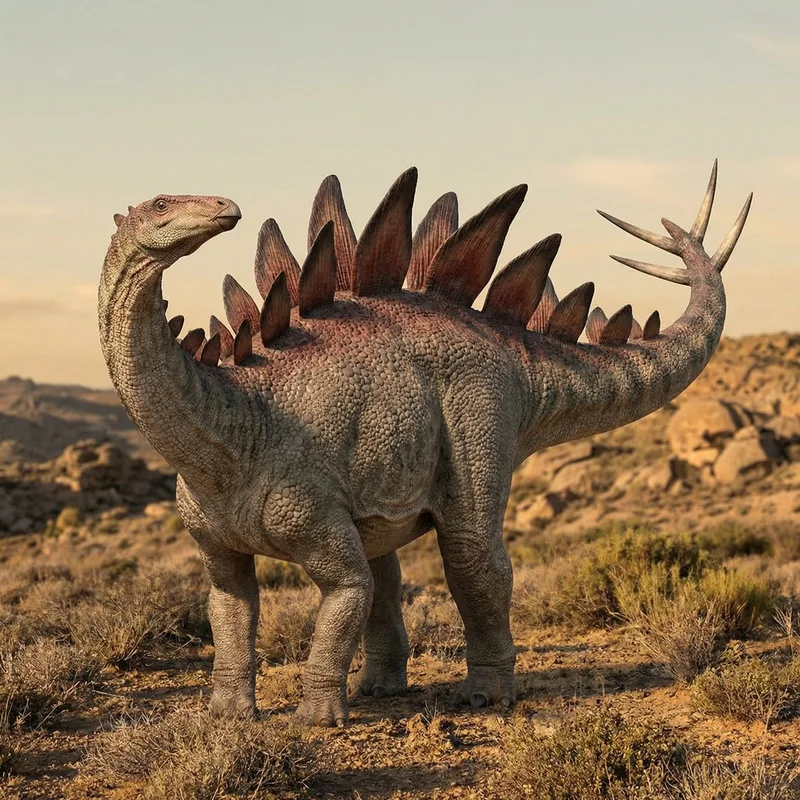
Thirteen dermal plates and one spike were recovered from the holotype. The cervical plates are triangular, arranged in pairs, slightly convex laterally and concave medially, with unexpanded bases and a distinctive hook-like notch on the anterodorsal margin — a feature that clearly distinguishes them from the cervical plates of all other stegosaurs (Costa, 2026). The posteriormost pair of dorsal plates is uniformly thin except at the base, resembling the back plates of Stegosaurus. A long, narrow, straight spike originally interpreted as a shoulder spine was later reinterpreted as part of the tail arrangement (thagomizer).
The cervical plate UMNH VP 5572 from the Cleveland-Lloyd Quarry in Utah closely matches the holotype cervical plates in morphology, confirming the diagnostic utility of this element for species-level identification (Costa, 2026).
Diet and ecology
Diet
Miragaia was an obligate herbivore, as indicated by its beak morphology and dentition. The premaxilla is edentulous, with a keratinous beak used for cropping vegetation. The maxilla bore 16 teeth of the typical stegosaurian leaf-shaped morphology, suited for cutting and processing plant matter.
Functional interpretations of the long neck
Mateus et al. (2009) proposed two hypotheses for the function of Miragaia's long neck. The first is ecological niche partitioning: the elongated neck may have allowed Miragaia to browse at an intermediate height that other herbivores could not exploit. While the large Iberian sauropods (Lusotitan, Dinheirosaurus, Turiasaurus) browsed at canopy level, and other stegosaurs were low-level browsers, Miragaia may have occupied a mid-level feeding niche. However, the presence of Dacentrurus and Stegosaurus in the same formation complicates this interpretation because of potential overlap in feeding envelopes.
The second hypothesis is sexual selection, analogous to the proposed role of neck length in giraffe evolution (Simmons & Scheepers, 1996). A long neck simultaneously provides a wider feeding radius (survival advantage) while presenting a larger target for predators (survival cost), making it difficult to determine which selective pressure was primary.
Defence
The thagomizer (tail-spike array) served as the primary defensive weapon, as in all stegosaurs. Lategano, Conti & Lozar (2024) analysed the tail biomechanics of Miragaia and concluded that the tail could achieve high velocities and generate significant impact pressures against predators. However, the study also found that Miragaia's tail spikes, while larger than those of Stegosaurus stenops, exhibited somewhat lower resistance to stress loading.
Costa (2026) demonstrated that Miragaia's caudal spikes possess a sigmoid cross-section with rotational symmetry, clearly distinguishing them from the elliptical cross-section of stegosaurine spikes.
Ecological context and contemporaneous fauna
The Lourinhã Formation herbivore community included small ornithopods (Draconyx), stegosaurs (Miragaia, Dacentrurus, Stegosaurus), and large sauropods (Lusotitan, Dinheirosaurus, Turiasaurus), representing diverse feeding strategies. Major predators sharing the environment with Miragaia included Torvosaurus gurneyi (the largest known Jurassic theropod from Europe), Allosaurus europaeus, and Ceratosaurus.
Distribution and palaeogeography
Portugal (type locality)
The confirmed occurrences of Miragaia are from the Lourinhã Formation of western Portugal. The holotype (ML 433) comes from near the village of Miragaia in the Lourinhã municipality, and MG 4863 was found at Atouguia da Baleia, Peniche.
North America (Morrison Formation)
Costa & Mateus (2019) reassigned Alcovasaurus longispinus (originally Stegosaurus longispinus Gilmore, 1914) from Wyoming as Miragaia longispinus, first proposing a North American presence for Dacentrurinae. In 2026, Costa reported five additional probable dacentrurine specimens from the Morrison Formation of Utah and Wyoming, including material assigned to cf. M. longicollum and Miragaia sp. These findings support the hypothesis of ephemeral land bridges connecting the Iberian Peninsula and North America during the Late Jurassic, facilitating faunal exchange of various dinosaur clades including dacentrurine stegosaurs.
Africa
Adratiklit boulahfa (Maidment et al., 2020) from the Middle Jurassic El Mers III Formation of Morocco and Thyreosaurus atlasicus (Zafaty et al., 2024) have been tentatively placed within Dacentrurinae, though both taxa are highly incomplete and these assignments remain uncertain (Costa, 2026).
Phylogeny and taxonomic debate
Synonymy with Dacentrurus
The taxonomic validity of Miragaia has been debated since shortly after its description. The core issue is the minimal anatomical overlap between the Miragaia holotype (primarily anterior skeleton) and the Dacentrurus holotype (primarily posterior skeleton).
Cobos et al. (2010) argued that all diagnostic characters of Miragaia are based on elements absent in the Dacentrurus holotype, while all comparable features are shared, and therefore proposed Miragaia as a junior synonym of Dacentrurus. Costa & Mateus (2019) countered this by describing MG 4863, which provides overlapping elements, and argued for Miragaia's validity with additional distinguishing characters. Sánchez-Fenollosa et al. (2024) supported the synonymy based on a new Dacentrurus specimen from the Villar del Arzobispo Formation of Spain. Costa et al. (2025) reaffirmed Miragaia's distinctiveness through a re-description of MG 4863 with direct comparisons to the Dacentrurus holotype.
Costa (2026), in his study of North American dacentrurine material, maintained the independent genus-level diagnosis of Miragaia and continued to recognise two species within the genus.
Alcovasaurus and the second species
Alcovasaurus longispinus was originally named Stegosaurus longispinus by Gilmore (1914), based on a partial skeleton (UW 20503) from Wyoming that was largely destroyed by a flood in the 1920s. Galton & Carpenter (2016) reclassified it as a new genus Alcovasaurus, and Costa & Mateus (2019) subsequently reassigned it to Miragaia longispinus. Sánchez-Fenollosa et al. (2024) argued that Alcovasaurus is a distinct genus, while Costa et al. (2025) and Costa (2026) maintained it as a second species of Miragaia.
Phylogenetic analyses
In Mateus et al. (2009), Miragaia was recovered with Dacentrurus in Dacentrurinae, sister to Stegosaurinae. Synapomorphies supporting Dacentrurinae include: cervical ribs fused to the centra; dorsal centra wider than long; an olecranon horn present on the ulna; and the anterior end of the prepubic process expanded dorsally.
Sánchez-Fenollosa & Cobos (2025), in a phylogenetic analysis incorporating the most complete European stegosaurian skull, proposed a new clade Neostegosauria (the smallest clade containing Kentrosaurus aethiopicus, Dacentrurus armatus, and Stegosaurus stenops), which reorganises stegosaurian relationships on a global scale.
| Study | Miragaia validity | Basis |
|---|---|---|
| Mateus et al., 2009 | Valid (new genus named) | Six autapomorphies identified |
| Cobos et al., 2010 | Synonym of Dacentrurus | No comparable overlapping elements; shared traits only |
| Costa & Mateus, 2019 | Valid | MG 4863 provides additional distinguishing characters |
| Sánchez-Fenollosa et al., 2024 | Synonym of Dacentrurus | New Spanish specimen; morphological homogeneity |
| Costa et al., 2025 | Valid | MG 4863 re-description; distinguishable from Dacentrurus holotype |
| Costa, 2026 | Valid (genus diagnosis maintained) | North American material; revised Miragaia genus diagnosis |
Reconstruction and uncertainty
Established facts
Miragaia possessed at least 17 cervical vertebrae, making it the longest-necked stegosaur known. It includes the first cranial material for any European stegosaurid. It belongs to Dacentrurinae within Stegosauridae. The MG 4863 specimen has substantially improved knowledge of the posterior skeleton, including tail and pelvic anatomy.
Well-supported hypotheses
The size estimate of 5.5–6.5 m in length and approximately 2 tonnes in mass is consistently supported across multiple studies. Cervicalisation (incorporation of dorsal vertebrae into the cervical series) is widely accepted as the primary mechanism for neck elongation. The long neck likely served a feeding-related or sexual-selection function.
Ongoing debates
The synonymy with Dacentrurus is the most active controversy. The inclusion of Alcovasaurus within Miragaia and the precise species-level assignment of North American specimens also remain disputed.
Common misconceptions in reconstructions
Miragaia's long neck was likely held in a more or less horizontal or slightly elevated position rather than raised high like a sauropod, though detailed postural analyses are lacking. Popular media sometimes depict Miragaia as a very large dinosaur, but it was actually substantially smaller than Stegosaurus. The precise arrangement and number of posterior plates and tail spikes depend heavily on the MG 4863 specimen, as the holotype preserves only the anterior half.
Comparison with related and contemporaneous taxa
| Genus | Cervical count | Estimated length | Age/formation | Locality |
|---|---|---|---|---|
| Miragaia | At least 17 | 5.5–6.5 m | Late Jurassic (Kimmeridgian–Tithonian) | Portugal, USA(?) |
| Dacentrurus | Unknown (only 3 cervicals preserved in holotype) | ~7–9 m | Late Jurassic (Kimmeridgian–Tithonian) | UK, Spain, Portugal |
| Stegosaurus | 12–13 | ~9 m | Late Jurassic (Kimmeridgian–Tithonian) | North America, Portugal |
| Huayangosaurus | 9 | ~4 m | Middle Jurassic | China |
| Kentrosaurus | Unknown | ~4.5 m | Late Jurassic (Kimmeridgian) | Tanzania |
| Hesperosaurus | 12–13 (est.) | ~6 m | Late Jurassic (Kimmeridgian) | North America |
Fun Facts
FAQ
📚References
- Mateus, O., Maidment, S. C. R., & Christiansen, N. A. (2009). A new long-necked 'sauropod-mimic' stegosaur and the evolution of the plated dinosaurs. Proceedings of the Royal Society B: Biological Sciences, 276(1663), 1815–1821. https://doi.org/10.1098/rspb.2008.1909
- Araújo, R., Mateus, O., Walen, A., & Christiansen, N. (2009). Preparation techniques applied to a stegosaurian dinosaur from Portugal. Journal of Paleontological Techniques, 5, 1–23.
- Costa, F., & Mateus, O. (2019). Dacentrurine stegosaurs (Dinosauria): A new specimen of Miragaia longicollum from the Late Jurassic of Portugal resolves taxonomical validity and shows the occurrence of the clade in North America. PLoS ONE, 14(11), e0224263. https://doi.org/10.1371/journal.pone.0224263
- Cobos, A., Royo-Torres, R., Luque, L., Alcalá, L., & Mampel, L. (2010). An Iberian stegosaurs paradise: The Villar del Arzobispo Formation (Tithonian–Berriasian) in Teruel (Spain). Palaeogeography, Palaeoclimatology, Palaeoecology, 293(1–2), 223–236. https://doi.org/10.1016/j.palaeo.2010.05.024
- Sánchez-Fenollosa, S., Escaso, F., & Cobos, A. (2024). A new specimen of Dacentrurus armatus Owen, 1875 (Ornithischia: Thyreophora) from the Upper Jurassic of Spain and its taxonomic relevance in the European stegosaurian diversity. Zoological Journal of the Linnean Society, 203(3), zlae074. https://doi.org/10.1093/zoolinnean/zlae074
- Costa, F., Maidment, S. C. R., Sequero, C., & Crespo, V. D. (2025). Miragaia longicollum MG 4863: New fossil and historical evidence from the most complete stegosaur from Europe. Comunicações Geológicas, 112(1), 35–58. https://doi.org/10.34637/xs1n-3d27
- Costa, F. (2026). Dacentrurine stegosaurs in North America: New occurrences from the Upper Jurassic of USA (Morrison Formation). Diversity, 18(3), 143. https://doi.org/10.3390/d18030143
- Paul, G. S. (2010). The Princeton Field Guide to Dinosaurs. Princeton University Press, p. 223.
- Waskow, K., & Mateus, O. (2017). Dorsal rib histology of dinosaurs and a crocodylomorph from western Portugal: Skeletochronological implications on age determination and life history traits. Comptes Rendus Palevol, 16(4), 425–439. https://doi.org/10.1016/j.crpv.2017.01.003
- Raven, T. J., & Maidment, S. C. R. (2017). A new phylogeny of Stegosauria (Dinosauria, Ornithischia). Palaeontology, 60(3), 401–408. https://doi.org/10.1111/pala.12291
- Maidment, S. C. R., Norman, D. B., Barrett, P. M., & Upchurch, P. (2008). Systematics and phylogeny of Stegosauria (Dinosauria: Ornithischia). Journal of Systematic Palaeontology, 6(4), 367–407. https://doi.org/10.1017/S1477201908002459
- Lategano, F., Conti, S., & Lozar, F. (2024). Miragaia tail biomechanics and defences. Evaluation of the tail mobility and resistance to loadings and collisions. Rivista Italiana di Paleontologia e Stratigrafia, 130(2), 475–486. https://doi.org/10.54103/2039-4942/21688
- Myers, T. S., Tabor, N. J., & Rosenau, N. A. (2012). Palaeoclimate of the Late Jurassic of Portugal: comparison with the Western United States. Sedimentology, 59(6), 1695–1717. https://doi.org/10.1111/j.1365-3091.2012.01322.x
- Galton, P. M., & Upchurch, P. (2004). Stegosauria. In D. B. Weishampel, H. Osmólska, & P. Dodson (Eds.), The Dinosauria (2nd ed., pp. 343–362). University of California Press.
- Mateus, O. (2010). Paleontological Collections of the Museum of Lourinhã (Portugal). In J. M. Brandão, P. M. Callapez, O. Mateus et al. (Eds.), Colecções e museus de Geologia: missão e gestão (pp. 121–126). Universidade de Coimbra.
- Sánchez-Fenollosa, S., & Cobos, A. (2025). New insights into the phylogeny and skull evolution of stegosaurian dinosaurs: An extraordinary cranium from the European Late Jurassic (Dinosauria: Stegosauria). Vertebrate Zoology, 75, 165–189. https://doi.org/10.3897/vz.75.e146618
- Galton, P. M., & Carpenter, K. (2016). The plated dinosaur Stegosaurus longispinus Gilmore, 1914 (Dinosauria: Ornithischia; Upper Jurassic, western USA), type species of Alcovasaurus n. gen. Neues Jahrbuch für Geologie und Paläontologie – Abhandlungen, 279(2), 185–208. https://doi.org/10.1127/njgpa/2016/0551
- Gilmore, C. W. (1914). Osteology of the armoured Dinosauria in the United States National Museum, with special reference to the genus Stegosaurus. United States National Museum Bulletin, 89, 1–143.
Gallery
5 images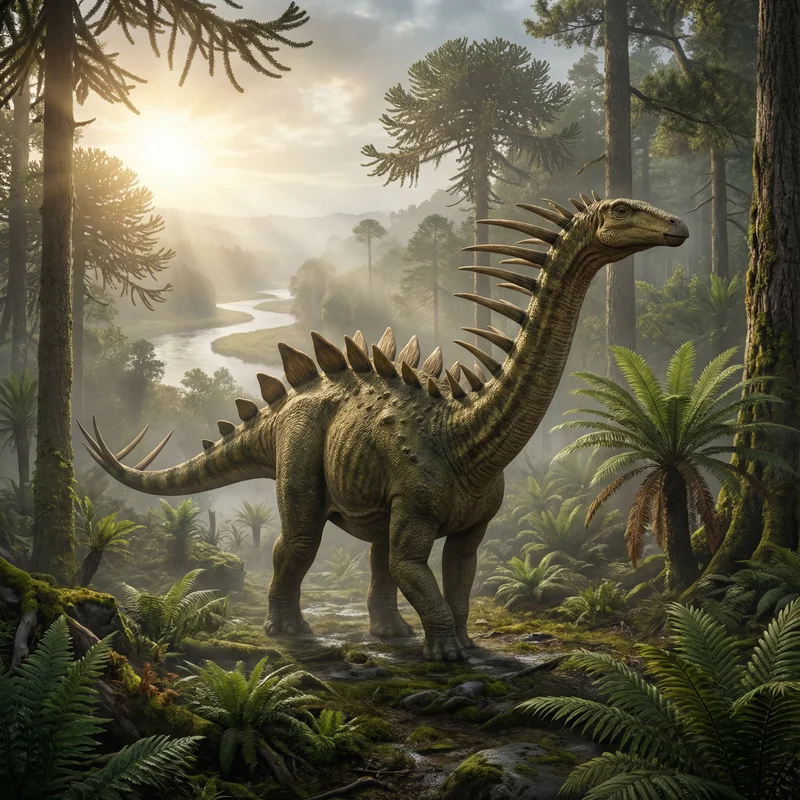 Miragaia
Miragaia · Jurassic Period · Herbivore
 Miragaia
Miragaia · Jurassic Period · Herbivore
 Miragaia
Miragaia · Jurassic Period · Herbivore
 Miragaia
Miragaia · Jurassic Period · Herbivore
 Miragaia
Miragaia · Jurassic Period · Herbivore
🔗Related Creatures
Barosaurus
Barosaurus lentus
Dacentrurus
Dacentrurus armatus

Scutellosaurus
Scutellosaurus lawleri
Scelidosaurus
Scelidosaurus harrisonii
Tuojiangosaurus
Tuojiangosaurus multispinus
Dracopelta
Dracopelta zbyszewskii

Stegosaurus
Stegosaurus stenops

Brachiosaurus
Brachiosaurus altithorax