Allosaurus
Jurassic Period Carnivore Creature Type
Allosaurus fragilis
Scientific Name: "Allosaurus: Greek allos (different, strange) + sauros (lizard); fragilis: Latin for 'fragile', referring to the lightweight vertebrae"
Local Name: Allosaurus
Physical Characteristics
Discovery
Habitat

Allosaurus fragilis Marsh, 1877 is a large theropod dinosaur from the Late Jurassic (Kimmeridgian to Tithonian, approximately 155–145 Ma) and the type genus of the family Allosauridae. The genus name Allosaurus derives from the Greek allos (different, strange) and sauros (lizard), coined by Othniel Charles Marsh in 1877 in reference to the uniquely lightweight, pneumaticized vertebrae that distinguished this animal from other dinosaurs known at the time. The species epithet fragilis is Latin for "fragile," again alluding to these airy vertebral structures.
Allosaurus is the most abundantly recovered large carnivorous dinosaur from the Morrison Formation of western North America. At the Cleveland-Lloyd Dinosaur Quarry alone, at least 46 individuals of A. fragilis have been identified, spanning nearly every ontogenetic stage, making it one of the most thoroughly studied theropod genera in the fossil record (Madsen, 1976). The average body length of A. fragilis is estimated at approximately 8.5 m with a mean mass of about 1.7 tonnes, while the largest confirmed specimen (AMNH 680) reached approximately 9.7 m and an estimated 2.3–2.7 tonnes. In December 2023, the International Commission on Zoological Nomenclature (ICZN) formally designated the more complete skeleton USNM 4734 as the neotype of A. fragilis, replacing the original, fragmentary holotype YPM 1930 (ICZN Opinion 2486).
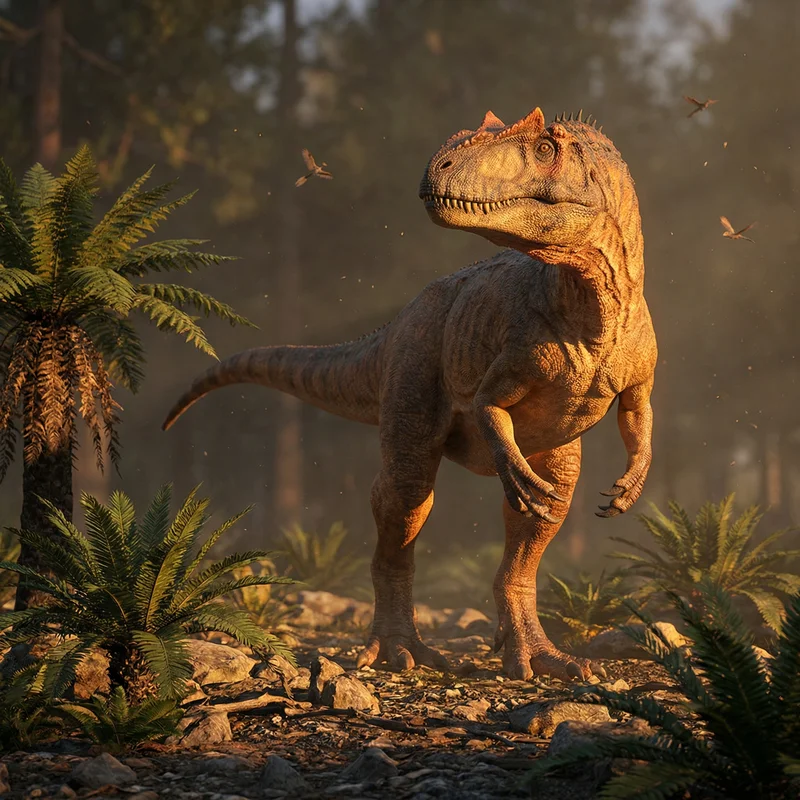
The most distinctive features of Allosaurus include a lightweight yet structurally robust skull, a pair of lacrimal horns projecting above and in front of the eyes, ridges running along the nasal bones, and pneumaticized cervical and anterior dorsal vertebrae. Finite element analysis (FEA) of the skull revealed that it could withstand approximately 55,500 N of vertical force along the tooth row despite a comparatively weak muscle-driven bite force of 805–8,724 N, leading to proposals of a "hatchet bite" or "falcon-like strike-and-tear" predatory strategy (Rayfield et al., 2001; Snively et al., 2013). This contrasts fundamentally with the bone-crushing bite strategy employed by Tyrannosaurus rex.
At least three (potentially four) species are currently recognized within the genus: the type species A. fragilis Marsh, 1877; A. europaeus Mateus et al., 2006 (Portugal); A. jimmadseni Chure & Loewen, 2020 (lower Morrison Formation); and A. anax Danison et al., 2024 (Oklahoma, separated from the reassessed Saurophaganax material).
Overview
Etymology
The genus name Allosaurus combines the Greek words allos (ἄλλος, "different" or "strange") and sauros (σαῦρος, "lizard" or "reptile"). Marsh (1877) chose the name "different lizard" because the vertebrae possessed internal pneumatic cavities (air spaces) that made them markedly lighter than those of other dinosaurs known at the time—a feature he considered unique. The species epithet fragilis is Latin for "fragile" or "delicate," once again referencing the lightened vertebral construction.
Taxonomic status and validity
Allosaurus is classified within Saurischia, Theropoda, Allosauridae, and the subfamily Allosaurinae. For over fifty years during the 20th century, the genus was referred to as Antrodemus Leidy, 1870, following Gilmore's (1920) conclusion that the two names were synonymous and that Antrodemus, being older, had priority. However, Madsen (1976) demonstrated that the Antrodemus type specimen was based on non-diagnostic material with uncertain provenance, restoring Allosaurus as the valid name. Additional junior synonyms include Creosaurus Marsh, 1878, Labrosaurus Marsh, 1879, and possibly Epanterias Cope, 1878.
The currently recognized valid species are summarized below:
| Species | Authority | Primary locality | Notes |
|---|---|---|---|
| A. fragilis | Marsh, 1877 | North America, Morrison Fm (Brushy Basin Mbr) | Type species; neotype USNM 4734 (ICZN, 2023) |
| A. europaeus | Mateus et al., 2006 | Portugal, Lourinhã Fm | Validity debated; Malafaia et al. (2025) suggest possible synonymy with A. fragilis |
| A. jimmadseni | Chure & Loewen, 2020 | North America, lower Morrison Fm (Salt Wash Mbr) | Includes 'Big Al' (MOR 693) |
| A. anax | Danison et al., 2024 | Oklahoma, Morrison Fm (Kenton Mbr) | Separated from reassessed Saurophaganax material |
Key summary
Allosaurus was the apex predator of the Late Jurassic Morrison ecosystem in North America, distinguished among large theropods by its lightweight skull, lacrimal horns, and a falcon-like strike-and-tear feeding strategy that set it apart from the bone-crushing approach of later tyrannosaurids.
Stratigraphy, Age, and Depositional Environment
Temporal range
The temporal range of Allosaurus spans the Late Jurassic Kimmeridgian to Tithonian stages, approximately 155–145 Ma. This age range is constrained by radiometric dates (40Ar/39Ar and U-Pb methods) from bentonite beds within the Morrison Formation and by biostratigraphic correlation. A. jimmadseni is predominantly recovered from the lower portion of the Morrison Formation (upper Salt Wash Member to lower Brushy Basin Member), while A. fragilis occurs in the upper Brushy Basin Member, indicating a degree of temporal separation between the two species (Chure & Loewen, 2020).
Formation and lithology
The Morrison Formation is a widespread Late Jurassic sedimentary unit exposed across the western United States (Colorado, Utah, Wyoming, Montana, New Mexico, Oklahoma, and several other states). The two principal members relevant to Allosaurus are the Salt Wash Member (interbedded sandstones and mudstones representing fluvial channel and floodplain deposits) and the Brushy Basin Member (predominantly mudstones, calcareous mudstones, and siliceous mudstones representing floodplain, lacustrine, and overbank environments). In Portugal, Allosaurus material occurs in the Lourinhã Formation, Alcobaça Formation, and Bombarral Formation, which represent coastal floodplain, deltaic, and shallow marine-margin settings.
Paleoenvironment
The Morrison Formation paleoenvironment has been reconstructed as a predominantly semiarid to seasonally wet-dry landscape. Evidence for this interpretation includes the presence of eolian (wind-blown) sedimentary units, calcretes (caite paleosols), and a large alkaline-saline lake system (the "T'oo'dichi'" lake of Turner & Peterson), alongside localized evidence for perennial rivers, freshwater ponds, and conifer-fern-cycad vegetation (Parrish et al., 2004; Dodson et al., 1980). The paleolatitude of the Allosaurus habitat in western North America was approximately 27.8°N, placing it in a subtropical to warm-temperate climatic zone—considerably lower in latitude than the present-day location of these fossil sites.
Specimens and Diagnostic Features
Type specimen history
The original holotype of Allosaurus fragilis, YPM 1930, was collected by Benjamin Mudge and Samuel W. Williston at Felch Quarry in the Garden Park area of Colorado in autumn 1877. It consists of fragmentary material: parts of three vertebrae, a rib fragment, a single tooth, a toe bone, and the shaft of the right humerus. This assemblage is widely considered inadequate for species-level diagnosis—a problem that persisted for nearly 150 years.
To resolve this, Gregory S. Paul and Kenneth Carpenter submitted Case 3506 to the ICZN in 2010, proposing that USNM 4734, a nearly complete skeleton (including skull) from the same Felch Quarry locality collected by Marshall P. Felch in 1883, be designated as the neotype. This petition received widespread support (Carrano, Loewen & Evers, 2018; Yun, 2019) and was formally ratified as ICZN Opinion 2486 on December 29, 2023.
Key specimens
| Specimen | Locality / Formation | Completeness | Significance |
|---|---|---|---|
| USNM 4734 | Colorado, Garden Park / Morrison Fm | Nearly complete skeleton with skull | Neotype of A. fragilis (ICZN, 2023) |
| YPM 1930 | Colorado, Garden Park / Morrison Fm | Vertebrae, rib, tooth, toe, humerus shaft | Former holotype (fragmentary) |
| AMNH 5753 | Wyoming, Como Bluff / Morrison Fm | Nearly complete skeleton | First free-standing theropod mount; never formally described |
| MOR 693 ('Big Al') | Wyoming, Howe Ranch / Morrison Fm | ~95% complete, partially articulated | A. jimmadseni; 19 pathological sites (Hanna, 2002) |
| SMA 0005 ('Big Al II') | Wyoming, Howe Ranch / Morrison Fm | Nearly complete skeleton | A. jimmadseni; Aathal Dinosaur Museum |
| DINO 11541 | Utah, Dinosaur NM / Morrison Fm | One of the most complete Jurassic theropods | Holotype of A. jimmadseni |
| DINO 2560 | Utah, Dinosaur NM / Morrison Fm | Skull of particularly large individual | A. fragilis; Dinosaur NM exhibit |
| ML 415 | Portugal, Lourinhã / Lourinhã Fm | Partial skull + 3 cervical vertebrae | Holotype of A. europaeus |
Diagnostic features
Key diagnostic features of Allosaurus include: paired lacrimal horns projecting above and anterior to the orbits; longitudinal ridges along the nasal bones; a lightweight skull architecture with well-developed fenestrae; serrated, labiolingually compressed teeth that were continuously replaced; and strongly pneumaticized cervical and anterior dorsal vertebrae. A. jimmadseni is distinguished from A. fragilis by a proportionally lower and longer skull, rounded (rather than pointed) lacrimal horns, and differences in jugal morphology (Chure & Loewen, 2020). A. anax is distinguished by features of the vertebral and appendicular skeleton, including distinctive laminae on the dorsal neural arches (Danison et al., 2024).
Morphology and Functional Anatomy
Overall body plan and size
Allosaurus was a typical large theropod with a proportionally large skull on a short, powerful neck, reduced forelimbs, robust hindlimbs, and a long, muscular tail for counterbalance. The average body length of A. fragilis is approximately 8.5 m with an average mass of roughly 1.7 tonnes, though Foster (2007) has suggested more conservative estimates of approximately 700 kg for average individuals and about 1 tonne for large adults. The largest confirmed specimen, AMNH 680, is estimated at approximately 9.7 m and 2.3–2.7 tonnes. Madsen (1976) noted a range of bone sizes suggesting a maximum length of 12–13 m, but no complete skeleton of this size has been recovered. Hip height was approximately 2.5 m, and maximum head height when the neck was raised was about 3.5 m.
Computational modeling by Bates et al. (2009) estimated the mass of the subadult specimen 'Big Al' (MOR 693) at approximately 1.5 tonnes (range: 1.4–2.0 tonnes). An adaptive optimum body mass analysis by Grillo & Delcourt (2017) yielded a value of approximately 2.3 tonnes for the genus.
Skull and dentition
The skull of Allosaurus was moderately sized for a theropod of its body length; Gregory S. Paul reported a skull length of approximately 845 mm for an individual estimated at 7.9 m total length. The skull architecture featured multiple large fenestrae that reduced weight while maintaining structural integrity. The premaxilla bore 5 teeth with D-shaped cross-sections; the maxilla carried 14–17 teeth; and the dentary held 14–17 teeth (average 16). All teeth were serrated along their edges and became progressively shorter, narrower, and more recurved toward the rear of the jaw. Teeth were shed continually and replaced throughout life, making isolated Allosaurus teeth among the most common fossils in the Morrison Formation.
The most visually distinctive cranial feature is the pair of lacrimal horns projecting above and in front of the eyes, which were likely covered by keratinous sheaths in life. These horns varied considerably in shape and size among individuals and may have functioned in display, species recognition, intraspecific combat, or as sunshades for the eyes. The nasal bones also bore paired longitudinal ridges. Within the skull, depressions inside the lacrimal bones may have housed glands (possibly salt glands), and the maxillary sinuses were more developed than in more basal theropods such as Ceratosaurus, potentially related to olfaction.
An intramandibular joint between the anterior and posterior portions of the lower jaw allowed the mandibles to bow outward, increasing gape width. Lautenschlager et al. (2013) estimated a maximum gape of approximately 92 degrees—wider than Tyrannosaurus (~80 degrees) and the therizinosaurid Erlikosaurus analyzed in the same study.
Forelimbs and claws
The forelimbs were approximately 35% the length of the hindlimbs in adults and bore three fingers with large, strongly curved, pointed claws. The phalangeal formula was 2-3-4-0-0, with the first digit (thumb) being the largest and diverging from the other two. The forearm was somewhat shorter than the upper arm (ulna:humerus ratio of approximately 1:1.2). A semilunate carpal was present in the wrist, foreshadowing the more derived wrist structure found in maniraptorans. The forelimbs were well-suited for both grasping prey at a distance and clutching it close, and the claw articulation suggests a hooking function (Carpenter, 2002; Gilmore, 1920).
Hindlimbs and locomotion
The hindlimbs were long and powerful, each foot bearing three weight-supporting toes and an inner dewclaw. Top speed estimates range from approximately 30–55 km/h depending on methodology. The toe claws were less developed and more hoof-like compared to earlier theropods, suggesting some adaptation for sustained locomotion. Ontogenetic changes in the femur—increasing thickness, changing cross-sectional shape, and shifting muscle attachment points—indicate that juveniles had relatively longer legs and were likely faster runners employing different hunting strategies than adults.
Tail
The tail was long and heavily muscled, serving as the primary counterbalance for the anterior body. The exact number of caudal vertebrae varied individually; Madsen (1976) estimated about 50, while Paul suggested 45 or fewer. The tail also played a role in rapid directional changes during locomotion.
Skin
Several skin impressions have been documented for Allosaurus. A juvenile specimen preserves a 30 cm² impression from the anterior dorsal/pectoral region showing small scales of 1–3 mm diameter. Mandibular skin impressions show scales of 1–2 mm, while the ventral neck preserves scutate (shield-like) scales approximately 0.5 cm wide and up to 11 cm long. A large-scale impression (scales up to 2 cm) associated with the tail base of 'Big Al II' may not belong to Allosaurus, as it more closely resembles sauropod scales, and non-theropod remains were found in association. No evidence for feathers has been documented in Allosaurus.
Feeding Ecology and Behavior
Feeding strategy debate
The predatory strategy of Allosaurus has been the subject of extensive biomechanical research and debate, centering on three principal hypotheses.
The first is the "hatchet bite" hypothesis. Rayfield et al. (2001, Nature) used finite element analysis to show that the Allosaurus skull could withstand approximately 55,500 N of vertical force along the tooth row, despite a relatively weak muscle-driven bite force (estimated at 805–8,724 N). They proposed that Allosaurus attacked prey with its mouth agape, driving the upper tooth row downward into flesh in a chopping motion—similar to a hatchet blow—powered primarily by neck musculature rather than jaw muscles.
The second is the "falcon-like strike-and-tear" hypothesis. Snively et al. (2013) constructed a multibody dynamics model of the Allosaurus head and neck, finding that the longissimus capitis superficialis muscle had an unusually low attachment point on the skull compared to other theropods. This configuration enabled rapid and forceful vertical head movements. The authors proposed that Allosaurus gripped prey with its jaws and feet, then pulled its head backward and upward to tear flesh—analogous to the feeding behavior of modern falcons such as kestrels. This contrasts with the lateral head-shaking method inferred for tyrannosaurids and crocodilians.
The third is the "muscle-powered wide-gape" reinterpretation. Sakamoto (2010) argued that the unusually wide gape of Allosaurus was not adapted for hatchet attacks but rather for delivering a muscle-driven bite to large prey, with the weaker jaw musculature representing a biomechanical trade-off for the expanded gape.
Prey and ecological role
Direct evidence links Allosaurus to attacks on stegosaurs: an Allosaurus caudal vertebra bears a partially healed puncture wound matching a Stegosaurus tail spike (thagomizer), and a Stegosaurus cervical plate shows a U-shaped wound consistent with an Allosaurus snout. Scrape marks matching Allosaurus teeth on sauropod bones and shed allosaur teeth found in association with sauropod remains provide evidence for both active predation on and scavenging of sauropods. Paul (1988) noted that the relatively modest skull and tooth size would have made it difficult for a solitary Allosaurus to overpower a fully grown sauropod, suggesting predation on juveniles or cooperative hunting. Foster (2007) proposed that ornithopods were the most commonly available prey and that Allosaurus may have subdued them in a manner analogous to modern big cats—grasping prey with the forelimbs and delivering multiple throat bites to crush the trachea.
Forensic analysis indicates that sauropod carcasses were targeted by Allosaurus at all stages of decomposition, suggesting that scavenging—particularly of the massive sauropod carcasses abundant in the Morrison ecosystem—was an important component of the energy budget. A single adult Barosaurus or Brachiosaurus carcass could have sustained multiple large theropods for weeks to months.
Social behavior
Whether Allosaurus hunted cooperatively in groups remains contested. The concentration of at least 46 Allosaurus individuals at the Cleveland-Lloyd Quarry has been interpreted as evidence for gregariousness, but Roach & Brinkman (2007) argued that cooperative hunting of prey much larger than the individual predator is rare among living diapsids (lizards, crocodiles, birds). They proposed instead that the Cleveland-Lloyd accumulation resulted from aggressive aggregation at a feeding site, where individuals drawn to carrion or disabled prey attacked and killed each other—explaining the high proportion of juveniles and subadults, as is observed at modern communal feeding sites of crocodilians and Komodo dragons. Evidence for cannibalism in Allosaurus (shed teeth among rib fragments, tooth marks on a scapula, cannibalized skeletons at Bakker's lair sites) supports the aggressive-aggregation model. Conversely, pathological analysis by Foth et al. identified individuals that survived serious injuries, which could support some degree of social tolerance or gregariousness.
Growth and life history
Histological analysis of limb bones indicates that Allosaurus reached maximum growth rate at approximately age 15, gaining about 148 kg per year, with bone deposition ceasing around 22–28 years of age (Lee & Werning, 2008). Reproductive maturity was reached by approximately age 10, earlier than expected under a reptilian growth model and more consistent with patterns seen in birds and mammals. Medullary bone tissue has been reported in one Allosaurus tibia from the Cleveland-Lloyd Quarry, potentially indicating a reproductively active female, although subsequent studies have questioned whether this tissue may represent a bone pathology rather than true medullary bone.
Juvenile specimens show relatively longer legs, with proportionally elongated lower leg and foot segments compared to the femur, suggesting that young Allosaurus were faster runners that may have pursued small prey before transitioning to an ambush strategy targeting larger prey as adults.
Distribution and Paleogeography
Geographic range
The vast majority of Allosaurus fossils come from the Morrison Formation of western North America, with key localities including Garden Park and Dry Mesa Quarry (Colorado), the Cleveland-Lloyd Dinosaur Quarry and Dinosaur National Monument (Utah), Como Bluff and Howe Ranch (Wyoming), Peterson Quarry (New Mexico), and the Kenton locality (Oklahoma). In Europe, Allosaurus is known from at least three localities in Portugal: the Lourinhã, Alcobaça, and Bombarral formations.
Allosaurus tendegurensis Janensch, 1925, from the Tendeguru Beds of Tanzania (based on a single tibia), was dismissed as an indeterminate tetanuran theropod by Carrano et al. (2012) and is no longer considered referable to Allosaurus.
Paleogeographic context
During the Late Jurassic, the western North American Allosaurus habitat was situated at a paleolatitude of approximately 27.8°N, within a subtropical to warm-temperate climatic zone. The Atlantic Ocean had not yet fully opened, and intermittent land bridges between North America and Iberia allowed faunal interchange—explaining the shared presence of Allosaurus, Torvosaurus, Ceratosaurus, and Supersaurus across both continents. The recognition of A. europaeus as a distinct species (if valid) may indicate that progressive Atlantic rifting eventually disrupted this exchange, leading to vicariant speciation. However, Malafaia et al. (2025) suggested that the Portuguese Andrés specimens are more closely related to certain North American specimens than to the A. europaeus holotype, potentially undermining the validity of A. europaeus as a separate species.
Phylogenetics and Taxonomic Debates
Phylogenetic position of Allosauridae
Allosauridae, together with Carcharodontosauria, forms the clade Allosauria, which in turn unites with Metriacanthosauridae to form Allosauroidea. Allosauroidea falls within Avetheropoda → Carnosauria, a clade fundamentally separate from Coelurosauria, which includes Tyrannosauridae. Some 1980s–1990s studies proposed a closer relationship between Allosaurus and Tyrannosauridae, but this has been firmly rejected by subsequent analyses (Holtz, 1994; Carrano et al., 2012). The internal topology of Allosauroidea as recovered by Hendrickx et al. (2015) places Metriacanthosauridae as the basal branch, with Allosauridae and Carcharodontosauria (comprising Neovenator + Carcharodontosauridae) forming the Allosauria clade.
Within Allosauridae, following the 2024 reassessment by Danison et al., the family is effectively restricted to Allosaurus alone, as the holotype of Saurophaganax was demonstrated to be a chimera of Allosaurus and sauropod material, rendering Saurophaganax a nomen dubium.
Species-level controversies
The species-level taxonomy of Allosaurus has a long and complex history. Britt (1991) identified two morphs within the Morrison Formation—a gracile form (long, low skull, rounded lacrimal horns; geologically older, found at Cleveland-Lloyd and Dinosaur National Monument) and a robust form (short, tall skull, pointed lacrimal horns; geologically younger, from Dry Mesa Quarry and Garden Park). This observation was later formalized by Chure & Loewen (2020) with the description of A. jimmadseni (the gracile form) as a distinct species from A. fragilis (the robust form). However, Smith's statistical analyses (1996, 1998, 1999) found that the observed morphological differences fell within the range of individual variation, and Carpenter (2010) noted broad variation in Cleveland-Lloyd skull elements that called into question the jugal-based diagnosis of A. jimmadseni.
The validity of A. europaeus has been particularly contentious. Since its description by Mateus et al. (2006) based on a partial skull from the Lourinhã Formation, it has been variously interpreted as valid, as a junior synonym of A. fragilis, or as a nomen dubium. Burigo & Mateus (2024) re-described the holotype and identified nine unique features supporting its validity. In contrast, Malafaia et al. (2025) conducted a specimen-level phylogenetic analysis that recovered the Portuguese Andrés specimens as more closely related to certain North American specimens than to the A. europaeus holotype, suggesting possible synonymy with A. fragilis.
Reconstruction and Uncertainties
Well-established facts
That Allosaurus was a large, bipedal, carnivorous theropod with a lightweight pneumaticized skull, serrated teeth, lacrimal horns, and pneumatic vertebrae is confirmed by numerous nearly complete skeletons. Growth parameters—a maximum growth rate of approximately 148 kg/year at age 15, growth cessation at 22–28 years, and an average body length of 8.5 m for A. fragilis—are consistently supported across independent histological and morphometric studies.
Probable but debated
The feeding strategy (hatchet bite vs. falcon-like strike-and-tear vs. wide-gape muscle-powered bite) has biomechanical support from multiple approaches but has not reached full consensus. The falcon-like model, supported by the most recent multibody dynamics analysis (Snively et al., 2013), currently appears to be the best-supported hypothesis, but it is not universally accepted. Whether Allosaurus was a social, cooperative hunter or an aggressive, primarily solitary predator that formed opportunistic feeding aggregations also remains unresolved.
Hypothetical or speculative
Skin coloration and patterning, the presence or absence of feathers (only scales have been documented so far), exact top speed, and sexual dimorphism in external appearance remain at the hypothetical level. Motani et al. (2020) reported potential sexual dimorphism in femoral head width-to-length ratios, but this requires further verification.
Common misconceptions in popular media
Allosaurus is frequently depicted as a "Jurassic Tyrannosaurus," but the two genera are phylogenetically distant (Carnosauria vs. Coelurosauria), separated by approximately 80 million years, and employed fundamentally different predatory strategies. The commonly cited figure of a 79-degree maximum gape is also outdated; Lautenschlager et al. estimated approximately 92 degrees.
Contemporaneous Fauna Comparison
Allosaurus coexisted with a diverse assemblage of large theropods and herbivores in the Morrison ecosystem:
| Taxon | Age | Estimated length | Estimated mass | Feeding strategy / Key features |
|---|---|---|---|---|
| Allosaurus fragilis | Late Jurassic (155–145 Ma) | 8.5–9.7 m | 1.0–2.7 t | Lightweight skull, falcon-like tearing / hatchet strike |
| Torvosaurus tanneri | Late Jurassic (153–148 Ma) | 9–10 m | 2–3 t | Megalosaurid; heavier skull, powerful bite |
| Ceratosaurus nasicornis | Late Jurassic (153–148 Ma) | 5.5–7 m | 0.5–1 t | Ceratosaurid; nasal horn, possible small-prey specialist |
| Allosaurus anax | Late Jurassic (Morrison Fm) | ~10.5 m | 3.8–4.6 t | Large Allosaurus species; reassessed from Saurophaganax |
| Tyrannosaurus rex | Late Cretaceous (68–66 Ma) | 11–12.3 m | 8–14 t | Coelurosauria; bone-crushing bite, reduced forelimbs |
Data Tables
Size and mass estimates across studies
| Study | Method | Specimen / Target | Estimated mass |
|---|---|---|---|
| Madsen, 1976 | Bone size range | A. fragilis (maximum) | Up to 12–13 m range (mass not specified) |
| Paul, 1988 | Volumetric reconstruction | A. fragilis adult | ~1.4 t |
| Bates et al., 2009 | 3D computational model | 'Big Al' (MOR 693, subadult) | ~1.5 t (range 1.4–2.0 t) |
| Foster, 2007 | Empirical estimate | A. fragilis average to large | ~700 kg (average) to ~1 t (large) |
| Grillo & Delcourt, 2017 | Adaptive optimum body mass | Allosaurus | ~2.3 t |
| AMNH 680 estimate | Skeletal proportions | Largest confirmed A. fragilis | 2.3–2.7 t |
📚References
- Marsh, O. C. (1877). Notice of new dinosaurian reptiles from the Jurassic formation. American Journal of Science, 14(84), 514–516.
- Madsen, J. H. Jr. (1976). Allosaurus fragilis: A revised osteology. Bulletin of the Utah Geological and Mining Survey, 109, 1–163.
- Rayfield, E. J., Norman, D. B., Horner, C. C., Horner, J. R., Smith, P. M., Thomason, J. J., & Upchurch, P. (2001). Cranial design and function in a large theropod dinosaur. Nature, 409, 1033–1037. https://doi.org/10.1038/35059070
- Snively, E., Cotton, J. R., Ridgely, R., & Witmer, L. M. (2013). Multibody dynamics model of head and neck function in Allosaurus (Dinosauria, Theropoda). Palaeontologia Electronica, 16(2), 11A. https://doi.org/10.26879/338
- Chure, D. J. & Loewen, M. A. (2020). Cranial anatomy of Allosaurus jimmadseni, a new species from the lower part of the Morrison Formation (Upper Jurassic) of Western North America. PeerJ, 8, e7803. https://doi.org/10.7717/peerj.7803
- Paul, G. S. & Carpenter, K. (2010). Case 3506: Allosaurus Marsh, 1877 (Dinosauria, Theropoda): proposed conservation of usage by designation of a neotype for its type species Allosaurus fragilis Marsh, 1877. Bulletin of Zoological Nomenclature, 67(1), 53–56.
- ICZN (2023). Opinion 2486 (Case 3506) – Allosaurus Marsh, 1877 (Dinosauria, Theropoda): usage conserved by designation of a neotype for its type species Allosaurus fragilis Marsh, 1877. Bulletin of Zoological Nomenclature, 80(1), 68–70. https://doi.org/10.21805/bzn.v80.a015
- Bates, K. T., Falkingham, P. L., Breithaupt, B. H., Hodgetts, D., Sellers, W. I., & Manning, P. L. (2009). How big was 'Big Al'? Quantifying the effect of soft tissue and osteological unknowns on mass predictions for Allosaurus (Dinosauria: Theropoda). Palaeontologia Electronica, 12(3), 14A.
- Lee, A. H. & Werning, S. (2008). Sexual maturity in growing dinosaurs does not fit reptilian growth models. Proceedings of the National Academy of Sciences, 105(2), 582–587. https://doi.org/10.1073/pnas.0708903105
- Mateus, O., Walen, A., & Antunes, M. T. (2006). The large theropod fauna of the Lourinhã Formation (Portugal) and its similarity to the Morrison Formation, with a description of a new species of Allosaurus. New Mexico Museum of Natural History and Science Bulletin, 36, 123–129.
- Danison, A., Wedel, M. J., Hendrickx, C., & Cifelli, R. L. (2024). Chimerism of specimens referred to Saurophaganax maximus reveals a new species of Allosaurus (Dinosauria, Theropoda). Vertebrate Anatomy Morphology Palaeontology, 12, 1–35.
- Carrano, M. T., Benson, R. B. J., & Sampson, S. D. (2012). The phylogeny of Tetanurae (Dinosauria: Theropoda). Journal of Systematic Palaeontology, 10(2), 211–300. https://doi.org/10.1080/14772019.2011.630927
- Brusatte, S. L. & Sereno, P. C. (2008). Phylogeny of Allosauroidea (Dinosauria: Theropoda): comparative analysis and resolution. Journal of Systematic Palaeontology, 6(2), 155–182. https://doi.org/10.1017/S1477201907002404
- Hanna, R. R. (2002). Multiple injury and infection in a sub-adult theropod dinosaur (Allosaurus fragilis) with comparisons to allosaur pathology in the Cleveland-Lloyd Dinosaur Quarry Collection. Journal of Vertebrate Paleontology, 22(1), 76–90.
- Foster, J. R. (2007). Jurassic West: The Dinosaurs of the Morrison Formation and Their World. Indiana University Press.
- Parrish, J. T., Peterson, F., & Turner, C. E. (2004). The implications of a dry climate for the paleoecology of the fauna of the Upper Jurassic Morrison Formation. Sedimentary Geology, 167, 297–308. https://doi.org/10.1016/j.sedgeo.2004.01.004
- Malafaia, E., et al. (2025). Cranial osteology of a new specimen of Allosaurus Marsh, 1877 (Theropoda: Allosauridae) from the Upper Jurassic of Portugal and a specimen-level phylogenetic analysis of Allosaurus. Zoological Journal of the Linnean Society, 204(1), zlaf029. https://doi.org/10.1093/zoolinnean/zlaf029
- Roach, B. T. & Brinkman, D. L. (2007). A reevaluation of cooperative pack hunting and gregariousness in Deinonychus antirrhopus and other nonavian theropod dinosaurs. Bulletin of the Peabody Museum of Natural History, 48(1), 103–138.
- Sakamoto, M. (2010). Jaw biomechanics and the evolution of biting performance in theropod dinosaurs. Proceedings of the Royal Society B, 277, 3327–3333. https://doi.org/10.1098/rspb.2010.0794
- Hendrickx, C., Hartman, S. A., & Mateus, O. (2015). An overview of non-avian theropod discoveries and classification. PalArch's Journal of Vertebrate Palaeontology, 12(1), 1–73.
- Gilmore, C. W. (1920). Osteology of the carnivorous Dinosauria in the United States National Museum, with special reference to the genera Antrodemus (Allosaurus) and Ceratosaurus. Bulletin of the United States National Museum, 110, 1–159.
- Lautenschlager, S., Witmer, L. M., Altangerel, P., & Rayfield, E. J. (2013). Edentulism, beaks, and biomechanical innovations in the evolution of theropod dinosaurs. Proceedings of the National Academy of Sciences, 110(51), 20657–20662. https://doi.org/10.1073/pnas.1310711110
- Paul, G. S. (1988). Predatory Dinosaurs of the World. Simon & Schuster, New York.
Gallery
5 images Allosaurus
Allosaurus · Jurassic Period · Carnivore
 Allosaurus
Allosaurus · Jurassic Period · Carnivore
 Allosaurus
Allosaurus · Jurassic Period · Carnivore
 Allosaurus
Allosaurus · Jurassic Period · Carnivore
 Allosaurus
Allosaurus · Jurassic Period · Carnivore
🔗Related Creatures
Sinraptor
Sinraptor dongi
Megalosaurus
Megalosaurus bucklandii
Dilophosaurus
Dilophosaurus wetherilli
Anchiornis
Anchiornis huxleyi

Compsognathus
Compsognathus longipes

Archaeopteryx
Archaeopteryx lithographica
Ceratosaurus
Ceratosaurus nasicornis

Apatosaurus
Apatosaurus