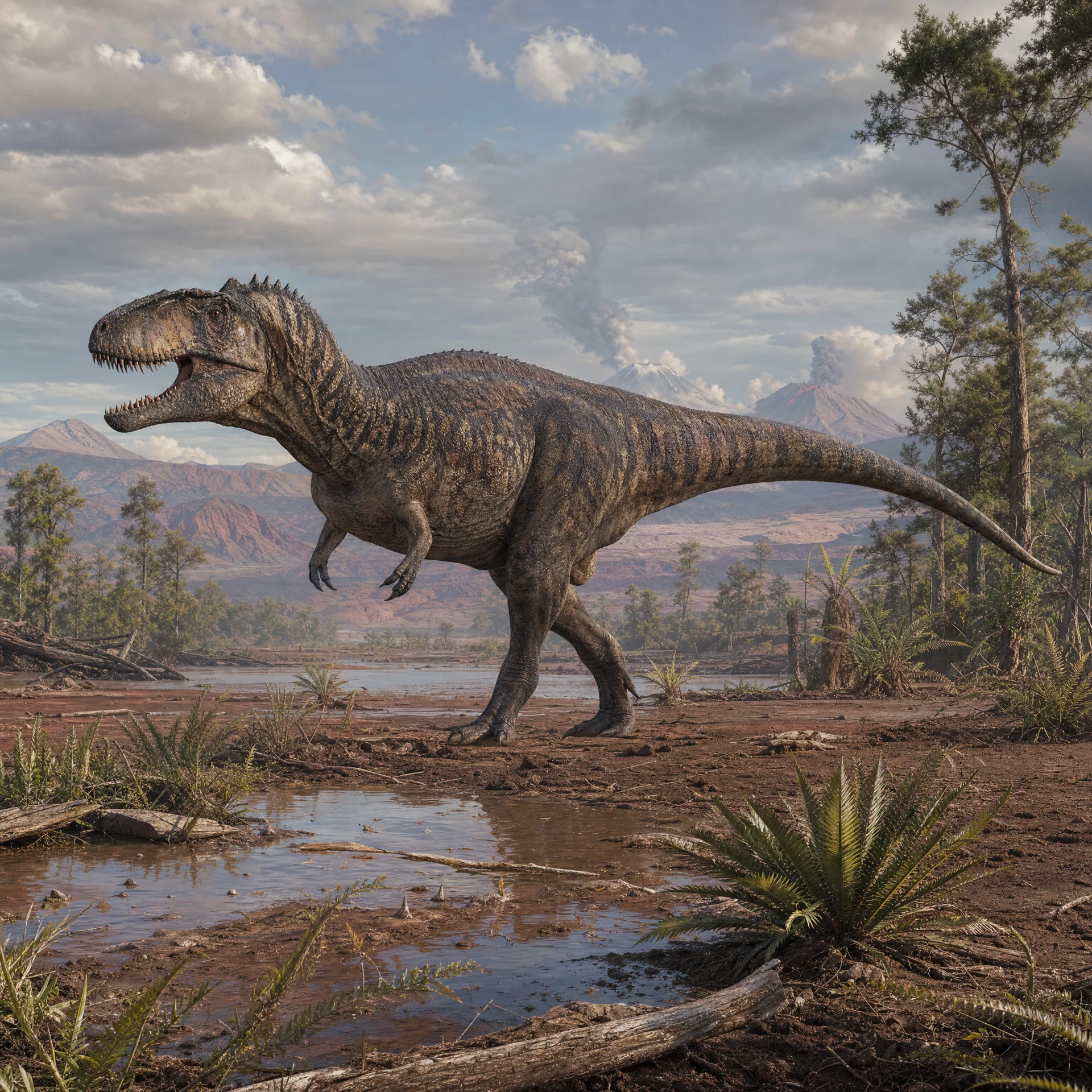
Sinraptor
Sinraptor dongi
⏳ Jurassic Period🍽️ CarnivoreDinosaurs
Physical Characteristics
⏳
PeriodJurassic Period
🍽️
DietCarnivore
📏
Size7.6~8.8m
⚖️
Weight1000~1300kg
↕
Height3m
Classification
GEN
GenusSinraptor
SP
SpeciesS. dongi
Sinraptor dongi
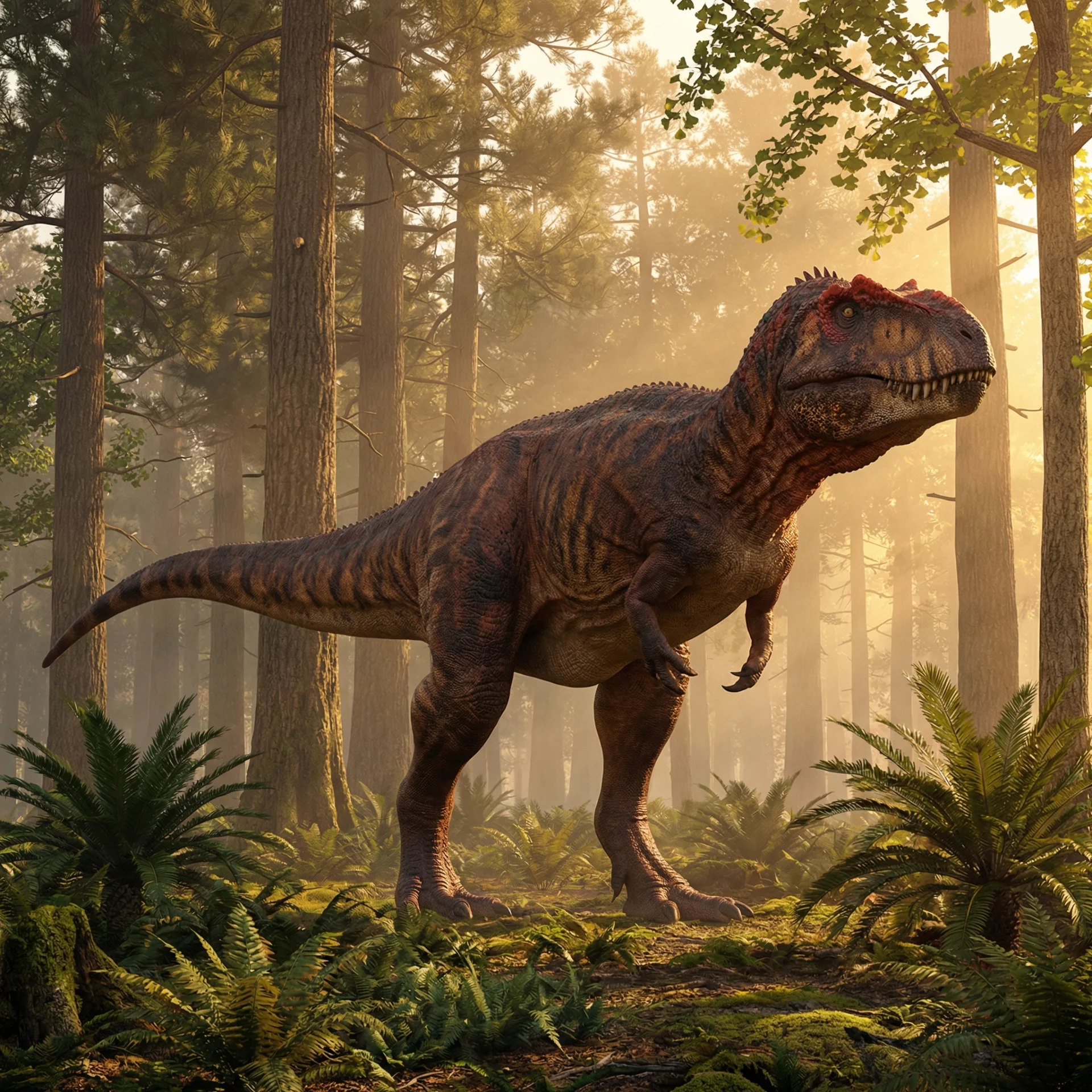
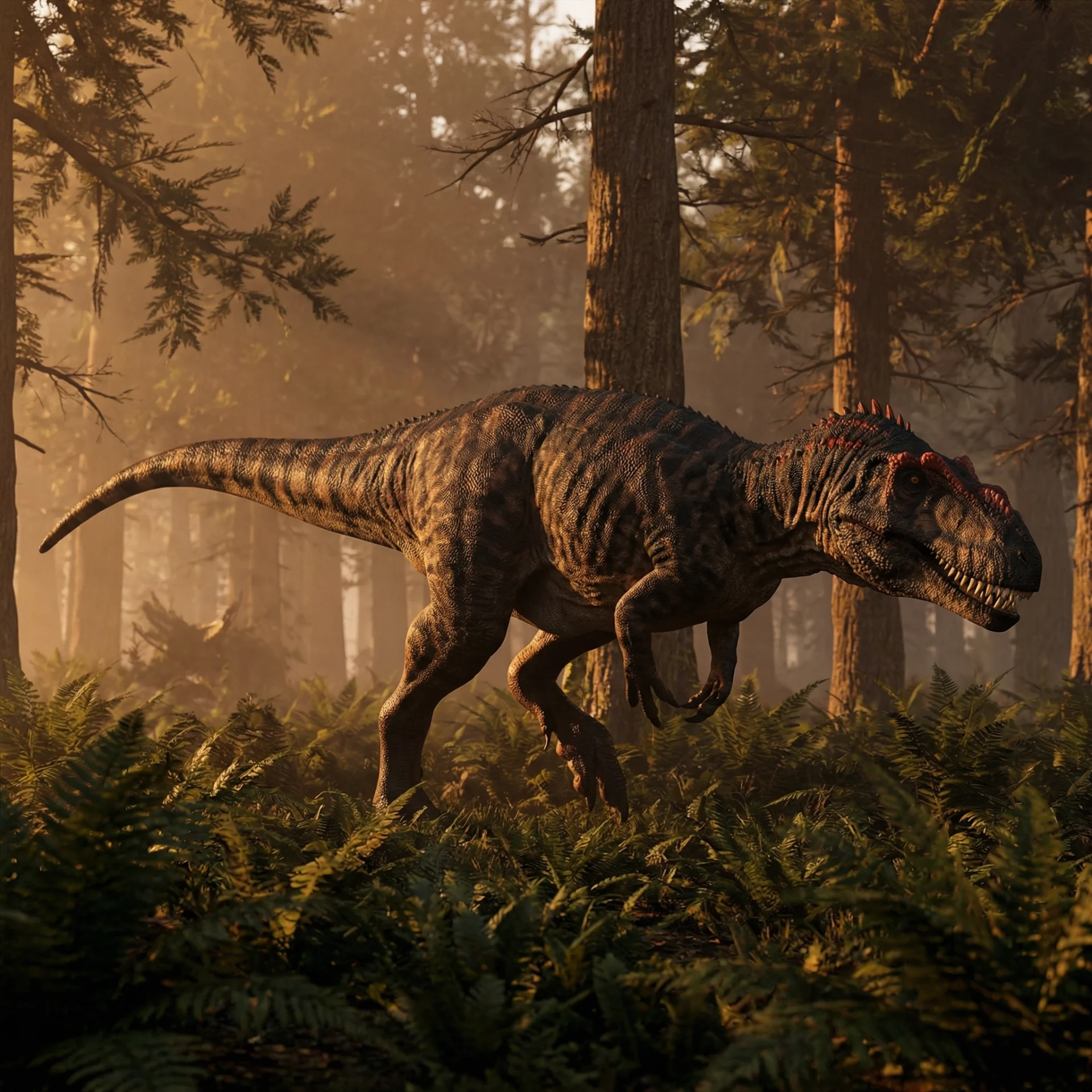
Sinraptor (Sinraptor dongi Currie & Zhao, 1993) is a large theropod dinosaur from the Late Jurassic (Oxfordian, approximately 160 million years ago) of the Junggar Basin in the Xinjiang Uygur Autonomous Region of northwestern China. A carnivorous carnosaur belonging to the family Metriacanthosauridae (formerly known as Sinraptoridae), it remains the best-known member of this clade. The holotype (IVPP 10600)—a nearly complete skull and partial postcranial skeleton—was discovered during the 1987 Sino-Canadian Dinosaur Project expedition from the upper part of the Shishugou Formation, and the taxon is recognized as the apex terrestrial predator of its ecosystem.
Estimated at roughly 7.6–8.8 m in total length and 1–1.3 metric tons in body mass (Currie & Zhao, 1993; Paul, 2016; Holtz, 2012), Sinraptor stood nearly 3 m tall at the shoulder. Its skull, approximately 90 cm long, bore blade-like teeth closely resembling those of Allosaurus, well-suited for inflicting deep, fatal wounds on medium-to-large herbivorous dinosaurs (Hendrickx et al., 2020). The holotype skull preserves multiple paleopathological lesions—tooth drags, punctures, and a fully penetrating bite wound—interpreted as evidence of intraspecific head-biting behavior (Tanke & Currie, 1998).
Sinraptor represents an early stage in the Jurassic carnosaur radiation, occupying a phylogenetic position more derived than Piatnitzkysaurus of Argentina yet more basal than Allosaurus. Together with its close relatives Yangchuanosaurus, Metriacanthosaurus, and the recently described Alpkarakush from Kyrgyzstan (Rauhut et al., 2024), it documents the diversity of medium-to-large-bodied predators in Laurasia during the Middle to Late Jurassic.
The genus name Sinraptor is derived from the Latin prefix "Sino-" (meaning Chinese) and "raptor" (meaning robber or thief), yielding "Chinese robber." The specific epithet dongi honors the distinguished Chinese paleontologist Dong Zhiming. Despite the inclusion of "raptor" in its name, Sinraptor is not related to the dromaeosaurids commonly nicknamed "raptors" (such as Velociraptor). Instead, it is a carnosaur distantly related to Allosaurus (Currie & Zhao, 1993).
Sinraptor dongi is currently accepted as a valid species. In the original description, Currie & Zhao (1993) erected the family Sinraptoridae to include Sinraptor and Yangchuanosaurus. Carrano, Benson & Sampson (2012) later determined that the name Metriacanthosauridae has nomenclatural priority. A second species, S. hepingensis, was originally described as Yangchuanosaurus hepingensis by Gao (1992) and reassigned to Sinraptor by Currie & Zhao (1993). However, this reassignment remains contentious: Rauhut et al. (2024), in the description of Alpkarakush kyrgyzicus, recovered hepingensis within Yangchuanosaurus in their phylogenetic analysis.
A large apex-predator theropod from the Late Jurassic Shishugou Formation of Xinjiang, China, representing the best-known member of Metriacanthosauridae.
Sinraptor dongi was recovered from the upper Shishugou Formation. Radiometric dating constrains the Shishugou Formation to approximately 163–156 Ma (Callovian–Oxfordian) (Xu et al., 2022; Choiniere et al., 2013). The holotype IVPP 10600 was collected approximately 65 m above the contact with the Wucaiwan Formation/Member, placing it within the Oxfordian (approximately 160 Ma) (Currie & Zhao, 1993; Hendrickx et al., 2020).
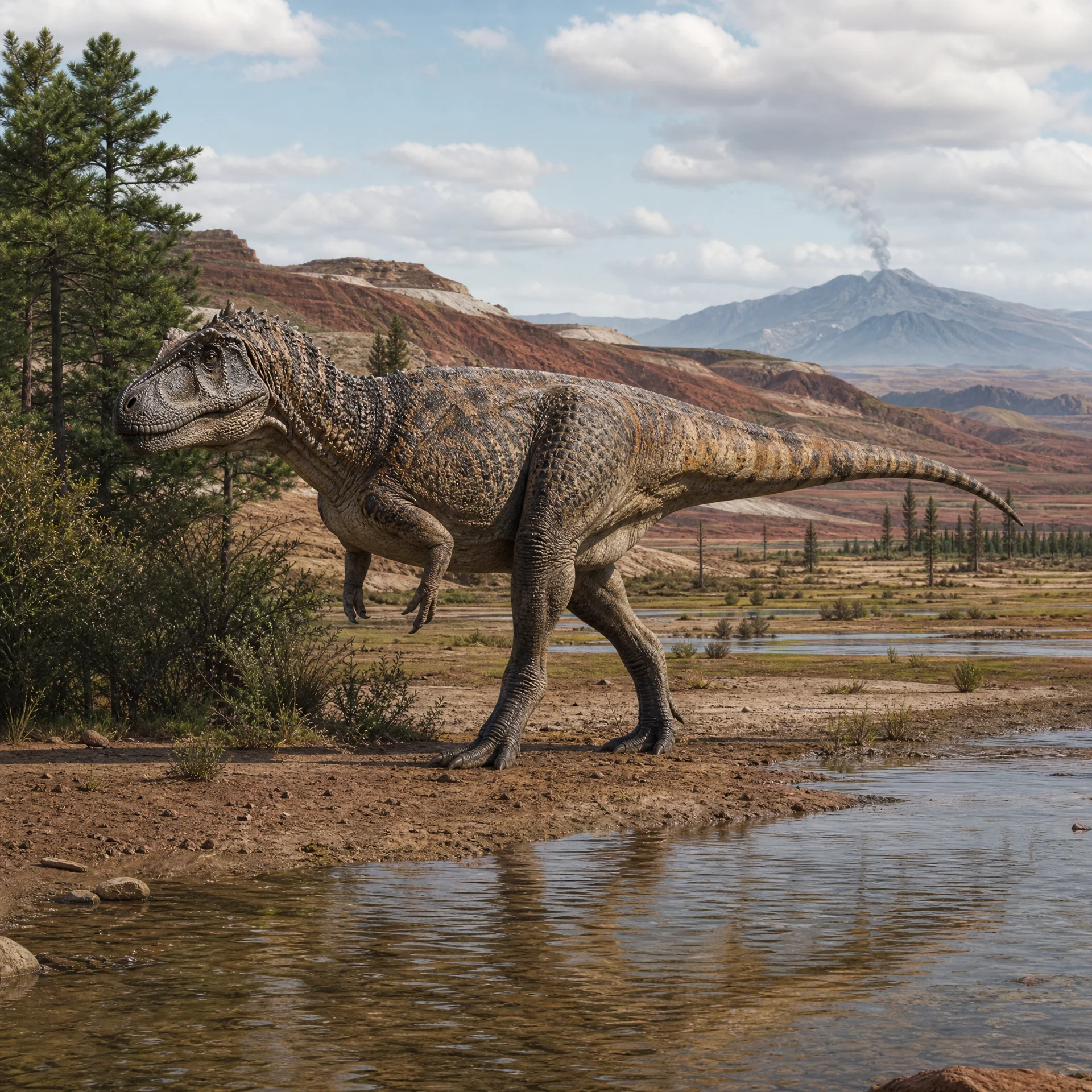
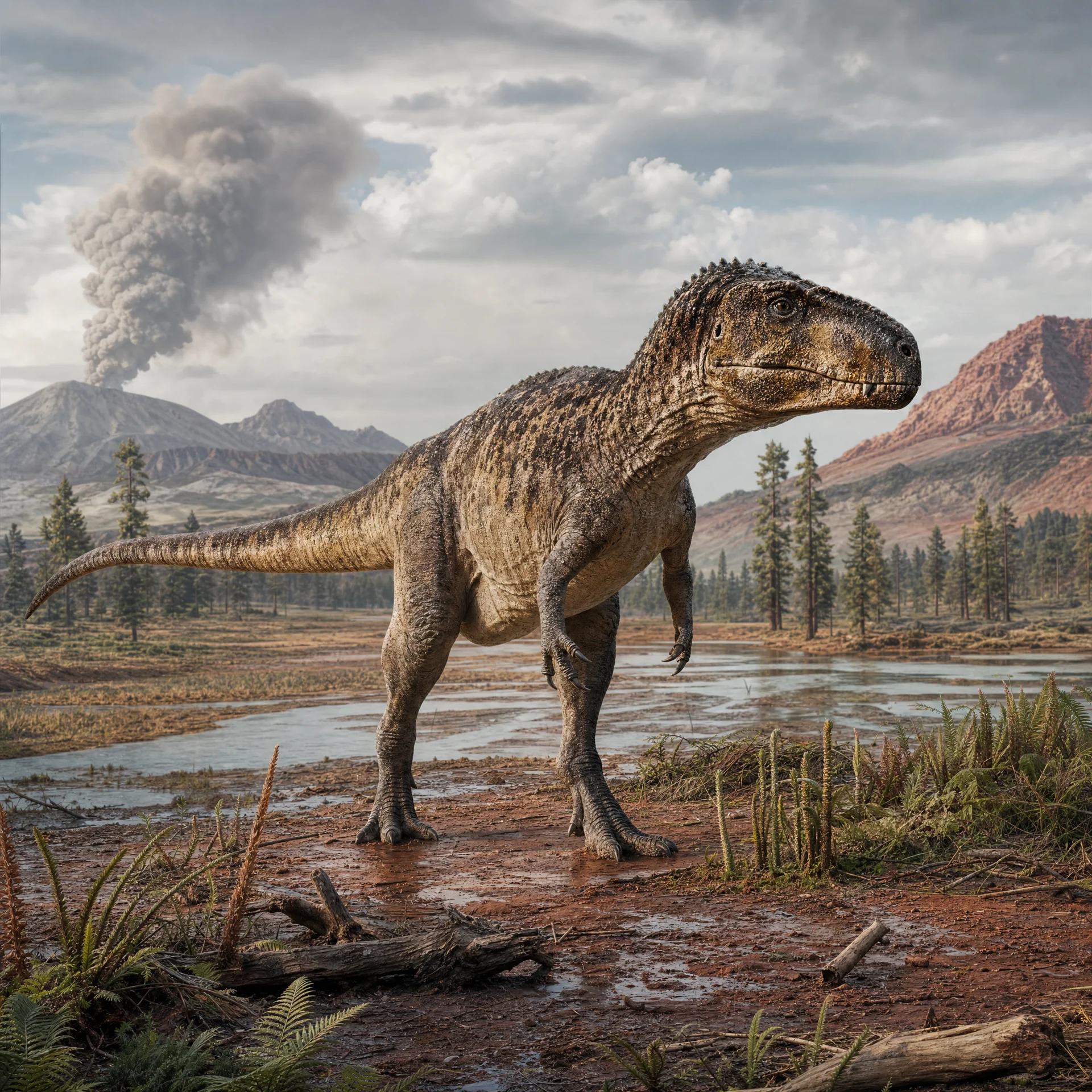
The Shishugou Formation crops out along the northeastern margin of the Junggar Basin in Xinjiang, northwestern China. It attains an overall thickness of approximately 380 m. The basal approximately 30 m is predominantly conglomerate, while the bulk of the formation comprises red-colored mudstone with frequent channel and sheet sandstone lenses and occasional tuffaceous deposits (Choiniere et al., 2013; Eberth et al., 2010). The formation is named after the abundant silicified wood ("Shishugou" translates to "stone tree valley") found within its strata.
The Shishugou Formation at the Wucaiwan locality is interpreted as representing primarily alluvial (river/floodplain) and paludal (wetland) facies deposited at the up-dip margins of the internally drained Junggar Basin (Xu et al., 2022). The region during the Late Jurassic supported marshlands and small river systems under semi-humid to semi-arid conditions, with active volcanism in adjacent ranges contributing frequent ashfalls. Volcanic ash mixing with wetland sediments created viscous mud traps—the so-called "dinosaur death pits" described by Eberth et al. (2010)—in which small theropods and other vertebrates became mired. Associated flora includes abundant petrified wood, indicating the presence of extensive forests.
| Item | Details |
|---|---|
| Formation | Shishugou Formation (upper part) |
| Lithology | Red mudstone, channel/sheet sandstone lenses, tuffaceous deposits, basal conglomerate |
| Age | Late Jurassic, Oxfordian (~160 Ma) |
| Paleoenvironment | Inland basin alluvial floodplain/wetland; semi-humid to semi-arid; adjacent volcanism |
| Dating Basis | Radiometric dating (~159–164 Ma range) |
The holotype, IVPP 10600, was discovered in 1987 during the Sino-Canadian Dinosaur Project (China–Canada–Alberta–Ex Terra) at a locality approximately 25 km northeast of Jiangjunmiao in the Shishugou Formation, Xinjiang. The specimen includes a nearly complete skull (approximately 900 mm in length) and mandible (approximately 893 mm), along with most of the postcranial skeleton including cervical, dorsal, and sacral vertebrae, partial caudal series, the shoulder girdle, and the pelvis. However, most of the forelimbs and a significant portion of the tail are missing (Currie & Zhao, 1993). The skeleton was found lying on its right side. The specimen is housed at the Institute of Vertebrate Paleontology and Paleoanthropology (IVPP) in Beijing.
Nine isolated teeth were recovered in association with sauropod bones from a quarry less than 1 km from the holotype locality and referred to S. dongi. Additionally, an isolated left metatarsal IV (IVPP V 18060) from the upper Shishugou Formation at the Wucaiwan locality was reported as cf. Sinraptor by He, Clark & Xu (2013). Hendrickx et al. (2020) noted that the holotype IVPP 10600 may represent a subadult individual, suggesting that fully grown adults could have been larger.
According to Currie & Zhao (1993), Sinraptor can be distinguished by the following combination of characters:
This unique combination of features differentiates Sinraptor from other metriacanthosaurid taxa.
Gregory S. Paul (2016) estimated S. dongi at approximately 8 m in total length with a body mass of approximately 1.3 metric tons. Thomas Holtz (2012) proposed a somewhat larger estimate of approximately 8.8 m. The original description (Currie & Zhao, 1993) recorded the preserved holotype skeleton at approximately 7.6 m in length. Because the holotype may represent a subadult (Hendrickx et al., 2020), fully mature individuals could have exceeded these estimates. The animal stood approximately 3 m tall at the shoulder.
| Study | Estimated Length | Estimated Mass | Notes |
|---|---|---|---|
| Currie & Zhao, 1993 | ~7.6 m | Not provided | Based on holotype |
| Paul, 2016 | ~8 m | ~1.3 t | Princeton Field Guide |
| Holtz, 2012 | ~8.8 m | Not provided | Dinosaurs Encyclopedia |
The skull of Sinraptor dongi measures approximately 90 cm in length and exhibits a relatively elongate, low profile. For comparison, the skull of Yangchuanosaurus shangyouensis measures approximately 78 cm and that of S. hepingensis approximately 104 cm (Zou et al., 2025). Key cranial features include a low lacrimal horn/boss with prominent rugosity and a well-developed postorbital rugosity forming a modest supraorbital protuberance. These cranial ornaments are convergent with, though less developed than, the lacrimal horns of Allosaurus.
Each premaxilla bears 4 teeth, each maxilla approximately 15 tooth positions, and each dentary 16 tooth positions (Currie & Zhao, 1993; Hendrickx et al., 2020).
Hendrickx et al. (2020) provided a comprehensive study of the dental anatomy of Sinraptor dongi, confirming close morphological similarity to Allosaurus. The teeth are labiolingually compressed, blade-shaped crowns with well-developed serrations (denticles) on both the mesial and distal carinae. This dental morphology is well-suited for inflicting deep, slashing wounds on medium-to-large herbivorous prey such as the co-occurring stegosaur Jiangjunosaurus junggarensis. The premaxillary teeth are relatively labiolingually thicker than the lateral dentition, indicating functional differentiation along the tooth row.
The postcranium is preserved from the cervical vertebrae through the sacrum, including the shoulder girdle and pelvis, but lacks most of the forelimbs and the posterior portion of the tail. The preserved elements indicate the typical large theropod bauplan: a large head, short neck, robust hindlimbs, and a long, counterbalancing tail. One rib exhibits evidence of fracture healing via telescoping of its capitular shaft, indicating that this individual survived significant traumatic injury during life (Molnar, 2001).
Hendrickx et al. (2020) designated Sinraptor dongi as the apex terrestrial predator of the upper Shishugou Formation ecosystem. It was the largest carnivorous theropod in this assemblage by a substantial margin. Other co-occurring theropods—Guanlong (approximately 3 m; basal tyrannosauroid), Limusaurus (approximately 1.7 m; ceratosaur), Zuolong (approximately 3 m; basal coelurosaur), and Haplocheirus (approximately 2 m; alvarezsaurid)—were all small to medium in size, occupying distinctly lower trophic positions.
The blade-like dental morphology of Sinraptor was optimally adapted for a slash-and-tear predatory strategy targeting medium-to-large herbivores. Potential prey in the same ecosystem included the stegosaur Jiangjunosaurus junggarensis (approximately 6 m), the basal ceratopsians Yinlong (approximately 1.2 m) and Hualianceratops, the ornithopod "Eugongbusaurus", and juvenile sauropods such as Bellusaurus. Fully grown individuals of the giant sauropod Mamenchisaurus sinocanadorum (approximately 35 m) were likely too large for predation by Sinraptor, although juveniles, injured, or infirm individuals may have been vulnerable.
Nine isolated Sinraptor teeth recovered alongside sauropod bones near the holotype locality may represent indirect evidence of feeding (predation or scavenging) on sauropod carcasses.
Tanke & Currie (1998) documented a range of paleopathological lesions on the holotype skull (IVPP 10600), including gently curving tooth drags and gouges, shallow circular punctures, and one fully penetrating lesion. These marks are interpreted as evidence of intraspecific head-biting behavior among large theropods, likely related to territorial disputes or mating competition. Non-overlapping placement of the bite marks suggests multiple encounters over the animal's lifetime.
Confirmed occurrences of Sinraptor dongi are restricted to the upper Shishugou Formation of the Junggar Basin in Xinjiang, China, specifically in the Jiangjunmiao area. An additional referred specimen (IVPP V 18060, an isolated metatarsal IV) was recovered from the same formation at the nearby Wucaiwan locality (He, Clark & Xu, 2013).
The second species, S. hepingensis (= Yangchuanosaurus hepingensis), derives from the Upper Shaximiao Formation of Zigong, Sichuan Province, but its assignment to Sinraptor remains debated.
The approximate paleocoordinates for the Shishugou Formation are 42.5°N / 100.5°E, corresponding to an inland position on the East Asian portion of Laurasia during the Late Jurassic. The broader distribution of Metriacanthosauridae—spanning China (Xinjiang, Sichuan, Chongqing, Yunnan), England (Oxfordian–Kimmeridgian), Kyrgyzstan (Callovian), and Thailand (Late Jurassic to Early Cretaceous)—indicates a pan-Laurasian distribution for this family during the Middle to Late Jurassic.
In the comprehensive tetanuran phylogenetic analysis of Carrano, Benson & Sampson (2012), Sinraptor dongi was recovered within Metriacanthosaurinae inside Metriacanthosauridae. In that framework, Sinraptor forms a sister-taxon relationship with Yangchuanosaurus, together constituting a subclade alongside Metriacanthosaurus parkeri (Oxfordian, England).
The 2025 description of Yuanmouraptor jinshajiangensis by Zou et al. provided an updated phylogenetic analysis in which Yuanmouraptor was recovered as the most basal member of Metriacanthosauridae. In this topology, Sinraptor dongi, S. hepingensis, and Yangchuanosaurus shangyouensis retain their positions as more derived members of the clade in close mutual relationship.
Currie & Zhao (1993) reassigned Yangchuanosaurus hepingensis Gao, 1992 (holotype ZDM 0024, from Zigong, Sichuan) as a second species of Sinraptor. However, the morphological differences between S. dongi and S. hepingensis were described as very slight and potentially within intraspecific variation (Rauhut, 2000). Carrano et al. (2012) tentatively maintained this assignment while acknowledging uncertainty. In 2024, Rauhut et al., in their description of Alpkarakush kyrgyzicus from Kyrgyzstan, recovered hepingensis within Yangchuanosaurus rather than Sinraptor in their phylogenetic analysis, supporting its return to the original generic assignment.
The broader placement of Metriacanthosauridae within Allosauroidea is itself subject to two competing hypotheses. Most analyses (Carrano et al., 2012; Hendrickx et al., 2015, among others) recover Metriacanthosauridae as a clade basal to Allosauridae and Carcharodontosauridae. In contrast, some workers (Coria & Currie, 2002; Rauhut, 2003; Kellermann, Cuesta & Rauhut, 2025) have recovered Metriacanthosauridae in a more derived position, closer to Carcharodontosauridae.
The current state of knowledge about Sinraptor dongi can be categorized into confirmed, well-supported, and hypothetical interpretations.
Confirmed: (1) The existence and provenance of holotype IVPP 10600 from the upper Shishugou Formation. (2) Membership in Metriacanthosauridae. (3) Late Jurassic (Oxfordian) age. (4) Status as the apex predator of its paleocommunity. (5) Diagnostic cranial features (jugal pneumatopore, postorbital rugosity, pneumatic palatine, etc.).
Well-supported: (1) Total length of approximately 7.6–8.8 m and body mass of approximately 1–1.3 t (with the caveat that the holotype may be subadult, so adults could have been larger). (2) Close sister-taxon relationship with Yangchuanosaurus. (3) Slash-and-tear predatory strategy using blade-like teeth.
Hypothetical/Debated: (1) The generic assignment of S. hepingensis (Sinraptor vs. Yangchuanosaurus). (2) The ontogenetic stage of the holotype (subadult vs. adult). (3) Precise maximum adult body size.
The name Sinraptor is frequently confused with the dromaeosaurid "raptors" in popular culture, but it belongs to an entirely different lineage of large-bodied carnosaurs. Some popular sources inflate its body length to 10–11 m; however, the scientifically supported range is approximately 7.6–8.8 m. The animal is occasionally depicted with extensive feathering in some modern reconstructions, but there is currently no direct integumentary evidence for Sinraptor, and phylogenetic bracketing is ambiguous at the base of Allosauroidea.
The following table compares Sinraptor dongi with closely related metriacanthosaurids and the broadly contemporaneous allosaurid Allosaurus.
| Taxon | Family | Age | Locality | Estimated Length | Estimated Mass |
|---|---|---|---|---|---|
| Sinraptor dongi | Metriacanthosauridae | Oxfordian (~160 Ma) | Xinjiang, China | ~7.6–8.8 m | ~1–1.3 t |
| Yangchuanosaurus shangyouensis | Metriacanthosauridae | Bathonian–Oxfordian | Sichuan, China | ~8–10 m | ~1–3.4 t |
| Metriacanthosaurus parkeri | Metriacanthosauridae | Oxfordian | England, UK | ~8 m | ~1 t |
| Alpkarakush kyrgyzicus | Metriacanthosauridae | Callovian | Kyrgyzstan | ~7–8 m | Not estimated |
| Yuanmouraptor jinshajiangensis | Metriacanthosauridae | Aalenian–Bajocian | Yunnan, China | ~6 m (est.) | Not estimated |
| Allosaurus fragilis | Allosauridae | Kimmeridgian–Tithonian | North America | ~8.5–9.7 m | ~1.5–2 t |
| Specimen Number | Elements Preserved | Locality / Formation | Assignment | Reference |
|---|---|---|---|---|
| IVPP 10600 (holotype) | Nearly complete skull + partial postcranial skeleton (most forelimbs and part of tail missing) | Jiangjunmiao, upper Shishugou Fm. | S. dongi | Currie & Zhao, 1993 |
| IVPP (9 isolated teeth) | 9 isolated teeth (associated with sauropod bones) | Near holotype locality, Shishugou Fm. | cf. S. dongi | Currie & Zhao, 1993 |
| IVPP V 18060 | Left metatarsal IV | Wucaiwan, upper Shishugou Fm. | cf. Sinraptor | He, Clark & Xu, 2013 |
| ZDM 0024 (S. hepingensis holotype) | Skull + dentary + most of postcranium (forelimbs, right leg, lower left leg, distal caudals missing) | Zigong, Sichuan; Upper Shaximiao Fm. | S. hepingensis (debated) | Gao, 1992; Currie & Zhao, 1993 |
Despite its name meaning 'Chinese robber,' Sinraptor has no evolutionary relationship to the dromaeosaurid 'raptors' like Velociraptor—it was a large carnosaur more closely related to Allosaurus.
The holotype skull preserves over 25 bite lesions, including tooth drags, punctures, and one fully penetrating wound, providing rare fossil evidence of aggressive intraspecific behavior among Jurassic theropods.
The Shishugou Formation contains 'dinosaur death pits'—natural mud traps created when volcanic ash mixed with wetland sediments, trapping small dinosaurs that were then buried by the struggles of later victims.
The name 'Shishugou' means 'stone tree valley,' derived from the abundant petrified logs found in the formation where Sinraptor was discovered.
The species name 'dongi' honors Dong Zhiming, one of the most prolific dinosaur paleontologists in history, having named dozens of dinosaur species from China.
Sinraptor's teeth were blade-like and closely resembled those of Allosaurus, optimized for a 'slash-and-tear' predatory strategy that inflicted deep, fatal wounds on prey.
One of the holotype's ribs shows evidence of fracture healing via telescoping of its capitular shaft, demonstrating that this individual survived significant physical trauma during its lifetime.
Guanlong—the earliest known tyrannosauroid—lived in the same ecosystem as Sinraptor but at a fraction of its size, occupying a completely different ecological niche as a mid-tier predator.
Yuanmouraptor, described in 2025 from Yunnan Province, is the most basal known metriacanthosaurid, pushing the origins of the family that includes Sinraptor back to the Middle Jurassic (Aalenian–Bajocian).
Despite having 'raptor' in its name, Sinraptor is not related to the dromaeosaurids commonly known as 'raptors' (such as Velociraptor). It belongs to Allosauroidea, a group of large-bodied carnosaurs distantly related to Allosaurus. The word 'raptor' in its name simply means 'robber' or 'thief' in Latin and is not exclusive to dromaeosaurids.
The holotype skeleton (IVPP 10600) was measured at approximately 7.6 m in total length by Currie & Zhao (1993). Paul (2016) estimated about 8 m and 1.3 metric tons, while Holtz (2012) proposed approximately 8.8 m. Since the holotype may represent a subadult individual, fully grown adults could have been somewhat larger.
Sinraptor belongs to Metriacanthosauridae within Allosauroidea, making it a relatively close relative of Allosaurus (family Allosauridae) at the superfamily level. However, the two are not in the same family. The original description (Currie & Zhao, 1993) noted that Sinraptor is phylogenetically more basal (primitive) than Allosaurus within the allosauroid radiation.
Tanke & Currie (1998) documented multiple lesions on the holotype skull, including gently curving tooth drags and gouges, shallow circular punctures, and one fully penetrating bite wound. These are interpreted as evidence of head-biting behavior, likely from intraspecific combat such as territorial disputes or mating rivalry.
The holotype was discovered in 1987 during the Sino-Canadian Dinosaur Project at a site approximately 25 km northeast of Jiangjunmiao in the Junggar Basin, Xinjiang Uygur Autonomous Region, northwestern China. The fossil came from the upper part of the Shishugou Formation.
The two genera are closely related and both belong to Metriacanthosauridae. Currie & Zhao (1993) even reassigned one species of Yangchuanosaurus (Y. hepingensis) as a second species of Sinraptor (S. hepingensis). However, this reassignment remains debated, and Rauhut et al. (2024) recovered hepingensis within Yangchuanosaurus in their phylogenetic analysis.
The upper Shishugou Formation has yielded a remarkably diverse assemblage including the early tyrannosauroid Guanlong, the ceratosaur Limusaurus, the giant sauropod Mamenchisaurus sinocanadorum, the stegosaur Jiangjunosaurus, the basal ceratopsians Yinlong and Hualianceratops, as well as various crocodylomorphs, pterosaurs, and early mammaliamorphs.
Metriacanthosauridae is a family of medium-to-large carnivorous theropods within Allosauroidea. They ranged from the Middle Jurassic to the Early Cretaceous across Laurasia (China, England, Kyrgyzstan, Thailand). The family was formerly known as 'Sinraptoridae,' but the name Metriacanthosauridae has nomenclatural priority (Carrano et al., 2012).
Hendrickx et al. (2020) noted that the holotype IVPP 10600 may represent a subadult individual rather than a fully mature adult. If confirmed, this would mean that adult Sinraptor dongi were larger than the holotype measurements indicate, potentially exceeding the currently estimated 7.6–8.8 m range.
5images