Megalosaurus
Jurassic Period Carnivore Creature Type
Megalosaurus bucklandii
Scientific Name: "Greek μέγας (megas, "great") + σαῦρος (sauros, "lizard") = "Great Lizard""
Local Name: Megalosaurus
Physical Characteristics
Discovery
Habitat
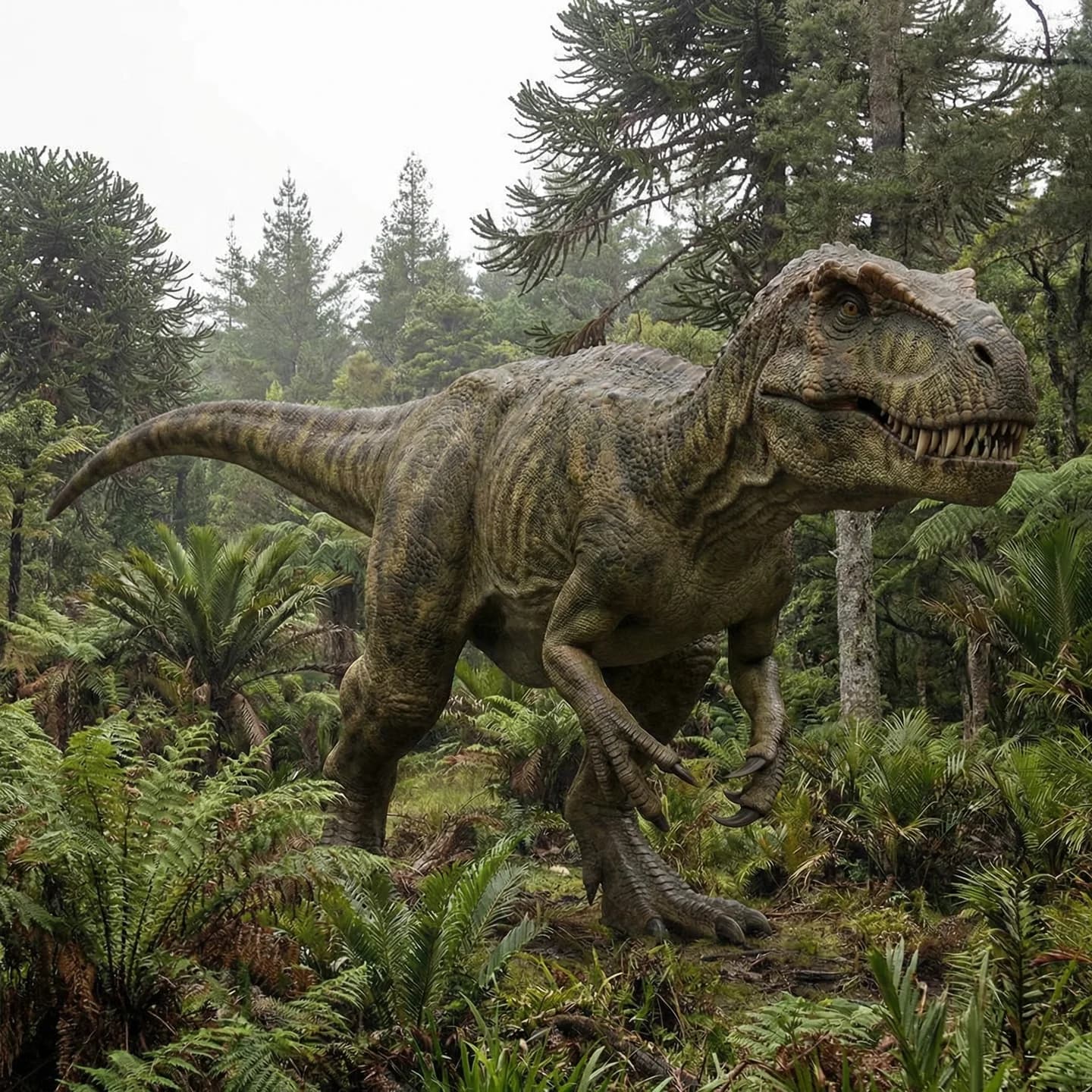
Megalosaurus bucklandii Mantell, 1827 is a large carnivorous theropod dinosaur from the Middle Jurassic Bathonian stage (approximately 168.2–165.3 Ma) of southern England. On 20 February 1824, William Buckland, Professor of Geology at the University of Oxford, formally described Megalosaurus before the Geological Society of London, making it the first genus of non-avian dinosaur to be validly named in the history of science. The species name bucklandii was assigned in 1827 by Gideon Mantell in honour of Buckland.
Megalosaurus occupies an iconic position in the history of palaeontology. When Richard Owen established the taxon Dinosauria in 1842, Megalosaurus was one of the three founding genera — alongside Iguanodon and Hylaeosaurus — upon which the concept of "dinosaur" was built. It is the type genus of Megalosauridae and Megalosaurinae, and is inferred to have been the apex predator of its Middle Jurassic ecosystem in England.
Modern size estimates vary: Paul (2010) estimated a body length of approximately 6 m and a mass of around 700 kg, while Benson (2010) estimated the lectotype individual at roughly 7 m, noting that larger specimens may have approached 9 m. No complete skeleton has ever been found, and detailed reconstructions rely heavily on comparison with close relatives such as Torvosaurus, Eustreptospondylus, and Afrovenator. Nevertheless, Benson et al. (2008) and Benson (2010) confirmed two autapomorphies of the lectotype dentary — a longitudinal groove on the ventral part of the lateral surface and a slit-like anterior Meckelian foramen — establishing M. bucklandii as a valid, diagnosable taxon and rescuing it from its long reputation as a "wastebasket taxon."
Overview
Name and Etymology
The genus name Megalosaurus derives from the Greek μέγας (megas, "great") and σαῦρος (sauros, "lizard"), meaning "great lizard." Buckland and his colleague William Conybeare had been referring to the animal informally as the "Huge Lizard" since around 1821, and Conybeare coined the Latinised Greek name. Buckland adopted it because the animal was initially estimated at around 12 m (40 feet) in length, a size that justified such a dramatic name.
The species name bucklandii was bestowed by Gideon Mantell in 1827 to honour William Buckland. An earlier specific name, M. conybeari, was published by Ferdinand von Ritgen in 1826 but was never widely used and is now treated as a nomen oblitum (forgotten name). The variant spelling M. bucklandi, first published by Christian Erich Hermann von Meyer in 1832, was used for many decades but the original M. bucklandii has priority.
Taxonomic Position
Megalosaurus is classified within Theropoda, Tetanurae, Megalosauroidea, Megalosauridae, and Megalosaurinae. In the large-scale phylogenetic analysis of Tetanurae by Carrano, Benson & Sampson (2012), Megalosauridae forms a clade with Spinosauridae within Megalosauroidea (= Megalosauria).
Significance in the History of Science
Megalosaurus holds several milestones in the history of palaeontology. First, its 1824 description by Buckland is recognised as the first valid naming of a non-avian dinosaur genus (though the first theropod remains to be scientifically described were those of Streptospondylus by Cuvier in 1808). Second, it was one of three genera used by Owen in 1842 to establish Dinosauria. Third, the 1854 life-sized concrete model at Crystal Palace Park, sculpted by Benjamin Waterhouse Hawkins under Owen's direction, was one of the first attempts to reconstruct a dinosaur for public display, creating widespread public awareness of prehistoric reptiles. Fourth, its mention in the opening passage of Charles Dickens's Bleak House (1852–1853) represents one of the earliest appearances of a dinosaur in literary fiction.
Geological Age, Stratigraphy, and Depositional Environment
Temporal Range
Megalosaurus fossils come from the Middle Jurassic Bathonian stage (approximately 168.2–165.3 Ma). The primary fossil-bearing unit, the Taynton Limestone Formation, dates to the mid-Bathonian (around 166 Ma). Fossils referred to Megalosaurus have also been recovered from the slightly older Chipping Norton Limestone Formation (Lower Bathonian).
Lithostratigraphy
The Taynton Limestone Formation is located in Oxfordshire and is dominated by ooidal grainstone, with subordinate sandstone and marl. The formation reaches a maximum thickness of about 30 m. Within it, the Stonesfield Slate — a historically important horizon quarried for roofing material since at least the 17th century — has yielded the greatest concentration of Megalosaurus specimens. The quarries were worked until 1911.
The Chipping Norton Limestone Formation, slightly older (Lower Bathonian), yielded approximately 30 individual teeth and bones referred to Megalosaurus by Reynolds (1938, 1939). Benson (2009) found no relevant anatomical differences between the New Park Quarry material and M. bucklandii specimens from the Taynton Limestone, affirming their referral. However, an ilium from Oakham Quarry was clearly dissimilar, leaving its referral uncertain.
Palaeoenvironment
During the Middle Jurassic, Europe was a tropical to subtropical archipelago surrounding the Tethys Ocean. Megalosaurus inhabited an island formed by the London–Brabant Massif. The palaeolatitude of southern England at this time was approximately 30–35°N, comparable to present-day North Africa or the Mediterranean.
The Taynton Limestone Formation was deposited in a nearshore shallow-marine environment; the ooidal grainstones indicate warm, shallow waters. Fossil plant assemblages (conifers, ferns, cycads, horsetails) from associated deposits reflect forested habitats on nearby land. The 2024–2025 excavations at Dewars Farm Quarry revealed that the trackmaking surface was a muddy lagoon near the shore — footprint preservation was so detailed that deformation of the substrate as the dinosaurs trod across soft ground could be observed.
Specimens and Diagnostic Characters
History of Discovery and Naming
The history of Megalosaurus fossils stretches back to the 17th century. In 1676, a distal femur fragment was recovered from the Stonesfield quarries and described by Robert Plot in his Natural History of Oxfordshire (1677). This was the first published illustration of a dinosaur bone, though Plot interpreted it as belonging to a Roman war elephant or a biblical giant.
In 1699, Edward Lhuyd described a tooth (specimen OU 1328) that was later re-identified as a Megalosaurus tooth crown by Delair & Sarjeant (2002), representing the third dinosaur fossil to be illustrated.
In 1763, Richard Brookes reproduced Plot's femur illustration and labelled it "Scrotum humanum" — apparently a reference to its resemblance to a pair of human testicles. Whether this constitutes a valid scientific name was debated: palaeontologist Beverly Halstead argued in 1970 that it represented a valid Linnaean binomial with priority over Megalosaurus. However, Philip K. Tubbs, then Executive Secretary of the International Commission on Zoological Nomenclature (ICZN), concluded that the name was merely a caption for an illustration and did not constitute valid nomenclatural establishment. The name Megalosaurus retained its priority.
In 1822, physician James Parkinson mentioned the name "Megalosaurus" in print and illustrated a tooth, but this publication lacked a formal description and is treated as a nomen nudum.
On 20 February 1824, William Buckland formally described Megalosaurus at a meeting of the Geological Society of London, published in the Transactions of the Geological Society. This constitutes the first valid naming of a non-avian dinosaur genus.
Lectotype and Key Specimens
The lectotype is OUMNH J.13505, a partial right dentary with a single erupted tooth, designated by Ralph Molnar in 1990. It is housed at the Oxford University Museum of Natural History.
The paralectotype series from Buckland's 1824 description comprises the following specimens:
| Specimen Number | Element | Notes |
|---|---|---|
| OUMNH J.13505 | Right dentary (partial) | Lectotype |
| OUMNH J.13577 | Posterior dorsal vertebra | Paralectotype |
| OUMNH J.13579 | Anterior caudal vertebra | Paralectotype |
| OUMNH J.13576 | Sacrum (5 sacral vertebrae) | Paralectotype |
| OUMNH J.13585 | Cervical rib | Paralectotype |
| OUMNH J.13580 | Rib | Paralectotype |
| OUMNH J.29881 | Ilium | Paralectotype |
| OUMNH J.13563 | Pubis (partial) | Paralectotype |
| OUMNH J.13565 | Ischium (partial) | Paralectotype |
| OUMNH J.13561 | Femur | Paralectotype |
| OUMNH J.13572 | Metatarsal II (distal) | Paralectotype |
As Buckland himself recognised, these bones did not all belong to the same individual; only the sacrum was articulated. Benson (2010) counted a total of 103 specimens from the Stonesfield Slate, representing a minimum of seven individuals. Benson (2010) also referred an ischium (SDM 44.20) and a metatarsal III (NHMUK R9665) from Oakham Quarry to M. bucklandii on the basis of shared autapomorphies.
Diagnostic Characters
Benson et al. (2008) identified two autapomorphies of the lectotype dentary that establish M. bucklandii as a valid taxon: a longitudinal groove on the ventral part of the lateral surface of the dentary, and a slit-like anterior Meckelian foramen. The revised diagnosis also notes 13–14 dentary teeth. Benson (2010) expanded the diagnosis to include character combinations from additional referred material, incorporating features of the sacrum, pelvis, and hindlimb elements.
Limitations of the Material
Megalosaurus fossils are predominantly fragmentary, and a complete skeleton has never been found. The skull is known only from the dentary and partial maxilla fragments (e.g. OUMNH J.13506). The forelimb is virtually unknown. Detailed body reconstructions therefore depend heavily on comparison with better-known relatives such as Torvosaurus, Eustreptospondylus, and Afrovenator.
Morphology and Function
Body Size
Modern size estimates differ between researchers. Paul (2010) estimated a body length of approximately 6 m and a mass of about 700 kg. Benson (2010) estimated the lectotype individual at around 7 m in length, with mass estimates approaching one tonne, and noted that larger specimens (based on femur dimensions) may have reached nearly 9 m. Hip height is estimated at approximately 2 m.
Early estimates were considerably inflated. Buckland (1824), following Cuvier's advice, estimated the body length at about 12 m (40 feet). This was an overestimate based on the assumption of a sprawling lizard-like posture. The inclusion of a femur that actually belonged to Iguanodon led Buckland to further inflate the maximum estimate to 18–21 m (60–70 feet). Owen (1842) reduced the estimate to about 9 m (30 feet). Modern estimates of 6–9 m are based on direct measurement of referred material and comparison with complete skeletons of related taxa.
Skull and Dentition
The skull of Megalosaurus is incompletely known. The lectotype dentary is deep and robust, bearing 13–14 teeth. The teeth are laterally compressed with anterior and posterior serrations — the typical morphology of a large carnivorous theropod. A maxilla fragment (OUMNH J.13506) has been referred to M. bucklandii since Huxley (1869), though its identity was debated: Bakker (1992) suggested Sinraptoridae, Naish (2007) suggested Abelisauroidea, but Benson (2010) concluded it was essentially indistinguishable from other known M. bucklandii maxillae.
Postcranial Skeleton and Locomotion
Megalosaurus was a bipedal theropod with a typical large-theropod body plan: robust hindlimbs supporting the body, short but strong forelimbs (inferred; direct evidence is sparse), and a long horizontal tail for balance. The skeleton was heavily ossified, indicating a robust and muscular animal. The tibia has a strongly hooked cnemial crest, suggesting powerful leg musculature.
Early reconstructions depicted Megalosaurus as a quadrupedal, lizard-like animal. The discovery of the nearly complete Eustreptospondylus skeleton near Oxford in 1870, which was clearly bipedal, along with North American finds of large bipedal theropods like Allosaurus in the 1870s, firmly established the bipedal posture of megalosaurs.
Trackway Evidence (2024–2025)
In 2024–2025, Dewars Farm Quarry in Oxfordshire yielded the largest dinosaur trackway site ever found in Britain. During the summer 2024 excavation, over 200 footprints were uncovered, forming five extensive trackways — the longest stretching over 150 m. Four trackways were made by sauropod dinosaurs (likely Cetiosaurus), and the fifth was made by a large theropod identified as Megalosaurus, featuring three-toed prints with sharp claw marks.
In summer 2025, further excavations at the same quarry uncovered Europe's longest individual sauropod trackway (approximately 220 m from first to last exposed footprint), along with additional trackways. The preservation was so detailed that researchers could observe how the mud was deformed as dinosaurs trod across the soft substrate. The site has been nicknamed the "Jurassic Highway" and provides direct behavioural evidence of these animals moving through a muddy lagoon environment 166 million years ago.
Diet and Ecology
Diet
Megalosaurus was a large-bodied carnivore. The laterally compressed, serrated teeth and the deep, robust dentary are consistent with a hypercarnivorous diet. No direct dietary evidence (stomach contents, bite marks on prey bones, etc.) has been reported. Based on the contemporaneous fauna, likely prey included juvenile sauropods (Cetiosaurus, body length up to 16–18 m in adults), ornithopods, and other small to medium-sized vertebrates.
Ecological Role
Benson (2010) concluded that Megalosaurus was the apex predator of the Bathonian ecosystem in England. This interpretation is supported by three lines of evidence: it is the most commonly recovered large theropod from the Taynton Limestone Formation; it was the largest carnivorous dinosaur in its ecosystem; and it was widely distributed across the London–Brabant Massif island. The 2024–2025 Dewars Farm trackway discoveries directly demonstrate that Megalosaurus and Cetiosaurus shared the same environment.
Coexisting Fauna
The Bathonian fauna of England (based on the Taynton Limestone Formation and adjacent units) included the following. Among dinosaurs: the large sauropod Cetiosaurus oxoniensis, the small theropod Iliosuchus (of uncertain phylogenetic position), and indeterminate ornithopods. Among pterosaurs: Rhamphocephalus. Among other reptiles: the marine crocodyliform Teleosaurus, turtles, ichthyosaurs, and plesiosaurs. The Stonesfield Slate also yielded some of the earliest known Mesozoic mammal fossils. The 2025 Dewars Farm excavations additionally recovered marine invertebrates, plant material, and a crocodilian jaw.
Distribution and Palaeogeography
Geographic Distribution
Confirmed M. bucklandii fossils are restricted to Oxfordshire, England. The primary locality is Stonesfield (Taynton Limestone Formation); additional material comes from the Chipping Norton area (Chipping Norton Limestone Formation). Fossils from France, Portugal, and elsewhere in Europe that were historically referred to Megalosaurus have been reassigned to distinct genera including Poekilopleuron, Dubreuillosaurus, and Magnosaurus upon modern re-examination.
Palaeogeographic Context
Middle Jurassic Europe was geographically very different from today. The Tethys Ocean extended across southern Europe, and the continent was fragmented into an archipelago of islands. Megalosaurus inhabited an island formed by the London–Brabant Massif. The climate was warm and humid subtropical to tropical. The palaeolatitude was approximately 30–35°N, comparable to present-day North Africa or the Mediterranean region. The island setting may have restricted the geographic range of Megalosaurus to southern England.
Phylogeny and Taxonomic Debates
Phylogenetic Analysis
Megalosaurus is the type genus of Megalosauridae and Megalosaurinae. In the comprehensive phylogenetic analysis of Tetanurae by Carrano, Benson & Sampson (2012), Megalosauridae groups with Spinosauridae within Megalosauroidea (= Megalosauria). Within this framework, Megalosaurus is closely related to Torvosaurus, Dubreuillosaurus, and Afrovenator.
However, the fragmentary nature of the lectotype means that the precise phylogenetic placement of Megalosaurus can be somewhat unstable across different analyses. Benson (2010) placed it within Megalosaurinae in his own analysis but acknowledged that incompleteness limits resolution.
The "Wastebasket Taxon" Problem
Throughout the 19th and 20th centuries, more than 50 species of diverse theropods were classified under Megalosaurus. Taxa as disparate as Dilophosaurus, Ceratosaurus, Metriacanthosaurus, Proceratosaurus, and Carcharodontosaurus were at one time named as species of Megalosaurus. This occurred because few dinosaur genera were recognised in the early days, and "large theropod = Megalosaurus" became an easy default assignment.
Modern taxonomic revision has removed virtually all of these referrals. Most have been reassigned to separate genera or treated as nomina dubia. Today, the only valid species is M. bucklandii.
Reconstruction and Uncertainty
Well-Established Facts
The following are firmly established: Megalosaurus is the first validly named non-avian dinosaur genus (1824); its fossils come from the Middle Jurassic Bathonian stage (~166 Ma) of Oxfordshire, England; it was a large carnivorous bipedal theropod; it is the type genus of Megalosauridae; and its lectotype dentary is diagnosed by two autapomorphies (the longitudinal groove and slit-like anterior Meckelian foramen).
Probable Interpretations
A body length of approximately 6–9 m and a mass of roughly 700–1,000 kg are well-supported estimates. Its role as the apex predator of its ecosystem is strongly supported by its abundance and size relative to contemporaneous taxa. A close relationship with Torvosaurus and other megalosaurids within Megalosauroidea is consistently recovered in phylogenetic analyses.
Uncertain or Debated Aspects
The overall skull morphology remains uncertain because no complete skull has been found. The forelimb is virtually unknown. Detailed body proportions are inferred from relatives. The identity of maxilla fragment OUMNH J.13506 has been debated by multiple authors. The nature of the external integument — whether purely scaly or with some filamentous covering — has no direct fossil evidence. Witton (2025) comprehensively reviewed the history of Megalosaurus life restorations and noted that many aspects of its appearance remain conjectural due to the limitations of the fossil material.
Early vs. Modern Reconstructions
The 1854 Crystal Palace Park model, sculpted by Benjamin Waterhouse Hawkins under Owen's direction, depicted Megalosaurus as a quadrupedal, mammal-like reptile with a conspicuous shoulder hump. The hump was inspired by a set of high neural spines that Owen had referred to Megalosaurus but which are now assigned to the separate genus Becklespinax. Modern reconstructions depict a bipedal animal with a horizontal body posture, a horizontal tail, and a deep, robust skull (inferred from relatives), presenting an overall image of a powerfully built, medium-to-large theropod.
Comparison with Related and Contemporaneous Taxa
| Taxon | Age | Locality | Estimated Length | Notes |
|---|---|---|---|---|
| Megalosaurus bucklandii | Bathonian (~166 Ma) | England | ~6–9 m | First named non-avian dinosaur, type species |
| Eustreptospondylus oxoniensis | Callovian (~164 Ma) | England | ~5 m | First nearly complete large theropod skeleton |
| Torvosaurus tanneri | Kimmeridgian (~153 Ma) | North America | ~10 m | Large megalosaurid |
| Dubreuillosaurus valesdunensis | Bathonian (~167 Ma) | France | ~6 m | Megalosauridae |
| Afrovenator abakensis | Bathonian–Callovian | Niger | ~8 m | Megalosauridae, more complete skeleton |
| Cetiosaurus oxoniensis | Bathonian (~166 Ma) | England | ~16–18 m | Sauropod coexisting with Megalosaurus |
Fun Facts
FAQ
📚References
- Buckland, W. (1824). Notice on the Megalosaurus or great Fossil Lizard of Stonesfield. Transactions of the Geological Society of London, Series 2, 1(2), 390–396.
- Mantell, G. A. (1827). Illustrations of the Geology of Sussex. Lupton Relfe, London.
- Owen, R. (1842). Report on British fossil reptiles, Part II. Report of the British Association for the Advancement of Science, 11, 60–204.
- Benson, R. B. J., Barrett, P. M., Powell, H. P., & Norman, D. B. (2008). The taxonomic status of Megalosaurus bucklandii (Dinosauria, Theropoda) from the Middle Jurassic of Oxfordshire, UK. Palaeontology, 51(2), 419–424. https://doi.org/10.1111/j.1475-4983.2008.00751.x
- Benson, R. B. J. (2009). An assessment of variability in theropod dinosaur remains from the Bathonian (Middle Jurassic) of Stonesfield and New Park Quarry, UK and taxonomic implications for Megalosaurus bucklandii and Iliosuchus incognitus. Palaeontology, 52(4), 857–877. https://doi.org/10.1111/j.1475-4983.2009.00884.x
- Benson, R. B. J. (2010). A description of Megalosaurus bucklandii (Dinosauria: Theropoda) from the Bathonian of the UK and the relationships of Middle Jurassic theropods. Zoological Journal of the Linnean Society, 158(4), 882–935. https://doi.org/10.1111/j.1096-3642.2009.00569.x
- Carrano, M. T., Benson, R. B. J., & Sampson, S. D. (2012). The phylogeny of Tetanurae (Dinosauria: Theropoda). Journal of Systematic Palaeontology, 10(2), 211–300. https://doi.org/10.1080/14772019.2011.630927
- Paul, G. S. (2010). The Princeton Field Guide to Dinosaurs. Princeton University Press.
- Naish, D., & Martill, D. M. (2007). Dinosaurs of Great Britain and the role of the Geological Society of London in their discovery: basal Dinosauria and Saurischia. Journal of the Geological Society, 164(3), 493–510. https://doi.org/10.1144/0016-76492006-027
- Molnar, R. E. (1990). Problematic Theropoda: "Carnosaurs". In D. B. Weishampel, P. Dodson, & H. Osmólska (Eds.), The Dinosauria (pp. 306–317). University of California Press.
- Delair, J. B., & Sarjeant, W. A. S. (2002). The earliest discoveries of dinosaurs: the records re-examined. Proceedings of the Geologists' Association, 113(3), 185–197. https://doi.org/10.1016/S0016-7878(02)80023-0
- Day, J. J., & Barrett, P. M. (2004). Material referred to Megalosaurus (Dinosauria: Theropoda) from the Middle Jurassic of Stonesfield, Oxfordshire, England: one taxon or two? Proceedings of the Geologists' Association, 115(4), 359–366. https://doi.org/10.1016/S0016-7878(04)80014-3
- Witton, M. P. (2025). The past, present and future of Megalosaurus bucklandii in paleoart. Earth Sciences History, 44(1), 202–246. https://doi.org/10.17704/1944-6187-44.1.202
- Plot, R. (1677). The Natural History of Oxford-shire, Being an Essay Toward the Natural History of England. Mr. S. Miller.
- Reynolds, S. H. (1939). On a collection of reptilian bones from the Oolite of Stow-on-the-Wold, Gloucestershire. Geological Magazine, 76(5), 193–214.
Gallery
5 images Megalosaurus
Megalosaurus · Jurassic Period · Carnivore
 Megalosaurus
Megalosaurus · Jurassic Period · Carnivore
 Megalosaurus
Megalosaurus · Jurassic Period · Carnivore
 Megalosaurus
Megalosaurus · Jurassic Period · Carnivore
 Megalosaurus
Megalosaurus · Jurassic Period · Carnivore
🔗Related Creatures

Archaeopteryx
Archaeopteryx lithographica
Allosaurus
Allosaurus fragilis
Ceratosaurus
Ceratosaurus nasicornis
Dilophosaurus
Dilophosaurus wetherilli
Anchiornis
Anchiornis huxleyi
Sinraptor
Sinraptor dongi

Compsognathus
Compsognathus longipes
Supersaurus
Supersaurus vivianae