Compsognathus
Jurassic Period Carnivore Creature Type
Compsognathus longipes
Scientific Name: "Compsognathus: Greek kompsos (elegant, dainty) + gnathos (jaw) = 'elegant jaw'; longipes: Latin longus (long) + pes (foot) = 'long foot'"
Local Name: Compsognathus
Physical Characteristics
Discovery
Habitat
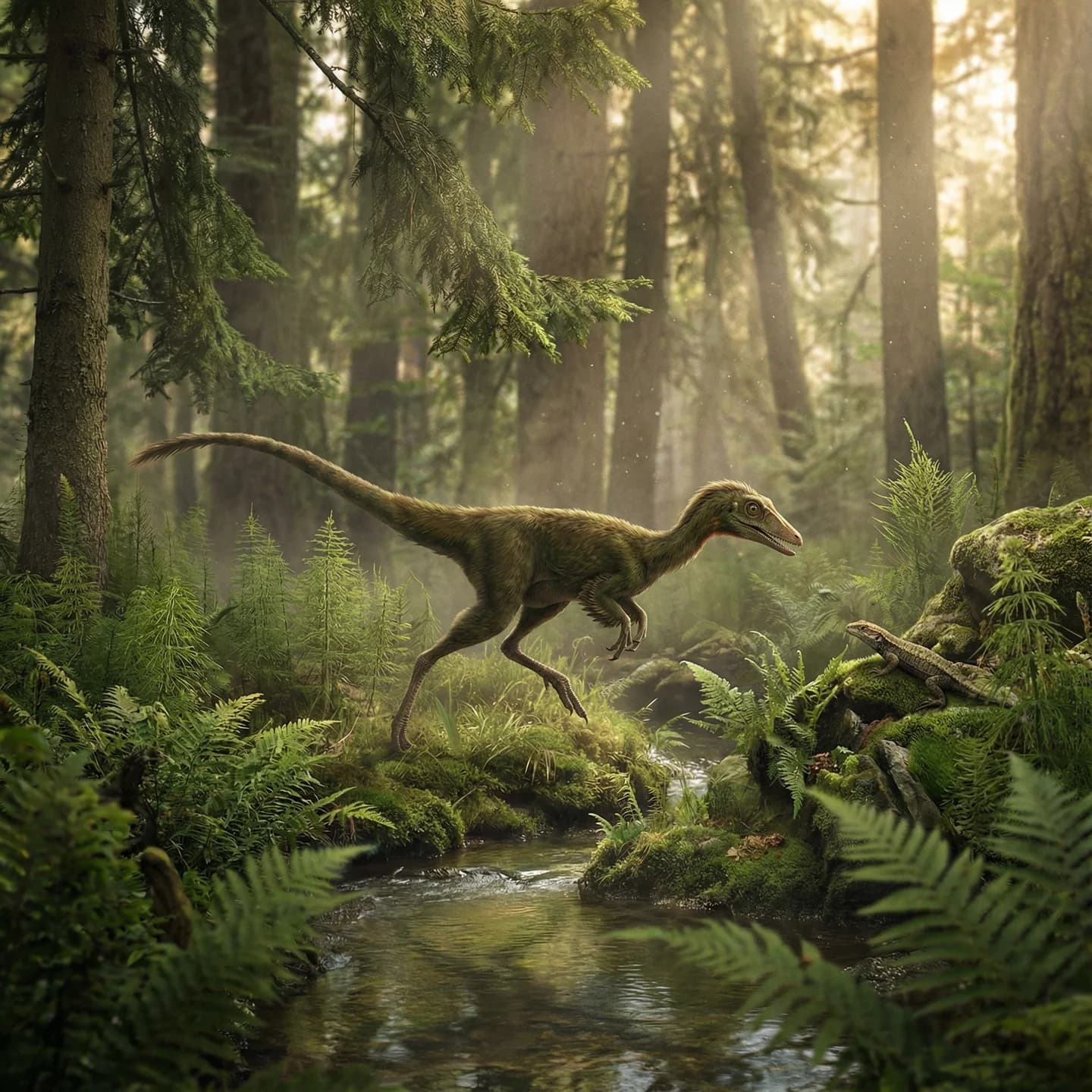
Compsognathus longipes Wagner, 1859 is a small theropod dinosaur from the Late Jurassic (Tithonian stage, approximately 150–145 Ma) of Europe. The genus name derives from the Greek kompsos (elegant, dainty) and gnathos (jaw), meaning "elegant jaw," while the specific epithet longipes is Latin for "long foot." It is the type genus of the family Compsognathidae, and C. longipes is the sole valid species.
Compsognathus was long celebrated as the "smallest known dinosaur," but this reputation was based on the German holotype specimen — now understood to be a juvenile. The adult French specimen measures approximately 1.25–1.4 m in total length and weighed an estimated 2.5–3.5 kg, roughly the size of a large chicken or small turkey. Both known specimens preserve gut contents containing small lizards, making Compsognathus one of the very few non-avian dinosaurs for which diet is directly confirmed from fossil evidence. Furthermore, its discovery in the same deposits as Archaeopteryx made it a pivotal taxon in the 19th-century debate on the evolutionary relationship between dinosaurs and birds.
The habitats in which Compsognathus lived were subtropical island archipelagos fringing the Tethys Sea. The Solnhofen Archipelago of present-day Bavaria and the Canjuers locality in southeastern France both consisted of shallow, hypersaline lagoons bordered by low-lying islands. The fine-grained lithographic limestone deposited in these anoxic lagoons created a Konservat-Lagerstätte of exceptional fossil preservation, capturing soft-tissue impressions and even stomach contents. Paleogeographic reconstructions place the Bavarian localities at approximately 40°N, 20°E during the Late Jurassic, indicating a warm subtropical to semi-arid climate.
Overview
Name and Etymology
The genus name Compsognathus combines the Greek kompsos (κομψός, "elegant, refined, dainty") with gnathos (γνάθος, "jaw"), referring to the delicate and slender skull of this dinosaur. The specific epithet longipes is a Latin compound of longus (long) and pes (foot), describing its proportionally elongated hind feet. The name was coined in 1859 by German paleontologist Johann Andreas Wagner, who initially classified the animal not as a dinosaur but as one of the "most curious forms among the lizards" (Wagner, 1859).
Taxonomic Status
Compsognathus is the type genus of Compsognathidae, a family placed within Coelurosauria (Theropoda). Traditionally, Compsognathidae has been regarded as a basal coelurosaurian clade (Holtz et al., 2004), comprising genera such as Sinosauropteryx, Huaxiagnathus, Mirischia, Sinocalliopteryx, and possibly Juravenator and Scipionyx. However, Cau (2024) proposed that Compsognathidae may not be monophyletic, suggesting that some members represent juvenile morphs of other theropod lineages. This hypothesis remains contentious and is not yet widely accepted.
Only one species is currently recognized: C. longipes Wagner, 1859. The French specimen, originally described as C. corallestris by Bidar et al. (1972), has been synonymized with C. longipes by Ostrom (1978), Michard (1991), and Peyer (2006).
Scientific Significance
Compsognathus was the first theropod dinosaur known from a reasonably complete skeleton. In the 1860s, Thomas Huxley compared it with Archaeopteryx and used their striking similarities to argue for an evolutionary link between dinosaurs and birds (Huxley, 1868; 1870). Both specimens also provide rare direct dietary evidence through preserved gut contents, making Compsognathus a keystone taxon in understanding small theropod paleoecology.
Stratigraphy, Age, and Depositional Environment
Temporal Range
The confirmed temporal range of Compsognathus spans the latest Kimmeridgian to lower Tithonian (approximately 150.8–145 Ma). The German holotype is from the Painten Formation of Bavaria, dated to the latest Kimmeridgian or earliest Tithonian based on ammonite biostratigraphy and regional stratigraphic correlations (Reisdorf & Wuttke, 2012; Schweigert, 2007). The French specimen comes from the Portlandian lithographic limestone of Canjuers, dated to the lower Tithonian by ammonite index fossils (Peyer, 2006).
Formation and Lithology
The German specimen originates from the Painten Formation, one of several lithographic limestone units constituting the Solnhofen Archipelago deposits. The primary lithology is fine-grained lithographic limestone (Plattenkalk) and carbonate mudstone. The French specimen is from the Canjuers Portlandian limestone, a similar lagoonal micritic carbonate deposit.
It should be noted that while older literature commonly refers to the German specimen as coming from the "Solnhofen Limestone," in modern stratigraphic usage the Solnhofen Limestone sensu stricto corresponds to the Altmühltal Formation, which is a distinct unit from the Painten Formation (Reisdorf & Wuttke, 2012).
Additionally, 49 isolated teeth tentatively assigned to Compsognathus sp. were reported from the Alcobaça Formation (formerly Guimarota Formation) of Portugal by Zinke (1998). These teeth differ from C. longipes in having serrations on the anterior edge and have not been definitively attributed to this genus.
Paleoenvironment
The Solnhofen Archipelago was a series of shallow, hypersaline lagoons along the northwestern margin of the Tethys Sea during the Late Jurassic. Bottom waters in these lagoons were anoxic or even toxic, inhibiting decomposition of organisms that sank to the lagoon floor and enabling the exceptional preservation of soft tissues, skin impressions, and gastric contents. Low-lying islands dotted the archipelago, supporting sparse vegetation and small terrestrial faunas of lizards, insects, and small dinosaurs. The Canjuers locality in southeastern France preserves a comparable lagoonal environment; its limestones were historically quarried and sold as "dalles de Provence."
Specimens and Diagnostic Features
Holotype — German Specimen (BSP AS I 563)
The holotype was discovered in the 1850s in the Riedenburg-Kelheim region or possibly Jachenhausen area of Bavaria. The exact year and locality of discovery are unknown because the original owner, physician and fossil collector Joseph Oberndorfer, withheld this information to prevent other collectors from exploiting the site (Göerlich, 2006). The fossil is preserved as a nearly complete skeleton on a limestone slab, and it is currently housed in the Bayerische Staatssammlung für Paläontologie und Geologie (Bavarian State Collection for Paleontology and Geology) in Munich.
This specimen represents a juvenile individual approximately 70–89 cm in total length (Ostrom, 1978; Paul, 1988), with an estimated body mass of 0.32–0.58 kg (Therrien & Henderson, 2007; Paul, 1988) and a hip height of approximately 20 cm (Paul, 1988).
French Specimen (MNHN.F.CNJ79)
Discovered around 1971 by quarry owner Louis Ghirardi in the Portlandian limestone of Canjuers near Nice, southeastern France. It was described as C. corallestris by Bidar et al. (1972) but subsequently synonymized with C. longipes (Ostrom, 1978; Michard, 1991; Peyer, 2006). The entire Ghirardi collection, including this specimen, was acquired by the Muséum national d'Histoire naturelle (MNHN) in Paris in 1983. Estimated total length is approximately 1.25–1.4 m, with a body mass of 2.5–3.5 kg and a hip height of approximately 29 cm (Paul, 1988; Seebacher, 2001; Peyer, 2006).
| Feature | German specimen (BSP AS I 563) | French specimen (MNHN.F.CNJ79) |
|---|---|---|
| Formation | Painten Formation, Bavaria | Canjuers Portlandian limestone, Var |
| Age | Latest Kimmeridgian–earliest Tithonian | Lower Tithonian |
| Total length | ~70–89 cm | ~1.25–1.4 m |
| Estimated mass | ~0.32–0.58 kg | ~2.5–3.5 kg |
| Hip height | ~20 cm | ~29 cm |
| Ontogenetic stage | Juvenile | Adult or subadult |
| Gut contents | Schoenesmahl dyspepsia (lizard) | Unidentified lizards or sphenodontids |
| Repository | BSP, Munich | MNHN, Paris |
Diagnostic Features
Key diagnostic characters of Compsognathus include (Ostrom, 1978; Peyer, 2006): a small, elongate, and slender skull; 3–4 premaxillary teeth, 15–18 maxillary teeth; anterior teeth unserrated with fine serrations on the posterior edge of rear teeth only; tooth crowns curving posteriorly at approximately two-thirds of their height with expanded bases (a compsognathid synapomorphy); a highly reduced, possibly non-functional third manual digit; and proportionally elongated hindlimbs and feet.
Morphology and Functional Anatomy
Body Size and Proportions
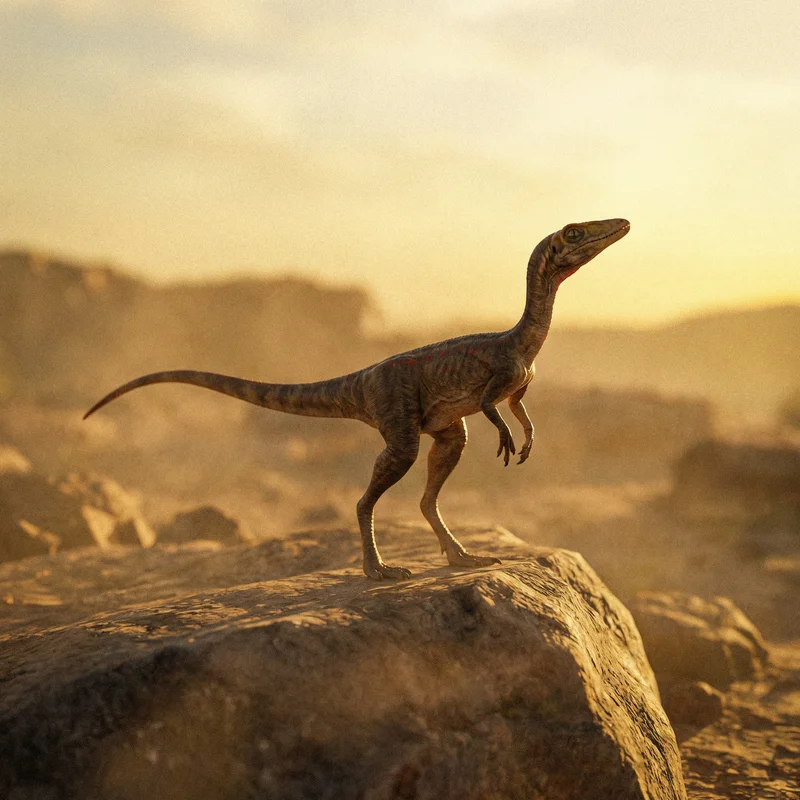
Compsognathus was a small, gracile, bipedal theropod in which the long tail comprised more than half the total body length. The German juvenile measured approximately 70–89 cm in total length, while the French adult reached approximately 1.25–1.4 m. Body mass estimates range from 0.32–0.58 kg for the juvenile (Therrien & Henderson, 2007; Paul, 1988) to 2.5–3.5 kg for the adult (Paul, 1988; Seebacher, 2001).
Skull and Dentition
The skull was narrow, elongate, and tapered anteriorly. It bore five pairs of fenestrae, the largest being the orbit. A distinctive absence of a mandibular fenestra in the lower jaw differentiates it from many other archosaurs. In the German specimen, tooth counts were 3 in each premaxilla, 15–16 in each maxilla, and 18 in the dentary (Stromer, 1934; Ostrom, 1978). The French specimen had more teeth: 4 premaxillary, 17–18 maxillary, and at least 21 dentary teeth (Peyer, 2006). Teeth were small, pointed, and recurved, suited for seizing small prey. A diastema (tooth gap) behind the first three premaxillary teeth was noted in the German specimen but absent in the French one, suggesting possible ontogenetic or individual variation (Peyer, 2006).
Forelimbs and the Digit Controversy
The forelimbs were considerably shorter than the hindlimbs. The number of functional manual digits was long debated. The German holotype preserved phalanges from only two digits, leading to the interpretation that Compsognathus bore only two functional fingers (Ostrom, 1978). However, examination of the French specimen revealed a third metacarpal with at least one or two small phalanges, though no ungual (claw) was found (Peyer, 2006; Gishlick, 2007). The third digit was therefore likely vestigial and non-functional.
Tail and Locomotion
The tail was long and rigid, serving as a counterbalance during bipedal locomotion. The elongated hindlimbs and light body construction suggest Compsognathus was a swift runner capable of rapid directional changes. Some biomechanical estimates suggest a maximum running speed of approximately 30–40 km/h, though such figures are model-dependent and should be treated as approximations rather than established values.
Integument — Feathers and Scales
No feathers or feather-like structures have been preserved with any Compsognathus specimen, in contrast to Archaeopteryx, which occurs in the same deposits. However, close relatives including Sinosauropteryx and Sinocalliopteryx preserve simple filamentous integumentary structures covering the body like fur (Currie & Chen, 2001; Ji et al., 2007), suggesting Compsognathus may have borne similar coverings. Peyer (2006) reported skin impressions on the French specimen's tail starting at the 13th caudal vertebra, showing small bumpy tubercles resembling the scales found in the closely related Juravenator. This pattern suggests a possible mosaic distribution of scales and feather-like structures within Compsognathidae.
Diet and Ecology
Gut Contents — Direct Dietary Evidence
Compsognathus is among the earliest non-avian theropods for which diet has been directly confirmed through preserved stomach contents. The German holotype contains the remains of a small lizard in its thoracic cavity. This lizard was long identified as Bavarisaurus macrodactylus (Ostrom, 1978), but a 2018 reanalysis of its cranial anatomy by Conrad led to its reclassification as Schoenesmahl dyspepsia, an ardeosaurid lizard — making it a holotype nested within a holotype (Conrad, 2018). The lizard's long tail and limb proportions indicate it was a fast, agile runner, and its articulated condition within the Compsognathus body cavity demonstrates that the dinosaur swallowed its prey whole.
The French specimen also preserves gastric contents consisting of unidentified lizards or sphenodontids (Peyer, 2006). The presence of gut contents in both known specimens strongly supports the inference that Compsognathus was a predator of small vertebrates.
Ecological Role
Compsognathus likely occupied a mid-tier predatory niche on the small islands of the Solnhofen Archipelago. Its primary diet consisted of small lizards, insects, and other diminutive animals. Contemporaneous fauna in the same deposits include Archaeopteryx, small pterosaurs such as Rhamphorhynchus, various squamates and sphenodontids, and diverse marine organisms in the adjacent lagoons.
Locomotor Performance
The proportionally long hindlimbs and light body mass indicate that Compsognathus was built for cursorial locomotion. Some biomechanical analyses estimate maximum sprint speeds of roughly 30–40 km/h, but such estimates depend heavily on model assumptions regarding muscle mass, lever arms, and substrate conditions, and should be regarded as approximate.
Distribution and Paleogeography
Geographic Distribution
Only two confirmed C. longipes specimens are known: one from Bavaria (Painten Formation) and one from southeastern France (Canjuers Portlandian limestone). Additionally, 49 isolated teeth tentatively assigned to Compsognathus sp. were recovered from the Guimarota coal mine, Alcobaça Formation, Portugal (Zinke, 1998), but these differ morphologically from C. longipes (presence of anterior serrations) and their generic attribution remains unresolved.
Paleogeographic Interpretation
The Painten Formation's paleocoordinates are approximately 40.2°N, 19.6°E. During the Late Jurassic, Europe consisted of an archipelago of islands and shallow continental shelves along the northwestern margin of the Tethys Sea, situated significantly further south than present-day positions. The paleoclimate was warm subtropical to semi-arid, with mean annual temperatures well above modern values for the same geographic area.
Phylogeny and Classification Debates
Traditional Classification
Wagner (1859) originally classified Compsognathus as a lizard. Its dinosaurian affinities were first recognized by Gegenbaur (1863), Cope (1867), and Huxley (1868). Huxley was particularly struck by its similarities to Archaeopteryx and used Compsognathus as a key argument for the dinosaurian origin of birds. Marsh (1896) erected the family Compsognathidae, and von Huene (1914) placed it within his newly erected Coelurosauria.
Modern Phylogenetic Analyses
In the analysis by Senter et al. (2012), Compsognathus is placed within Compsognathidae as a basal coelurosaurian clade, alongside Sinosauropteryx, Sinocalliopteryx, Huaxiagnathus, and Mirischia. Some analyses alternatively recover Compsognathidae within Maniraptora. The family's exact position within Coelurosauria remains debated.
The Cau (2024) Hypothesis
In a large-scale phylogenetic analysis, Cau (2024) proposed that Compsognathidae may not constitute a natural (monophyletic) group. According to this framework, some traditional compsognathid taxa may instead represent juvenile specimens of other theropod lineages, placed at various positions within Coelurosauria. While provocative, this hypothesis has not yet gained broad acceptance in the paleontological community and requires further testing with additional material and analyses.
Restoration and Uncertainty
Established Facts
Compsognathus was a small, bipedal, carnivorous theropod. Both known specimens preserve nearly complete skeletons, and gut contents directly confirm a diet of small lizards.
Well-Supported Inferences
The German specimen is a juvenile and the French specimen an adult or near-adult of the same species (C. longipes). Based on phylogenetic bracketing with feathered relatives, Compsognathus likely bore simple integumentary structures, though no direct fossil evidence of feathers has been found.
Hypothetical or Unresolved
The monophyly of Compsognathidae is currently debated. Maximum running speed estimates (~30–40 km/h) are model-dependent. The attribution of Portuguese teeth to Compsognathus remains uncertain.
Popular Media vs. Science
Compsognathus was famously depicted in The Lost World: Jurassic Park (1997) as packs of tiny, aggressive predators swarming larger prey. However, there is no fossil evidence for pack hunting — both specimens were found individually at separate localities. Furthermore, the film tends to understate the size of adult Compsognathus; the French specimen at 1.25–1.4 m is substantially larger than a chicken.
Comparison with Related and Contemporary Taxa
| Taxon | Total length (m) | Mass (kg) | Age | Locality |
|---|---|---|---|---|
| Compsognathus longipes | 0.7–1.4 | 0.32–3.5 | Late Jurassic (Kimmeridgian–Tithonian) | Germany, France |
| Sinosauropteryx prima | 0.68–0.98 | ~0.55 | Early Cretaceous | Liaoning, China |
| Huaxiagnathus orientalis | ~1.8 | Unknown | Early Cretaceous | Liaoning, China |
| Juravenator starki | ~0.75 | Unknown | Late Jurassic (Kimmeridgian) | Bavaria, Germany |
| Archaeopteryx lithographica | ~0.5 | ~0.5–1.0 | Late Jurassic (Tithonian) | Bavaria, Germany |
Compsognathus was the first compsognathid discovered and, at adult size, is larger than Sinosauropteryx but smaller than Huaxiagnathus. The contemporaneous Juravenator from the same Solnhofen Archipelago is similar in size but is notable for its mosaic integument of scales and partial feather impressions.
Discovery and Research History
The research history of Compsognathus is deeply intertwined with the early development of dinosaur paleontology.
In 1859, physician and fossil collector Joseph Oberndorfer lent a nearly complete small reptile skeleton from Bavaria to Johann Andreas Wagner, who published a brief notice naming it Compsognathus longipes and classifying it as a lizard (Wagner, 1859). A more detailed description followed in 1861 (Wagner, 1861). Oberndorfer's collection, including the Compsognathus specimen, was acquired by the Bavarian state paleontological collection in Munich in 1866.
Between 1868 and 1870, Thomas Huxley compared Compsognathus with Archaeopteryx, describing it as a "bird-like reptile" and marshaling it as evidence for the dinosaurian origin of birds (Huxley, 1868; 1870). In 1881, O. C. Marsh visited Munich to examine the specimen; his assistant J. G. Baur removed the right ankle from the slab for study and illustration, but this piece was subsequently lost (Ostrom, 1978).
Around 1971, a second, larger specimen was discovered at the Canjuers quarry in southeastern France and described as C. corallestris by Bidar et al. (1972). In 1978, John Ostrom published a comprehensive monograph on both specimens, establishing Compsognathus as one of the best-known small theropods of that era. Ostrom identified the German specimen as a likely juvenile and synonymized C. corallestris with C. longipes.
In 2006, Karin Peyer redescribed the French specimen, providing detailed cranial and dental comparisons and reporting skin impressions with scale-like tubercles on the tail. In 2012, Reisdorf and Wuttke published a detailed taphonomic analysis of the German specimen. In 2018, Jack Conrad reclassified the stomach contents lizard from Bavarisaurus to the new genus and species Schoenesmahl dyspepsia, an ardeosaurid — a holotype preserved within a holotype.
Fun Facts
FAQ
📚References
- Wagner, J. A. (1859). Über einige im lithographischen Schiefer neu aufgefundene Schildkröten und Saurier. Gelehrte Anzeigen der Bayerischen Akademie der Wissenschaften, 49, 553–558.
- Wagner, J. A. (1861). Neue Beiträge zur Kenntnis der urweltlichen Fauna des lithographischen Schiefers; V. Compsognathus longipes Wagner. Abhandlungen der Bayerischen Akademie der Wissenschaften, Mathematisch-naturwissenschaftliche Klasse, 9, 30–38.
- Ostrom, J. H. (1978). The osteology of Compsognathus longipes Wagner. Zitteliana, 4, 73–118.
- Peyer, K. (2006). A reconsideration of Compsognathus from the Upper Tithonian of Canjuers, southeastern France. Journal of Vertebrate Paleontology, 26(4), 879–896. https://doi.org/10.1671/0272-4634(2006)26[879:AROCFT]2.0.CO;2
- Bidar, A., Demay, L., & Thomel, G. (1972). Compsognathus corallestris, une nouvelle espèce de dinosaurien théropode du Portlandien de Canjuers (Sud-Est de la France). Annales du Muséum d'Histoire Naturelle de Nice, 1, 9–40.
- Reisdorf, A. G., & Wuttke, M. (2012). Re-evaluating Moodie's Opisthotonic-Posture Hypothesis in fossil vertebrates. Part I: Reptiles — The taphonomy of the bipedal dinosaurs Compsognathus longipes and Juravenator starki from the Solnhofen Archipelago (Jurassic, Germany). Palaeobiodiversity and Palaeoenvironments, 92(1), 119–168. https://doi.org/10.1007/s12549-011-0068-y
- Conrad, J. L. (2018). A new lizard (Squamata) was the last meal of Compsognathus (Theropoda: Dinosauria) and is a holotype in a holotype. Zoological Journal of the Linnean Society, 183(3), 584–634. https://doi.org/10.1093/zoolinnean/zlx055
- Huxley, T. H. (1868). On the animals which are most nearly intermediate between birds and reptiles. Annals and Magazine of Natural History, 4(2), 66–75.
- Huxley, T. H. (1870). Further evidence of the affinity between the dinosaurian reptiles and birds. Quarterly Journal of the Geological Society, 26, 12–31.
- Zinke, J. (1998). Small theropod teeth from the Upper Jurassic coal mine of Guimarota (Portugal). Paläontologische Zeitschrift, 72(1–2), 179–189. https://doi.org/10.1007/BF02987825
- Paul, G. S. (1988). Predatory Dinosaurs of the World. New York: Simon & Schuster.
- Seebacher, F. (2001). A new method of calculating allometric length-mass relationships of dinosaurs. Journal of Vertebrate Paleontology, 21(1), 51–60.
- Therrien, F., & Henderson, D. M. (2007). My theropod is bigger than yours ... or not: estimating body size from skull length in theropods. Journal of Vertebrate Paleontology, 27(1), 108–115.
- Senter, P., Kirkland, J. I., DeBlieux, D. D., Madsen, S., & Toth, N. (2012). New dromaeosaurids (Dinosauria: Theropoda) from the Lower Cretaceous of Utah, and the evolution of the dromaeosaurid tail. PLoS ONE, 7(5), e36790.
- Cau, A. (2024). A unified framework for predatory dinosaur macroevolution. Bollettino della Società Paleontologica Italiana, 63, 1–19.
- Callison, G., & Quimby, H. M. (1984). Tiny dinosaurs: Are they fully grown? Journal of Vertebrate Paleontology, 3(4), 200–209.
- Holtz, T. R., Jr., Molnar, R. E., & Currie, P. J. (2004). Basal Tetanurae. In D. B. Weishampel, P. Dodson, & H. Osmólska (Eds.), The Dinosauria (2nd ed., pp. 71–110). University of California Press.
- Stromer, E. (1934). Die Zähne des Compsognathus und Bemerkungen über das Gebiß der Theropoda. Centralblatt für Mineralogie, Geologie und Paläontologie, B, 1934, 378–385.
- Gishlick, A. D. (2007). On the manual morphology of Compsognathus longipes and its bearing on the diagnosis of Compsognathidae. Zoological Journal of the Linnean Society, 149(4), 569–581.
- Michard, J.-G. (1991). Description du Compsognathus (Saurischia, Theropoda) de Canjuers (Jurassique supérieur du sud-est de la France), position phylogénétique, relation avec Archaeopteryx et implications théoriques. Ph.D. dissertation, Muséum national d'histoire naturelle, Paris.
Gallery
5 images Compsognathus
Compsognathus · Jurassic Period · Carnivore
 Compsognathus
Compsognathus · Jurassic Period · Carnivore
 Compsognathus
Compsognathus · Jurassic Period · Carnivore
 Compsognathus
Compsognathus · Jurassic Period · Carnivore
 Compsognathus
Compsognathus · Jurassic Period · Carnivore
🔗Related Creatures
Megalosaurus
Megalosaurus bucklandii

Archaeopteryx
Archaeopteryx lithographica
Anchiornis
Anchiornis huxleyi
Dilophosaurus
Dilophosaurus wetherilli
Ceratosaurus
Ceratosaurus nasicornis
Allosaurus
Allosaurus fragilis
Sinraptor
Sinraptor dongi

Microraptor
Microraptor zhaoianus