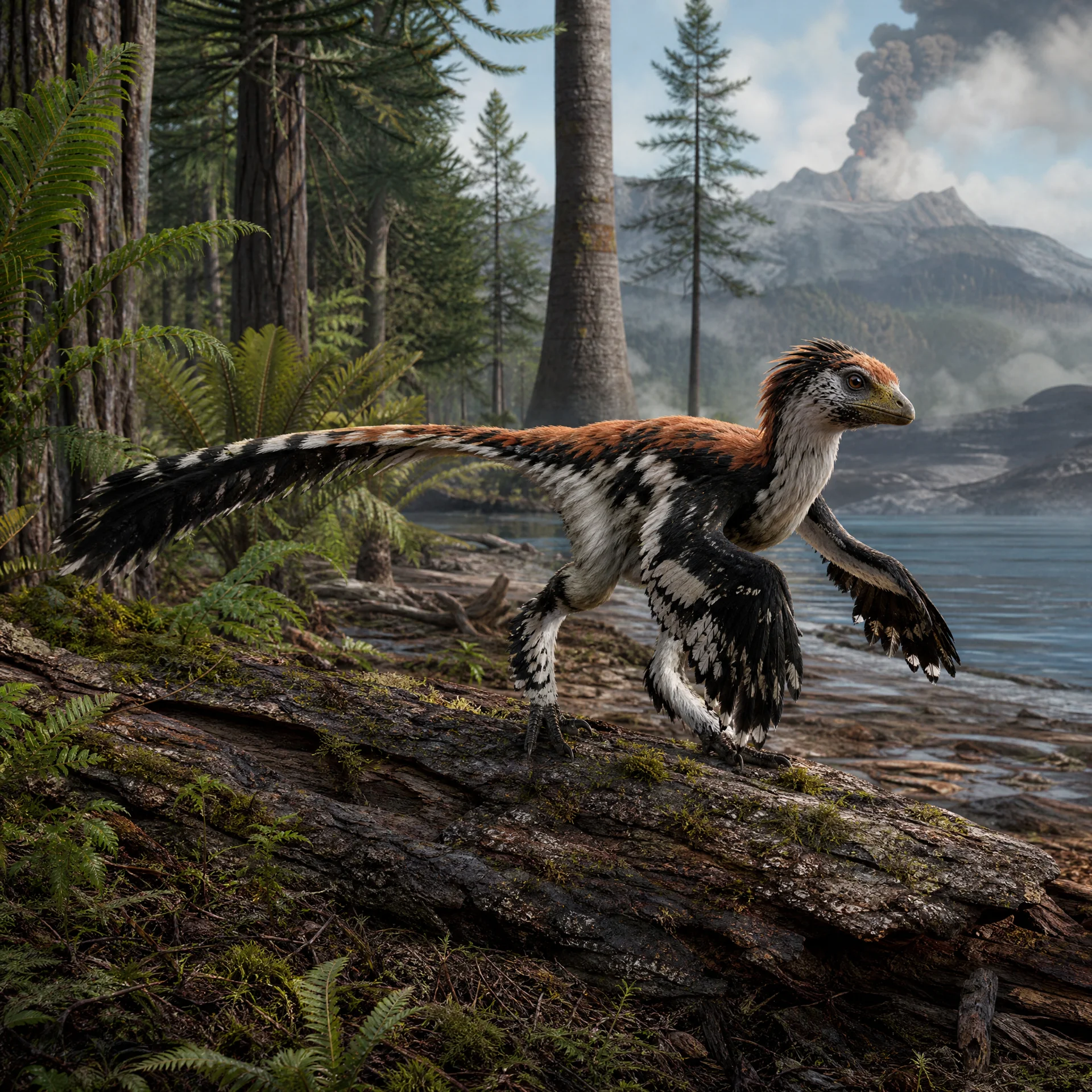
Anchiornis
Anchiornis huxleyi
⏳ Jurassic Period🍽️ CarnivoreDinosaurs
Physical Characteristics
⏳
PeriodJurassic Period
🍽️
DietCarnivore
📏
Size0.34~0.62m
⚖️
Weight0.11~1kg
🪽
Wingspan0.57m
Classification
GEN
GenusAnchiornis
SP
SpeciesA. huxleyi
Anchiornis huxleyi
Anchiornis (Anchiornis huxleyi Xu et al., 2009) is a small feathered paravian dinosaur from the Late Jurassic Oxfordian stage (approximately 160.89–160.25 million years ago) of what is now northeastern China. Classified within the Saurischia, Theropoda, and Maniraptora, it is placed in the family Anchiornithidae in recent phylogenetic analyses. The generic name derives from the Ancient Greek anchi (near) and ornis (bird), meaning 'near bird', reflecting its close morphological resemblance to the avian body plan. The specific name huxleyi honours Thomas Henry Huxley (1825–1895), the British biologist who was among the first to propose a close evolutionary relationship between birds and dinosaurs (Xu et al., 2009).
Anchiornis was an exceptionally small dinosaur, roughly the size of a crow. The holotype individual measured approximately 34 cm in total length and weighed about 110 g, while the largest known specimens reached approximately 60–62 cm in length and an estimated 0.6–1 kg in mass (Pei et al., 2017; Dececchi et al., 2020). It is one of the best-known examples of a 'four-winged' dinosaur, bearing long pennaceous feathers on both the arms and legs, and alongside Microraptor, represents a critical taxon for understanding the evolutionary transition from non-avian dinosaurs to birds. Most notably, a 2010 study by Li et al. made Anchiornis the first Mesozoic dinosaur for which nearly the entire plumage coloration was scientifically reconstructed, cementing its unique place in the history of palaeontology.
Anchiornis fossils are known exclusively from the Tiaojishan Formation of Liaoning and Hebei Provinces, China, with hundreds of specimens recovered to date. Some fossils preserve feathers, skin, and soft tissues in extraordinary detail, enabling studies of feather microstructure, melanosome distribution, molecular keratin composition, and gastric pellet contents. In 2017, laser-stimulated fluorescence (LSF) imaging revealed soft-tissue body outlines with unprecedented precision, leading to Anchiornis being hailed as 'the Mesozoic dinosaur with the most accurately known life appearance' (Wang et al., 2017).
The generic name Anchiornis combines the Ancient Greek anchi (ἄγχι, near) and ornis (ὄρνις, bird), reflecting the animal's morphological proximity to avian body plans. The specific epithet huxleyi pays tribute to Thomas Henry Huxley, a contemporary of Charles Darwin and one of the earliest proponents of the hypothesis that birds descended from dinosaurs. The taxon was named and described by Xu Xing and colleagues in a paper published in Chinese Science Bulletin in 2009 (Xu et al., 2009).
Anchiornis is a monotypic genus, with A. huxleyi as its sole valid species. Its phylogenetic placement has been highly contentious: it was originally assigned to the Avialae (Xu et al., 2009), then reclassified as a troodontid (Hu et al., 2009), subsequently placed in the Archaeopterygidae (Xu et al., 2011), back in the Avialae (Godefroit et al., 2013), and at the base of Paraves outside Eumaniraptora (Lefèvre et al., 2017). The current prevailing view, following Foth & Rauhut (2017) and Cau et al. (2017), places Anchiornis within the family Anchiornithidae—a clade of basal paravians that falls outside the Dromaeosauridae, Troodontidae, and Avialae. Additionally, Aurornis xui, Eosinopteryx brevipenna, and Serikornis sungei have been suggested as potential junior synonyms of Anchiornis, though this has not been formally resolved.
A crow-sized, four-winged feathered dinosaur from the Late Jurassic of China—the first Mesozoic dinosaur with nearly complete plumage coloration scientifically reconstructed, and a key taxon illuminating early stages in the evolutionary transition to birds.
The temporal range of Anchiornis is constrained to the Late Jurassic Oxfordian stage. High-precision U-Pb zircon geochronology by Chu et al. (2016) dates the fossil-bearing horizons to approximately 160.89–160.25 Ma. This makes Anchiornis more than 10 million years older than Archaeopteryx (~150 Ma), establishing it as one of the oldest known feathered dinosaurs. The holotype was recovered from lacustrine sediments of the Tiaojishan Formation in the Yaolugou area of Jianchang County, Liaoning Province.
All Anchiornis fossils derive from the Tiaojishan Formation, a volcano-sedimentary complex distributed across Hebei and Liaoning Provinces, China, spanning the Middle to Late Jurassic (Bathonian–Oxfordian, approximately 165–153 Ma). The formation is primarily composed of andesitic volcanic rocks interspersed with sandstone, shale, tuff, and lacustrine mudstone.
| Formation | Locality | Primary lithology | Age |
|---|---|---|---|
| Tiaojishan Fm. | Jianchang Co., Liaoning; Hebei Province | Andesite, sandstone, shale, tuff, lacustrine mudstone | Oxfordian (~160 Ma) |
The tuffaceous composition of certain horizons indicates that the area experienced active volcanism with periodic heavy ashfalls, and the fine-grained lacustrine beds that yielded the exquisitely preserved fossils likely resulted from rapid burial by volcanic ash in anoxic lake-bottom conditions.
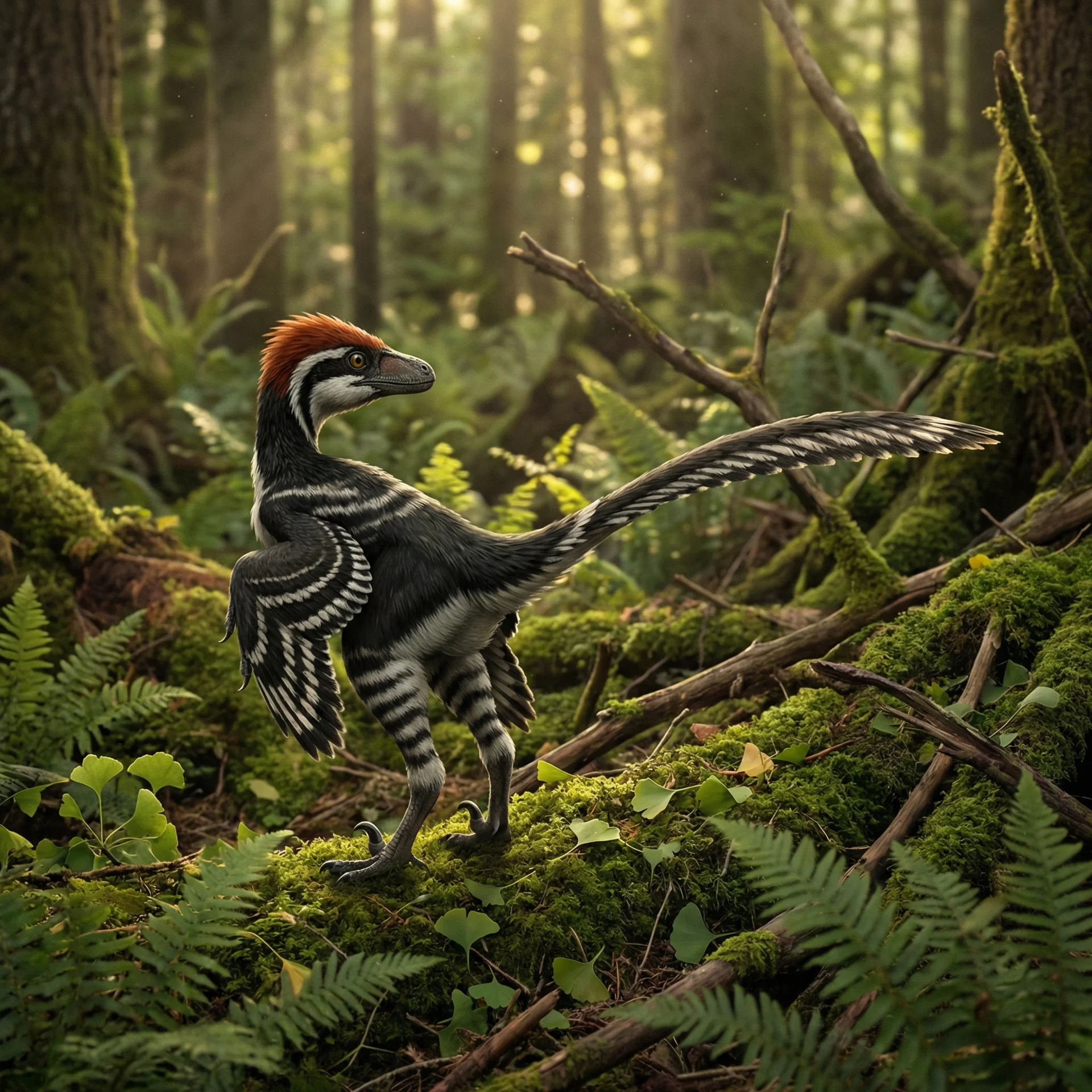
The depositional setting of the Tiaojishan Formation is interpreted as a lacustrine-fluvial complex in a volcanically active region. The fossil-bearing, finely laminated sediments represent quiet, deep-lake environments, surrounded by montane streams and dense gymnosperm forests (Tan et al., 2006). Palaeobotanical analyses by Wang et al. (2006) indicate a subtropical to warm-temperate, humid climate, with abundant ginkgoaleans (Ginkgo, Czekanowskia, Phoenicopsis), conifers (Pityophyllum, Podozamites), cycads (Anomozamites), and ferns (Todites, Coniopteris) forming gymnosperm-dominated woodland. Anchiornis shared this environment with a rich assemblage comprising the Yanliao Biota: salamanders, lizards, pterosaurs (Darwinopterus), other theropods (Xiaotingia, Eosinopteryx), and early mammaliaforms (Juramaia, Volaticotherium), among others.
Anchiornis is known from hundreds of specimens, some preserving feathers, skin, soft tissues, and even gut contents in exceptional detail:
| Specimen | Repository | Preserved elements | Locality/Formation | Notes |
|---|---|---|---|---|
| IVPP V14378 (holotype) | Institute of Vertebrate Paleontology and Paleoanthropology, Beijing | Articulated skeleton lacking skull, part of tail, and right forelimb; faint feather traces | Yaolugou, Jianchang Co., Tiaojishan Fm. | Described by Xu et al. (2009); subadult/young adult, ~34 cm long, ~110 g |
| LPM-B00169 | Liaoning Paleontological Museum | Nearly complete articulated skeleton with long pennaceous feathers on arms and legs; larger than holotype | Daxishan, Jianchang Co., Tiaojishan Fm. | Described by Hu et al. (2009) in Nature; confirmed four-winged morphology |
| BMNHC PH828 | Beijing Museum of Natural History | Nearly complete skeleton (tail absent), extensive feather preservation, head crest documented | Tiaojishan Fm. | Used for 2010 colour reconstruction (Li et al.); referral to Anchiornis questioned |
| PKUP V1068 | Peking University | Nearly complete skeleton with skull; one of the largest known specimens | Tiaojishan Fm. | Described by Pei et al. (2017); estimated total length ~60 cm |
| BMNHC PH804, PH822, PH823 | Beijing Museum of Natural History | Partial to nearly complete skeletons | Tiaojishan Fm. | Described by Pei et al. (2017) |
| STM 0-214 | Shandong Tianyu Museum of Nature | Nearly complete skeleton with visible colour patterns | Tiaojishan Fm. | Used in wing covert study by Longrich et al. (2012) |
| YTGP-T5199 | Yizhou Fossil and Geology Park | Nearly complete skeleton | Tiaojishan Fm. | Used for second melanosome study by Lindgren et al. (2015) |
As of 2010, the Shandong Tianyu Museum of Nature alone was reported to hold 255 Anchiornis specimens, indicating that the actual total is far higher than the number formally described.
Synthesizing the original description (Xu et al., 2009), the supplementary description (Hu et al., 2009), and the revised diagnosis (Pei et al., 2017), the key diagnostic features that distinguish Anchiornis from other paravians include: (1) a triangular skull combining features shared with dromaeosaurids, troodontids, and basal avialans; (2) proportionally long forelimbs, measuring approximately 80% of hindlimb length; (3) a bird-like wrist including a semilunate carpal bone; (4) long pennaceous feathers attached to the metatarsus, forming hindwings; and (5) symmetrical wing feathers with rounded tips, longest at the wrist rather than at the wingtip (unlike other paravians).
The holotype (IVPP V14378) lacks the skull, limiting the morphological information available at the time of the original description. The second specimen (LPM-B00169) and subsequent discoveries have substantially filled this gap, but only a small fraction of the hundreds of known specimens have been formally described in detail, and many remain in private collections or await preparation. Furthermore, Lindgren et al. (2015) raised the possibility that BMNHC PH828—the key specimen used for the 2010 colour reconstruction—might belong to a contemporaneous closely related species rather than Anchiornis itself.
Anchiornis was an extremely small bipedal theropod, roughly crow-sized. The holotype (IVPP V14378), a subadult to young adult, measured approximately 34 cm in total length and an estimated 110 g in body mass (Xu et al., 2009). The largest known specimens (e.g., PKUP V1068) reached an estimated total length of 60–62 cm, a wingspan of approximately 57.4 cm, and a body mass of roughly 0.6–1 kg (Pei et al., 2017; Dececchi et al., 2020). Anchiornis ranks among the smallest known non-avian theropods.
The skull was triangular and displayed a mosaic of features shared with dromaeosaurids, troodontids, and primitive avialans (Pei et al., 2017). Small teeth were present, tending toward small conical forms suitable for capturing small animal prey rather than the phylliform (leaf-shaped) teeth typical of herbivorous ornithischians.
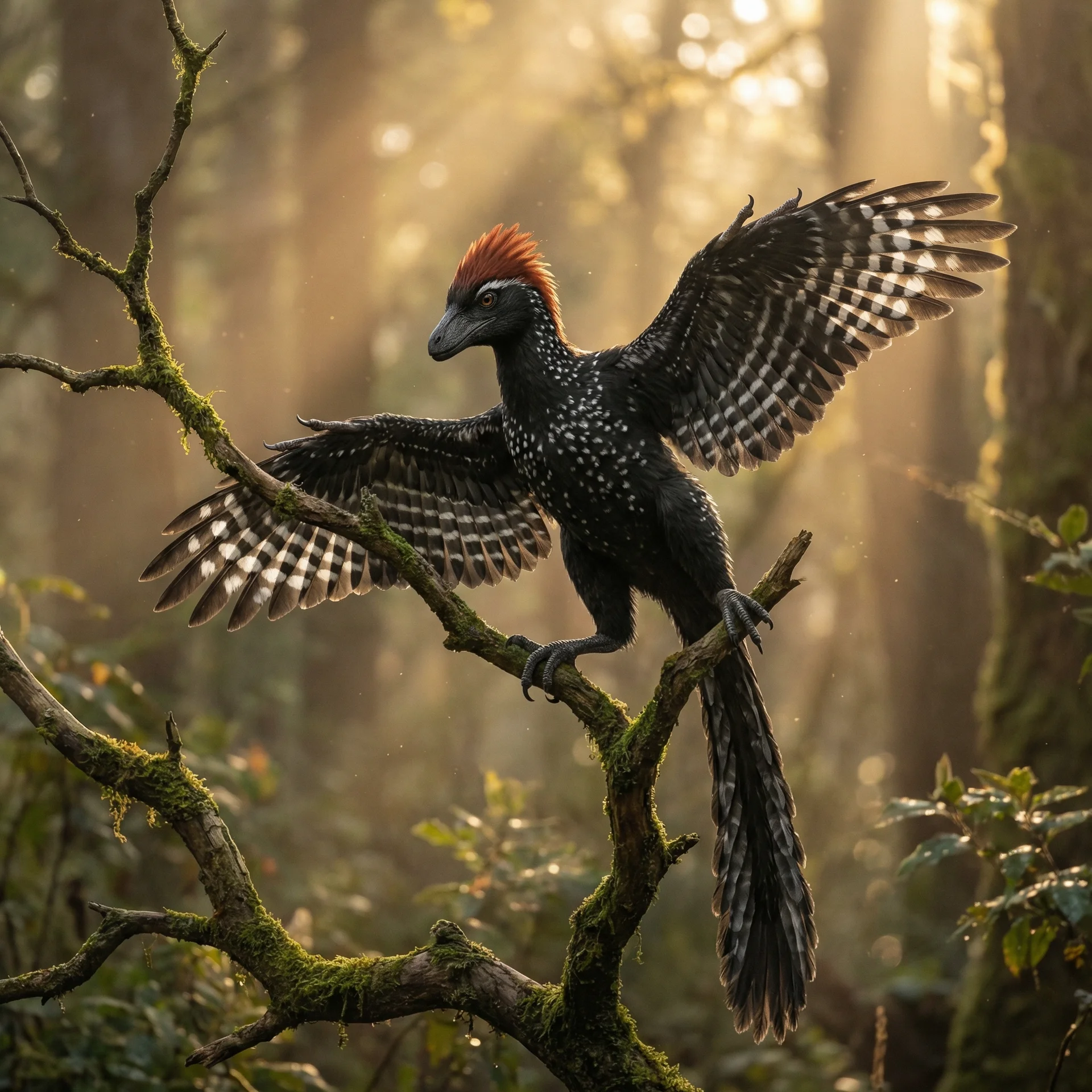
The forewings of Anchiornis comprised 11 primary feathers and 10 secondary feathers. The wing feathers were relatively short, symmetrical, and rounded at the tips—indicating poor aerodynamic capability. While in Microraptor and Archaeopteryx the longest feathers are positioned near the wingtip, creating a pointed wing profile, in Anchiornis the longest feathers were situated near the wrist, producing a wing broadest at mid-span that tapered toward the tip in a rounded, less flight-adapted shape (Hu et al., 2009). A propatagium (skin flap) connected the shoulder to the wrist, and covert feathers covered most of the wing surface in multiple layers. Unlike in modern birds, where coverts cover only the upper wing with the main flight feathers largely exposed below, in Anchiornis the coverts extended in several overlapping layers across much of the wing surface, presumably reinforcing the otherwise narrow and weak primary and secondary feathers (Longrich et al., 2012). Three clawed fingers were present in the wing, but the longest two were bound together by skin and tissue, making Anchiornis functionally two-fingered (Wang et al., 2017).
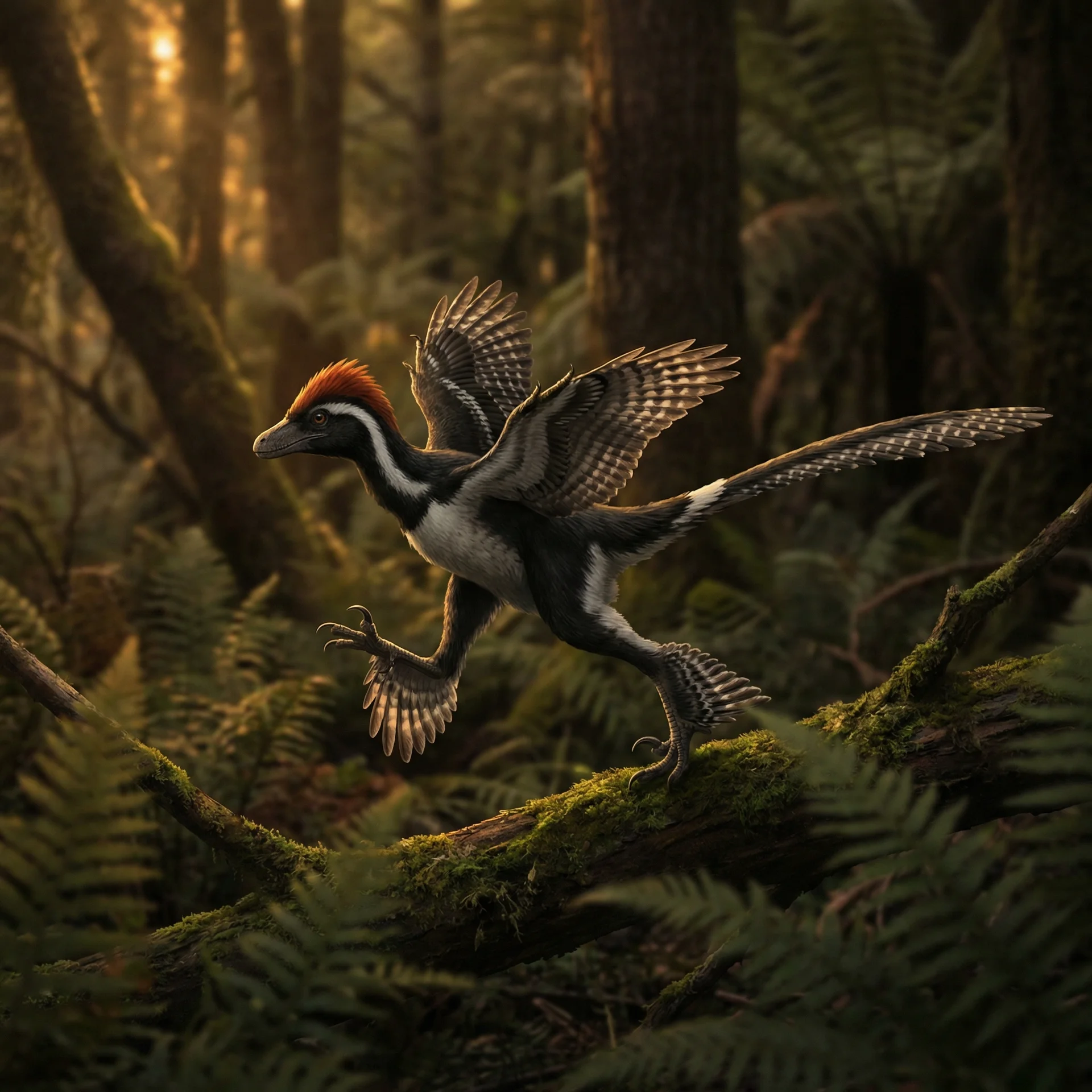
In addition to the forewings, Anchiornis bore long pennaceous feathers on the hindlimbs, qualifying it as a 'four-winged' dinosaur. The hindwings comprised 12–13 feathers anchored to the tibia (lower leg) and 10–11 to the tarsus (upper foot). These hindwing feathers were shorter than those of Microraptor, more symmetrical, and more curved, suggesting that their primary function was display rather than flight (O'Connor & Chang, 2015). The toes were almost entirely covered in short feathers, beneath which small scales were present (Wang et al., 2017).
Saitta et al. (2018) demonstrated that Anchiornis body feathers consisted of short quills from which independent, flexible barbs projected at low angles on two opposing blades, giving each feather an overall forked shape. This produced a much coarser, 'shaggier' plumage texture than that of modern birds, likely affecting thermoregulation and water repellence while reducing aerodynamic efficiency. At the molecular level, Pan et al. (2019) showed that Anchiornis feathers contained both α-keratins and β-keratins, but with α-keratins predominating—in contrast to modern flight feathers, which are dominated by β-keratins. This composition rendered the feathers mechanically weaker than their modern avian counterparts.
No ossified sternum (breastbone) has been identified in Anchiornis, suggesting it was cartilaginous or absent (Zheng et al., 2014). The sternum is the primary attachment site for flight muscles in modern birds, and its underdevelopment strongly implies that powered flapping flight was highly limited or impossible. Dececchi et al. (2016) calculated that while juvenile specimens could potentially have used their wings to assist in running up inclines (wing-assisted incline running, WAIR) or even achieved weak flapping flight at very high wing-stroke angles, adult specimens were simply too heavy relative to their wing area to gain any aerodynamic benefit. Wing-flapping while running would have increased speed by only about 10%, and using the wings during leaps would have boosted height and distance by approximately 15–20%.
In 2025, Kiat et al. examined nine specimens and identified 20–28 primary feathers and three series of primary coverts—markedly different from the 9–11 primaries and two series of primary coverts found in modern volant birds. They further demonstrated that wing feather replacement (moult) in Anchiornis was asymmetrical and irregular, resembling the pattern seen in secondarily flightless birds rather than the sequential moult of modern volant birds and some non-avian pennaraptorans (e.g., Microraptor, confuciusornithiforms). This provides additional evidence that Anchiornis was flightless (Kiat et al., 2025).
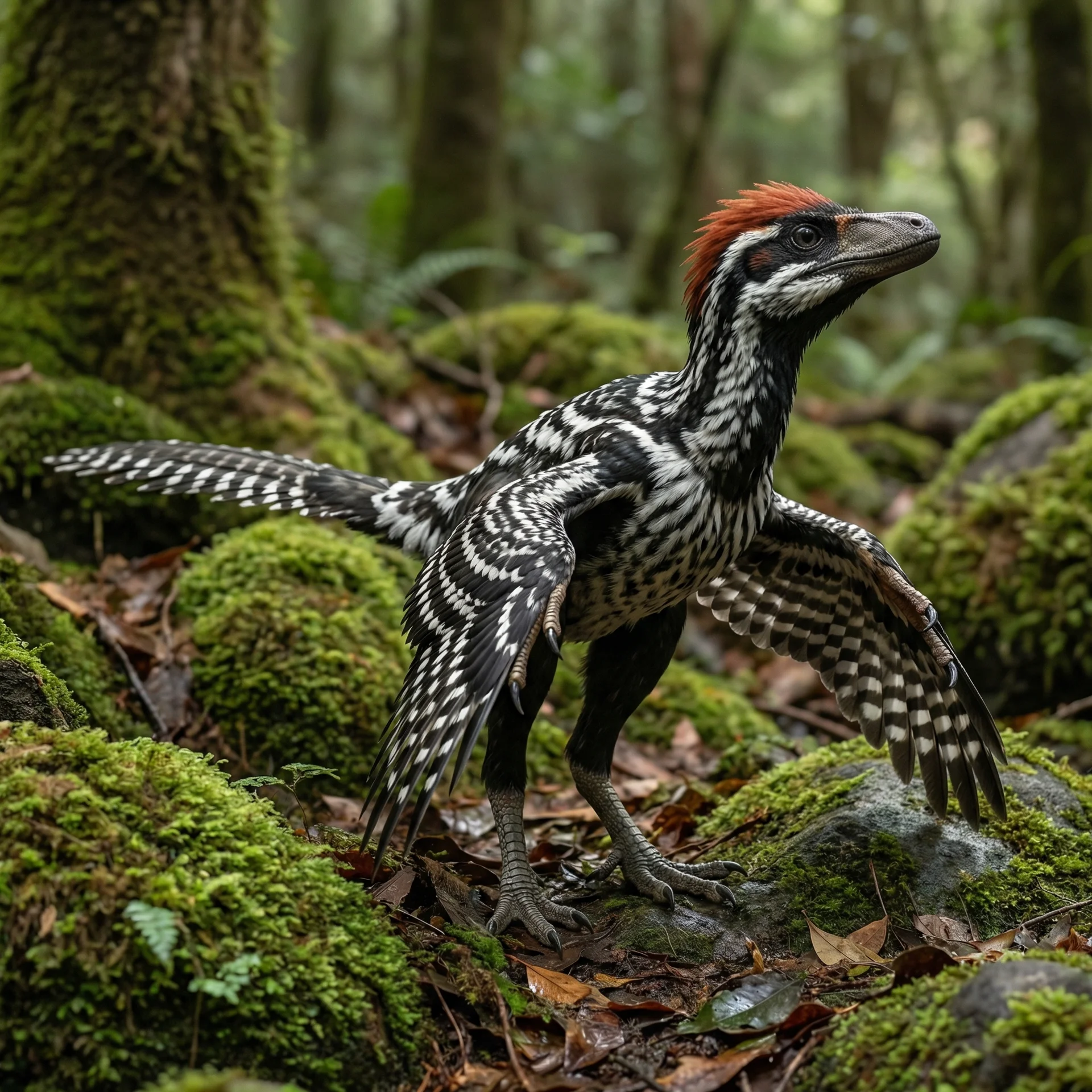
In 2010, Li et al. surveyed the distribution of melanosomes (pigment-bearing organelles) across the feathers of an exceptionally well-preserved specimen (BMNHC PH828) at the Beijing Museum of Natural History. By comparing melanosome morphologies with those of modern birds, they mapped specific colours and patterning across nearly the entire body, making Anchiornis the first Mesozoic dinosaur for which near-complete life coloration was determined (Science, 2010). Key findings: the body plumage was predominantly grey and black; the crown feathers were mainly rufous (reddish-brown) with a grey base and front; the face bore rufous speckles among predominantly black head feathers; the fore- and hindwing feathers were white with black tips; coverts were grey; leg shanks were grey; and the feet and toes were black. This complex, multi-coloured pattern implies that plumage coloration served functions in communication and display.
Lindgren et al. (2015) conducted a similar melanosome survey on a different specimen (YTGP-T5199) at the Yizhou Fossil and Geology Park, but found only grey-black eumelanosomes—no round, rufous-type phaeomelanosomes were detected, even in the crown feathers. Several explanations were proposed for this discrepancy: (1) differences in preservation or analytical technique; (2) ontogenetic colour change (BMNHC PH828 is smaller and potentially younger, with rufous colour replaced during maturation); (3) the possibility that BMNHC PH828 is not Anchiornis but a contemporaneous closely related species; and (4) intra-specific or inter-population colour variation.
Direct evidence of Anchiornis diet comes from gastric pellets. Zheng et al. (2018) surveyed over 230 Anchiornis specimens at the Shandong Tianyu Museum and discovered gastric pellets within or adjacent to the body cavities of several individuals. These pellets contained lightly acid-etched lizard bones and ptycholepid fish scales, demonstrating that Anchiornis expelled indigestible remains through regurgitation in a manner analogous to modern raptorial birds. This represents the oldest known record of avian-style gastric pellet production in a theropod. Taken together, Anchiornis is interpreted as an opportunistic small carnivore that fed on lizards, fish, and possibly other small vertebrates.
The Yanliao Biota in which Anchiornis lived included numerous small paravians—Xiaotingia, Eosinopteryx, Serikornis—that coexisted in the same formation and likely underwent ecological niche partitioning. Eosinopteryx, which lacked flight feathers on its tail and lower legs and possessed straight rear claws, appears to have been better adapted for cursorial (ground-running) habits (Godefroit et al., 2013), whereas Anchiornis, with its more extensive leg plumage and curved claws, may have been better suited for arboreal activity.
Anchiornis hindlimb proportions resemble those of more primitive theropods adapted for fast running, with elongate legs. However, the extensive feathering on the legs may have impeded running speed, suggesting that long legs could represent a vestigial trait from a cursorial ancestor (Hu et al., 2009). Powered flight was impossible or extremely limited in adults (Dececchi et al., 2016; Kiat et al., 2025). Tree-climbing (supported by claw curvature) and short-distance gliding may have served as supplementary locomotor modes.
Anchiornis fossils are known exclusively from northeastern China (Liaoning and Hebei Provinces), all from the Tiaojishan Formation. The holotype locality is the Yaolugou area of Jianchang County, Liaoning, and the major collecting site at Daxishan (Linglongta) has also yielded numerous specimens.
During the Oxfordian, the palaeolatitude of the fossil localities was approximately 43°N and the palaeolongitude approximately 123°E, not substantially different from the present-day position. The climate was subtropical to warm-temperate and humid, in an inland region with active volcanism. The distribution of Anchiornithidae is currently restricted to northeastern China, suggesting this group may have been an endemic clade specialised to the Jurassic lacustrine-volcanic ecosystems of East Asia.
The phylogenetic placement of Anchiornis has shifted repeatedly since its discovery:
| Study | Placement | Notes |
|---|---|---|
| Xu et al. (2009) | Basal Avialae | Original description; based on incomplete holotype |
| Hu et al. (2009) | Troodontidae | Based on more complete second specimen |
| Xu et al. (2011) | Archaeopterygidae | With Xiaotingia |
| Godefroit et al. (2013) | Basal Avialae | With description of Aurornis |
| Lefèvre et al. (2017) | Basal Paraves | With description of Serikornis; outside Troodontidae, Dromaeosauridae, and Avialae |
| Foth & Rauhut (2017) | Anchiornithidae | Formal establishment of the family |
| Cau et al. (2017) | Anchiornithidae | Confirmed in Halszkaraptor description |
In 2017, Foth & Rauhut formally established the family Anchiornithidae during their re-evaluation of the Haarlem Archaeopteryx specimen, grouping Anchiornis with Eosinopteryx, Xiaotingia, Aurornis, Serikornis, and Pedopenna. The family is defined as "all maniraptoran theropods more closely related to Anchiornis huxleyi than to Passer domesticus, Archaeopteryx lithographica, Dromaeosaurus albertensis, Troodon formosus, or Oviraptor philoceratops." Under this framework, Anchiornithidae occupies a position as a basal paravian clade outside Eumaniraptora (the clade containing Dromaeosauridae, Troodontidae, and Avialae).
Aurornis xui (Godefroit et al., 2013), Eosinopteryx brevipenna (Godefroit et al., 2013), and Serikornis sungei (Lefèvre et al., 2017) have all been suggested as potential junior synonyms of Anchiornis. All derive from the same Tiaojishan Formation and are osteologically very similar to Anchiornis, though they differ in plumage structure and certain skeletal details. This issue awaits formal taxonomic revision.
Established: (1) Anchiornis is a small feathered dinosaur from the Late Jurassic (Oxfordian, ~160 Ma) Tiaojishan Formation of northeastern China, placed in Anchiornithidae. (2) It possessed a four-winged morphology with pennaceous feathers on both arms and legs. (3) Melanosome analysis has reconstructed a substantial portion of its plumage coloration. (4) Gastric pellets containing lizard bones and fish scales confirm a small-carnivore diet.
Probable: (1) Adults were incapable of powered flight (supported by wing morphology, absence of ossified sternum, feather structure, and moult pattern). (2) Anchiornithidae represents a basal paravian clade sister to or outside Eumaniraptora, documenting early experimental stages in the evolution toward avian flight. (3) A feathered crest was present on the head.
Hypothetical: (1) Whether the rufous crown coloration reconstructed for BMNHC PH828 is universal to Anchiornis or restricted to certain individuals/species remains unresolved. (2) The synonymy of Aurornis, Eosinopteryx, and Serikornis with Anchiornis is unconfirmed. (3) Whether the hindwings functioned exclusively for display or also provided some aerodynamic advantage remains debated. (4) Whether Anchiornis was primarily arboreal or terrestrial is uncertain.
Anchiornis is frequently introduced in popular media as 'the first dinosaur whose colour was reconstructed', with the 2010 rufous-crested, black-and-white-winged restoration serving as the iconic image. However, this reconstruction is based on a single specimen (BMNHC PH828), and a 2015 study found inconsistent results in a different specimen. Additionally, Anchiornis is sometimes depicted as a 'flying dinosaur', whereas the current scientific consensus is that adults were flightless.
| Taxon | Age | Locality | Estimated length | Wing morphology | Classification |
|---|---|---|---|---|---|
| Anchiornis | Oxfordian (~160 Ma) | China, Liaoning/Hebei | 34–62 cm | Four-winged, symmetrical rounded feathers | Anchiornithidae |
| Xiaotingia | Oxfordian (~160 Ma) | China, Liaoning | ~60 cm | Four-winged | Anchiornithidae |
| Aurornis | Oxfordian (~160 Ma) | China, Liaoning | ~50 cm | Four-winged | Anchiornithidae |
| Eosinopteryx | Oxfordian (~160 Ma) | China, Liaoning | ~30 cm | Reduced hindwings | Anchiornithidae |
| Serikornis | Oxfordian (~160 Ma) | China, Liaoning | ~50 cm | Plumulaceous feathers dominant | Anchiornithidae |
| Microraptor | Aptian (~125 Ma) | China, Liaoning | ~77 cm | Four-winged, asymmetrical feathers | Dromaeosauridae |
| Archaeopteryx | Tithonian (~150 Ma) | Germany, Bavaria | ~50 cm | Two-winged, asymmetrical feathers | Avialae |
All members of Anchiornithidae derive from the Yanliao Biota of the same age and region, predating Archaeopteryx by approximately 10 million years. They display pre-flight feather and wing configurations that contrast with the more advanced four-winged gliding apparatus of Microraptor (~35 million years later) and the flight-adapted plumage of Archaeopteryx.
Anchiornis was the first Mesozoic dinosaur for which nearly the entire plumage coloration was scientifically reconstructed (Li et al., 2010).
The name Anchiornis means 'near bird' in Ancient Greek, and the species name honours Thomas Henry Huxley, who first proposed that birds evolved from dinosaurs.
Gastric pellets found inside Anchiornis specimens contained lizard bones and fish scales, providing the oldest known evidence of avian-style pellet regurgitation in a theropod (Zheng et al., 2018).
The holotype weighed approximately 110 g—lighter than a typical smartphone.
Anchiornis feathers were dominated by α-keratins rather than β-keratins, making them mechanically weaker than modern bird flight feathers (Pan et al., 2019).
The Shandong Tianyu Museum of Nature alone holds over 255 Anchiornis specimens, making it one of the most abundantly represented Mesozoic feathered dinosaurs.
At approximately 160 million years old, Anchiornis predates Archaeopteryx by about 10 million years, making it one of the oldest known feathered dinosaurs.
Laser-stimulated fluorescence imaging in 2017 revealed skin, muscles, foot pads, and finger scales, making Anchiornis the Mesozoic dinosaur with the most accurately known life appearance.
Anchiornis wings contained 20–28 primary feathers—roughly two to three times the 9–11 primaries found in modern flying birds (Kiat et al., 2025).
The toes of Anchiornis were entirely covered in feathers, but small pebble-like scales were hidden beneath the plumage (Wang et al., 2017).
A 2025 study found that Anchiornis moulted irregularly, like secondarily flightless birds, providing additional evidence that it could not fly.
The family Anchiornithidae includes Aurornis, Eosinopteryx, Serikornis, Xiaotingia, and Pedopenna—some of which may actually be the same species as Anchiornis.
Flapping its wings while running would have increased Anchiornis's speed by only about 10%, and using wings during leaps would have boosted height and distance by roughly 15–20% (Dececchi et al., 2016).
The current scientific consensus is that adult Anchiornis was incapable of powered flight. Its wing feathers were symmetrical with rounded tips, it lacked an ossified sternum, and its body mass was too great relative to wing area (Dececchi et al., 2016). A 2025 study by Kiat et al. additionally found that its moult pattern was irregular and asymmetrical, resembling that of secondarily flightless birds rather than volant species. However, juveniles may have been able to use their wings to assist running up inclines, and adults could have gained a modest ~10% increase in running speed and ~15–20% increase in leap height/distance from wing-flapping.
In 2010, Li et al. examined melanosomes—microscopic pigment-bearing organelles—preserved in the feathers of specimen BMNHC PH828 using scanning electron microscopy (SEM). By comparing melanosome shapes with those of modern birds (rod-shaped eumelanosomes correspond to black/grey, round phaeomelanosomes to rufous/reddish-brown), they mapped colours across nearly the entire body. This made Anchiornis the first Mesozoic dinosaur with near-complete plumage coloration determined. A 2015 study on a different specimen, however, found only grey-black melanosomes, sparking debate about the universality of the 2010 reconstruction.
Zheng et al. (2018) discovered gastric pellets within or adjacent to the body cavities of several Anchiornis specimens. These pellets contained acid-etched lizard bones and ptycholepid fish scales, demonstrating that Anchiornis consumed small vertebrates and regurgitated indigestible remains in an avian-like manner. This represents the oldest known record of gastric pellet production in a theropod. Anchiornis is interpreted as an opportunistic small carnivore that fed on lizards, fish, and possibly other small animals.
Anchiornis is called 'four-winged' because it bore long pennaceous feathers not only on its arms (forewings) but also on its legs (hindwings), creating four wing-like surfaces. The forewings had 11 primaries and 10 secondaries, while the hindwings consisted of 12–13 feathers on the tibia and 10–11 on the tarsus. However, the hindwing feathers were symmetrical and probably served primarily for display rather than flight.
Anchiornis appeared approximately 10 million years before Archaeopteryx (~160 Ma vs ~150 Ma) but was less well-adapted for flight. Archaeopteryx had asymmetrical, pointed wing feathers suitable for aerodynamic function, whereas Anchiornis had symmetrical, rounded wing feathers. Anchiornis lacked an ossified sternum, possessed hindwing feathers forming a four-winged configuration, and had 'shaggier' body feathers of a more primitive texture than Archaeopteryx.
Anchiornis was among the smallest known non-avian theropods. The holotype (a subadult) was approximately 34 cm long and weighed about 110 g—between the size of a sparrow and a pigeon. The largest adult specimens reached about 60–62 cm in length and 0.6–1 kg in mass, roughly the size of a crow.
Anchiornis body feathers had short quills with flexible barbs projecting at low angles in a forked shape, producing a much coarser and 'shaggier' texture than modern avian plumage (Saitta et al., 2018). At the molecular level, they were dominated by α-keratins rather than the β-keratins that predominate in modern flight feathers, making them mechanically weaker (Pan et al., 2019). Additionally, the wing coverts were not arranged in orderly tracts but instead covered the wing in multiple overlapping layers—a more primitive configuration than in modern birds.
In 2017, Wang et al. used laser-stimulated fluorescence (LSF), a technique in which high-powered lasers cause trace soft-tissue atoms preserved in the rock matrix to fluoresce, revealing the body outline. This method illuminated skin, muscle tissue, foot pads, finger scales, and other details hidden beneath feathers. The result was the most precisely reconstructed body outline of any Mesozoic dinosaur, earning Anchiornis the distinction of having the most accurately known life appearance among non-avian dinosaurs.
5images