Dromaeosaurus
Cretaceous Period Carnivore Creature Type
Dromaeosaurus albertensis
Scientific Name: "dromeus (runner, Ancient Greek) + sauros (lizard, Ancient Greek) = 'running lizard'; albertensis = referring to the province of Alberta, Canada"
Local Name: Dromaeosaurus
Physical Characteristics
Discovery
Habitat
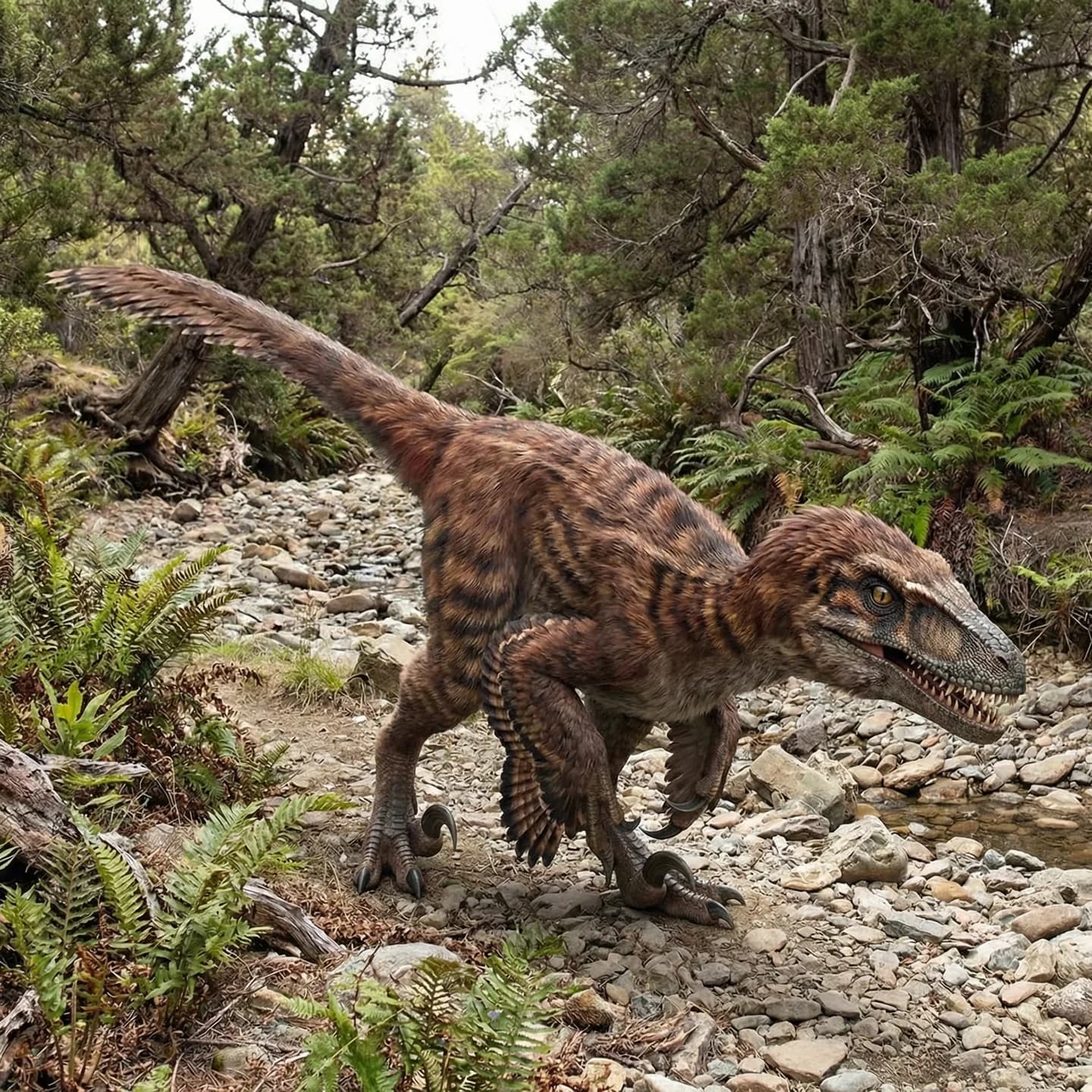
Dromaeosaurus albertensis (Matthew & Brown, 1922) is a dromaeosaurid theropod dinosaur from the Late Cretaceous (Campanian to Maastrichtian, approximately 80–69 Ma) of North America. The generic name derives from the Ancient Greek δρομεύς (dromeus, 'runner') and σαῦρος (sauros, 'lizard'), meaning 'running lizard', while the specific epithet albertensis refers to the Canadian province of Alberta, the principal fossil locality. As the type genus of both Dromaeosauridae and the subfamily Dromaeosaurinae, Dromaeosaurus holds a foundational position in the classification of raptor dinosaurs.
Fossils are primarily known from the Dinosaur Park Formation (approximately 76.5–74.8 Ma) in Alberta, Canada, with additional material reported from the Horseshoe Canyon Formation. The animal measured approximately 2 m in total length, stood about 0.6 m at the hip, and weighed an estimated 15–16 kg (Brown et al., 2013; Flaig et al., 2018), placing it among the smaller members of Dromaeosauridae. Despite its modest size, Dromaeosaurus was more heavily built than other dromaeosaurids of comparable dimensions, most notably possessing a short, deep skull and remarkably powerful jaws. Therrien et al. (2005) estimated its bite force at approximately three times that of Velociraptor, suggesting that Dromaeosaurus relied more on its jaws than on its sickle claw for dispatching prey.
The holotype fossil was discovered by Barnum Brown in 1914 along the Red Deer River in Alberta and formally described in 1922 by William Diller Matthew and Brown. However, the actual fossil material is extremely limited: a partial skull, mandible, a few hand and foot bones, and approximately 30 isolated teeth comprise the entirety of known specimens (Currie, 1995). The complete mounted skeletons seen in museums worldwide are composite reconstructions based on better-known relatives such as Deinonychus and Velociraptor.
Overview
Name and Etymology
The name Dromaeosaurus is a compound of the Ancient Greek δρομεύς (dromeus, 'runner' or 'racer') and σαῦρος (sauros, 'lizard'), translating to 'running lizard' (Matthew & Brown, 1922). This name reflects the presumed agility of the animal. The specific epithet albertensis references the province of Alberta, Canada, where the holotype specimen was collected.
Taxonomic Status and Validity
Dromaeosaurus albertensis is currently recognized as the sole valid species in its genus. Seven additional species were historically assigned to Dromaeosaurus (D. laevifrons, D. cristatus, D. gracilis, D. explanatus, D. minutus, D. falculus, and D. mongoliensis), but all have been either reclassified into other genera or treated as nomina dubia based on their fragmentary nature (Currie, 1995). The genus Chirostenotes was once considered synonymous with Dromaeosaurus (Glut, 2013) but is now recognized as a separate oviraptorosaur.
Summary
Dromaeosaurus is the type genus of Dromaeosauridae, characterized by a short, robust skull and the strongest bite force among studied dromaeosaurids—a small but formidable predator of Late Cretaceous North America.
Temporal Range, Stratigraphy, and Depositional Environment
Temporal Range and Evidence
The confirmed fossil record of Dromaeosaurus centers on the Dinosaur Park Formation, which dates to the Campanian (approximately 76.5–74.8 Ma; Eberth, 2005; Currie, 1995). Additional material from the Horseshoe Canyon Formation extends the range into the latest Campanian to early Maastrichtian.
Isolated teeth from the late Maastrichtian Hell Creek and Lance Formations (approximately 66 Ma) were historically referred to Dromaeosaurus, but Evans et al. (2013) demonstrated that most, if not all, of these teeth likely belong to the newly described Acheroraptor temertyorum. This reinterpretation significantly weakens the evidence that Dromaeosaurus persisted until the end-Cretaceous mass extinction, and the confirmed range is restricted to approximately 80–69 Ma.
Formations and Lithology
| Formation | Location | Lithology | Age | Material |
|---|---|---|---|---|
| Dinosaur Park Formation | Alberta, Canada | Sandstone, mudstone, siltstone | Campanian (76.5–74.8 Ma) | Skull, mandible, hand/foot bones, teeth |
| Horseshoe Canyon Formation | Alberta, Canada | Sandstone, shale | Campanian–Maastrichtian | Skull fragments, teeth |
| Aguja Formation | Texas, USA | Sandstone, shale | Campanian | Teeth (generic assignment uncertain) |
| Hell Creek Formation | Montana, USA | Claystone, mudstone, sandstone | Maastrichtian (66 Ma) | Teeth (likely Acheroraptor) |
| Lance Formation | Wyoming, USA | Sandstone, shale | Maastrichtian | Teeth (likely Acheroraptor) |
Paleoenvironment
The Dinosaur Park Formation was deposited in an alluvial to coastal plain setting (Eberth, 2005). The sedimentary record indicates a low-gradient, highly sinuous meandering river system with well-developed point bars, counter-point bars, abandoned channels, and floodplain paleosols. The formation is sandwiched between the terrestrial Oldman Formation below and the marine Bearpaw Formation above, with increasing marine influence toward the top. The climate was warm and subtropical, with wetlands and forests coexisting across the coastal lowlands.
Specimens and Diagnosis
Holotype and Key Specimens
The holotype, AMNH 5356, is housed at the American Museum of Natural History in New York. It was discovered by Barnum Brown in 1914 at 'Sand Creek' along the Red Deer River in what is now Dinosaur Provincial Park, Alberta, and formally described by Matthew and Brown in 1922. The specimen comprises a partial skull approximately 24 cm in length (with most of the upper snout missing), a mandible, two hyoids, a first metacarpal, and several foot bones.
| Specimen | Institution | Elements | Notes |
|---|---|---|---|
| AMNH 5356 | American Museum of Natural History | Holotype: partial skull, mandible, hyoids, foot bones | Matthew & Brown, 1922 original description |
| TMP specimens | Royal Tyrrell Museum | Skull fragments, teeth | Additional Alberta material |
| Various Alberta/Montana | Multiple institutions | Isolated teeth (30), bone fragments | Currie, 1995 |
Dromaeosaurus was among the first small theropods described with reasonably good cranial material (Currie, 1995), yet its actual fossil record remains exceedingly poor. The complete mounted skeleton casts seen in museums were produced by the Royal Tyrrell Museum using anatomical knowledge gained from more recently discovered dromaeosaurids.
Diagnosis
According to Currie's (1995) redescription, Dromaeosaurus is distinguished from other dromaeosaurids by the following combination of features: a short, robust skull with a deep snout; only 9 teeth in each maxilla (relatively few); large, curved teeth with thick enamel coating (Hwang, 2011); heavier tooth wear than in Saurornitholestes, suggesting crushing rather than simple slicing; a unique vascular structure at the back of the skull where the vena capitis dorsalis drains through two long canals to the posterior brain surface (Larsson, 2001); and a relatively shallow Meckelian groove on the dentary (Senter, 2007).
Limitations of the Fossil Record
The holotype skull is missing most of the upper snout. The iconic sickle claw of the second pedal digit—the hallmark of Dromaeosauridae—has never been directly preserved in Dromaeosaurus. Axial vertebrae, the pelvis, and complete limb bones are likewise unknown, meaning that whole-body proportional reconstructions carry substantial uncertainty (Currie, 1995).
Morphology and Functional Anatomy
Body Size
Dromaeosaurus measured approximately 2 m in total length, with a hip height of about 0.6 m and an estimated body mass of 15–16 kg (Brown et al., 2013; Flaig et al., 2018). Some sources cite up to 2.3 m in length and 34 kg in mass (GBIF), but these figures likely represent broader uncertainty ranges rather than well-constrained estimates. Compared to other dromaeosaurids of similar size, such as Velociraptor, Dromaeosaurus was more heavily built.
Skull and Dentition
The skull of Dromaeosaurus is characteristically short, robust, and deep-snouted. Tse et al. (2024) demonstrated through geometric morphometric analysis that this robust morphology represents a derived condition within Dromaeosauridae: the gracile rostrum seen in Velociraptor is closer to the ancestral deinonychosaurian condition, whereas the robust rostra of Dromaeosaurus and Deinonychus are independently or jointly derived.
The maxilla bore only 9 teeth—fewer than in most other dromaeosaurids (Currie, 1995). The teeth were large, curved, and coated with thick enamel (Hwang, 2011).
Bite Force Analysis
Therrien et al. (2005) applied beam theory to model mandibular biomechanics and estimated that Dromaeosaurus had a bite force approximately three times that of Velociraptor. Specifically, the dorsoventral bending strength (Zx/L) at the middentary was 0.0442 for Dromaeosaurus, compared with 0.0128 for Velociraptor, 0.0190 for Saurornitholestes, and 0.0251 for Deinonychus (Therrien et al., 2005; Yun, 2024).
Tse et al. (2024) corroborated these findings through finite element analysis (FEA) and mechanical advantage (MA) calculations. Dromaeosaurus exhibited the highest temporal muscle group MA (0.306) of all examined dromaeosaurids, and its mesh-weighted arithmetic mean (MWAM) strain of 399 με was the second lowest (after Velociraptor at 360 με), indicating high structural resistance of the skull to bite-induced forces.
These results collectively suggest that Dromaeosaurus relied more heavily on its jaws than on its sickle claw for prey processing (Therrien et al., 2005).
Sickle Claw
Like all other dromaeosaurids, Dromaeosaurus is inferred to have possessed a hyperextensible sickle-shaped claw on the second pedal digit. However, this feature has not been directly preserved in any known Dromaeosaurus specimen; its presence is inferred from the phylogenetic bracket, as the sickle claw is universally present in all other Dromaeosauridae.
Feather Restoration
Dromaeosauridae is established as a feathered dinosaur clade. Direct feather preservation is known from Microraptor and Sinornithosaurus, while quill knobs (feather attachment points on the ulna) have been documented in Velociraptor. Dromaeosaurus is therefore very likely to have been feathered, although no direct integumentary evidence has been found for this species.
Diet and Ecology
Feeding Behavior
Dromaeosaurus was a carnivore whose feeding behavior can be inferred from tooth microwear analysis and cranial morphology. Torices et al. (2018, published in Current Biology) demonstrated that coelurosaurian theropods, including Dromaeosaurus, universally employed a "puncture-and-pull" feeding mechanism. Their tooth surfaces exhibited only scratches and no pits, consistent with processing tough but soft food items.
The same study found that both Dromaeosaurus and Saurornitholestes showed microwear patterns indicating adaptation for handling struggling prey and incorporating bone into their diet. In contrast, troodontids with weaker jaws likely preyed on softer items such as invertebrates and carrion (Torices et al., 2018). This dietary partitioning is interpreted as a key mechanism enabling multiple maniraptoran taxa to coexist in the same ecosystem.
Diel Activity
Choiniere et al. (2021) identified Dromaeosaurus as a diurnal predator, alongside Alioramus (Tyrannosauroidea). This contrasts with the nocturnal Shuvuuia (Alvarezsauridae), which possessed enlarged eyes and exceptional hearing adapted for night hunting.
Contemporaneous Fauna
The Dinosaur Park Formation preserves a diverse fauna alongside Dromaeosaurus. Large predators included Gorgosaurus and Daspletosaurus (Tyrannosauridae), while small-to-medium theropods included Saurornitholestes, Hesperonychus (Dromaeosauridae), troodontids, and Chirostenotes (Oviraptorosauria). Herbivores comprised Centrosaurus, Styracosaurus, Chasmosaurus (Ceratopsidae), Corythosaurus, Parasaurolophus, Lambeosaurus (Hadrosauridae), and Euoplocephalus (Ankylosauridae), among others. Non-dinosaurian fauna included fish, turtles, crocodilians, and pterosaurs.
Currie (1995) noted that Dromaeosaurus was rarer in its ecosystem than other small theropods such as Saurornitholestes.
Distribution and Paleogeography
Geographic Distribution
Confirmed Dromaeosaurus albertensis material is restricted to Alberta, Canada (Dinosaur Park and Horseshoe Canyon Formations). Teeth reported from the Aguja Formation in Texas are of uncertain generic assignment.
Isolated teeth previously referred to Dromaeosaurus from Montana (Hell Creek Formation) and Wyoming (Lance Formation) have been reinterpreted as most likely belonging to Acheroraptor temertyorum (Evans et al., 2013). Teeth attributed to Dromaeosaurus from the Prince Creek Formation of Alaska also remain unconfirmed.
Paleolatitude and Paleogeography
PBDB data and paleomagnetic reconstructions place the Dinosaur Park Formation locality at approximately 57–58°N paleolatitude and -59°W paleolongitude during the Campanian. Western North America was bisected by the Western Interior Seaway at this time, and Dromaeosaurus inhabited the western landmass of Laramidia.
Phylogeny and Taxonomic Debates
Dromaeosauridae and Dromaeosaurinae
Dromaeosaurus is the type genus of both Dromaeosauridae and the subfamily Dromaeosaurinae. Matthew & Brown (1922) originally placed the genus within their "Deinodontidae" (now Tyrannosauridae), but in 1969 Ostrom recognized shared derived characters with Velociraptor and the newly described Deinonychus, establishing Dromaeosauridae as a separate family (Ostrom, 1969).
Turner et al. (2012) supported the monophyly of Dromaeosauridae in a large-scale phylogenetic analysis. In Senter et al. (2012), Dromaeosaurus was recovered in a clade with Utahraptor, Achillobator, and Yurgovuchia within Dromaeosaurinae.
Relationship with Dakotaraptor
DePalma et al. (2015) recovered the large Hell Creek dromaeosaurid Dakotaraptor steini (approximately 5–6 m in length) as the sister taxon of Dromaeosaurus. However, subsequent analyses have not consistently supported this close relationship, and the precise phylogenetic position of Dakotaraptor remains debated.
Functional Convergence with Deinonychus
Tse et al. (2024) found that Dromaeosaurus and Deinonychus antirrhopus shared high bite force capabilities and similar skull strain distribution patterns, grouping together as a functional cluster. Both taxa exhibited elevated tensile strain at the posterior end of the skull during biting—a pattern distinct from that of velociraptorines (Linheraptor, Tsaagan, Velociraptor).
Reconstruction and Uncertainty
Confirmed, Probable, and Hypothetical
Confirmed: type genus of Dromaeosauridae; Late Cretaceous Campanian occurrence in Alberta, Canada; short, robust skull with deep snout; 9 maxillary teeth; strongest relative bite force among studied dromaeosaurids (Therrien et al., 2005; Yun, 2024).
Probable: possession of a sickle claw on pedal digit II (phylogenetic bracket across Dromaeosauridae); feathered integument (direct evidence from close relatives); greater reliance on jaws than sickle claw for prey processing.
Hypothetical: survival into the late Maastrichtian (66 Ma), substantially weakened by Evans et al. (2013); sister-taxon relationship with Dakotaraptor; precise body proportions (limb ratios, tail length).
Limitations of Museum Reconstructions
The complete mounted Dromaeosaurus skeletons displayed in museums worldwide are composite casts, not actual fossils. The holotype preserves only a partial skull, mandible, and a few hand/foot bones. The Royal Tyrrell Museum produced these casts using anatomical information from better-known dromaeosaurids such as Deinonychus and Velociraptor. Consequently, many details—including sickle claw size, limb proportions, and tail length—are reconstructed rather than directly observed.
Comparison with Related and Contemporaneous Taxa
| Taxon | Age | Region | Length | Key Features |
|---|---|---|---|---|
| Dromaeosaurus albertensis | 80–69 Ma | Canada/USA | 2 m | Robust skull, strongest bite force |
| Saurornitholestes langstoni | 77–74 Ma | Alberta, Canada | 1.8 m | Contemporaneous competitor, lighter skull |
| Velociraptor mongoliensis | 75–71 Ma | Mongolia/China | 2 m | Gracile snout, quill knobs confirmed |
| Deinonychus antirrhopus | 115–108 Ma | USA | 3.3–3.4 m | Larger, similar bite force pattern |
| Acheroraptor temertyorum | 66 Ma | Montana, USA | 2–3 m | Hell Creek Fm., weaker bite force |
| Dakotaraptor steini | 66 Ma | Montana, USA | ~5–6 m | Giant, potential sister taxon |
Fun Facts
FAQ
📚References
- Matthew, W. D., & Brown, B. (1922). The family Deinodontidae, with notice of a new genus from the Cretaceous of Alberta. Bulletin of the American Museum of Natural History, 46, 367–385. http://hdl.handle.net/2246/1300
- Currie, P. J. (1995). New information on the anatomy and relationships of Dromaeosaurus albertensis (Dinosauria: Theropoda). Journal of Vertebrate Paleontology, 15(3), 576–591. https://doi.org/10.1080/02724634.1995.10011250
- Colbert, E. H., & Russell, D. A. (1969). The small Cretaceous dinosaur Dromaeosaurus. American Museum Novitates, 2380, 1–49. http://hdl.handle.net/2246/2590
- Ostrom, J. H. (1969). Osteology of Deinonychus antirrhopus, an unusual theropod from the Lower Cretaceous of Montana. Peabody Museum of Natural History Bulletin, 30, 1–165.
- Therrien, F., Henderson, D. M., & Ruff, C. B. (2005). Bite Me: Biomechanical models of theropod mandibles and implications for feeding. In K. Carpenter (Ed.), The Carnivorous Dinosaurs (pp. 179–237). Indiana University Press.
- Turner, A. H., Makovicky, P. J., & Norell, M. A. (2012). A review of dromaeosaurid systematics and paravian phylogeny. Bulletin of the American Museum of Natural History, 371, 1–206. https://doi.org/10.1206/748.1
- Senter, P., Kirkland, J. I., Deblieux, D. D., Madsen, S., & Toth, N. (2012). New Dromaeosaurids (Dinosauria: Theropoda) from the Lower Cretaceous of Utah, and the Evolution of the Dromaeosaurid Tail. PLoS ONE, 7(5), e36790. https://doi.org/10.1371/journal.pone.0036790
- DePalma, R. A., Burnham, D. A., Martin, L. D., Larson, P. L., & Bakker, R. T. (2015). The first giant raptor (Theropoda: Dromaeosauridae) from the Hell Creek Formation. Paleontological Contributions, 14, 1–16. https://doi.org/10.17161/paleo.1808.18764
- Torices, A., Currie, P. J., Canudo, J. I., & Pereda-Suberbiola, X. (2018). Puncture-and-Pull Biomechanics in the Teeth of Predatory Coelurosaurian Dinosaurs. Current Biology, 28(9), 1467–1474.e2. https://doi.org/10.1016/j.cub.2018.03.042
- Choiniere, J. N., Neenan, J. M., Schmitz, L., Ford, D. P., Chapelle, K. E. J., Balanoff, A. M., ... & Benson, R. B. J. (2021). Evolution of vision and hearing modalities in theropod dinosaurs. Science, 372(6542), 610–613. https://doi.org/10.1126/science.abe7941
- Brown, C. M., Evans, D. C., Campione, N. E., O'Brien, L. J., & Eberth, D. A. (2013). Evidence for taphonomic size bias in the Dinosaur Park Formation (Campanian, Alberta), a model Mesozoic terrestrial alluvial-paralic system. Palaeogeography, Palaeoclimatology, Palaeoecology, 372, 108–122.
- Flaig, P. P., Hasiotis, S. T., & Fiorillo, A. R. (2018). A paleopolar dinosaur track site in the Cretaceous (Maastrichtian) Prince Creek Formation of Arctic Alaska: Track characteristics and probable trackmakers. Ichnos, 25(2–3), 208–220.
- Tse, Y. T., Miller, C. V., & Pittman, M. (2024). Morphological disparity and structural performance of the dromaeosaurid skull informs ecology and evolutionary history. BMC Ecology and Evolution, 24(1), 37. https://doi.org/10.1186/s12862-024-02222-5
- Yun, C.-G. (2024). Mandibular biomechanics of Acheroraptor temertyorum (Theropoda: Dromaeosauridae) with implications for the feeding ecology and behaviour. Mesozoic, 1(4), 459–468. https://doi.org/10.11646/mesozoic.1.4.3
- Evans, D. C., Larson, D. W., & Currie, P. J. (2013). A new dromaeosaurid (Dinosauria: Theropoda) with Asian affinities from the latest Cretaceous of North America. Naturwissenschaften, 100, 1041–1049. https://doi.org/10.1007/s00114-013-1107-5
- Eberth, D. A. (2005). The geology. In P. J. Currie & E. B. Koppelhus (Eds.), Dinosaur Provincial Park: A Spectacular Ancient Ecosystem Revealed (pp. 54–82). Indiana University Press.
- Hwang, S. H. (2011). The evolution of dinosaur tooth enamel microstructure. Biological Reviews, 86(1), 183–216. https://doi.org/10.1111/j.1469-185X.2010.00142.x
- Senter, P. (2007). A new look at the phylogeny of Coelurosauria (Dinosauria: Theropoda). Journal of Systematic Palaeontology, 5(4), 429–463. https://doi.org/10.1017/S1477201907002143
- Larsson, H. C. E. (2001). Endocranial anatomy of Carcharodontosaurus saharicus (Theropoda: Allosauroidea) and its implications for theropod brain evolution. In D. H. Tanke, K. Carpenter, & M. W. Skrepnick (Eds.), Mesozoic Vertebrate Life (pp. 19–33). Indiana University Press.
- Paul, G. S. (1988). Predatory Dinosaurs of the World. Simon & Schuster, New York.
- Weishampel, D. B., Dodson, P., & Osmólska, H. (Eds.). (2004). The Dinosauria (2nd ed.). University of California Press.
- Wilson, L. E. (2008). Comparative taphonomy and paleoecological reconstruction of two microvertebrate accumulations from the Late Cretaceous Hell Creek Formation (Maastrichtian), Eastern Montana. PALAIOS, 23(5), 289–297. https://doi.org/10.2110/palo.2007.p07-006r
Gallery
5 images Dromaeosaurus
Dromaeosaurus · Cretaceous Period · Carnivore
 Dromaeosaurus
Dromaeosaurus · Cretaceous Period · Carnivore
 Dromaeosaurus
Dromaeosaurus · Cretaceous Period · Carnivore
 Dromaeosaurus
Dromaeosaurus · Cretaceous Period · Carnivore
 Dromaeosaurus
Dromaeosaurus · Cretaceous Period · Carnivore
🔗Related Creatures

Carcharodontosaurus
Carcharodontosaurus saharicus

Nanotyrannus
Nanotyrannus lancensis
Gorgosaurus
Gorgosaurus libratus
Sinosauropteryx
Sinosauropteryx prima
Abelisaurus
Abelisaurus comahuensis

Giganotosaurus
Giganotosaurus carolinii
Concavenator
Concavenator corcovatus

Deinonychus
Deinonychus antirrhopus