Gorgosaurus
Cretaceous Period Carnivore Creature Type
Gorgosaurus libratus
Scientific Name: "Gorgosaurus (Greek gorgos 'fierce/terrible/dreadful' + sauros 'lizard') + libratus (Latin 'balanced')"
Local Name: Gorgosaurus
Physical Characteristics
Discovery
Habitat
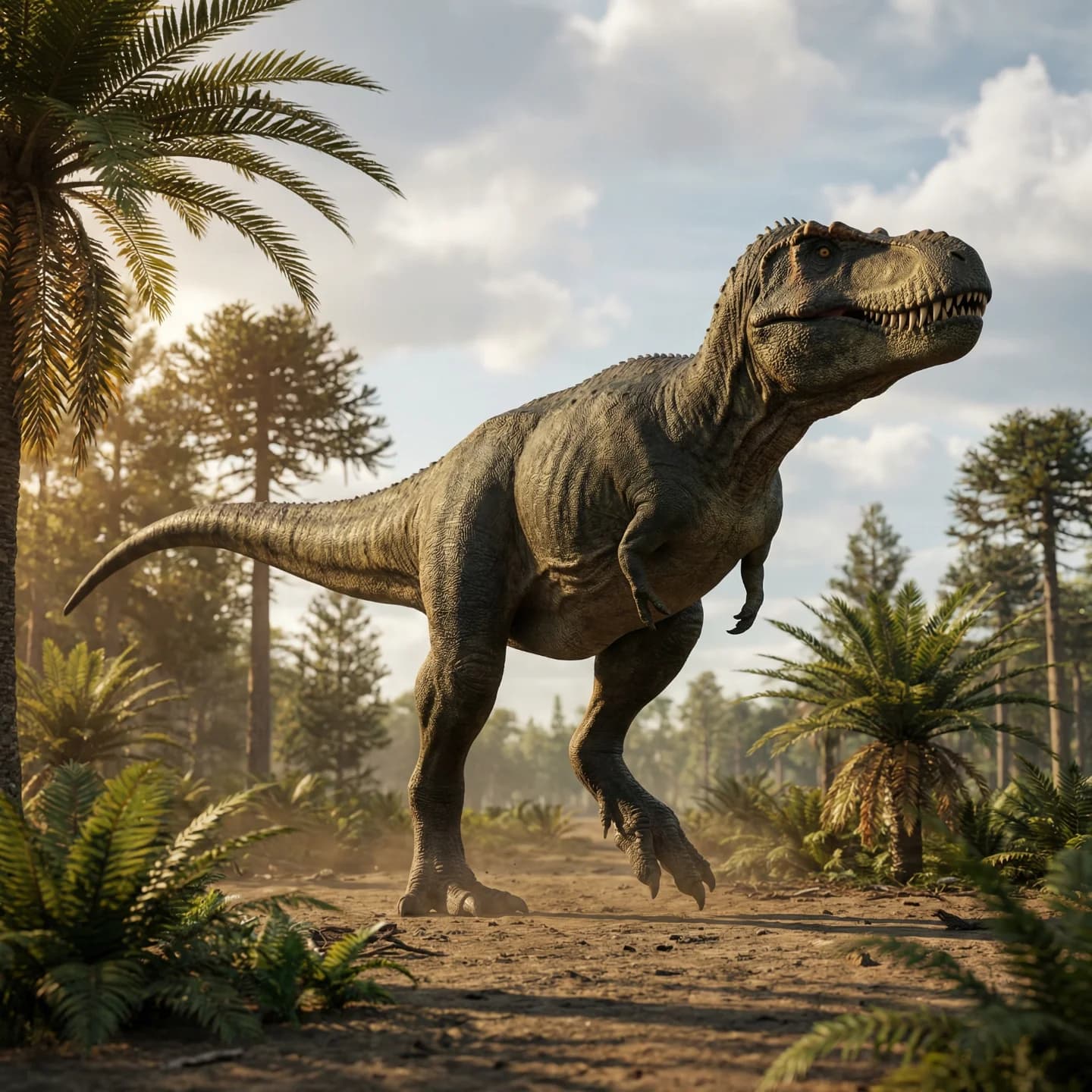
Gorgosaurus libratus (Lambe, 1914) is a large theropod dinosaur from the Late Cretaceous Campanian stage, approximately 76.5–75 million years ago, that inhabited western North America. It belongs to the subfamily Albertosaurinae within the family Tyrannosauridae, and G. libratus remains the only valid species currently assigned to the genus. Fossils are primarily known from the Dinosaur Park Formation of Alberta, Canada, with additional material reported from the Judith River Formation and Two Medicine Formation of Montana, USA.
Adults reached approximately 8–9 m in total length and an estimated body mass of 2–3 metric tons (Seebacher, 2001; Campione et al., 2014). Although smaller than Tyrannosaurus rex or Tarbosaurus bataar, Gorgosaurus was comparable in size to Albertosaurus sarcophagus and ranked among the apex predators of the Laramidian landmass during the middle Campanian. The genus is exceptionally well represented in the fossil record — it is the best-represented tyrannosaurid known, with dozens of specimens spanning a nearly complete growth series from small juveniles to large adults (Currie, 2003; Holtz, 2004).
Of particular significance, a juvenile specimen (TMP 2009.12.14) reported in 2023 preserves in situ stomach contents consisting of the hindlimbs of two yearling caenagnathids (Citipes), providing the first direct dietary evidence for an ontogenetic dietary shift in tyrannosaurids (Therrien et al., 2023). Additionally, the subadult specimen TMP 1991.036.500 was recognized by Guinness World Records in 2022 as the most complete tyrannosaurid skeleton ever found, at approximately 93% completeness (98% by volume).
Overview
Name and Etymology
The genus name Gorgosaurus is derived from the Greek γοργός (gorgos, 'fierce', 'terrible', or 'dreadful') and σαῦρος (sauros, 'lizard'), meaning 'fierce lizard' or 'dreadful lizard' (Liddell & Scott, 1980). The specific epithet libratus is the past participle of the Latin verb librare ('to balance'), meaning 'balanced'. The genus and species were erected in 1914 by Canadian paleontologist Lawrence M. Lambe, based on a nearly complete skeleton (NMC 2120) recovered from the Dinosaur Park Formation along the Red Deer River in Alberta (Lambe, 1914a; 1914b).
Taxonomic Status
Gorgosaurus is classified within the Albertosaurinae, a subfamily of Tyrannosauridae. Together with Albertosaurus sarcophagus, it constitutes one of two definitively described albertosaurine genera, as opposed to the Tyrannosaurinae, which includes Daspletosaurus, Tarbosaurus, and Tyrannosaurus (Currie et al., 2003; Loewen et al., 2013). Albertosaurines are distinguished from tyrannosaurines by their relatively lighter builds, proportionally longer and lower skulls, and longer tibiae and metatarsals (Currie, 2003; Holtz, 2004).
The taxonomic relationship between Gorgosaurus and Albertosaurus has been debated for over a century. The two genera are distinguished primarily by subtle differences in teeth and cranial bones, leading some workers to regard Gorgosaurus as a junior synonym of Albertosaurus. In 1970, Dale Russell formally reassigned G. libratus to Albertosaurus libratus, and several subsequent authors followed this arrangement (Russell, 1970; Paul, 1988). However, Philip J. Currie (2003) argued that the anatomical differences between the two genera — particularly in the shapes of bones surrounding the braincase — are as great as those between Daspletosaurus and Tyrannosaurus, which are almost always maintained as separate genera. The current majority view treats the two as distinct genera, separated by approximately 6 million years (Gorgosaurus: ~76–75 Ma; Albertosaurus: ~70 Ma).
Key Summary
Gorgosaurus was a flagship apex predator of the middle Campanian Laramidian ecosystems, and its abundant fossil record makes it one of the most important taxa for studying tyrannosaurid ontogeny, growth dynamics, feeding ecology, and brain development.
Temporal Range, Stratigraphy, and Depositional Environment
Temporal Range
Gorgosaurus lived during the middle Campanian stage of the Late Cretaceous. The Dinosaur Park Formation is dated to approximately 76.5–74.8 Ma (Gardner et al., 2015), and G. libratus fossils occur specifically in the lower to middle portions of the formation, constraining its temporal range to approximately 76.6–75.1 Ma.
Formation and Lithology
The primary fossil-bearing unit is the Dinosaur Park Formation, the uppermost formation of the Belly River Group in southern Alberta. At Dinosaur Provincial Park, the formation is approximately 70–80 m thick, composed of fine- to medium-grained sandstones (channel deposits), siltstones, and mudstones (floodplain deposits). The lower portion is dominated by fluvial sediments, while the upper portion shows increasing marine influence from the encroaching Bearpaw Sea.
Specimens tentatively referred to Gorgosaurus have also been recovered from the Judith River Formation and Two Medicine Formation of Montana, but whether these belong to G. libratus or represent a distinct species remains uncertain (Currie, 2003).
Paleoenvironment
During the Campanian, the region lay along the western coastal margin of the Western Interior Seaway, which divided North America into the western Laramidia and eastern Appalachia landmasses. Rivers draining the rising Rocky Mountains (Laramide Orogeny) deposited sediment across vast floodplains. The climate was subtropical with pronounced seasonality, and periodic droughts sometimes caused mass mortality events among dinosaur herds, preserved as bonebeds in the formation. Conifers formed the forest canopy, while the understory comprised ferns, tree ferns, and angiosperms (Eberth, 2005).
Around 73 Ma, the Bearpaw transgression caused a major sea-level rise that drowned the Dinosaur Park ecosystem, recorded by the overlying marine sediments of the Bearpaw Shale.
| Category | Details |
|---|---|
| Formation | Dinosaur Park Formation (uppermost Belly River Group) |
| Age | Late Cretaceous, middle Campanian, ca. 76.5–74.8 Ma (fossils: 76.6–75.1 Ma) |
| Lithology | Fine- to medium-grained sandstone, siltstone, mudstone |
| Depositional setting | Coastal floodplain, low-gradient meandering river system |
| Climate | Subtropical, marked seasonality |
Specimens and Diagnostic Features
Holotype and Key Specimens
The holotype (NMC 2120, now CMN 2120) is a nearly complete skeleton with an associated skull, collected in 1913 by Charles M. Sternberg from the Dinosaur Park Formation. This specimen was the first tyrannosaurid ever found with a complete hand, confirming that tyrannosaurids possessed only two functional digits on the forelimb. It is housed at the Canadian Museum of Nature in Ottawa (Lambe, 1914a).
In 1923, Matthew and Brown described four additional complete G. libratus skulls (three with associated skeletons) collected by the American Museum of Natural History from along the Red Deer River. They also named a smaller specimen (AMNH 5664) as the holotype of a new species, G. sternbergi, but this is now regarded as a juvenile G. libratus (Carr, 1999; Holtz, 2004).
Dozens of subsequent specimens have been recovered, making G. libratus the best-represented tyrannosaurid in the fossil record. Notable specimens include:
| Specimen | Type | Key Features | Notes |
|---|---|---|---|
| NMC (CMN) 2120 | Holotype | Nearly complete skeleton + skull | First tyrannosaurid with complete hand |
| TMP 1991.036.500 | Subadult | 93% complete (98% by volume) | 2022 Guinness World Record: most complete tyrannosaurid skeleton |
| TMP 2009.12.14 | Juvenile (5–7 years old) | Preserved stomach contents (two Citipes juveniles) | Reported in 2023, Science Advances |
| AMNH 5664 | Juvenile | Originally named G. sternbergi holotype | Reclassified as juvenile G. libratus |
| TCMI 2001.89.1 | Adult (Montana) | Multiple pathologies (fractures, osteomyelitis, possible brain tumor) | Children's Museum of Indianapolis |
Diagnostic Features
Gorgosaurus libratus is diagnosed by the following autapomorphies (Currie, 2003):
First, the first maxillary tooth is incisiform, matching the shape and size of the premaxillary teeth. This feature is unique among tyrannosaurids. Second, the palatine bears a slot-like articular surface for articulation with the pterygoid. Third, there are differences in the shapes of bones surrounding the braincase that distinguish Gorgosaurus from Albertosaurus.
Shared albertosaurine features include proportionally longer and lower skulls compared to tyrannosaurines, roughly circular orbits (rather than oval or keyhole-shaped), and a tall crest on the lacrimal bone anterior to each orbit (Holtz, 2004).
Specimen Limitations
Whether the Montana specimens belong to G. libratus or represent a separate species remains unresolved (Currie, 2003). Several species were historically misassigned to Gorgosaurus:
| Original Name | Current Status | Notes |
|---|---|---|
| Gorgosaurus lancensis (Gilmore, 1946) | Nanotyrannus or juvenile T. rex | Hell Creek Formation, late Maastrichtian |
| Gorgosaurus lancinator (Maleev, 1955) | Juvenile Tarbosaurus bataar | Nemegt Formation, Mongolia |
| Gorgosaurus novojilovi (Maleev, 1955) | Juvenile Tarbosaurus bataar | Nemegt Formation, Mongolia |
| Gorgosaurus sternbergi (Matthew & Brown, 1923) | Juvenile G. libratus | AMNH 5664 |
Morphology and Functional Anatomy
Body Size
Gorgosaurus was smaller than Tyrannosaurus or Tarbosaurus, comparable in size to Albertosaurus. Adults reached 8–9 m in total length from snout to tail (Russell, 1970; Paul, 2016), with an estimated body mass of 2–3 metric tons (Seebacher, 2001; Campione et al., 2014). The largest known skull measures 99 cm in length, slightly smaller than that of Daspletosaurus (Russell, 1970). Hip height is estimated at approximately 3 m. The largest known femur measures 105 cm in length (Russell, 1970).
Skull and Dentition
The skull was large relative to body size, but pneumatic chambers within the skull bones and large fenestrae reduced its weight. The snout was blunt, and the nasals and parietals were fused along the midline, as in all other tyrannosaurids. Gorgosaurus and Albertosaurus share proportionally longer and lower skulls than Daspletosaurus and other tyrannosaurids (Holtz, 2004).
The dental formula includes 8 premaxillary teeth, 26–30 maxillary teeth, and 30–34 dentary teeth (Currie et al., 2003). The premaxillary teeth are small, closely packed, and D-shaped in cross-section. Uniquely for G. libratus, the first maxillary tooth is incisiform, matching the premaxillary teeth. The remaining teeth are oval in cross-section, unlike the blade-like teeth of most other theropods. Tooth counts are similar to Albertosaurus and Daspletosaurus but lower than in Tarbosaurus or Tyrannosaurus.
Limb Structure
As in other tyrannosaurids, the forelimbs were very small relative to the head and possessed only two functional digits, with a vestigial third metacarpal present in some specimens. The hindlimbs were proportionally long relative to body size, adapted for efficient locomotion (Holtz, 2004). In smaller specimens, the tibia exceeded the femur in length — a proportion typical of cursorial animals — but in the largest individuals, the two bones were of equal length (Matthew & Brown, 1923). A long, heavy tail counterbalanced the head and torso, positioning the center of gravity over the hips.
Integument
Skin impressions have been reported from the holotype NMC 2120 and other specimens. Philip Currie (2001) initially reported the skin as essentially smooth and lacking the scales found in other dinosaurs, resembling the secondarily featherless skin of large modern birds. However, subsequent observation (Holtz, 2001) revealed the presence of very small scales that were widely dispersed from one another. Other isolated Gorgosaurus skin patches show denser, somewhat larger but still relatively fine scales — smaller than hadrosaurid scales and approximately as fine as those of a Gila monster. Kenneth Carpenter (1997) noted that skin impressions from the tail region exhibited small rounded or hexagonal scales.
Diet and Ecology
Feeding Evidence
Gorgosaurus was a large carnivore that likely preyed primarily on ceratopsids and hadrosaurs — the most abundant herbivorous dinosaurs in the Dinosaur Park Formation ecosystem.
In 2023, a juvenile specimen (TMP 2009.12.14) was described with in situ stomach contents containing the hindlimbs of two yearling Citipes (a caenagnathid theropod), providing the first direct dietary evidence for a tyrannosaurid (Therrien et al., 2023). This juvenile Gorgosaurus was estimated to have been 5–7 years old at death, approximately 4 m long and weighing about 335 kg. The two Citipes prey items weighed an estimated 9–12 kg each, demonstrating that juvenile tyrannosaurids consumed much smaller prey relative to their body size than previously assumed. Only the hindlimbs and some caudal vertebrae were present in the stomach, suggesting preferential consumption of muscular hindquarters. Paleontologist Thomas R. Holtz Jr. commented that the fossil 'looks like it was Thanksgiving.'
Bite Force Estimates
As in other tyrannosaurids, bite force in Gorgosaurus and Albertosaurus increases slowly through early ontogeny, then rises exponentially at the late juvenile stage (Therrien et al., 2021).
| Study | Anterior Bite Force (N) | Posterior Bite Force (N) | Notes |
|---|---|---|---|
| Jovanelly & Lane, 2012 | 22,000 (minimum) | 42,000 (maximum) | Functional morphology comparison |
| Therrien et al., 2021 | — | 12,200–21,800 | Maximum for largest albertosaurines |
| Sakamoto, 2022 | 6,418 | 13,817 | Phylogenetic predictive model |
Estimates vary substantially depending on methodology. Sakamoto's (2022) phylogenetic prediction model yields more conservative values, while Jovanelly and Lane's (2012) regression analyses including mammalian data produce higher estimates.
Ecological Niche
Gorgosaurus was one of the apex predators in the Dinosaur Park Formation ecosystem. Notably, it coexisted with another tyrannosaurid, Daspletosaurus, representing one of the few known instances of two tyrannosaurid genera living in the same ecosystem simultaneously. In 1970, Dale Russell hypothesized that the more common, lighter-built Gorgosaurus hunted fleet-footed hadrosaurs, while the heavier Daspletosaurus preyed upon armored ceratopsians and ankylosaurs. However, a Daspletosaurus specimen from the contemporaneous Two Medicine Formation (OTM 200) preserves digested juvenile hadrosaur remains in its gut region (Currie et al., 2005), suggesting the niche partitioning was more complex than a simple prey-type division.
Ontogeny and Life History
Growth Rate and Lifespan
Gregory Erickson et al. (2004) studied tyrannosaurid growth and life history using bone histology. Analysis of five Gorgosaurus specimens of various sizes yielded a maximum growth rate of approximately 50 kg per year during the rapid growth phase, slower than in tyrannosaurines like Daspletosaurus and Tyrannosaurus but comparable to Albertosaurus. Tyrannosaurids underwent an extended juvenile phase followed by approximately four years of rapid growth, which decelerated markedly upon reaching sexual maturity.
In 2026, Cullen et al. published a study in PeerJ re-evaluating growth in the Tyrannosaurus rex species complex, comparing femur and tibia microstructure of two Gorgosaurus libratus specimens. This study suggests that Tyrannosaurus grew more gradually over a longer lifespan than indicated by prior models.
Ontogenetic Changes
Voris et al. (2021) described two exceptionally preserved juvenile Gorgosaurus skulls, demonstrating that the morphological shift from gracile juveniles to robust adults occurred at an earlier absolute age (approximately 5–7 years) in Gorgosaurus than in Tyrannosaurus. However, both genera underwent these transformations at a similar percentage of maximum adult skull length.
Therrien et al. (2021) estimated that the ontogenetic dietary shift in Gorgosaurus and Albertosaurus occurs when mandibular length reaches approximately 58 cm — the stage at which bite force increases exponentially and large prey pursuit begins.
In 2025, Voris et al. used CT scans to reconstruct the endocranial morphology across a growth series of Gorgosaurus, providing the first detailed account of ontogenetic changes in brain shape in a tyrannosaurid and offering new insights into the evolution of the tyrannosauroid endocranium (Voris et al., 2025).
Ecological Niche Partitioning Through Ontogeny
Gorgosaurus spent as much as half its life in the juvenile phase before ballooning to near-maximum size within a few years (Erickson et al., 2004). The complete absence of intermediate-sized predators between massive adult tyrannosaurids and other small theropods (dromaeosaurids, troodontids, oviraptorosaurs) suggests that juvenile tyrannosaurids may have filled these intervening predatory niches (Holtz, 2004). This pattern parallels modern Komodo dragons, whose hatchlings begin as arboreal insectivores and gradually mature into apex predators of large vertebrates.
Distribution and Paleogeography
Geographic Range
The vast majority of Gorgosaurus fossils come from the Dinosaur Park Formation of Alberta. Additional specimens tentatively referred to Gorgosaurus have been reported from the Two Medicine Formation and Judith River Formation of Montana, but their specific identity remains uncertain (Currie, 2003).
Paleogeographic Interpretation
During the Campanian, North America was divided by the Western Interior Seaway into the western Laramidia and eastern Appalachia landmasses. Gorgosaurus inhabited northern Laramidia. The genus appears more common in northern formations (e.g., Dinosaur Park), while Daspletosaurus species are more abundant in southern formations (Montana, southwestern North America). This geographic pattern is also observed in other dinosaur groups: centrosaurine ceratopsians and lambeosaurine hadrosaurs dominate at northern latitudes, while chasmosaurine ceratopsians and saurolophine hadrosaurs are more common southward. Holtz (2004) suggested this pattern may reflect shared ecological preferences among tyrannosaurines, chasmosaurines, and saurolophines.
Precise paleolatitude and paleolongitude values for the Dinosaur Park Formation area vary among sources; therefore, specific coordinates are not reported in this document.
Phylogeny and Taxonomic Debate
Phylogenetic Analyses
In the phylogenetic analysis by Loewen et al. (2013), Gorgosaurus groups with Albertosaurus in the Albertosaurinae, forming the sister clade to the Tyrannosaurinae. Gorgosaurus is recovered as slightly more basal than Albertosaurus, or the two form a sister-taxon pair. The large-scale tyrannosauroid phylogeny by Brusatte and Carr (2016) produced similar results, confirming the close relationship between the two albertosaurine genera.
The Albertosaurus Synonymy Debate
The close similarities between Gorgosaurus libratus and Albertosaurus sarcophagus have long prompted debate over whether they represent a single genus. Matthew and Brown questioned the distinction as early as 1922. Russell (1970) formally synonymized them under Albertosaurus, and many workers followed this usage.
However, Currie (2003) argued that the anatomical differences between the two genera are comparable to those distinguishing Daspletosaurus from Tyrannosaurus, and advocated maintaining them as separate genera. He also noted that undescribed tyrannosaurid material from Alaska, New Mexico, and elsewhere may eventually help resolve the issue. Gregory S. Paul (2010) suggested that G. libratus may be ancestral to A. sarcophagus. The two genera are separated by approximately 6 million years (Gorgosaurus: ~76–75 Ma; Albertosaurus: ~70 Ma), and the current majority view maintains them as separate.
Paleopathology and Intraspecific Interactions
Documented Pathologies
Numerous Gorgosaurus specimens exhibit paleopathological conditions.
The holotype NMC 2120 shows healed fractures on the third right dorsal rib, the 13th and 14th gastralia, and the left fibula; roughened exostoses on the fourth left metatarsal; and deformation of the third phalanx of the right third toe (the claw described as 'quite small and amorphous'). These three pathologies may have resulted from a single encounter with another dinosaur.
Specimen TMP94.12.602 bears a 10 cm longitudinal fracture in the midshaft of the right fibula, multiple healed rib fractures, a pseudoarthrotic gastralium, and facial bite lesions that were still healing at the time of death.
The Montana specimen TCMI 2001.89.1 exhibits healed leg, rib, and vertebral fractures; osteomyelitis at the tip of the lower jaw resulting in permanent tooth loss; and what has been suggested as a possible brain tumor.
Intraspecific Face-Biting
As in many tyrannosaurids, several Gorgosaurus specimens show evidence of intraspecific face-biting (Tanke & Currie, 1998). Specimen TMP 2017.012.0002 is a right maxilla with five raised scars — healed injuries from bites by conspecifics. Such intraspecific aggression may have been related to territorial disputes or mating competition.
Reconstruction and Uncertainty
Established Facts
That Gorgosaurus was a large tyrannosaurid theropod of the Late Cretaceous middle Campanian (~76.5–75 Ma) in western North America, classified within the Albertosaurinae, reaching approximately 8–9 m in length and 2–3 metric tons in mass, is well established by abundant specimens and multiple independent studies.
Probable Interpretations
The view that Gorgosaurus and Albertosaurus should be maintained as separate genera is the current majority position, though some workers continue to advocate synonymy. The hypothesis of an ontogenetic dietary shift — from small prey in juveniles to large prey in adults — is strongly supported by the 2023 stomach contents discovery (Therrien et al., 2023).
Uncertain or Hypothetical Aspects
The species-level identity of Montana specimens (conspecific with G. libratus vs. a new species), the precise mechanism of niche partitioning with Daspletosaurus, exact paleolatitude/paleolongitude, and the extent and distribution of integumentary structures (scales vs. protofeathers) all remain subjects requiring further research.
Popular Media vs. Scientific Understanding
In popular media, Gorgosaurus is often simplified as a 'smaller version of T. rex.' In the scientific literature, the distinction between Albertosaurinae and Tyrannosaurinae — including differences in body proportions, skull shape, and ecological niches — is emphasized. Furthermore, the Hell Creek Formation's 'Gorgosaurus lancensis' (now reclassified as Nanotyrannus or juvenile T. rex) is sometimes conflated with the Dinosaur Park Formation's G. libratus, despite the two being separated by approximately 10 million years (~76–75 Ma vs. ~66 Ma) and different stratigraphic units.
Comparison with Related and Contemporary Taxa
| Taxon | Temporal Range | Locality | Estimated Length | Estimated Mass | Key Features |
|---|---|---|---|---|---|
| Gorgosaurus libratus | ca. 76.6–75.1 Ma | Alberta, Canada; Montana, USA | 8–9 m | 2–3 t | Light build, long low skull, long tibia, incisiform first maxillary tooth |
| Albertosaurus sarcophagus | ca. 70 Ma | Alberta, Canada (Horseshoe Canyon Fm.) | 8–9 m | 1.7–3.0 t | Very similar to Gorgosaurus, subtle braincase bone differences |
| Daspletosaurus torosus | ca. 77–74 Ma | Alberta, Canada; Montana, USA | 8–9 m | 2.5–3 t | Heavier build, deeper skull, Tyrannosaurinae |
| Tyrannosaurus rex | ca. 68–66 Ma | Western USA and Canada | 11–13 m | 8–14 t | Much larger body, stronger bite force, Tyrannosaurinae |
Fun Facts
FAQ
📚References
- Lambe, L. M. (1914a). On the fore-limb of a carnivorous dinosaur from the Belly River Formation of Alberta, and a new genus of Ceratopsia from the same horizon, with remarks on the integument of some Cretaceous herbivorous dinosaurs. Ottawa Naturalist, 27: 129–135.
- Lambe, L. M. (1914b). On a new genus and species of carnivorous dinosaur from the Belly River Formation of Alberta, with a description of Stephanosaurus marginatus from the same horizon. Ottawa Naturalist, 28: 13–20.
- Matthew, W. D. & Brown, B. (1923). Preliminary notices of skeletons and skulls of Deinodontidae from the Cretaceous of Alberta. American Museum Novitates, 89: 1–9.
- Russell, D. A. (1970). Tyrannosaurs from the Late Cretaceous of western Canada. National Museum of Natural Sciences Publications in Paleontology, 1: 1–34.
- Currie, P. J. (2003). Cranial anatomy of tyrannosaurids from the Late Cretaceous of Alberta. Acta Palaeontologica Polonica, 48(2): 191–226.
- Currie, P. J., Hurum, J. H. & Sabath, K. (2003). Skull structure and evolution in tyrannosaurid phylogeny. Acta Palaeontologica Polonica, 48(2): 227–234.
- Holtz, T. R. (2004). Tyrannosauroidea. In Weishampel, D. B., Dodson, P. & Osmólska, H. (eds.), The Dinosauria (2nd ed.), pp. 111–136. Berkeley: University of California Press.
- Carr, T. D. (1999). Craniofacial ontogeny in Tyrannosauridae (Dinosauria, Coelurosauria). Journal of Vertebrate Paleontology, 19(3): 497–520. https://doi.org/10.1080/02724634.1999.10011161
- Erickson, G. M., Makovicky, P. J., Currie, P. J., Norell, M. A., Yerby, S. A. & Brochu, C. A. (2004). Gigantism and comparative life-history parameters of tyrannosaurid dinosaurs. Nature, 430: 772–775. https://doi.org/10.1038/nature02699
- Loewen, M. A., Irmis, R. B., Sertich, J. J. W., Currie, P. J. & Sampson, S. D. (2013). Tyrant Dinosaur Evolution Tracks the Rise and Fall of Late Cretaceous Oceans. PLoS ONE, 8(11): e79420. https://doi.org/10.1371/journal.pone.0079420
- Voris, J. T., Zelenitsky, D. K., Therrien, F., Ridgely, R. C., Currie, P. J. & Witmer, L. M. (2021). Two exceptionally preserved juvenile specimens of Gorgosaurus libratus (Tyrannosauridae, Albertosaurinae) provide new insight into the timing of ontogenetic changes in tyrannosaurids. Journal of Vertebrate Paleontology, 41(6): e2041651. https://doi.org/10.1080/02724634.2021.2041651
- Therrien, F., Zelenitsky, D. K., Voris, J. T. & Tanaka, K. (2021). Mandibular force profiles and tooth morphology in growth series of Albertosaurus sarcophagus and Gorgosaurus libratus (Tyrannosauridae: Albertosaurinae) provide evidence for an ontogenetic dietary shift in tyrannosaurids. Canadian Journal of Earth Sciences, 58(9): 812–828. https://doi.org/10.1139/cjes-2020-0177
- Therrien, F., Zelenitsky, D. K., Tanaka, K., Voris, J. T., Erickson, G. M., Currie, P. J., DeBuhr, C. L. & Kobayashi, Y. (2023). Exceptionally preserved stomach contents of a young tyrannosaurid reveal an ontogenetic dietary shift in an iconic extinct predator. Science Advances, 9(49): eadi0505. https://doi.org/10.1126/sciadv.adi0505
- Sakamoto, M. (2022). Estimating bite force in extinct dinosaurs using phylogenetically predicted physiological cross-sectional areas of jaw adductor muscles. PeerJ, 10: e13731. https://doi.org/10.7717/peerj.13731
- Jovanelly, T. J. & Lane, L. (2012). Comparison of the Functional Morphology of Appalachiosaurus and Albertosaurus. The Open Geology Journal, 6(1): 65–71. https://doi.org/10.2174/1874262901206010065
- Brusatte, S. L., Norell, M. A., Carr, T. D., Erickson, G. M., Hutchinson, J. R., Balanoff, A. M., Bever, G. S., Choiniere, J. N., Makovicky, P. J. & Xu, X. (2010). Tyrannosaur Paleobiology: New Research on Ancient Exemplar Organisms. Science, 329(5998): 1481–1485. https://doi.org/10.1126/science.1193304
- Paul, G. S. (2016). The Princeton Field Guide to Dinosaurs (2nd ed.). Princeton University Press.
- Seebacher, F. (2001). A new method to calculate allometric length-mass relationships of dinosaurs. Journal of Vertebrate Paleontology, 21(1): 51–60. https://doi.org/10.1671/0272-4634(2001)021[0051:ANMTCA]2.0.CO;2
- Campione, N. E., Evans, D. C., Brown, C. M. & Carrano, M. T. (2014). Body mass estimation in non-avian bipeds using a theoretical conversion to quadruped stylopodial proportions. Methods in Ecology and Evolution, 5(9): 913–923. https://doi.org/10.1111/2041-210X.12226
- Voris, J. T., Therrien, F., Zelenitsky, D. K., Ridgely, R. C. & Witmer, L. M. (2025). Ontogenetic Changes in Endocranial Anatomy in Gorgosaurus libratus (Theropoda: Tyrannosauridae) Provide Insight Into the Evolution of the Tyrannosauroid Endocranium. Journal of Comparative Neurology, 533(5): e70056. https://doi.org/10.1002/cne.70056
- Cullen, T. M. et al. (2026). Prolonged growth and extended subadult development in the Tyrannosaurus rex species complex revealed by expanded histological sampling and statistical modeling. PeerJ, 14: e20469. https://doi.org/10.7717/peerj.20469
- Tanke, D. H. & Currie, P. J. (1998). Head-biting behavior in theropod dinosaurs: paleopathological evidence. Gaia, 15: 167–184.
- Gardner, J. D., Henderson, D. M. & Therrien, F. (2015). Introduction to the Special Issue commemorating the 30th anniversary of the Royal Tyrrell Museum of Palaeontology. Canadian Journal of Earth Sciences, 52(8): 5–18. https://doi.org/10.1139/cjes-2015-0059
- Carpenter, K. (1997). Tyrannosauridae. In Currie, P. J. & Padian, K. (eds.), Encyclopedia of Dinosaurs, p. 768. San Diego: Academic Press.
- Liddell, H. G. & Scott, R. (1980). Greek-English Lexicon (abridged ed.). Oxford: Oxford University Press.
Gallery
5 images Gorgosaurus
Gorgosaurus · Cretaceous Period · Carnivore
 Gorgosaurus
Gorgosaurus · Cretaceous Period · Carnivore
 Gorgosaurus
Gorgosaurus · Cretaceous Period · Carnivore
 Gorgosaurus
Gorgosaurus · Cretaceous Period · Carnivore
 Gorgosaurus
Gorgosaurus · Cretaceous Period · Carnivore
🔗Related Creatures

Giganotosaurus
Giganotosaurus carolinii

Carcharodontosaurus
Carcharodontosaurus saharicus
Yutyrannus
Yutyrannus huali
Rajasaurus
Rajasaurus narmadensis
Concavenator
Concavenator corcovatus

Deinonychus
Deinonychus antirrhopus
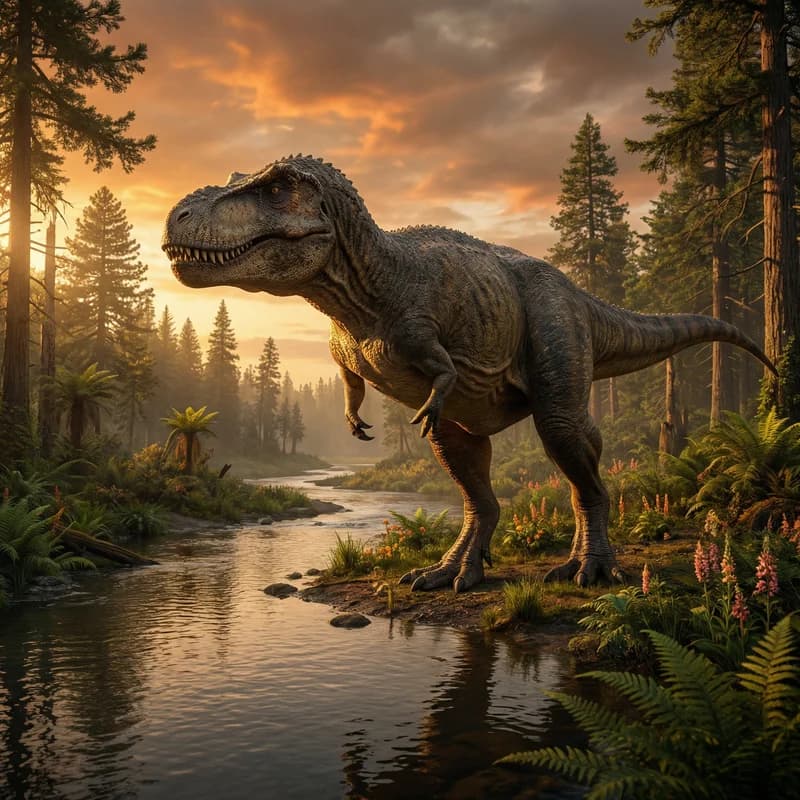
Albertosaurus
Albertosaurus sarcophagus
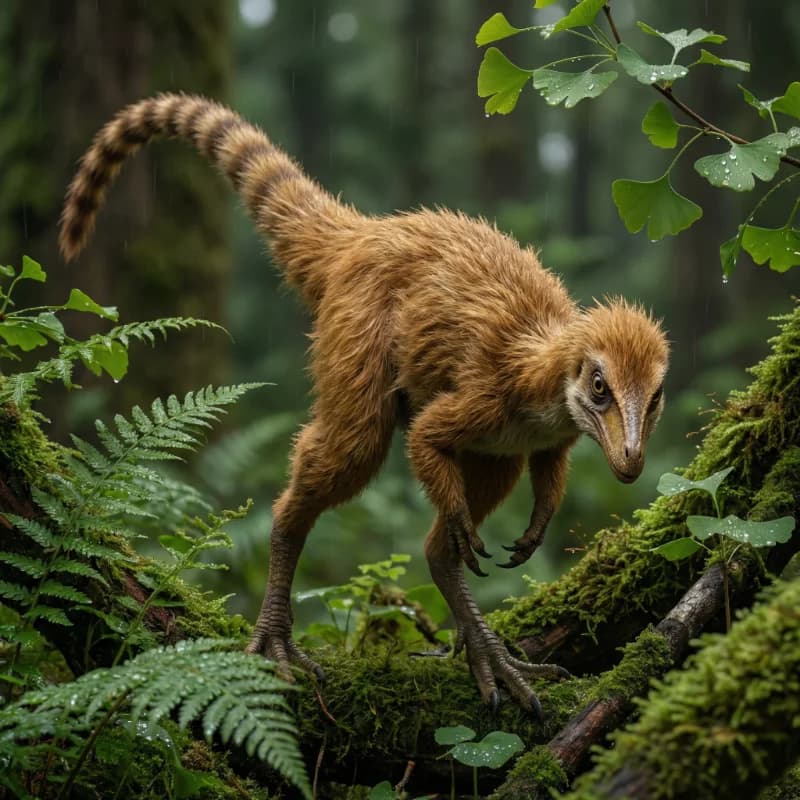
Sinosauropteryx
Sinosauropteryx prima