Concavenator
Cretaceous Period Carnivore Creature Type
Concavenator corcovatus
Scientific Name: "Conca (Latin name for the Spanish province of Cuenca) + venator (hunter) = 'Hunter from Cuenca'; corcovatus = Latin for 'hunchbacked'"
Local Name: Concavenator
Physical Characteristics
Discovery
Habitat

Concavenator (Concavenator corcovatus Ortega, Escaso & Sanz, 2010) is a medium-sized carcharodontosaurid theropod dinosaur that lived during the Early Cretaceous epoch, specifically the Barremian stage (approximately 125 million years ago), in what is now the Cuenca Province of central Spain. Classified within the order Saurischia and suborder Theropoda, it is a basal member of the family Carcharodontosauridae, the same lineage that would later produce some of the largest terrestrial predators of all time, including Carcharodontosaurus and Giganotosaurus. The holotype specimen, MCCM-LH 6666, is a nearly complete, articulated skeleton recovered from the Las Hoyas fossil site of the La Huérguina Formation — one of the most complete theropod specimens ever found in Europe.
Two features make Concavenator immediately distinctive among theropods. First, the neural spines of the last two dorsal (back) vertebrae are extraordinarily elongated, forming a tall, narrow, pointed crest or hump-like projection on the animal's back just in front of the hips. Second, a row of regularly spaced bumps along the ulna (forearm bone) was reported in the original description and interpreted as structures analogous to the quill knobs of modern birds — attachment points for feather-like integumentary structures. Whether these bumps truly represent quill knobs or are instead intermuscular attachment scars remains one of the most actively debated questions in theropod integument research.
The exceptional preservation at Las Hoyas, a Konservat-Lagerstätte renowned for its exquisite fossil detail, has allowed researchers to study not only the skeleton but also preserved scale impressions on the feet and tail, plantar pads, and other integumentary traces. This makes Concavenator an invaluable window into carcharodontosaurid anatomy, integument diversity, and the paleoecology of Early Cretaceous European wetland ecosystems.
Overview
Name and Etymology
The generic name Concavenator is derived from the Latin Conca, the historical Latin name for the Spanish province of Cuenca where the fossil was found, and venator, meaning "hunter" — thus "Hunter from Cuenca." A common misconception interprets the name as "concave hunter" (from Latin concavus + venator), but this is incorrect; the name specifically references the geographic provenance. The specific epithet corcovatus is Latin for "hunchbacked," referring to the distinctive dorsal vertebral crest (Ortega et al., 2010). In Spain, the specimen is popularly known by its nickname "Pepito."
Taxonomic Status
Concavenator belongs to Saurischia, Theropoda, Carnosauria, Allosauroidea, and Carcharodontosauria. The original cladistic analysis (Ortega et al., 2010) placed it as a basal member of Carcharodontosauria, with two unambiguous synapomorphies supporting this placement: a deeply concave iliac articular surface on the ischium and a distinctive proximomedial ischial morphology. Subsequent analyses (Novas et al., 2013; Cuesta et al., 2018a, b; Cau, 2024) have consistently placed Concavenator within Carcharodontosauridae as a basal member, at a phylogenetic position comparable to or less derived than Acrocanthosaurus. The most recent analysis by Cau (2024) recovered Concavenator in a clade with Sauroniops, Veterupristisaurus, Lusovenator, and Eocarcharia within the family. Only a single species, C. corcovatus, is recognized, and no synonymy or reclassification disputes exist.
Scientific Significance
Concavenator is significant for three primary reasons: (1) it possesses the most complete skeleton known for any carcharodontosaurid, providing unparalleled anatomical data for the family; (2) the putative quill knobs on the ulna are key evidence in the debate over the phylogenetic distribution of feather-like integumentary structures in theropods; and (3) it documents the presence of Carcharodontosauria in the Early Cretaceous of Europe, contributing to our understanding of the group's paleobiogeographic history.
Age, Stratigraphy, and Depositional Environment
Temporal Range
The holotype derives from the La Huérguina Formation (= Calizas de La Huérguina Formation), which is dated to the Barremian stage of the Early Cretaceous, approximately 129–125 Ma. The Las Hoyas locality specifically corresponds to the upper Barremian, approximately 125 Ma (Martínez et al., 2017; Marugán-Lobón et al., 2023).
Formation and Lithology
The La Huérguina Formation is located in the South Iberian Basin (Serranía de Cuenca region, Castile-La Mancha, Spain) and has a total thickness of 60–100 m. Its primary lithology consists of lacustrine limestone and marl, with minor conglomerate intervals. The Las Hoyas locality itself is composed of finely laminated lithographic limestone, a key factor in its status as a Konservat-Lagerstätte — a deposit of exceptional fossil preservation. Fossil burial was rapid, likely aided by microbial mats, obruption (rapid sediment burial), and stagnation (anoxic bottom conditions), resulting in the outstanding preservation of soft tissues and integumentary structures across many taxa (Marugán-Lobón et al., 2023).
Paleoenvironment
Las Hoyas represents an inland freshwater lacustrine-wetland environment. The climate was subtropical with pronounced seasonality — alternating wet and dry seasons — reflected in the rhythmic lamination of the sediments (Buscalioni & Fregenal-Martínez, 2010). The paleoflora included charophytes, the aquatic angiosperm Montsechia, the fern Weichselia, and the conifer Frenelopsis, indicating a landscape of shallow lakes, marshes, and surrounding woodland. The paleofauna was remarkably diverse, spanning at least five or six phyla, including arthropods (crustaceans, insects), mollusks, chordates (fish, amphibians, squamates, turtles, crocodylomorphs, pterosaurs, dinosaurs, birds, mammals), and various soft-bodied invertebrates.
Specimens and Diagnostic Features
Holotype
The holotype and only known specimen is MCCM-LH 6666, housed in the Museo de las Ciencias de Castilla-La Mancha (MCCM) in Cuenca, Spain. The fossil was first exposed at the Las Hoyas quarry around 2002–2003 and was formally described and named in 2010 by paleontologists Francisco Ortega, Fernando Escaso, and José Luis Sanz in the journal Nature. The specimen is a nearly complete, articulated skeleton encased in limestone, comprising the skull, ten cervical vertebrae, thirteen dorsal vertebrae (the last two with anomalously elongated neural spines), five sacral vertebrae, approximately thirty caudal vertebrae, a partial pectoral girdle and forelimb, the pelvic girdle and partial hindlimbs, and ribs. Integumentary traces including scale impressions on the feet and underside of the tail are also preserved.
Specimen summary:
| Specimen | Repository | Locality | Formation | Composition | Notes |
|---|---|---|---|---|---|
| MCCM-LH 6666 | Museo de las Ciencias de Castilla-La Mancha (MCCM), Spain | Las Hoyas, Cuenca Province, Spain | La Huérguina Fm. (upper Barremian) | Nearly complete articulated skeleton (skull, vertebral column, partial limbs, ribs, integument traces) | Holotype; only known specimen |
Diagnostic Features (Autapomorphies)
The original diagnosis by Ortega et al. (2010) identified the following key autapomorphies: (1) extreme elongation of the neural spines of the 11th and 12th dorsal vertebrae, forming a prominent triangular crest; (2) a series of regularly spaced bumps on the posterolateral surface of the ulna. Subsequent detailed redescriptions by Cuesta et al. (2018a, b, 2019) identified additional diagnostic features in the cranium, axial skeleton, and appendicular skeleton.
Specimen Limitations
Only a single individual is known, precluding any assessment of intraspecific variation, ontogenetic change, or sexual dimorphism. Parts of the forelimb, particularly the proximal ulna, exhibit fracturing and abrasion, which has complicated the interpretation of the ulnar bumps and contributed to the ongoing feather-versus-muscle debate (Cuesta Fidalgo, 2018).
Morphology and Functional Anatomy
Body Size
Concavenator was a medium-sized carcharodontosaurid, with a total body length estimated at approximately 5–6 m (16–20 ft), a hip height of approximately 1.5–1.8 m, and a maximum height (head raised) of approximately 2 m. Body mass estimates range from approximately 320–400 kg (710–880 lb) (Paul, 2016; Molina-Pérez & Larramendi, 2019). It is among the smallest known carcharodontosaurids, reflecting its position as a basal, Early Cretaceous member of the family — far smaller than later, more derived relatives such as Carcharodontosaurus (~12–13 m) or Giganotosaurus (~12–13 m).
Dorsal Vertebral Crest (Hump/Sail)
The most striking anatomical feature of Concavenator is the extreme elongation of the neural spines of the 11th and 12th dorsal vertebrae, which are dramatically taller than those of adjacent vertebrae, forming a narrow, pointed, triangular projection approximately 20–30 cm in height. This structure stands in sharp contrast to the sail-like structures seen in Spinosaurus or Acrocanthosaurus, which involve many consecutive vertebrae; in Concavenator, only two vertebrae are affected, producing a more localized hump rather than an extended sail (Ortega et al., 2010; Cuesta et al., 2019).
Several functional hypotheses have been proposed: thermoregulation (increased surface area for heat exchange), fat storage (analogous to a camel's hump), and intraspecific visual display. None of these has been conclusively confirmed. Additionally, some caudal vertebrae also exhibit hypertrophied neural spines, indicating a broader trend of neural spine elaboration along the axial skeleton (Cuesta et al., 2019).
Ulnar Bumps and the Feather Debate
In the original description, Ortega et al. (2010) reported a series of regularly spaced bumps along the posterolateral surface of the ulna and interpreted these as quill knobs — bony attachment points for feather follicle ligaments, analogous to those seen in modern birds and feathered dromaeosaurids. If correct, this interpretation would imply that feather-like integumentary structures were present outside of Coelurosauria, pushing back the origin of feathers to a much earlier divergence within Theropoda (at least to the base of Neotetanurae).
However, this interpretation has been contested. Foth et al. (2014) argued that the bumps were located on the anterolateral surface of the ulna and represented intermuscular lines (tendon attachment ridges) rather than quill knobs. In response, Cuesta Fidalgo et al. (2015) presented a myological reconstruction at the Society of Vertebrate Paleontology meeting, demonstrating that the bumps could not correspond to any known intermuscular ridge and were most consistent with quill knobs, albeit in an unusual posterolateral position — a configuration that does occur in some extant birds such as the Moorhen. Cuesta Fidalgo's 2018 doctoral thesis further argued that the ulna was preserved in lateral view, making the bumps posterolateral rather than anterolateral, and that taphonomic distortion of the proximal ulna made direct comparisons with Allosaurus and Acrocanthosaurus misleading.
The debate remains unresolved. Rauhut & Foth (2020) maintained skepticism about the quill knob interpretation. Critically, no feather impressions were found near the arm, although extensive scale impressions were preserved on other body parts.
Cranial Anatomy
The skull of Concavenator was comprehensively redescribed using 3D virtual reconstruction by Cuesta et al. (2018a). It is relatively large and laterally compressed, consistent with carcharodontosaurid cranial morphology. The teeth are serrated, with a blade-like morphology optimized for slicing flesh. Dentition-based discriminant analysis, cluster analysis, and a cladistic analysis incorporating cranial data all support the placement of Concavenator as a basal carcharodontosaurid (Cuesta et al., 2018a).
Limb Structure
The forelimbs are relatively short, as is typical for carcharodontosaurids, but Concavenator has unusually elongated manual phalanges (finger bones) compared to other members of the family (Cuesta et al., 2018b). The hindlimbs are long, robust, and well-suited for obligate bipedal locomotion. Cuesta et al. (2018b) identified several allosauroid and carcharodontosaurid synapomorphies in the appendicular skeleton, including symmetric glenoid rims, a canted humeral orientation, and a concavity on the proximomedial surface of the tibial cnemial crest.
Integument
Thanks to the exceptional preservation at Las Hoyas, diverse integumentary traces have been documented in Concavenator. The underside of the tail preserves broad, rectangular scale impressions. The feet display bird-like scutellate and reticulate scales, as well as plantar pads on the soles — among the first detailed records of a non-avian theropod podotheca (foot integument) (Cuesta et al., 2015). No integumentary impressions of any kind were found near the forelimb, leaving the question of arm-feather presence entirely dependent on the interpretation of the ulnar bumps.
Diet and Paleoecology
Diet
Concavenator is unambiguously classified as a carnivore based on its serrated, blade-like teeth and robust skull architecture, both hallmarks of the carcharodontosaurid lineage (the family name itself derives from "shark-toothed lizard"). No direct evidence of gut contents or coprolites has been reported for this taxon.
Ecological Role
At 5–6 m in length and 320–400 kg in mass, Concavenator was likely the apex or near-apex predator of the Las Hoyas ecosystem. Co-occurring fauna at the site includes the ornithomimosaur Pelecanimimus polyodon (~2–2.5 m long), an iguanodontian (Mantellisaurus atherfieldensis, represented by a hindlimb), isolated theropod teeth (Euronychodon cf., Richardoestesia cf.), the tapejarid pterosaur Europejara olcadesorum, various enantiornithine birds, diverse crocodylomorphs, fish, and the eutriconodont mammal Spinolestes xenarthrosus. Concavenator would have preyed upon small to medium-sized herbivorous and omnivorous vertebrates in this wetland setting.
Behavioral Inferences
The dorsal crest may have served a role in intraspecific display or species recognition, but with only a single specimen, hypotheses about sexual dimorphism, social behavior, or gregariousness cannot be tested. There is no evidence for pack hunting or social aggregation.
Distribution and Paleogeography
Geographic Range
Concavenator is currently known only from the Las Hoyas locality in the Cuenca Province of central Spain (La Huérguina Formation). No additional occurrences have been reported from any other site.
Paleogeographic Context
During the Barremian (~129–125 Ma), the Iberian Peninsula was situated at a paleolatitude of approximately 25–33°N, somewhat south of its present position, and was part of a partially isolated European archipelago. The presence of a carcharodontosaurid in Early Cretaceous Europe demonstrates that this lineage had achieved a broad, possibly cosmopolitan distribution by this time. Contemporary evidence from the Iberian Peninsula also documents the co-occurrence of carcharodontosaurids, abelisauroid ceratosaurians, and spinosaurids, paralleling the large-predator guild compositions seen on other Cretaceous landmasses.
Phylogeny and Taxonomic Debate
Original Phylogenetic Position
The original cladistic analysis by Ortega et al. (2010), published in Nature, recovered Concavenator as a basal member of Carcharodontosauria. Two unambiguous synapomorphies of Carcharodontosauria were identified: a deeply concave iliac articular surface on the ischium and a characteristic proximomedial ischial morphology.
Subsequent Analyses
Novas et al. (2013) placed Concavenator in a basal position within Carcharodontosauria, near Neovenator. The detailed cranial and appendicular redescriptions by Cuesta et al. (2018a, b) resulted in a more firmly resolved position within Carcharodontosauridae (i.e., within the family rather than stemward of it), at a grade comparable to or slightly less derived than Acrocanthosaurus. The most recent comprehensive theropod phylogeny by Cau (2024) recovered Concavenator within a clade alongside Sauroniops, Veterupristisaurus, Lusovenator, and Eocarcharia inside Carcharodontosauridae.
Comparison with related taxa:
| Taxon | Age | Locality | Est. Length | Key Features |
|---|---|---|---|---|
| Concavenator corcovatus | Barremian (~125 Ma) | Spain | 5–6 m | Dorsal crest, ulnar bumps |
| Acrocanthosaurus atokensis | Aptian–Albian (~116–110 Ma) | North America | 11–12 m | Tall neural spines |
| Eocarcharia dinops | Aptian (~112 Ma) | Niger | ~6–8 m (est.) | Hypertrophied supraorbital |
| Carcharodontosaurus saharicus | Cenomanian (~100–94 Ma) | North Africa | 12–13 m | Massive skull, serrated teeth |
| Giganotosaurus carolinii | Cenomanian (~98–97 Ma) | Argentina | 12–13 m | One of the largest terrestrial predators |
Current Consensus
There is broad agreement that Concavenator belongs to Carcharodontosauria and, more specifically, to Carcharodontosauridae. Its exact position within the family (basal Carcharodontosauridae vs. stem Carcharodontosauria outside the family) varies slightly between analyses, but most recent studies support a position within the family.
Restoration and Uncertainty
Confirmed
The following aspects are firmly established: Concavenator is a carcharodontosaurid theropod; it possesses a localized dorsal vertebral crest formed by two elongated neural spines; its feet and tail bore scales; it inhabited a freshwater lacustrine-wetland environment in what is now Spain; and it dates to the upper Barremian (~125 Ma).
Well-Supported
The size estimates of 5–6 m in length and 320–400 kg in mass are consistently supported across multiple independent studies (Paul, 2016; Molina-Pérez & Larramendi, 2019). The basal carcharodontosaurid phylogenetic position is recovered by multiple independent analyses.
Hypothetical / Debated
The identity of the ulnar bumps (quill knobs vs. muscle attachment scars) remains unresolved. The function of the dorsal crest (thermoregulation vs. fat storage vs. display) is speculative. The presence or absence of feathers on the forelimbs is entirely dependent on the ulnar bump interpretation — no direct feather impressions have been found.
Popular Misconceptions
Popular restorations frequently depict Concavenator with prominent arm feathers and a dramatic sail-like structure on its back. Scientifically, however, feather presence is uncertain, and the dorsal projection — confined to just two vertebrae — may have been a fleshy hump rather than a sail. Additionally, some Korean-language sources have erroneously classified Concavenator within Ornithischia; it is unambiguously a saurischian theropod.
Coexisting Fauna Comparison
The Las Hoyas ecosystem hosted a remarkably diverse assemblage of organisms. Key co-occurring vertebrate taxa are summarized below:
| Taxon | Classification | Notes |
|---|---|---|
| Pelecanimimus polyodon | Ornithomimosauria (Theropoda) | First ornithomimosaur described from Europe |
| Mantellisaurus atherfieldensis | Iguanodontia (Ornithopoda) | Hindlimb material recovered |
| Iberomesornis romerali | Enantiornithes (Aves) | Mixture of primitive and derived avian features |
| Eoalulavis hoyasi | Enantiornithes (Aves) | Earliest record of an alula (bastard wing) |
| Concornis lacustris | Enantiornithes (Aves) | Postcranial skeleton |
| Europejara olcadesorum | Tapejaridae (Pterosauria) | Pterosaur from Las Hoyas |
| Montsecosuchus sp. etc. | Crocodylomorpha | Most abundant amniotes at Las Hoyas |
| Spinolestes xenarthrosus | Eutriconodonta (Mammalia) | Exceptionally preserved with pelage, ears, and internal organs |
Discovery and Research History
The fossil of Concavenator was first exposed in limestone slabs at the Las Hoyas quarry around 2002–2003. Following careful excavation, the specimen was studied by a team led by Francisco Ortega, Fernando Escaso, and José Luis Sanz, resulting in its formal description in 2010 in Nature (Ortega et al., 2010). The discovery immediately attracted global attention due to the unusual dorsal crest and the putative quill knobs.
Subsequently, Elena Cuesta Fidalgo undertook a comprehensive anatomical restudy as her doctoral thesis. In 2015, the foot integument was described (Cuesta et al., 2015). In 2018, three monographic papers were published covering the cranium (Cuesta et al., 2018a), appendicular skeleton (Cuesta et al., 2018b), and axial skeleton (Cuesta et al., 2019). This body of work elevated Concavenator to the most thoroughly described carcharodontosaurid in terms of appendicular anatomy, and provided critical new data for understanding carcharodontosaurid diversity and evolution.
Fun Facts
FAQ
📚References
- Ortega, F., Escaso, F. & Sanz, J. L. (2010). A bizarre, humped Carcharodontosauria (Theropoda) from the Lower Cretaceous of Spain. Nature, 467(7312), 203–206. doi:10.1038/nature09181
- Cuesta, E., Díaz-Martínez, I., Ortega, F. & Sanz, J. L. (2015). Did all theropods have chicken-like feet? First evidence of a non-avian dinosaur podotheca. Cretaceous Research, 56, 53–59. doi:10.1016/j.cretres.2015.03.008
- Cuesta, E., Vidal, D., Ortega, F. & Sanz, J. L. (2018a). The cranial osteology of Concavenator corcovatus (Theropoda; Carcharodontosauria) from the Lower Cretaceous of Spain. Cretaceous Research, 91, 176–194. doi:10.1016/j.cretres.2018.06.007
- Cuesta, E., Ortega, F. & Sanz, J. L. (2018b). Appendicular osteology of Concavenator corcovatus (Theropoda; Carcharodontosauridae) from the Lower Cretaceous of Spain. Journal of Vertebrate Paleontology, 38(4), 1–24. doi:10.1080/02724634.2018.1485153
- Cuesta, E., Ortega, F. & Sanz, J. L. (2019). Axial osteology of Concavenator corcovatus (Theropoda; Carcharodontosauria) from the Lower Cretaceous of Spain. Cretaceous Research, 95, 106–120. doi:10.1016/j.cretres.2018.10.026
- Cuesta Fidalgo, E. (2018). Concavenator corcovatus: (Theropoda, Dinosauria) from Las Hoyas fossil site (Early Cretaceous, Cuenca, Spain): taphonomic, phylogenetic and morphofunctional analyses. Doctorate Thesis, Universidad Autónoma de Madrid. https://repositorio.uam.es/handle/10486/678416
- Cuesta Fidalgo, E., Ortega, F. & Sanz, J. L. (2015). Ulnar bumps of Concavenator: Quill Knobs or Muscular scar? Myological Reconstruction of the forelimb of Concavenator corcovatus. Abstracts, 75th Annual Meeting of the Society of Vertebrate Paleontology, 111–112.
- Novas, F. E., Agnolín, F. L., Ezcurra, M. D., Porfiri, J. & Canale, J. I. (2013). Evolution of the carnivorous dinosaurs during the Cretaceous: The evidence from Patagonia. Cretaceous Research, 45, 174–215. doi:10.1016/j.cretres.2013.04.001
- Cau, A. (2024). A Unified Framework for Predatory Dinosaur Macroevolution. Bollettino della Società Paleontologica Italiana, 63(1), 1–19. doi:10.4435/BSPI.2024.08
- Foth, C., Tischlinger, H. & Rauhut, O. W. M. (2014). New specimen of Archaeopteryx provides insights into the evolution of pennaceous feathers. Nature, 511(7507), 79–82. doi:10.1038/nature13467
- Rauhut, O. W. M. & Foth, C. (2020). The Origin of Birds: Current Consensus, Controversy, and the Occurrence of Feathers. In C. Foth & O. W. M. Rauhut (Eds.), The Evolution of Feathers (pp. 27–45). Springer Nature. doi:10.1007/978-3-030-27223-4_3
- Paul, G. S. (2016). The Princeton Field Guide to Dinosaurs (2nd ed.). Princeton University Press, p. 102.
- Molina-Pérez, R. & Larramendi, A. (2019). Dinosaurs Facts and Figures: The Theropods and Other Dinosauriformes. Princeton University Press, p. 261.
- Martínez, M. F., Meléndez, N., Muñoz García, M. B., Elez, J. & de la Horra, R. (2017). The stratigraphic record of the Late Jurassic–Early Cretaceous rifting in the Alto Tajo–Serranía de Cuenca region. Revista de la Sociedad Geológica de España, 30, 113–142.
- Marugán-Lobón, J., Martín-Abad, H. & Buscalioni, Á. D. (2023). The Las Hoyas Lagerstätte: a palaeontological view of an Early Cretaceous wetland. Journal of the Geological Society, 180(3). doi:10.1144/jgs2022-079
- Laursen, L. (2010). Crested dinosaur pushes back dawn of feathers. Nature News, 8 September 2010. doi:10.1038/news.2010.455
- Hendrickx, C. et al. (2022). Morphology and distribution of scales, dermal ossifications, and other non-feather integumentary structures in non-avialan theropod dinosaurs. Biological Reviews, 97(3), 960–1004. doi:10.1111/brv.12829
Gallery
5 images Concavenator
Concavenator · Cretaceous Period · Carnivore
 Concavenator
Concavenator · Cretaceous Period · Carnivore
 Concavenator
Concavenator · Cretaceous Period · Carnivore
 Concavenator
Concavenator · Cretaceous Period · Carnivore
 Concavenator
Concavenator · Cretaceous Period · Carnivore
🔗Related Creatures
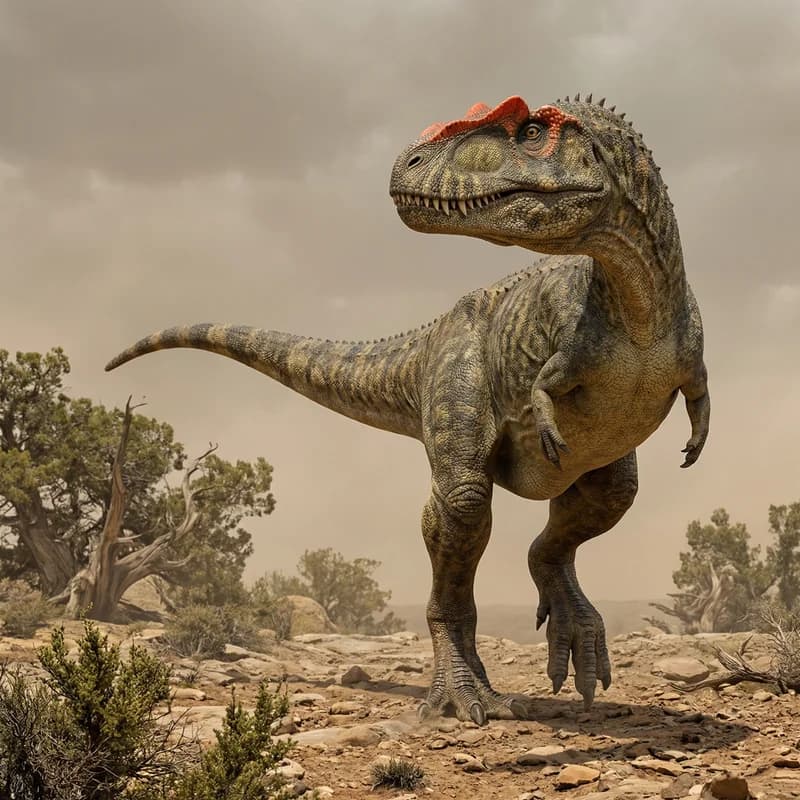
Abelisaurus
Abelisaurus comahuensis
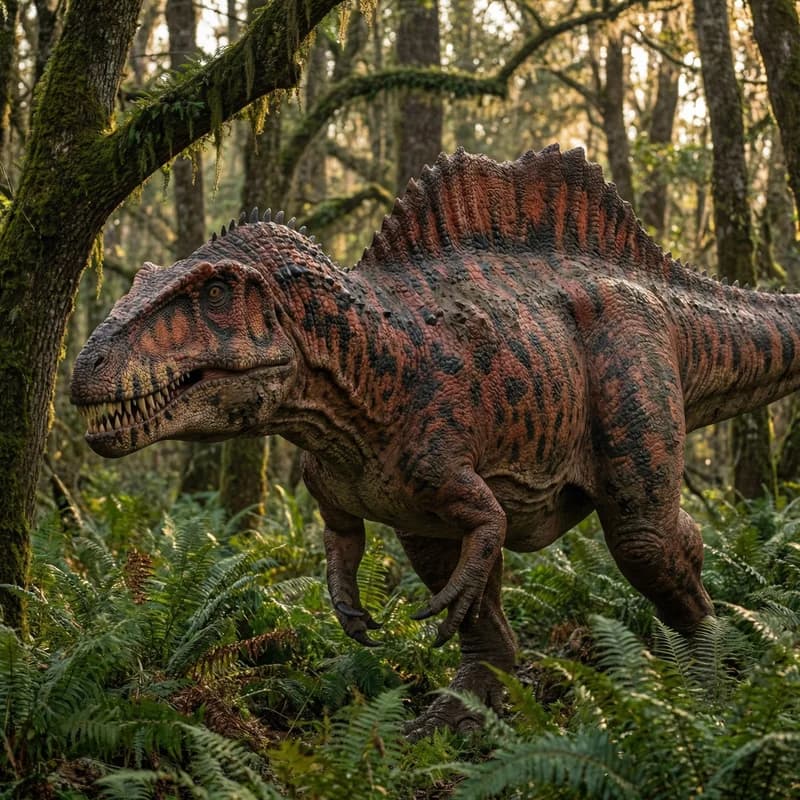
Acrocanthosaurus
Acrocanthosaurus atokensis

Microraptor
Microraptor zhaoianus

Australovenator
Australovenator wintonensis

Carnotaurus
Carnotaurus sastrei

Velociraptor
Velociraptor mongoliensis

Albertosaurus
Albertosaurus sarcophagus

Nanotyrannus
Nanotyrannus lancensis