Carnotaurus
Cretaceous Period Carnivore Creature Type
Carnotaurus sastrei
Scientific Name: "Latin carno (carnis, 'flesh/meat') + taurus ('bull') = 'meat-eating bull'. The specific name sastrei honors Angel Sastre, owner of the ranch where the holotype was discovered"
Local Name: Carnotaurus
Physical Characteristics
Discovery
Habitat
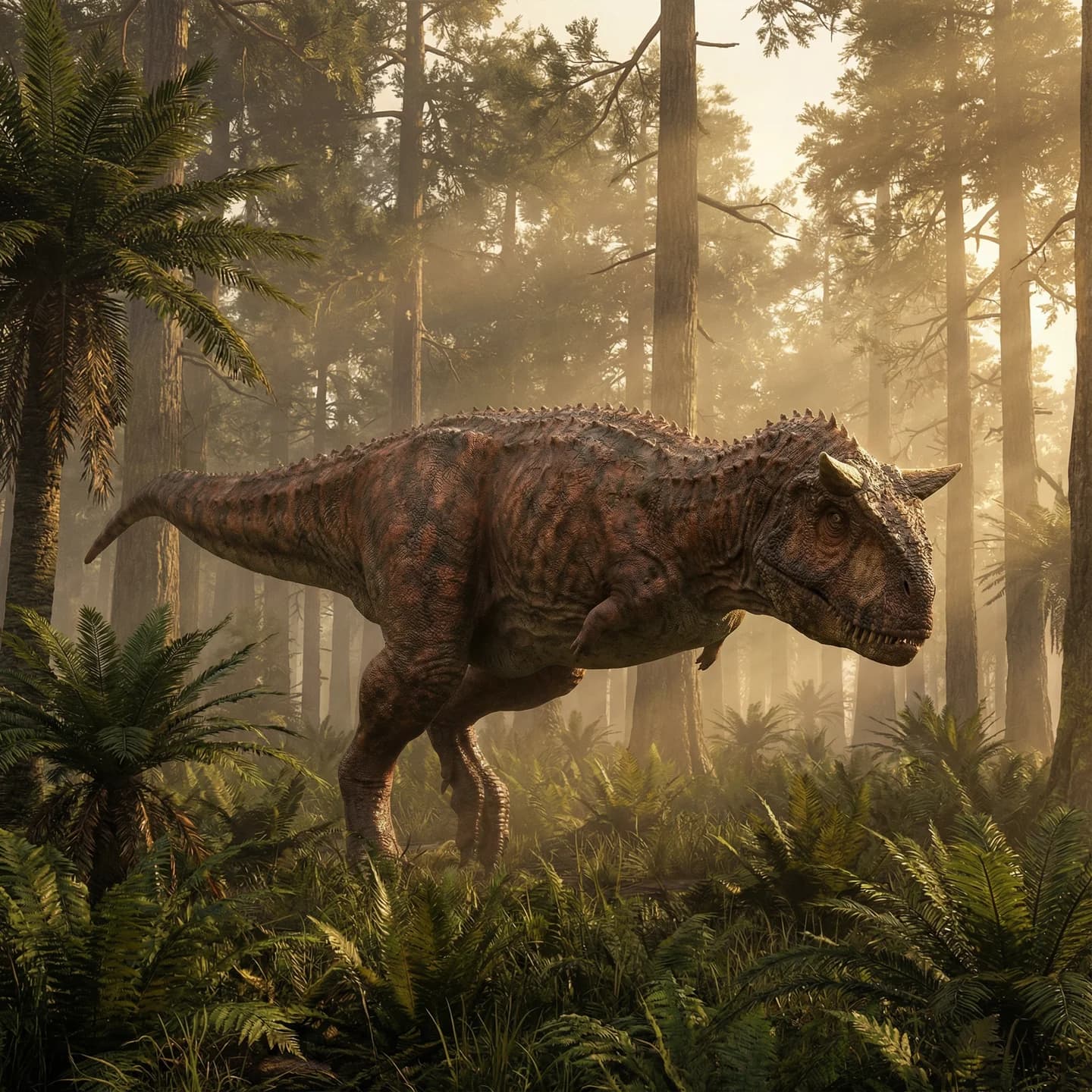
Carnotaurus sastrei Bonaparte, 1985 is an abelisaurid theropod dinosaur from the Late Cretaceous (Maastrichtian, approximately 72–69 Ma) of Patagonia, South America. It is a monotypic genus, known solely from a single, remarkably well-preserved skeleton (holotype MACN-CH 894), discovered in 1984 by an expedition led by Argentine paleontologist José Bonaparte in the Chubut Province of Argentina. The skeleton was recovered from rocks of the La Colonia Formation and represents one of the best-understood theropods from the Southern Hemisphere, preserving a nearly complete skull, much of the vertebral column, the limbs, and—most remarkably—extensive skin impressions from multiple body regions.
The most striking features of Carnotaurus include a pair of thick, conical horns above the eyes (formed by the frontal bones), extremely reduced forelimbs that are proportionally shorter than those of any other known large carnivorous dinosaur (including tyrannosaurids), and a short, deep skull unlike that of any other large theropod. Its hindlimbs were long and slender, and digital muscle modeling has shown that the tail locomotor muscle (M. caudofemoralis) was proportionally larger than in any other theropod studied, suggesting powerful sprinting capability. The skin was covered entirely in non-overlapping polygonal scales with no trace of feathers—the most complete theropod skin impression known to science.
Body length is estimated at approximately 7.5–8 m, with mass estimates ranging from roughly 1,306 to 2,100 kg depending on the methodology employed. Carnotaurus is a derived member of the Abelisauridae, the dominant large predators of Late Cretaceous Gondwana, and is typically placed within the Brachyrostra, a clade of short-snouted abelisaurids restricted to South America. Its combination of horns, vestigial arms, speed-adapted tail, and superbly preserved scaly integument makes it one of the most distinctive and scientifically important theropods ever discovered.
Overview
Name and Etymology
The generic name Carnotaurus is derived entirely from Latin: carno (genitive carnis, meaning 'flesh' or 'meat') and taurus ('bull'), translating to 'meat-eating bull'. This alludes to the animal's prominent pair of bull-like horns above its eyes—a feature unparalleled among carnivorous dinosaurs. The specific epithet sastrei honors Angel Sastre, the owner of the 'Pocho Sastre' ranch near Bajada Moreno (Telsen Department, Chubut Province, Argentina) where the holotype skeleton was found (Bonaparte, 1985). The full binomial can thus be interpreted as 'Sastre's meat-eating bull'.
Taxonomic Status
Carnotaurus is classified within the Theropoda, family Abelisauridae, and more specifically within the clade Carnotaurini under Brachyrostra—a group of short-snouted abelisaurids restricted to South America. The Abelisauridae occupied the large-predator niche in Late Cretaceous Gondwana, serving as the ecological counterparts of the Tyrannosauridae in the northern landmasses of Laurasia. Only a single species, C. sastrei, is recognized. In 2024, Koleken inakayali was described from the same La Colonia Formation, demonstrating that Carnotaurus coexisted with at least one other abelisaurid in the same geographic area and time interval (Canale et al., 2024).
One-Line Summary
The iconic abelisaurid theropod defined by its supraorbital horns, extremely vestigial forelimbs, and the most extensive scaly skin impressions known for any theropod.
Age, Stratigraphy, and Depositional Environment
Temporal Range
The holotype of Carnotaurus was recovered from the upper part of the La Colonia Formation in Chubut Province, Argentina. The age of this formation was initially considered Campanian (~73–72 Ma), but detrital zircon U–Pb ages from the directly underlying Punto Chico Formation indicate that the base of the La Colonia Formation is younger than ~71.7 Ma, supporting a Maastrichtian age (Gasparini et al., 2015). A 2021 study employing magnetostratigraphy and palynological data provided an age range of approximately 69–64 Ma. The most widely cited temporal range for Carnotaurus is approximately 72–69 Ma (lower Maastrichtian).
Formation and Lithology
The La Colonia Formation is an Upper Cretaceous to Paleogene (Maastrichtian–Danian) shallow marine to coastal sedimentary unit exposed along the southeastern margin of the Somún Curá Plateau in north-central Chubut Province. Its dominant lithologies comprise siltstone, mudstone, and fine-grained sandstone interbeds, with notable occurrences of hematite concretions. The holotype of Carnotaurus was embedded within a very large, exceptionally hard hematite concretion, which made preparation extremely difficult and time-consuming (Bonaparte, 1985; Paul, 1988).
Paleoenvironment
The La Colonia Formation was deposited during a Maastrichtian transgressive episode of the South Atlantic Ocean that flooded the continental margin of Argentina. The sediments reflect deposition in estuarine, tidal flat, and coastal plain environments, indicative of low-energy marginal marine to coastal conditions (Gasparini et al., 2015). A rich and taxonomically diverse fauna has been recovered from this unit, including fish, turtles, snakes, lizards, crocodilians, plesiosaurs, mammals, and dinosaurs. This mixed paleoenvironmental setting suggests that Carnotaurus inhabited low-lying coastal plains and estuarine margins adjacent to the sea.
Specimens and Diagnostic Features
Holotype
The sole known specimen, holotype MACN-CH 894, is housed at the Museo Argentino de Ciencias Naturales "Bernardino Rivadavia" in Buenos Aires. It was discovered in 1984 by a team led by José Bonaparte at the 'Pocho Sastre' ranch near Bajada Moreno in Chubut Province. The expedition was the eighth in the "Jurassic and Cretaceous Terrestrial Vertebrates of South America" project (begun 1976), sponsored by the National Geographic Society. The same expedition also recovered the spiny-necked sauropod Amargasaurus (Salgado & Bonaparte, 1991).
The skeleton is articulated and was found lying on its right side in a typical death pose with the neck arched back over the torso. It is remarkably well preserved, with only the posterior two-thirds of the tail, much of the lower leg, and the hind feet having been destroyed by weathering. Fused braincase sutures confirm the individual was an adult (Paulina Carabajal, 2011). The skull was deformed during fossilization: the left snout bones were displaced forward relative to the right side, the nasals were pushed upward, and the premaxillae were compressed backward onto the nasals. This deformation exaggerated the upward curvature of the upper jaw (Cerroni et al., 2020).
Autapomorphies (Diagnostic Features)
According to the comprehensive re-description by Cerroni et al. (2020), the principal autapomorphies of Carnotaurus include: (1) a pair of thick, conical horns on the frontal bones; (2) an extremely short and deep skull; (3) excavations above the promaxillary fenestra in the maxilla; (4) a unique canal structure for the nasolacrimal duct exit on the medial surface of the lacrimal; (5) a deep, elongated pneumatic excavation in the quadrate; (6) an elongated depression on the pterygoid of the palate.
Specimen Limitations
As only a single specimen is known, information on intraspecific variation, sexual dimorphism, and ontogenetic changes remains extremely limited. The loss of the posterior tail and hind feet means that these regions must be reconstructed based on close relatives, particularly Aucasaurus garridoi.
| Item | Details |
|---|---|
| Specimen Number | MACN-CH 894 (holotype, sole specimen) |
| Repository | Museo Argentino de Ciencias Naturales, Buenos Aires |
| Locality | Chubut Province, Telsen Department, Bajada Moreno, 'Pocho Sastre' ranch |
| Formation | La Colonia Formation (Upper Cretaceous, Maastrichtian) |
| Preserved Elements | Nearly complete skull and mandible, cervical through anterior caudal vertebrae, pectoral girdle and forelimbs, partial pelvis and hindlimbs, extensive skin impressions |
| Missing Elements | Posterior two-thirds of tail, much of lower leg, hind feet |
| Year of Discovery | 1984 |
| Discovery Team | José Bonaparte expedition |
Morphology and Function
Overall Size and Body Mass
Body length of Carnotaurus is estimated at approximately 7.5–8 m (Bonaparte et al., 1990; Paul, 2010). Grillo & Delcourt (2017) calculated a length of approximately 7.8 m using allometric scaling equations for abelisauroids. Body mass estimates vary considerably with methodology: approximately 1,306–1,743 kg (Cerroni & Paulina Carabajal, 2019), approximately 1,350 kg (Mazzetta et al., 1998), approximately 1,500 kg (Paul, 2010, alternative estimate), approximately 2,000 kg (Paul, 2010), and approximately 2,100 kg (Mazzetta et al., 2004). This range reflects differences in estimation methods, including geometric approximation, skeletal circumference regression, and digital volumetric modeling.
Skull
The skull measures approximately 59.6 cm in length and was proportionally shorter and deeper than that of any other known large carnivorous dinosaur. The snout was moderately broad and not as tapered as in more basal theropods such as Ceratosaurus, with upwardly curved jaws. A prominent pair of horns protrudes obliquely above the eyes, formed by the frontal bones, internally solid, somewhat vertically flattened in cross-section, and measuring approximately 15 cm in length (Paulina Carabajal, 2011; Cerroni et al., 2020). Bonaparte (1990) suggested these horns were bony cores of much longer keratinous sheaths; however, Cerroni et al. (2020) argued that the sheaths would not have extended greatly beyond the bone cores.
The dental formula included 4 premaxillary and 12 maxillary teeth per side in the upper jaw, and 15 dentary teeth per side in the lower jaw. While originally described as long and slender, Cerroni et al. (2020) revealed that most erupted teeth had been severely damaged during excavation and reconstructed with plaster. CT imaging of replacement teeth shows low, flattened crowns that were closely spaced and inclined forward at approximately 45°.
Ossified hyoid bones were found in life position with the mandible, including a pair of curved ceratobranchials articulating with a single trapezoidal basihyal. The basihyal of Carnotaurus is the only one known for any non-avian theropod (Cerroni et al., 2020).
Horn Function
Multiple hypotheses have been proposed for the function of the horns: (1) intraspecific combat—rival individuals may have engaged in quick head blows, slow pushing contests using the upper skull surfaces, or head-on ramming with horns as shock absorbers (Bonaparte et al., 1990; Mazzetta et al., 2009); (2) species recognition and sexual display; (3) auxiliary thermoregulation. A combination of functions is considered most likely.
Cervical Vertebrae and Muscular Neck
Méndez (2012) demonstrated that the neck of Carnotaurus was nearly straight (lacking the typical theropod S-curve) and unusually wide, especially toward its base. Enlarged, upwardly directed epipophyses formed a double row atop the cervical vertebrae, towering above the unusually low spinous processes. These structures indicate attachment areas for exceptionally powerful neck musculature, providing biomechanical support for the horn-based intraspecific combat hypothesis.
Extremely Reduced Forelimbs
The forelimbs of Carnotaurus were proportionally shorter than those of any other known large carnivorous dinosaur, including tyrannosaurids. The forearm was only about one-quarter the length of the upper arm, and no carpal bones were present—the metacarpals articulated directly with the forearm. Four basic digits were present, but only the middle two bore phalanges; the fourth was a single splint-like metacarpal and the longest bone in the hand. The fingers were fused and immobile, and may have lacked claws (Agnolin & Chiarelli, 2010; Ruiz et al., 2011). Senter (2010) found that the nerve fibers in abelisaurid forelimbs were reduced to levels comparable to those of modern emus and kiwis, confirming functional vestigiality.
Tail and Locomotor Ability
The landmark study by Persons & Currie (2011) on the caudal musculature of Carnotaurus revealed perhaps its most extraordinary adaptation. The anterior caudal ribs are steeply inclined dorsally, with flattened, crescent-shaped tips that interlock with those of adjacent vertebrae. This unique morphology allowed the hypaxial musculature, particularly the M. caudofemoralis (the primary femoral retractor during locomotion), to expand dorsally at the expense of the epaxial musculature. Digital muscle modeling yielded a conservative M. caudofemoralis mass estimate of approximately 222 kg (both sides combined), representing about 14.8% of total body mass—the highest proportion recorded for any theropod studied (Tyrannosaurus ~9.3%, Gorgosaurus ~4.3%).
This massive investment in the primary locomotor muscle indicates the potential for powerful short-burst sprinting, with top speed estimates of approximately 48–56 km/h. However, the tightly interlocking anterior caudal vertebrae substantially reduced lateral and dorsoventral tail flexibility, implying diminished turning ability. Carnotaurus was therefore likely a straight-line speed specialist—a 'speed demon'—but with limited agility.
Skin Structure
Carnotaurus was the first theropod discovered with a significant amount of fossil skin impressions (Czerkas & Czerkas, 1997). Impressions come from the lower jaw, front of the neck, shoulder girdle, rib cage, and anterior tail. The comprehensive re-study by Hendrickx et al. (2022) revealed that the basement scales formed a mosaic of non-overlapping polygonal scales approximately 5–12 mm in diameter, varying in shape from small and elongated to large and polygonal depending on body region. Conical feature scales (approximately 20–65 mm in diameter) were distributed randomly across the body—contradicting earlier depictions of discrete row arrangements. No evidence of feathers was found. The scale differentiation may have been related to thermoregulation and shedding excess body heat, given the animal's large size and active lifestyle.
Feeding Ecology
Jaw Mechanics and Bite Force
A series of studies by Mazzetta et al. (1998, 2004, 2009) demonstrated that the jaw structure of Carnotaurus was adapted for quick but relatively weak bites. The estimated bite force at the posteriormost teeth was approximately 3,341 N (Mazzetta et al., 2009), considerably lower than in similarly sized theropods and extant crocodilians. A 2022 phylogenetic regression analysis by Sakamoto estimated a slightly higher value of approximately 3,392 N. Meanwhile, Therrien et al. (2005) analyzed mandibular bending resistance and suggested the jaws may have been suited for delivering repeated rapid bites to larger prey rather than capturing small, fast-moving animals.
Diet and Hunting Strategy
Two competing interpretations exist regarding the diet: (1) quick, weak bite combined with long, light hindlimbs suggests specialization in pursuing relatively small prey such as small ornithopods (Mazzetta et al., 1998); (2) powerful neck musculature, wide gape, and short deep skull suggest a hatchet-bite strategy against large prey such as sauropods (Bakker, 1998). No direct evidence of diet (stomach contents, bite marks) has been reported, and both hypotheses remain based on morphological and biomechanical inference.
Sensory Capabilities
Studies of the braincase and digital endocast by Paulina Carabajal (2011, 2019) revealed relatively enlarged olfactory regions, indicating an acute sense of smell. Hearing and vision appear to have been less well developed by comparison. The orbit was slightly rotated forward, probably permitting some degree of binocular vision.
Distribution and Paleogeography
Geographic Distribution
Carnotaurus fossils are known exclusively from a single locality in the La Colonia Formation of Chubut Province, central Patagonia, Argentina. This area lies along the southeastern margin of the Somún Curá Plateau.
Paleogeographic Context
During the Late Cretaceous Maastrichtian, South America had already largely separated from Africa, India, and Madagascar as Gondwana continued to fragment. The paleolatitude of the Carnotaurus site in Patagonia was approximately 47°S, and the climate was significantly warmer and more humid than at present—likely subtropical to warm-temperate conditions. The morphological divergence between South American abelisaurids (Carnotaurus, Aucasaurus, Skorpiovenator) and those from Madagascar (Majungasaurus) and India (Rajasaurus) reflects geographic isolation and independent evolutionary trajectories following Gondwanan breakup.
Phylogeny and Taxonomic Debates
Position within Abelisauridae
Carnotaurus is consistently recovered as one of the most derived members of the Abelisauridae. Most phylogenetic analyses place it within the Brachyrostra, a clade of short-snouted forms restricted to South America. Aucasaurus garridoi has traditionally been considered its sister taxon (Coria et al., 2002; Canale et al., 2009).
However, the analysis by Carrano & Sampson (2008) recovered an alternative topology in which the Malagasy Majungasaurus was more closely related to Carnotaurus than any other South American taxon, demonstrating that internal abelisaurid phylogeny remains partially unresolved. The expanded matrix-based analysis in Canale et al. (2024), published with the description of Koleken, stably places Carnotaurus in a derived position within Brachyrostra.
Evolutionary Trends in South American Abelisauridae
Persons & Currie (2011) identified a progressive evolutionary sequence among South American abelisaurids involving increasing dorsal inclination of the caudal ribs, development of interlocking caudal rib structures, and enlargement of the M. caudofemoralis. This sequence—Ekrixinatosaurus (Cenomanian) → Skorpiovenator (Cenomanian–Turonian) → Aucasaurus (Campanian) → Carnotaurus (Maastrichtian)—suggests increasing selection pressure for cursorial ability over time. This trend may have been driven by ecological niche partitioning with co-occurring carcharodontosaurid theropods (the dominant apex predators during the earlier part of this interval) and/or predator evasion.
Reconstruction and Uncertainty
Confirmed Facts vs. Hypotheses
Confirmed by fossil evidence: A pair of frontal horns (~15 cm long); extremely reduced forelimbs (forearm ~1/4 of upper arm); non-overlapping polygonal scaly skin with no feathers; short, deep skull (~59.6 cm long); vertebral formula of 10 cervicals, 12 dorsals, 6 sacrals; body length approximately 7.5–8 m.
Well-supported inferences (morphological/comparative analysis): Body mass approximately 1,300–2,100 kg; powerful sprinting capability (proportionally largest M. caudofemoralis among studied theropods); limited ability to make tight turns; acute sense of smell.
Hypotheses (indirect reasoning): Exact function of the horns (intraspecific combat / display / thermoregulation); precise top speed (48–56 km/h is an indirect estimate); solitary vs. group hunting behavior; primary prey (small ornithopods vs. large sauropods).
Popular Media vs. Scientific Understanding
The Disney film Dinosaur (2000) depicted Carnotaurus as far larger and more heavily built than the actual animal. In reality, Carnotaurus was lightly built and gracile, with long legs and a thick, muscular tail adapted for speed. Additionally, the 2021–2022 skin studies by Hendrickx et al. demonstrated that feature scales were randomly distributed, not arranged in discrete rows as shown in earlier artistic reconstructions. Forelimb posture has also been corrected since Carpenter (2002), with the proper neutral wrist orientation replacing the previously depicted pronated posture.
Comparison with Related and Contemporary Taxa
| Taxon | Age | Locality | Length (m) | Mass (kg) | Key Features |
|---|---|---|---|---|---|
| Carnotaurus sastrei | Maastrichtian, ~72–69 Ma | Argentina, Chubut Province | 7.5–8 | 1,306–2,100 | Frontal horns, extreme forelimb reduction, scaly skin |
| Aucasaurus garridoi | Campanian, ~83–73 Ma | Argentina, Neuquén Province | ~5 | ~500–700 | Vestigial horn remnants, sister taxon to Carnotaurus |
| Majungasaurus crenatissimus | Maastrichtian, ~70–66 Ma | Madagascar | ~6–7 | ~1,100 | Sagittal dome on skull roof, evidence of cannibalism |
| Skorpiovenator bustingorryi | Cenomanian–Turonian, ~95 Ma | Argentina | ~6–7.5 | ~1,500–1,700 | Nearly complete skeleton, short snout |
| Koleken inakayali | Maastrichtian, ~69–66 Ma | Argentina, Chubut Province | ~6–7 (est.) | Unknown | Same formation as Carnotaurus, cranial differences |
| Pycnonemosaurus nevesi | Campanian, ~83–70 Ma | Brazil | ~8.9 | Unknown | Longest abelisaurid (fragmentary) |
Fun Facts
FAQ
📚References
- Bonaparte, J. F. (1985). A horned Cretaceous carnosaur from Patagonia. National Geographic Research, 1(1), 149–151.
- Bonaparte, J. F., Novas, F. E., & Coria, R. A. (1990). Carnotaurus sastrei Bonaparte, the horned, lightly built carnosaur from the Middle Cretaceous of Patagonia. Contributions in Science, Natural History Museum of Los Angeles County, 416, 1–42.
- Cerroni, M. A., Canale, J. I., & Novas, F. E. (2020). The skull of Carnotaurus sastrei Bonaparte 1985 revisited: insights from craniofacial bones, palate and lower jaw. Historical Biology, 33(10), 2444–2479. https://doi.org/10.1080/08912963.2020.1802445
- Persons, W. S., IV, & Currie, P. J. (2011). Dinosaur speed demon: the caudal musculature of Carnotaurus sastrei and implications for the evolution of South American abelisaurids. PLoS ONE, 6(10), e25763. https://doi.org/10.1371/journal.pone.0025763
- Hendrickx, C., Bell, P. R., Pittman, M., Milner, A. R. C., Cuesta, E., O'Connor, J., Araújo, R., & Mateus, O. (2022). The scaly skin of the abelisaurid Carnotaurus sastrei (Theropoda: Ceratosauria) from the Upper Cretaceous of Patagonia. Cretaceous Research, 128, 104994. https://doi.org/10.1016/j.cretres.2021.104994
- Paulina Carabajal, A. (2011). The braincase anatomy of Carnotaurus sastrei (Theropoda: Abelisauridae) from the Upper Cretaceous of Patagonia. Journal of Vertebrate Paleontology, 31(2), 378–386. https://doi.org/10.1080/02724634.2011.550354
- Paulina Carabajal, A., & Succar, C. (2019). Novel information on the endocranial morphology of the abelisaurid theropod Carnotaurus sastrei. Comptes Rendus Palevol, 18(8), 985–995. https://doi.org/10.1016/j.crpv.2019.09.005
- Mazzetta, G. V., Fariña, R. A., & Vizcaíno, S. F. (1998). On the palaeobiology of the South American horned theropod Carnotaurus sastrei Bonaparte. Gaia, 15, 185–192.
- Mazzetta, G. V., Cisilino, A. P., Blanco, R. E., & Calvo, N. (2009). Cranial mechanics and functional interpretation of the horned carnivorous dinosaur Carnotaurus sastrei. Journal of Vertebrate Paleontology, 29(3), 822–830. https://doi.org/10.1671/039.029.0313
- Méndez, A. H. (2014). The cervical vertebrae of the Late Cretaceous abelisaurid dinosaur Carnotaurus sastrei. Acta Palaeontologica Polonica, 59(3), 569–579. https://doi.org/10.4202/app.2011.0129
- Czerkas, S. A., & Czerkas, S. J. (1997). The integument and life restoration of Carnotaurus. In D. L. Wolberg, E. Stump, & G. Rosenberg (Eds.), Dinofest International (pp. 155–158). Philadelphia: Academy of Natural Sciences.
- Ruiz, J., Torices, A., Serrano, H., & López, V. (2011). The hand structure of Carnotaurus sastrei (Theropoda, Abelisauridae). Palaeontology, 54(6), 1271–1277. https://doi.org/10.1111/j.1475-4983.2011.01091.x
- Gasparini, Z., Sterli, J., Parras, A., O'Gorman, J. P., Salgado, L., Varela, J., & Pol, D. (2015). Late Cretaceous reptilian biota of the La Colonia Formation, central Patagonia, Argentina: Occurrences, preservation, and paleoenvironments. Cretaceous Research, 54, 154–168. https://doi.org/10.1016/j.cretres.2014.11.010
- Grillo, O. N., & Delcourt, R. (2017). Allometry and body length of abelisauroid theropods: Pycnonemosaurus nevesi is the new king. Cretaceous Research, 69, 71–89. https://doi.org/10.1016/j.cretres.2016.09.001
- Canale, J. I., Cerda, I. A., Novas, F. E., Haluza, A., & Ibiricu, L. M. (2024). A new abelisaurid dinosaur from the end Cretaceous of Patagonia and evolutionary rates among the Ceratosauria. Cladistics, 40(4), 307–356. https://doi.org/10.1111/cla.12583
- Senter, P. (2010). Vestigial skeletal structures in dinosaurs. Journal of Zoology, 280(1), 60–71. https://doi.org/10.1111/j.1469-7998.2009.00640.x
- Therrien, F., Henderson, D. M., & Ruff, C. B. (2005). Bite me: biomechanical models of theropod mandibles and implications for feeding behavior. In K. Carpenter (Ed.), The Carnivorous Dinosaurs (pp. 179–237). Indiana University Press.
- Paul, G. S. (2010). The Princeton Field Guide to Dinosaurs. Princeton University Press.
Gallery
5 images Carnotaurus
Carnotaurus · Cretaceous Period · Carnivore
 Carnotaurus
Carnotaurus · Cretaceous Period · Carnivore
 Carnotaurus
Carnotaurus · Cretaceous Period · Carnivore
 Carnotaurus
Carnotaurus · Cretaceous Period · Carnivore
 Carnotaurus
Carnotaurus · Cretaceous Period · Carnivore
🔗Related Creatures

Tyrannosaurus Rex
Tyrannosaurus rex
Dromaeosaurus
Dromaeosaurus albertensis
Yutyrannus
Yutyrannus huali
Rajasaurus
Rajasaurus narmadensis

Deinonychus
Deinonychus antirrhopus
Gorgosaurus
Gorgosaurus libratus

Tarbosaurus
Tarbosaurus bataar
Albertosaurus
Albertosaurus sarcophagus