Majungasaurus
Cretaceous Period Carnivore Creature Type
Majungasaurus crenatissimus
Scientific Name: "Greek Mahajanga (a region in Madagascar; old French spelling 'Majunga') + Greek sauros (lizard) = 'Mahajanga lizard'; species name crenatissimus from Latin crenatus (notched/serrated) + superlative suffix -issimus (most) = 'most serrated' (referring to tooth serrations)"
Local Name: Majungasaurus
Physical Characteristics
Discovery
Habitat

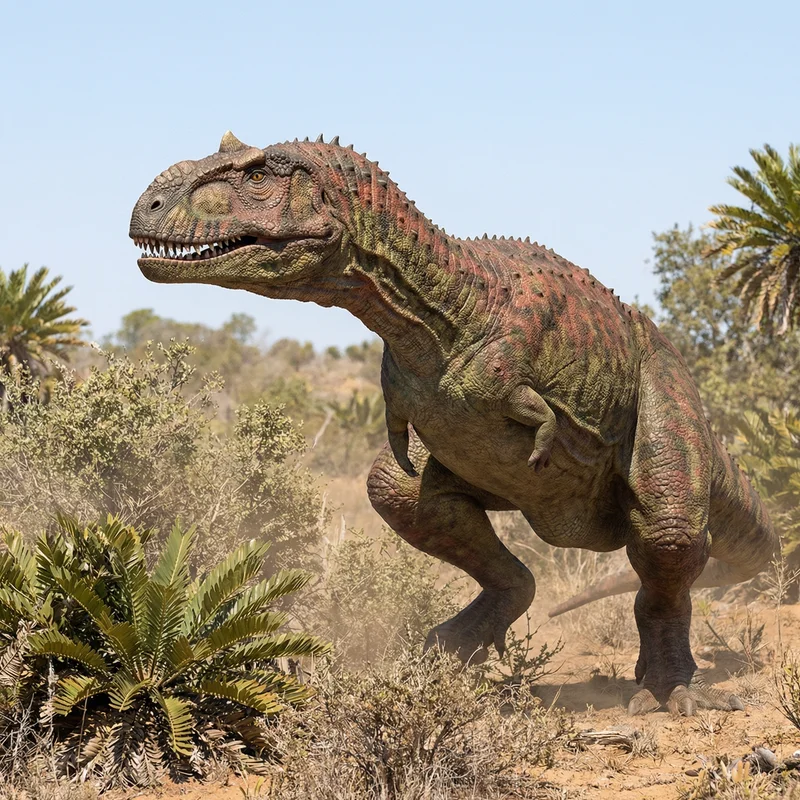
Majungasaurus (Majungasaurus crenatissimus (Depéret, 1896) Lavocat, 1955) is an abelisaurid theropod dinosaur from the Late Cretaceous Maastrichtian stage (approximately 70–66 Ma) of Madagascar. As one of the last non-avian dinosaurs to survive until the K-Pg mass extinction, it was the apex predator of its island ecosystem. This medium-sized theropod measured approximately 5.6–7 m in total length and weighed an estimated 750–1,100 kg (Sampson & Witmer, 2007; Grillo & Delcourt, 2016), with fragmentary evidence suggesting some individuals may have exceeded 8 m in length.
Majungasaurus possesses the best-known skull of any abelisaurid, characterized by a short, tall snout, extremely thickened and fused nasal bones, and a single dome-shaped horn atop the fused frontal bones. This horn was initially misidentified as a pachycephalosaur dome, leading to the erection of the separate genus Majungatholus (Sues & Taquet, 1979), before the discovery of a complete skull in 1998 revealed it to be an abelisaurid feature (Sampson et al., 1998). Tooth marks found on Majungasaurus bones that match the dentition of Majungasaurus itself represent the clearest direct evidence of cannibalism in any non-avian dinosaur (Rogers et al., 2003).
The Maevarano Formation, where Majungasaurus fossils are found, records a semi-arid, strongly seasonal climate. High mortality during the dry season followed by rapid burial under debris flows at the onset of the wet season produced the exceptional fossil preservation that has made Majungasaurus one of the most thoroughly studied theropods from the Southern Hemisphere (Rogers, 2005; Krause et al., 2007). Additionally, pneumatic structures in the vertebrae of Majungasaurus provided key evidence that an avian-style air sac system and flow-through ventilation existed early in theropod evolution, long before the appearance of birds (O'Connor & Claessens, 2005).
Overview
Name and Etymology
The genus name Majungasaurus combines an older French spelling of Madagascar's northwestern city Mahajanga — "Majunga" — with the Greek sauros (σαῦρος, 'lizard'), meaning "Mahajanga lizard" (Lavocat, 1955). The species name crenatissimus is the superlative form of the Latin crenatus ('notched' or 'serrated'), referring to the finely serrated anterior and posterior edges of the teeth (Depéret, 1896).
Taxonomic Status and Synonymy
Majungasaurus is classified within Saurischia, Theropoda, Ceratosauria, Abelisauroidea, Abelisauridae. Only a single valid species, M. crenatissimus, is recognized.
The species was originally described by Depéret (1896) as Megalosaurus crenatissimus, based on fragmentary material — two teeth, a claw bone (ungual phalanx), and two partial vertebrae — collected by a French army officer along the Betsiboka River in northwestern Madagascar and deposited at the Université Claude Bernard Lyon 1. In 1955, René Lavocat described a theropod dentary with teeth (MNHN.MAJ 1) from the Maevarano Formation in the same region, erecting the new genus Majungasaurus for it. In 1979, Sues & Taquet described a dome-shaped skull fragment (MNHN.MAJ 4) as a new pachycephalosaur, Majungatholus atopus — reported as the first pachycephalosaur from the Southern Hemisphere. However, the 1996 discovery of a spectacularly complete skull (FMNH PR 2100) revealed that the "dome" was in fact the frontal horn of an abelisaurid (Sampson et al., 1998). Majungatholus atopus was subsequently synonymized with Majungasaurus crenatissimus. A 2009 ICZN petition (Carrano et al., 2009) and the resulting Opinion 2269 (2011) designated Lavocat's dentary (MNHN.MAJ 1) as the neotype specimen.
One-Line Summary
Majungasaurus is the apex predator of latest Cretaceous Madagascar, the only non-avian theropod with confirmed fossil evidence of cannibalism, and the most thoroughly studied member of Abelisauridae.
Age, Stratigraphy, and Depositional Setting
Temporal Range
All Majungasaurus fossils derive from Maastrichtian-aged deposits (approximately 72.2–66 Ma). According to PBDB records, all occurrences fall within this interval. Biostratigraphy and paleomagnetic data confirm the Anembalemba Member of the Maevarano Formation as the principal fossiliferous horizon, with isolated teeth occurring up to the very end of the Maastrichtian, immediately before the K-Pg boundary (Rogers et al., 2007; Krause et al., 2007).
Formation and Lithology
Nearly all Majungasaurus specimens were collected from the Maevarano Formation in Mahajanga Province, northwestern Madagascar. The formation is dominated by sandstones and mudstones recording seasonal fluvial environments.
| Formation Member | Lithology | Fossil Yield |
|---|---|---|
| Anembalemba Member | Sandy channel and floodplain deposits | Most complete specimens |
| Masorobe Member | Lower sandstones | Isolated teeth |
| Miadana Member | Upper mudstones (including tidal deposits) | Isolated teeth |
Depositional Environment and Paleoenvironment
The Maevarano Formation records a semi-arid, strongly seasonal climate. During the dry season, water stress led to elevated mortality rates. At the onset of the wet season, violent debris flows surged through river channels, rapidly burying carcasses and enabling exceptional fossil preservation — in some cases even preserving soft tissues (Rogers, 2005). According to GPlates paleogeographic reconstructions in the PBDB, Madagascar was positioned at approximately 36.6°S paleolatitude and 43.8°E paleolongitude during the Maastrichtian — over 20° further south than its present position (approximately 15.7°S), corresponding roughly to the latitude of modern southern South Africa. Madagascar had separated from the Indian subcontinent less than 20 million years earlier and was drifting northward. Rising sea levels meant that coastal environments such as tidal flats were also accessible to Majungasaurus. The neighboring Berivotra Formation records the contemporaneous marine setting (Rogers et al., 2007).
Specimens and Diagnostic Features
Key Specimens
Majungasaurus has the most complete fossil record of any abelisaurid. Since the Mahajanga Basin Project began in 1993, tens of thousands of fossils have been recovered, representing individuals ranging from juveniles to adults and spanning nearly the entire skeleton, although most of the forelimbs, pelvis, and tail tip remain unknown (Krause et al., 2007).
| Specimen | Institution | Elements | Notes |
|---|---|---|---|
| MNHN.MAJ 1 (neotype) | Muséum National d'Histoire Naturelle, Paris | Dentary with teeth | Described by Lavocat (1955); designated neotype by ICZN Opinion 2269 (2011) |
| FMNH PR 2100 | Field Museum, Chicago | Nearly complete skull | Discovered 1996; most complete skull; basis for CT scanning studies |
| UA 8678 | Université d'Antananarivo | Vertebral series | Basis for air sac/respiratory system study (O'Connor & Claessens, 2005) |
| MNHN.MAJ 4 | MNHN, Paris | Skull dome fragment | Originally described as Majungatholus atopus (Sues & Taquet, 1979) |
| FMNH PR 2836 | Field Museum, Chicago | Nearly complete skeleton | Multiple pathologies documented (Gutherz et al., 2020) |
| FMNH PR 2294 | Field Museum, Chicago | Caudal vertebral series | Tail truncation pathology (Farke & O'Connor, 2007) |
Diagnostic Features
Key features distinguishing Majungasaurus from other abelisaurids (Sampson & Witmer, 2007) include the following.
Regarding the skull: it is markedly wider than in other abelisaurids. The nasal bones are extremely thickened and fused, forming a low median ridge on the snout. A single dome-shaped horn projects from the fused frontal bones; CT scanning reveals hollow sinus cavities within both the nasal structure and the frontal horn. Large individuals had skulls measuring 60–70 cm in length.
Regarding the dentition: there are 17 teeth in both the maxilla and dentary — more than in any other abelisaurid except Rugops (Smith, 2007). Tooth crowns are short with fine serrations on both anterior and posterior edges.
Regarding the limbs: the forelimbs are extremely reduced, with a short, curved humerus. The hand bears four metacarpals and four highly vestigial digits (minimum phalangeal formula 1-2-1-1), with fused finger bones and probable absence of claws (Burch & Carrano, 2012). The hindlimbs are short and robust, with a tibia even stockier than that of Carnotaurus and a prominent crest at the knee (Carrano, 2007).
Morphology and Function
Body Size
Typical adult Majungasaurus measured 5.6–7 m in total length and weighed 750–1,100 kg (Grillo & Delcourt, 2016; Paul, 2016). Sampson & Witmer (2007) estimated an average adult body mass of approximately 1,130 kg. Fragmentary remains of larger individuals suggest that some may have approached 8 m in length, rivaling the closely related Carnotaurus. Osteohistological studies reveal that Majungasaurus was among the slowest-growing theropods, requiring approximately 20 years to reach skeletal maturity (Ratsimbaholison et al., 2016). The maximum relative growth rate was estimated at approximately 13% of total body mass per year, or roughly 117 kg annually.
Skull and Frontal Horn
The skull of Majungasaurus exhibits the typical abelisaurid morphology — short, tall, and blunt-snouted — but is notably wider than in other genera. The tall premaxilla creates an exceptionally blunt snout tip. The nasal bones are fused and thickened, forming a rugose median ridge, while a single dome-shaped horn projects from the frontal bones. This structure was famously misidentified as a pachycephalosaur dome (Sues & Taquet, 1979) until the complete skull (FMNH PR 2100) revealed it as an abelisaurid feature (Sampson et al., 1998).
CT scanning revealed hollow sinus cavities within both the nasal structure and the frontal horn, implying they functioned to reduce weight. This hollow construction indicates the horn was structurally too weak for direct physical combat (e.g., head-butting), and it likely served a display or species-recognition function (Tykoski & Rowe, 2004; Sampson & Witmer, 2007). While individual variation in ornamentation exists, no evidence of sexual dimorphism has been found.
Forelimbs and Hands
The forelimbs of Majungasaurus are extremely reduced, convergently similar in degree to those of tyrannosaurids but morphologically distinct. The humerus is short and curved, comparable to those of Aucasaurus and Carnotaurus. The articulated forelimb specimen described by Burch & Carrano (2012) revealed a robust but short forearm and a hand with four metacarpals and four highly vestigial, probably inflexible digits (minimum phalangeal formula 1-2-1-1). Majungasaurine hand bones lack the characteristic pits and grooves for claw and tendon attachment (Agnolin & Chiarelli, 2009), indicating the hand was effectively non-functional. This convergent reduction in both abelisaurids and tyrannosaurids is interpreted as a result of both lineages independently evolving skull-dominated predation strategies.
Hindlimbs and Locomotion
The hindlimbs are short and robust, with a body-length ratio lower than in most other theropods. The tibia is even stockier than in Carnotaurus, with a prominent crest at the knee. The astragalus and calcaneum are fused, and the foot had three functional digits, with a reduced first digit not contacting the ground (Carrano, 2007). This anatomy suggests optimization for power rather than speed. Maximum speed was likely below 24 km/h (15 mph), but this would have been more than adequate for pursuing slow-moving sauropods.
Brain and Inner Ear
CT scanning of the complete skull (FMNH PR 2100) permitted reconstruction of the brain and inner ear. The brain was very small relative to body size but otherwise similar to that of other non-coelurosaurian theropods, with a conservative morphology closer to modern crocodilians than to birds. The flocculus of the cerebellum was notably small, suggesting Majungasaurus and other abelisaurids did not rely on rapid, gaze-stabilizing head movements to track prey. Analysis of the lateral semicircular canal revealed that in the alert posture, the skull was held nearly horizontal — contrasting with many other theropods whose heads were more strongly downturned (Sampson & Witmer, 2007).
Respiratory System
A superbly preserved vertebral series (UA 8678) revealed pneumatic foramina in the cervical vertebrae and some ribs. By analogy with modern birds — where cervical air sacs pneumatize neck vertebrae, the lung pneumatizes upper dorsal vertebrae, and abdominal air sacs pneumatize lower dorsal and sacral vertebrae — similar patterns in Majungasaurus imply the presence of an avian-style air sac system and a basic form of flow-through ventilation (O'Connor & Claessens, 2005). Because the ceratosaur lineage (including Majungasaurus) diverged from the tetanuran lineage (including birds) very early in theropod evolution, the avian respiratory system must have evolved before this split, well before the emergence of birds themselves — a critical piece of evidence supporting the dinosaurian origin of birds.
Diet and Ecology
Feeding Strategy: The 'Bite-and-Hold' Hypothesis
Unlike most theropods, which had long, narrow skulls adapted for delivering multiple bites, abelisaurids — especially Majungasaurus — possessed short, broad skulls that may have been adapted for a feeding strategy more analogous to modern felids: biting once and holding on until the prey is subdued (Sampson & Witmer, 2007). Multiple anatomical features support this hypothesis.
Regarding neck reinforcement: the cervical vertebrae are robust with interlocking ribs and ossified tendons, and the skull base and vertebrae have reinforced muscle attachment sites — all of which would have allowed the head to be held steady despite the struggles of prey.
Regarding mandibular flexibility: the lower jaw features large fenestrae and synovial joints between certain bones, providing flexibility that may have prevented jaw fracture when holding struggling prey.
Regarding tooth morphology: the low crown height made teeth resistant to breakage. The anterior upper jaw teeth were more robust, providing anchor points. Unlike most theropods whose teeth are curved on both edges, abelisaurid teeth are curved on the front edge but straighter on the back (cutting) edge — a form better suited to holding rather than slicing.
A January 2026 finite element analysis by Rowe, Cerroni & Rayfield, using 3D models of ceratosaurian skulls including Majungasaurus, found that Majungasaurus exhibited relatively lower cranial stresses at the anterior than expected given its size, suggesting its skull was mechanically robust under sustained loading. Its mandible, however, showed very high stresses consistent with resisting prey struggling. These results support the functional plausibility of bite-and-hold feeding. The study also demonstrated that large abelisaurids converged on biomechanical and ecological roles comparable to those of Northern Hemisphere tyrannosaurids (Rowe et al., 2026).
Majungasaurus replaced its teeth approximately every 56 days — 2 to 13 times faster than other theropods (D'Emic et al., 2019). For comparison, Tyrannosaurus replaced its teeth approximately every 777 days. This rapid replacement rate may be linked to bone-gnawing behavior.
Prey and Cannibalism
Majungasaurus was the sole large predator in its ecosystem, and its primary prey likely consisted of titanosaurian sauropods such as Rapetosaurus. Tooth marks matching Majungasaurus dentition have been confirmed on Rapetosaurus bones, demonstrating that it at least fed on sauropods (Rogers et al., 2003).
More remarkably, Majungasaurus bones bear tooth marks identical in spacing, size, and serration imprints to those found on sauropod bones from the same localities. As Majungasaurus is the only large theropod known from the area, these marks constitute the most compelling direct evidence of cannibalism in any non-avian dinosaur (Rogers et al., 2003). Earlier claims that Coelophysis was cannibalistic were refuted by Nesbitt et al. (2006), leaving Majungasaurus as the only confirmed case. Whether this cannibalism involved active hunting or scavenging of conspecific carcasses remains uncertain. Modern Komodo monitors sometimes kill rivals competing for carcass access and subsequently cannibalize them, which has been proposed as an analogous behavior (Roach & Brinkman, 2007).
Ecological Role
Majungasaurus was the apex terrestrial predator of the Maevarano Formation ecosystem. Other theropods present — the small noasaurid Masiakasaurus and the possibly volant dromaeosaurid Rahonavis — were far smaller. The only large herbivores were titanosaurian sauropods (including Rapetosaurus), which may have driven the evolution of abelisaurids as sauropod specialists.
Aquatic competitors included large crocodylomorphs such as Mahajangasuchus and Trematochampsa, with at least seven distinct crocodylomorph species known from the formation. The giant snake Madtsoia madagascariensis may have preyed on subadult Majungasaurus. The broader fauna also included frogs (including the giant Beelzebufo), lizards, five to six mammal species, and multiple bird species including Vorona.
Pathology
Pathology in Majungasaurus was the subject of the first systematic study of disease and injury in any abelisauroid (Farke & O'Connor, 2007). Of at least 21 individuals examined, four exhibited notable pathologies. No wounds were found on skull elements — a contrast to tyrannosaurids, where facial bite wounds are common.
The most severe pathology involved a series of five large caudal vertebrae (FMNH PR 2294). The first two showed only minor abnormalities, but the posterior three were completely fused at multiple points into a solid bony mass. No vertebrae were preserved beyond the fifth, indicating premature tail termination. Based on vertebral size, approximately ten vertebrae were lost. This is interpreted as either severe physical trauma followed by osteomyelitis (bone infection), or primary infection leading to necrosis and loss of the tail tip. This represents the first documented case of tail truncation in a non-avian theropod (Farke & O'Connor, 2007).
Gutherz et al. (2020) subsequently reported multiple pathologies — including infections, deformities, and trauma — in a nearly complete skeleton (FMNH PR 2836), demonstrating that some individuals survived numerous injuries over their lifetimes. Overall, most well-preserved individuals lack observable pathology, while a few individuals exhibit multiple pathologies concentrated in a single specimen, a pattern suggesting a 'snowball effect' where an initial injury increases susceptibility to further maladies.
Growth and Ontogeny
Majungasaurus is well suited for ontogenetic studies thanks to the availability of specimens spanning a wide range of ages. Throughout growth, the skull (particularly the jugal, postorbital, and quadratojugal) became taller and more robust, skull bones became more fused, and the eye sockets became proportionally smaller — indicating a shift in dietary preferences between juveniles and adults (Ratsimbaholison et al., 2016).
Osteohistological analysis of lines of arrested growth (LAGs) reveals that Majungasaurus was among the slowest-growing theropods known, requiring approximately 20 years to reach skeletal maturity. This slow growth may reflect the harsh, resource-limited semi-arid environment. However, comparably slow growth rates have been documented in other abelisaurids, suggesting that phylogenetic (genetic) factors also contributed.
Distribution and Paleogeography
All Majungasaurus fossils are known exclusively from the Maevarano Formation in Mahajanga Province, northwestern Madagascar. The PBDB records more than 25 occurrences, all concentrated in this region.
During the Maastrichtian, Madagascar had separated from the Indian subcontinent approximately 20 million years earlier. GPlates paleogeographic reconstructions yield a paleolatitude of approximately 36.6°S and paleolongitude of approximately 43.8°E — over 20° further south than Madagascar's present position. This latitude corresponds to modern southern South Africa, consistent with the semi-arid seasonal climate recorded by the Maevarano Formation.
Phylogenetic analyses consistently recover Majungasaurus as more closely related to Indian abelisaurids (Rajasaurus, Indosaurus, Rahiolisaurus) than to South American (Carnotaurus, Aucasaurus) or mainland African (Rugops) forms (Tortosa et al., 2013). This pattern implies that a biogeographic connection persisted between Madagascar and India for some time after their separation, and that eastern Gondwanan (Madagascar + India) and western Gondwanan (South America + Africa) abelisaurid lineages diversified independently — a key piece of evidence for understanding Gondwanan fragmentation and Late Cretaceous faunal distributions.
Phylogeny and Systematic Debates
Position Within Abelisauridae
Majungasaurus belongs to Abelisauridae, which together with Noasauridae forms Abelisauroidea within Ceratosauria. Early cladistic analyses suggested a sister-group relationship with South American Carnotaurus (Sereno et al., 2004), while some analyses could not firmly resolve its position (Coria et al., 2002). The most comprehensive analysis, by Tortosa et al. (2013), recovered Majungasaurus in a clade with Indian taxa (Rajasaurus, Indosaurus, Rahiolisaurus) and the southern French Arcovenator, forming the subfamily Majungasaurinae — distinct from the South American Carnotaurinae (Carnotaurus, Aucasaurus, Abelisaurus, etc.).
Biogeographic Implications
The close relationship between Majungasaurus and Indian abelisaurids, along with the inclusion of the Provençal Arcovenator, suggests an eastern Gondwanan dispersal pathway — from India through Madagascar and potentially to Europe via India. This is critical evidence for understanding Late Cretaceous faunal exchange and the sequential fragmentation of Gondwana.
Restoration and Uncertainty
Confirmed
Majungasaurus was a medium-sized abelisaurid theropod (5.6–7 m, 750–1,100 kg). Fossil evidence confirms cannibalism (tooth mark analysis). A single dome-shaped horn atop the skull is internally hollow, precluding use in head-butting. The forelimbs were extremely reduced with four digits and probable absence of claws. It was the apex predator of a semi-arid, seasonal environment. Growth was very slow, taking approximately 20 years to maturity. An avian-style air sac system is documented from vertebral pneumaticity.
Probable Hypotheses / Uncertainties
The 'bite-and-hold' feeding strategy is well supported by anatomy and recent FEA (Rowe et al., 2026), but direct behavioral evidence is lacking. The function of cranial ornaments is most likely display or species recognition, but with no sexual dimorphism detected, the precise function remains uncertain. Whether cannibalism resulted from food stress during dry seasons, carcass competition, or routine behavior is unknown. The existence of 8+ m individuals is suggested by fragmentary material but not confirmed.
Common Misconceptions
"Head-butting combat": The frontal horn is internally hollow and structurally unsuited for direct impact. It is an entirely different structure from the dense bone domes of pachycephalosaurs. "Ornithischian dinosaur": Majungasaurus is a saurischian theropod, not an ornithischian. "Majungatholus as a separate animal": Majungatholus atopus is a junior synonym of Majungasaurus crenatissimus.
Comparison With Related Taxa
| Taxon | Body Length | Body Mass | Forelimbs | Cranial Ornament | Age and Locality |
|---|---|---|---|---|---|
| Majungasaurus crenatissimus | 5.6–7 (~8?) m | 750–1,100 kg | Extremely reduced, 4 digits | Single median dome-horn | Maastrichtian, Madagascar |
| Carnotaurus sastrei | ~7.5 m | ~1,300 kg | Extremely reduced, 4 digits | Paired lateral horns | Maastrichtian, Argentina |
| Rajasaurus narmadensis | ~6.6 m | ~1,000 kg (est.) | Incomplete | Single nasal horn | Maastrichtian, India |
| Rugops primus | ~6 m | Unknown | Incomplete | Skull roof pits and ridges | Cenomanian, Niger |
| Arcovenator escotae | ~5 m (est.) | Unknown | Incomplete | Unknown | Campanian–Maastrichtian, France |
Fun Facts
FAQ
📚References
- Depéret, C. (1896). Note sur les Dinosauriens Sauropodes et Théropodes du Crétacé supérieur de Madagascar. Bulletin de la Société Géologique de France, 21, 176–194.
- Lavocat, R. (1955). Sur une portion de mandibule de Théropode provenant du Crétacé supérieur de Madagascar. Bulletin du Muséum National d'Histoire Naturelle, 27, 256–259.
- Sues, H.-D. & Taquet, P. (1979). A pachycephalosaurid dinosaur from Madagascar and a Laurasia−Gondwanaland connection in the Cretaceous. Nature, 279, 633–635. https://doi.org/10.1038/279633a0
- Sampson, S.D., Krause, D.W., Dodson, P. & Forster, C.A. (1996). The premaxilla of Majungasaurus (Dinosauria: Theropoda), with implications for Gondwanan paleobiogeography. Journal of Vertebrate Paleontology, 16(4), 601–605. https://doi.org/10.1080/02724634.1996.10011350
- Sampson, S.D. et al. (1998). Predatory Dinosaur Remains from Madagascar: Implications for the Cretaceous Biogeography of Gondwana. Science, 280(5366), 1048–1051. https://doi.org/10.1126/science.280.5366.1048
- Rogers, R.R., Krause, D.W. & Curry Rogers, K. (2003). Cannibalism in the Madagascan dinosaur Majungatholus atopus. Nature, 422(6931), 515–518. https://doi.org/10.1038/nature01532
- O'Connor, P.M. & Claessens, L.P.A.M. (2005). Basic avian pulmonary design and flow-through ventilation in non-avian theropod dinosaurs. Nature, 436, 253–256. https://doi.org/10.1038/nature03716
- Rogers, R.R. (2005). Fine-grained debris flows and extraordinary vertebrate burials in the Late Cretaceous of Madagascar. Geology, 33(4), 297–300. https://doi.org/10.1130/G21036.1
- Nesbitt, S.J., Turner, A.H., Erickson, G.M. & Norell, M.A. (2006). Prey choice and cannibalistic behaviour in the theropod Coelophysis. Biology Letters, 2(4), 611–614. https://doi.org/10.1098/rsbl.2006.0524
- Krause, D.W., Sampson, S.D., Carrano, M.T. & O'Connor, P.M. (2007). Overview of the history of discovery, taxonomy, phylogeny, and biogeography of Majungasaurus crenatissimus. Journal of Vertebrate Paleontology, 27(Suppl. 2), 1–20. https://doi.org/10.1671/0272-4634(2007)27[1:OOTHOD]2.0.CO;2
- Sampson, S.D. & Witmer, L.M. (2007). Craniofacial anatomy of Majungasaurus crenatissimus (Theropoda: Abelisauridae) from the Late Cretaceous of Madagascar. Journal of Vertebrate Paleontology, 27(Suppl. 2), 32–102. https://doi.org/10.1671/0272-4634(2007)27[32:CAOMCT]2.0.CO;2
- Smith, J.B. (2007). Dental morphology and variation in Majungasaurus crenatissimus. Journal of Vertebrate Paleontology, 27(Suppl. 2), 103–126.
- O'Connor, P.M. (2007). The postcranial axial skeleton of Majungasaurus crenatissimus. Journal of Vertebrate Paleontology, 27(Suppl. 2), 127–162.
- Carrano, M.T. (2007). The appendicular skeleton of Majungasaurus crenatissimus. Journal of Vertebrate Paleontology, 27(Suppl. 2), 163–179.
- Farke, A.A. & O'Connor, P.M. (2007). Pathology in Majungasaurus crenatissimus (Theropoda: Abelisauridae) from the Late Cretaceous of Madagascar. Journal of Vertebrate Paleontology, 27(Suppl. 2), 180–184.
- Rogers, R.R., Krause, D.W., Curry Rogers, K., Rasoamiaramanana, A.H. & Rahantarisoa, L. (2007). Paleoenvironment and paleoecology of Majungasaurus crenatissimus. Journal of Vertebrate Paleontology, 27(Suppl. 2), 21–31.
- Roach, B.T. & Brinkman, D.T. (2007). A reevaluation of cooperative pack hunting and gregariousness in Deinonychus antirrhopus and other non-avian theropod dinosaurs. Bulletin of the Peabody Museum of Natural History, 48(1), 103–138.
- Tykoski, R.B. & Rowe, T. (2004). Ceratosauria. In Weishampel, D.B., Dodson, P. & Osmólska, H. (eds.), The Dinosauria (2nd ed., pp. 47–70). University of California Press.
- Agnolin, F.L. & Chiarelli, P. (2009). The position of the claws in Noasauridae (Dinosauria: Abelisauroidea) and its implications for abelisauroid manus evolution. Paläontologische Zeitschrift, 84(2), 293–300. https://doi.org/10.1007/s12542-009-0044-2
- Carrano, M.T., Krause, D.W., O'Connor, P.M. & Sampson, S.D. (2009). Case 3487: Megalosaurus crenatissimus Depéret, 1896: proposed replacement of the holotype by a neotype. Bulletin of Zoological Nomenclature, 66(3), 261–264.
- Opinion 2269 (Case 3487). (2011). Megalosaurus crenatissimus Depéret, 1896: designation of a neotype. Bulletin of Zoological Nomenclature, 68(1), 89–90.
- Burch, S.H. & Carrano, M.T. (2012). An articulated pectoral girdle and forelimb of the abelisaurid theropod Majungasaurus crenatissimus from the Late Cretaceous of Madagascar. Journal of Vertebrate Paleontology, 32(1), 1–16. https://doi.org/10.1080/02724634.2012.622027
- Tortosa, T. et al. (2013). A new abelisaurid dinosaur from the Late Cretaceous of southern France: Palaeobiogeographical implications. Annales de Paléontologie, 100(1), 63–86. https://doi.org/10.1016/j.annpal.2013.10.003
- Grillo, O.N. & Delcourt, R. (2016). Allometry and body length of abelisauroid theropods: Pycnonemosaurus nevesi is the new king. Cretaceous Research, 69, 71–89. https://doi.org/10.1016/j.cretres.2016.09.001
- Paul, G.S. (2016). The Princeton Field Guide to Dinosaurs (2nd ed.). Princeton University Press.
- Ratsimbaholison, N.O., Felice, R.N. & O'Connor, P.M. (2016). Ontogenetic changes in the craniomandibular skeleton of the abelisaurid dinosaur Majungasaurus crenatissimus from the Late Cretaceous of Madagascar. Acta Palaeontologica Polonica, 61(2), 281–292. https://doi.org/10.4202/app.00132.2014
- D'Emic, M.D. et al. (2019). Evolution of high tooth replacement rates in theropod dinosaurs. PLOS ONE, 14(11), e0224734. https://doi.org/10.1371/journal.pone.0224734
- Gutherz, S.B., Groenke, J.R., Sertich, J.J.W., Burch, S.H. & O'Connor, P.M. (2020). Paleopathology in a nearly complete skeleton of Majungasaurus crenatissimus (Theropoda: Abelisauridae). Cretaceous Research, 115, 104553. https://doi.org/10.1016/j.cretres.2020.104553
- Rowe, A.J., Cerroni, M.A. & Rayfield, E.J. (2026). Southern hemisphere ceratosaurs evolved feeding mechanics paralleling those of Northern hemisphere tyrannosaurids. Scientific Reports, 16, 2804. https://doi.org/10.1038/s41598-025-32686-4
Gallery
5 images Majungasaurus
Majungasaurus · Cretaceous Period · Carnivore
 Majungasaurus
Majungasaurus · Cretaceous Period · Carnivore
 Majungasaurus
Majungasaurus · Cretaceous Period · Carnivore
 Majungasaurus
Majungasaurus · Cretaceous Period · Carnivore
 Majungasaurus
Majungasaurus · Cretaceous Period · Carnivore
🔗Related Creatures

Velociraptor
Velociraptor mongoliensis

Giganotosaurus
Giganotosaurus carolinii

Carcharodontosaurus
Carcharodontosaurus saharicus
Acrocanthosaurus
Acrocanthosaurus atokensis

Tarbosaurus
Tarbosaurus bataar
Rajasaurus
Rajasaurus narmadensis

Tyrannosaurus Rex
Tyrannosaurus rex
Concavenator
Concavenator corcovatus