Abelisaurus
Cretaceous Period Carnivore Creature Type
Abelisaurus comahuensis
Scientific Name: "Abelisaurus: Greek sauros (lizard) + Roberto Abel (discoverer and former director of the Cipolletti Provincial Museum); comahuensis: referring to the Comahue region of Argentina"
Local Name: Abelisaurus
Physical Characteristics
Discovery
Habitat
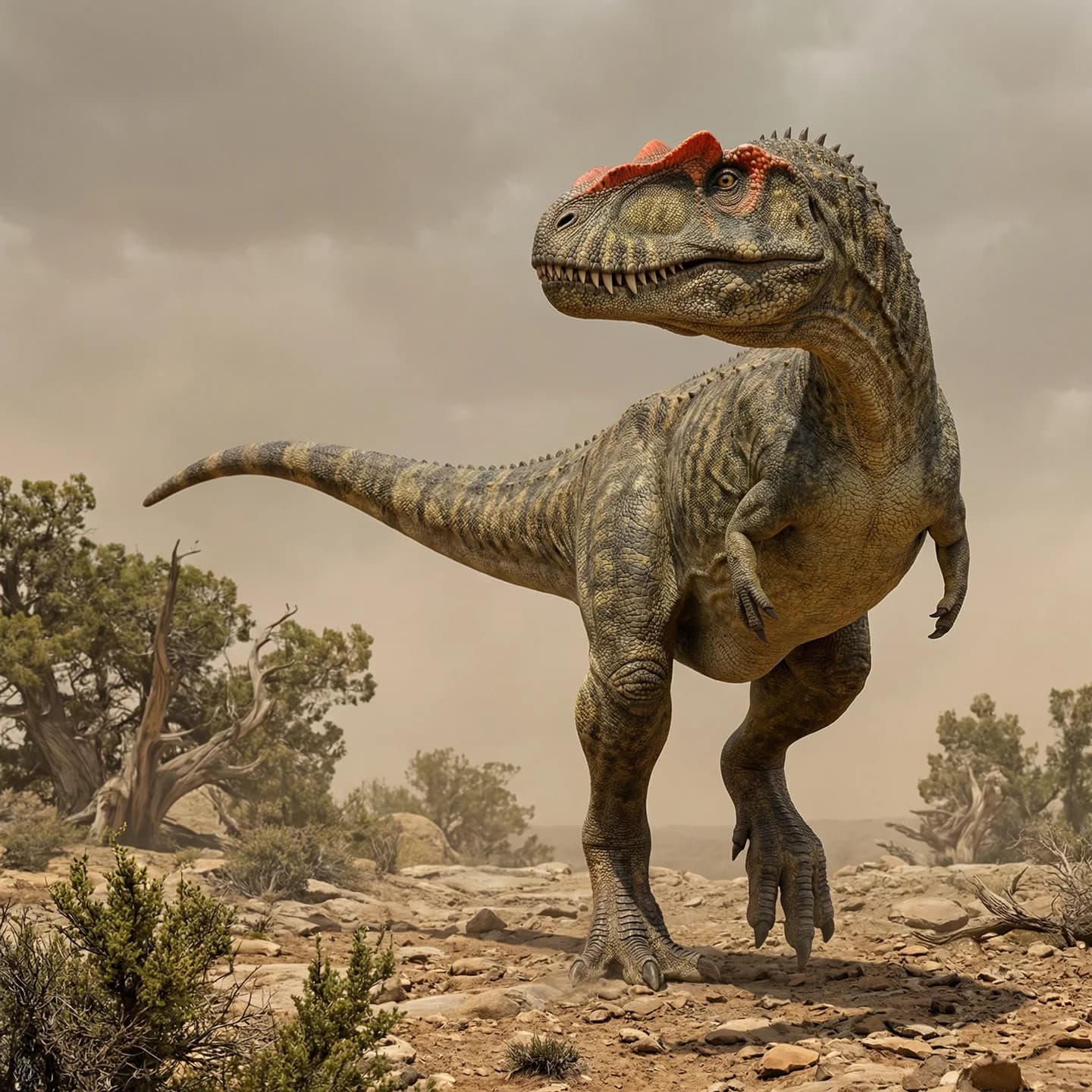
Abelisaurus comahuensis Bonaparte & Novas, 1985 is a large abelisaurid theropod dinosaur from the Late Cretaceous Campanian stage (approximately 83–80 Ma) of what is now Patagonia, Argentina. It holds considerable historical importance as the first genus named within the family Abelisauridae and the taxon from which the entire family derives its name. The only known fossil is a single incomplete skull lacking the lower jaws (holotype MC 11098), which means that virtually all estimates of body size, proportions, and postcranial anatomy carry substantial uncertainty.
The skull is estimated at roughly 85 cm in length and is characterised by its relatively deep and broad construction, rugose ridges on the snout and above the eyes, a thickened skull roof, and large triangular fenestrae — the antorbital fenestra in the snout and the infratemporal fenestra behind the orbit. Unlike some other abelisaurids such as Carnotaurus, Abelisaurus lacks bony horns or prominent crests, though the rugose ridges may have supported keratinous structures in life. Body length has been most recently estimated at approximately 7.2–7.4 m with a mass of roughly 1.65 tonnes (Grillo & Delcourt, 2016; Molina-Pérez & Larramendi, 2016), significantly smaller than earlier estimates of 10 m and 3 tonnes (Paul, 2010).
Phylogenetically, Abelisaurus is placed within the Abelisauridae as part of Furileusauria and the tribe Carnotaurini, closely related to Aucasaurus and Carnotaurus (Gianechini et al., 2021). Originally classified as a carnosaur by Bonaparte & Novas (1985), abelisaurids were subsequently recognised as ceratosaurians (Neoceratosauria), a lineage entirely separate from the allosauroid carnosaurs and tyrannosaurid coelurosaurs of the Northern Hemisphere. As a representative of the dominant large predator clade of Gondwana during the Cretaceous, Abelisaurus exemplifies the independent evolutionary trajectories of Southern and Northern Hemisphere theropod faunas.
Overview
Name and Etymology
The generic name Abelisaurus combines the surname of Roberto Abel — who discovered the holotype and served as the former director of the provincial Museum of Cipolletti (now the Museo Provincial Carlos Ameghino) in Río Negro Province, Argentina — with the Greek sauros (σαῦρος, 'lizard'), meaning 'Abel's lizard'. The specific epithet comahuensis refers to the Comahue region of Argentina where the fossil was found (Bonaparte & Novas, 1985).
Taxonomic Status and Validity
Abelisaurus has been considered a valid genus since its original description in 1985. However, the fact that it is known from only a single incomplete skull limits its diagnostic resolution. In 2009, Novas suggested that Aucasaurus garridoi might represent a junior synonym of Abelisaurus comahuensis, and in 2010 Paul formally recombined it as Abelisaurus garridoi. This synonymy has not found acceptance in the broader palaeontological community, and both genera are generally treated as distinct.
Scientific Significance
Abelisaurus is the founding member and namesake of the Abelisauridae. When Bonaparte & Novas (1985) described the genus, they simultaneously erected the family Abelisauridae to accommodate it. The subsequent discovery of far more complete abelisaurids — Carnotaurus, Majungasaurus, Aucasaurus, Skorpiovenator, among others — has greatly expanded understanding of the family's anatomy, diversity, and evolutionary history, but Abelisaurus retains its historical significance as the taxon that initiated this research programme.
Age, Stratigraphy, and Depositional Environment
Temporal Range
The age of Abelisaurus corresponds to the Late Cretaceous Campanian stage, broadly dated to approximately 83–80 Ma (Leanza et al., 2004). However, the stratigraphic uncertainty described below means that the precise age within the Campanian cannot be firmly established.
Formation and Stratigraphic Debate
The holotype was originally described by Bonaparte & Novas (1985) as coming from the lower part of the Allen Formation at the Lago Pellegrini sandstone quarries, General Roca Department, Río Negro Province. Subsequent research reinterpreted the strata at Lago Pellegrini as belonging to the older Anacleto Formation, the uppermost unit of the Neuquén Group's Río Colorado Subgroup (Heredia & Salgado, 1999). However, Gianechini et al. (2015) noted that the holotype is locally known to have come from the Sr. Fernández field, which is situated within the Campanian Allen Formation, making the precise stratigraphic provenance unclear. This ambiguity remains unresolved and represents a significant limitation for biostratigraphic and palaeoenvironmental interpretation.
Depositional Environment and Palaeoenvironment
The Anacleto Formation is 60–90 m thick and consists predominantly of purple to dark red claystones and mudstones, with minor sandstone and limestone intercalations. Sedimentological studies indicate deposition in low-energy fluvial systems associated with extensive alluvial plains, floodplains, and lacustrine settings (Leanza et al., 2004; Armas et al., 2014). During the Campanian, Patagonia experienced a significantly warmer and more arid to semi-arid climate than today. The presence of massive titanosaur nesting sites at the Auca Mahuevo locality within the same formation confirms a diverse and productive ecosystem.
Specimens and Diagnostic Features
Holotype
The sole known specimen, holotype MC 11098 (also cited as MPCA 11098 or MPCA-PV 11098), is an incomplete skull lacking the mandible. It was uncovered in 1983 by Roberto Abel at the "Cantera de la Pala Mecánica" quarry site at Lago Pellegrini, exploited by Abel since 1975. The skull is especially incomplete on the right side, and most of the palate is missing. Most of the connections between the snout and braincase are absent. Despite this incompleteness, overall skull length could be estimated at approximately 85 cm (Bonaparte & Novas, 1985). The specimen is housed at the Museo Provincial Carlos Ameghino, Cipolletti, Argentina.
Diagnosis
Key diagnostic features identified by Bonaparte & Novas (1985) include a relatively deep and broad skull estimated at 85 cm in length; wide lower temporal (infratemporal), antorbital, orbital, and nasal fenestrae; a robust cranial construction with a thickened skull roof; rugose ridges on the snout and above the eyes (which may have supported keratinous structures in life); a high orbit constricted in its mid-section by projections of the lacrimal (anteriorly) and postorbital (posteriorly) bones, with the eye positioned above the constriction; and a large triangular infratemporal fenestra whose shape reflects a strong forward inclination of the occiput.
Limitations of the Material
The most significant limitation is the total absence of postcranial material. No vertebrae, limb bones, girdle elements, or tail elements are known for Abelisaurus. This means that the degree of forelimb reduction, hindlimb proportions, tail length, and overall body shape cannot be directly confirmed. All body size and mass estimates are derived entirely from skull-to-body scaling relationships calibrated against more complete abelisaurids, introducing considerable uncertainty.
| Specimen | Elements | Locality | Formation | Notes |
|---|---|---|---|---|
| MC 11098 (= MPCA 11098) | Incomplete skull (mandible absent, right side incomplete, most of palate missing) | Lago Pellegrini, Río Negro Province, Argentina | Anacleto Fm or Allen Fm (debated) | Holotype; Bonaparte & Novas, 1985 |
Morphology and Function
Skull Morphology
The skull of Abelisaurus is estimated at approximately 85 cm in length and is relatively short and deep — a characteristic shared broadly across the Abelisauridae and contrasting with the more elongated skulls of carcharodontosaurids and tyrannosaurids. The posterior portion of the skull is notably broad, a feature that led Bonaparte & Novas (1985) to draw functional comparisons with the wide-skulled Tyrannosauridae.
No bony horns or crests are present (in contrast to the supraorbital horns of Carnotaurus), but distinct rugose ridges on the nasal and frontal regions may have anchored keratinous structures in life that would not have been preserved in the fossil record. The skull bears large fenestrae: a large triangular antorbital fenestra in the snout, a relatively tall orbit constricted by bony projections of the lacrimal and postorbital bones, and a large triangular infratemporal fenestra behind the orbit. These openings reduced skull weight while providing extensive surfaces for jaw muscle attachment.
Dentition
The premaxilla bore four relatively small teeth. The maxilla behind it contained at least seven, and possibly as many as thirteen, larger teeth (Bonaparte & Novas, 1985). With the mandible unknown, no information is available on the lower dentition. The teeth were typical of carnivorous theropods, suited for slicing flesh.
Body Size Estimates
Because only the skull is known, body size reconstruction relies entirely on proportional comparisons with more complete abelisaurids. Size estimates have varied considerably over time.
| Study | Estimated Length | Estimated Mass | Method / Notes |
|---|---|---|---|
| Paul (2010) | ~10 m | ~3 t | High skull-to-body ratio assumed; now considered an overestimate |
| Holtz (2012) | ~11 m | — | Popular reference; likely an overestimate |
| Grillo & Delcourt (2016) | 7.4 ± 0.7 m | — | Abelisauroid allometric analysis; most systematic current estimate |
| Molina-Pérez & Larramendi (2016) | ~7.2 m | ~1.65 t | Comparative scaling with relatives |
The most widely cited current estimate is that of Grillo & Delcourt (2016), at approximately 7.4 m (with an error margin of ±0.7 m). Under this estimate, Abelisaurus ranks as the third-largest known abelisaurid, after Pycnonemosaurus (~8.9 m) and Carnotaurus (~7.8 m).
Locomotion and Functional Inference
No postcranial remains are known, so direct evidence for locomotion is absent. By analogy with close relatives Carnotaurus and Aucasaurus, which preserve robust hindlimbs and extremely reduced forelimbs, Abelisaurus was almost certainly an obligate biped with powerful legs and vestigial arms. This inference is based on shared derived features (synapomorphies) of the Abelisauridae as a whole and should be treated as a well-supported hypothesis rather than a confirmed fact.
Diet and Ecology
Diet
Abelisaurus was unambiguously a carnivore, as evidenced by its sharp, laterally compressed teeth suited for slicing flesh. The premaxillary and maxillary tooth morphology is consistent with that of other abelisaurids. No direct dietary evidence (stomach contents, coprolites, bite marks) has been found.
Ecological Role
The breadth of the posterior skull and the well-developed jaw muscle attachment surfaces led Bonaparte & Novas (1985) to interpret Abelisaurus as an apex predator in its ecosystem, analogous to the role of tyrannosaurids in Northern Hemisphere faunas. Paul (2010) suggested that Abelisaurus would have preyed upon contemporaneous titanosaurian sauropods such as Antarctosaurus, Pellegrinisaurus, Barrosasaurus, and Neuquensaurus.
Contemporary Fauna
Animals known from the Anacleto Formation (and/or the Allen Formation) that would have coexisted with Abelisaurus include titanosaurian sauropods (Neuquensaurus, Barrosasaurus, Laplatasaurus, Pitekunsaurus, Narambuenatitan), the small ornithopod Gasparinisaura, the abelisaurid Aucasaurus, the megaraptoran Aerosteon, the crocodyliform Gasparinisuchus, the large snake Dinilysia, chelid turtles, and various lizards and mammals — indicating a rich and diverse terrestrial ecosystem.
Distribution and Palaeogeography
Geographic Range
Fossils of Abelisaurus are known exclusively from the Lago Pellegrini quarries in Río Negro Province, Argentina. This locality lies on the eastern margin of the Neuquén Basin, one of the most prolific Late Cretaceous dinosaur-bearing regions in South America.
Palaeogeographic Context
The reconstructed palaeocoordinates for the Anacleto Formation are approximately 40.8°S, 53.0°W. During the Campanian, South America had already separated substantially from Africa but may have retained intermittent connections with Antarctica, India, and Madagascar. This palaeogeographic setting explains the pan-Gondwanan distribution of the Abelisauridae: the family is known from South America (Abelisaurus, Carnotaurus, Aucasaurus, Skorpiovenator), Africa (Rugops, Kryptops), Madagascar (Majungasaurus), India (Rajasaurus, Indosaurus), and Europe (Arcovenator).
Phylogeny and Classification
Original Classification and Revision
Bonaparte & Novas (1985) classified Abelisaurus as a carnosaur and erected the family Abelisauridae to accommodate it. However, the subsequent discovery of more complete abelisaurids — particularly Carnotaurus (Bonaparte, 1985) and Majungasaurus (Sampson et al., 1998) — demonstrated that abelisaurids were not carnosaurs in the modern sense but instead belonged to the Ceratosauria (specifically Neoceratosauria), a lineage entirely separate from allosauroid carnosaurs.
Recent Phylogenetic Analyses
In the phylogenetic analysis accompanying the description of the abelisaurid Llukalkan, Gianechini et al. (2021) placed Abelisaurus within the Abelisauridae as a member of Furileusauria and the tribe Carnotaurini, in a sister-group relationship with Aucasaurus, and with Carnotaurus as the outgroup to this pair. The simplified topology is: Abelisauridae > Brachyrostra > Furileusauria > Carnotaurini (Carnotaurus + (Aucasaurus + Abelisaurus)).
Alternative Hypotheses and Debates
Earlier analyses placed Abelisaurus as a basal abelisaurid outside the subfamily Carnotaurinae (Tykoski & Rowe, 2004; Sereno et al., 2004), while others found its position uncertain (Sampson et al., 1998; Lamanna et al., 2002). Notably, Novas (1997) observed that Abelisaurus shares certain skull features — such as a relative elongation — with the Carcharodontosauridae, an unrelated group, and suggested that future postcranial discoveries might reveal Abelisaurus to actually be a carcharodontosaurid. Lamanna et al. (2002) considered this unlikely, and subsequent analyses have consistently supported abelisaurid affinities. Nevertheless, the absence of postcranial material means that the phylogenetic placement of Abelisaurus cannot be considered fully resolved.
Reconstruction and Uncertainty
Confirmed, Probable, and Hypothetical
What can be confirmed about Abelisaurus is limited: it was a large theropod with a deep, broad skull approximately 85 cm long, bearing sharp carnivorous teeth, that lived during the Campanian in Patagonia, Argentina.
Probable inferences include its placement within the Abelisauridae (Carnotaurini), a body length of approximately 7–7.4 m, and extremely reduced forelimbs consistent with the abelisaurid bauplan.
Hypothetical or uncertain aspects include its precise stratigraphic provenance (Anacleto vs Allen Formation), the synonymy with Aucasaurus, specific hunting behaviours or social behaviour, the presence of keratinous crests, and integument or colouration.
Popular Media vs Scientific Consensus
Abelisaurus is frequently depicted in popular media as a massive predator reaching 10 m in length. Current scientific estimates place its body length at approximately 7–7.4 m, substantially smaller than these popularised figures. Additionally, popular reconstructions sometimes depict the skull fenestrae as exposed bony openings, whereas in life these would have been entirely covered by skin and soft tissue.
Comparison with Related and Contemporary Taxa
| Taxon | Estimated Length | Age / Formation | Key Features | Known Material |
|---|---|---|---|---|
| Abelisaurus comahuensis | ~7.2–7.4 m | Campanian; Anacleto/Allen Fm (Argentina) | No horns/crests; broad occiput | Single incomplete skull |
| Carnotaurus sastrei | ~7.8 m | Maastrichtian; La Colonia Fm (Argentina) | Two supraorbital horns; extremely reduced forelimbs | Nearly complete skeleton |
| Aucasaurus garridoi | ~6.1 m | Campanian; Anacleto Fm (Argentina) | Low projections (underdeveloped horns) | Adult skeleton |
| Pycnonemosaurus nevesi | ~8.9 m | Campanian?; Bauru Group (Brazil) | Largest known abelisaurid candidate | Incomplete postcranial material |
| Majungasaurus crenatissimus | ~6–7 m | Maastrichtian; Maevarano Fm (Madagascar) | Frontal dome; evidence of cannibalism | Multiple specimens |
Fun Facts
FAQ
📚References
- Bonaparte, J.F. & Novas, F.E. (1985). "Abelisaurus comahuensis, n.g., n.sp., Carnosauria del Crétacico Tardío de Patagonia." Ameghiniana, 21: 259–265.
- Grillo, O.N. & Delcourt, R. (2016). "Allometry and body length of abelisauroid theropods: Pycnonemosaurus nevesi is the new king." Cretaceous Research, 69: 71–89. doi:10.1016/j.cretres.2016.09.001
- Molina-Pérez, R. & Larramendi, A. (2016). Récords y curiosidades de los dinosaurios Terópodos y otros dinosauromorfos. Barcelona: Larousse. p. 257.
- Paul, G.S. (2010). The Princeton Field Guide to Dinosaurs. Princeton University Press.
- Holtz, T.R. (2012). Dinosaurs: The Most Complete, Up-to-date Encyclopedia for Dinosaur Lovers of All Ages. Random House. p. 83.
- Gianechini, F.A.; Apesteguía, S.; Landini, W.; Finotti, F.; Juárez Valieri, R.; Zandonai, F. (2015). "New abelisaurid remains from the Anacleto Formation (Upper Cretaceous), Patagonia, Argentina." Cretaceous Research, 54: 1–16. doi:10.1016/j.cretres.2014.11.009
- Gianechini, F.A.; Méndez, A.H.; Filippi, L.S.; Paulina-Carabajal, A.; Juárez-Valieri, R.D.; Garrido, A.C. (2021). "A New Furileusaurian Abelisaurid from La Invernada (Upper Cretaceous, Santonian, Bajo De La Carpa Formation), Northern Patagonia, Argentina." Journal of Vertebrate Paleontology, 40(6): e1877151. doi:10.1080/02724634.2020.1877151
- Leanza, H.A.; Apesteguía, S.; Novas, F.E.; De la Fuente, M.S. (2004). "Cretaceous terrestrial beds from the Neuquén Basin (Argentina) and their tetrapod assemblages." Cretaceous Research, 25(1): 61–87. doi:10.1016/j.cretres.2003.10.005
- Novas, F.E. (1997). "Abelisauridae." In: Currie, P.J. & Padian, K.P. (eds.), Encyclopedia of Dinosaurs. San Diego: Academic Press. pp. 1–2.
- Novas, F.E. (2009). The Age of Dinosaurs in South America. Indiana University Press. p. 281.
- Lamanna, M.C.; Martínez, R.D.; Smith, J.B. (2002). "A definitive abelisaurid theropod dinosaur from the early Late Cretaceous of Patagonia." Journal of Vertebrate Paleontology, 22(1): 58–69. doi:10.1671/0272-4634(2002)022[0058:ADATDF]2.0.CO;2
- Tykoski, R.S. & Rowe, T. (2004). "Ceratosauria." In: Weishampel, D.B.; Dodson, P.; Osmólska, H. (eds.), The Dinosauria (2nd ed.). University of California Press. pp. 47–70.
- Sereno, P.C.; Wilson, J.A.; Conrad, J.L. (2004). "New dinosaurs link southern landmasses in the Mid-Cretaceous." Proceedings of the Royal Society B, 271(1546): 1325–1330. doi:10.1098/rspb.2004.2692
- Sampson, S.D.; Witmer, L.M.; Forster, C.A.; Krause, D.A.; O'Connor, P.M.; Dodson, P.; Ravoavy, F. (1998). "Predatory Dinosaur Remains from Madagascar: Implications for the Cretaceous Biogeography of Gondwana." Science, 280(5366): 1048–1051. doi:10.1126/science.280.5366.1048
- Coria, R.A.; Chiappe, L.M.; Dingus, L. (2002). "A New Close Relative of Carnotaurus sastrei Bonaparte 1985 (Theropoda: Abelisauridae) from the Late Cretaceous of Patagonia." Journal of Vertebrate Paleontology, 22(2): 460–465.
- Armas, P.; Moreno, C.; Sánchez, M.L. (2014). "Sedimentary palaeoenvironment, petrography, provenance and diagenetic inference of the Anacleto Formation in the Neuquén Basin (Late Cretaceous, Argentina)." Journal of South American Earth Sciences, 53: 59–76. doi:10.1016/j.jsames.2014.04.002
- Baiano, M.A.; Coria, R.A.; Canale, J.I.; Gianechini, F.A. (2021). "New abelisaurid material from the Anacleto Formation (Campanian, Upper Cretaceous) of Patagonia, Argentina, shed light on the diagnosis of the Abelisauridae (Theropoda, Ceratosauria)." Journal of South American Earth Sciences, 110: 103402. doi:10.1016/j.jsames.2021.103402
Gallery
5 images Abelisaurus
Abelisaurus · Cretaceous Period · Carnivore
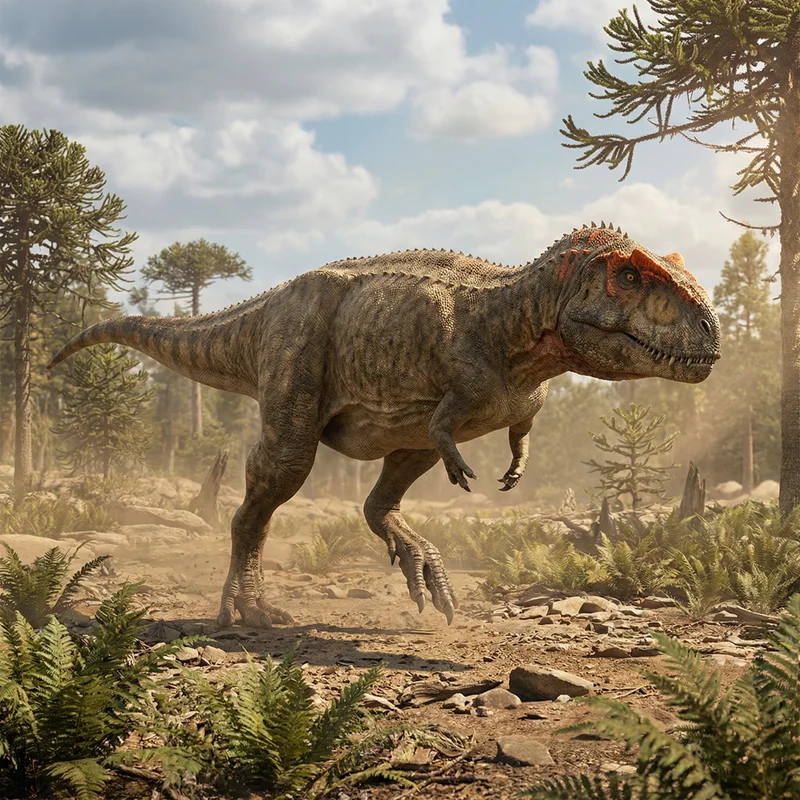 Abelisaurus
Abelisaurus · Cretaceous Period · Carnivore
 Abelisaurus
Abelisaurus · Cretaceous Period · Carnivore
 Abelisaurus
Abelisaurus · Cretaceous Period · Carnivore
 Abelisaurus
Abelisaurus · Cretaceous Period · Carnivore
🔗Related Creatures
Albertosaurus
Albertosaurus sarcophagus
Sinosauropteryx
Sinosauropteryx prima

Carnotaurus
Carnotaurus sastrei
Yutyrannus
Yutyrannus huali

Australovenator
Australovenator wintonensis

Microraptor
Microraptor zhaoianus

Deinonychus
Deinonychus antirrhopus
Rajasaurus
Rajasaurus narmadensis