Coelophysis
Triassic Period Carnivore Creature Type
Coelophysis bauri
Scientific Name: "Ancient Greek κοῖλος (koilos, 'hollow') + φύσεις (fysis, 'form'); named for the pneumatized, hollow limb bones"
Local Name: Coelophysis
Physical Characteristics
Discovery
Habitat

Coelophysis bauri (Cope, 1889) is a coelophysid theropod dinosaur from the Late Triassic (middle Norian to Rhaetian, approximately 215–201.4 Ma) of what is now the southwestern United States. The genus name Coelophysis derives from the Ancient Greek κοῖλος (koilos, "hollow") and φύσεις (fysis, "form"), referring to the hollow, pneumatized limb bones that characterize this animal. The species name bauri honours the German-born palaeontologist Georg Baur. First described by Edward Drinker Cope in 1887 as Coelurus bauri and erected as a distinct genus in 1889, Coelophysis is one of the earliest known dinosaur genera and among the most specimen-rich of all non-avian dinosaurs.
The fame of Coelophysis rests largely on the spectacular mass-death assemblage discovered at the Whitaker Quarry at Ghost Ranch, New Mexico, where more than 1,000 individuals—ranging from juveniles to adults—were recovered beginning in 1947 by Edwin H. Colbert and his American Museum of Natural History (AMNH) field crew. This extraordinary concentration has made C. bauri a cornerstone for research on early theropod anatomy, ontogeny, population biology, and taphonomy. Adults reached a maximum length of approximately 3 m (9.8 ft) and weighed an estimated 15–37 kg depending on the study and individual morph, making Coelophysis a lightly built, agile, bipedal predator.
Notable distinctions of Coelophysis include its possession of a furcula (wishbone)—the earliest confirmed example in any dinosaur—and scleral ring morphology suggesting diurnal, visually oriented predatory habits comparable to those of modern raptorial birds. A Coelophysis skull from the Carnegie Museum of Natural History flew aboard Space Shuttle Endeavour (STS-89 mission, 22 January 1998) and visited the Russian space station Mir, making it one of the most travelled dinosaur fossils in history. In 1981, Coelophysis was designated as the official State Fossil of New Mexico.
Overview
Name and Etymology
The genus name Coelophysis combines the Ancient Greek κοῖλος (koilos, "hollow") and φύσεις (fysis, "form"), meaning "hollow form." Cope (1889) coined the name in reference to the pneumatic cavities within the limb bones that made them distinctively hollow. The species epithet bauri is a patronym honouring Georg Baur. Cope originally described the material in 1887 as Coelurus bauri, reassigned it later that year to Tanystrophaeus bauri, and finally erected the new genus Coelophysis in 1889 upon recognizing that the vertebrae differed from the European Tanystrophaeus.
Taxonomic Status
Coelophysis is a valid genus containing a single recognized species, C. bauri. Two additional species originally described by Cope—C. longicollis and C. willistoni—are now considered nomina dubia (Hunt & Lucas, 1991). The Ghost Ranch material was briefly renamed Rioarribasaurus colberti by Hunt & Lucas (1991), but in 1996 the ICZN (Opinion 1842) designated the nearly complete skeleton AMNH 7224 as the neotype of C. bauri, thereby making Rioarribasaurus an objective junior synonym and a nomen rejectum. Longosaurus (Welles, 1984) is likewise a synonym of Coelophysis.
The Zimbabwean genus Megapnosaurus rhodesiensis (formerly Syntarsus rhodesiensis) was at various times considered congeneric with Coelophysis, but recent phylogenetic analyses have shown that it is not the sister taxon of C. bauri and should be maintained as a separate genus (Barta et al., 2018; Marsh & Rowe, 2020). "Syntarsus" kayentakatae from the Kayenta Formation is phylogenetically distant from both Coelophysis and Megapnosaurus and requires a new genus name.
Key Significance
Coelophysis bauri is among the most important early dinosaurs for understanding Triassic theropod diversity, population structure, and growth biology, owing to its extraordinary abundance of well-preserved specimens from a single locality.
Stratigraphy, Age, and Depositional Environment
Temporal Range
The temporal range of Coelophysis spans approximately 215–201.4 Ma (middle Norian to Rhaetian). Cope's original material, collected by David Baldwin in 1881, derives from the Petrified Forest Member of the Chinle Formation, radiometrically dated to approximately 211.9 ± 0.7 Ma (late Norian) based on high-precision U-Pb zircon geochronology (Ramezani et al., 2011). The Ghost Ranch Coelophysis Quarry (Whitaker Quarry) lies within the upper "siltstone member" of the Chinle Formation, assigned a Rhaetian age by most recent stratigraphic studies (Irmis, 2005; Ramezani et al., 2011).
Formation and Lithology
All confirmed Coelophysis material comes from the Chinle Formation in Rio Arriba County, New Mexico. The principal bone-bearing strata at Ghost Ranch are abandoned-channel deposits within a siltstone overbank sequence (Schwartz & Gillette, 1994). The lithology consists of interbedded siltstone and sandstone. Baldwin's original collecting sites along Arroyo Seco and Gallina Canyon are from the older Petrified Forest Member, stratigraphically below the quarry horizon (Hunt et al., 1996; Sullivan et al., 1996). The stratigraphic separation between the two horizons has been a significant factor in the taxonomic debate surrounding Coelophysis and Rioarribasaurus.
Paleoenvironment
Schwartz & Gillette (1994) interpreted the Ghost Ranch bone bed as the product of a regional environmental crisis—most likely drought—that concentrated large numbers of Coelophysis around dwindling water sources or fish spawning areas, followed by catastrophic fluvial transport and burial within an abandoned channel. The broader Chinle depositional system records a semi-arid to sub-humid tropical to subtropical floodplain–fluvial environment dominated by a monsoonal climate pattern with alternating wet and dry seasons. Paleomagnetic reconstructions place the region at approximately 10.97°N paleolatitude and −32.65°W paleolongitude, near the equatorial belt of Pangaea.
Specimens and Diagnostic Characters
Holotype History and Neotype
The original syntype material of C. bauri was collected by David Baldwin in 1881 from three localities in Rio Arriba County, New Mexico, and consisted of fragmentary postcranial elements lacking skulls and teeth. Because this material proved insufficiently diagnostic, there was sustained debate over the validity of Coelophysis (Padian, 1986; Hunt & Lucas, 1991). In 1996, the ICZN resolved this by designating AMNH 7224—a nearly complete, articulated skeleton with skull from the Ghost Ranch quarry—as the neotype of C. bauri (ICZN Opinion 1842). This specimen represents the "robust morph" and is mounted on display at the American Museum of Natural History.
Key Specimens
| Specimen | Repository | Preservation | Notes |
|---|---|---|---|
| AMNH 7224 | American Museum of Natural History | Nearly complete articulated skeleton with skull | Neotype; robust morph |
| AMNH 7223 | American Museum of Natural History | Nearly complete articulated skeleton | Gracile morph |
| NMMNH P-42200 | New Mexico Museum of Natural History and Science | Nearly complete skeleton with skull | Robust morph; preserved scleral ring |
| NMMNH P-44551 | New Mexico Museum of Natural History and Science | Nearly complete skeleton | Regurgitate material near mouth |
| CM skull | Carnegie Museum of Natural History | Skull | Flew on STS-89 mission (1998) |
Diagnostic Characters
According to Ezcurra (2007) and Bristowe & Raath (2004), Coelophysis can be distinguished from other theropods by the following combination of characters: (1) absence of an offset rostral process of the maxilla; (2) strongly caudally inclined quadrate; (3) small external mandibular fenestra (approximately 9–10% of mandibular length); and (4) anteroposterior length of the ventral lacrimal process exceeding 30% of its height. Additional distinctions from Megapnosaurus rhodesiensis include the retention of the 5th metacarpal (Barta et al., 2018), a longer maxillary tooth row (Bristowe & Raath, 2004), and differences in cervical proportions and proximal caudal vertebral anatomy (Downs, 2000).
Morphology and Functional Biology
Body Size and Proportions
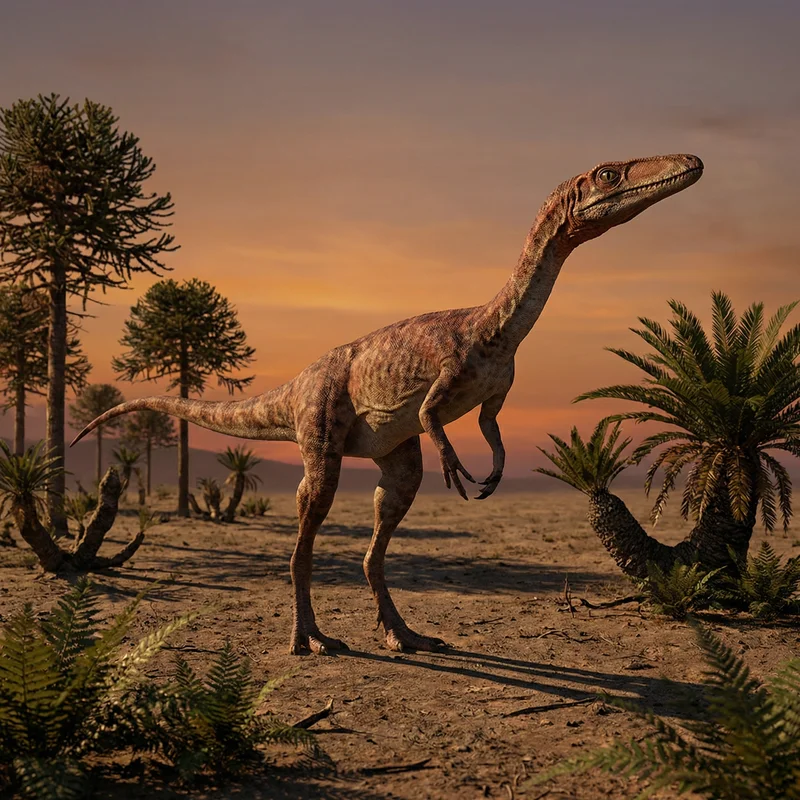
Coelophysis was a lightly built, slender bipedal theropod reaching a maximum total length of approximately 3 m (9.8 ft), with a hip height exceeding 1 m. Body mass estimates vary by study and individual morph: Paul (1988) estimated 15 kg for the gracile morph and 20 kg for the robust morph, later revising the general estimate upward to 25 kg (Paul, 2016). Therrien & Henderson (2007) estimated approximately 37 kg for specimen AMNH 7223 (body length 2.86 m), while Molina-Pérez & Larramendi (2019) suggested approximately 32 kg. The overall estimated weight range is therefore approximately 15–37 kg.
Skull and Dentition
The skull of Coelophysis is elongated and narrow, measuring approximately 270 mm in length, with large, forward-facing orbits that afforded binocular vision and excellent depth perception. Large fenestrae in the snout reduced skull weight while narrow bony struts maintained structural integrity. The neck exhibited a pronounced sigmoid (S-shaped) curve. Low, laterally raised bony ridges were present on the dorsolateral margins of the nasal and lacrimal bones above the antorbital fenestra, but no prominent cranial crests or horns were present.
The teeth were blade-like, recurved, and finely serrated on both anterior and posterior edges—typical of a predatory theropod. The maxilla bore approximately 26 teeth, while the dentary carried approximately 27 (Colbert, 1989). Teeth were replaced continuously throughout life.
Furcula and Forelimbs
Coelophysis bears the earliest confirmed furcula (wishbone) among dinosaurs. The manus retained four digits, though only three were functional; the fourth was vestigial and embedded within the flesh of the hand. Carpenter (2002) analysed theropod forelimb biomechanics and found that the arm of Coelophysis was flexible with a good range of motion but structurally weak, suggesting predation on animals substantially smaller than itself. Carpenter classified Coelophysis as a "combination grasper-clutcher."
Hindlimbs and Tail
The hindlimbs were long and powerful, with the fully open acetabulum and straight ankle hinge characteristic of Dinosauria. The foot (pes) bore three functional toes with a raised dewclaw (hallux). The tail was long and slender, with a distinctive structure in which interlocking prezygapophyses formed a semi-rigid lattice that restricted dorsoventral movement, likely serving as a dynamic counterbalance during rapid locomotion.
Vision and Sensory Biology
Rinehart et al. (2004) described the complete scleral ring from a juvenile C. bauri (NMMNH P-4200) and compared it with extant reptile data, concluding that Coelophysis was a diurnal, visually oriented predator with accommodative power comparable to that of modern eagles and hawks. Night vision was likely poor, and the pupil was probably round rather than slit-shaped.
Feeding Ecology and Behavior
Diet and Hunting Strategy
The blade-like, serrated teeth clearly indicate a carnivorous diet. Rinehart et al. (2009) concluded that Coelophysis was a "hunter of small, fast-moving prey." Likely prey items included small lizard-like reptiles, early crurotarsans (such as Hesperosuchus), insects, and other small vertebrates. Carpenter's (2002) biomechanical analysis of the forelimbs suggests that Coelophysis preyed primarily upon animals substantially smaller than itself.
The Cannibalism Debate
Colbert (1989) reported juvenile bones within the abdominal cavities of some Ghost Ranch adults, interpreting this as evidence of cannibalism. However, Gay (2002) demonstrated that several of the supposed "juvenile coelophysids" were actually small crurotarsan reptiles such as Hesperosuchus, a conclusion supported by Nesbitt et al. (2006). Gay (2010) further showed that in AMNH 7224 (the neotype), the alleged cannibalized juvenile bones occupied a volume 17 times greater than the estimated maximum stomach capacity, lacked tooth marks or acid etching, and were deposited stratigraphically below the adult skeleton—indicating coincidental superposition rather than ingestion.
However, Rinehart et al. (2009) identified regurgitate material near the mouth of specimen NMMNH P-44551 containing tooth and jaw bone fragments morphologically consistent with juvenile Coelophysis, suggesting that limited cannibalistic behaviour cannot be entirely ruled out. The current consensus is that large-scale cannibalism is unsupported, though isolated instances remain possible.
Gregarious Behavior
The discovery of over 1,000 individuals at Ghost Ranch has often been cited as evidence for gregarious (pack or herd) behaviour (Schwartz & Gillette, 1994). However, no direct evidence for flocking or pack-hunting exists. The taphonomic evidence suggests that the animals may have congregated around dwindling water sources or fish spawning sites during a drought, then been killed and buried en masse by a catastrophic flash flood. Similarly, approximately 30 specimens of Megapnosaurus rhodesiensis found together in Zimbabwe may reflect a comparable taphonomic event rather than habitual social behavior. Thus, gregariousness in Coelophysis remains plausible but unconfirmed.
Growth and Ontogeny
Rinehart (2009) analysed femoral length data and proposed that Coelophysis juveniles grew rapidly, especially during the first year, reached sexual maturity between the 2nd and 3rd year, and attained full adult size (approximately 3 m) by about the 8th year, recognizing four growth stages (1-year, 2-year, 4-year, and 7+ year).
Barta et al. (2022) conducted a landmark osteohistological study of the Ghost Ranch population, sectioning femora from multiple individuals. Their findings revealed that most individuals were immature (1–4 years old), and that correlations among body size, age, and morphological maturity were remarkably poor. This demonstrates that Coelophysis exhibited highly variable growth trajectories, a pattern that may have been typical of early dinosaur ontogeny.
Robust and Gracile Morphs
Two morphological variants have been recognized among Ghost Ranch specimens. The gracile morph (e.g., AMNH 7223) has a longer skull and neck, shorter forelimbs, and fused sacral neural spines. The robust morph (e.g., AMNH 7224, NMMNH P-42200) has a shorter skull and neck, longer forelimbs, and unfused sacral neural spines (Colbert, 1989). Whether these morphs represent sexual dimorphism or a continuum of individual growth variability remains debated. The osteohistological evidence of Barta et al. (2022) suggests that individual developmental variation, rather than simple sex-based dimorphism, may account for much of the observed morphological disparity.
Distribution and Paleogeography
Geographic Range
Confirmed localities of Coelophysis are restricted to the Chinle Formation in New Mexico and Arizona, United States. The most prolific site is the Whitaker Quarry at Ghost Ranch, near Abiquiu, Rio Arriba County, New Mexico. Cope's original material was collected by Baldwin from Arroyo Seco and Gallina Canyon in the same general region. Similar coelophysoid material has been reported from Utah and elsewhere in Arizona, but species-level assignment to C. bauri has not been confirmed.
In 1981, the New Mexico State Legislature designated Coelophysis as the official State Fossil.
Paleogeographic Context
Paleomagnetic reconstructions indicate that during the Late Triassic, southwestern North America lay near the equator of Pangaea, at approximately 10.97°N paleolatitude and −32.65°W paleolongitude. The region experienced a subtropical to tropical climate with monsoonal precipitation patterns and episodic droughts—a dramatically different continental configuration and climate from the present day.
Phylogeny and Classification
Classification History
Cope (1889) initially placed Coelophysis within the carnivorous dinosaur group Goniopoda as a relative of Anchisaurus and Coelurus. Huene (1906) reclassified it within Coeluridae, and later (1914, 1915) within Podokesauridae under the broader grouping Coelurosauria. Welles (1984) erected the family Coelophysidae, placing C. bauri within it. Holtz (1994) named the clade Coelophysoidea to unite coelophysids with Dilophosaurus and allies.
Current Phylogenetic Position
In the phylogenetic analysis of Ezcurra et al. (2020), Coelophysis is recovered within Neotheropoda as a member of Coelophysoidea, specifically within Coelophysidae. The family was phylogenetically defined by Sereno (1998) as the most recent common ancestor of Coelophysis bauri and Procompsognathus triassicus, plus all descendants. Within Coelophysidae, Coelophysis forms a clade with Lepidus, Camposaurus, Lucianovenator, Megapnosaurus, and Segisaurus. Coelophysidae is the sister group to a clade containing Dilophosaurus, Cryolophosaurus, Sarcosaurus, and other taxa leading toward Averostra.
| Taxon | Age | Locality | Notes |
|---|---|---|---|
| Coelophysis bauri | Late Triassic (Norian–Rhaetian) | New Mexico, Arizona | Type genus of Coelophysidae |
| Megapnosaurus rhodesiensis | Early Jurassic | Zimbabwe, South Africa | Formerly Syntarsus; Coelophysidae |
| Camposaurus arizonensis | Late Triassic (Norian) | Arizona | Distinct coelophysid |
| Segisaurus halli | Early Jurassic | Arizona | Coelophysidae |
| Procompsognathus triassicus | Late Triassic | Germany | Coelophysidae specifier taxon |
| Lucianovenator bonoi | Late Triassic (Norian) | Argentina | South American coelophysid |
Alternative Hypotheses
Earlier analyses (1980s–1990s) placed Coelophysoidea as a basal clade within Ceratosauria. Since Tykoski (2005), the mainstream view has been that Coelophysoidea occupies a basal position within Neotheropoda, outside of Ceratosauria. Some analyses recover a polytomy at the base of Neotheropoda, so the precise interrelationships of coelophysoids, dilophosaurids, and averostrans remain an active area of investigation.
Reconstruction and Uncertainty
Well-Established Facts
The basic body plan, proportions, dentition, limb structure, and locomotion of Coelophysis are firmly established through hundreds to thousands of specimens. Bipedal locomotion, carnivorous diet, furcula, vestigial fourth manual digit, and pneumatized hollow bones are all confirmed by direct fossil evidence.
Probable and Hypothetical Aspects
Gregarious behaviour is probable but not confirmed. Sexual dimorphism may or may not explain the robust/gracile morphs; recent osteohistological evidence favours individual growth variability. No direct evidence for integumentary covering (scales vs. protofeathers) has been reported; as a non-coelurosaur basal theropod, Coelophysis is conventionally reconstructed with scaly skin. Skin colour and patterning are entirely unknown.
Popular Media vs. Science
Coelophysis has long been depicted as a "cannibal dinosaur" in popular media, based on Colbert's (1989) interpretation. This claim has been largely refuted by Nesbitt et al. (2006) and Gay (2010). The mass-death assemblage at Ghost Ranch is also frequently presented as direct proof of pack hunting, when in fact the taphonomic evidence points to a catastrophic aggregation event rather than habitual cooperative behaviour.
Comparison with Related and Contemporary Taxa
| Genus | Length (m) | Mass (kg) | Age | Locality | Key Differences |
|---|---|---|---|---|---|
| Coelophysis | 2–3 | 15–37 | Late Triassic | North America | No offset maxillary rostral process; small external mandibular fenestra |
| Megapnosaurus | 2–3 | 20–30 | Early Jurassic | Zimbabwe, South Africa | Pit at base of premaxillary nasal process; shorter maxillary tooth row |
| Dilophosaurus | 6–7 | 300–400 | Early Jurassic | North America | Much larger; paired cranial crests; non-coelophysid coelophysoid |
| Liliensternus | 5–5.3 | 100–130 | Late Triassic | Germany | Larger; non-coelophysid coelophysoid |
| Herrerasaurus | 5–6 | 200–350 | Late Triassic | Argentina | More basal theropod (or basal saurischian) |
Coelophysis coexisted with a diverse Late Triassic fauna within the Chinle Formation, including the phytosaur Pseudopalatus, the aetosaur Typothorax, early crocodylomorphs such as Hesperosuchus, dinosauromorphs like Dromomeron, and various small reptiles and amphibians that likely constituted its prey base.
Fun Facts
FAQ
📚References
- Cope, E. D. (1889). On a new genus of Triassic Dinosauria. The American Naturalist, 23, 626. — Original erection of the genus Coelophysis.
- Cope, E. D. (1887). The dinosaurian genus Coelurus. The American Naturalist, 21, 367–369. — First description of Coelurus bauri.
- Colbert, E. H. (1989). The Triassic dinosaur Coelophysis. Museum of Northern Arizona Bulletin, 57, 1–160. — Major monograph on Ghost Ranch material.
- Hunt, A. P. & Lucas, S. G. (1991). Rioarribasaurus, a new name for a Late Triassic dinosaur from New Mexico (USA). Paläontologische Zeitschrift, 65(1–2), 191–198.
- Schwartz, H. L. & Gillette, D. D. (1994). Geology and taphonomy of the Coelophysis quarry, Upper Triassic Chinle Formation, Ghost Ranch, New Mexico. Journal of Paleontology, 68(5), 1118–1130.
- ICZN (1996). Opinion 1842. Coelophysis Cope, 1889 (Reptilia, Saurischia): neotype replaced. Bulletin of Zoological Nomenclature, 53(2), 142–144.
- Nesbitt, S. J., Turner, A. H., Erickson, G. M. & Norell, M. A. (2006). Prey choice and cannibalistic behaviour in the theropod Coelophysis. Biology Letters, 2(4), 611–614. doi:10.1098/rsbl.2006.0524
- Gay, R. (2010). Evidence related to the cannibalism hypothesis in Coelophysis bauri from Ghost Ranch, New Mexico. In: New Perspectives on Horned Dinosaurs (Ryan, M. J. et al., eds.), pp. 68–78. Indiana University Press.
- Ezcurra, M. D. (2007). The cranial anatomy of the coelophysoid theropod Zupaysaurus rougieri from the Upper Triassic of Argentina. Historical Biology, 19(2), 185–202.
- Bristowe, A. & Raath, M. A. (2004). A juvenile coelophysoid skull from the Early Jurassic of Zimbabwe, and the synonymy of Coelophysis and Syntarsus. Palaeontologia Africana, 40, 31–41.
- Rinehart, L. F., Lucas, S. G., Heckert, A. B., Spielmann, J. A. & Celeskey, M. D. (2009). The Paleobiology of Coelophysis bauri (Cope) from the Upper Triassic (Apachean) Whitaker Quarry, New Mexico. New Mexico Museum of Natural History and Science Bulletin, 45, 1–130.
- Barta, D. E., Nesbitt, S. J. & Norell, M. A. (2018). The evolution of the manus of early theropod dinosaurs is characterized by high inter- and intraspecific variation. Journal of Anatomy, 232(1), 80–104. doi:10.1111/joa.12775
- Barta, D. E., Nesbitt, S. J. & Norell, M. A. (2022). Osteohistology of a Triassic dinosaur population reveals highly variable growth trajectories typified early dinosaur ontogeny. Scientific Reports, 12, 17475. doi:10.1038/s41598-022-22216-x
- Ezcurra, M. D., Nesbitt, S. J., Bronzati, M. et al. (2020). Enigmatic dinosaur precursors bridge the gap to the origin of Pterosauria. Nature, 588, 445–449.
- Tykoski, R. S. (2005). Anatomy, Ontogeny, and Phylogeny of Coelophysoid Theropods. PhD dissertation, University of Texas at Austin.
- Carpenter, K. (2002). Forelimb biomechanics of nonavian theropod dinosaurs in predation. Senckenbergiana lethaea, 82(1), 59–75.
- Bugos, J. E. & McDavid, S. N. (2024). Immature skulls of the theropod dinosaur Coelophysis bauri from Ghost Ranch, New Mexico. Acta Palaeontologica Polonica, 69(4), 549–564. doi:10.4202/app.01085.2023
- Paul, G. S. (2016). The Princeton Field Guide to Dinosaurs. 2nd ed. Princeton University Press.
- Therrien, F. & Henderson, D. M. (2007). My theropod is bigger than yours… or not: estimating body size from skull length in theropods. Journal of Vertebrate Paleontology, 27(1), 108–115.
- Ramezani, J., Hoke, G. D., Fastovsky, D. E. et al. (2011). High-precision U-Pb zircon geochronology of the Late Triassic Chinle Formation, Petrified Forest National Park (Arizona, USA): Temporal constraints on the early evolution of dinosaurs. Geological Society of America Bulletin, 123(11–12), 2142–2159.
Gallery
5 images Coelophysis
Coelophysis · Triassic Period · Carnivore
 Coelophysis
Coelophysis · Triassic Period · Carnivore
 Coelophysis
Coelophysis · Triassic Period · Carnivore
 Coelophysis
Coelophysis · Triassic Period · Carnivore
 Coelophysis
Coelophysis · Triassic Period · Carnivore
🔗Related Creatures
Procompsognathus
Procompsognathus triassicus
Marasuchus
Marasuchus lilloensis
Liliensternus
Liliensternus liliensterni
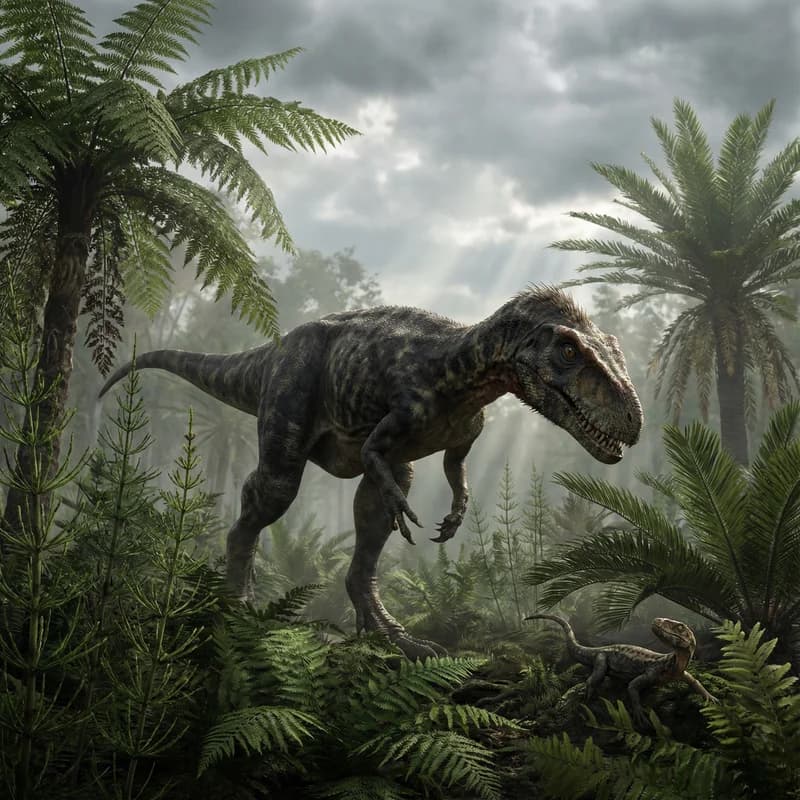
Herrerasaurus
Herrerasaurus
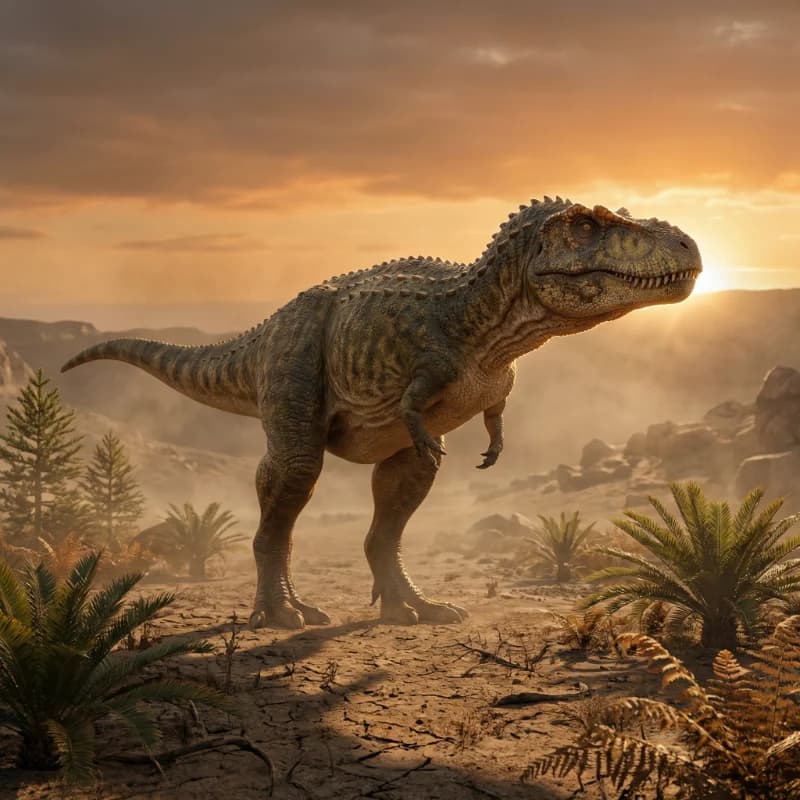
Smok
Smok wawelski

Utahraptor
Utahraptor ostrommaysi
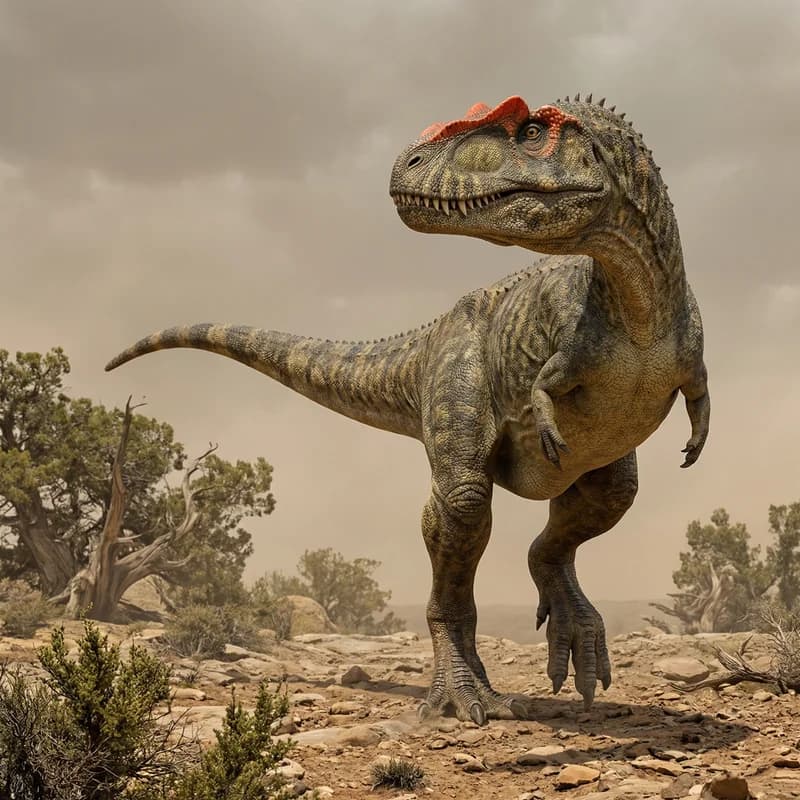
Abelisaurus
Abelisaurus comahuensis

Giganotosaurus
Giganotosaurus carolinii