Liliensternus
Liliensternus liliensterni
⏳ Triassic Period🍽️ CarnivoreDinosaurs
Physical Characteristics
⏳
PeriodTriassic Period
🍽️
DietCarnivore
📏
Size5.15~5.2m
⚖️
Weight127~200kg
Classification
GEN
GenusLiliensternus
SP
SpeciesL. liliensterni
Liliensternus liliensterni
Liliensternus liliensterni (Huene, 1934) is a basal neotheropod dinosaur from the Late Triassic (Norian–Rhaetian, approximately 228–201 Ma) of what is now Germany and Switzerland. It is widely recognized as the best-represented Triassic theropod from Europe (Rauhut & Hungerbühler, 1998), and based on the known syntype material — which likely represents subadult individuals — it reached an estimated total length of approximately 5.15–5.2 m and a body mass of roughly 127–200 kg (Paul, 1988). As a bipedal, ground-dwelling carnivore, Liliensternus was among the largest predatory dinosaurs of the European Late Triassic.
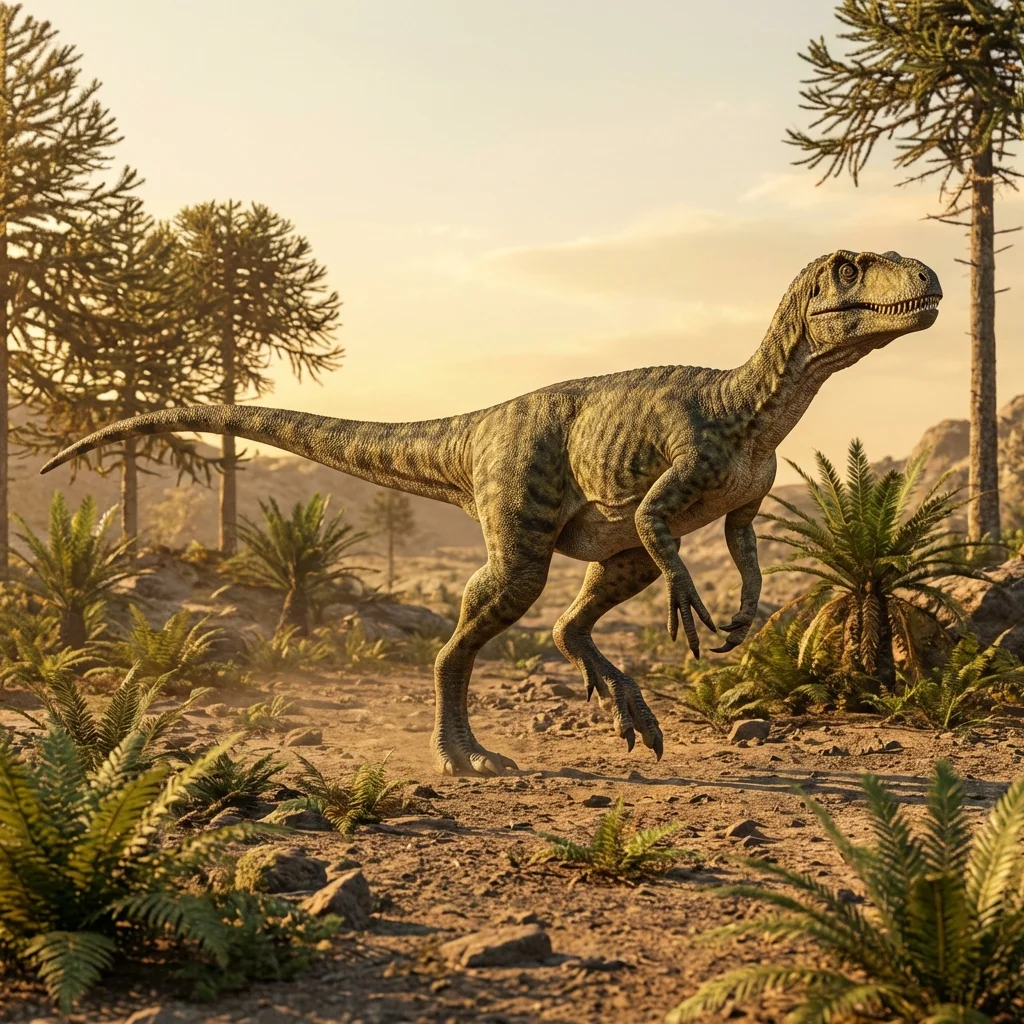
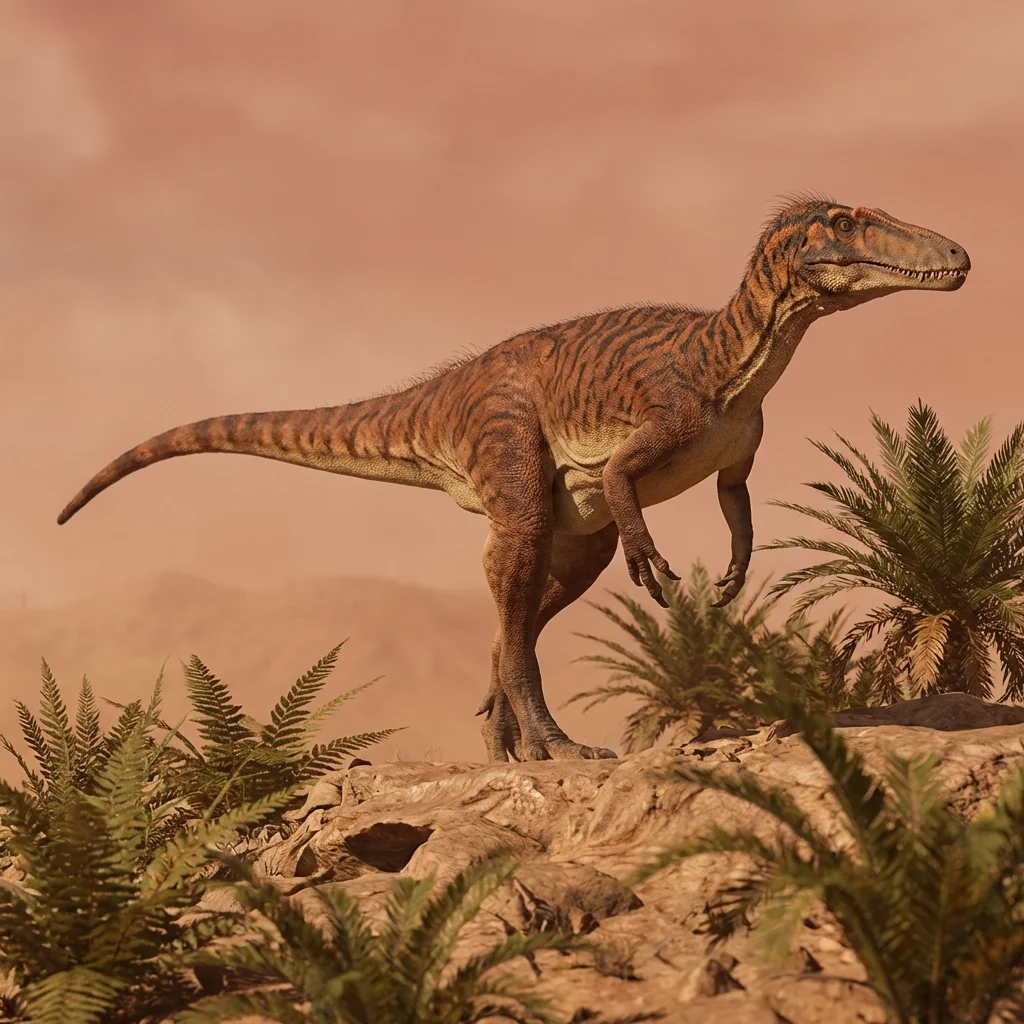
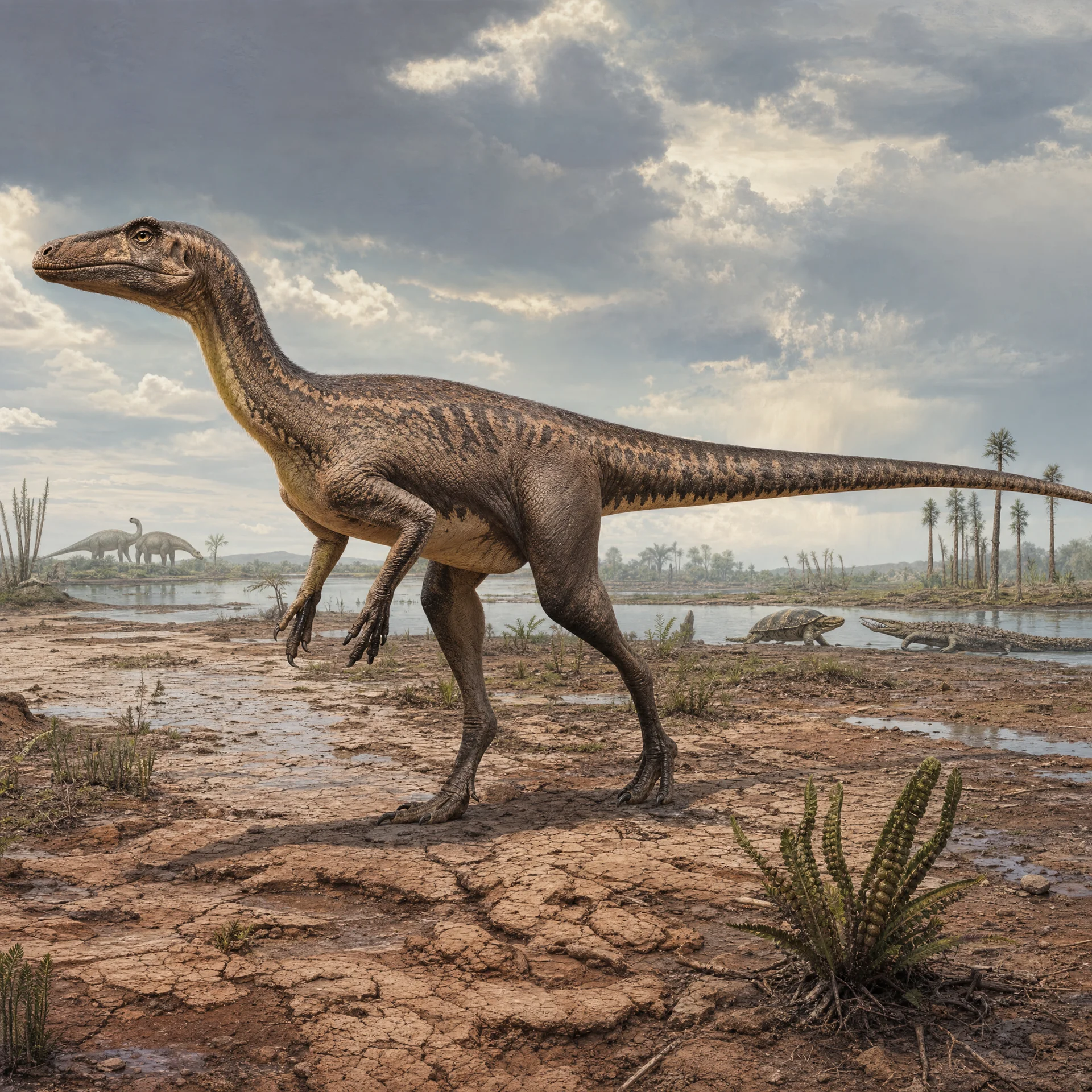
Morphologically, Liliensternus possessed a slender, agile build with several derived features shared with Dilophosaurus, including a characteristically short ilium and a femur longer than the tibia (440 mm vs. 409 mm). The cervical vertebrae bear a single pair of pleurocoels and a distinctive broad, rounded ridge extending from the diapophyses to the posteroventral centrum, among other diagnostic characters (Rauhut, 2000). While the skull is only fragmentarily preserved, many paleoart reconstructions depict Liliensternus with paired cranial crests similar to Dilophosaurus — though this remains a speculative interpretation unsupported by the available cranial material.
Notably, a 2024 conference abstract by Kirmse et al. (SVP 2024) reported fragmentary remains of several large theropods from the same formation that are either adult Liliensternus or a closely related taxon, suggesting an adult body length of 7–9 meters. If confirmed by formal description, this would make Liliensternus possibly the largest known theropod dinosaur of the entire Triassic Period.
Phylogenetically, Liliensternus is consistently recovered as a basal member of Coelophysoidea within Neotheropoda, positioned outside the more derived Coelophysidae. Its exact relationship to the Dilophosaurus–Averostra clade varies among analyses, but all major studies agree on its placement as a non-coelophysid coelophysoid (Hendrickx et al., 2015; Rowe & Gauthier, 1990). Originally described as Halticosaurus liliensterni by Friedrich von Huene in 1934, it was reassigned to the new genus Liliensternus by Samuel Paul Welles in 1984 after the type species of Halticosaurus was determined to be a nomen dubium.
Both the genus name Liliensternus and the specific epithet liliensterni honor Count Hugo Rühle von Lilienstern (1882–1946), a German amateur paleontologist and medical doctor. Rühle von Lilienstern discovered the type specimens during the winter of 1932/1933 near Großer Gleichberg in Thuringia, and on 1 July 1934 he founded a paleontological museum at his castle in Bedheim to further the study of paleontology in Germany (Mohr et al., 2008). Friedrich von Huene originally named the species Halticosaurus liliensterni in the same year (Huene, 1934). In 1984, Samuel Paul Welles concluded that the type species of Halticosaurus, H. longotarsus, was a nomen dubium (an undiagnosable name based on fragmentary material), and erected the new genus Liliensternus to accommodate the Thuringian theropod (Welles, 1984).
Liliensternus liliensterni is currently recognized as a valid species and the sole species within Liliensternus. A second species, Liliensternus airelensis, was described by Cuny & Galton (1993) based on fragmentary vertebral material from Triassic–Jurassic boundary outcrops in Normandy, France. However, notable differences in cervical vertebral morphology — particularly the presence of two pairs of pleurocoels in the French material versus only one pair in L. liliensterni — led Ezcurra & Cuny (2007) to reassign it to a new genus, Lophostropheus.
The best-represented large theropod from the European Triassic, Liliensternus occupies a pivotal phylogenetic position as a basal coelophysoid neotheropod that may have been an apex predator in Late Triassic floodplain–playa ecosystems dominated by large sauropodomorphs.
The type material of Liliensternus comes from the Trossingen Formation (= Knollenmergel) in Thuringia, which is dated to the late Norian (Sevatian) stage of the Late Triassic, approximately 228–208 Ma. This dating is supported by co-occurrence with Plateosaurus engelhardti, a taxon well established from the Late Norian of southern Germany and Switzerland (Rauhut & Hungerbühler, 1998; Sander, 1992). Some material from Halberstadt (Saxony-Anhalt) derives from Rhaetian-age (approximately 208–201 Ma) blue claystone, suggesting the temporal range of Liliensternus may extend from the Norian through the Rhaetian.
The type locality is near Großer Gleichberg, southwest of Hildburghausen in Thuringia, within the Trossingen Formation (also known as the Arnstadt Formation or Knollenmergel) of the Middle Keuper Group. This formation consists of fairly uniform, reddish-brown to red-purple claystones and marlstones (calcareous mudstones), with occasional layers of calcareous nodules — the characteristic \"Knollenmergel\" (nodular marl) (Schoch & Seegis, 2014). Formation thickness varies from about 10 m in southern Württemberg to 55–60 m in northern Franconia.
Referred material has been recovered from other lithostratigraphic units: a left metatarsal IV from sandstone of the Trossingen Formation in Bavaria (re-identified by Moser, 2003), a tooth from dark red mudstone of the Löwenstein Formation in Baden-Württemberg, and additional skeletal material from grey-green marlstone of the Löwenstein Formation in Aargau, Switzerland (Sander, 1992).
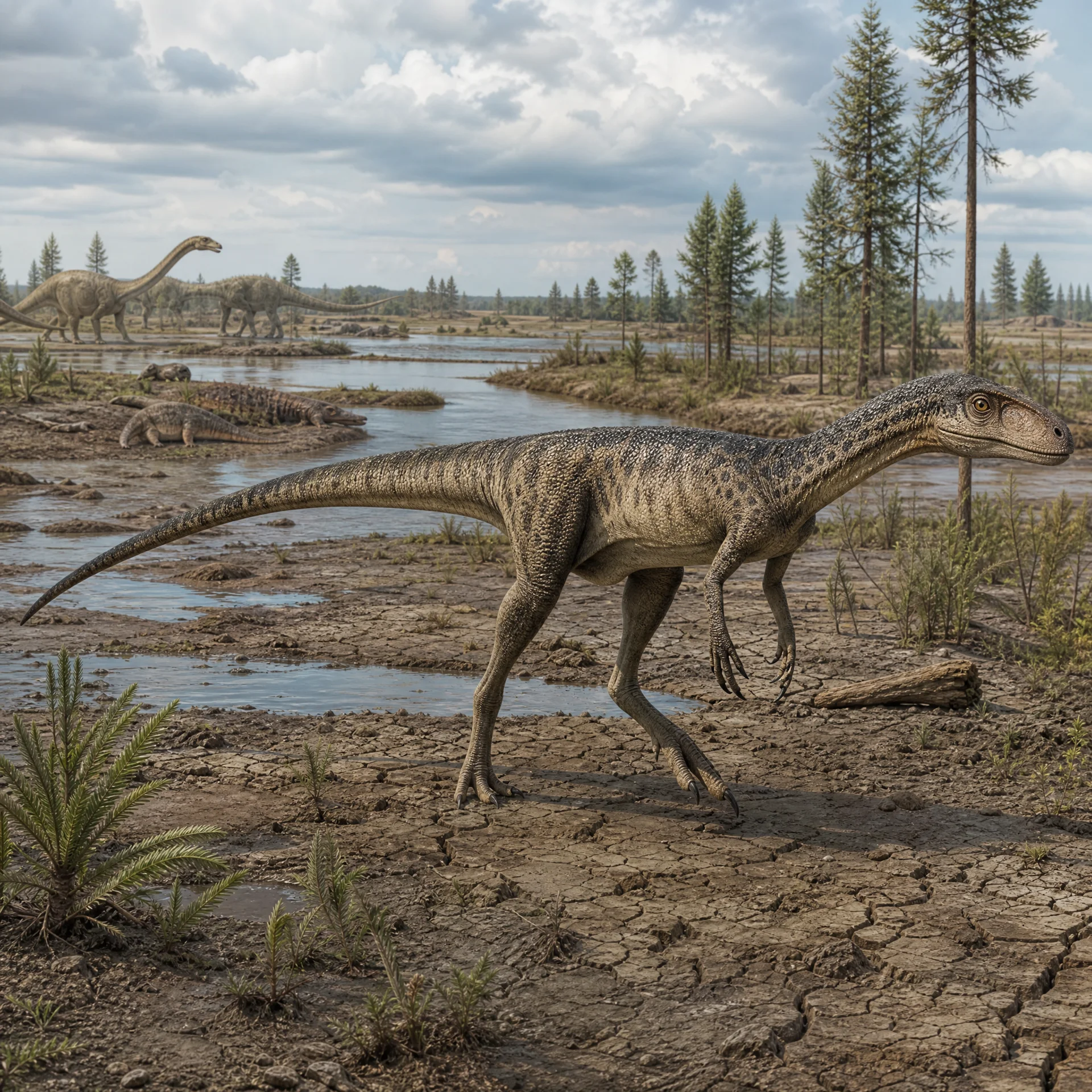
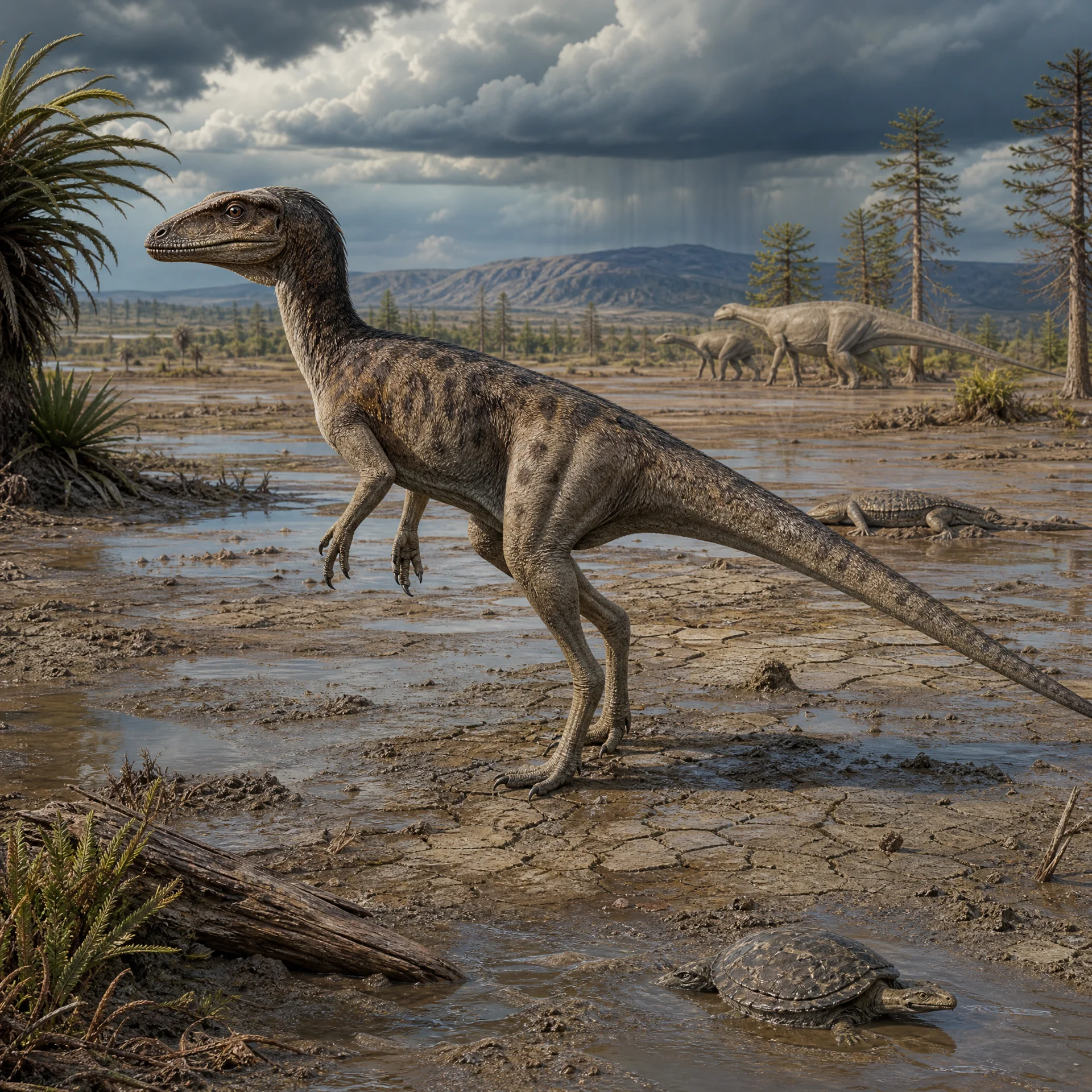
The Trossingen Formation was deposited as a result of episodic sheet floods in a well-drained playa basin at a paleolatitude of approximately 32°N within the Pangaean supercontinent (Vollmer et al., 2008). The regional climate was strongly influenced by the Triassic \"megamonsoon\" system, producing pronounced wet–dry seasonality. Sedimentological evidence includes pedogenic slickensides, pseudoanticlines, deep desiccation cracks, and vertisol development — all consistent with soils forming under strong seasonal moisture fluctuations (Schoch & Seegis, 2014; Reinhardt & Ricken, 2000). The notable absence of evaporitic sulfate minerals, despite the presence of desiccation features, suggests that groundwater was too deep for evaporite formation (Richter, 1985).
Palynological data indicate that the surrounding vegetation was dominated by Hirmeriellaceae conifers (Classopollis, Granuloperculatipollis rudis), with liverwort communities (Porcellispora longdonensis) occupying ephemeral lake margins (Reinhardt & Ricken, 2000). The overall picture is one of a semi-arid floodplain–playa landscape with intermittent vegetation, where large herbivorous sauropodomorphs — particularly Plateosaurus — became trapped in clay-rich sediments that acted as natural mud traps (Schoch & Seegis, 2014).
The type material of Liliensternus is designated as syntype series HMN MB.R.2175 and consists of partial, disarticulated skeletal remains of at least two individuals. The preserved elements include skull fragments, lower jaw fragments, vertebrae (cervical, dorsal, sacral, and caudal), and appendicular skeleton elements. Welles (1984) attempted to designate the larger individual as a lectotype, but because it proved nearly impossible to reliably separate the bones of the larger and smaller individuals (W. D. Heinrich, pers. comm. 1996), the entire assemblage is best retained as syntypes (Rauhut & Hungerbühler, 1998). The specimens are currently housed at the Museum für Naturkunde Berlin, having been transferred from Rühle von Lilienstern's castle at Bedheim in 1969.
| Specimen | Locality | Formation | Content | Notes |
|---|---|---|---|---|
| HMN MB.R.2175 (syntype) | Großer Gleichberg, Thuringia | Trossingen Fm. (Knollenmergel) | Skull fragments, jaws, vertebrae, limb elements of 2+ individuals | Type material; likely subadult |
| Unnumbered (cf. Liliensternus) | Heroldsberg, Bavaria | Trossingen Fm. (Feuerletten) | Left metatarsal IV | Re-identified by Moser (2003) |
| Unnumbered | Aargau, Switzerland | Lowenstein Fm. | Additional postcranial elements | Referred by Sander (1992) |
| Unnumbered | Baden-Wurttemberg | Lowenstein Fm. | Single tooth | Norian |
| Unnumbered | Halberstadt, Saxony-Anhalt | Trossingen Fm. | Material from blue claystone | Rhaetian |
According to Rauhut (2000), Liliensternus can be distinguished from other theropods by the following combination of features: (1) cervical vertebrae possess a broad, rounded ridge extending from the posterior end of the diapophyses to the posteroventral end of the centrum; (2) a single pair of pleurocoels in the cervical vertebrae; (3) a less-developed infradiapophyseal fossa; (4) absence of a horizontal ridge at the base of the cervical neural spines; and (5) absence of a lateral bulge on the ilium.
The type specimens are interpreted as juvenile to subadult individuals, based on two key lines of evidence: the neurocentral sutures remain visible in the vertebrae, and only two sacral vertebrae are fused (Huene, 1934; Rauhut & Hungerbühler, 1998). Therefore, all published size and mass estimates (approximately 5.15–5.2 m and 127–200 kg) represent subadult dimensions, and the true adult size was likely considerably larger.
Based on the syntype material, the estimated total body length of Liliensternus is approximately 5.15 m (Paul, 1988), with an alternative estimate of up to 5.2 m. Body mass estimates range from approximately 127 kg (Paul, 1988) to 200 kg. However, these figures are based on subadult individuals. A 2024 SVP conference abstract by Kirmse et al. reported fragmentary remains of large theropods — either adult Liliensternus or a closely related genus — suggesting an adult body length of 7–9 m. If confirmed, this would make Liliensternus potentially the largest theropod dinosaur known from the Triassic Period.
The skull of Liliensternus is only fragmentarily preserved, limiting detailed cranial description. Jaw fragments (MB.R.2175 1.4, 1.8) with teeth have been documented (Dorka, 2002). Paul (1988) described the dentition as \"slashing tooth arrays\" well suited for disabling large herbivorous prey. A subnarial gap is probably present (Welles, 1984), a feature shared with ceratosaurs. Many reconstructions depict Liliensternus with paired cranial crests similar to those of Dilophosaurus, but the incomplete state of the skull means the presence of crests is not confirmed — it remains a hypothetical reconstruction.
Liliensternus was a bipedal predator with a femur (440 mm) longer than the tibia (409 mm), a ratio contrasting with the tibia-over-femur proportions typical of coelophysids such as Coelophysis. This femur-dominant ratio is instead shared with Dilophosaurus. The ilium is unusually short, another feature shared with Dilophosaurus (Paul, 1988). Paul (1988) noted that in overall appearance, Liliensternus could be considered intermediate between Coelophysis and Dilophosaurus.
The forelimb bore five digits, consistent with Late Triassic theropods generally, but the fourth and fifth digits were substantially reduced. The slender, long-limbed build suggests Liliensternus was an agile, active predator capable of considerable running speed.
The pelvic structure exhibits several derived characters shared with Ceratosauria or its subgroups: a strong lateroventral expansion of the dorsal rim of the acetabulum, a strongly downturned femoral head (Huene, 1934; Rowe & Gauthier, 1990), and a completely enclosed obturator foramen that opened dorsomedially — a condition also seen in Syntarsus (= Megapnosaurus) (Raath, 1969).
Liliensternus is unambiguously interpreted as a carnivore based on its laterally compressed, serrated tooth crowns and the overall predatory bauplan (bipedal stance, grasping forelimbs). Paul (1988) hypothesized that the slashing tooth arrays were suited for attacking prosauropod-grade herbivores and that the animal's speed would have allowed it to pursue swift ornithischians. However, no direct evidence of diet — such as stomach contents, coprolites, or bite marks — has been reported, so specific prey composition remains inferential.
The associated fauna of the Trossingen Formation includes large sauropodomorphs (Plateosaurus trossingensis, Ruehleia bedheimensis, Pachysauriscus), the basal turtle Proganochelys quenstedtii, phytosaurs (Mystriosuchus spp.), temnospondyl amphibians (Cyclotosaurus, Gerrothorax, Plagiosaurus), haramiyidan mammaliaforms (Thomasia), and diverse fishes (Mujal et al., 2025; Kuhn, 1939). Within this assemblage, Liliensternus likely occupied the role of apex or near-apex predator, primarily targeting the abundant large herbivorous sauropodomorphs and smaller reptiles.
The type material comprises at least two disarticulated individuals found at the same site, but it remains unclear whether these individuals died simultaneously or accumulated over time. This precludes confident inference of gregarious behavior. Solitary habits may have been more typical (Rauhut & Hungerbühler, 1998).
The confirmed type locality is Großer Gleichberg in Thuringia, Germany. Additional referred material extends the geographic range to: Heroldsberg in Bavaria (metatarsal; Moser, 2003), Baden-Württemberg (isolated tooth), Halberstadt in Saxony-Anhalt (postcranial elements in Rhaetian claystone), and the Aargau canton of Switzerland (postcranial elements; Sander, 1992). Collectively, these occurrences suggest that Liliensternus ranged widely across the Central European Basin during the Late Triassic.
The paleocoordinates for the Trossingen Formation are estimated at approximately 31.9°N, 10.4°E, placing Liliensternus in the low-latitude to mid-latitude tropical–subtropical belt of the Pangaean supercontinent, well inland from the Tethys Ocean margin.
Liliensternus was originally described as Halticosaurus liliensterni within the now-abandoned family Halticosauridae (Huene, 1934). When Welles (1984) demonstrated that the type species of Halticosaurus, H. longotarsus, was based on undiagnosable fragmentary material from the Stubensandstein of southern Germany, he erected the new genus Liliensternus to accommodate the Thuringian theropod.
The current consensus places Liliensternus as a basal member of Coelophysoidea within Neotheropoda. Rowe & Gauthier (1990) positioned it as the sister taxon to the Syntarsus + Coelophysis clade based on features including a well-developed horizontal maxillary ridge. In the synthetic classification of Hendrickx et al. (2015), Liliensternus is consistently recovered outside Coelophysidae but more basal than Zupaysaurus, Dilophosauridae (Dilophosaurus, Dracovenator), and Averostra (Ceratosauria + Tetanurae).
However, some recent analyses have recovered Liliensternus in a polytomy at the base of Neotheropoda or in slightly different positions within Coelophysoidea (e.g., Spiekman et al., 2021; Ezcurra & Cuny, 2007), indicating that its precise phylogenetic placement remains somewhat fluid.
| Clade | Representative Taxa | Position of Liliensternus |
|---|---|---|
| Neotheropoda | All averostrans + coelophysoids | Within |
| Coelophysoidea | Coelophysidae + basal members | Basal member |
| Coelophysidae | Coelophysis, Megapnosaurus | Liliensternus excluded |
| Dilophosauridae | Dilophosaurus, Dracovenator | More derived than Liliensternus |
| Averostra | Ceratosauria + Tetanurae | More derived than Liliensternus |
The following are well-established: Liliensternus is a bipedal carnivorous theropod from the Late Triassic (Norian) Trossingen Formation of Germany; it is classified as a basal coelophysoid neotheropod; and it is the best-preserved Triassic theropod known from Europe.
The subadult status of the type material is well supported by skeletal maturity indicators (unfused neurocentral sutures, only two fused sacrals), strongly implying that adults were significantly larger than the known 5.15–5.2 m specimens. The morphological similarities to Dilophosaurus (short ilium, femur > tibia ratio) have been consistently documented across multiple independent studies.
The proposed adult body length of 7–9 m (Kirmse et al., 2024 SVP abstract) is a preliminary report and requires formal publication before it can be considered confirmed. The presence of cranial crests, as depicted in popular reconstructions, cannot be verified from the available skull material and remains speculative. The specific prey composition (primarily Plateosaurus) is inferred from co-occurrence and body size rather than direct evidence such as bite marks or gut contents.
| Taxon | Age | Region | Length (m) | Mass (kg) | Notes |
|---|---|---|---|---|---|
| Liliensternus liliensterni | Norian–Rhaetian | Germany, Switzerland | 5.15–5.2 (subadult) | 127–200 (subadult) | Best-known European Triassic theropod |
| Coelophysis bauri | Norian–Rhaetian | North America | ~3 | ~15–20 | Coelophysidae; much smaller |
| Dilophosaurus wetherilli | Sinemurian–Pliensbachian | North America | ~6–7 | ~400 | Early Jurassic; morphologically similar |
| Lophostropheus airelensis | Rhaetian–Hettangian | France | Unknown (fragmentary) | Unknown | Former L. airelensis; reclassified 2007 |
| Zupaysaurus rougieri | Norian–Rhaetian | Argentina | ~4 | Unknown | Basal neotheropod |
| Gojirasaurus quayi | Norian | North America | ~5.5 | Unknown | Validity debated |
Liliensternus is the best-preserved Triassic theropod dinosaur from Europe, with the type material comprising partial skeletons of at least two individuals designated as a syntype series.
The genus is named after Count Hugo Rühle von Lilienstern, who not only discovered the fossils himself in the winter of 1932/1933 but also founded a paleontological museum at his castle in Bedheim, Germany.
The known size estimates (~5.2 m) are based on subadult specimens. A 2024 conference abstract suggested that adult Liliensternus may have reached 7–9 meters in length, potentially making it the largest Triassic theropod ever discovered.
The Dilophosaurus-like head crests commonly depicted in paleoart are not confirmed by fossil evidence — the skull of Liliensternus is too fragmentary to verify their existence.
The fossils remained in the Lilienstern family's castle at Bedheim until 1969, when they were finally transferred to the Museum für Naturkunde Berlin.
Liliensternus shared its habitat with some of the earliest known turtles (Proganochelys), massive herds of Plateosaurus, crocodile-like phytosaurs, and giant temnospondyl amphibians.
Originally named Halticosaurus liliensterni in 1934, the species was given its own genus in 1984 after the original genus Halticosaurus was declared a nomen dubium (undiagnosable name).
Gregory S. Paul (1988) described Liliensternus as morphologically intermediate between the small Coelophysis and the larger Dilophosaurus — a living bridge between early and more advanced theropods.
A second species once assigned to Liliensternus — L. airelensis from France — was reclassified in 2007 as a separate genus, Lophostropheus.
During the Late Triassic, the German fossil sites where Liliensternus was found lay at about 32°N latitude on the Pangaea supercontinent — roughly the same latitude as modern-day Cairo or New Delhi.
Liliensternus had five fingers on each hand, but the fourth and fifth digits were substantially reduced — showcasing the evolutionary trend toward digit reduction that would continue in later theropods.
Based on the known syntype material, which likely represents subadult individuals, Liliensternus reached an estimated total length of approximately 5.15–5.2 m (about 17 ft) and a body mass of roughly 127–200 kg (280–441 lbs) (Paul, 1988). However, a 2024 SVP conference abstract reported fragmentary remains suggesting adult body lengths of 7–9 m. This preliminary report has not yet been formally published.
Both the genus name and the specific epithet honor Count Hugo Rühle von Lilienstern (1882–1946), a German amateur paleontologist and medical doctor. He discovered the type specimens in 1932–1933 and founded a paleontological museum at his castle in Bedheim, Thuringia, Germany, in 1934.
Liliensternus and Dilophosaurus share several morphological features, including a short ilium and a femur-over-tibia length ratio. Paul (1988) described Liliensternus as morphologically intermediate between Coelophysis and Dilophosaurus. In phylogenetic analyses, both are placed within or near Coelophysoidea, but Liliensternus occupies a more basal position while Dilophosaurus is more derived. They are not in a direct ancestor–descendant relationship.
Many popular reconstructions depict Liliensternus with paired cranial crests similar to those of Dilophosaurus. However, the skull of Liliensternus is only fragmentarily preserved, and the presence of crests cannot be confirmed from the available material. The crest remains a speculative artistic interpretation.
The type specimens were discovered near Großer Gleichberg in Thuringia, Germany. Additional referred material has been reported from Bavaria, Baden-Württemberg, and Saxony-Anhalt in Germany, as well as from the Aargau canton of Switzerland. This suggests a wide distribution across the Late Triassic Central European Basin.
Liliensternus was a carnivore, as evidenced by its laterally compressed, serrated teeth and predatory body plan. It likely preyed on the large sauropodomorphs (such as Plateosaurus) and smaller reptiles that co-occurred in the same ecosystem. However, no direct dietary evidence such as stomach contents or bite marks has been discovered.
In 1934, Friedrich von Huene named this theropod as a new species within the existing genus Halticosaurus: H. liliensterni. In 1984, Samuel Paul Welles determined that the type species of Halticosaurus (H. longotarsus) was a nomen dubium — a name based on undiagnosable fragments — and erected the new genus Liliensternus to accommodate the well-preserved Thuringian material.
Even the known subadult specimens (~5.2 m) make Liliensternus one of the largest well-documented theropods from the European Triassic. The preliminary 2024 report suggesting adult lengths of 7–9 m, if confirmed, would potentially make it one of the largest theropod dinosaurs from the entire Triassic Period worldwide.
The syntype specimens (HMN MB.R.2175) are housed at the Museum für Naturkunde Berlin (Natural History Museum Berlin), Germany. They were originally kept at Rühle von Lilienstern's castle in Bedheim and were transferred to the Berlin museum in 1969.
Liliensternus inhabited a semi-arid playa basin floodplain environment influenced by the Triassic Pangaean megamonsoon climate system. The landscape featured alternating wet and dry seasons, intermittent vegetation dominated by conifers, and vertisol soils. It shared this ecosystem with abundant Plateosaurus herds, early turtles, phytosaurs, and temnospondyl amphibians.
5images