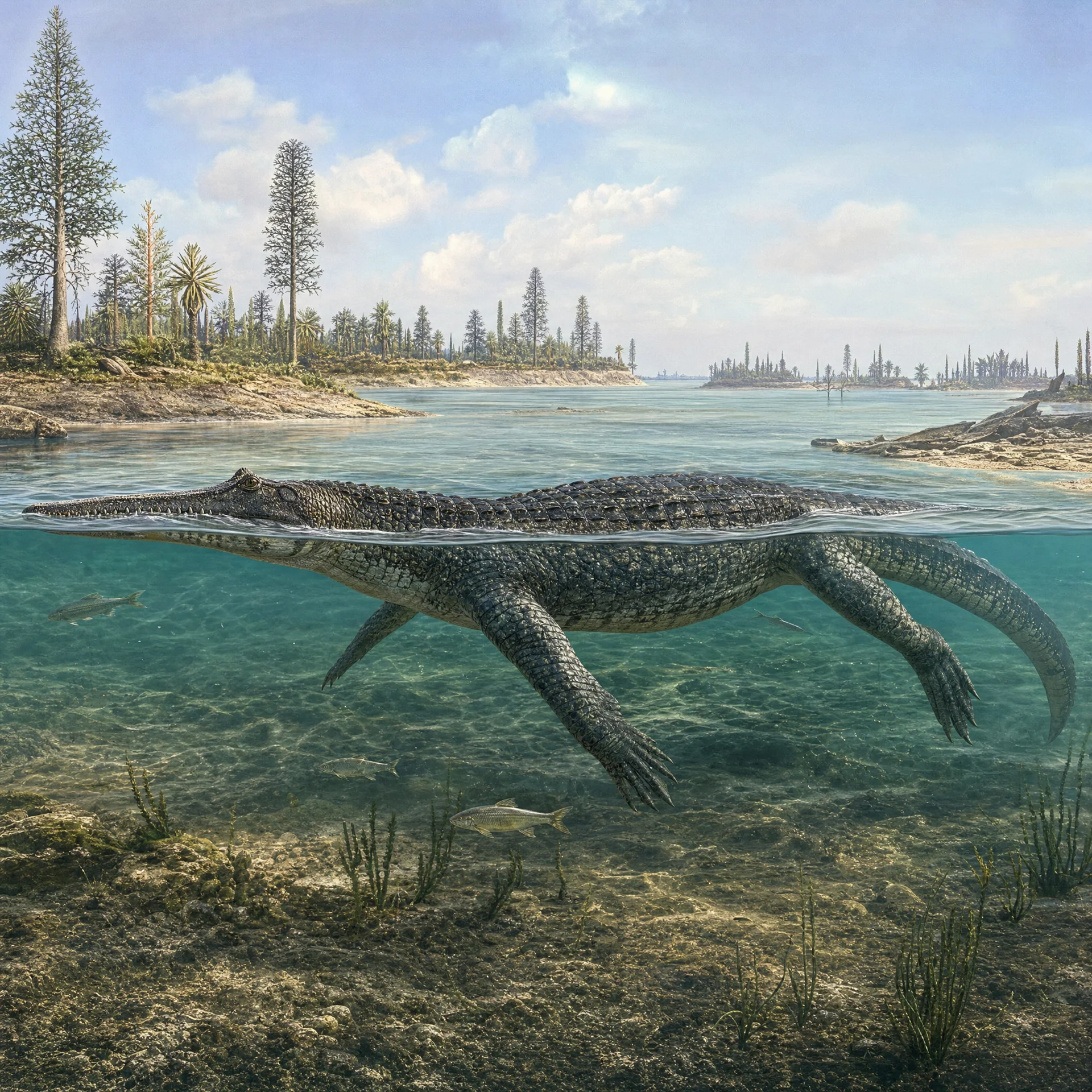
Mystriosuchus
Mystriosuchus planirostris
⏳ Triassic Period🍽️ PiscivoreDinosaurs
Physical Characteristics
⏳
PeriodTriassic Period
🍽️
DietPiscivore
📏
Size4m
⚖️
Weight200~350kg
Classification
GEN
GenusMystriosuchus
SP
SpeciesM. planirostris
Mystriosuchus planirostris
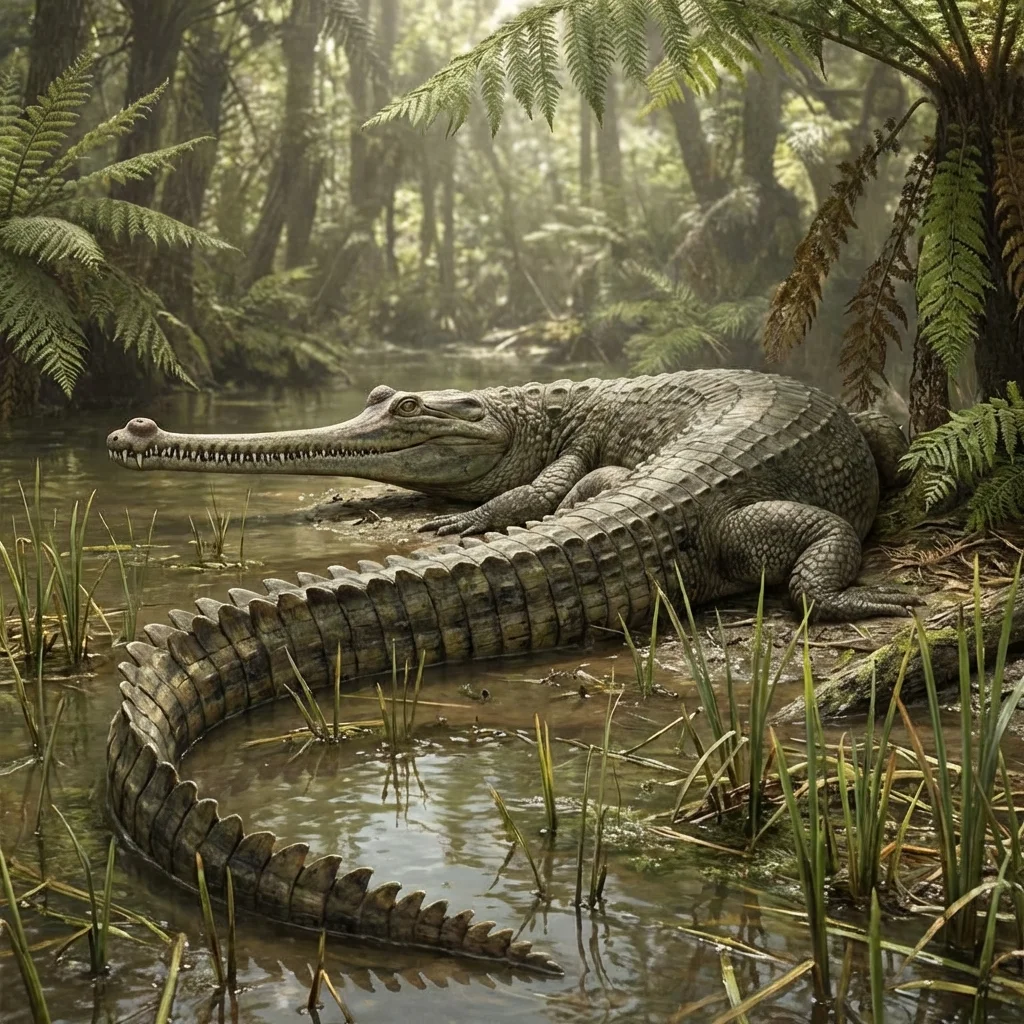
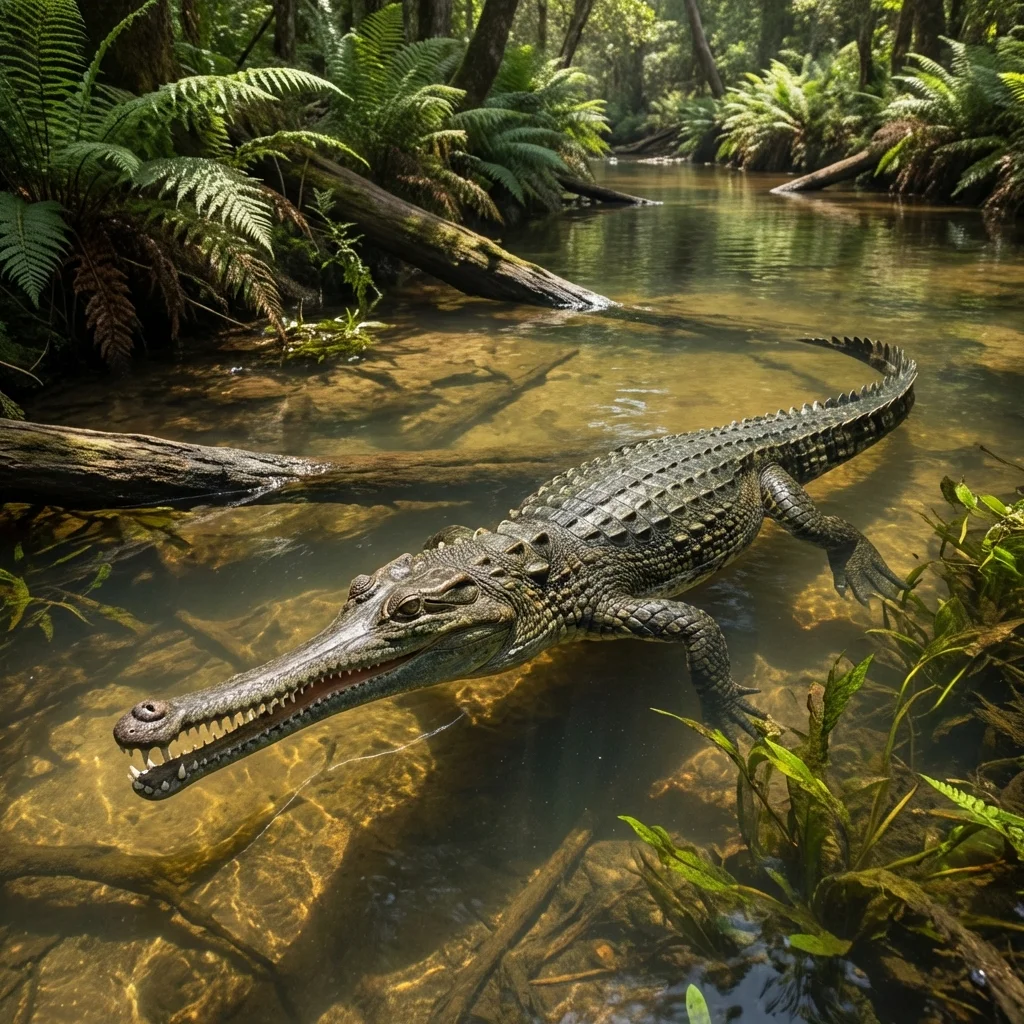
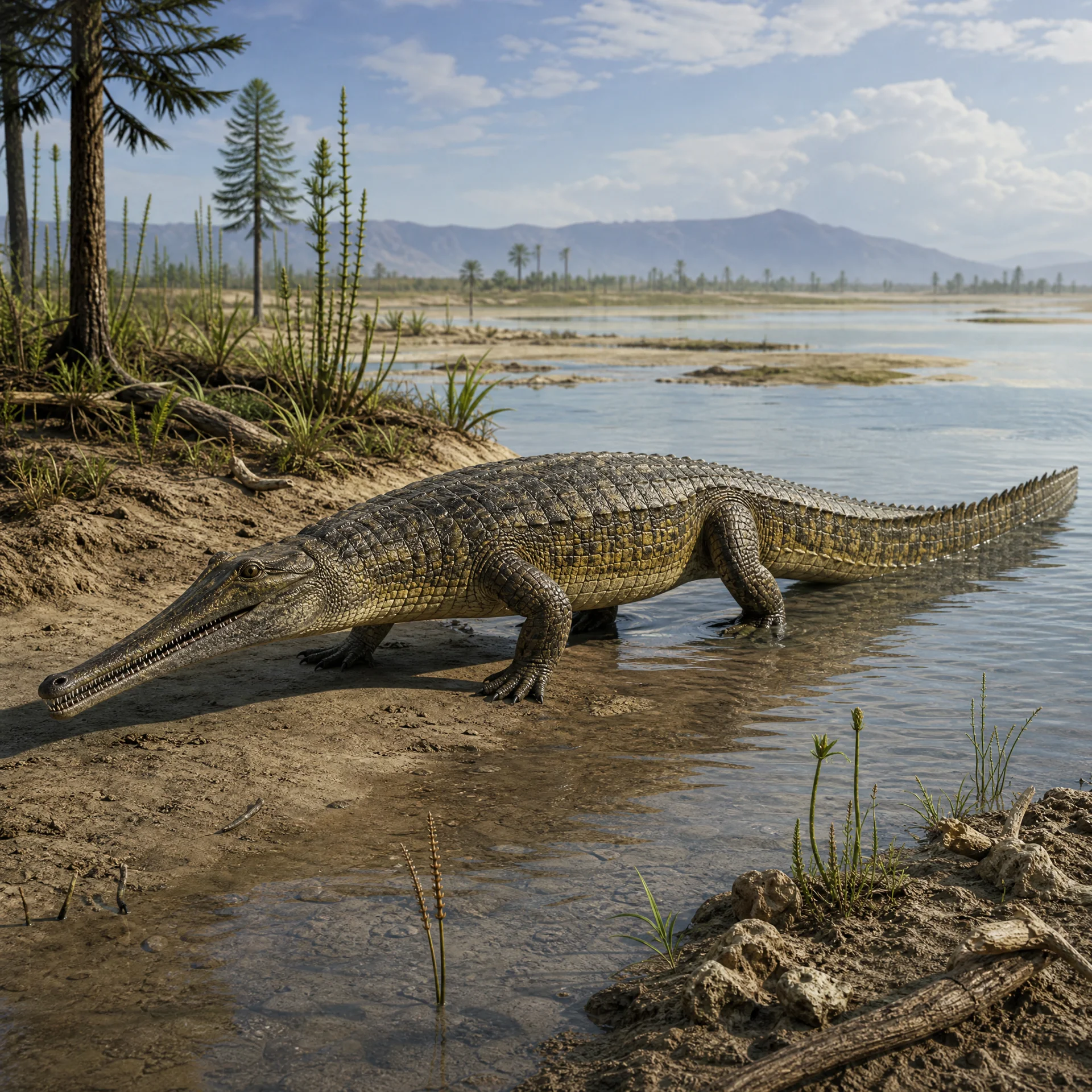
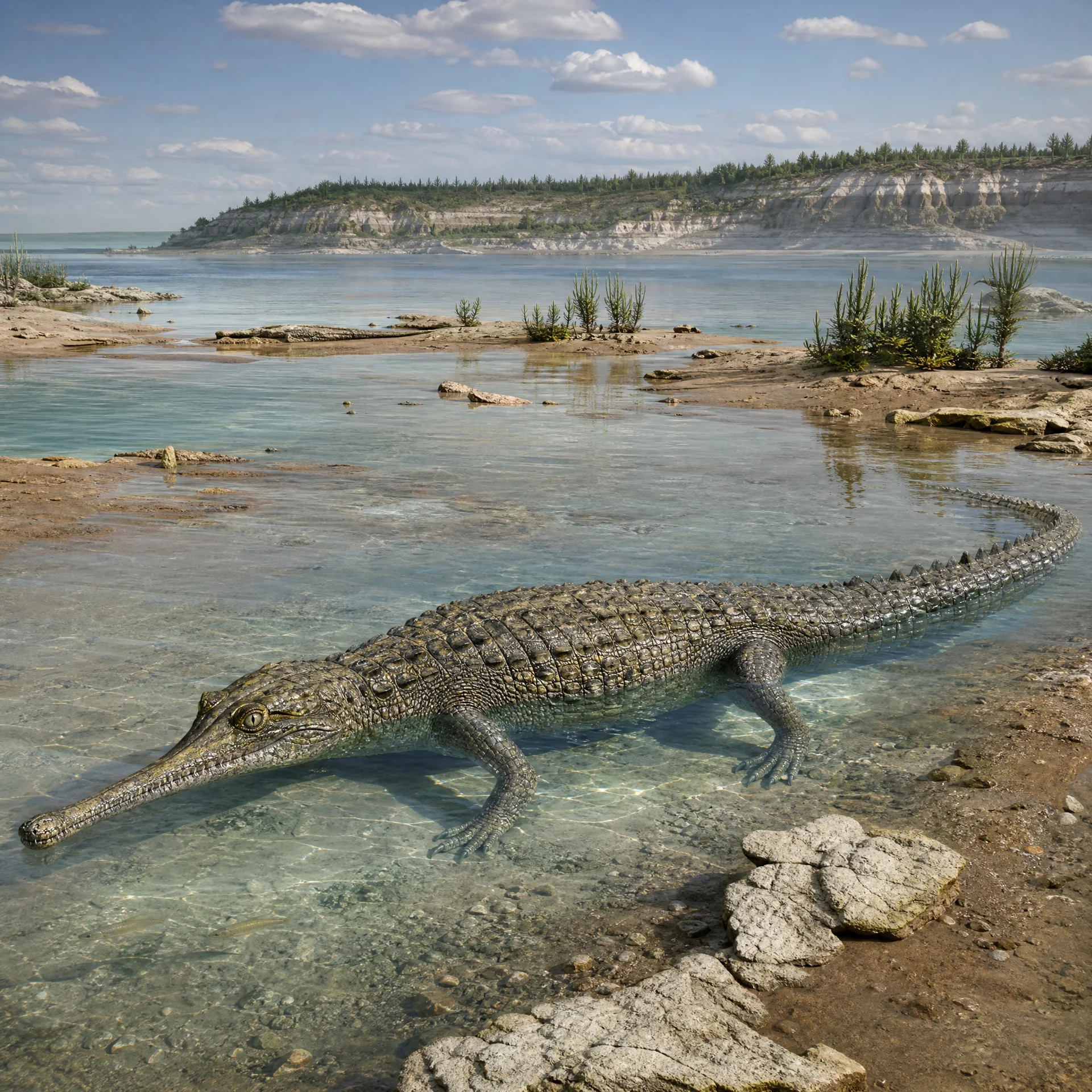
Mystriosuchus Fraas, 1896 is an extinct genus of phytosaur (Phytosauria) that inhabited Europe and Greenland during the Late Triassic (Norian stage, approximately 228–212 Ma). The genus name derives from the Greek mystrion (spoon) and soukhos (crocodile), meaning "spoon crocodile" — a reference to the remarkably elongated and flattened snout that bears a striking resemblance to that of the modern gharial (Gavialis gangeticus). Phytosaurs were a group of large, semi-aquatic archosauromorph reptiles that achieved an almost global distribution during the Late Triassic. Although superficially resembling modern crocodilians, they represent an outstanding case of convergent evolution rather than a direct ancestral lineage of crocodiles.
Mystriosuchus displays greater adaptation to aquatic life than other known phytosaurs, as evidenced by its proportionally shorter, more paddle-like limbs and a simplified osteoderm complement consisting of only two morphotypes rather than the greater diversity seen in other phytosaurs. The most complete known specimen — a nearly fully articulated M. planirostris skeleton approximately 4 m in length from northern Italy — was recovered from a marine intraplatform basin, and M. steinbergeri from Austria was found in a marine lagoonal depositional environment, providing the strongest evidence to date for marine adaptations within Phytosauria. In 2023, a fourth species, M. alleroq, was described from East Greenland, extending the geographic range of the genus beyond continental Europe.
Four species are currently recognized within Mystriosuchus: the type species M. planirostris (von Meyer, 1863), M. westphali Hungerbühler & Hunt, 2000, M. steinbergeri Butler et al., 2019, and M. alleroq López-Rojas et al., 2023. Phylogenetically, Mystriosuchus is a derived phytosaur placed within the Parasuchidae, tribe Mystriosuchini (formerly Pseudopalatinae), consistently recovered in a derived position in all quantitative cladistic analyses to date.
The genus name Mystriosuchus combines the Greek mystrion (spoon) with soukhos (crocodile), referencing the animal's distinctively flattened, elongated snout likened to a spoon. The type species epithet planirostris derives from the Latin planus (flat) and rostrum (snout/beak), meaning "flat-snouted." The species name westphali honours Friedrich von Westphal, a German palaeontologist. M. steinbergeri is named after Sepp Steinberger, who discovered and helped collect the holotype material in Austria, and M. alleroq takes its name from the Greenlandic word alleroq, meaning "jawbone."
The genus Mystriosuchus was erected by Eberhard Fraas in 1896. The type species had originally been described by Christian Erich Hermann von Meyer in 1863 as Belodon planirostris, before being separated into its own genus by Fraas. Four species are currently regarded as valid. Historically, Mystriosuchus was placed in its own subfamily, Mystriosuchidae (von Huene, 1915), but subsequent cladistic analyses consistently recovered the genus within Pseudopalatinae — now renamed Mystriosuchini after Kammerer et al. (2016) established priority of the latter name.
A gharial-snouted, aquatically specialized Late Triassic phytosaur from Europe and Greenland, with the strongest evidence of marine habits among all known phytosaurs.
The temporal distribution of Mystriosuchus falls within the Late Triassic Norian stage, estimated at approximately 228–212 Ma. The type species M. planirostris and M. westphali occur in the Löwenstein Formation (Stubensandstein) of southwestern Germany, which corresponds to the middle Norian (Alaunian) (Sues, 2025). M. steinbergeri was recovered from the Dachstein Limestone of Austria, correlated to the Norian (Butler et al., 2019), and M. alleroq comes from the Malmros Klint Formation of East Greenland, likewise dated to the Norian (López-Rojas et al., 2023).
The principal formations and lithological associations for Mystriosuchus species are summarized below.
| Species | Locality | Formation | Lithology | Depositional Environment |
|---|---|---|---|---|
| M. planirostris | SW Germany, Baden-Württemberg | Löwenstein Fm. (Stubensandstein) | Sandstone, mudstone | Fluvial-floodplain |
| M. planirostris | N. Italy, Lombardy (Endenna) | Calcare di Zorzino | Limestone | Marine intraplatform basin |
| M. westphali | SW Germany, Baden-Württemberg | Löwenstein Fm. (Stubensandstein) | Sandstone | Fluvial-floodplain |
| M. steinbergeri | Austria, Totes Gebirge | Dachstein Limestone | Limestone | Marine lagoon |
| M. alleroq | E. Greenland, Jameson Land | Malmros Klint Fm. | Floodplain sandstone | Floodplain |
A notable aspect of Mystriosuchus is its occurrence across a remarkably diverse range of depositional settings. The German Stubensandstein comprises primarily fluvial-floodplain sandstones and mudstones, from which the genus was traditionally interpreted as a freshwater inhabitant. However, the Italian Calcare di Zorzino (Zorzino Limestone) represents a Norian marine intraplatform basin, and the nearly complete skeleton recovered there in 1995 (approximately 4 m long) was found within this marine depositional context, raising the possibility of marine habitation (Gozzi & Renesto, 2003). More compellingly, the Austrian Dachstein Limestone specimens of M. steinbergeri — comprising at least four individuals of similar size found in association — come from a marine lagoonal depositional environment, representing the strongest evidence to date for marine adaptations in phytosaurs (Butler et al., 2019). The Greenlandic M. alleroq was found in floodplain overbank sandstones, suggesting freshwater or marginal settings in that region.
The principal specimens of Mystriosuchus are tabulated below.
| Species | Specimen Number | Elements Preserved | Repository | Notes |
|---|---|---|---|---|
| M. planirostris | MCZ VPRA-1018 (lectotype) | Skull, dorsal vertebrae | Museum of Comparative Zoology, Harvard | Lectotype; originally described as Belodon planirostris by von Meyer (1863) |
| M. planirostris | Endenna specimen (unnumbered) | Nearly complete articulated skeleton (~4 m) | Museo Civico di Scienze Naturali di Bergamo | Described by Gozzi & Renesto (2003); includes skull |
| M. westphali | GPIT 261/001 (holotype) | Large, well-preserved complete cranium + snout fragment | Institut für Geowissenschaften, Universität Tübingen | Named by Hungerbühler & Hunt (2000); redescribed by Hungerbühler (2002) |
| M. steinbergeri | NHMW 1986/0024/0001 (holotype) | Complete skull | Naturhistorisches Museum Wien | Described by Butler et al. (2019); at least 4 individuals in total |
| M. alleroq | NHMD-916731 (holotype) | Nearly complete left mandible | Natural History Museum of Denmark | Named by López-Rojas et al. (2023); first Mystriosuchus from Greenland |
According to Hungerbühler (2002), the genus Mystriosuchus is diagnosed by five autapomorphies: (1) a slit-like interpremaxillary fossa, (2) a triangular cross-section of the postorbito-squamosal bar, (3) a strongly reduced posttemporal fenestra, and (4–5) two unique features of the cranial sculpture. An additional eight synapomorphies that also occur in some more distantly related taxa further support the generic diagnosis.
M. planirostris is further characterized by the naris facing forward anteriorly and upward posteriorly, the longest rostrum proportionally among all phytosaurs, and the highest degree of depression of the supratemporal opening. M. westphali is diagnosed by, among other features, a distinct premaxillary crest, a squamosal-prootic contact, absence of a posterior process of the squamosal, and a slit-like posttemporal fenestra (Hungerbühler, 2002). M. steinbergeri is distinguished by numerous additional features from the two previously named species (Butler et al., 2019), and M. alleroq is diagnosed by an L-shaped retroarticular process and other mandibular and postcranial characters (López-Rojas et al., 2023).
The type species M. planirostris was originally described by von Meyer (1863) without formal holotype designation, and the lectotype MCZ VPRA-1018 preserves only the skull and dorsal vertebrae, limiting postcranial information. This gap was substantially filled by the Italian Endenna skeleton in 2003. For M. alleroq, the holotype consists of a mandible, and referred postcranial material is disarticulated, limiting cranial comparisons with other species. The M. steinbergeri specimens, while including multiple individuals and a complete skull, represent skeletally immature individuals, leaving the adult morphology somewhat uncertain.
The overall body form of Mystriosuchus was convergently similar to modern crocodilians, particularly the gharial. The complete M. planirostris skeleton from Endenna, Italy measures approximately 4 m in total length (Gozzi & Renesto, 2003). The Austrian M. steinbergeri specimens are of comparable size (approximately 4 m), but histological analysis revealed that these individuals were at least eight years old at time of death yet had not reached skeletal maturity, implying that adults may have been somewhat larger (Butler et al., 2019). The holotype cranium of M. westphali (GPIT 261/001) is notably large, and skull lengths within the genus typically range from approximately 600 to over 900 mm, suggesting the existence of substantially larger individuals.
No dedicated body mass study exists for Mystriosuchus specifically. However, based on the phytosaur body mass estimation study by Heckert et al. (2003), which employed regression equations derived from modern crocodilians, phytosaurs of comparable size (approximately 4 m body length) would have massed approximately 200–350 kg. Given the comparatively gracile build of Mystriosuchus, the actual mass may have been toward the lower end of this range.
The most distinctive anatomical feature of Mystriosuchus is its extremely elongated, slender rostrum. In M. planirostris, as the species name implies, the snout is "plain" — lacking osseous ornamentation or crests. M. westphali, by contrast, possesses multiple bony crests along the upper jaw, most prominently at the base and tip of the snout, including a well-developed premaxillary crest. As keratinous crests are documented in phytosaurs (Stocker & Butler, 2013), M. planirostris may have had soft-tissue ornamentation not preserved in the fossil record.
As in all phytosaurs, the external nares of Mystriosuchus are positioned not at the tip of the snout but on a raised eminence immediately anterior to the orbits. This is the most conspicuous anatomical distinction from crocodilians. The dentition is gharial-like, comprising slender, slightly recurved teeth arrayed along the elongated jaws — a configuration well-suited for seizing fish.
Postcranial analysis of the Endenna specimen (Gozzi & Renesto, 2003) indicates that Mystriosuchus was more adapted to aquatic life than other known phytosaurs. The limbs are proportionally shorter and more paddle-like compared to those of other phytosaurs, and the osteoderm complement comprises only two morphotypes, in contrast to the greater diversity found in most phytosaurs. These features collectively suggest enhanced aquatic locomotion capabilities.
Based on the Italian specimen, Mystriosuchus possessed 25 cervical-dorsal vertebrae, 2 sacral vertebrae, and 74 caudal vertebrae. The tail was longer than the rest of the body, constituting approximately 51% of total body length. At the distal end of the tail, the chevrons form an inverted "T" shape — a structure not observed in other phytosaurs but present in sauropterygians and some crocodilians (Gozzi & Renesto, 2003). This may indicate specialization for tail-driven aquatic propulsion.
The cranial morphology of Mystriosuchus, particularly the gharial-like elongated, slender snout, is strongly indicative of a primarily piscivorous diet. The narrow jaws would have experienced substantially less hydrodynamic resistance during opening and closing in water, greatly increasing jaw speed, but their structural fragility would have made attacking large prey impractical. Bestwick et al. (2021) applied dental microwear texture analysis to phytosaur teeth and found that Mystriosuchus showed a preference for softer invertebrates, suggesting a diet that may have included molluscs or crustaceans in addition to fish.
Mystriosuchus would have occupied an important position in the aquatic predator guild of Late Triassic Europe. In the German Stubensandstein, it co-occurred with Nicrosaurus, a phytosaur with a relatively broad, robust snout, suggesting niche partitioning through different feeding strategies — Mystriosuchus specializing in fish and soft invertebrates, while Nicrosaurus could have taken a wider range of harder prey (Hungerbühler, 2002). The occurrence in marine environments (Italy, Austria) demonstrates that Mystriosuchus utilized a remarkably broad range of aquatic habitats, potentially ranging from upstream freshwater rivers, through estuaries, to coastal marine settings.
Histological analysis of the Austrian M. steinbergeri specimens revealed that these individuals were at least eight years old at death but had not yet attained skeletal maturity (Butler et al., 2019). This suggests either a relatively slow growth rate or a prolonged period required to reach full adult size. The recovery of at least four similarly-sized individuals in close association is potentially suggestive of gregarious behaviour, though post-mortem aggregation by currents or other taphonomic processes cannot be excluded.
Confirmed localities for Mystriosuchus include southwestern Germany (Baden-Württemberg), northern Italy (Lombardy, Endenna), Austria (Totes Gebirge), and East Greenland (Jameson Land). Both M. planirostris and M. westphali are known from the Löwenstein Formation of Germany, M. planirostris also occurs in the Italian Zorzino Limestone, M. steinbergeri is restricted to the Austrian Dachstein Limestone, and M. alleroq is known solely from the Malmros Klint Formation of Greenland.
Prior to the 2023 description of M. alleroq, Mystriosuchus was regarded as an exclusively European taxon. The Greenlandic discovery supports a European faunal influence extending into East Greenland during the Norian (López-Rojas et al., 2023), and implies that faunal interchange between Europe and Greenland was possible during the pre-Atlantic rifting phase of the Late Triassic.
Mystriosuchus is classified within Archosauriformes > Phytosauria > Parasuchidae > Mystriosuchinae > Mystriosuchini. Kammerer et al. (2016) demonstrated that the name Mystriosuchini von Huene, 1915 has nomenclatural priority over Pseudopalatinae Long & Murry, 1995, and accordingly synonymized the latter with the former.
The exact position of Mystriosuchus within Mystriosuchini varies between analyses. In the most taxonomically comprehensive cladistic study to date, Jones & Butler (2018) recovered four tree topologies from four data matrices. In two topologies, Mystriosuchus forms the most basal clade within Mystriosuchini, while in the other two it occupies a highly derived position nested within the Machaeroprosopus clade. Butler et al. (2019), in their description of M. steinbergeri, found that this species was recovered as the sister taxon to a clade comprising M. planirostris + M. westphali, providing strong statistical support for the monophyly of Mystriosuchus.
A basal position of Mystriosuchus within Phytosauria — such as placement as sister to Paleorhinus (=Parasuchus), as suggested by Gregory (1962) and Long & Murry (1995) — has not been supported by any quantitative cladistic analysis (Jones & Butler, 2018).
Should Mystriosuchus nest within Machaeroprosopus in future analyses, the genus name Mystriosuchus Fraas, 1896 would have priority over Machaeroprosopus Mehl, 1915, potentially requiring extensive taxonomic reorganization (Jones & Butler, 2018). This issue remains unresolved and awaits additional character data and analyses.
The placement of Mystriosuchus within Mystriosuchini, its gharial-like elongated snout, and its enhanced aquatic adaptations relative to other phytosaurs are all firmly established by anatomical evidence. Marine occurrence (Italy, Austria) is confirmed by multiple independent specimens from demonstrably marine deposits.
A primarily piscivorous diet (with possible inclusion of soft invertebrates) is supported by both cranial morphology and dental microwear analysis. The euryhaline lifestyle — utilizing both freshwater and marine habitats — is well-supported by the diversity of depositional environments from which the genus has been recovered.
Whether the inverted "T"-shaped chevrons at the distal tail actually enhanced swimming propulsion remains a hypothesis pending functional morphological analysis. Gregarious behaviour (inferred from the Austrian multi-individual assemblage) also remains hypothetical, as taphonomic aggregation cannot be excluded.
Phytosaurs are often mistakenly presented in popular media as "ancestors of crocodiles," but in reality they do not bear a direct ancestor-descendant relationship with Crocodylia and instead represent a remarkable case of convergent evolution. The common assumption that all phytosaurs were exclusively freshwater animals also requires revision in light of the marine records of Mystriosuchus.
| Taxon | Age | Snout Morphology | Estimated Size | Habitat | Inferred Diet |
|---|---|---|---|---|---|
| Mystriosuchus | Norian (~228–212 Ma) | Very slender, elongated (gharial-type) | ~4 m | Freshwater to marine | Piscivory / soft invertebrates |
| Nicrosaurus | Norian | Broad and robust | ~2.5–4 m | Primarily freshwater | Generalist carnivore |
| Machaeroprosopus | Norian–Rhaetian | Moderate to broad | ~4–6 m | Primarily freshwater | Carnivore |
| Smilosuchus | Carnian–Norian | Moderate to elongated | Up to ~7.6 m | Freshwater | Carnivore |
Mystriosuchus stands out among contemporaneous phytosaurs as having the most extreme gharial-like snout morphology and the most pronounced aquatic specializations, and is the only genus within Phytosauria for which marine habitation has been convincingly demonstrated.
The tail of Mystriosuchus was longer than the rest of its body, comprising approximately 51% of total body length.
Mystriosuchus is the only phytosaur genus for which marine habitation has been convincingly demonstrated, with at least four individuals found together in an Austrian marine lagoon deposit.
Unlike crocodilians, whose nostrils are at the tip of the snout, Mystriosuchus had its nostrils positioned on a raised bump just in front of the eyes.
The type species M. planirostris was originally described in 1863 under the name Belodon planirostris before being placed in its own genus by Fraas in 1896.
Although Mystriosuchus looks astonishingly similar to the modern gharial, these two animals are separated by over 200 million years and evolved their similar snout form completely independently — a textbook example of convergent evolution.
M. westphali had prominent bony crests on its snout, including a distinct premaxillary crest, making it visually very different from the 'plain-snouted' M. planirostris.
Bone histology of the Austrian M. steinbergeri specimens showed they were at least eight years old at death but had not yet reached skeletal maturity, suggesting adults were larger than the known 4 m specimens.
The 2023 discovery of M. alleroq in East Greenland overturned the longstanding view that Mystriosuchus was an exclusively European genus.
While most phytosaurs had diverse types of osteoderms (bony armour plates), Mystriosuchus possessed only two morphotypes — a greatly simplified body armour possibly related to its more aquatic lifestyle.
Dental microwear analysis suggests Mystriosuchus may have fed on soft invertebrates as well as fish, not unlike some modern crocodilians (Bestwick et al., 2021).
The species name 'alleroq' comes from the Greenlandic word for 'jawbone,' as the holotype of this species is a nearly complete mandible.
No. Mystriosuchus belongs to the Phytosauria, an extinct group of archosauromorph reptiles that superficially resembled modern crocodilians but are not their direct ancestors. Phytosaurs and crocodilians are both archosaurs, but they independently evolved similar semi-aquatic body plans through convergent evolution.
The most complete known skeleton of M. planirostris, discovered in Italy in 1995, measures approximately 4 m (13 ft) in total length (Gozzi & Renesto, 2003). The Austrian M. steinbergeri specimens are of similar size but were not yet skeletally mature at death, suggesting adults could have been somewhat larger.
Strong evidence supports marine habitation. Specimens have been recovered from the Italian Calcare di Zorzino (a marine intraplatform basin) and the Austrian Dachstein Limestone (a marine lagoonal environment). The Austrian M. steinbergeri assemblage, comprising at least four individuals found in a marine lagoon, represents the strongest evidence for marine adaptations in any phytosaur (Butler et al., 2019).
Its gharial-like elongated, slender snout strongly suggests a primarily piscivorous (fish-eating) diet. Dental microwear texture analysis by Bestwick et al. (2021) also indicated a preference for softer invertebrates, suggesting the diet may have included molluscs or crustaceans alongside fish. The slender jaws enabled fast snapping in water but were too fragile for attacking large prey.
Four species are currently recognized: M. planirostris (type species; Germany and Italy), M. westphali (Germany), M. steinbergeri (Austria), and M. alleroq (Greenland). The most recent, M. alleroq, was described in 2023 from East Greenland.
Despite their very similar external appearance, the most conspicuous anatomical difference is the position of the nostrils (external nares). In phytosaurs, the nostrils are located on a raised eminence just in front of the eyes, whereas in crocodilians they are at the tip of the snout. Phylogenetically, phytosaurs are not the direct ancestors of crocodilians but belong to a separate archosaur lineage.
The tail comprised 74 caudal vertebrae and accounted for approximately 51% of total body length. Notably, the distal chevrons form an inverted 'T' shape — a structure not found in other phytosaurs but seen in sauropterygians and some crocodilians (Gozzi & Renesto, 2003). This may indicate specialization for tail-driven swimming.
Specimens are known from southwestern Germany (Baden-Württemberg), northern Italy (Lombardy), Austria (Totes Gebirge), and East Greenland (Jameson Land). Until the 2023 discovery in Greenland, Mystriosuchus was considered an exclusively European genus.
Mystriosuchus and all other phytosaurs went extinct by the end-Triassic mass extinction event (approximately 201 Ma) or before. The last known occurrence of Mystriosuchus is in the Norian stage (approximately 212 Ma), with no confirmed Rhaetian records.
The genus name combines the Greek words mystrion (spoon) and soukhos (crocodile), meaning 'spoon crocodile' — a reference to the elongated, flattened snout. The type species name planirostris comes from Latin planus (flat) and rostrum (snout), meaning 'flat-snouted.'
5images