Plesiosaurus
Jurassic Period Piscivore Creature Type
Plesiosaurus dolichodeirus
Scientific Name: "Plesiosaurus: from Ancient Greek plesios (near, close to) + sauros (lizard) = 'near-lizard,' indicating it was more reptile-like than Ichthyosaurus. dolichodeirus: from Greek dolichos (long) + deire (neck) = 'long-necked'"
Local Name: Plesiosaurus
Physical Characteristics
Discovery
Habitat
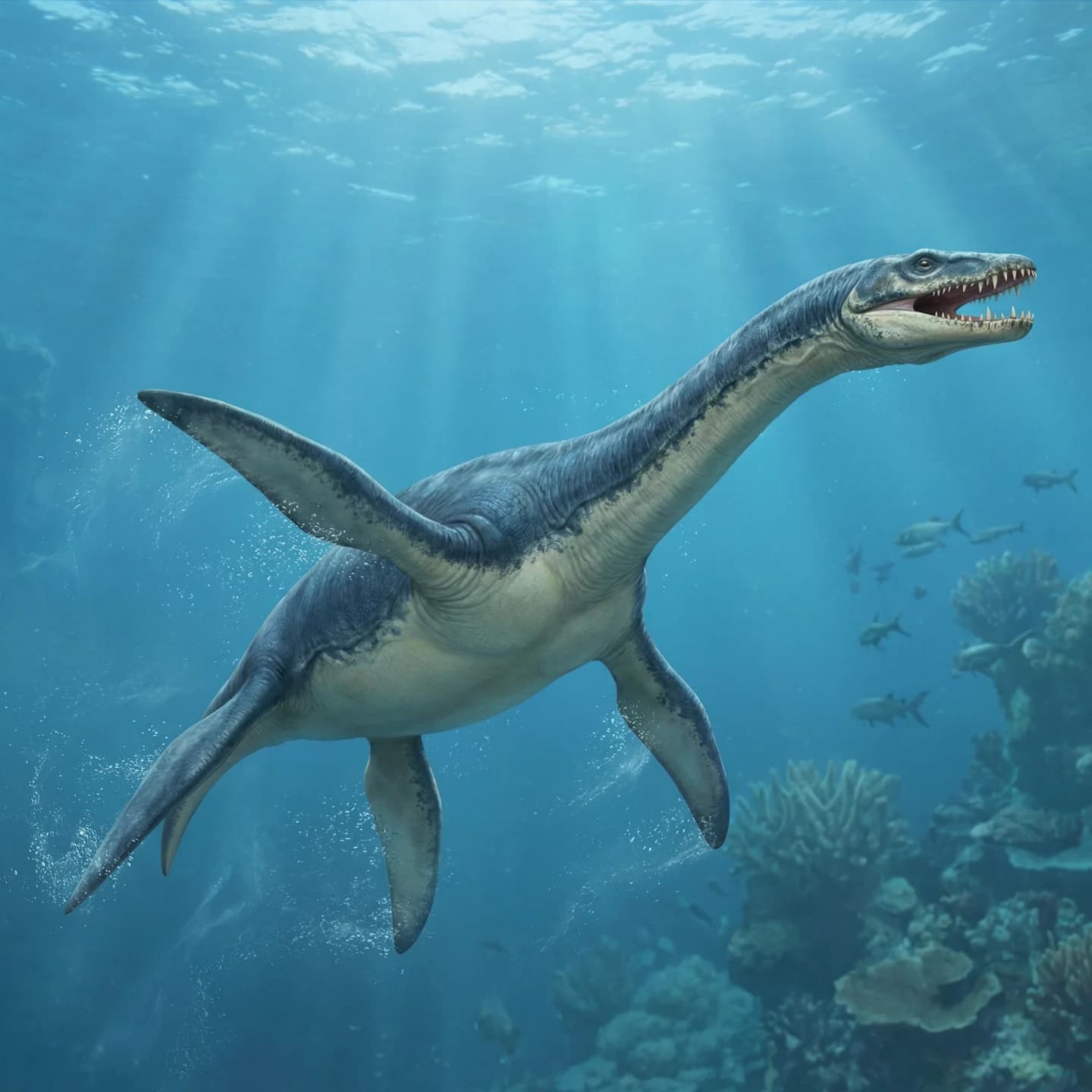
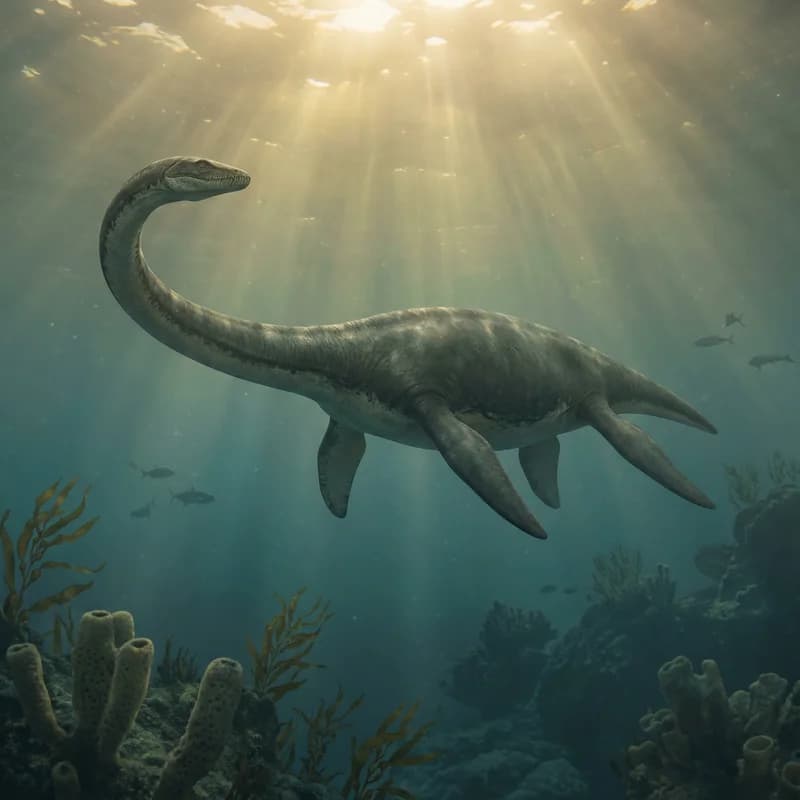
Plesiosaurus dolichodeirus Conybeare, 1824 is a moderately sized marine sauropterygian reptile from the Early Jurassic (Sinemurian stage, approximately 199.5–192.9 Ma). It is the type genus of the order Plesiosauria and holds a singular place in the history of palaeontology as the first plesiosaur ever discovered and named. Known primarily from nearly complete skeletons recovered from the Lias Group of Dorset, England, Plesiosaurus is characterised by its small head, long and slender neck composed of approximately 38–42 cervical vertebrae, broad turtle-like body, short tail, and two pairs of elongated paddle-like flippers. It measured approximately 2.87–3.5 m (9.4–11.5 ft) in total length.
Plesiosaurus is not a dinosaur. It belongs to the Sauropterygia, a major clade of marine reptiles that is phylogenetically distinct from Dinosauria. While plesiosaurs lived alongside dinosaurs throughout the Mesozoic, they represent an entirely separate evolutionary lineage of secondarily aquatic reptiles. The genus name was coined by Henry De la Beche and William Conybeare in 1821, based on fragmentary remains from the Bristol region and Dorset, to indicate that this animal was closer to a normal reptile (a "saurian") than the fish-like Ichthyosaurus found in the same strata. The type species, P. dolichodeirus, was formally described by Conybeare in 1824, based on a nearly complete articulated skeleton (NHMUK PV OR 22656) famously discovered by Mary Anning at Lyme Regis on 10 December 1823.
Today, Plesiosaurus contains only a single valid species, P. dolichodeirus. Historically, the genus served as a notorious "wastebasket taxon," with hundreds of species from across the Mesozoic and around the world uncritically assigned to it. Storrs (1997) undertook a comprehensive morphological and taxonomic revision, drastically reducing the number of valid species and demonstrating that most non-English and non-Sinemurian species did not belong in Plesiosaurus. Subsequent work by Grossmann (2007) and others reassigned former species to new genera such as Seeleyosaurus, Hydrorion, and Occitanosaurus. Phylogenetically, Plesiosaurus is placed as a basal member of Plesiosauroidea within Neoplesiosauria (Benson et al., 2012), belonging to the family Plesiosauridae.
Overview
Name and Etymology
The genus name Plesiosaurus derives from the Ancient Greek πλήσιος (plesios, "near" or "close to") and the Latinised σαῦρος (sauros, "lizard" or "saurian"). It was coined by De la Beche & Conybeare (1821) to express that this animal was positioned closer to normal reptiles (particularly the crocodile) in the Great Chain of Being than Ichthyosaurus, which had the form of a fish. The specific epithet dolichodeirus comes from the Greek δολιχός (dolichos, "long") and δειρή (deire, "neck"), directly referencing the animal's most conspicuous anatomical feature (Conybeare, 1824). The name was provided when Conybeare described Anning's nearly complete skeleton, which finally revealed the extraordinary length of the neck.
Taxonomic Status
Plesiosaurus was historically one of palaeontology's most abused genera. From the early 19th century onward, a lack of critical anatomical or taxonomic study meant that hundreds of species—representing most of the world and most of the Mesozoic—were dumped into this genus. Storrs (1997) demonstrated that none of the younger Jurassic or Cretaceous species belonged to Plesiosaurus, and that the only English species properly assigned to the genus was P. dolichodeirus. Several other Early Jurassic European species have since been reassigned: P. guilielmiimperatoris became Seeleyosaurus (reinstated by Grossmann, 2007), P. brachypterygius became Hydrorion (Grossmann, 2007), and P. tournemirensis became Occitanosaurus. The residual taxon 'Plesiosaurus' macrocephalus (Owen, 1838) remains unrevised but is probably a juvenile rhomaleosaurid (Plesiosaur Directory). Currently, Plesiosaurus is monotypic, containing only P. dolichodeirus.
One-Line Summary
The first plesiosaur ever discovered and named, and the archetype that gave the entire order Plesiosauria its name—a moderate-sized, long-necked marine reptile from the Early Jurassic of England.
Age, Stratigraphy, and Depositional Environment
Temporal Range
The temporal range of Plesiosaurus dolichodeirus falls within the Sinemurian stage of the Early Jurassic, approximately 199.5–192.9 Ma (ICS Chronostratigraphic Chart v2024/12). Most unequivocal specimens are from the early Sinemurian, specifically from the upper Blue Lias, the "Shales with Beef," and the lower Black Ven Marls member of the Charmouth Mudstone Formation, as constrained by ammonite biostratigraphy (Storrs, 1997, pp. 179–180). Some specimens come from later Sinemurian rocks. The oldest specimen may be a skull tentatively attributed to the late Rhaetian or early Hettangian (Storrs, 1997, p. 180), though this attribution remains uncertain.
Formation and Lithology
All unequivocal P. dolichodeirus specimens are limited to the Lyme Regis area of Dorset, within the Lias Group (Storrs, 1997, p. 148). The principal fossil-bearing units are the Blue Lias Formation (upper part) and the Charmouth Mudstone Formation (lower part, including the Black Ven Marls member). The Blue Lias consists of thinly interbedded limestone (laminated, nodular, or massive and persistent) and calcareous mudstone or siltstone (BGS Lexicon). The Charmouth Mudstone grades upward from the Blue Lias through the progressive loss of limestone beds, becoming increasingly mudstone-dominated.
Palaeoenvironment
The Blue Lias and Charmouth Mudstone formations were deposited in an epicontinental sea that covered much of western Europe during the latest Triassic to Early Jurassic (Hallam, 1960; trace fossil studies from Lyme Regis). During the Sinemurian, the Lyme Regis area lay at approximately 30–35°N palaeolatitude, in a warm subtropical to tropical marine setting on the western margin of the Tethys Ocean. The rhythmic alternation of limestone and mudstone is interpreted as reflecting sea-level fluctuations modulated by Milankovitch orbital cycles (Cambridge Geological Magazine; Weedon, 1986). The associated fauna—including abundant ammonites, belemnites, fishes, ichthyosaurs, and other plesiosaurs—indicates a biologically productive shallow marine environment where Plesiosaurus occupied the role of a mid-sized predator.
Specimens and Diagnostic Features
Holotype and Key Specimens
The holotype is NHMUK PV OR 22656, a nearly complete articulated skeleton discovered by Mary Anning in December 1823 at Lyme Regis. It was purchased by the Duke of Buckingham, and in 1848 was acquired by the British Museum (Natural History), now the Natural History Museum, London, where it remains on display. Key referred specimens include the following:
| Specimen | Elements | Repository | Reference |
|---|---|---|---|
| NHMUK PV OR 22656 | Nearly complete articulated skeleton (holotype) | NHM London | Conybeare, 1824 |
| BMNH 36183 | Partial skeleton | NHM London | Owen, 1865 |
| R.1313 | Partial skeleton (collected by Anning, 1829) | NHM London | Buckland, 1837 |
| MNHN A.-C. 8592 | Skeleton in ventrolateral view | MNHN Paris | Vincent et al., 2010 |
| YPM 1654 | Isolated pair of dentaries | Yale Peabody Museum | Storrs, 1997 |
| YPM-PU 3352 | Juvenile specimen | Yale Peabody Museum | Storrs, 1997 |
| NIMG F:8758 | Referred material | National Museum of Ireland | Storrs, 1997 |
Diagnosis
Following Storrs (1997), Plesiosaurus dolichodeirus is diagnosed by the following combination of characters: approximately 38–42 cervical vertebrae with centra slightly longer than tall; a narrow, elongate skull that reaches greatest width at the postorbital bar; external nostrils positioned closer to the eyes than to the snout tip; procumbent teeth that are simple, needle-like cones with fine longitudinal striations; a distinctive curvature of the humerus with a ventral groove on the shaft in mature individuals (interpreted as a retained primitive sauropterygian feature); and forelimbs that are significantly larger than hindlimbs in adults.
Limitations of the Material
While the holotype is remarkably complete, most referred specimens are incomplete or consist of isolated elements. Storrs (1997, p. 148) noted that numerous isolated but frequently non-diagnostic bones assigned to P. dolichodeirus are contained in virtually all collections of Lias material, making confident referral difficult. Unequivocal specimens are geographically restricted to the Lyme Regis area.
Morphology and Functional Anatomy
Body Size
Plesiosaurus dolichodeirus was a moderately sized plesiosaur that grew to approximately 2.87–3.5 m (9.4–11.5 ft) in total length (Sollas, 1881; Storrs, 1997, p. 149). No rigorous skeletal-based body mass estimate has been published specifically for P. dolichodeirus. Informal estimates range from approximately 90–450 kg, but these carry significant uncertainty. Zhao (2024, preprint) has developed volumetric scaling equations for plesiosaur body mass estimation using trunk length and dorsal vertebral dimensions as proxies, but direct application to P. dolichodeirus has not yet been published.
Skull and Dentition
The skull is small relative to the body and much narrower than long, reaching its greatest width just behind the eyes at the postorbital bar. The anterior portion is described as "bluntly triangular" (Storrs, 1997, p. 165). The orbits are roughly circular, positioned about halfway along the skull length, and face upward and laterally. The external nostrils are situated closer to the eyes than to the snout tip, and unlike Rhomaleosaurus, they do not appear adapted for underwater olfaction (Cruickshank et al., 1991; Storrs, 1997). The supratemporal fenestrae are approximately the same size as the orbits. The teeth are "simple, needle-like cones" that are slightly curved with circular cross-sections, sharply pointed with fine striations running from tip to base (Storrs, 1997, p. 166). They are procumbent, especially near the snout tip, where they may be only 10–15° above horizontal. There are 20–25 teeth per upper jaw row and 24 per lower jaw row. Up to four lower-jaw teeth are found in the symphyseal region, where the two mandibular rami form a robust, pointed, V-shaped scoop at an angle of approximately 45° (Storrs, 1997, pp. 166, 169).
Cervical Column
The most distinctive anatomical feature of Plesiosaurus is its long neck, composed of approximately 38–42 cervical vertebrae depending on the specimen (Storrs, 1997, p. 170). The cervical centra are relatively elongated, slightly longer than tall, with widths usually greater than or equal to length. Articular surfaces are "slightly concave and kidney-shaped, with rounded, slightly rugose edges." Small foramina subcentralia are found on the ventral surface. Cervical ribs are hatchet-shaped with two articular heads.
Post-Cervical Vertebral Column
Beyond the neck, the vertebral column includes 4–5 "pectoral" transitional vertebrae, approximately 21 dorsal vertebrae, 3 or more sacrals, and at least 28 caudals (Storrs, 1997, pp. 170–171). Dorsal ribs are thick and single-headed. Sacral ribs are "short, robust, and blunt or knob-like on both ends." Nine or more sets of gastralia ("belly ribs") are present between the shoulder and pelvis, each set comprising seven elements: a midline bone flanked by three lateral elements on each side.
Limbs and Girdles
The shoulder girdle includes fused clavicles, scapulae, and large coracoids. The forelimbs are elongate and relatively narrow compared to most plesiosaurs. The humerus has a distinctive curvature interpreted as a retained primitive sauropterygian feature, with a ventral groove in mature specimens. The forearm includes a broad crescent-shaped ulna and a "robust and pillar-like" radius, with six carpal bones and five digits. The phalangeal formula for one large individual is 4-8-9-8-6 (Storrs, 1997, p. 176). The pelvis includes equant pubic bones, ischia, and blade-shaped ilia. Hindlimbs are significantly smaller than forelimbs in adults, with straight femora and at least 3-7-9-8-7 toe phalanges (Storrs, 1997, pp. 173–178).
Locomotion
The current scientific consensus is that plesiosaurs employed a form of "underwater flight," with their primary limb movements being dorso-ventral (Frey & Riess, 1982; Godfrey, 1984). Liu et al. (2015) used computational fluid dynamics simulations to demonstrate that plesiosaurs were forelimb-dominated swimmers, with the hind flippers contributing primarily to manoeuvrability and stability. Muscutt et al. (2017) conducted robotic experiments confirming that all four flippers contributed to propulsion and that this four-flipper system enabled efficient and effective locomotion—a unique arrangement among vertebrates. The long neck may have created hydrodynamic drag during acceleration, leading some researchers to suggest that Plesiosaurus may have favoured ambush (sit-and-wait) predation over active pursuit.
Diet and Ecology
Feeding
Plesiosaurus is interpreted as primarily piscivorous (fish-eating), based on its tooth morphology. The needle-like, procumbent teeth and the U-shaped mandibular symphysis would have formed an effective "fish trap" for grasping slippery, free-swimming prey such as fish and belemnites (Storrs, 1997, p. 166). Some plesiosaurs have been shown to have fed on benthic invertebrates: McHenry et al. (2005) reported Australian plesiosaur stomach contents dominated by crushed clam and snail shells. However, no direct stomach contents have been reported for P. dolichodeirus specifically, so its diet is inferred from dental morphology and comparison with related taxa.
Ecological Role
Plesiosaurus dolichodeirus appears to have been the most common plesiosaur species in the Lias Group of England (Storrs, 1997, p. 179). It coexisted with ichthyosaurs (notably Ichthyosaurus), short-necked rhomaleosaurid plesiosaurs, diverse fish, ammonites, and belemnites. As a long-necked, small-headed plesiosauromorph, it occupied a different ecological niche from the co-occurring short-necked, large-headed pliosauromorph taxa, suggesting niche partitioning among Early Jurassic marine reptile predators.
Reproduction
Plesiosaurs are inferred to have been viviparous (live-bearing). O'Keefe & Chiappe (2011) described a pregnant specimen of the Late Cretaceous polycotylid Polycotylus latippinus, providing the first direct fossil evidence of live birth in plesiosaurs. The fetus was large and singular, suggesting a K-selected reproductive strategy comparable to modern whales. While this evidence does not come from Plesiosaurus itself, it strongly suggests that viviparity was widespread across Plesiosauria.
Distribution and Palaeogeography
Geographic Range
Unequivocal P. dolichodeirus specimens are restricted to the Lyme Regis area of Dorset, southern England (Storrs, 1997, p. 148). Some fragmentary and non-diagnostic material has been reported from other parts of the Lias Group across southern England (e.g., the Bristol area), but confident taxonomic attribution is difficult for isolated elements.
Palaeogeographic Setting
During the early Sinemurian (~195 Ma), the Lyme Regis area was situated at approximately 30–35°N palaeolatitude, far south of its present-day position. It lay on the western margin of the Tethys Ocean, within a shallow epicontinental sea covering much of what is now western Europe. Pangaea was beginning to break apart, and western Europe consisted of an archipelago of islands separated by shallow seaways. The warm, subtropical climate supported a rich and diverse marine ecosystem.
Phylogeny and Taxonomic Debate
Phylogenetic Position
In the cladistic analysis of Benson et al. (2012), Plesiosaurus dolichodeirus is recovered within Neoplesiosauria (sensu Ketchum & Benson, 2010), specifically as a basal member of Plesiosauroidea. It is positioned just crownward of Eoplesiosaurus antiquior and outside the clade Microcleididae (which includes Seeleyosaurus, Microcleidus, and relatives). The simplified phylogenetic placement is: Plesiosauria > Neoplesiosauria > Plesiosauroidea > Plesiosauridae > Plesiosaurus dolichodeirus.
The Family Plesiosauridae
Plesiosaurus belongs to the family Plesiosauridae and was for many years considered its sole member. Recent research into Early Jurassic plesiosaur diversity has revealed greater generic diversity within the family, though the precise membership and scope of Plesiosauridae remains under active discussion.
Alternative Hypotheses
Ketchum & Benson (2010) introduced the clade Neoplesiosauria to unite Plesiosauroidea and Pliosauroidea, based on a comprehensive phylogenetic dataset of 66 taxa and 178 characters. This analysis indicated that the large-headed, short-necked "pliosaurs" and the long-necked, small-headed "plesiosaurs" (in the vernacular sense) are both derived from within Plesiosauria, challenging earlier ideas of a deep split between the two body plans. Plesiosaurus, as a basal plesiosauroid, is particularly important for understanding this early radiation. However, the precise topology of basal plesiosauroid interrelationships remains sensitive to taxon sampling (Ketchum & Benson, 2010).
Reconstruction and Uncertainty
Confirmed Facts
The fundamental body plan (small skull, long neck of 38–42 cervical vertebrae, broad trunk, four paddle-like flippers, short tail), dental morphology (procumbent needle-like cones), humeral curvature with ventral groove, and relative forelimb-hindlimb proportions are all confirmed by multiple specimens, particularly the holotype. The stratigraphic provenance (Blue Lias / Charmouth Mudstone, Sinemurian) is well established.
Well-Supported Inferences
Underwater flight locomotion using four flippers, a primarily piscivorous diet, and viviparous reproduction are strongly supported by functional morphology, biomechanical simulations, and evidence from related taxa—but direct evidence (e.g., stomach contents or pregnant specimens) has not been reported for P. dolichodeirus specifically. These remain well-supported inferences rather than confirmed facts.
Uncertain or Speculative
Precise body mass (the 90–450 kg range cited in popular sources lacks rigorous methodological support), social behaviour, swimming speed, thermoregulatory strategy, and maximum lifespan are all poorly constrained by current evidence. The popular depiction of plesiosaurs raising their heads high above the water surface on swan-like necks is biomechanically questionable: the cervical column was likely not flexible enough to permit such extreme dorsiflexion (Henderson, 2006).
Comparison with Contemporary and Related Taxa
| Taxon | Age | Length (m) | Neck | Diet | Phylogenetic Position |
|---|---|---|---|---|---|
| Plesiosaurus dolichodeirus | Early Jurassic (Sinemurian) | 2.87–3.5 | Long (38–42 cervicals) | Piscivore (inferred) | Plesiosauridae (basal plesiosauroid) |
| Seeleyosaurus guilelmiimperatoris | Early Jurassic (Toarcian) | ~3–4 | Long | Piscivore (inferred) | Microcleididae |
| Rhomaleosaurus cramptoni | Early Jurassic (Toarcian) | ~5–7 | Short | Carnivore | Rhomaleosauridae |
| Meyerasaurus victor | Early Jurassic (Toarcian) | ~3.5 | Moderate | Carnivore (inferred) | Rhomaleosauridae |
| Thalassiodracon hawkinsi | Early Jurassic (Rhaetian–Hettangian) | ~1.5–2 | Short | Piscivore (inferred) | Basal Pliosauridae |
| Eoplesiosaurus antiquior | Early Jurassic (Sinemurian) | Unknown (fragmentary) | Unknown | Unknown | Basal Plesiosauroidea |
Plesiosaurus represents the classic "plesiosauromorph" body plan—long neck, small head—in contrast to co-occurring rhomaleosaurids that display the "pliosauromorph" morphology with short necks and large heads. This morphological divergence suggests niche partitioning in the Early Jurassic marine ecosystems of England.
Fun Facts
FAQ
📚References
- De la Beche, H. T. & Conybeare, W. D. (1821). Notice of the discovery of a new fossil animal, forming a link between the Ichthyosaurus and crocodile, together with general remarks on the osteology of the Ichthyosaurus. Transactions of the Geological Society of London, 5, 559–594.
- Conybeare, W. D. (1824). On the discovery of an almost perfect skeleton of the Plesiosaurus. Transactions of the Geological Society of London, Series 2, 1, 381–389.
- Storrs, G. W. (1997). Morphological and taxonomic clarification of the genus Plesiosaurus. In Callaway, J. M. & Nicholls, E. L. (eds.), Ancient Marine Reptiles, pp. 145–190. Academic Press, London.
- Benson, R. B. J., Evans, M. & Druckenmiller, P. S. (2012). High Diversity, Low Disparity and Small Body Size in Plesiosaurs (Reptilia, Sauropterygia) from the Triassic–Jurassic Boundary. PLoS ONE, 7(3), e31838. https://doi.org/10.1371/journal.pone.0031838
- Ketchum, H. F. & Benson, R. B. J. (2010). Global interrelationships of Plesiosauria (Reptilia, Sauropterygia) and the pivotal role of taxon sampling in determining the outcome of phylogenetic analyses. Biological Reviews, 85(2), 361–392. https://doi.org/10.1111/j.1469-185X.2009.00107.x
- Grossmann, F. (2007). The taxonomic and phylogenetic position of the Plesiosauroidea from the Lower Jurassic Posidonia Shale of south-west Germany. Palaeontology, 50(3), 545–564. https://doi.org/10.1111/j.1475-4983.2007.00654.x
- O'Keefe, F. R. & Chiappe, L. M. (2011). Viviparity and K-selected life history in a Mesozoic marine plesiosaur (Reptilia, Sauropterygia). Science, 333(6044), 870–873. https://doi.org/10.1126/science.1205689
- Liu, S., Smith, A. S., Gu, Y., Tan, J., Liu, C. K. & Turk, G. (2015). Computer Simulations Imply Forelimb-Dominated Underwater Flight in Plesiosaurs. PLoS Computational Biology, 11(12), e1004605. https://doi.org/10.1371/journal.pcbi.1004605
- Muscutt, L. E., Dyke, G., Stokes, G. D., Sherren, D., Sullivan, L. & Sherren, C. (2017). The four-flipper swimming method of plesiosaurs enabled efficient and effective locomotion. Proceedings of the Royal Society B, 284(1861), 20170951. https://doi.org/10.1098/rspb.2017.0951
- Sollas, W. J. (1881). On a new species of Plesiosaurus (P. Conybeari) from the Lower Lias of Charmouth; with observations on P. megacephalus, Stutchbury, and P. brachycephalus, Owen. Quarterly Journal of the Geological Society of London, 37(1–4), 440–480. https://doi.org/10.1144/GSL.JGS.1881.037.01-04.42
- Owen, R. (1865). Fossil Reptilia of the Liassic Formations, Part III. Monographs of the Palaeontographical Society.
- Andrews, C. W. (1896). On the structure of the plesiosaurian skull. Quarterly Journal of the Geological Society, London, 52, 246–253.
- McHenry, C. R., Cook, A. G. & Wroe, S. (2005). Bottom-feeding plesiosaurs. Science, 310(5745), 75. https://doi.org/10.1126/science.1117241
- Cruickshank, A. R. I., Small, P. G. & Taylor, M. A. (1991). Dorsal nostrils and hydrodynamically driven underwater olfaction in plesiosaurs. Nature, 352, 62–64. https://doi.org/10.1038/352062a0
- Brown, D. S. (1981). The English Upper Jurassic Plesiosauroidea (Reptilia) and a review of the phylogeny and classification of the Plesiosauria. Bulletin of the British Museum (Natural History): Geology, 35(4), 253–347.
- Zhao, T. (2024/2025). Body reconstruction and size estimation of plesiosaurs. bioRxiv preprint. https://doi.org/10.1101/2024.02.15.578844
- Torrens, H. (1995). Mary Anning (1799–1847) of Lyme; 'The Greatest Fossilist the World Ever Knew'. The British Journal for the History of Science, 25(3), 257–284.
- Vincent, P., Bardet, N., Suberbiola, X. P., Bouya, B., Amaghzaz, M. & Meslouh, S. (2010). A plesiosaur specimen from the Lias of Lyme Regis: the second plesiosaur specimen of the Natural History Museum, Paris. Geodiversitas, 32(3), 377–390.
Gallery
5 images Plesiosaurus
Plesiosaurus · Jurassic Period · Piscivore
 Plesiosaurus
Plesiosaurus · Jurassic Period · Piscivore
 Plesiosaurus
Plesiosaurus · Jurassic Period · Piscivore
 Plesiosaurus
Plesiosaurus · Jurassic Period · Piscivore
 Plesiosaurus
Plesiosaurus · Jurassic Period · Piscivore
🔗Related Creatures
Ichthyosaurus
Ichthyosaurus communis
Ophthalmosaurus
Ophthalmosaurus icenicus
Liopleurodon
Liopleurodon ferox
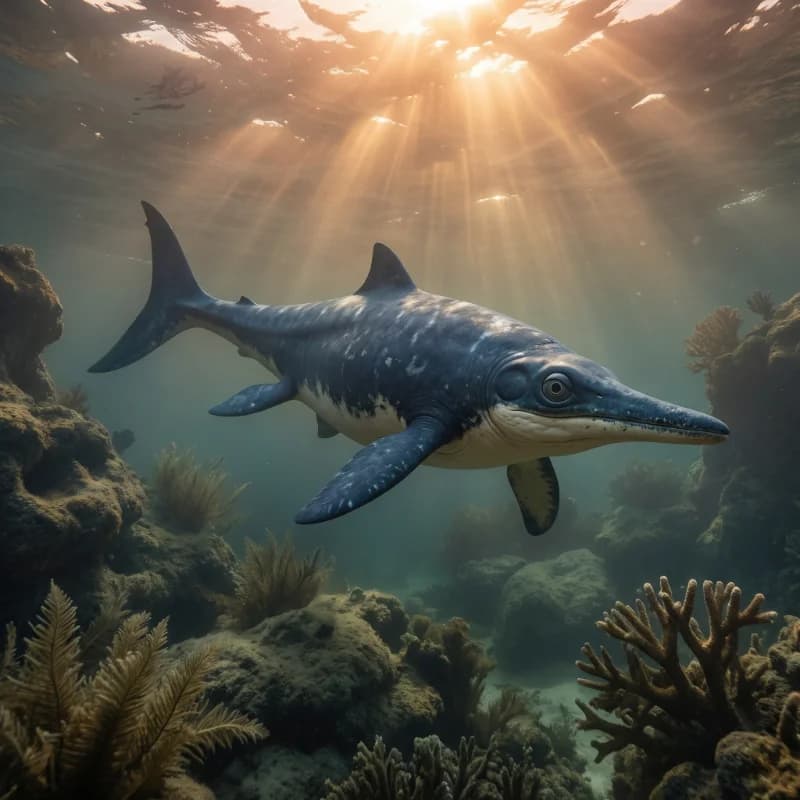
Temnodontosaurus
Temnodontosaurus
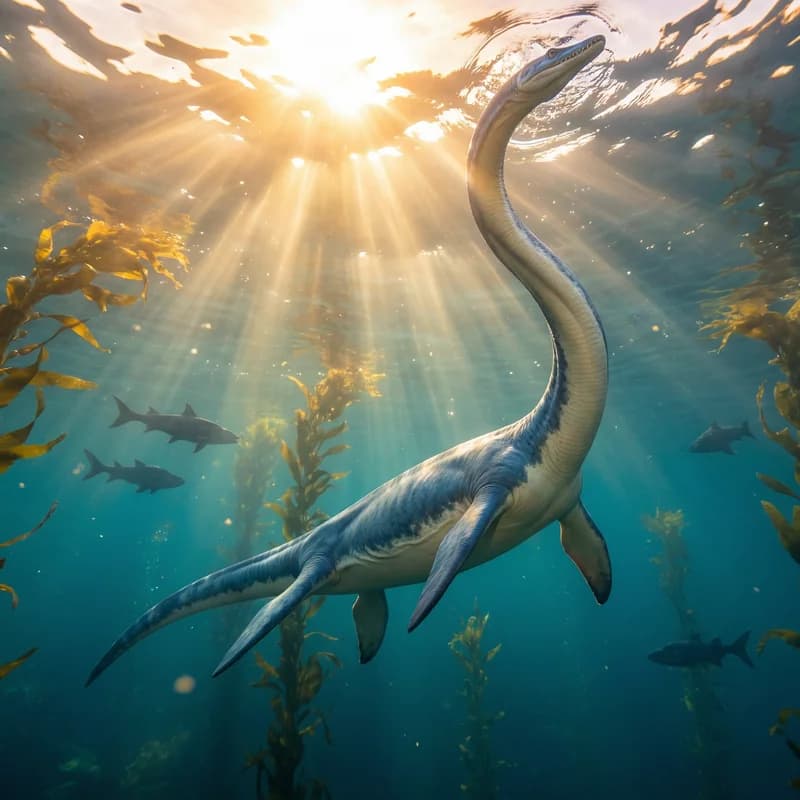
Tanystropheus
Tanystropheus longobardicus
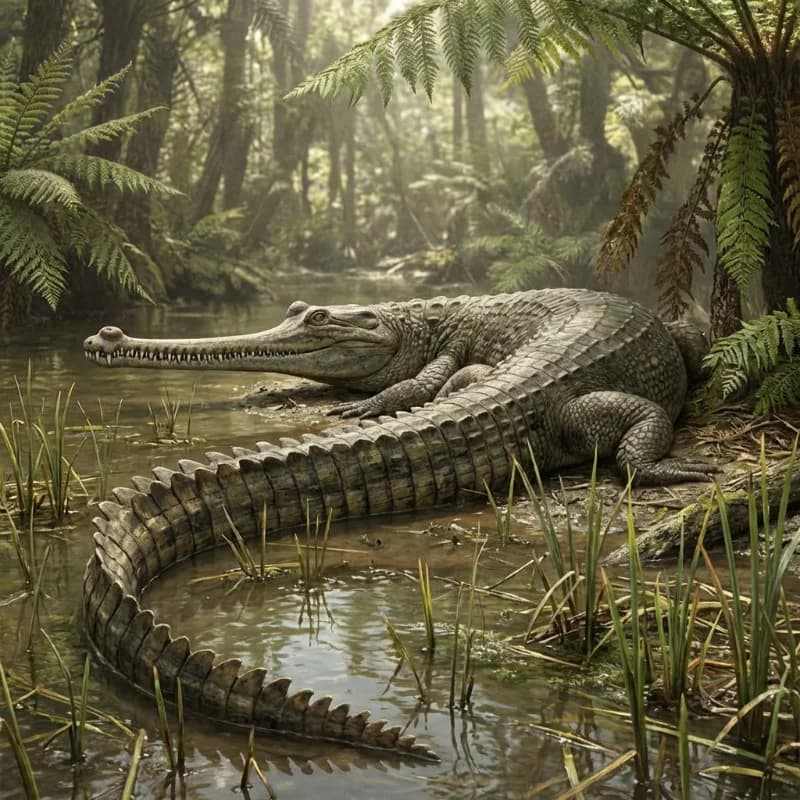
Mystriosuchus
Mystriosuchus planirostris
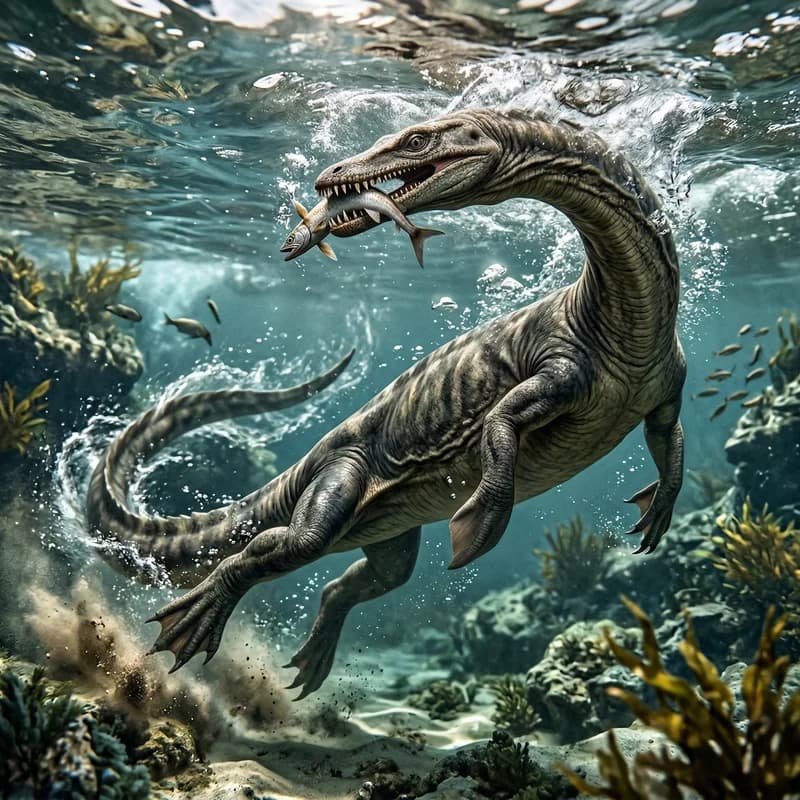
Nothosaurus
Nothosaurus mirabilis
Elasmosaurus
Elasmosaurus platyurus