Elasmosaurus
Cretaceous Period Piscivore Creature Type
Elasmosaurus platyurus
Scientific Name: "Elasmosaurus: Greek élasma (thin plate) + saûros (lizard) = 'thin-plate lizard'; platyurus: platýs (flat) + ourá (tail) = 'flat-tailed'"
Local Name: Elasmosaurus
Physical Characteristics
Discovery
Habitat
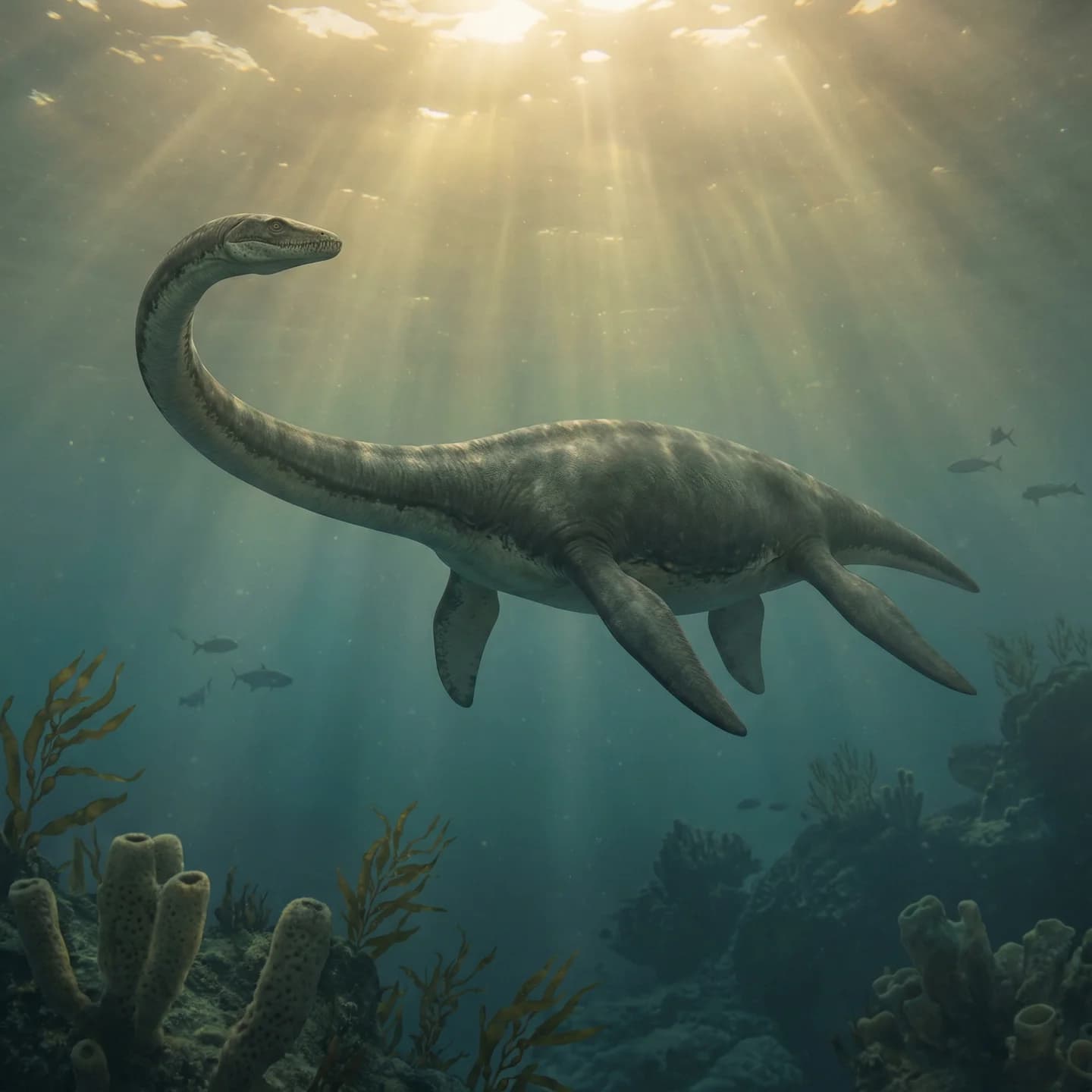
Elasmosaurus platyurus Cope, 1868 is a large elasmosaurid plesiosaur from the Late Cretaceous Campanian stage (approximately 80.6–77 million years ago) of the Western Interior Seaway in North America. It belongs to the order Plesiosauria, superfamily Plesiosauroidea, and family Elasmosauridae, of which it is the naming genus. Only one species is currently recognized as valid, the type species E. platyurus, and the holotype specimen ANSP 10081 was recovered from the Sharon Springs Member of the Pierre Shale in Logan County, Kansas, USA.
The most striking feature of Elasmosaurus is its extraordinarily long neck, comprising 72 cervical vertebrae and measuring approximately 7.1 m in length. Together with Albertonectes vanderveldei (which possessed at least 75 cervicals), Elasmosaurus holds the record for the highest number of neck vertebrae among all known vertebrates and is among the "longest-necked" animals ever to have lived (Sachs & Kear, 2013). Total body length has been estimated at approximately 10.3 m (Welles, 1952; O'Gorman, 2016), though Cope's original estimate of 13.1–13.7 m is still occasionally repeated in popular sources—this figure reflects overestimation of missing elements and cartilaginous components.
Elasmosaurus also holds a prominent place in the history of paleontology. When Edward Drinker Cope first described the skeleton in 1868, he infamously placed the skull on the wrong end of the vertebral column—at the tip of the tail rather than the neck. This error was later pointed out by Joseph Leidy and subsequently exploited by Cope's rival Othniel Charles Marsh, making the episode one of the most celebrated anecdotes of the "Bone Wars" (Davidson, 2002). Elasmosaurus was the first major vertebrate fossil discovered in Kansas and the first recognized member of the long-necked plesiosaur family Elasmosauridae.
Important: Elasmosaurus was not a dinosaur. It was a marine reptile belonging to Sauropterygia, an entirely separate evolutionary lineage from Dinosauria. Although plesiosaurs coexisted with dinosaurs during the Mesozoic, they were not ancestors, descendants, or members of the dinosaur clade.
Overview
Name and Etymology
The generic name Elasmosaurus is a compound of the Ancient Greek ἔλᾰσμᾰ (élasma, 'thin metal plate') and σαῦρος (saûros, 'lizard'), referring to the plate-like bones of the sternal and pelvic regions. The name has commonly been translated as 'thin-plate reptile' in later literature. The specific epithet platyurus derives from πλατύς (platýs, 'flat') and ουρά (ourá, 'tail'), referring to the compressed vertebrae and their laminae that Cope observed in what he originally misidentified as the 'tail'—actually the neck (Cope, 1868; Sachs, 2005).
Taxonomic Status
Only the type species E. platyurus is currently considered valid. Numerous additional species assigned to Elasmosaurus by Cope, Williston, and other authors—including E. orientalis, E. serpentinus, E. snowii, E. intermedius, and several Russian species—have all been either transferred to other genera (Styxosaurus, Libonectes, Thalassomedon, etc.) or relegated to nomen dubium status (Sachs, 2005; Carpenter, 1999; Welles, 1952). The junior synonym Discosaurus carinatus Cope, 1868 is also referable to this taxon.
The family Elasmosauridae is defined as the most inclusive clade containing Elasmosaurus platyurus but not other plesiosaurs, making Elasmosaurus the specifier for the entire family.
Scientific Significance
Elasmosaurus is a key taxon for understanding the evolution of long-necked plesiosaurs. Its 72 cervical vertebrae represent an autapomorphy (unique derived trait) for the genus (Sachs, 2005), and the extreme neck length was achieved by increasing the number of vertebrae rather than elongating individual centra—a strategy contrasting with that of sauropod dinosaurs (Sachs & Kear, 2013; O'Keefe & Hiller, 2006). Additionally, the 1868 skeletal reconstruction error has become a symbol in the history of paleontology, illustrating the importance of careful anatomical interpretation and peer review.
Age, Stratigraphy, and Depositional Environment
Stratigraphic Position and Age
The holotype ANSP 10081 was collected from the Sharon Springs Member of the Pierre Shale in Logan County, Kansas. The Sharon Springs Member corresponds to the lower Campanian stage, dated to approximately 80.6–77 Ma based on biostratigraphy and radiometric calibration (Storrs, 1999; Sachs, 2005). Some older popular sources erroneously cite an age range of 93.9–83.6 Ma, which conflates Elasmosauridae's broader temporal range with the specific occurrence of the genus Elasmosaurus.
Depositional Environment and Paleoenvironment
The Sharon Springs Member consists of organic-rich black shale representing marine deposits of the Western Interior Seaway (Storrs, 1999). This epicontinental sea bisected North America from north to south during the Late Cretaceous, spanning tropical to subtropical climate zones. The high organic content of the black shale indicates anoxic to dysoxic seafloor conditions, reflecting high primary productivity coupled with limited benthic activity. Sea-surface temperatures in the Campanian Western Interior Seaway are estimated to have been warm (approximately 20–28 °C) based on oxygen isotope data from coeval mollusks.
| Category | Details |
|---|---|
| Formation | Pierre Shale, Sharon Springs Member |
| Age | Late Cretaceous, lower Campanian, ~80.6–77 Ma |
| Lithology | Black organic-rich shale |
| Depositional environment | Western Interior Seaway, open marine |
| Type locality | Near McAllaster, Logan County, Kansas, USA |
Specimens and Diagnostic Features
Holotype
The holotype ANSP 10081 is housed at the Academy of Natural Sciences of Drexel University (formerly the Academy of Natural Sciences of Philadelphia). The specimen comprises: both premaxillae, part of the posterior section of the right maxilla, two maxillary fragments with teeth, the anterior portions of the dentaries, three additional jaw fragments, two indeterminate cranial fragments, 72 cervical vertebrae (including the atlas-axis complex), 3 pectoral vertebrae, 6 dorsal vertebrae, 4 sacral vertebrae, 18 caudal vertebrae, and rib fragments (Sachs, 2005; Sachs & Kear, 2013).
The pectoral and pelvic girdles, originally described and figured by Cope (1869, 1875), were noted as missing from the collection by Williston in 1906. These elements had been loaned to sculptor Benjamin Waterhouse Hawkins for preparation and were probably destroyed in May 1871 when Hawkins' workshop in New York's Central Park was vandalized (Davidson & Everhart, 2018).
Diagnosis
Sachs (2005) provided the following diagnosis for Elasmosaurus:
- Six premaxillary teeth per side: distinguishing it from primitive plesiosauroids and most other elasmosaurids, which typically have five.
- 72 cervical vertebrae (revised from 71 by Sachs & Kear, 2013): the highest count among plesiosaurs except for Albertonectes (75+), and the only plesiosaur genus with more than 70 cervicals.
- Additional features include: a long, low atlas-axis complex with a distinct median ventral keel; four sacral vertebrae; and a prominent midline bar in the pectoral and pelvic girdles (known from Cope's original descriptions).
Limitations of the Holotype
The holotype is incomplete: no limb bones are preserved, the skull is fragmentary, and the girdle elements have been lost since the 19th century. Many cervical vertebrae are laterally compressed due to taphonomic distortion, and some remain inadequately prepared (Sachs, 2005). These limitations mean that body-shape reconstruction must rely heavily on comparisons with more complete elasmosaurid specimens.
Morphology and Functional Anatomy
Overall Size and Body Plan
Welles (1952) estimated the total body length of Elasmosaurus at approximately 10.3 m (34 ft), a figure subsequently adopted by O'Gorman (2016). Cope's original estimate of 13.1–13.7 m included excessive extrapolation for missing caudal vertebrae and intervertebral cartilage and is no longer considered accurate. A replica skeleton at the Fort Wallace Museum measures approximately 12.8 m, but this includes restored missing elements.
No formal body mass estimate has been published for Elasmosaurus. Informal estimates for a ~10 m elasmosaurid range around 2,000–2,500 kg, but these lack the rigor of volumetric modeling or validated scaling equations and should be treated as highly uncertain. Recent preprint work by Zhao et al. (2024) developing plesiosaur body-volume scaling equations may eventually permit more precise mass estimates.
Like other elasmosaurids, Elasmosaurus would have possessed a compact, streamlined body, four large paddle-like flippers (the pectoral pair longer than the pelvic pair), a short tail, a proportionately small triangular skull, and an extremely long neck.
The Neck and Cervical Vertebrae
The most remarkable feature of Elasmosaurus is its neck, estimated at approximately 7.1 m in length and composed of 72 cervical vertebrae (Sachs, 2005, reporting 71; revised to 72 by Sachs & Kear, 2013, following the rediscovery of a 'lost' centrum). Only Albertonectes (75+) exceeds this count among all vertebrates.
Critically, the extreme neck length was achieved not by elongating individual vertebral centra but by dramatically increasing the number of vertebrae—a strategy contrasting with that of sauropod dinosaurs, which evolved long necks primarily through individual vertebral elongation (Sachs & Kear, 2013; O'Keefe & Hiller, 2006). Most of the cervical vertebrae are laterally compressed, and a prominent longitudinal lateral crest (or keel) runs along the sides of cervicals 3 through 55, serving as an attachment surface for neck musculature. This lateral crest is a synapomorphy of Elasmosauridae (Sachs, 2005; Brown, 1981).
The atlas-axis complex is long and low, with the two centra co-ossified—confirming that the holotype individual was an osteologically mature adult.
Neck Flexibility
Earlier popular reconstructions frequently depicted Elasmosaurus raising its neck high above the water surface in a swan-like posture, but this is now considered incorrect. Zammit et al. (2008) demonstrated that intervertebral range of motion in elasmosaurids was limited, and the neck was only moderately flexible overall. Noè et al. (2017) calculated cumulative neck ranges of 75°–177° ventrally, 87°–155° dorsally, and 94°–176° laterally, but individual intervertebral movements were very small. The swan-like posture would have been physically impossible.
Skull and Dentition
Based on comparisons with more complete elasmosaurid skulls, the head of Elasmosaurus would have been slender and triangular. The snout was rounded and nearly semi-circular in dorsal view, with a low midline keel on the premaxillae. Each premaxilla bore six teeth: the anterior two were smaller and positioned between the first two dentary teeth, while the remaining premaxillary teeth were large fangs. The maxillae probably contained about 14 teeth each, and the dentaries approximately 17–19 teeth each. The dentition was heterodont, with teeth becoming progressively smaller from front to back. Tooth crowns were slender and rounded in cross-section, interlocking when the jaws closed—well suited for seizing slippery prey (Sachs, 2005).
Flippers and Locomotion
Like all plesiosaurs, Elasmosaurus possessed four large paddle-like flippers with elongated digits. The anterior (pectoral) flippers were longer than the posterior (pelvic) ones. Current consensus holds that plesiosaurs employed a form of underwater flight, generating thrust primarily through dorsoventral flapping of the flippers analogous to the locomotion of sea turtles and penguins. Computer simulations (Liu et al., 2015) suggest the front flippers provided the main propulsive force, while the hind flippers may have assisted with maneuvering and stability.
Diet and Ecology
Diet
No direct dietary evidence (stomach contents) has been reported from the Elasmosaurus holotype itself, but closely related elasmosaurid specimens from the same formation have provided important data. Everhart (2000) described a well-preserved elasmosaurid specimen (NJSM 15435) from the Sharon Springs Member of the Pierre Shale whose abdominal region contained small fish bones (including Enchodus) and numerous gastroliths (stomach stones). This supports the interpretation that elasmosaurids were primarily piscivorous, feeding on small fish and marine invertebrates.
The dentition—long, slender, conical teeth with large anterior fangs—is consistent with a diet of small, elusive prey captured by rapid strikes of the neck. McHenry et al. (2005) also reported benthic invertebrates (clams and snails) in the intestinal contents of some plesiosaurs, suggesting dietary breadth beyond strict piscivory.
Gastroliths
Gastroliths are commonly found associated with plesiosaur fossils. Everhart (2005) noted that a small, polished stone wedged in the neural canal of one of the holotype's caudal vertebrae may represent a gastrolith. The function of gastroliths in plesiosaurs remains debated, with proposed roles including digestive grinding, ballast for buoyancy control, and incidental ingestion.
Ecological Position and Coexisting Fauna
The Campanian Western Interior Seaway supported a rich marine ecosystem. Fauna coexisting with Elasmosaurus included mosasaurs (Tylosaurus, Platecarpus), other plesiosaurs (Styxosaurus), large sharks (Cretoxyrhina), pterosaurs (Pteranodon), diving birds (Hesperornis), and large bony fish (Enchodus, Xiphactinus). Elasmosaurus would have occupied the role of a medium-to-large marine predator within this ecosystem. Evidence that elasmosaurids themselves were prey to larger mosasaurs comes from Everhart (2005), who reported plesiosaur remains in the stomach contents of Tylosaurus proriger.
Distribution and Paleogeography
Geographic Distribution
Definite specimens of Elasmosaurus are restricted to the Pierre Shale (Sharon Springs Member) of Logan County, Kansas. Additional elements potentially belonging to the holotype individual were recovered near the type locality in 1954, 1991, 1994, and 1998 (Everhart, 2005), though their attribution has been questioned (Noè & Gómez-Pérez, 2007).
Sachs & Ladwig (2017) tentatively suggested that a fragmentary elasmosaurid skeleton from the upper Campanian of Kronsmoor, Schleswig-Holstein, Germany, may belong to Elasmosaurus, but this assignment remains provisional.
Paleogeographic Position
During the Campanian, the holotype locality was situated within the Western Interior Seaway. Paleomagnetic reconstructions place it at approximately 50.9°N, 114.25°W—a position within the subtropical to warm-temperate belt of the open epicontinental sea, somewhat west of the present-day coordinates.
Phylogenetics and Taxonomic Debates
Position within Elasmosauridae
As the naming genus and specifier for Elasmosauridae, the phylogenetic position of Elasmosaurus platyurus is directly tied to the circumscription of the family. Elasmosauridae is consistently recovered as a monophyletic clade within Plesiosauroidea across multiple phylogenetic analyses (O'Keefe, 2001; Druckenmiller & Russell, 2008; Ketchum & Benson, 2010; Benson & Druckenmiller, 2013).
Sachs (2005) identified the autapomorphies of Elasmosaurus as the possession of six premaxillary teeth per side and 71 cervical vertebrae (subsequently revised to 72). Styxosaurus, Albertonectes, and other taxa with 60+ cervicals represent the most derived long-necked forms within Elasmosauridae alongside Elasmosaurus.
The Pectoral Vertebra Problem
A significant source of instability in elasmosaurid phylogenetics is the treatment of the cervical-dorsal transition, specifically the so-called 'pectoral vertebrae'—the three or more transitional vertebrae between the cervical and dorsal series. Carpenter (1999) proposed abandoning the term 'pectorals' and reassigning these vertebrae to either the cervical or dorsal count, which altered cervical numbers used in phylogenetic coding. Sachs & Kear (2013) advocated retaining the pectoral vertebrae as a distinct morphological category, defined by a functional rib facet that crosses the neurocentral suture. Under their definition, Elasmosaurus possesses 72 cervicals + 3 pectorals, whereas alternative schemes may yield different counts. This terminological issue continues to affect elasmosaurid systematics.
Discovery and Research History
Initial Discovery and Naming
In early 1867, U.S. Army surgeon Theophilus Hunt Turner and scout William Comstock discovered the bones of a large fossil reptile in a ravine of the Pierre Shale approximately 23 km northeast of Fort Wallace, Kansas, during construction of the Union Pacific Railroad. Turner passed three vertebrae to John LeConte, who delivered them to Edward Drinker Cope at the Academy of Natural Sciences of Philadelphia in December 1867. Recognizing the remains as those of a plesiosaur larger than any from Europe, Cope requested excavation of the remainder (Almy, 1987; Davidson, 2002).
In December 1867, Turner and others returned to the site, recovering most of the vertebral column and bone-bearing concretions—a total weight of approximately 360 kg. The fossils arrived in Philadelphia by rail in March 1868. Cope reported on the specimen at the March ANSP meeting, naming it Elasmosaurus platyurus.
The Head-on-the-Wrong-End Error and the Bone Wars
In his 1869 preprint, Cope published a skeletal reconstruction of Elasmosaurus that placed the skull at the end of the tail rather than the neck. Cope had interpreted the long cervical series as caudal vertebrae because the jaw fragments had been found at that end of the skeleton, even though the opposite end terminated in the atlas and axis bones characteristic of the neck.
At an ANSP meeting in March 1870, Joseph Leidy publicly pointed out the error. Cope hurriedly issued a corrected version, attempted to recall the preprints, and claimed he had been misled by Leidy's own earlier reversal of vertebrae in Cimoliasaurus. However, one copy reached Othniel Charles Marsh, who exploited the mistake for decades as ammunition in their rivalry—including during their public newspaper dispute in the 1890s New York Herald. The episode became one of the most famous anecdotes of the "Bone Wars" (Davidson, 2002; Everhart, 2005).
Why Cope—reputed as a brilliant paleontologist—made such a basic anatomical error has been much discussed. Contributing factors may include his youth (late twenties), lack of formal training, the unprecedented nature of the specimen in 1868, and possible influence from Leidy's own vertebral-ordering mistake. Davidson (2002) notes, however, that plesiosaur anatomy was sufficiently well known at the time that the error should have been avoidable.
Subsequent Research
After Cope's 1870 corrected description, the specimen languished in storage for nearly 30 years. Williston (1906) addressed it in his revision of North American plesiosaurs but did not provide a detailed redescription. The first comprehensive redescription was published by Sven Sachs in 2005, establishing the diagnostic features: 71 cervicals (later revised to 72) and six premaxillary teeth per side. Sachs & Kear (2013) subsequently rediscovered a misplaced cervical centrum, revised the cervical count to 72, and proposed a standardized terminology for the plesiosaurian cervical-dorsal transition.
Reconstruction and Uncertainty
Confirmed
- 72 cervical vertebrae (second-highest count among plesiosaurs, after Albertonectes).
- Six premaxillary teeth per side.
- Total body length of approximately 10.3 m (Welles, 1952; O'Gorman, 2016).
- Neck length of approximately 7.1 m.
- Lower Campanian age, Pierre Shale (Sharon Springs Member).
- Atlas-axis co-ossification indicating an osteologically mature adult.
Probable (Well-Supported Hypotheses)
- Locomotion via underwater flight using four paddle-like flippers.
- Diet primarily of small fish and marine invertebrates (based on stomach contents of closely related elasmosaurids).
- Use of gastroliths (digestive aid or buoyancy control).
Uncertain or Unknown
- Exact body mass: no formal volumetric or scaling-equation-based estimate has been published.
- Skin color and external texture: no direct evidence.
- Precise swimming speed and behavioral patterns: computational studies are ongoing but no consensus.
- Exact function of the long neck: feeding assistance is the leading hypothesis, but intraspecific signaling, stealth approach, and other proposals remain unresolved.
Popular Depictions vs. Scientific Consensus
The most common error in popular reconstructions is depicting Elasmosaurus raising its neck high above the water in a swan-like posture—this was physically impossible given the limited intervertebral flexibility (Zammit et al., 2008). Additionally, the body length of '14 m' or '46 ft' frequently cited in popular sources derives from Cope's overestimate and does not reflect the current scholarly consensus of approximately 10.3 m.
Comparison with Related and Contemporary Taxa
The table below compares Elasmosaurus with other notable elasmosaurids.
| Genus | Cervical count | Estimated length | Age | Locality |
|---|---|---|---|---|
| Elasmosaurus | 72 | ~10.3 m | Lower Campanian | Kansas, USA |
| Albertonectes | 75+ | ~11.2 m | Upper Campanian | Alberta, Canada |
| Styxosaurus | ~62 | ~11 m | Campanian | Kansas, South Dakota, USA |
| Thalassomedon | ~62 | ~12 m | Cenomanian–Campanian | Colorado, USA |
| Libonectes | ~62 | ~7 m | Turonian | Texas, USA |
While absolute neck length is comparable between Elasmosaurus (~7.1 m) and Thalassomedon (~6+ m), the two taxa achieved their long necks via different strategies: Elasmosaurus by dramatically increasing vertebral count, and Thalassomedon by elongating individual centra (O'Keefe & Hiller, 2006).
Fun Facts
FAQ
📚References
- Cope, E. D. (1868). Remarks on a new enaliosaurian, Elasmosaurus platyurus. Proceedings of the Academy of Natural Sciences of Philadelphia, 20, 92–93.
- Cope, E. D. (1869). Synopsis of the extinct Batrachia and Reptilia of North America, Part I. Transactions of the American Philosophical Society, 14, 1–235.
- Sachs, S. (2005). Redescription of Elasmosaurus platyurus Cope 1868 (Plesiosauria: Elasmosauridae) from the Upper Cretaceous (lower Campanian) of Kansas, U.S.A. Paludicola, 5(3), 92–106.
- Sachs, S. & Kear, B. P. (2013). Revised vertebral count in the "longest-necked vertebrate" Elasmosaurus platyurus Cope 1868, and clarification of the cervical-dorsal transition in Plesiosauria. PLoS ONE, 8(8), e70877. https://doi.org/10.1371/journal.pone.0070877
- Welles, S. P. (1952). A review of the North American Cretaceous elasmosaurs. University of California Publications in Geological Sciences, 29, 44–143.
- Carpenter, K. (1999). Revision of North American elasmosaurs from the Cretaceous of the Western Interior. Paludicola, 2, 148–173.
- Storrs, G. W. (1999). An examination of Plesiosauria (Diapsida: Sauropterygia) from the Niobrara Chalk (Upper Cretaceous) of central North America. University of Kansas Paleontological Contributions, 11, 1–15.
- Davidson, J. P. (2002). Bonehead mistakes: The background in scientific literature and illustrations for Edward Drinker Cope's first restoration of Elasmosaurus platyurus. Proceedings of the Academy of Natural Sciences of Philadelphia, 152, 215–240.
- Everhart, M. J. (2005). Oceans of Kansas – A Natural History of the Western Interior Sea. Indiana University Press, 322 pp.
- Everhart, M. J. (2005). Elasmosaurid remains from the Pierre Shale (Upper Cretaceous) of western Kansas. Possible missing elements of the type specimen of Elasmosaurus platyurus Cope 1868? PalArch, 4, 19–32.
- Everhart, M. J. (2000). An elasmosaur with stomach contents and gastroliths from the Pierre Shale (Late Cretaceous) of Kansas. Transactions of the Kansas Academy of Science, 104, 129–143.
- O'Keefe, F. R. & Hiller, N. (2006). Morphologic and ontogenetic patterns in elasmosaur neck length, with comments on the taxonomic utility of neck length variables. Paludicola, 5, 206–229.
- Davidson, J. P. & Everhart, M. J. (2018). The mystery of Elasmosaurus platyurus Cope 1868 – Where is the rest of it? Transactions of the Kansas Academy of Science, 121(3-4), 335–345. https://doi.org/10.1660/062.121.0403
- Noè, L. F. & Gómez-Pérez, M. (2007). Postscript to Everhart, 2005. PalArch's Journal of Vertebrate Palaeontology, 2(1), 1–10.
- Zammit, M., Daniels, C. B. & Kear, B. P. (2008). Elasmosaur (Reptilia: Sauropterygia) neck flexibility: Implications for feeding strategies. Comparative Biochemistry and Physiology Part A, 150, 195–198.
- Almy, K. J. (1987). Thof's dragon and the letters of Capt. Theophilus Turner, M.D., U.S. Army. Kansas History, 10, 170–189.
- Sachs, S. & Ladwig, J. (2017). Reste eines Elasmosauriers aus der Oberkreide von Schleswig-Holstein. Berichte des Naturwissenschaftlichen Vereins für Bielefeld und Umgegend, 55, 28–42.
- O'Gorman, J. P. (2016). A small body sized non-aristonectine elasmosaurid (Sauropterygia, Plesiosauria) from the Late Cretaceous of Patagonia with comments on the relationships of the Patagonian and Antarctic elasmosaurids. Ameghiniana, 53, 245–268.
- McHenry, C. R., Cook, A. G. & Wroe, S. (2005). Bottom-feeding plesiosaurs. Science, 310(5745), 75. https://doi.org/10.1126/science.1117241
- Kubo, T., Mitchell, M. T. & Henderson, D. M. (2012). Albertonectes vanderveldei, a new elasmosaur (Reptilia, Sauropterygia) from the Upper Cretaceous of Alberta. Journal of Vertebrate Paleontology, 32, 557–572.
Gallery
5 images Elasmosaurus
Elasmosaurus · Cretaceous Period · Piscivore
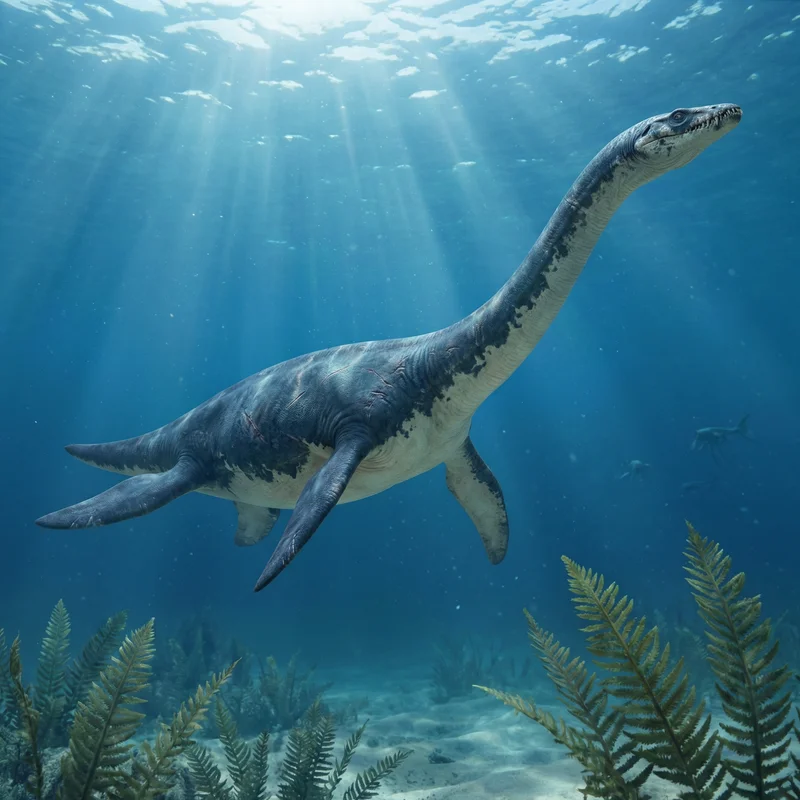 Elasmosaurus
Elasmosaurus · Cretaceous Period · Piscivore
 Elasmosaurus
Elasmosaurus · Cretaceous Period · Piscivore
 Elasmosaurus
Elasmosaurus · Cretaceous Period · Piscivore
 Elasmosaurus
Elasmosaurus · Cretaceous Period · Piscivore
🔗Related Creatures
Prognathodon
Prognathodon
Kronosaurus
Kronosaurus queenslandicus
Ophthalmosaurus
Ophthalmosaurus icenicus
Ichthyosaurus
Ichthyosaurus communis
Nothosaurus
Nothosaurus mirabilis
Plesiosaurus
Plesiosaurus dolichodeirus
Mosasaurus
Mosasaurus hoffmannii
Tanystropheus
Tanystropheus longobardicus