Hesperornis
Hesperornis regalis
⏳ Cretaceous Period🍽️ PiscivoreDinosaurs
Physical Characteristics
⏳
PeriodCretaceous Period
🍽️
DietPiscivore
📏
Size1.5~2m
⚖️
Weight9~11kg
Classification
GEN
GenusHesperornis
SP
SpeciesH. regalis
Hesperornis regalis
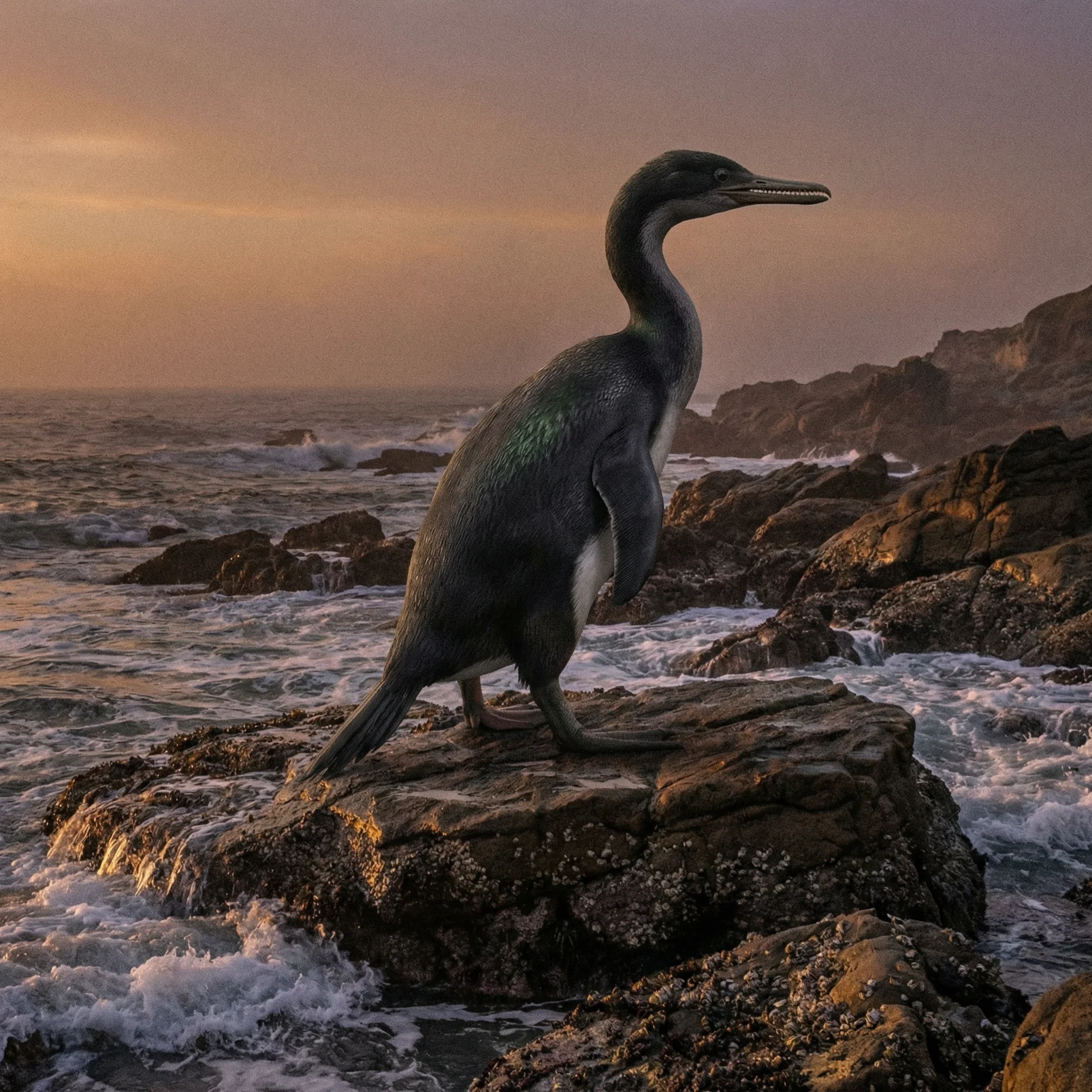
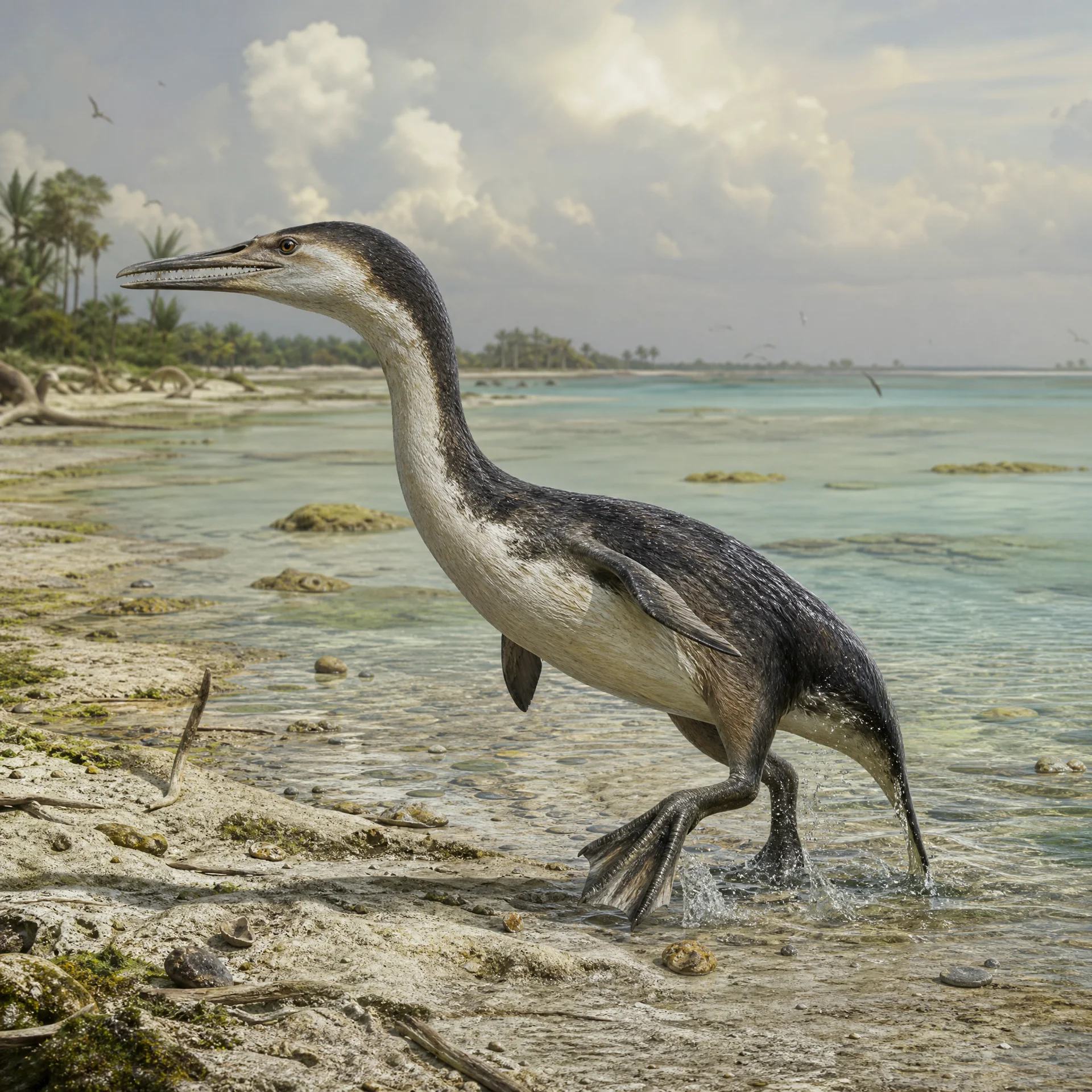
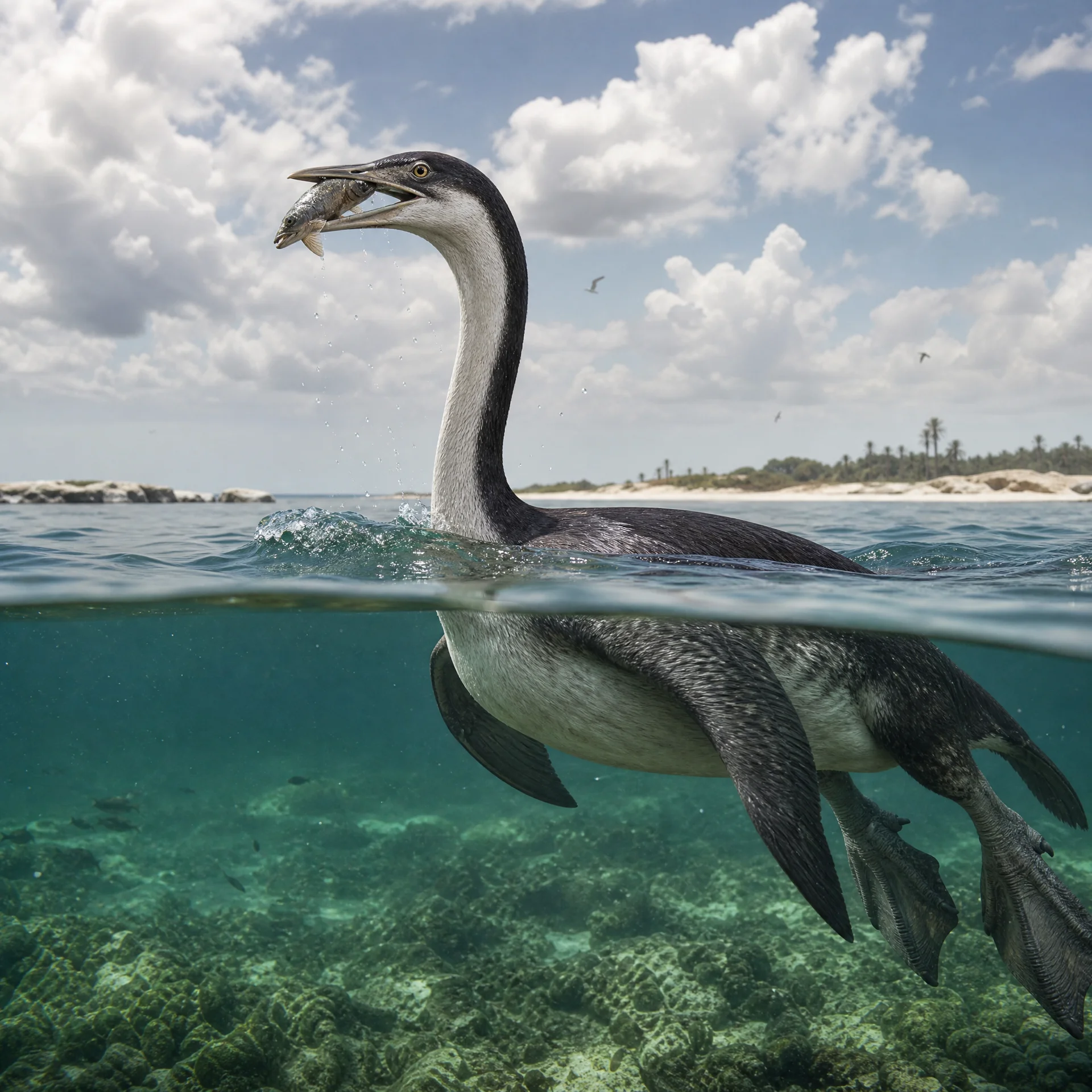
Hesperornis (Hesperornis regalis Marsh, 1872) is a genus of large, flightless diving seabirds that lived during the Late Cretaceous Campanian age (approximately 83.6–72 Ma), with possible survival into the early Maastrichtian. Belonging to the order Hesperornithiformes within Ornithuromorpha, it is among the most iconic Mesozoic birds ever discovered. With an estimated body length of 1.5–2 m and a body mass of roughly 9–11 kg, Hesperornis possessed virtually vestigial wings and instead relied on powerful hindlimbs for foot-propelled diving, converging in lifestyle with modern loons and cormorants despite lacking any close phylogenetic relationship with them.
Perhaps the most remarkable feature of Hesperornis is the presence of teeth within its beak—a trait shared with few other Mesozoic birds. Small, sharp, recurved teeth lined nearly the entire dentary (lower jaw) and the posterior portion of the maxilla (upper jaw), set within a longitudinal groove rather than in individual sockets. This unusual tooth implantation, termed aulacodonty, represents an autapomorphy of the Hesperornithiformes and a striking case of convergent evolution with mosasaurs. The premaxilla and the tip of the lower jaw lacked teeth entirely and were covered in a keratinous beak (rhamphotheca).
Discovered during the legendary Bone Wars of the late 19th century by O. C. Marsh along the Smoky Hill River in Kansas, Hesperornis was immediately recognized as pivotal evidence bridging the evolutionary gap between reptiles and birds. As of the most recent taxonomic reviews, eleven species are assigned to the genus, with fossils known from across the Northern Hemisphere—primarily North America, but also Russia and Sweden. Hesperornis was predominantly a marine predator inhabiting the subtropical to tropical shallow shelf seas of the Western Interior Seaway, the Turgai Strait, and the North Sea region, though some species have been recovered from inland freshwater deposits, suggesting a broader ecological range than previously assumed.
The name Hesperornis derives from the Ancient Greek words ἕσπερος (hésperos, meaning \"western\") and ὄρνις (órnis, meaning \"bird\"), thus translating to \"western bird.\" The specific epithet regalis is Latin for \"regal\" or \"kingly,\" reflecting the imposing size of the animal when first described. Marsh coined the name in 1872 upon describing the first substantial remains from western Kansas, where this large bird stood out as one of the most impressive fossil vertebrates recovered at the time (Marsh, 1872).
Hesperornis is the type genus of the family Hesperornithidae, the most taxonomically diverse family within the order Hesperornithiformes. Eleven species are currently recognized: H. regalis (type species), H. crassipes, H. gracilis, H. altus, H. montana, H. rossicus, H. bairdi, H. chowi, H. macdonaldi, H. mengeli, and H. lumgairi (Bell & Chiappe, 2022). However, many of these species are founded on highly fragmentary material (often a single bone), and their validity remains debated. Junior synonyms include Lestornis Marsh, 1876, Coniornis Marsh, 1893, and Hargeria Lucas, 1903.
A large, toothed, flightless diving seabird of the Late Cretaceous, Hesperornis is one of the most historically significant fossil birds, providing key evidence for the evolutionary link between reptiles and modern birds.
The fossil record of Hesperornis is concentrated in the Campanian stage of the Late Cretaceous, spanning approximately 83.6–72 Ma. Some specimens suggest possible survival into the early Maastrichtian (Hills et al., 1999). Reinvestigation of the holotype locality by Everhart (2011) indicated that the earliest stratigraphic occurrence of H. regalis may be slightly older than previously recognized, falling within the lower portion of the Smoky Hill Chalk.
The type species H. regalis is known primarily from the Smoky Hill Chalk Member of the Niobrara Formation in western Kansas. The Smoky Hill Chalk is a marine chalky limestone unit spanning the upper Coniacian to lower Campanian (approximately 87.3–80.6 Ma), composed predominantly of coccolithic chalk deposited in the Western Interior Seaway (Hattin, 1982; Carpenter, 2008). Additional species have been recovered from the Sharon Springs Member of the Pierre Shale (H. bairdi, H. chowi, H. macdonaldi, H. mengeli; Martin & Lim, 2002), the base of the Judith River Formation in Montana (H. altus), the Claggett Shale (H. montana), and Lower Campanian deposits near Volgograd, Russia (H. rossicus; Nessov & Yarkov, 1993).
The Smoky Hill Chalk was deposited in the subtropical to tropical shallow shelf environment of the Western Interior Seaway, a vast epicontinental sea that bisected North America during the Late Cretaceous. The sediment is dominated by pelagic calcareous microfossils (coccoliths), indicating an open-water, offshore depositional setting. Associated fauna includes mosasaurs (Tylosaurus, Clidastes), plesiosaurs (Dolichorhynchops), large bony fish (Xiphactinus, Ichthyodectes), sharks, the volant toothed bird Ichthyornis, and the pterosaur Pteranodon, collectively indicating a highly productive marine ecosystem. Notably, H. altus was recovered from freshwater deposits at the base of the Judith River Formation (Fox, 1974), and hesperornithiform remains from the Foremost Formation of Canada also come from freshwater facies, suggesting that some species were not exclusively marine.
The holotype of Hesperornis regalis is YPM 1200, a partial skeleton including much of the hindlimb, collected by O. C. Marsh himself in July 1871 along the south bank of the Smoky Hill River in western Kansas. This specimen lacked a skull (Marsh, 1872). The following year, Marsh's student Thomas H. Russell discovered a nearly complete skeleton (YPM 1206) that preserved enough of the skull to reveal the presence of teeth in the jaws for the first time (Marsh, 1873). YPM 1476 is another important specimen preserving a relatively complete postcranial skeleton including the pelvis. Over his career, Marsh accumulated parts of approximately 50 individual Hesperornis specimens, the vast majority of which are housed at the Yale Peabody Museum of Natural History.
| Specimen | Locality / Formation | Preserved Elements | Notes |
|---|---|---|---|
| YPM 1200 (holotype) | Kansas, Smoky Hill Chalk | Partial hindlimb (femur to phalanges) | Collected by Marsh, 1871 |
| YPM 1206 | Kansas, Smoky Hill Chalk | Nearly complete skeleton with partial skull | Discovered by T. H. Russell, 1872; teeth confirmed |
| YPM 1476 | Kansas, Smoky Hill Chalk | Partial skeleton (pelvis, hindlimb) | Used in pelvic morphology studies |
| YPM 1201 (paratype) | Kansas, Smoky Hill Chalk | Partial skeleton | Collected 1871 |
The genus Hesperornis is diagnosed by the following combination of features (after Bell & Chiappe, 2015, 2022): (1) extreme reduction of the forelimb with near-complete loss of morphological landmarks such as the deltopectoral crest and distal condyles on the humerus; (2) robust, blocky coracoid; (3) robust femur with an expanded trochanter; (4) expanded proximal tibiotarsus with robust cnemial crests; (5) enlarged fourth trochlea of the tarsometatarsus and enlarged pedal phalanx IV; and (6) small, recurved teeth implanted in a longitudinal groove on the dentary and maxilla.
While the type species H. regalis is represented by dozens of specimens, nearly complete skulls are extremely rare. Most other species within the genus (H. montana, H. gracilis, H. mengeli, etc.) are founded on single skeletal elements—a vertebra, a metatarsus, or a tibiotarsus fragment—making direct interspecific comparison and taxonomic validation difficult (Bell & Chiappe, 2022).
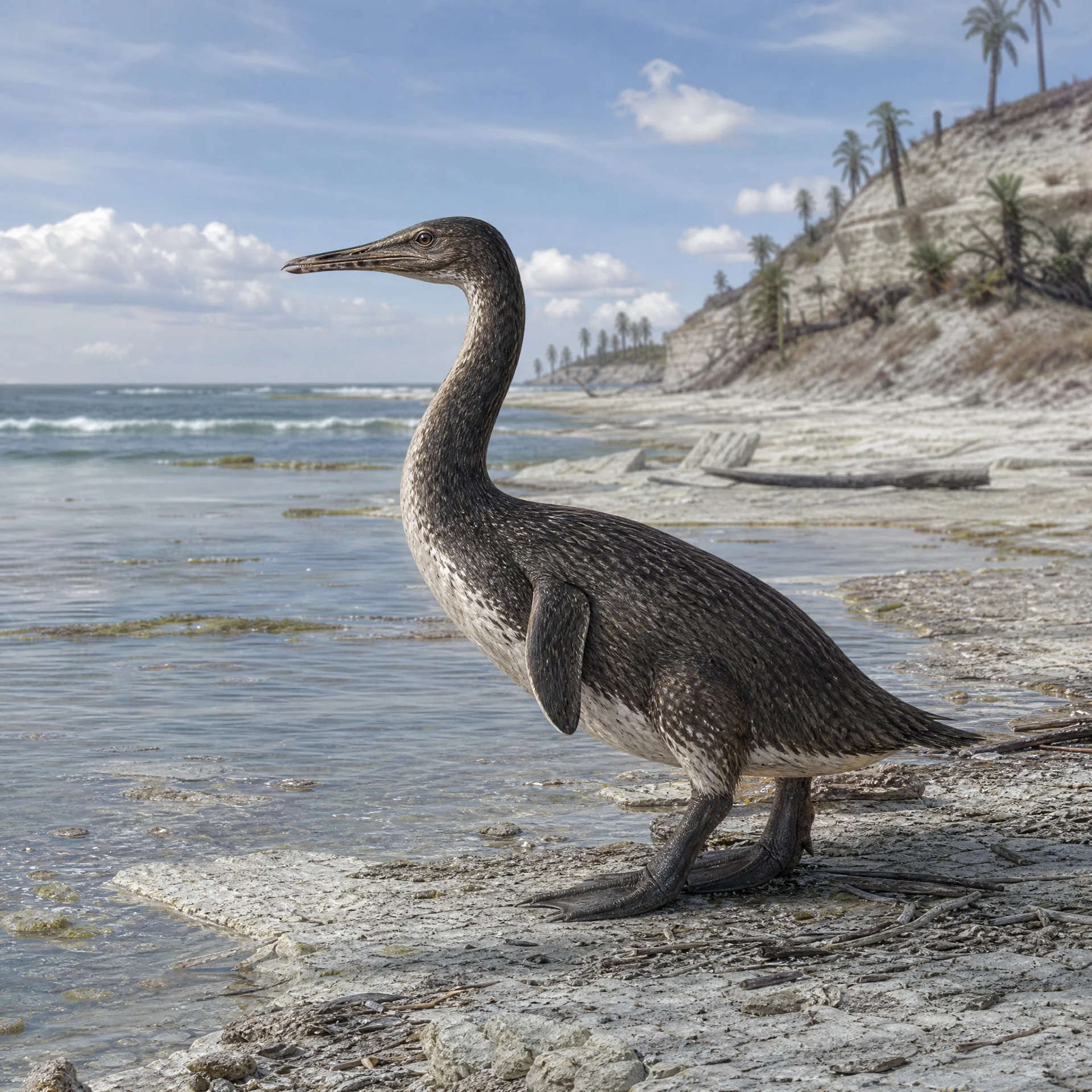
Hesperornis regalis is estimated to have been approximately 1.5–2 m in total length and roughly 9–11 kg in body mass (Bell & Chiappe, 2022; Zelenitsky et al., 2011, supplementary data). The body was streamlined, with an elongated skull and neck, drastically reduced forelimbs, and powerful hindlimbs positioned far posteriorly on the body. The largest species, H. rossicus, reached approximately 1.4 m in length, while the smallest species (H. macdonaldi, H. mengeli) were considerably smaller.
The skull is elongate, with a long rostrum produced primarily by the premaxilla, as in modern birds. The premaxilla and tip of the dentary lack teeth and were covered by a keratinous rhamphotheca (Hieronymus & Witmer, 2010). The dentary bears small, sharp, posteriorly recurved teeth along nearly its entire length, while the maxilla is toothed only posteriorly. The teeth are set in a longitudinal groove (aulacodonty), an autapomorphy of the Hesperornithiformes not found in other toothed birds such as Ichthyornis or Archaeopteryx (Dumont et al., 2016). Synchrotron X-ray microtomography revealed that the tooth roots have fully thecodont-style attachment via gomphosis, but secondary loss of periodontal ligaments led to the unique groove implantation (Dumont et al., 2016). Tooth replacement occurred via lingual replacement with a calculated mean frequency of approximately 66 days. The enamel is thin with fine fluted ornamentation formed by thickened enamel ridges.
The palate contained small pits allowing the lower teeth to interlock when the jaws closed (Elzanowski, 1991). A primitive intramandibular joint was retained between the lower jaw bones, which may have permitted independent rotation of the posterior mandible, potentially aiding in prey manipulation—a remarkable convergence with the jaw mechanics of mosasaurs (Gregory, 1951, 1952).
The forelimb is reduced to a vestigial state, rendering flight completely impossible. The humerus has lost virtually all identifiable morphological landmarks, including the deltopectoral crest and distal condyles. Martin & Tate (1976) questioned whether the more distal elements (ulna, radius, carpometacarpus, manual digits) developed at all, proposing they may have been entirely lost in some taxa. This extreme forelimb reduction underscores the degree of specialization for foot-propelled diving, representing the earliest known instance of secondary flightlessness in the avian lineage.
The hindlimb shows proportions characteristic of foot-propelled diving birds: a shortened femur, greatly elongated tibiotarsus, and relatively short tarsometatarsus. The femur is rotated extremely posteriorly, placing the hindlimbs directly behind the body. This orientation maximized propulsive efficiency in water while severely compromising terrestrial locomotion (Marsh, 1880). Traditionally, Hesperornis was compared to the common loon (Gavia immer) in terms of limb proportions and locomotor habits (Reynaud, 2006). However, a comprehensive morphometric analysis by Bell et al. (2019) demonstrated that hesperornithiforms occupy morphospace more similar to cormorants and diving ducks than to loons and grebes, suggesting that some degree of upright terrestrial locomotion may have been possible.
Whether Hesperornis had lobed toes (like grebes) or webbed toes (like loons and cormorants) remains unresolved. Stolpe (1935) initially supported lobed toes, but Bell et al. (2019) found that morphometric evidence supports webbed toes equally, leaving the question open in the absence of preserved soft tissue.
Histological analysis of Hesperornis limb bones (Chinsamy et al., 1998) revealed rapid, sustained bone deposition without growth marks (lines of arrested growth), indicating continuous growth to adulthood—a pattern shared with modern birds but contrasting with the interrupted, slower growth of Enantiornithes. This suggests that Hesperornis was endothermic and reached adult size relatively quickly.
The small, sharp, recurved teeth of Hesperornis are well suited for grasping slippery prey such as fish. The groove arrangement would have prevented captured prey from escaping forward. While no stomach contents have been directly reported for Hesperornis itself, fish remains have been identified in association with the closely related genus Baptornis. The combination of tooth morphology, marine depositional setting, and associated fauna strongly supports classification as a piscivore (fish-eater). Cephalopods (ammonites, belemnites) have been suggested as additional prey items, though direct evidence is lacking.
Hesperornis is interpreted as a specialized pursuit diver operating in the mid- to upper water column of the Western Interior Seaway. Contemporaneous fauna included large apex predators such as mosasaurs (Tylosaurus, Clidastes), plesiosaurs (Dolichorhynchops), large bony fish (Xiphactinus), sharks, as well as the volant toothed bird Ichthyornis. These predators likely represented significant threats to Hesperornis. Direct evidence of predation comes from a Hesperornis tibiotarsus recovered from the Pierre Shale of South Dakota, which bears bite marks matching the teeth of a polycotylid plesiosaur (possibly Dolichorhynchops or a similar taxon). The bone also shows signs of infection around the wound, indicating the individual survived the attack (Martin, Rothschild & Burnham, 2016).
By analogy with modern loons and cormorants, Hesperornis likely hunted via high-speed pursuit diving using its powerful feet. Terrestrial locomotion was severely limited. It has been suggested that these birds moved on land by pushing themselves forward on their bellies, similar to modern seals (Martin et al., 2012), although the morphometric results of Bell et al. (2019) raise the possibility that they could adopt a more upright posture akin to cormorants. Nesting likely occurred on shores near the water, but no nesting sites, eggs, or nest structures have been discovered. Bone microstructure indicates that juveniles grew rapidly and continuously to adult size, as in modern birds (Chinsamy et al., 1998).
Hesperornis fossils are known from across the Northern Hemisphere. The most abundant locality is the Smoky Hill Chalk of western Kansas, but specimens have also been recovered from South Dakota, Montana, Arkansas, and Wyoming in the United States. In Canada, fossils are known from Alberta, Saskatchewan, and as far north as Ellesmere Island in the High Arctic (Hills et al., 1999). In Europe, H. rossicus has been reported from near Volgograd, Russia, and from Ivö Klack in Sweden (Rees & Lindgren, 2005). Hesperornithiform material has also been found in Alaska (Bryant, 1983).
In the Late Cretaceous paleogeographic context, Hesperornis inhabited the shallow epicontinental seas of the Western Interior Seaway, the Turgai Strait connecting it to the Tethys Ocean, and the proto-North Sea region (Rees & Lindgren, 2005). These waters were substantially warmer than today, under subtropical to tropical climatic conditions. The discovery of specimens on Ellesmere Island (paleolatitude approximately 75°N) demonstrates that the genus ranged into surprisingly high latitudes, suggesting tolerance for at least seasonally cooler conditions or exploitation of productive polar waters.
Bell & Chiappe (2015) presented the first comprehensive species-level phylogenetic analysis of the Hesperornithiformes, incorporating 24 taxa (17 hesperornithiforms) and 72 morphological characters. This analysis confirmed the monophyly of Hesperornithidae, with Parahesperornis alexi recovered as the sister taxon of Hesperornis. Within the broader context of avian phylogeny, Hesperornithiformes consistently place as derived members of Ornithuromorpha. Some analyses recover them as the sister group of Neornithes (crown-group birds) (Bell & Chiappe, 2015; Bell & Chiappe, 2020), while others place them as the sister group of the clade Ichthyornis + Neornithes (Tanaka et al., 2017; Field et al., 2018).
Early classifications allied Hesperornis with modern loons and grebes (Cracraft, 1982), a placement now understood to reflect convergent morphological evolution rather than phylogenetic affinity. The central ongoing debate concerns whether Hesperornithiformes are (1) the direct sister group of Neornithes, or (2) sister to a broader clade including Ichthyornis and Neornithes. Results vary depending on taxon sampling and character coding; Bell & Chiappe (2022) noted that studies including multiple hesperornithiform taxa tend to resolve them closer to Neornithes, and that outdated or erroneous specimen codings have influenced some analyses.
| Taxon | Family | Known Species | Geographic Range | Stratigraphic Range |
|---|---|---|---|---|
| Enaliornis | Enaliornithidae | 3 | England (Cambridge Greensand) | Cenomanian (~100 Ma) |
| Baptornis | Baptornithidae | 1 | North America, Europe, Mongolia | Cenomanian–Campanian/Maastrichtian |
| Brodavis | Brodavidae | 4 | North America, Mongolia | Campanian–Maastrichtian |
| Hesperornis | Hesperornithidae | 11 | North America, Russia, Sweden | Campanian (~Maastrichtian?) |
| Parahesperornis | Hesperornithidae | 1 | North America (Kansas) | Campanian |
| Canadaga | Hesperornithidae | 1 | Canada | Campanian |
Confirmed: Hesperornis was a large, flightless, foot-propelled diving seabird with teeth set in longitudinal grooves in the dentary and maxilla. It is abundantly documented from Late Cretaceous marine deposits across the Northern Hemisphere.
Probable: It was piscivorous (supported by tooth morphology + marine depositional context). It exhibited rapid, continuous growth similar to modern birds (supported by bone microstructure). Body mass was in the range of approximately 9–11 kg.
Hypothetical: Whether the toes were lobed or webbed remains undetermined. The precise mode of terrestrial locomotion (belly-sliding versus semi-upright walking) is debated. No direct evidence exists for nesting behavior, egg morphology, or reproductive biology.
Popular media frequently depicts Hesperornis as \"penguin-like,\" but this comparison is misleading. Penguins are wing-propelled divers, whereas Hesperornis was a foot-propelled diver—a fundamentally different locomotor strategy. The two groups are also phylogenetically distant. The aquatic body plan of Hesperornis is more accurately compared to that of loons and cormorants, and the superficial similarities reflect convergent evolution driven by similar ecological pressures rather than common ancestry.
| Taxon | Age | Body Length (m) | Flight | Teeth | Habitat | Locomotion |
|---|---|---|---|---|---|---|
| Hesperornis regalis | Campanian (~83–72 Ma) | 1.5–2.0 | Flightless | Groove-implanted | Marine (shallow shelf) | Foot-propelled diving |
| Ichthyornis dispar | Coniacian–Campanian | ~0.6 | Volant | Socketed (thecodont) | Marine (shallow shelf) | Flight + diving (inferred) |
| Baptornis advenus | Coniacian–Campanian | ~1.0 | Flightless | Groove-implanted | Marine (shallow shelf) | Foot-propelled diving |
| Parahesperornis alexi | Campanian | ~1.0 | Flightless | Groove-implanted | Marine (shallow shelf) | Foot-propelled diving |
| Canadaga arctica | Campanian | ~1.5+ | Flightless | Unknown | Marine | Foot-propelled diving |
Hesperornis is by far the best-known hesperornithiform and, alongside Ichthyornis, the most famous Mesozoic bird from the Western Interior Seaway. It coexisted in the Niobrara Formation with Parahesperornis and Baptornis, and differences in body size and skull morphology suggest ecological niche partitioning among these sympatric diving birds (Bell & Chiappe, 2022).
The teeth of Hesperornis were arranged in a longitudinal groove in the jawbone rather than in individual sockets, a unique feature shared convergently with mosasaurs.
When O. C. Marsh published the discovery of toothed birds in 1872–1873, it was hailed as decisive evidence supporting Darwin's theory of evolution by showing transitional features between reptiles and birds.
The wings of Hesperornis were so reduced that the humerus lacked a deltopectoral crest, and the ulna and radius may not have developed at all.
A Hesperornis leg bone from the Pierre Shale bears plesiosaur bite marks and signs of infection, proving the bird survived an attack by a marine reptile predator.
Hesperornis fossils have been found from Kansas to the Canadian High Arctic (Ellesmere Island) and as far east as Russia and Sweden, demonstrating a vast Northern Hemisphere range.
The hindlimbs were positioned so far back on the body that Hesperornis may have moved on land by sliding on its belly, much like modern seals.
Bone microstructure analysis shows that Hesperornis grew rapidly and continuously like modern birds, suggesting it was warm-blooded (endothermic).
Synchrotron X-ray imaging revealed that Hesperornis replaced its teeth approximately every 66 days, as calculated from dentine increment lines preserved in fossilized teeth.
Of the more than 20 described hesperornithiform species across all genera, 18 are known from only a single bone, highlighting how fragmentary the fossil record of these birds truly is.
During the Bone Wars, Edward Drinker Cope accidentally received boxes of fossils—including Hesperornis specimens—meant for Marsh, and reportedly called the toothed birds 'simply delightful.'
Morphometric analysis shows Hesperornis occupied morphospace closer to cormorants and diving ducks than to loons or grebes, challenging the long-held 'loon analogy.'
The largest species, H. rossicus from Russia, was among the biggest hesperornithiforms known, only slightly smaller than the Canadian genus Canadaga.
No. Hesperornis had extremely vestigial wings incapable of flight. The humerus had lost virtually all identifiable morphological landmarks such as the deltopectoral crest, and it has been proposed that more distal elements like the ulna and radius may not have developed at all (Martin & Tate, 1976). Instead, Hesperornis was highly specialized for foot-propelled diving using its powerful hindlimbs.
Hesperornis had small, sharp, posteriorly recurved teeth lining nearly the entire dentary (lower jaw) and the posterior portion of the maxilla (upper jaw). Uniquely, these teeth were implanted in a longitudinal groove rather than in individual sockets—a condition called aulacodonty that is an autapomorphy of the Hesperornithiformes. Synchrotron imaging revealed that while the tooth roots have fully thecodont-style gomphosis attachment, secondary loss of the periodontal ligament led to the groove arrangement (Dumont et al., 2016).
No. Penguins are wing-propelled divers, while Hesperornis was a foot-propelled diver—a fundamentally different locomotor strategy. The two groups are phylogenetically very distant. Any superficial resemblance in body shape is the result of convergent evolution driven by similar aquatic lifestyles, not common ancestry.
The most prolific locality is the Smoky Hill Chalk of western Kansas, USA. Additional fossils have been recovered from South Dakota, Montana, Arkansas, and Wyoming in the US; Alberta, Saskatchewan, and Ellesmere Island in Canada; near Volgograd, Russia; and Ivö Klack, Sweden. Hesperornithiform material has also been found in Alaska, demonstrating a wide Northern Hemisphere distribution.
With its hindlimbs positioned far posteriorly on the body, Hesperornis was severely limited in terrestrial locomotion. It was traditionally thought to have pushed itself along on its belly like a seal (Martin et al., 2012). However, Bell et al. (2019) found that hesperornithiform hindlimb morphometrics overlap more with cormorants than with loons, suggesting some degree of upright walking may have been possible. The exact mode of terrestrial locomotion remains unresolved.
Based on its small, sharp, recurved tooth morphology and its occurrence in marine deposits, Hesperornis is interpreted as a piscivore that primarily hunted small to medium-sized fish. No direct stomach contents have been reported for Hesperornis, though fish remains have been found associated with the closely related genus Baptornis. Cephalopods may also have been part of its diet, but direct evidence is lacking.
Contemporaneous mosasaurs, plesiosaurs, large bony fish, and sharks were likely predators of Hesperornis. Direct evidence comes from a Hesperornis tibiotarsus from the Pierre Shale of South Dakota bearing bite marks from a polycotylid plesiosaur and signs of post-attack infection, demonstrating the bird survived the predatory encounter (Martin, Rothschild & Burnham, 2016).
Technically, yes. Birds (Avialae) are a derived clade within theropod dinosaurs (Dinosauria), so in a cladistic sense, Hesperornis is indeed a dinosaur. However, it is a highly derived ornithuran bird that occupied an advanced position near the divergence of modern birds (Neornithes) and is more properly understood as a Mesozoic seabird.
Eleven species are currently recognized: H. regalis (type species), H. crassipes, H. gracilis, H. altus, H. montana, H. rossicus, H. bairdi, H. chowi, H. macdonaldi, H. mengeli, and H. lumgairi. However, many of these are based on highly fragmentary material (often a single bone), and their validity is debated (Bell & Chiappe, 2022).
This remains unresolved. Stolpe (1935) initially argued for grebe-like lobed toes, but Bell et al. (2019) found that morphometric evidence supports webbed toes equally. Without preserved soft tissue, both hypotheses remain viable.
5images