Irritator
Cretaceous Period Piscivore Creature Type
Irritator challengeri
Scientific Name: "From Latin 'irritare' (to irritate), reflecting the authors' frustration at the fossil's artificial modification; 'challengeri' honours Professor Challenger from Arthur Conan Doyle's novels"
Local Name: Irritator
Physical Characteristics
Discovery
Habitat
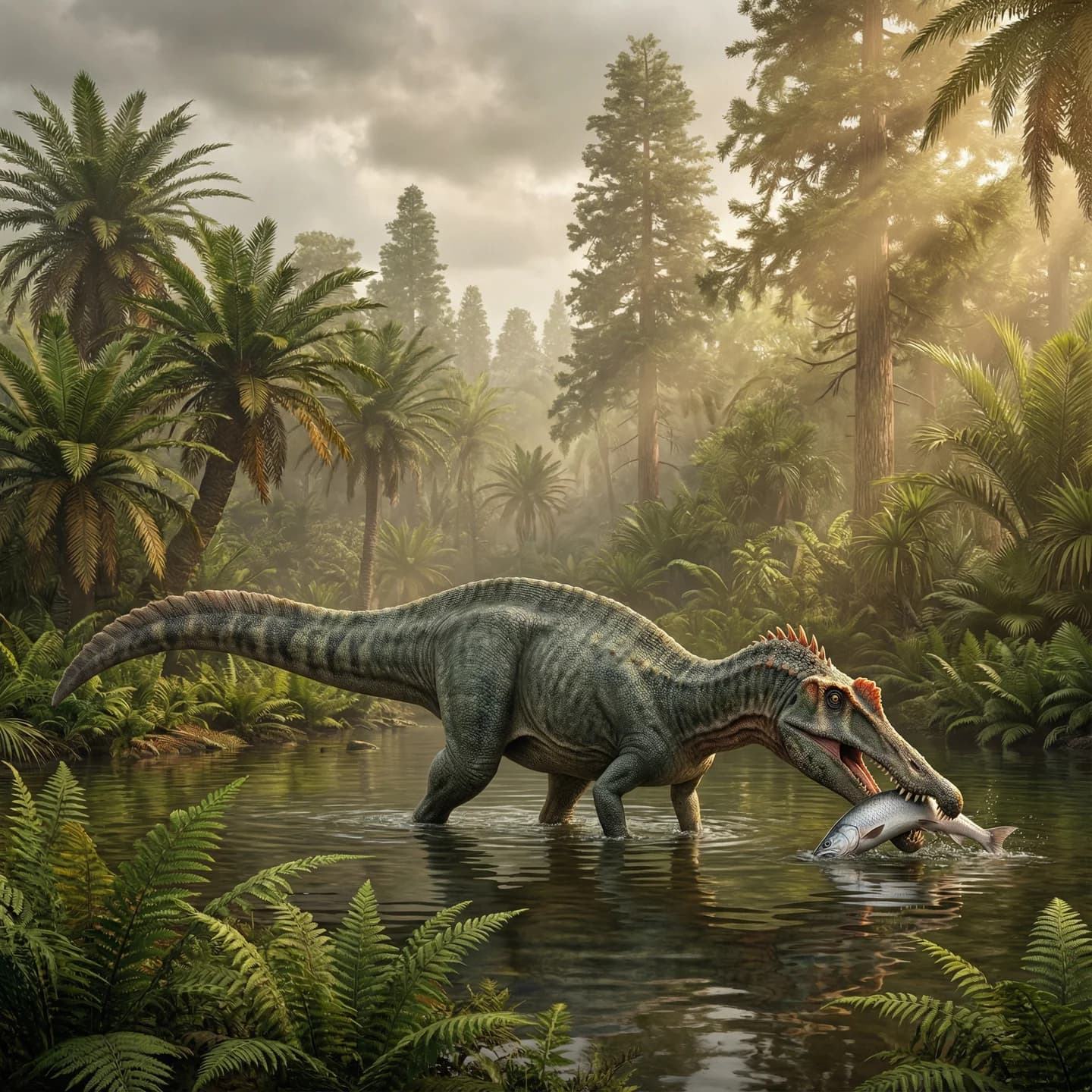
Irritator challengeri Martill et al., 1996 is a spinosaurid theropod dinosaur from the Albian stage of the Early Cretaceous Period (approximately 113–110 Ma) of northeastern Brazil. It belongs to Saurischia, Theropoda, within the family Spinosauridae and the subfamily Spinosaurinae. Its holotype specimen, SMNS 58022, is a nearly complete subadult skull housed at the State Museum of Natural History Stuttgart (Staatliches Museum für Naturkunde Stuttgart), Germany. It represents the most completely preserved spinosaurid skull discovered to date.
The genus name Irritator derives from the Latin word 'irritare' (to irritate), a reflection of the frustration experienced by the describing authors upon discovering that fossil dealers had extensively modified the skull with plaster and car body filler to enhance its commercial value. The species name 'challengeri' pays homage to Professor Challenger, a fictional character from Arthur Conan Doyle's adventure novel The Lost World. Estimated at approximately 6–8 metres in length and around 1 tonne in body mass, Irritator ranks among the smallest known spinosaurids.
The scientific significance of Irritator is multifaceted. First, as the holder of the most complete spinosaurid skull, it provides critical data for understanding cranial anatomy across the family. Second, a landmark CT-based neuroanatomical study (Schade et al., 2020) documented, for the first time in any spinosaurid, detailed brain endocast and inner ear morphology, revealing adaptations consistent with rapid downward head-striking movements and binocular vision—traits compatible with a piscivorous lifestyle. Third, a comprehensive osteological reappraisal (Schade et al., 2023) proposed the novel hypothesis that the mandible could splay laterally in a pelican-like fashion, significantly expanding current understanding of spinosaurid feeding mechanics.
Overview
Name and Etymology
The generic name Irritator is derived from Latin 'irritare' (to irritate). In the original description, Martill et al. (1996) stated that the name came "from irritation, the feeling the authors felt (understated here) when discovering that the snout had been artificially elongated." Fossil dealers had obscured the skull beneath plaster in hopes of making it appear more complete and valuable—a widespread practice among local collectors in the Chapada do Araripe region. The specific epithet 'challengeri' honours the fictional Professor Challenger from Arthur Conan Doyle's The Lost World. Notably, two years earlier, the same team (Frey & Martill, 1994) had named the pterosaur Arthurdactylus conandoylei after the novelist himself from the nearby Crato Formation.
Taxonomic Status
Irritator challengeri is currently recognised as a valid taxon within Spinosauridae, Spinosaurinae. In the original 1996 description, Martill et al. erroneously classified it as a maniraptoran dinosaur within the clade Bullatosauria (now considered non-monophyletic), erecting the new family Irritatoridae. That same year, Kellner (1996) reclassified the genus within Spinosauridae on the basis of comparisons with Spinosaurus, and this assignment was firmly corroborated by the thorough redescription of Sues et al. (2002). Angaturama limai Kellner & Campos, 1996, described from a snout tip from the same formation just weeks later, is widely regarded as a probable junior synonym of Irritator, although Sales & Schultz (2017) and Schade et al. (2023) could not definitively resolve this question.
Key Summary
Irritator is a small spinosaurine theropod possessing the most complete spinosaurid skull known, interpreted as a generalist predator with a predominantly piscivorous diet and evidence for semiaquatic adaptations.
Age, Stratigraphy, and Depositional Setting
Temporal Range
The holotype originates from the Romualdo Formation of the Araripe Basin, dated to the Albian stage of the Early Cretaceous (approximately 113–110 Ma). The formation was previously designated the Romualdo Member of the Santana Formation but is now treated as an independent lithostratigraphic unit. The age assignment is supported by biostratigraphic evidence, including microfossils of the ostracod Pattersoncypris and fish scales of the ichthyodectid Cladocyclus, both characteristic of the Romualdo Formation (Sues et al., 2002).
Formation and Lithology
The Romualdo Formation is situated within the Araripe Basin in northeastern Brazil, spanning the junction of Pernambuco, Piauí, and Ceará states. It constitutes a Konservat-Lagerstätte—a sedimentary deposit renowned for exceptional fossil preservation—composed of limestone concretions embedded in shales, with subordinate sandstones and conglomerates. Fossils are commonly preserved three-dimensionally within calcareous nodules, including spectacular pterosaur specimens retaining soft tissues such as muscle fibres. The holotype SMNS 58022 was extracted from a chalk concretion, and its probable collection site is near the village of Buxexé close to Santana do Cariri, on the flank of the Chapada do Araripe at approximately 650 metres elevation (Sues et al., 2002).
Palaeoenvironment
The Romualdo Formation is interpreted as a coastal lagoon environment with irregular freshwater influx that experienced cycles of marine transgression and regression. The climate was tropical, broadly comparable to that of modern Brazil. The surrounding regions were arid to semi-arid, with xerophytic (dry-adapted) vegetation predominating. Cycadales and the extinct conifer Brachyphyllum were the most widespread plants (Aureliano et al., 2018). The formation preserves a rich and diverse biota including numerous pterosaur genera, fishes, turtles, crocodyliforms, and theropod dinosaurs.
Specimens and Diagnostic Features
Holotype
The holotype SMNS 58022, housed at the State Museum of Natural History Stuttgart, consists of a largely complete subadult skull missing the snout tip and the anterior portion of the mandible. The preserved skull measures 16.5 cm in height and 10 cm in width; the total skull length has been estimated at approximately 60 cm based on comparisons with Baryonyx (Sues et al., 2002). Incomplete co-ossification of certain skull bones confirms the specimen as a subadult individual.
Diagnosis (Autapomorphies)
Key features distinguishing Irritator from other spinosaurids include (Sues et al., 2002; Sales & Schultz, 2017; Schade et al., 2023): a thin sagittal crest formed by the elongate nasal bones that runs along the skull midline and terminates in a knob-like process above the frontal bones; proportionally larger and more anteriorly positioned external nares than in Spinosaurus, with the premaxilla contributing to the nostril border; and a maxillary tooth count of approximately 11 per side—roughly half that of Baryonyx, Suchomimus, and Cristatusaurus.
Specimen Limitations
The holotype sustained significant damage and modification. The left side was extensively damaged during collection, acid preparation was attempted, and fossil dealers heavily obscured the skull with plaster and car body filler. CT scanning revealed that portions of the maxilla had been grafted onto the front of the rostrum. These modifications caused numerous errors in the original 1996 description, including an overestimation of total skull length by approximately 24 cm and misidentification of an unattached bone fragment as a prominent head crest (Sues et al., 2002).
| Specimen | Composition | Repository | Notes |
|---|---|---|---|
| SMNS 58022 | Nearly complete skull (holotype) | State Museum of Natural History Stuttgart | I. challengeri holotype; subadult |
| USP GP/2T-5 | Snout tip (Angaturama limai holotype) | University of São Paulo | Probable junior synonym of Irritator |
| MN 4819-V | Partial skeleton (skull lacking) | National Museum of Rio de Janeiro | Referred to Spinosaurinae; possibly damaged in 2018 fire |
| MN 4743-V | Partial vertebral column | National Museum of Rio de Janeiro | Referred to Spinosauridae |
| LPP-PV-0042 | Left tibial fragment | Brazilian institution | Large individual (estimated ~10 m); osteosclerosis confirmed |
Morphology and Function
Body Size
Gregory S. Paul (2010) estimated Irritator's body length at 7.5 metres with a mass of approximately 1 tonne. Thomas R. Holtz Jr. published a higher length estimate of 8 metres, with a weight range of 0.9–3.6 tonnes. Dougal Dixon provided a more conservative estimate of 6 metres in length and 2 metres in height. According to Aureliano et al. (2018), scaling from Sales & Schultz (2017) reconstructions yields approximately 6.5 metres for the I. challengeri holotype and 8.3 metres for the Angaturama limai holotype. Given that the holotype is a subadult, the adult size was likely larger. The tibial fragment LPP-PV-0042 suggests a body length of roughly 10 metres for an individual that was also a subadult based on bone histology, indicating that mature individuals of the Romualdo Formation spinosaurines may have been substantially larger.
Skull Architecture
The skull of Irritator was elongate, narrow, and somewhat triangular in cross-section. The braincase was inclined posteriorly and deeper than it was long. The external nares were retracted far from the snout tip as in all spinosaurids, and were proportionally and absolutely smaller than in Suchomimus and Baryonyx but larger than in Spinosaurus (Sues et al., 2002; Sales & Schultz, 2017). A well-developed bony secondary palate on the roof of the mouth separated the oral and nasal cavities—a feature shared with extant crocodilians but absent in most theropod dinosaurs. This structure would have strengthened the snout against torsional forces during feeding and permitted respiration while the jaws were submerged or holding prey (Rayfield et al., 2007). The holotype is also one of the exceptionally rare non-avian dinosaur fossils in which the stapes bone is preserved.
Dentition
The teeth of Irritator are straight or only faintly recurved, conical, and circular in cross-section. They bear sharply defined but completely unserrated edges. Longitudinal flutes are present on both labial and lingual sides of the tooth crowns, as in Spinosaurus but unlike Baryonyx (which displays flutes only on the lingual side). The enamel is thin with a finely wrinkled texture. Each maxilla preserves approximately 9–10 teeth, with the anterior teeth being the largest (crown lengths of 32–40 mm) and decreasing posteriorly. CT scans revealed deeply embedded replacement teeth whose roots converged near the midline, almost reaching the top of the skull (Sues et al., 2002).
Neuroanatomy and Sensory Capabilities
Schade et al. (2020) performed CT-based analysis of the braincase, producing the first neuroanatomical study of any spinosaurid. Key findings include: relatively elongate olfactory tracts (plesiomorphic for basal tetanurans); an unusually large floccular recess (indicative of enhanced vestibulo-ocular and vestibulo-collic reflex processing); and a large anterior semicircular canal (indicating sensitivity to pitch-down head movements). The orientation of the lateral semicircular canal suggests an 'alert' head posture with the snout inclined approximately 45° downward, which would minimise visual obstruction by the elongate snout and enable stereoscopic binocular vision. Estimated hearing range was approximately 350–3,550 Hz, above the crocodilian range but at the lower end of avian hearing sensitivity.
Pelican-like Mandibular Gape Hypothesis
Schade et al. (2023) proposed that the mandibular rami of Irritator could rotate and splay laterally about a diagonal axis, analogous to the jaw mechanics of modern pelicans. This would have permitted the theropod to swallow very large prey items, though the resulting bite force would have been weak but rapid. This hypothesis has attracted both interest and controversy within the palaeontological community and requires further independent testing.
Diet and Ecology
Evidence for Piscivory
Multiple independent lines of evidence support a predominantly piscivorous diet for Irritator. The elongate, narrow snout with unserrated conical teeth closely parallels the morphology of the modern gharial (Gavialis gangeticus), the most piscivorous extant crocodilian. The secondary palate and retracted nostrils are consistent with feeding while the snout is submerged. A finite-element analysis by Rayfield et al. (2007) demonstrated that these cranial features provided enhanced resistance to torsional stress from prey loads. The sagittal crest would have anchored powerful neck musculature, necessary for rapid jaw closure against water resistance and swift head withdrawal (Sues et al., 2002).
Generalist Predation
Despite strong piscivorous adaptations, Irritator was likely not an obligate fish specialist. Sues et al. (2002) emphasised that the cranial morphology is consistent with generalist feeding on small prey animals. Direct evidence for broader prey selection includes the discovery of an Irritator tooth embedded in the cervical vertebral column of an anhanguerid pterosaur (estimated wingspan approximately 3.3 m) from the Romualdo Formation (Buffetaut et al., 2004). Whether this represents active predation or scavenging remains uncertain. Aureliano et al. (2018) reconstructed the Romualdo Formation food web and proposed that spinosaurines may also have preyed upon crocodyliforms, turtles, small to medium-sized dinosaurs, and juveniles of their own species, thereby functioning as apex predators within this ecosystem.
Semiaquatic Adaptations
Evidence for semiaquatic habits in spinosaurids is substantial and comes from diverse methodological approaches. Oxygen isotope analyses of spinosaurid tooth enamel (Amiot et al., 2010) indicate that these animals spent significant portions of their lives in aquatic environments. Arden et al. (2018) demonstrated that the frontal bones of Irritator, Spinosaurus, and Sigilmassasaurus share arched, dorsally concave, and anteriorly narrowed morphologies that would have positioned the eyes further up on the head than in other theropods. In Irritator, the broad lower jaw combined with narrowed frontals resulted in the orbits facing at a steep medial inclination, enabling the animal to see above the waterline when partially submerged. Aureliano et al. (2018) identified osteosclerosis (high bone density) in tibial fragment LPP-PV-0042, previously known only from Spinosaurus aegyptiacus. This condition may have facilitated submersion by increasing skeletal weight, and its occurrence in the Romualdo Formation material indicates that osteosclerosis had evolved within Spinosaurinae at least 10 million years before Spinosaurus appeared in Morocco.
Distribution and Palaeogeography
Geographic Range
All confirmed fossil material of Irritator and Angaturama derives from the Romualdo Formation of the Araripe Basin in northeastern Brazil. During the Albian, the South Atlantic Ocean was actively rifting open, forming a series of circum-Atlantic basins along southern Brazil and southwestern Africa, although northeastern Brazil and West Africa remained connected. This palaeogeographic context helps explain the circum-Atlantic distribution of Spinosauridae, with closely related forms found across South America, Africa, and Europe.
Contemporaneous Fauna
The Romualdo Formation is particularly rich in pterosaurs, including Anhanguera, Brasileodactylus, Cearadactylus, Tapejara, Thalassodromeus, Tupuxuara, Tropeognathus, Barbosania, and Maaradactylus, among others. Known dinosaur fauna beyond spinosaurids includes the coelurosaurians Santanaraptor and Mirischia. The formation also yields diverse fishes (notably Cladocyclus and Vinctifer), turtles, and crocodyliforms.
Phylogeny and Taxonomic Debates
Early Classification Confusion
Irritator has a remarkably convoluted taxonomic history. The holotype skull was initially mistaken for that of a giant basal pterosaur, and a paper describing it as such was actually submitted for publication before peer reviewers identified it as a theropod dinosaur. In the eventual 1996 publication, Martill et al. classified Irritator as a maniraptoran within Bullatosauria (now considered non-monophyletic) and erected the family Irritatoridae. That same year, Kellner (1996) pointed out that the skull lacked the diagnostic autapomorphy of maniraptorans and reclassified it within Spinosauridae. Rauhut (2003) assigned Irritator to Baryonychidae, and Holtz et al. (2004) subsequently synonymised Baryonychidae with Spinosauridae. These placements have been upheld by most subsequent analyses.
Current Phylogenetic Position
Within Sereno et al.'s (1998) bifurcation of Spinosauridae, Irritator is placed in Spinosaurinae alongside Spinosaurus, distinguished from Baryonychinae by its unserrated, straighter, and more widely spaced teeth, as well as smaller first premaxillary teeth. However, Sales & Schultz (2017) noted that Irritator's external nares are positioned more anteriorly—a feature typically associated with baryonychines—while its teeth conform to the spinosaurine condition. They suggested that Irritator and Angaturama may represent intermediate forms between earlier baryonychines and later spinosaurines, potentially rendering Baryonychinae paraphyletic. In the Sales & Schultz (2017) phylogenetic analysis, Irritator is recovered in a position crownward of Suchomimus but stemward of Oxalaia and Spinosaurus.
Synonymy with Angaturama
Angaturama limai was described by Kellner & Campos (1996) from an isolated snout tip (USP GP/2T-5) from the Romualdo Formation. The generic name means 'noble' in the Tupi language of Brazil, and the specific name honours the late palaeontologist Murilo R. de Lima. Since Charig & Milner (1997), numerous authors have considered Angaturama a probable junior synonym of Irritator, noting that both genera share retracted nostrils, elongate jaws, and characteristic spinosaurid dentition, and that the snout tip appears to complement the posterior skull (Sereno et al., 1998; Sues et al., 2002). However, Sales & Schultz (2017) demonstrated that the two holotypes differ in preservation colour, cracking patterns, and tooth damage severity, and that the Angaturama skull was likely larger. They concluded that the specimens do not belong to the same individual, although genus-level synonymy cannot be confirmed or refuted without more extensively overlapping material. Schade et al. (2023) were also unable to resolve this question.
Restoration and Uncertainty
Confirmed Facts
The classification of Irritator as a spinosaurid theropod within Spinosaurinae is firmly established. The holotype is confirmed as a subadult skull from the Romualdo Formation (Albian). Anatomical features including conical unserrated teeth, retracted nostrils, a secondary palate, and a thin sagittal crest are confirmed.
Well-supported Inferences
A generalist predatory lifestyle with emphasis on piscivory, semiaquatic tendencies, an estimated body length of approximately 6–8 metres with a mass near 1 tonne, and the probable display function of the sagittal crest are well-supported by multiple independent lines of evidence.
Hypotheses Requiring Further Testing
The pelican-like lateral mandibular splaying hypothesis (Schade et al., 2023), the presence or absence of a dorsal sail (the holotype consists only of cranial material; postcranial specimen MN 4819-V of uncertain attribution bears elongate neural spines suggestive of a sail), and the conspecificity of Irritator and Angaturama all remain at the hypothesis stage.
Common Misconceptions
Several misconceptions about Irritator persist in popular media. It belongs to Saurischia (Theropoda), not Ornithischia. There is no evidence that it was capable of quadrupedal locomotion or tree climbing. Claims that it coexisted with Carcharodontosaurus—an African theropod from the younger Cenomanian stage—are geographically and temporally incorrect.
Comparison with Related Taxa
| Taxon | Age | Locality | Estimated Length | Key Distinguishing Features |
|---|---|---|---|---|
| Irritator | Albian (~113–110 Ma) | Brazil | ~6–8 m | Most complete spinosaurid skull; small body size |
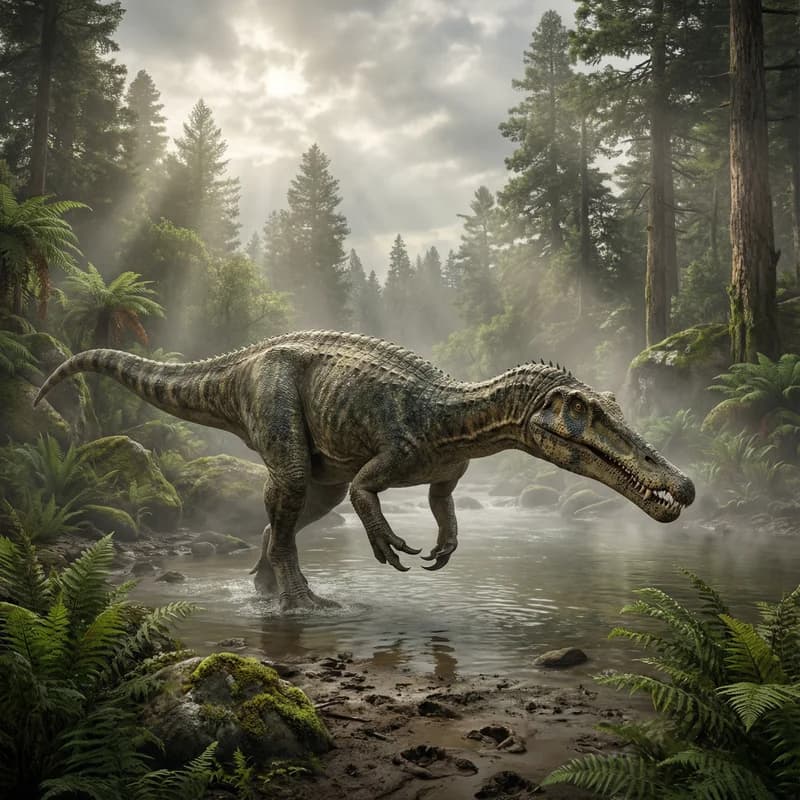
| Baryonyx | Barremian (~130–125 Ma) | England | ~7.5–10 m | First spinosaurid described from postcranial material; enlarged thumb claw |
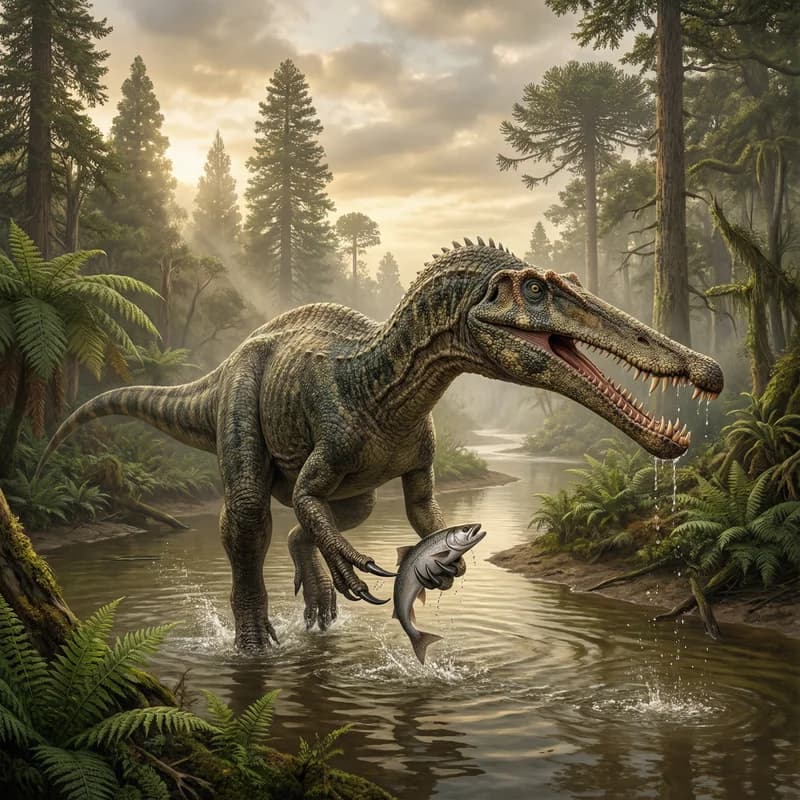
| Suchomimus | Aptian (~121–113 Ma) | Niger | ~9.5–11 m | Low dorsal sail; classified in Baryonychinae |
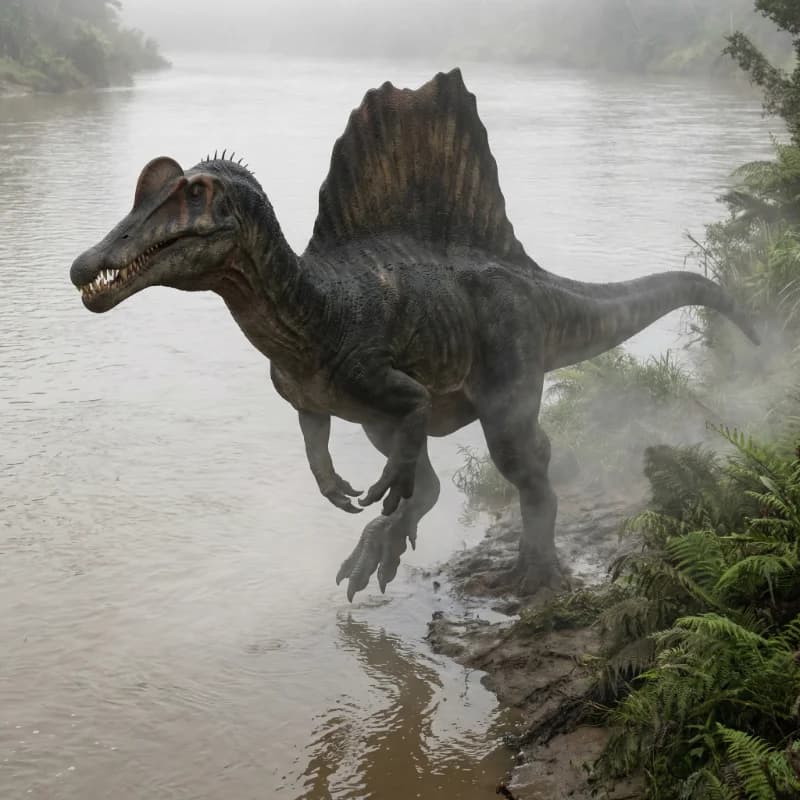
| Spinosaurus | Cenomanian (~99–94 Ma) | North Africa | ~14–15 m | Largest known spinosaurid; tail-propelled aquatic locomotion |
| Ichthyovenator | Aptian (~120–113 Ma) | Laos | ~8–10.5 m | First definitive Asian spinosaurid; sinusoidal sail |
Fun Facts
FAQ
📚References
- Martill, D. M., Cruickshank, A. R. I., Frey, E., Small, P. G. & Clarke, M. (1996). A new crested maniraptoran dinosaur from the Santana Formation (Lower Cretaceous) of Brazil. Journal of the Geological Society, 153(1), 5–8. https://doi.org/10.1144/gsjgs.153.1.0005
- Sues, H.-D., Frey, E., Martill, D. M. & Scott, D. M. (2002). Irritator challengeri, a spinosaurid (Dinosauria: Theropoda) from the Lower Cretaceous of Brazil. Journal of Vertebrate Paleontology, 22(3), 535–547. https://doi.org/10.1671/0272-4634(2002)022[0535:ICASDT]2.0.CO;2
- Kellner, A. W. A. & Campos, D. A. (1996). First Early Cretaceous theropod dinosaur from Brazil with comments on Spinosauridae. Neues Jahrbuch für Geologie und Paläontologie, Abhandlungen, 199, 151–166.
- Sales, M. A. F. & Schultz, C. L. (2017). Spinosaur taxonomy and evolution of craniodental features: Evidence from Brazil. PLoS ONE, 12(11), e0187070. https://doi.org/10.1371/journal.pone.0187070
- Schade, M., Rauhut, O. W. M. & Evers, S. W. (2020). Neuroanatomy of the spinosaurid Irritator challengeri (Dinosauria: Theropoda) indicates potential adaptations for piscivory. Scientific Reports, 10, 9259. https://doi.org/10.1038/s41598-020-66261-w
- Schade, M., Rauhut, O. W. M. & Evers, S. W. (2023). A reappraisal of the cranial and mandibular osteology of the spinosaurid Irritator challengeri (Dinosauria: Theropoda). Palaeontologia Electronica, 26(2), a17. https://doi.org/10.26879/1242
- Buffetaut, E., Martill, D. M. & Escuillié, F. (2004). Pterosaurs as part of a spinosaur diet. Nature, 430, 33. https://doi.org/10.1038/430033a
- Aureliano, T., Ghilardi, A. M., Buck, P. V., Fabbri, M., Samathi, A., Delcourt, R., Fernandes, M. A. & Sander, M. (2018). Semi-aquatic adaptations in a spinosaur from the Lower Cretaceous of Brazil. Cretaceous Research, 90, 283–295. https://doi.org/10.1016/j.cretres.2018.04.024
- Rayfield, E. J., Milner, A. C., Xuan, V. B. & Young, P. G. (2007). Functional morphology of spinosaur 'crocodile-mimic' dinosaurs. Journal of Vertebrate Paleontology, 27(4), 892–901. https://doi.org/10.1671/0272-4634(2007)27[892:FMOSCD]2.0.CO;2
- Arden, T. M. S., Klein, C. G., Zouhri, S. & Longrich, N. R. (2018). Aquatic adaptation in the skull of carnivorous dinosaurs (Theropoda: Spinosauridae) and the evolution of aquatic habits in spinosaurids. Cretaceous Research, 93, 275–284. https://doi.org/10.1016/j.cretres.2018.06.013
- Amiot, R., Buffetaut, E., Lécuyer, C., Wang, X., Boudad, L., Ding, Z., Fourel, F., Hutt, S., Martineau, F., Medeiros, M. A., Mo, J., Simon, L., Suteethorn, V., Sweetman, S., Tong, H., Zhang, F. & Zhou, Z. (2010). Oxygen isotope evidence for semi-aquatic habits among spinosaurid theropods. Geology, 38(2), 139–142. https://doi.org/10.1130/G30402.1
- Sereno, P. C., Beck, A. L., Dutheil, D. B., Gado, B., Larsson, H. C. E., Lyon, G. H., Marcot, J. D., Rauhut, O. W. M., Sadleir, R. W., Sidor, C. A., Varricchio, D. D., Wilson, G. P. & Wilson, J. A. (1998). A long-snouted predatory dinosaur from Africa and the evolution of spinosaurids. Science, 282(5392), 1298–1302. https://doi.org/10.1126/science.282.5392.1298
- Charig, A. J. & Milner, A. C. (1997). Baryonyx walkeri, a fish-eating dinosaur from the Wealden of Surrey. Bulletin of the Natural History Museum, Geology Series, 53, 11–70.
- Benson, R. B. J., Carrano, M. T. & Brusatte, S. L. (2010). A new clade of archaic large-bodied predatory dinosaurs (Theropoda: Allosauroidea) that survived to the latest Mesozoic. Naturwissenschaften, 97, 71–78. https://doi.org/10.1007/s00114-009-0614-x
- Evers, S. W., Rauhut, O. W. M., Milner, A. C., McFeeters, B. & Allain, R. (2015). A reappraisal of the morphology and systematic position of the theropod dinosaur Sigilmassasaurus from the 'middle' Cretaceous of Morocco. PeerJ, 3, e1323. https://doi.org/10.7717/peerj.1323
Gallery
5 images Irritator
Irritator · Cretaceous Period · Piscivore
 Irritator
Irritator · Cretaceous Period · Piscivore
 Irritator
Irritator · Cretaceous Period · Piscivore
 Irritator
Irritator · Cretaceous Period · Piscivore
 Irritator
Irritator · Cretaceous Period · Piscivore
🔗Related Creatures
Baryonyx
Baryonyx walkeri

Spinosaurus
Spinosaurus aegyptiacus
Suchomimus
Suchomimus tenerensis

Hesperornis
Hesperornis regalis
Spinosaurus mirabilis
Spinosaurus mirabilis
Sauropelta
Sauropelta edwardsorum

Maiasaura
Maiasaura peeblesorum
Concavenator
Concavenator corcovatus