Tapejara
Cretaceous Period Omnivore Creature Type
Tapejara wellnhoferi
Scientific Name: "Tupí-Guaraní tape (path) + jara (lord) = 'lord of the path'; specific epithet wellnhoferi honors German paleontologist Peter Wellnhofer"
Local Name: Tapezara
Physical Characteristics
Discovery
Habitat
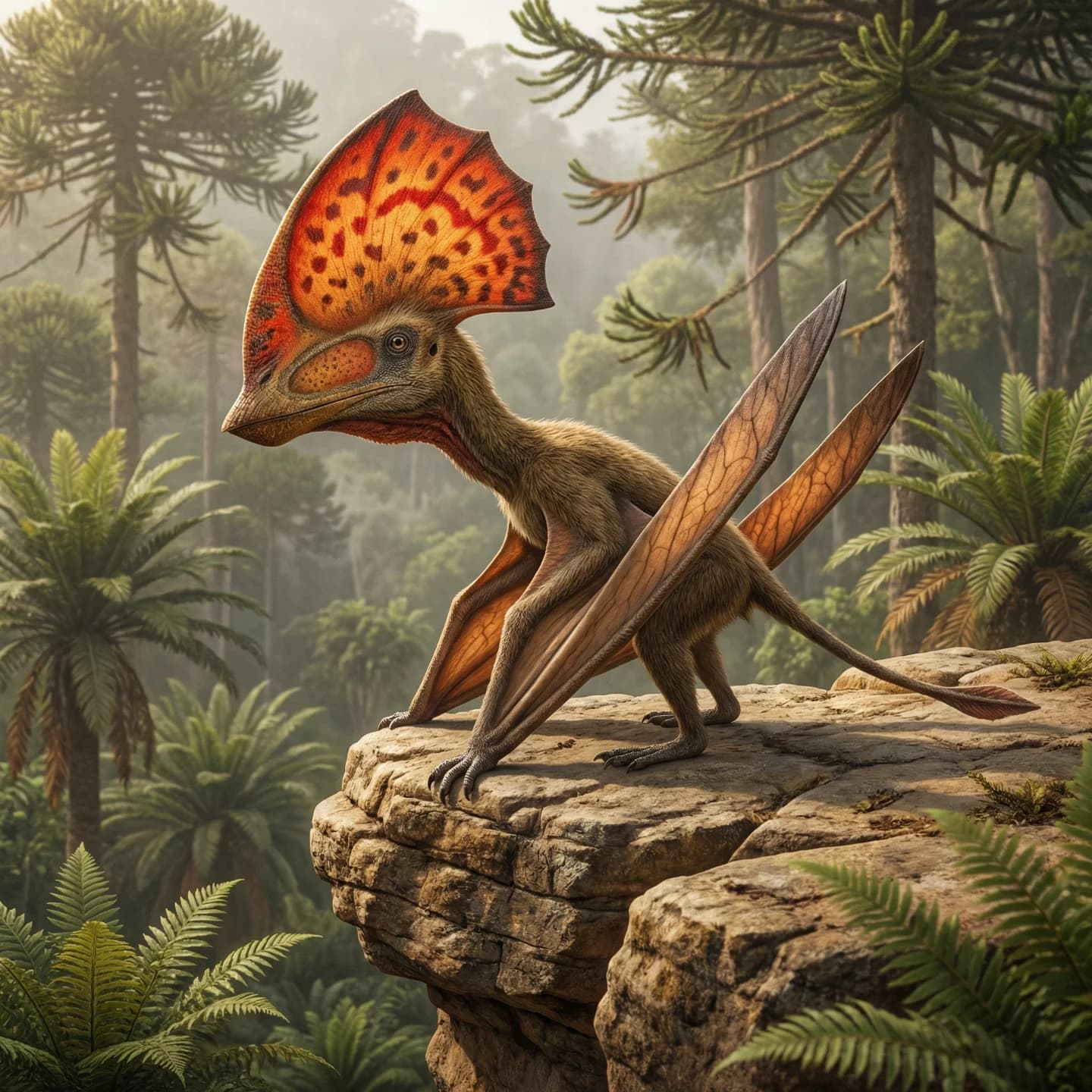
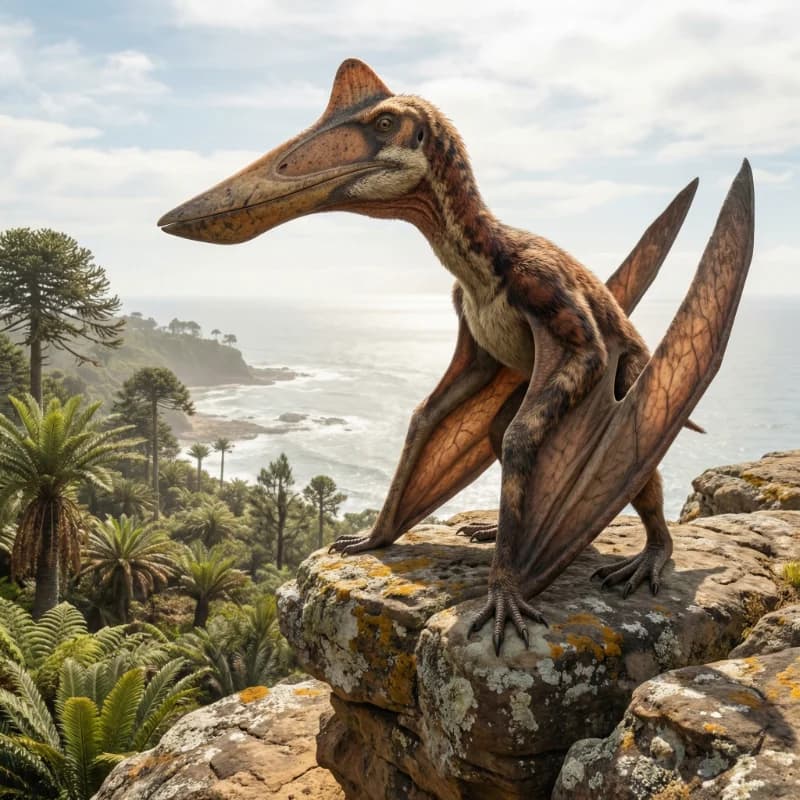
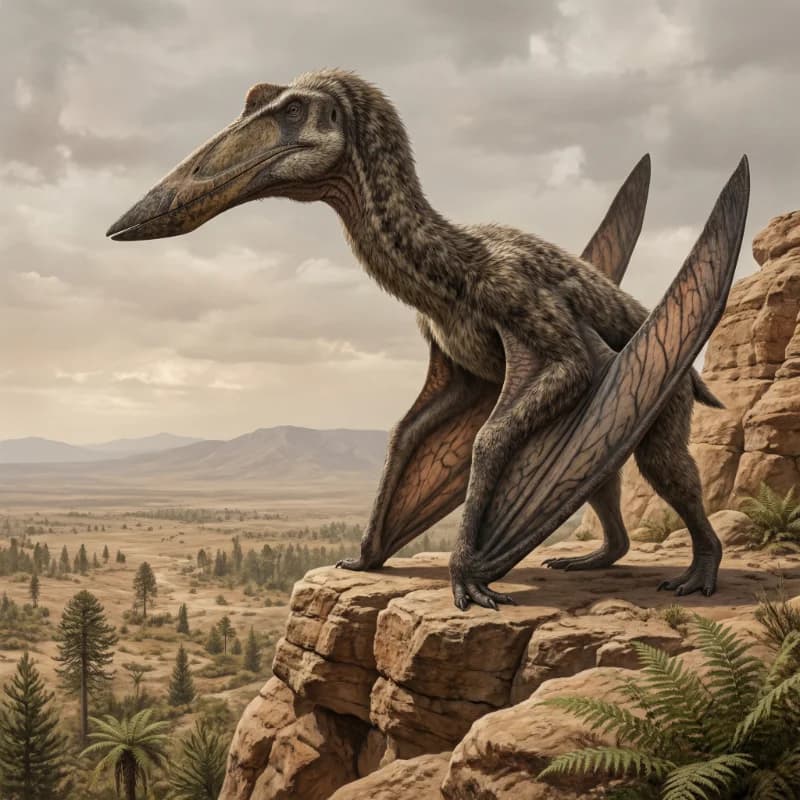
Tapejara (Tapejara wellnhoferi Kellner, 1989) is a small azhdarchoid pterosaur from the Early Cretaceous (Aptian–Albian, ~112 Ma) Romualdo Formation of the Araripe Basin, northeastern Brazil. It belongs to the family Tapejaridae within the superfamily Azhdarchoidea (order Pterosauria, suborder Pterodactyloidea), and is the type genus from which the family name is derived. Its most distinctive features include a toothless, short, deep beak reminiscent of a parrot's, a tall bony sagittal crest on the premaxilla, and an elongate parietooccipital process extending posteriorly from the braincase.
All known specimens of T. wellnhoferi represent subadult or juvenile individuals, with estimated wingspans of approximately 1.23–1.5 m (Eck et al., 2011; Vila Nova et al., 2014). The adult wingspan has been suggested to reach roughly 3.5 m, but no fully mature specimen has been recovered, leaving this figure uncertain. Body length (beak to tail) is estimated at approximately 0.5–0.7 m. No formal body-mass estimate has been published specifically for T. wellnhoferi.
Originally, three species were assigned to the genus: T. wellnhoferi, T. imperator, and T. navigans. However, the latter two were subsequently reassigned to the separate genus Tupandactylus (Kellner & Campos, 2007; Pinheiro et al., 2011), leaving T. wellnhoferi as the sole valid species. The elaborate soft-tissue crests commonly depicted in popular media actually derive from Tupandactylus, not from T. wellnhoferi, for which no evidence of a keratinous crest has been found.
Tapejarid pterosaurs have long been hypothesized to be frugivores or omnivores based on their parrot-like beak morphology. This hypothesis received its first direct support in 2025, when phytoliths and gastroliths were discovered in the abdominal cavity of the closely related tapejarid Sinopterus atavismus from China (Jiang et al., 2025). However, no gut contents have been reported from Tapejara itself, and its precise diet remains debated between frugivory and omnivory.
Overview
Name and Etymology
The genus name Tapejara derives from the Tupí-Guaraní language, combining tape (path) and jara (lord), meaning "lord of the path" (Costa, 2021). Kellner's original 1989 description mistranslated the name as "old being," but this was later corrected. The specific epithet wellnhoferi honors the German paleontologist Peter Wellnhofer, a pioneering figure in pterosaur research.
Taxonomic Status
Tapejara wellnhoferi is the type species and sole valid species of the genus Tapejara. Two additional species—T. imperator Campos & Kellner, 1997 and T. navigans Frey, Martill & Buchy, 2003—were originally placed in the genus but were later recognized as distinct enough to warrant separation into the genus Tupandactylus (Kellner & Campos, 2007). Unwin & Martill (2007) independently erected the genus Ingridia for the same species, but Tupandactylus retains nomenclatural priority.
Scientific Significance
As the type genus of Tapejaridae, Tapejara serves as the foundational reference point for understanding the family's anatomy, phylogeny, and ecology. The genus is central to debates about edentulous pterosaur feeding strategies, the functional morphology of cranial crests, and the phylogenetic relationships within Azhdarchoidea.
Stratigraphy, Age, and Depositional Environment
Age Range
All known specimens of T. wellnhoferi come from the Romualdo Formation (Santana Group) of the Araripe Basin. The age of the Romualdo Formation has been debated, but the most recent biostratigraphic and geochemical analyses place it in the late Aptian to early Albian, approximately 112–108 Ma (Martill, 2007; Melo et al., 2020). Some earlier references cite the broader Santana Group age range of 127–112 Ma, but T. wellnhoferi is restricted to the Romualdo Formation and thus falls within the younger portion of this interval.
Formation and Lithology
The Romualdo Formation consists primarily of mudstones and calcareous shales, with the characteristic early-diagenetic carbonate concretions that are famous for their exceptional fossil preservation (Konservat-Lagerstätte). All T. wellnhoferi specimens were recovered from these concretions, which formed around carcasses on the floor of a shallow water body, sometimes preserving soft tissues in remarkable detail (Maisey et al., 1991).
Paleoenvironment
The Romualdo Formation was deposited in a rift basin setting, representing a confined aquatic environment that experienced intermittent shallow marine incursions from the proto-Atlantic Ocean as South America and Africa separated (Custódio et al., 2017). The paleolatitude was approximately 12.2°S and the paleolongitude approximately 10.7°W, placing the Araripe Basin in a subtropical to tropical climate zone. The environment hosted a rich and diverse fauna including numerous fish species, other pterosaurs, crocodylomorphs, and even theropod dinosaurs.
Specimens and Diagnostic Characters
Key Specimens
| Specimen | Institution | Preserved Elements | Reference |
|---|---|---|---|
| MN 6595-V (= CD-R 080) | Museu Nacional, Brazil | Partial skull (anterior portion with premaxillary crest) | Kellner, 1989 (holotype) |
| AMNH 24440 | American Museum of Natural History | Partial skull, partial mandible, anterior cervical vertebra | Wellnhofer & Kellner, 1991 |
| SMNK PAL 1137 | Staatliches Museum fur Naturkunde Karlsruhe | Skull + extensive postcranium (minimum 2 individuals) | Eck et al., 2011 |
| MCT 1500-R | CPRM/Museu de Ciencias da Terra, Brazil | Braincase | Kellner, 1996 |
| AMNH 24445 | American Museum of Natural History | Cervical vertebrae (small/juvenile individual) | Vila Nova et al., 2015 |
| IMCF 1061 | Iwaki Coal and Fossil Museum, Japan | Cranial elements | — |
| TTU P10362 | Texas Tech University | Cast skeleton (wingspan 1.35 m) | Chatterjee & Templin, 2004 |
Revised Diagnosis
According to the revised diagnosis by Eck et al. (2011), T. wellnhoferi is characterized by the following combination of features: an edentulous azhdarchoid with a short skull bearing a tall median premaxillary sagittal crest on the rostral portion; an elongate frontoparietal crest extending posteriorly beyond the occipital plate; a very large nasoantorbital fenestra with the orbit positioned below the dorsal margin of the fenestra; a ventrally inclined rostrum with a concave palatal depression terminating in a pointed tip; a palate lacking a medial ridge; a median ventral crest on the mandibular symphysis; cervical vertebrae with short, low neural spines and paired large pneumatic foramina lateral to the neural canal (absent on the axis); and a unique pneumatic configuration of the humerus, pierced by both a dorsal and a ventral foramen.
Specimen Limitations
All known specimens appear to represent subadult or juvenile individuals, and no unambiguous adult has been described. This means that the full adult size, the maximum extent of crest development, and skeletal proportions at maturity remain uncertain. Additionally, most specimens lack precise locality data, as they were recovered from commercially traded concretions, limiting stratigraphic resolution.
Morphology and Functional Anatomy
Skull and Crest
The skull of Tapejara is short and tall, dominated anteriorly by the nasoantorbital fenestra and dorsally by the premaxillary sagittal crest. This bony crest is composed of two extremely thin blades of trabeculae-braced bone, with a combined cross-sectional width of only about 2 mm at its posterior margin (Eck et al., 2011). The parietooccipital process extends approximately 58 mm posterodorsally from the back of the skull in specimen SMNK PAL 1137.
It is important to note that no evidence for a soft-tissue (keratinous) crest has been found in T. wellnhoferi. The spectacular sail-like crests commonly shown in popular reconstructions are based on Tupandactylus imperator and T. navigans, not on Tapejara proper.
Beak and Oral Structures
The beak is entirely toothless (edentulous), short, and deep, with a ventrally inclined rostrum bearing a concave palatal surface. The mandibular symphysis is approximately 44 mm long, with a dorsally concave occlusal surface and a ventral sagittal crest. This beak morphology is strikingly similar to that of modern parrots and toucans.
Wing Structure and Flight
As a pterodactyloid, Tapejara possessed the characteristic elongated fourth digit supporting a wing membrane. Known specimens yield wingspans of approximately 1.23–1.5 m, but these are subadult individuals. Estimates for the adult wingspan range up to approximately 3.5 m, though this remains unconfirmed. The unusual dual-foramen pneumatic configuration of the humerus (one dorsal, one ventral) is a unique autapomorphy that reflects an exceptionally high degree of skeletal pneumaticity, consistent with efficient flight adaptations.
Xing et al. (2013) conducted a computer simulation suggesting that the cranial crest of Tapejara could have functioned as a forward rudder, facilitating agile turns during flight. However, this hypothesis remains controversial, and other researchers have argued that the crest primarily served display or thermoregulatory functions rather than aerodynamic ones.
Brain and Senses
A silicone endocast of the braincase from SMNK PAL 1137 reveals that the brain was oriented approximately 45° upward relative to the horizontal plane of the skull. The cerebral hemispheres are large and well-differentiated, while the cerebellum and osseous labyrinth (semicircular canals) are prominently developed, indicating sophisticated flight coordination and balance (Eck et al., 2011).
Schmitz & Motani (2011) analyzed the scleral ring and orbit morphology of Tapejara and concluded that it was likely cathemeral—active at irregular intervals throughout both day and night.
Diet and Ecology
Dietary Inference
The short, deep, toothless beak of Tapejara has long been compared to those of modern frugivorous birds such as parrots (Psittacidae), leading to the widespread hypothesis that tapejarids were frugivores or omnivores (Wellnhofer & Kellner, 1991; Vullo et al., 2012). No direct evidence of gut contents has been reported from T. wellnhoferi itself. However, the closely related tapejarid Sinopterus atavismus from the Jiufotang Formation of China was found with over 320 phytoliths (microscopic plant silica bodies) and gastroliths in its abdominal cavity, providing the first direct evidence of herbivory in any pterosaur (Jiang et al., 2025, Science Bulletin).
Some authors have suggested that tapejarids may have been omnivorous rather than strictly herbivorous (Naish, 2025, Tetrapod Zoology). The diet of T. wellnhoferi is therefore best characterized as frugivore/omnivore, with the balance between plant and animal food intake remaining uncertain.
Ecological Niche
Within the Romualdo Formation ecosystem, Tapejara coexisted with a diverse assemblage of pterosaurs occupying different ecological niches. Ornithocheirid pterosaurs such as Tropeognathus and Anhanguera were piscivores, while thalassodromids like Thalassodromeus and Tupuxuara appear to have been terrestrial predators or scavengers. Tapejara is interpreted as having diverged toward a frugivorous/herbivorous niche, reducing competition with these sympatric taxa.
Behavior
The scleral ring analysis by Schmitz & Motani (2011) suggests cathemeral activity. Sexual dimorphism in crest size has not been directly demonstrated in T. wellnhoferi, though the related tapejarid Caiuajara dobruskii is known from a mass-mortality assemblage preserving hundreds of individuals with crest size variation, consistent with social behavior and sexual display (Manzig et al., 2014). The multi-individual assemblage in SMNK PAL 1137 (at least two individuals in a single concretion) may also hint at some degree of gregarious behavior, though taphonomic aggregation cannot be ruled out.
Distribution and Paleogeography
Fossil Distribution
All T. wellnhoferi fossils come from the Romualdo Formation in the Araripe Basin, primarily in Ceará state, northeastern Brazil. Exact localities are uncertain for most specimens, but SMNK PAL 1137 is tentatively attributed to the Sierra de Maosina locality based on the original blue color of its concretion (Eck et al., 2011), and AMNH 24440 likely originates from the Jardim or Santana do Cariri localities.
Paleogeographic Context
During the Early Cretaceous, the Araripe Basin lay at approximately 12.2°S paleolatitude, 10.7°W paleolongitude, along the nascent South Atlantic rift zone between South America and Africa. The region experienced a subtropical to tropical climate, with the Romualdo Formation recording a phase of marine transgression into an initially lacustrine rift basin. This setting supported a rich and taxonomically diverse biota.
Phylogeny and Taxonomic Debates
Phylogenetic Position
Kellner et al. (2019) recovered Tapejara within the tribe Tapejarini, a subclade of the subfamily Tapejarinae within Tapejaridae. The cladogram places Tapejara wellnhoferi as sister taxon to Tupandactylus imperator, with Caiuajara dobruskii and Europejara olcadesorum as successive outgroups within Tapejarini. Tapejarinae as a whole is sister to Thalassodrominae (including Thalassodromeus and Tupuxuara) within Tapejaridae. The non-tapejarid azhdarchoid Keresdrakon was recovered as the outgroup to Tapejaridae.
Species-Level Taxonomy
The most significant taxonomic revision in Tapejara's history was the removal of T. imperator and T. navigans to Tupandactylus. The large and elaborate crests of these species differ markedly from the relatively modest crest of T. wellnhoferi. Kellner & Campos (2007) erected Tupandactylus for T. imperator, while Unwin & Martill (2007) independently created Ingridia for both species. Since Tupandactylus was named first, it has priority. The formal transfer of T. navigans to Tupandactylus was completed by Pinheiro et al. (2011).
Alternative Hypotheses
Some phylogenetic analyses have placed tapejarids in slightly different configurations within Azhdarchoidea, and a minority of workers have questioned the monophyly of Tapejaridae or the precise interrelationships of its subclades. However, the monophyly of the family is supported in the majority of analyses by shared derived characters including the edentulous jaws, short and deep skull, and well-developed premaxillary crest.
Restoration and Uncertainties
Confirmed, Probable, and Hypothetical
Confirmed: Toothless short deep beak; premaxillary sagittal bony crest; parietooccipital process; pterodactyloid wing architecture; high skeletal pneumaticity including unique dual-foramen humerus.
Probable: Frugivorous/herbivorous dietary component (supported by close relative's direct evidence plus beak morphology); cathemeral activity pattern (scleral ring analysis); phylogenetic placement within Tapejarini.
Hypothetical/Uncertain: Adult wingspan of ~3.5 m (no adult specimen known); aerodynamic function of cranial crest (rudder hypothesis); presence or absence of a soft-tissue crest; gregarious social behavior (multi-individual assemblage is suggestive but not conclusive).
Common Misconceptions
The most widespread misconception about Tapejara is the attribution of a large, colorful keratinous crest or sail, which in fact derives from Tupandactylus imperator and T. navigans. T. wellnhoferi preserves only a bony crest with no evidence of a keratinous extension. Similarly, wingspan figures of 4–5 m or more that appear in some popular sources conflate T. wellnhoferi with the larger species that were formerly assigned to the genus, or with speculative adult estimates.
Comparison with Related and Contemporaneous Taxa
| Taxon | Family | Estimated Wingspan | Inferred Diet | Formation |
|---|---|---|---|---|
| Tapejara wellnhoferi | Tapejaridae | ~1.23–1.5 m (subadult); ~3.5 m (adult?) | Frugivore/omnivore | Romualdo Fm. |
| Tupandactylus imperator | Tapejaridae | ~2.5–3 m | Frugivore/omnivore | Crato Fm. |
| Caiuajara dobruskii | Tapejaridae | ~0.65–2.35 m | Frugivore/omnivore | Goio-Ere Fm. |
| Sinopterus dongi | Tapejaridae | ~1.2 m | Herbivore (direct evidence) | Jiufotang Fm. |
| Tropeognathus mesembrinus | Anhangueridae | ~8.2 m | Piscivore | Romualdo Fm. |
| Thalassodromeus sethi | Thalassodromidae | ~4.2 m | Terrestrial predator/omnivore | Romualdo Fm. |
T. wellnhoferi was one of the smallest pterosaurs in the Romualdo Formation assemblage, starkly contrasting with the large ornithocheirids and thalassodromids that shared its environment, and clearly differentiated from them in diet and ecological niche.
Fun Facts
FAQ
📚References
- Kellner, A. W. A. (1989). A new edentate pterosaur of the Lower Cretaceous from the Araripe Basin, Northeast Brazil. Anais da Academia Brasileira de Ciências, 61(4), 439–446.
- Wellnhofer, P. & Kellner, A. W. A. (1991). The skull of Tapejara wellnhoferi Kellner (Reptilia, Pterosauria) from the Lower Cretaceous Santana Formation of the Araripe Basin, Northeastern Brazil. Mitteilungen der Bayerischen Staatssammlung für Paläontologie und historische Geologie, 31, 89–106.
- Eck, K., Elgin, R. A. & Frey, E. (2011). On the osteology of Tapejara wellnhoferi KELLNER 1989 and the first occurrence of a multiple specimen assemblage from the Santana Formation, Araripe Basin, NE-Brazil. Swiss Journal of Palaeontology, 130(2), 277–296. doi:10.1007/s13358-011-0024-5
- Vila Nova, B. C., Saraiva, A. Á. F., Kellner, A. W. A. & Sayão, J. M. (2014). A new specimen of the azhdarchoid pterosaur Tapejara wellnhoferi. Historical Biology, 27(7), 833–841. doi:10.1080/08912963.2011.613467
- Vila Nova, B. C., Kellner, A. W. A., Sayão, J. M. & Saraiva, A. Á. F. (2015). Comments on the cervical vertebrae of the Tapejaridae (Pterosauria, Pterodactyloidea) with description of new specimens. Historical Biology, 27(6), 771–781. doi:10.1080/08912963.2015.1007049
- Kellner, A. W. A. & Campos, D. A. (2007). Short note on the ingroup relationships of the Tapejaridae (Pterosauria, Pterodactyloidea). Boletim do Museu Nacional, Nova Série, Geologia, 75, 1–14.
- Unwin, D. M. & Martill, D. M. (2007). Pterosaurs of the Crato Formation. In Martill, D. M., Bechly, G. & Loveridge, R. F. (eds.), The Crato Fossil Beds of Brazil: Window into an Ancient World, pp. 475–524. Cambridge University Press.
- Pinheiro, F. L., Fortier, D. C., Schultz, C. L., De Andrade, J. A. F. G. & Bantim, R. A. M. (2011). New information on Tupandactylus imperator, with comments on the relationships of Tapejaridae (Pterosauria). Acta Palaeontologica Polonica, 56(3), 567–580. doi:10.4202/app.2010.0057
- Kellner, A. W. A., Weinschütz, L. C., Holgado, B., Bantim, R. A. M. & Sayão, J. M. (2019). A new toothless pterosaur (Pterodactyloidea) from Southern Brazil with insights into the paleoecology of a Cretaceous desert. Anais da Academia Brasileira de Ciências, 91(suppl 2), e20190768. doi:10.1590/0001-3765201920190768
- Vullo, R., Marugán-Lobón, J., Kellner, A. W. A., Buscalioni, A. D., Gomez, B., de la Fuente, M. & Moratalla, J. J. (2012). A new crested pterosaur from the Early Cretaceous of Spain: the first European tapejarid (Pterodactyloidea: Azhdarchoidea). PLoS ONE, 7(7), e38900. doi:10.1371/journal.pone.0038900
- Schmitz, L. & Motani, R. (2011). Nocturnality in dinosaurs inferred from scleral ring and orbit morphology. Science, 332(6030), 705–708. doi:10.1126/science.1200043
- Martill, D. M. (2007). The age of the Cretaceous Santana Formation fossil Konservat-Lagerstätte of north-east Brazil: a historical review and an appraisal of the biochronostratigraphic utility of its palaeobiota. Cretaceous Research, 28(6), 895–920. doi:10.1016/j.cretres.2007.01.002
- Melo, R. M., Guzmán, J., Almeida-Lima, D., Piasecki, S., Rodrigues, R. & Neumann, V. H. (2020). New marine data and age accuracy of the Romualdo Formation, Araripe Basin, Brazil. Scientific Reports, 10, 15779. doi:10.1038/s41598-020-72789-8
- Custódio, M. A., Quaglio, F., Warren, L. V., Simões, M. G., Fürsich, F. T., Perinotto, J. A. & Assine, M. L. (2017). The transgressive–regressive cycle of the Romualdo Formation (Araripe Basin): Sedimentary archive of the Early Cretaceous marine ingression in the interior of Northeast Brazil. Sedimentary Geology, 359, 1–15. doi:10.1016/j.sedgeo.2017.07.010
- Jiang, S., Zhang, X., Wu, Y., Zheng, M., Kellner, A. W. A. & Wang, X. (2025). First occurrence of phytoliths in pterosaurs—evidence for herbivory. Science Bulletin, 70(19), 3134–3138. doi:10.1016/j.scib.2025.06.040
- Costa, L. P. (2021). Redescription of Tupandactylus imperator Campos & Kellner, 1997 (Pterosauria, Tapejaridae) based on a new complete specimen from the Crato Formation (Aptian-Albian) of the Araripe Basin, Ceará, Brazil. M.Sc. Dissertation, Universidade de São Paulo.
- Xing, L., Wu, J., Lu, Y. & Chatterjee, S. (2013). The flight dynamics of Tapejara, a pterosaur from the Early Cretaceous of Brazil. Acta Geologica Sinica (English Edition), 87(1), 23–26. doi:10.1111/1755-6724.12007
- Chatterjee, S. & Templin, R. J. (2004). Posture, locomotion, and paleoecology of pterosaurs. Geological Society of America Special Paper, 376, 1–64.
- Manzig, P. C., Kellner, A. W. A., Weinschütz, L. C., Fragoso, C. E., Vega, C. S., Guimarães, G. B., Godoy, L. C., Liccardo, A., Ricetti, J. H. Z. & de Moura, C. C. (2014). Discovery of a rare pterosaur bone bed in a Cretaceous desert with insights on ontogeny and behavior of flying reptiles. PLoS ONE, 9(8), e100005. doi:10.1371/journal.pone.0100005
- Kellner, A. W. A. (1996). Description of new material of Tapejaridae and Anhangueridae (Pterosauria, Pterodactyloidea) and discussion of pterosaur phylogeny. Ph.D. Dissertation, Columbia University, New York.
- Maisey, J. G., Rutzky, I., Blum, S. & Elvers, W. (1991). Laboratory preparation techniques. In Maisey, J. G. (ed.), Santana Fossils: An Illustrated Atlas, pp. 99–103. TFH Publications.
Gallery
5 images Tapejara
Tapejara · Cretaceous Period · Omnivore
 Tapejara
Tapejara · Cretaceous Period · Omnivore
 Tapejara
Tapejara · Cretaceous Period · Omnivore
 Tapejara
Tapejara · Cretaceous Period · Omnivore
 Tapejara
Tapejara · Cretaceous Period · Omnivore
🔗Related Creatures
Pterodaustro
Pterodaustro guinazui
Tupuxuara
Tupuxuara longicristatus
Anhanguera
Anhanguera blittersdorffi
Istiodactylus
Istiodactylus latidens
Quetzalcoatlus
Quetzalcoatlus northropi
Arambourgiania
Arambourgiania philadelphiae
Guidraco
Guidraco venator
Hatzegopteryx
Hatzegopteryx thambema