Hatzegopteryx
Cretaceous Period Carnivore Creature Type
Hatzegopteryx thambema
Scientific Name: "Hatzeg (Hațeg Basin, Transylvania) + Greek pteryx (πτέρυξ, 'wing') = 'Hațeg basin wing'; species name thambema (Greek θάμβημα) = 'terror, monster'"
Local Name: Hatzegopteryx
Physical Characteristics
Discovery
Habitat
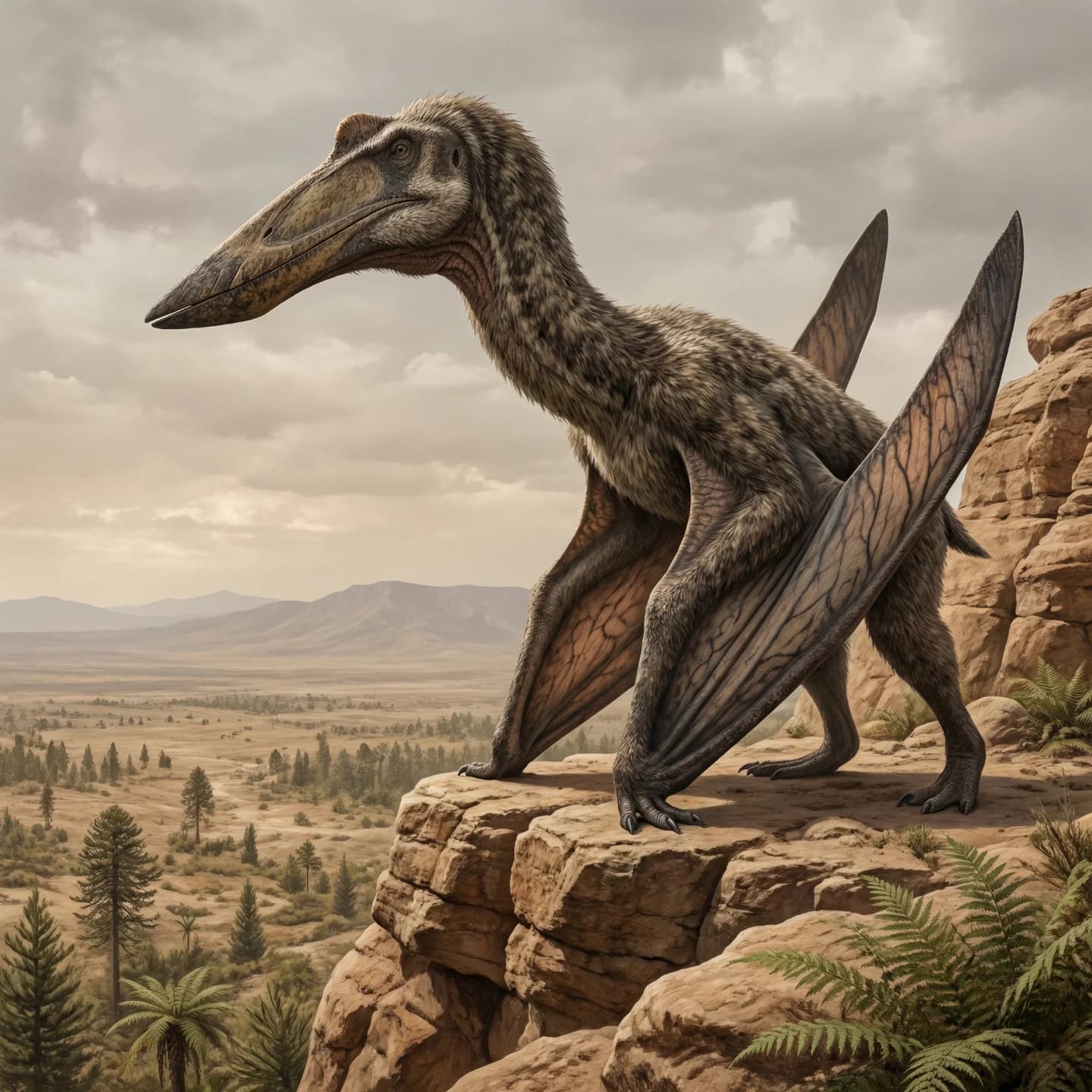
Hatzegopteryx thambema (Buffetaut, Grigorescu & Csiki, 2002) is a giant azhdarchid pterosaur from the late Maastrichtian (approximately 72–66 Ma) of Transylvania, present-day Romania. The generic name combines 'Hatzeg,' referring to the Hațeg Basin where the fossils were discovered, with the Greek word pteryx (πτέρυξ, 'wing'), meaning 'Hațeg basin wing.' The specific epithet thambema (θάμβημα) translates to 'terror' or 'monster,' in reference to the animal's enormous size. The holotype, FGGUB R 1083A, was described in 2002 by French paleontologist Eric Buffetaut and Romanian paleontologists Dan Grigorescu and Zoltán Csiki on the basis of two fragments from the back of the skull and the damaged proximal portion of a left humerus, recovered from the upper part of the Middle Densuș-Ciula Formation at Vălioara, northwestern Hațeg Basin.
What makes Hatzegopteryx particularly remarkable among giant azhdarchids is its dramatically different body proportions. While its estimated wingspan of 10–12 m places it among the largest flying animals of all time—rivaling Quetzalcoatlus northropi and Arambourgiania philadelphiae—its neck was only about 1.5 m long, roughly 50–60% the length expected for an azhdarchid of its size (Naish & Witton, 2017). This short, powerfully muscled neck, combined with an unusually wide, robust skull and bones filled with a distinctive spongy (spongiose) internal texture rather than being hollow, sets Hatzegopteryx apart from all other known giant azhdarchids and suggests it was adapted to tackle proportionally larger prey.
It is important to note that Hatzegopteryx was not a dinosaur but a pterosaur—a flying reptile belonging to the order Pterosauria. Pterosaurs were archosaurs that lived alongside dinosaurs but evolved along a separate lineage; they are neither ancestors nor descendants of birds. Hatzegopteryx inhabited Hațeg Island, a landmass in the Cretaceous subtropics within the Tethys Sea. In the absence of large theropod dinosaurs, Hatzegopteryx is hypothesized to have been the apex predator of the Hațeg Island ecosystem, preying on dwarf titanosaurs, iguanodontians, and other island fauna (Naish & Witton, 2017; Witton & Naish, 2015).
Overview
Name and Etymology
The genus name Hatzegopteryx is derived from the Hațeg (also spelled Hatzeg) Basin of Transylvania, Romania, where the holotype was found, combined with the Greek pteryx (πτέρυξ), meaning 'wing.' The specific name thambema (θάμβημα) is Greek for 'terror' or 'monster,' alluding to the animal's formidable size (Buffetaut et al., 2002).
Taxonomic Status
Hatzegopteryx is classified within the Pterosauria, suborder Pterodactyloidea, family Azhdarchidae. Early comparisons of its humerus with that of Quetzalcoatlus northropi led to suggestions that the two might be synonymous, but the relatively non-diagnostic nature of the humerus in giant azhdarchid taxonomy and, more importantly, the clearly distinct neck and jaw anatomy of Hatzegopteryx warrant its retention as a separate taxon (Naish & Witton, 2017; Witton et al., 2010). Phylogenetic analyses by Longrich et al. (2018), Andres (2021), and Pêgas et al. (2023) all place Hatzegopteryx within the subfamily Quetzalcoatlinae, though its precise position varies: Andres (2021) recovered it in a clade with Arambourgiania and Quetzalcoatlus, while Pêgas et al. (2023) found it as the sister taxon to Albadraco, another pterosaur from the Hațeg Basin.
Key Summary
Hatzegopteryx was a giant, robustly built azhdarchid pterosaur that likely served as the apex predator of Late Cretaceous Hațeg Island, distinguished from other members of its family by its short, powerfully muscled neck and wide, reinforced skull.
Age, Stratigraphy, and Depositional Environment
Age Range
The holotype of Hatzegopteryx was recovered from the upper part of the Middle Densuș-Ciula Formation at Vălioara, which has been dated to the late Campanian–early Maastrichtian, approximately 72 million years ago (Albert et al., 2025). The referred cervical vertebra EME 315 comes from the Sebeș Formation, a contemporaneous and adjacent unit (Vremir, 2010; Naish & Witton, 2017). The overall temporal range of Hatzegopteryx spans the Maastrichtian (approximately 72–66 Ma).
Formation and Lithology
The Densuș-Ciula Formation crops out in the northwestern Hațeg Basin and is divided into three members: Lower, Middle, and Upper. The fossil-rich Middle Member consists of silty mudstones, sandstones, and conglomerates containing volcanogenic clasts (Vasile et al., 2011). The Upper Member is dominated by matrix-supported red conglomerates and is poorly fossiliferous. The holotype locality of Vălioara lies in the upper part of the Middle Member.
Paleoenvironment
During the Maastrichtian, southern Europe formed an archipelago within the Tethys Sea. The Hațeg Basin was part of the Tisia–Dacia Block, a landmass approximately 80,000 km² in area that was separated from other terrestrial terrains by 200–300 km of deep ocean in all directions (Benton et al., 2010). Paleomagnetic data place the island at approximately 27°N latitude, well south of its present-day position of ~45°N (Panaiotu & Panaiotu, 2010). The climate was subtropical, with a mean annual temperature of approximately 25°C, distinct dry and wet seasons, and annual precipitation below 1,000 mm (Therrien, 2005; Therrien et al., 2009). The depositional environment consisted of alluvial plains, wetlands, and river systems surrounded by woodlands dominated by ferns and angiosperms (Benton et al., 2010).
Specimens and Diagnostic Features
Holotype
The holotype, FGGUB R 1083A, is housed in the Laboratory of Vertebrate Palaeontology, Faculty of Geology and Geophysics, University of Bucharest (FGGUB), Romania. It consists of two fragments from the posterior portion of the skull and the damaged proximal part of a left humerus. Notably, the occipital region fragment was initially misidentified as belonging to a theropod dinosaur when first reported in 1991 (Buffetaut et al., 2002; Weishampel et al., 2004).
Additional Specimens
| Specimen | Elements | Locality / Formation | Estimated Wingspan | Notes |
|---|---|---|---|---|
| FGGUB R 1083A (holotype) | Posterior skull fragments (2), left humerus (proximal) | Vălioara / Densuș-Ciula Fm. | 10–12 m | Buffetaut et al. (2002) |
| FGGUB R1625 | Femur midsection (38.5 cm) | Near Vălioara | 5–6 m | Smaller individual; referral uncertain |
| EME 315 | Cervical vertebra (probable CVII) | Râpa Roșie / Sebeș Fm. | 10–12 m | Naish & Witton (2017) |
| Unpublished mandible | Partial lower jaw | Vălioara | Large individual | Vremir et al. (2013) |
| Scapulocoracoid | Scapulocoracoid | Vadu, Sântămăria-Orlea / Sânpetru Fm. | 4.5–5 m | Medium-sized individual |
Diagnostic Features
Key features distinguishing Hatzegopteryx from other azhdarchids include: (1) an unusually wide and robust skull, approximately 0.5 m wide across the quadrate bones; (2) a distinctive spongiose (styrofoam-like) internal bone texture in the skull, humerus, and cervical vertebra, contrasting with the hollow construction of other pterosaurs; (3) well-developed nuchal lines and prominent scarring on the occipital bones, indicating powerful muscular attachments; and (4) abnormally short, thick-walled cervical vertebrae (ventral bone wall 4–6 mm thick, compared to less than 2.6 mm in other giant azhdarchids) (Buffetaut et al., 2002; Naish & Witton, 2017).
Limitations of the Material
The known material of Hatzegopteryx is highly fragmentary, and there is no overlapping anatomy between the holotype and the referred cervical vertebra EME 315, preventing definitive referral of the latter to H. thambema. Naish & Witton (2017) provisionally referred EME 315 to Hatzegopteryx sp. based on similar spongiose bone texture, comparable size, geographic and geological proximity, and the absence of evidence for a second giant azhdarchid in the region.
Morphology and Functional Anatomy
Size Estimates
The wingspan of Hatzegopteryx was initially estimated at 12 m or more by comparison with the humerus of Quetzalcoatlus northropi (Buffetaut et al., 2002). Witton & Habib (2010) subsequently revised this downward to 10–11 m after accounting for bone distortion, consistent with revised estimates for Q. northropi itself. The size of cervical vertebra EME 315 is also consistent with a 10–12 m wingspan individual (Naish & Witton, 2017). However, Vremir et al. (2018) proposed a more conservative wingspan of approximately 8 m based on analysis of an unpublished mandible. Body mass is estimated at 180–250 kg (Naish & Witton, 2017), comparable to other giant azhdarchids (Witton & Habib, 2010). Standing shoulder height in quadrupedal posture is estimated at approximately 4–5 m, comparable to a modern giraffe. Total head-to-tail body length is estimated at roughly 5–6 m.
Skull
Based on comparison with Nyctosaurus and Anhanguera, Buffetaut et al. (2003) estimated the total skull length of Hatzegopteryx at approximately 2.5 m, which would make it one of the largest skulls among non-marine animals. However, Vremir et al. (2018) concluded from unpublished mandibular remains that the skull was likely shorter and broader than initially thought, estimating its length at approximately 1.6 m. The precise skull length thus remains debated. What is clear from preserved material is that the skull was exceptionally broad (approximately 0.5 m across the quadrates) with stout, robust bones bearing large ridges indicative of strong muscular attachments (Buffetaut et al., 2002). Unpublished material further suggests that Hatzegopteryx had a proportionally short, deep beak, placing it among the 'blunt-beaked' azhdarchids rather than the 'slender-beaked' forms like Q. lawsoni (Witton et al., 2013).
Bone Structure
Unlike most pterosaurs, whose skull and limb bones are thin-walled and hollow, Hatzegopteryx exhibits a distinctive internal structure consisting of small pits and hollows (alveoli) up to 10 mm long, separated by a matrix of thin bony struts (trabeculae). Buffetaut et al. (2002) compared this construction to expanded polystyrene (Styrofoam), noting that it would have made the bones sturdy and stress-resistant while remaining relatively lightweight. This unusual texture is present in the skull, humerus, and the referred cervical vertebra EME 315 (Naish & Witton, 2017).
Neck Biomechanics
The cervical vertebra EME 315, identified as a probable seventh cervical (Naish & Witton, 2017), has a preserved length of 240 mm and an estimated complete length of approximately 300 mm. Regression analysis indicates that cervicals III through VII would have collectively measured approximately 1.508 m, compared to 2.652 m for the same vertebrae in the similarly giant Arambourgiania—making the neck of Hatzegopteryx approximately 50–60% the length expected for an azhdarchid of its wingspan (Naish & Witton, 2017).
The ventral bone wall of the vertebra is 4–6 mm thick, more than double the less-than-2.6 mm thickness in other giant azhdarchids including Arambourgiania. Relative failure force analysis demonstrates that the posterior cervical vertebrae of Hatzegopteryx could withstand 5–10 times its body weight in bending loads, compared to approximately 0.5 times body weight for Arambourgiania (Naish & Witton, 2017). Well-developed nuchal lines, robust neural spines, large zygapophyses with extensive muscle scarring, and elongate basioccipital tuberosities all indicate that the neck was heavily muscled, supporting the robust skull and enabling powerful head movements.
Diet and Paleoecology
Apex Predator Hypothesis
Hatzegopteryx is the largest known terrestrial predator from Maastrichtian Europe by a significant margin. The Hațeg Island ecosystem lacked large hypercarnivorous theropods (Benton et al., 2010), and it has been proposed that Hatzegopteryx filled this ecological vacancy as the apex predator (Naish & Witton, 2017; Witton & Naish, 2015). Its robust anatomy—the short, powerful neck, wide reinforced skull, and blunt beak—suggests it could tackle prey too large to swallow whole, including subadult or adult dwarf titanosaurs (Magyarosaurus, Paludititan) and iguanodontians (Zalmoxes). By contrast, other giant azhdarchids like Arambourgiania, with their long, slender necks, were probably limited to smaller prey items (Naish & Witton, 2017).
Dietary Evidence
The dietary interpretation of Hatzegopteryx is based entirely on functional morphological inference rather than direct evidence such as stomach contents or bite traces. Supporting lines of evidence include: (1) the exceptionally high bending strength of the neck vertebrae; (2) the wide skull with strong muscle attachments; (3) the blunt beak morphology; and (4) the absence of competing large predators in the ecosystem. Witton & Naish (2015) argued that azhdarchids in general were terrestrially foraging generalist predators ('terrestrial stalkers'), and Hatzegopteryx represents a specialized variant adapted for handling larger prey.
Flight Capability
Despite its massive skull, Hatzegopteryx was likely capable of flight. The proportions of its wing bones are comparable to those of other volant pterosaurs, and the spongiose bone structure would have reduced skull mass sufficiently to maintain the center of gravity within flight-compatible limits (Buffetaut et al., 2002; Witton & Habib, 2010). Nevertheless, like other giant azhdarchids, Hatzegopteryx probably spent the majority of its time foraging on the ground in quadrupedal locomotion.
Distribution and Paleogeography
Geographic Range
All known specimens of Hatzegopteryx come from the Hațeg Basin and the adjacent Sebeș Basin in Transylvania, western Romania. Key localities include Vălioara (holotype), Râpa Roșie (EME 315), and Vadu, Sântămăria-Orlea (scapulocoracoid).
Paleogeographic Setting
During the Maastrichtian, the Hațeg Basin lay at approximately 27°N latitude (Panaiotu & Panaiotu, 2010), considerably south of its present-day position at ~45°N. Hațeg Island was part of the Tisia–Dacia Block, an approximately 80,000 km² landmass isolated from other land by 200–300 km of deep ocean in all directions (Benton et al., 2010). This insular setting gave rise to distinctive evolutionary phenomena, most notably island dwarfism among the resident dinosaurs—including the titanosaur Magyarosaurus and the hadrosaurid Telmatosaurus—and, conversely, apparent island gigantism or ecological release in the case of Hatzegopteryx as the dominant predator.
Phylogeny and Taxonomic Debates
Phylogenetic Placement
Longrich et al. (2018) recovered Hatzegopteryx in a derived position within Azhdarchidae. Subsequent analyses by Andres (2021) and Pêgas et al. (2023) both place it within the subfamily Quetzalcoatlinae, though in different positions. Andres (2021) found Hatzegopteryx in a clade with Arambourgiania philadelphiae, Quetzalcoatlus lawsoni, and Q. northropi. Pêgas et al. (2023) instead recovered it as sister taxon to Albadraco tharmisensis, another pterosaur from the Hațeg Basin, with the Quetzalcoatlus species forming a separate subclade.
Alternative Hypotheses
The similarity of the humerus of Hatzegopteryx to that of Q. northropi initially raised the possibility of synonymy. Witton et al. (2010) argued that the humerus has limited diagnostic value in giant azhdarchid taxonomy and that the lack of a detailed description of Q. northropi at that time complicated comparisons. The subsequent discovery and description of markedly different cervical and jaw morphology firmly established Hatzegopteryx as a distinct genus (Naish & Witton, 2017).
Reconstruction and Uncertainty
Confirmed
The following are directly confirmed by holotype and referred material: membership in Azhdarchidae; possession of an abnormally wide, robust skull; and a distinctive spongiose internal bone structure unlike the hollow construction of other pterosaurs.
Strongly Supported Hypotheses
The referral of cervical vertebra EME 315 to Hatzegopteryx (as H. sp.), its identification as a seventh cervical, the resulting estimated neck length of approximately 1.5 m, and the apex predator role are all strongly supported by current evidence but remain provisional pending discovery of more complete material.
Uncertain Points and Common Misconceptions
Total skull length (1.6 m vs. 2.5 m), precise wingspan (8 m vs. 10–12 m), and exact body mass remain debated among researchers. Popular media frequently depict wingspans of 15 m or more, but the current scientific consensus ranges from 10 to 12 m, with some conservative estimates as low as 8 m. The common statement that Hatzegopteryx had 'hollow bones like other pterosaurs' is only partially accurate—its distinctive spongiose bone texture differs fundamentally from the simple hollow construction of other pterosaurs and may have resulted in somewhat heavier bones overall.
Contemporaneous Fauna Comparison
| Taxon | Wingspan | Neck Length | Body Mass | Skull Features | Locality |
|---|---|---|---|---|---|
| Hatzegopteryx thambema | 10–12 m | ~1.5 m | 180–250 kg | Wide, robust; spongiose bone texture | Romania |
| Quetzalcoatlus northropi | 10–11 m | ~3 m (est.) | 200–250 kg | Narrow, elongate (inferred) | Texas, USA |
| Arambourgiania philadelphiae | 10–11 m | ~3 m | 180–250 kg | Unknown (skull not found) | Jordan |
| Cryodrakon boreas | ~10 m | Unknown | Unknown | Unknown | Alberta, Canada |
| Eurazhdarcho langendorfensis | ~3.8 m | Unknown | Unknown | Unknown | Romania (contemporaneous) |
Hatzegopteryx coexisted with several other pterosaurs in the Hațeg Island ecosystem, including the small azhdarchid Eurazhdarcho (wingspan ~3.8 m), an unnamed small short-necked azhdarchid (wingspan ~3.5–4 m), and a somewhat larger unnamed azhdarchid (wingspan ~5 m) (Vremir et al., 2013, 2015). Other inhabitants of the ecosystem included the dwarf titanosaurs Magyarosaurus and Paludititan, the hadrosauriform Telmatosaurus, the rhabdodontid Zalmoxes, the nodosaurid Struthiosaurus, the paravian Balaur, crocodilians (Allodaposuchus, Doratodon, Acynodon), kogaionid multituberculate mammals (Kogaionon, Barbatodon, Litovoi, Hainina), and various squamates and lissamphibians (Benton et al., 2010; Martin et al., 2006; Folie & Codrea, 2005).
Fun Facts
FAQ
📚References
- Buffetaut, E., Grigorescu, D. & Csiki, Z. (2002). A new giant pterosaur with a robust skull from the latest Cretaceous of Romania. Naturwissenschaften, 89(4), 180–184. doi:10.1007/s00114-002-0307-1
- Buffetaut, E., Grigorescu, D. & Csiki, Z. (2003). Giant azhdarchid pterosaurs from the terminal Cretaceous of Transylvania (western Romania). Geological Society, London, Special Publications, 217(1), 91–104. doi:10.1144/GSL.SP.2003.217.01.09
- Naish, D. & Witton, M.P. (2017). Neck biomechanics indicate that giant Transylvanian azhdarchid pterosaurs were short-necked arch predators. PeerJ, 5, e2908. doi:10.7717/peerj.2908
- Witton, M.P. & Habib, M.B. (2010). On the size and flight diversity of giant pterosaurs, the use of birds as pterosaur analogues and comments on pterosaur flightlessness. PLoS ONE, 5(11), e13982. doi:10.1371/journal.pone.0013982
- Witton, M.P. & Naish, D. (2015). Azhdarchid pterosaurs: water-trawling pelican mimics or \"terrestrial stalkers\"? Acta Palaeontologica Polonica, 60(3). doi:10.4202/app.00005.2013
- Vremir, M.M. (2010). New faunal elements from the Late Cretaceous (Maastrichtian) continental deposits of Sebeș area (Transylvania). Acta Musei Sabesiensis, 2, 635–684.
- Vremir, M., Kellner, A.W.A., Naish, D. & Dyke, G.J. (2013). A new azhdarchid pterosaur from the Late Cretaceous of the Transylvanian Basin, Romania: implications for azhdarchid diversity and distribution. PLoS ONE, 8(1), e54268. doi:10.1371/journal.pone.0054268
- Benton, M.J., Csiki, Z., Grigorescu, D., Redelstorff, R., Sander, P.M., Stein, K. & Weishampel, D.B. (2010). Dinosaurs and the island rule: The dwarfed dinosaurs from Hațeg Island. Palaeogeography, Palaeoclimatology, Palaeoecology, 293(3), 438–454. doi:10.1016/j.palaeo.2010.01.026
- Therrien, F. (2005). Palaeoenvironments of the latest Cretaceous (Maastrichtian) dinosaurs of Romania: insights from fluvial deposits and paleosols of the Transylvanian and Hațeg basins. Palaeogeography, Palaeoclimatology, Palaeoecology, 218(1), 15–56. doi:10.1016/j.palaeo.2004.12.005
- Panaiotu, C.G. & Panaiotu, C.E. (2010). Palaeomagnetism of the Upper Cretaceous Sânpetru Formation (Hațeg Basin, South Carpathians). Palaeogeography, Palaeoclimatology, Palaeoecology, 293(4), 343–352. doi:10.1016/j.palaeo.2009.11.017
- Longrich, N.R., Martill, D.M., Andres, B. & Penny, D. (2018). Late Maastrichtian pterosaurs from North Africa and mass extinction of Pterosauria at the Cretaceous-Paleogene boundary. PLoS Biology, 16(3), e2001663. doi:10.1371/journal.pbio.2001663
- Andres, B. (2021). Phylogenetic systematics of Quetzalcoatlus Lawson 1975 (Pterodactyloidea: Azhdarchoidea). Journal of Vertebrate Paleontology, 41(sup1), 203–217. doi:10.1080/02724634.2020.1801703
- Pêgas, R.V., Zhou, X., Jin, X., Wang, K. & Ma, W. (2023). A taxonomic revision of the Sinopterus complex (Pterosauria, Tapejaridae) from the Early Cretaceous Jehol Biota, with the new genus Huaxiadraco. PeerJ, 11, e14829. doi:10.7717/peerj.14829
- Vremir, M., Dyke, G., Csiki-Sava, Z., Grigorescu, D. & Buffetaut, E. (2018). Partial mandible of a giant pterosaur from the uppermost Cretaceous (Maastrichtian) of the Hațeg Basin, Romania. Lethaia, 51(4), 493–503. doi:10.1111/let.12268
- Therrien, F., Zelenitsky, D.K. & Weishampel, D.B. (2009). Palaeoenvironmental reconstruction of the Late Cretaceous Sânpetru Formation (Hațeg Basin, Romania) using paleosols and implications for the \"disappearance\" of dinosaurs. Palaeogeography, Palaeoclimatology, Palaeoecology, 272(1), 37–52. doi:10.1016/j.palaeo.2008.10.023
- Martin, J.E., Csiki, Z., Grigorescu, D. & Buffetaut, E. (2006). Late Cretaceous crocodilian diversity in Hațeg Basin, Romania. Hantkeniana, 5, 31–37.
- Albert, G. et al. (2025). Age and palaeoenvironmental constraints on the earliest dinosaur-bearing strata of the Densuș-Ciula Formation (Hațeg Basin, Romania). Cretaceous Research, 170, 106095. doi:10.1016/j.cretres.2025.106095
- Vasile, Ș., Csiki, Z. & Grigorescu, D. (2011). Reassessment of the spatial extent of the Middle Member, Densuș-Ciula Formation (Maastrichtian), Hațeg Basin, Romania. Acta Palaeontologica Romaniae, 335–342.
- Folie, A. & Codrea, V. (2005). New lissamphibians and squamates from the Maastrichtian of Hațeg Basin, Romania. Acta Palaeontologica Polonica, 50(1), 57–71.
- Witton, M.P., Martill, D.M. & Loveridge, R.F. (2010). Clipping the wings of giant pterosaurs: comments on wingspan estimations and diversity. Acta Geoscientica Sinica, 31, 79–81.
- Weishampel, D.B. et al. (2004). Dinosaur distribution. In Weishampel, D.B., Dodson, P. & Osmólska, H. (eds.), The Dinosauria (2nd ed.), University of California Press, p. 593.
- Witton, M., Brusatte, S., Dyke, G., Naish, D., Norell, M. & Vremir, M. (2013). Pterosaur overlords of Transylvania: short-necked giant azhdarchids in Late Cretaceous Romania. Annual Symposium of Vertebrate Paleontology and Comparative Anatomy, Edinburgh.
Gallery
5 images Hatzegopteryx
Hatzegopteryx · Cretaceous Period · Carnivore
 Hatzegopteryx
Hatzegopteryx · Cretaceous Period · Carnivore
 Hatzegopteryx
Hatzegopteryx · Cretaceous Period · Carnivore
 Hatzegopteryx
Hatzegopteryx · Cretaceous Period · Carnivore
 Hatzegopteryx
Hatzegopteryx · Cretaceous Period · Carnivore
🔗Related Creatures
Istiodactylus
Istiodactylus latidens
Arambourgiania
Arambourgiania philadelphiae
Dsungaripterus
Dsungaripterus weii
Quetzalcoatlus
Quetzalcoatlus northropi

Pteranodon
Pteranodon
Pterodaustro
Pterodaustro guinazui
Guidraco
Guidraco venator
Kryptodrakon
Kryptodrakon progenitor