Quetzalcoatlus
Cretaceous Period Carnivore Creature Type
Quetzalcoatlus northropi
Scientific Name: "Quetzalcoatlus (after the Aztec feathered serpent sky god Quetzalcōātl, from Nahuatl quetzalli 'precious feather' + coatl 'serpent') + northropi (honoring John K. 'Jack' Northrop, pioneer of tailless flying-wing aircraft)"
Local Name: Quetzalcoatlus
Physical Characteristics
Discovery
Habitat
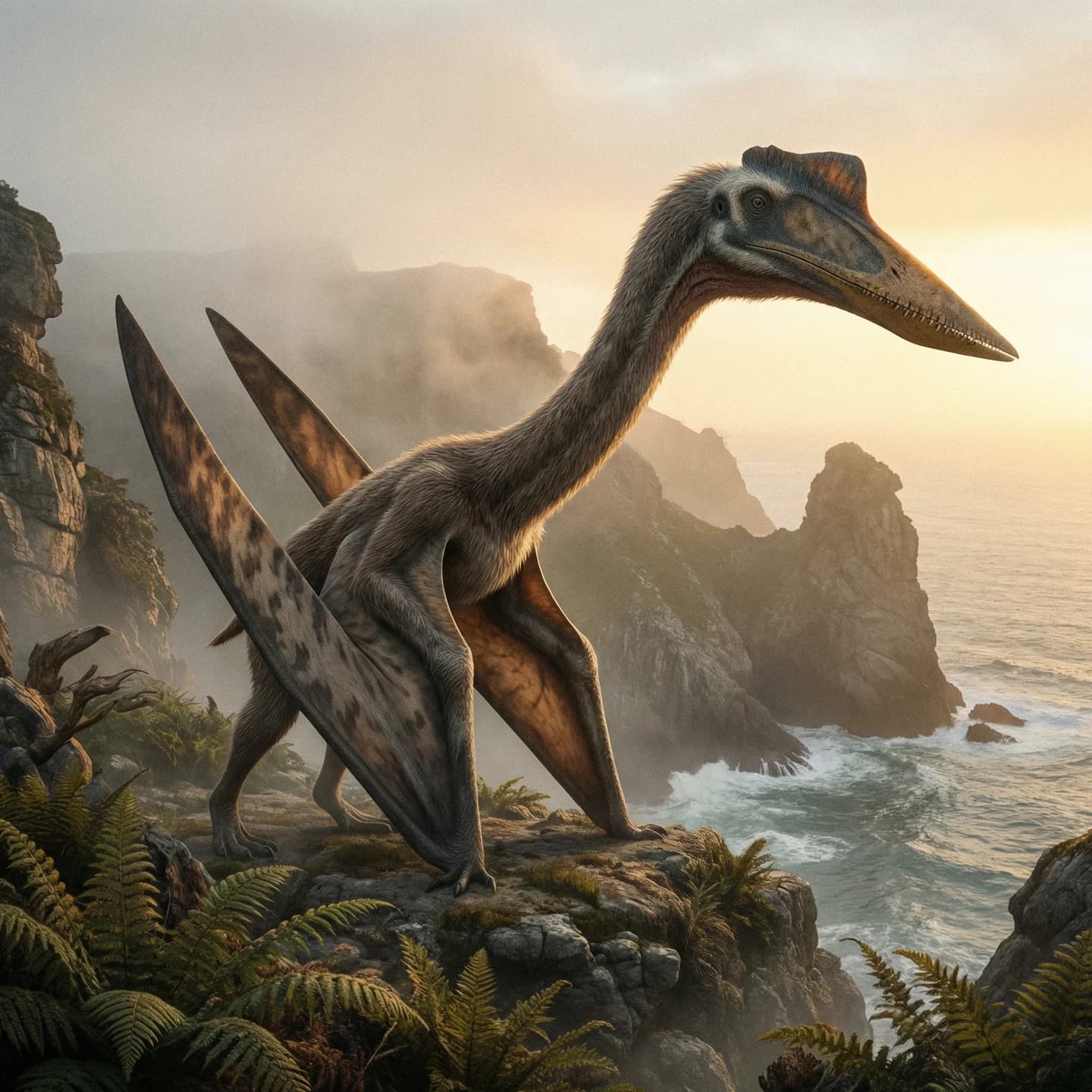
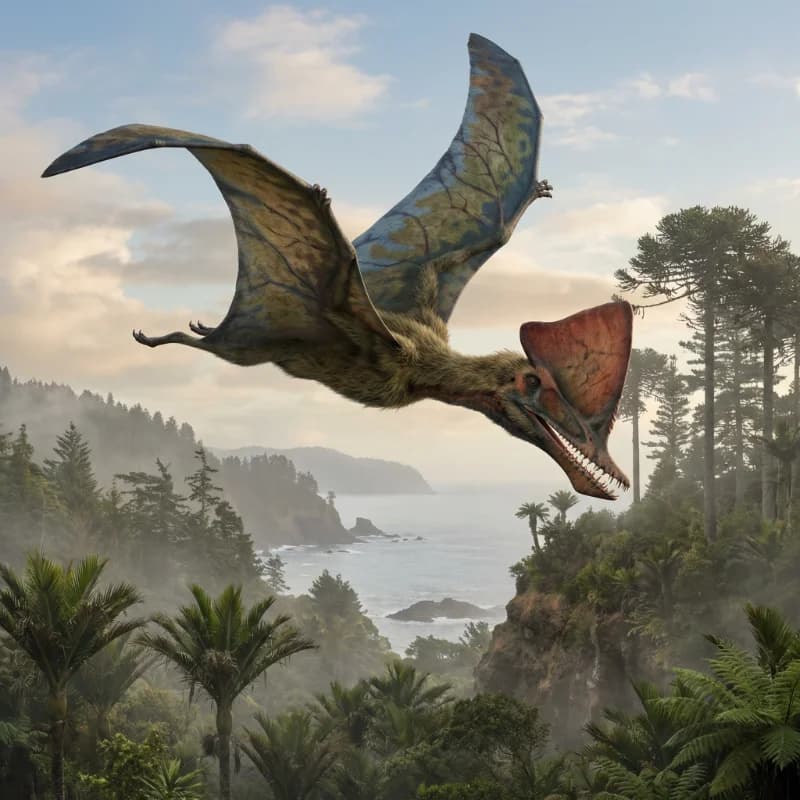
Quetzalcoatlus northropi Lawson, 1975 is a giant azhdarchid pterosaur from the Maastrichtian stage of the Late Cretaceous (approximately 68–66 Ma) of North America. It is among the largest known flying animals of all time, with recent wingspan estimates converging on approximately 10–11 m and a body mass of roughly 200–250 kg. Standing quadrupedally on the ground, it had a shoulder height of about 2–2.5 m and could raise its head to more than 4 m — rivalling the height of a modern giraffe. The genus name Quetzalcoatlus derives from the Aztec feathered serpent sky deity Quetzalcōātl, while the specific epithet northropi honors John K. Northrop, founder of Northrop Corporation and pioneer of tailless flying-wing aircraft whose designs the pterosaur's broad wings were thought to resemble.
The holotype (TMM 41450-3) was discovered in 1971 by Douglas A. Lawson, then a graduate student at the University of Texas at Austin, in the uppermost beds of the Javelina Formation in Big Bend National Park, Texas. Lawson announced the find in Science in March 1975, describing it as "without doubt the largest flying animal presently known." Approximately 50 km from the Q. northropi locality, numerous smaller specimens were found between 1972 and 1974 from an area known as Pterodactyl Ridge. In 2021, these specimens were formally named Quetzalcoatlus lawsoni by Brian Andres and (posthumously) Wann Langston Jr., as part of a landmark five-paper monograph — Memoir 19 of the Journal of Vertebrate Paleontology — that comprehensively described the genus's morphology, taxonomy, phylogeny, functional morphology, and paleoenvironment.
Under the predominant "terrestrial stalking" hypothesis (Witton & Naish, 2008), Quetzalcoatlus would have hunted on the ground in a manner similar to extant Marabou storks and ground hornbills, seizing small vertebrates and invertebrates with its long, toothless beak. Despite its enormous size, biomechanical analyses suggest it was capable of flight, launching via a powerful quadrupedal leap (Habib, 2008; Witton & Habib, 2010) and then soaring on thermals with an aspect ratio comparable to storks and birds of prey. The Javelina Formation preserves a diverse Maastrichtian ecosystem including the sauropod Alamosaurus, ceratopsians such as Torosaurus, tyrannosaurids, crocodilians, turtles, and small mammals.
Overview
Name and Etymology
The genus name Quetzalcoatlus derives from the Nahuatl name Quetzalcōātl — the feathered serpent deity revered by the Aztecs and other Mesoamerican cultures. In Nahuatl, quetzalli means "precious feather" (or "beautiful plumed tail feather") and coatl means "serpent." The specific epithet northropi honors John Knudsen Northrop ("Jack" Northrop), founder of the Northrop Corporation, who drove the development of large tailless flying-wing aircraft designs — most notably the YB-49 — that Lawson felt the pterosaur's wing planform resembled (Lawson, 1975b). The second species, Q. lawsoni, was named in 2021 in honor of Douglas Lawson himself, who first discovered the genus (Andres & Langston, 2021).
Taxonomic Status
Quetzalcoatlus northropi is the type species of Quetzalcoatlus and belongs to the family Azhdarchidae within the suborder Pterodactyloidea and the clade Azhdarchoidea. When originally named in 1975, the species lacked a formal diagnosis as required by the International Code of Zoological Nomenclature (ICZN), leading some authors to consider it a nomen nudum. In 2017, an ICZN petition was filed to conserve the name, and on August 30, 2019, Opinion 2440 formally validated Quetzalcoatlus northropi Lawson, 1975 as the valid authority (ICZN, 2019). The 2021 monograph provided a comprehensive rediagnosis, confirming the genus as distinct from other giant azhdarchids such as Hatzegopteryx (Andres & Langston, 2021).
However, in 2025, a phylogenetic revision of Azhdarchoidea by Thomas & McDavid recovered Quetzalcoatlus as polyphyletic — that is, Q. lawsoni did not cluster as sister taxon to Q. northropi but instead grouped closer to other azhdarchids. If this result is upheld by further analyses, Q. lawsoni may need to be transferred to a separate genus (Thomas & McDavid, 2025).
One-Line Summary
One of the largest flying animals ever known — a Maastrichtian azhdarchid pterosaur with a wingspan of approximately 10–11 m and a giraffe-like standing height.
Stratigraphy, Age, and Depositional Environment
Temporal Range
Quetzalcoatlus dates to the Maastrichtian stage of the Late Cretaceous, approximately 68–66 Ma. The holotype of Q. northropi (TMM 41450-3) comes from the uppermost beds of the Javelina Formation, making it among the youngest pterosaur specimens known worldwide (Andres & Langston, 2021). The Javelina Formation itself spans roughly 70–66.5 Ma based on magnetostratigraphy and biostratigraphy (Lehman, 2021).
Formation and Lithology
The type locality lies in Big Bend National Park, Brewster County, Texas, within the Javelina Formation of the Tornillo Group. The formation is approximately 120–200 m thick and consists of a fluvial depositional sequence dominated by alternating sandstones (stream channel facies) and mudstones/siltstones (floodplain facies) (Lehman, 2021). An additional specimen (TMM 44036-1, a left ulna) was recovered from the overlying Black Peaks Formation (Andres & Langston, 2021).
Paleoenvironment
According to Lehman's (2021) paleoenvironmental reconstruction, the Javelina Formation records a broad, southeast-draining coastal plain crossed by meandering stream channels and extensive floodplains. Notably, Q. northropi fossils within Big Bend occur exclusively in stream channel facies, whereas the smaller Q. lawsoni specimens were found in upper overbank deposits associated with alkaline lake environments (Brown et al., 2021; Lehman, 2021). This habitat partitioning suggests the two size classes (or species) occupied distinct ecological niches.
The Late Maastrichtian climate in this region was warm and humid, with subtropical to warm-temperate conditions and diverse vegetation including conifers, palms, and angiosperms. The paleolatitude of the Big Bend area was approximately 30–32°N (Lehman, 2021).
Specimens and Diagnostic Features
Holotype
The holotype of Q. northropi, TMM 41450-3, is housed at the Texas Memorial Museum (now the Texas Science and Natural History Museum), University of Texas at Austin. It consists of an incomplete left wing including a humerus, radius, ulna, wrist bones (syncarpals), phalanges, and elements of the elongate wing finger, along with thousands of unidentifiable fragments (Andres & Langston, 2021).
Key Specimens
| Specimen | Elements | Assignment | Formation |
|---|---|---|---|
| TMM 41450-3 | Partial left wing (holotype) | Q. northropi | Javelina Fm., uppermost beds |
| TMM 44036-1 | Left ulna | Q. northropi | Black Peaks Fm. |
| TMM 41047-1 | Partial femur | Q. cf. northropi | Javelina Fm. |
| TMM 41398-3 | Partial femur | Q. cf. northropi | Javelina Fm. |
| TMM 41961-1 | Skull, cervicals, both wings, femora, tibiotarsi, etc. (holotype) | Q. lawsoni | Javelina Fm. |
| TMM 42180-14 | Limb bones, cervicals (partial articulation) | Q. lawsoni | Javelina Fm. |
| TMM 42161-1 | Cervicals, skull (partial articulation) | Q. lawsoni | Javelina Fm. |
Q. lawsoni is known from 305 fossil elements across 214 specimens — the largest quantity of remains assigned to any single pterosaur species (Andres & Langston, 2021).
Diagnostic Features
The 2021 rediagnosis identified several features distinguishing Q. northropi from other azhdarchids: the humerus has a distinctive twisted hourglass shape, and the ulna-to-humerus length ratio is approximately 1.36, shorter than the ratio of about 1.52 seen in Q. lawsoni and other azhdarchiforms. The deltopectoral crest proportions also differ between the two species (Andres & Langston, 2021).
Limitations of the Material
The holotype of Q. northropi is restricted to wing elements, with no skull, cervical vertebrae, or postcranial trunk material preserved. All cranial and much skeletal anatomy attributed to the genus is actually derived from Q. lawsoni specimens. Given the 2025 finding that the two species may not be congeneric, the applicability of Q. lawsoni anatomy to Q. northropi reconstructions is now uncertain (Thomas & McDavid, 2025).
Morphology and Functional Anatomy
Body Size
Early wingspan estimates for Q. northropi ranged dramatically from 5.2 to 25.8 m, but as azhdarchid proportions became better understood, recent estimates have converged on approximately 10–11 m (Witton et al., 2010; Andres & Langston, 2021; Padian et al., 2021). Body mass has been estimated at 200–250 kg by Paul (2002), approximately 150 kg by Padian et al. (2021), and as high as 544 kg by Henderson (2010) — though the latter figure is widely considered an overestimate that would preclude flight. The shoulder height was approximately 2–2.5 m, and the head could reach over 4 m when the neck was raised — comparable to the height of a modern giraffe (Witton, 2013).
The smaller species Q. lawsoni had a wingspan of about 4.5–5 m and an estimated body mass of 20–65 kg (Padian et al., 2021; Paul, 2022).
| Parameter | Q. northropi estimate | Q. lawsoni estimate | Sources |
|---|---|---|---|
| Wingspan | ca. 10–11 m | ca. 4.5–5 m | Andres & Langston (2021); Paul (2022) |
| Body mass | ca. 150–250 kg | ca. 20–65 kg | Paul (2002); Padian et al. (2021) |
| Shoulder height | ca. 2–2.5 m | Unknown | Witton (2013) |
| Head height (standing) | ca. 4+ m | Unknown | Witton & Naish (2008) |
Skull and Beak
No skull material is known for Q. northropi. Skull anatomy is reconstructed from eight Q. lawsoni specimens. The skull of Q. lawsoni was approximately 94–96 cm long based on mandible length (Andres & Langston, 2021; Kellner & Langston, 1996). Like other azhdarchids, it bore a long, slender, toothless beak and a sagittal crest formed by the premaxilla. Two morphotypes have been identified — one with a square crest and tall nasoantorbital fenestra, and one with a semicircular crest and shorter fenestra — possibly representing sexual dimorphism, ontogenetic variation, or individual variation (Andres & Langston, 2021).
Neck and Skeleton
The neck of Q. lawsoni (measured from the third to seventh cervical vertebra) was approximately 149.5 cm long, composed of nine elongate, dorsoventrally compressed vertebrae. Internal trabeculae increased the buckling resistance of the cervicals by about 90%, possibly an adaptation for resisting shear forces during flight or enabling intraspecific combat behaviors analogous to neck-sparring in giraffes (Andres & Langston, 2021; Padian et al., 2021). All bones were extremely thin-walled and hollow — the sternum had bone walls as thin as 1.5 mm (Padian et al., 2021).
Limbs and Locomotion
The forelimb-to-hindlimb proportions of azhdarchids resemble those of modern running ungulates more than those of any other pterosaur clade, indicating a uniquely terrestrial lifestyle (Witton & Naish, 2008). The humerus of Q. northropi was short and robust, with a distinctive twisted hourglass shape. The wing finger was enormously elongated but folded against the body between the elbow and torso when on the ground. The feet were plantigrade (flat-footed), no wider than about 30% of the tibial length, and likely bore fleshy pads (Witton, 2013).
Flight Mechanics
The wing aspect ratio of azhdarchids is approximately 8.1, similar to that of storks and raptors that rely on static soaring — using thermals, updrafts, and other air currents to gain altitude (Witton & Naish, 2008). Habib (2008) and Witton & Habib (2010) proposed that giant pterosaurs launched via a powerful quadrupedal leap, using the forelimb musculature to propel the body off the ground before spreading the wings. Computer simulations have suggested that Q. northropi could soar at approximately 130 km/h and potentially remain aloft for up to 10 days.
Diet and Ecology
Terrestrial Stalking Hypothesis
Early dietary hypotheses for Quetzalcoatlus included scavenging (Lawson, 1975) and skim-feeding (Kellner & Langston, 1996). However, Witton & Naish (2008) proposed the now-dominant "terrestrial stalking" hypothesis based on a comprehensive analysis of azhdarchid limb proportions, depositional environments (predominantly inland fluvial settings rather than marine), beak morphology, and cervical range of motion. Under this model, Quetzalcoatlus would have walked across floodplains and channel margins picking up small vertebrates (lizards, mammals, juvenile dinosaurs) and invertebrates — much like modern Marabou storks or ground hornbills. Witton & Naish (2015) reinforced this hypothesis with additional evidence demonstrating the physical implausibility of skim-feeding at large body sizes. Padian et al. (2021) corroborated these findings through functional morphological analysis, showing the neck and head motion range was well-suited to downward-striking prey capture on the ground but poorly suited to skim-feeding.
Ecology of Q. lawsoni
The smaller Q. lawsoni was associated with alkaline lake deposits on upper floodplains and may have fed on small aquatic invertebrates (Lehman, 2021). Multiple individuals were found in close association, indicating gregarious (social) behavior — in contrast to Q. northropi, which is known from isolated or sparse specimens, suggesting a more solitary lifestyle (Brown et al., 2021).
Ecological Niche
Quetzalcoatlus was not an apex predator but occupied a unique niche as a giant aerial terrestrial stalker. Its flight capability would have allowed it to cover vast distances between foraging areas, while its terrestrial adaptations enabled effective ground-based hunting across the coastal plains of Maastrichtian western North America.
Distribution and Paleogeography
Geographic Distribution
Confirmed Quetzalcoatlus material is restricted to the Javelina Formation and Black Peaks Formation of Big Bend National Park, Texas. Specimens formerly referred to Quetzalcoatlus from other North American formations have since been reclassified: material from the Dinosaur Park Formation of Alberta became Cryodrakon (Hone et al., 2019); a neck vertebra from the Hell Creek Formation of Montana was named Infernodrakon (Thomas et al., 2025); and a humerus from the Two Medicine Formation was reassigned to an indeterminate azhdarchid or Montanazhdarcho. A Moroccan specimen (FSAC-OB 14) from the Ouled Abdoun Basin bears strong anatomical similarity to Quetzalcoatlus but has not been formally assigned to the genus (aff. Quetzalcoatlus; Pereda-Suberbiola et al., 2018).
Paleogeographic Interpretation
During the late Maastrichtian, the Big Bend region lay at approximately 30–32°N paleolatitude, on a broad coastal plain exposed by the retreating Western Interior Seaway. The climate was warm and humid, with subtropical conditions supporting diverse forests and well-watered floodplains.
Phylogeny and Taxonomic Debates
Position Within Azhdarchidae
Lawson (1975) did not assign Quetzalcoatlus to any clade more specific than Pterodactyloidea. In 1984, Nessov erected the subfamily Azhdarchinae, and independently that same year, Padian erected the family Titanopterygiidae. In 1986, Nessov consolidated these into the family Azhdarchidae. Andres's (2021) phylogenetic analysis recovered Q. northropi and Q. lawsoni as sister taxa within the clade Serpennata inside Azhdarchidae.
Polyphyly Controversy
Thomas & McDavid (2025), in a comprehensive revision of Azhdarchoidea, recovered Quetzalcoatlus as polyphyletic, with Q. lawsoni grouping with other azhdarchids rather than with Q. northropi. Their study also described Infernodrakon hastacollis from the Hell Creek Formation, adding to the recognized diversity of Maastrichtian North American azhdarchids. If upheld, this result would necessitate transferring Q. lawsoni to a new genus.
Alternative Hypotheses
Witton et al. (2010) noted that the holotype of Q. northropi preserves only wing elements — bones not typically considered taxonomically informative at the species level among close relatives — and flagged potential difficulty in distinguishing it from other giant azhdarchids such as Hatzegopteryx. The 2021 rediagnosis addressed this concern by identifying diagnostic features of the humerus and ulna, but the incompleteness of the material leaves some taxonomic uncertainty.
Reconstruction and Uncertainty
Well-Established Facts
It is firmly established that Q. northropi is a giant azhdarchid pterosaur from the Maastrichtian Javelina Formation of Texas, and that it represents one of the largest flying animals ever known, with a wingspan of approximately 10–11 m. The beak was long and toothless, and the animal was quadrupedal on the ground.
Prevailing Hypotheses
A body mass of approximately 200–250 kg, a terrestrial-stalking feeding ecology, and quadrupedal launch represent the currently most supported interpretations.
Uncertain or Debated Aspects
Exact body mass remains contentious, with published estimates ranging from 150 to 544 kg. The precise skull morphology of Q. northropi is unknown — all cranial reconstructions rely on Q. lawsoni material, whose congeneric status is now in question. Whether Q. northropi occurred outside of Big Bend is uncertain, as formerly referred specimens from other formations have been reclassified.
Media vs. Science
Popular depictions of "Quetzalcoatlus" typically conflate features of Q. northropi and Q. lawsoni (Witton, 2016). The familiar crested, long-skulled reconstruction is based entirely on Q. lawsoni, as no skull material is known for Q. northropi. Outdated wingspan estimates of 15 m or more still circulate in popular media but are not supported by current research.
Comparison With Related and Contemporary Taxa
| Taxon | Age | Locality | Estimated wingspan | Notes |
|---|---|---|---|---|
| Quetzalcoatlus northropi | Maastrichtian, 68–66 Ma | Texas, USA | ca. 10–11 m | Type species; incomplete wing only |
| Quetzalcoatlus lawsoni | Maastrichtian, 68–66 Ma | Texas, USA | ca. 4.5–5 m | Abundant material; possibly not congeneric (2025) |
| Hatzegopteryx thambema | Maastrichtian | Romania | ca. 10–12 m | Short-necked azhdarchid with robust skull |
| Arambourgiania philadelphiae | Maastrichtian | Jordan | ca. 7–12 m (uncertain) | Fragmentary; early-discovered giant azhdarchid |
| Cryodrakon boreas | Campanian | Alberta, Canada | ca. 10 m (uncertain) | Formerly referred to Quetzalcoatlus; new genus 2019 |
| Infernodrakon hastacollis | Maastrichtian | Montana, USA | Unknown | Known from single cervical; new genus 2025 |
Q. northropi and Hatzegopteryx compete for the title of largest flying animal, but they represent fundamentally different azhdarchid body plans: Q. northropi was a long-necked, slender-beaked form, whereas Hatzegopteryx was a short-necked form with a massive, robust skull — possibly an apex predator on the Hateg Island ecosystem.
Contemporary Fauna
The Javelina Formation preserves a diverse Maastrichtian vertebrate fauna. The dominant herbivore was the sauropod Alamosaurus sanjuanensis, with ceratopsians (Torosaurus, possibly Bravoceratops), hadrosaurids, and pachycephalosaurids also present. Large theropods included tyrannosaurids (whether these represent Tyrannosaurus rex or a distinct taxon remains debated). Channel facies yielded crocodilian remains including Deinosuchus, while floodplain deposits contained turtles, lizards, amphibians, and small mammals (Lehman, 2021).
Fun Facts
FAQ
📚References
- Lawson, D. A. (1975a). Pterosaur from the latest Cretaceous of West Texas: discovery of the largest flying creature. Science, 187(4180), 947–948. https://doi.org/10.1126/science.187.4180.947
- Lawson, D. A. (1975b). Could pterosaurs fly? Science, 188(4189), 676–678. https://doi.org/10.1126/science.188.4189.676
- Andres, B. & Langston, W. Jr. (2021). Morphology and taxonomy of Quetzalcoatlus Lawson 1975 (Pterodactyloidea: Azhdarchoidea). Journal of Vertebrate Paleontology, 41(sup1), 46–202. https://doi.org/10.1080/02724634.2021.1907587
- Brown, M. J., Sagebiel, C., & Andres, B. (2021). The discovery, local distribution, and curation of the giant azhdarchid pterosaurs from Big Bend National Park. Journal of Vertebrate Paleontology, 41(sup1), 3–20. https://doi.org/10.1080/02724634.2020.1780599
- Lehman, T. M. (2021). Habitat of the giant pterosaur Quetzalcoatlus Lawson 1975 (Pterodactyloidea: Azhdarchoidea): a paleoenvironmental reconstruction of the Javelina Formation (Upper Cretaceous), Big Bend National Park, Texas. Journal of Vertebrate Paleontology, 41(sup1), 21–45. https://doi.org/10.1080/02724634.2019.1593184
- Andres, B. (2021). Phylogenetic systematics of Quetzalcoatlus Lawson 1975 (Pterodactyloidea: Azhdarchoidea). Journal of Vertebrate Paleontology, 41(sup1), 203–217. https://doi.org/10.1080/02724634.2020.1801703
- Padian, K., Cunningham, J., Conway, J., & Langston, W. Jr. (2021). Functional morphology of Quetzalcoatlus Lawson 1975 (Pterodactyloidea: Azhdarchoidea). Journal of Vertebrate Paleontology, 41(sup1), 218–251. https://doi.org/10.1080/02724634.2020.1780247
- Kellner, A. W. A. & Langston, W. Jr. (1996). Cranial remains of Quetzalcoatlus (Pterosauria, Azhdarchidae) from Late Cretaceous sediments of Big Bend National Park, Texas. Journal of Vertebrate Paleontology, 16(2), 222–231. https://doi.org/10.1080/02724634.1996.10011310
- Witton, M. P. & Naish, D. (2008). A reappraisal of azhdarchid pterosaur functional morphology and paleoecology. PLoS ONE, 3(5), e2271. https://doi.org/10.1371/journal.pone.0002271
- Witton, M. P. & Habib, M. B. (2010). On the size and flight diversity of giant pterosaurs, the use of birds as pterosaur analogues and comments on pterosaur flightlessness. PLoS ONE, 5(11), e13982. https://doi.org/10.1371/journal.pone.0013982
- Witton, M. P. & Naish, D. (2015). Azhdarchid pterosaurs: water-trawling pelican mimics or \"terrestrial stalkers\"? Acta Palaeontologica Polonica, 60(3), 651–660. https://doi.org/10.4202/app.00005.2013
- Paul, G. S. (2002). Dinosaurs of the Air: The Evolution and Loss of Flight in Dinosaurs and Birds. Johns Hopkins University Press, Baltimore. 472 pp.
- Paul, G. S. (2022). The Princeton Field Guide to Pterosaurs. Princeton University Press, Princeton. 184 pp.
- Henderson, D. M. (2010). Pterosaur body mass estimates from three-dimensional mathematical slicing. Journal of Vertebrate Paleontology, 30(3), 768–785. https://doi.org/10.1080/02724631003758334
- Thomas, H. N. & McDavid, S. N. (2025). Enter the dragons: the phylogeny of Azhdarchoidea (Pterosauria: Pterodactyloidea) and the evolution of giant size in pterosaurs.
- Thomas, H. N. & Hone, D. W. E. (2025). Infernodrakon hastacollis gen. et sp. nov., a new azhdarchid pterosaur from the Hell Creek Formation of Montana and the pterosaur diversity of Maastrichtian North America. Journal of Vertebrate Paleontology. https://doi.org/10.1080/02724634.2024.2442476
- International Commission on Zoological Nomenclature (2019). Opinion 2440 (Case 3728) — Quetzalcoatlus northropi Lawson, 1975 (Reptilia, Pterosauria): generic and specific names conserved. Bulletin of Zoological Nomenclature, 76, 112–113. https://doi.org/10.21805/bzn.v76.a047
- Hone, D. W. E., Habib, M. B., & Therrien, F. (2019). Cryodrakon boreas, gen. et sp. nov., a Late Cretaceous Canadian azhdarchid pterosaur. Journal of Vertebrate Paleontology, 39(3), e1649681. https://doi.org/10.1080/02724634.2019.1649681
- Witton, M. P. (2013). Pterosaurs: Natural History, Evolution, Anatomy. Princeton University Press, Princeton. 291 pp.
Gallery
5 images Quetzalcoatlus
Quetzalcoatlus · Cretaceous Period · Carnivore
 Quetzalcoatlus
Quetzalcoatlus · Cretaceous Period · Carnivore
 Quetzalcoatlus
Quetzalcoatlus · Cretaceous Period · Carnivore
 Quetzalcoatlus
Quetzalcoatlus · Cretaceous Period · Carnivore
 Quetzalcoatlus
Quetzalcoatlus · Cretaceous Period · Carnivore
🔗Related Creatures
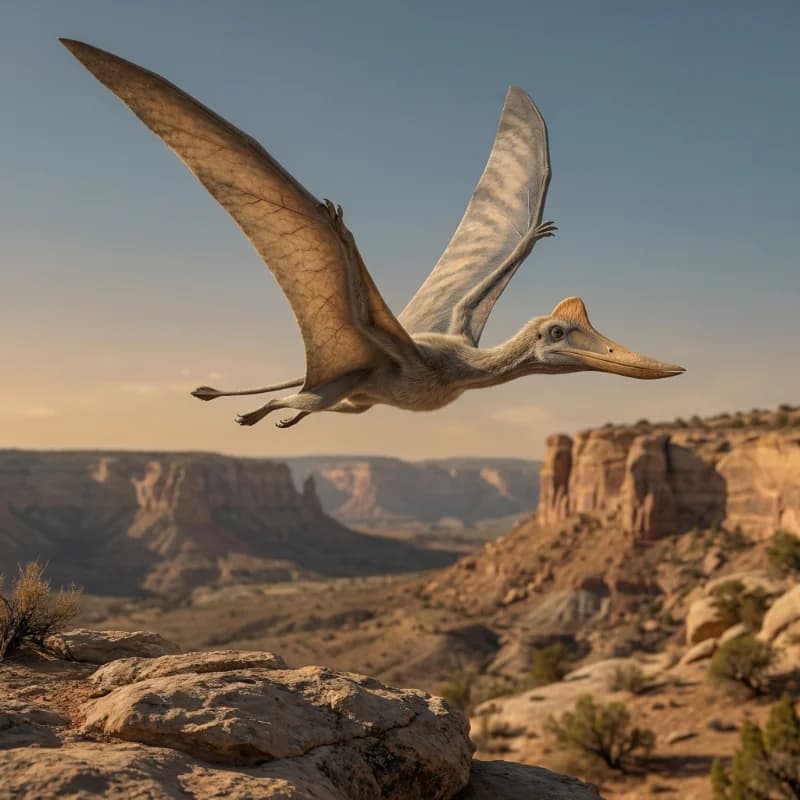
Dsungaripterus
Dsungaripterus weii
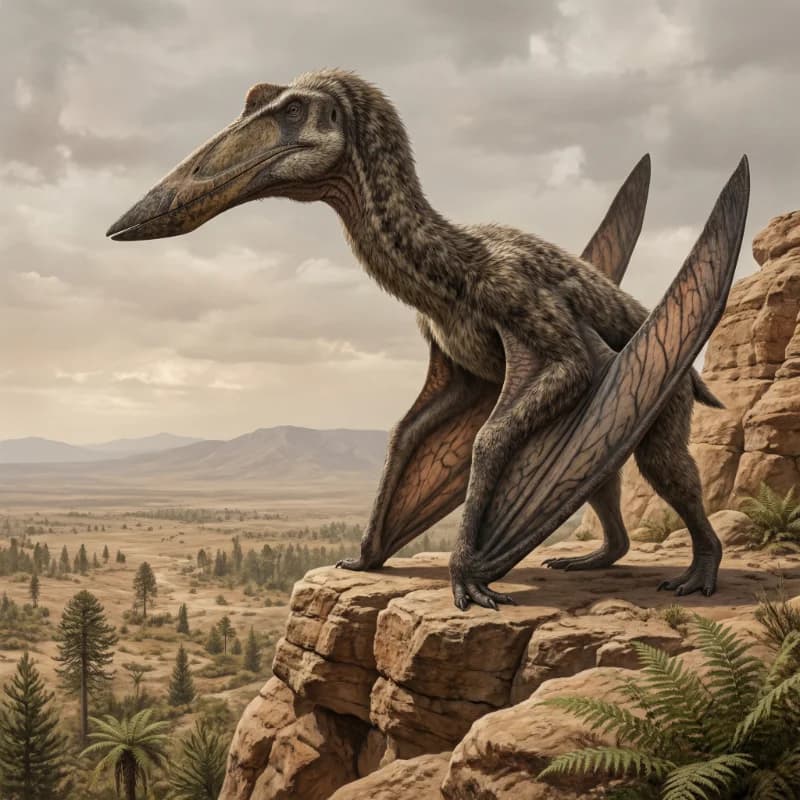
Hatzegopteryx
Hatzegopteryx thambema
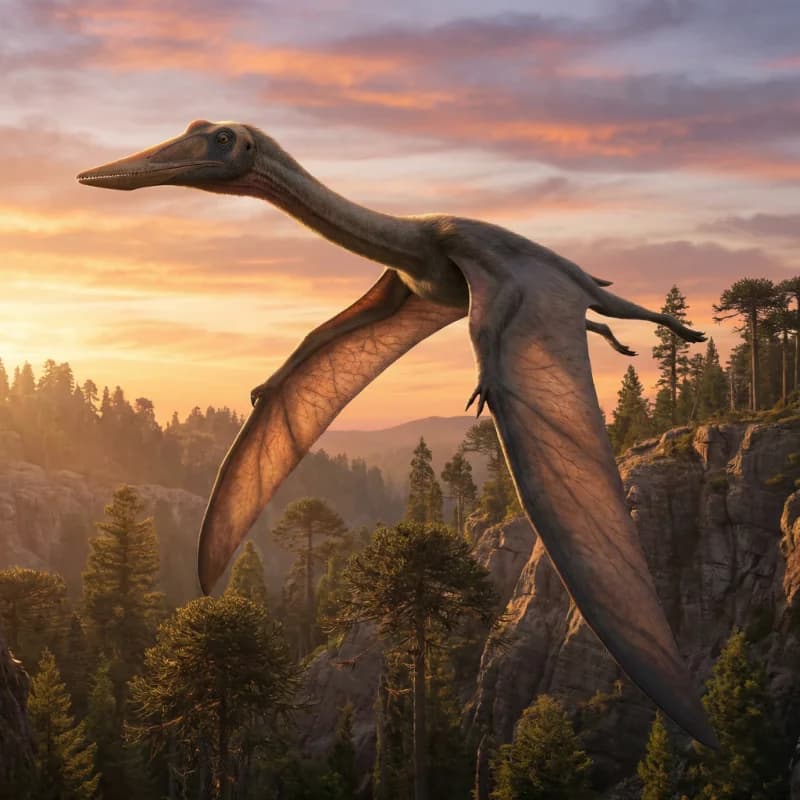
Arambourgiania
Arambourgiania philadelphiae
Istiodactylus
Istiodactylus latidens
Tapejara
Tapejara wellnhoferi
Caelestiventus
Caelestiventus hanseni
Guidraco
Guidraco venator
Tropeognathus
Tropeognathus mesembrinus