Torosaurus
Cretaceous Period Herbivore Creature Type
Torosaurus latus
Scientific Name: "Greek toreo (to perforate, to pierce) + sauros (lizard) = 'perforated lizard,' referring to the large parietal fenestrae in its frill. The specific name latus is Latin for 'wide,' referring to the breadth of the frill."
Local Name: Torosaurus
Physical Characteristics
Discovery
Habitat

Torosaurus (Torosaurus latus Marsh, 1891) is a large chasmosaurine ceratopsid dinosaur (Ceratopsidae, Chasmosaurinae) from the latest Maastrichtian stage of the Late Cretaceous (approximately 68–66 Ma), known from across the Western Interior of North America. The generic name derives from the Greek verb toreo (to perforate) and sauros (lizard), referring to the large parietal fenestrae — window-like openings — that pierce the frill. The specific epithet latus is Latin for "wide," alluding to the breadth of the frill. Despite frequent mistranslation as "bull lizard" (from Latin taurus or Spanish toro), Marsh himself clarified in 1896 that the name refers to the perforations in the parietal bone (Marsh, 1896). Two species are currently recognized: the type species T. latus and the provisionally referred T. ? utahensis.
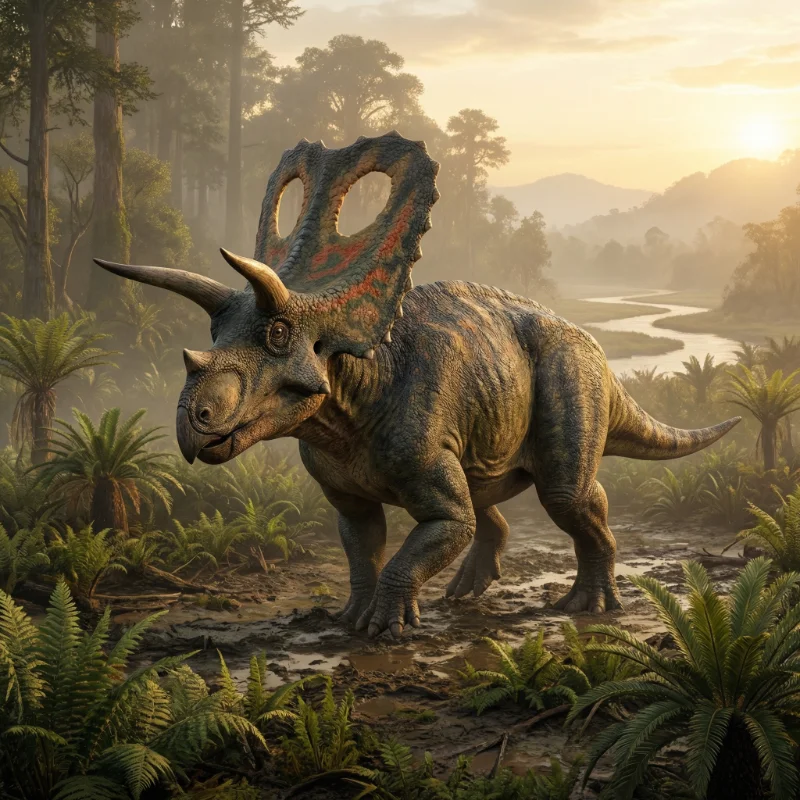
The most striking feature of Torosaurus is its enormous skull — the longest of any known terrestrial animal. Including the frill, the skull reaches up to approximately 2.77–3 m in length (Farke, 2006; the "Adam" specimen at the Museum of Evolution, Denmark). The frill is pierced by circular to transversely oval parietal fenestrae and is bordered posteriorly by 10–12 triangular epiparietals, with no midline epiparietal. The total body length is estimated at 7.5–9 m, with body mass in the range of 6–11 metric tons, comparable to the largest specimens of the contemporary Triceratops (Paul, 2010; Stein, 2019). The brow horns are highly variable among individuals — ranging from large and anteriorly curved (MOR 981) to short and straight (MOR 1122) — while the nasal horn is typically reduced to a low bump (Farke, 2006).
Torosaurus sits at the center of one of the most heated taxonomic debates in ceratopsian paleontology. In 2010, Scannella & Horner proposed that Torosaurus represents the fully mature growth stage ("toromorph") of Triceratops, making it a junior synonym. However, subsequent studies by Longrich & Field (2012), Maiorino et al. (2013), and Mallon et al. (2022) have challenged this hypothesis, citing the existence of genuine subadult Torosaurus specimens, independent geometric morphometric differences in skull proportions, and the incompatibility of parietal fenestra formation with normal ceratopsian ontogenetic sequences. The current consensus among researchers favors the interpretation that Torosaurus is a valid, distinct genus separate from Triceratops.
Fossil occurrence patterns also reveal intriguing ecological insights. According to Lyson & Longrich (2011), ceratopsians (including Torosaurus and Triceratops) are preferentially recovered from mudstone — i.e., floodplain deposits — in the Hell Creek Formation, whereas hadrosaurids are predominantly found in sandstone — i.e., channel-margin environments. This pattern suggests that ceratopsians favored floodplain habitats while hadrosaurids preferred riparian settings near river channels, providing important evidence for spatial niche partitioning among the large herbivorous dinosaurs of the latest Cretaceous.
Overview
Name and Etymology
The generic name Torosaurus is a compound of the Greek toreo (τορέω, to perforate, to pierce) and sauros (σαῦρος, lizard), directly referencing the large parietal fenestrae in the frill. In 1896, Marsh wrote: "The open perforations in the parietal, which have suggested the name Torosaurus, readily separate this genus from all the gigantic species hitherto known in the Ceratopsidae" (Marsh, 1896, p. 216). The specific name latus is Latin for "wide," referring to the breadth of the frill. A second species named simultaneously, T. gladius (Latin for "sword," alluding to the elongated squamosal), is now considered a junior synonym of T. latus.
Taxonomic Status
Torosaurus is classified within Ornithischia, Ceratopsia, Ceratopsidae, Chasmosaurinae, and the tribe Triceratopsini. Phylogenetic analyses consistently recover it as the closest sister taxon of Triceratops (Sampson et al., 2010; Brown & Henderson, 2015). Together with Eotriceratops, Ojoceratops, and Nedoceratops, it forms the Triceratopsini clade. The phylogenetic position of T. ? utahensis is less stable: some analyses recover it as monophyletic with T. latus (Sampson et al., 2010), while others place it closer to Triceratops (Longrich, 2014).
Summary
Torosaurus was a giant chasmosaurine ceratopsid of the latest Maastrichtian of North America, distinguished by its enormously elongated frill pierced by large parietal fenestrae — yielding the longest skull of any known land animal.
Stratigraphy and Depositional Setting
Temporal Range
The temporal range of Torosaurus spans the late Maastrichtian, approximately 68–66 Ma, with the most conservative estimates extending back to 69 Ma (Hicks et al., 2003). This places Torosaurus within the final 2–3 million years before the end-Cretaceous mass extinction (K-Pg event). The holotype and most referred specimens derive from the uppermost Maastrichtian of the Lance and Hell Creek Formations, while T. ? utahensis comes from the North Horn Formation of Utah.
Formations and Lithology
The principal formations yielding Torosaurus specimens are as follows:
| Formation | Region | Dominant Lithology | Key Specimens |
|---|---|---|---|
| Lance Formation | Wyoming | Sandstone–mudstone interbeds | Holotype YPM 1830, YPM 1831 |
| Hell Creek Formation | Montana, South Dakota, North Dakota | Mudstone, siltstone, sandstone; fluvial | MOR 981, MOR 1122, ANSP 15192, MPM VP6841, ESU 2009-6 |
| Frenchman Formation | Saskatchewan, Canada | Mudstone–sandstone | EM P16.1 (subadult) |
| Scollard Formation | Alberta, Canada | Mudstone–sandstone | UALVP 1646 |
| North Horn Formation | Utah | Sandstone–mudstone | T. ? utahensis holotype USNM 15583 |
| Javelina Formation | Texas | Mudstone–sandstone | T. cf. utahensis (Hunt & Lehman, 2008) |
The Hell Creek Formation as a whole consists of interbedded mudstones, siltstones, and sandstones deposited within meandering river systems, preserving channel, point bar, floodplain, and swamp environments (Fastovsky, 1987; Murphy et al., 2002).
Paleoenvironment
Lyson & Longrich (2011) conducted a lithology–occurrence analysis of 343 associated dinosaur specimens from the Hell Creek Formation and equivalent beds. Their results demonstrate that ceratopsians (including Torosaurus and Triceratops) preferentially occur in mudstone (floodplain deposits) by approximately a 2:1 ratio, whereas hadrosaurids are overwhelmingly associated with sandstone (channel/riparian deposits) at a 15:1 ratio. Tyrannosaurus rex shows no preference for either lithology. This strongly suggests that ceratopsians inhabited floodplain interiors away from river channels. The late Maastrichtian climate in the Hell Creek region was significantly warmer and more humid than today, with subtropical to warm-temperate conditions supporting abundant angiosperm-dominated woodlands and open plains (Johnson, 2002).
Specimens and Diagnostic Characters
Holotype and Key Specimens
The holotype is YPM 1830, a partial skull discovered by John Bell Hatcher in Niobrara County, southeastern Wyoming, from the Lance Formation. Marsh named it in 1891. A simultaneously discovered, larger skull, YPM 1831, was named T. gladius but is now synonymized with T. latus.
A summary of key specimens is presented below:
| Specimen | Repository | Formation | Preserved Elements | Notes |
|---|---|---|---|---|
| YPM 1830 (holotype) | Yale Peabody Museum | Lance Fm. | Partial skull | Skull estimated at 2.2–2.4 m |
| YPM 1831 | Yale Peabody Museum | Lance Fm. | Larger skull | T. gladius holotype; possibly subadult (Longrich, 2012) |
| ANSP 15192 | Academy of Natural Sciences | Hell Creek Fm. | Smaller individual | Described by Colbert & Bump (1947) |
| MOR 981 | Museum of the Rockies | Hell Creek Fm. | Skull (snout missing) | Skull length 2.77 m (Farke, 2006) |
| MOR 1122 | Museum of the Rockies | Hell Creek Fm. | Skull (snout missing) | Skull length 2.52 m |
| MPM VP6841 | Milwaukee Public Museum | Hell Creek Fm. | Partial skeleton with skull | Mounted display |
| SMM P97.6.1 | Science Museum of Minnesota | Hell Creek Fm. | Skull (snout missing) | — |
| ESU 2009-6 | Emporia State University | Hell Creek Fm. | Incomplete parietal | McDonald et al. (2016) |
| EM P16.1 | Eastend Historical Museum | Frenchman Fm. | Frill fragment | Subadult; Mallon et al. (2022) |
| UALVP 1646 | University of Alberta | Scollard Fm. | Frill fragment | Mallon et al. (2022) |
| "Adam" | Museum of Evolution, Denmark | Unknown (USA) | Near-complete skull + skeleton | Skull approx. 3 m; largest known (displayed 2023) |
Torosaurus specimens are overall extremely rare. The Stein (2019) census of Hell Creek and Lance Formation dinosaurs confirms this pronounced scarcity relative to Triceratops.
Diagnostic Characters
Farke (2006) established the following diagnostic traits for Torosaurus: the frill is extremely elongated relative to the rest of the skull; the posterior margin of the frill bears ten or more triangular epiparietals, with no midline epiparietal; the parietal is thin and pierced by parietal fenestrae that are circular to transversely oval; the parietal is approximately 20% wider than long. The autapomorphy distinguishing T. latus from both T. horridus and T. ? utahensis is a conspicuous ridge on the squamosal at the parietal contact, accompanied by a deep longitudinal trough parallel to it.
Specimen Limitations
The known sample of Torosaurus comprises only about a dozen specimens. Most are limited to skulls or frill fragments; substantial postcranial material is known only from MPM VP6841 and the "Adam" specimen. This scarcity and incompleteness introduce uncertainty into size and mass estimates, ontogenetic assessments, and interpretations of the relationship with Triceratops.
Morphology and Functional Anatomy
Body Size
Total body length is estimated at approximately 7.5–9 m, comparable to the largest Triceratops specimens (Paul, 2010; Stein, 2019). Body mass estimates vary: Stein (2019) provides a range of 6–11 metric tons, while Paul (2010) estimated roughly 6–8 t in The Princeton Field Guide to Dinosaurs. Shoulder height was approximately 2–2.5 m. The overall body plan was that of a robust quadrupedal animal with a broad torso and stout limbs.
The Skull and Frill
The most distinctive feature of Torosaurus is the enormous frill. Hatcher (1907) estimated the skull of YPM 1830 at approximately 2.2 m and that of YPM 1831 at approximately 2.35 m. Lull (1933) revised these upward to 2.4 m and 2.57 m, respectively. Subsequently discovered specimens exceeded these estimates: MOR 981 measures 2.77 m (Farke, 2006), and the "Adam" specimen on display at the Museum of Evolution in Denmark since 2023 reaches approximately 3 m — the longest skull of any known land animal.
The frill bears bilaterally symmetrical, circular to transversely oval parietal fenestrae, and the parietal bone itself is very thin. The posterior frill margin bears 10–12 triangular epiparietals, with no midline element. The squamosal is highly elongated, with a deep longitudinal trough on the dorsal surface. By contrast, the frill of Triceratops is solid (lacking fenestrae), the squamosal is relatively short, and there are approximately five epiparietals including a midline element.
Horns
Farke (2006) documented considerable individual variation in horn morphology. The brow horns (supraorbital horncores) range from large and anteriorly curved (MOR 981) to short and straight (MOR 1122, ANSP 15192). Their position also varies: they are typically located directly above the orbit, but in YPM 1831 they originate at the posterior orbital margin. The nasal horn is generally reduced to a low bump in most specimens (MOR 981, ANSP 15192, MOR 1122), though YPM 1830 and YPM 1831 bear a more prominent, upright nasal horn. This variability may reflect individual variation, ontogenetic stage, or sexual dimorphism.
Limbs and Locomotion
The limb structure of Torosaurus is generally comparable to that of Triceratops. The forelimbs were likely held in a slightly sprawled posture, while the hindlimbs were columnar and weight-bearing (Paul & Christiansen, 2000). Estimates of locomotor speed for large ceratopsids suggest that a gallop of approximately 25–32 km/h may have been possible (Paul, 2010), but such estimates are based on indirect inference and remain hypothetical.
Diet and Ecology
Diet
Torosaurus was a typical herbivorous ceratopsid, equipped with a parrot-like beak (formed by the rostral and predentary bones) and dental batteries optimized for processing tough plant material. Biomechanical analyses of ceratopsid jaw mechanics indicate that the beak was used to crop vegetation, which was then processed by the cheek teeth through a vertical slicing motion (Ostrom, 1964; Bell et al., 2009). Given the feeding height of approximately 1–2 m, Torosaurus likely fed primarily on low-browse vegetation — ferns, cycads, low-growing angiosperms, and shrubs (Mallon et al., 2013).
Stable isotope analysis by Fricke & Pearson (2008) demonstrated that ceratopsians and hadrosaurids in the Hell Creek Formation occupied distinct dietary niches. This differentiation reflects not only differences in dental morphology and jaw mechanics but also differences in preferred habitat (floodplain vs. riparian).
Ecological Role
Torosaurus belonged to the large herbivore guild of the terminal Maastrichtian Laramidian ecosystem. It coexisted with Triceratops (extremely abundant), the hadrosaurid Edmontosaurus, the ankylosaur Ankylosaurus, the small ceratopsian Leptoceratops, Pachycephalosaurus, and others. The apex predator was Tyrannosaurus rex. The frill and horns of Torosaurus have been hypothesized to have served roles in species recognition, intraspecific combat, thermoregulation, or predator defense, but the specific function remains at the hypothesis level.
Behavior
Direct evidence for social behavior in Torosaurus is limited. While Triceratops bonebeds have been reported, the extreme rarity of Torosaurus specimens makes it difficult to assess whether this taxon lived in herds. Hunt & Lehman (2008) reported juvenile and adult T. cf. utahensis material from a bonebed in the Javelina Formation of Texas, but the identification is provisional.
Distribution and Paleogeography
Geographic Distribution
Confirmed occurrences of T. latus span Wyoming, Montana, South Dakota, North Dakota, Colorado, Saskatchewan (Canada), and Alberta (Canada). Fragmentary remains tentatively attributed to Torosaurus have been reported from Texas and New Mexico (Farke, 2002; Lucas et al., 1998). T. ? utahensis is known from Utah and Texas (Javelina Formation). The overall distribution tracks the coastal lowlands along the eastern margin of the retreating Western Interior Seaway during the latest Maastrichtian, although finds become sparse at the northern extreme (north of Saskatchewan).
Paleogeographic Interpretation
Paleomagnetic coordinates (paleolat ~50.9°N, paleolng ~−67.1°W) indicate that during the Maastrichtian, the Hell Creek region occupied a position within a subtropical to warm-temperate climatic zone at a more southerly effective latitude than today. The retreat of the Western Interior Seaway created expansive coastal plains traversed by meandering rivers, with interspersed floodplains, wetlands, and forests that sustained the rich megafaunal community.
Phylogeny and Taxonomic Debate
The Toromorph Hypothesis (Synonymy with Triceratops)
In 2010, Scannella & Horner proposed, based on bone histology and growth analysis of 38 skulls (29 Triceratops, 9 Torosaurus) from the Hell Creek Formation, that Torosaurus represents the fully mature growth stage ("toromorph") of Triceratops. Under this hypothesis, the Triceratops frill would lengthen, thin, and develop parietal fenestrae as the individual aged. Supporting evidence included the observation that approximately 50% of subadult Triceratops frills possess thinned areas at positions corresponding to the Torosaurus fenestrae.
Counterarguments and Current Consensus
This hypothesis was challenged by multiple independent studies.
Farke (2011) redescribed Nedoceratops hatcheri and noted that its frill openings were surrounded by thick bony swellings rather than thinning bone, arguing that parietal fenestra formation in ceratopsians is typically present from early ontogeny and is not an age-related development.
Longrich & Field (2012) applied the principle of falsification, testing three predictions of the toromorph hypothesis: (1) Geographic overlap — largely confirmed but inconclusive. (2) All Torosaurus specimens should be adults; no Triceratops should be very old — falsified, as ANSP 15192 and YPM 1831 exhibit subadult external features, while ten Triceratops skulls showed fusion levels equal to the most mature Torosaurus. (3) Transitional forms should exist — rejected, as the Triceratops frill depressions differ in position (partly on squamosal) and surrounding bone thickness from the Torosaurus fenestrae (fully within the parietal, surrounded by thin bone). The hypothesis was rejected on two of the three predictions.
Maiorino et al. (2013) performed geometric morphometric analysis and demonstrated that Torosaurus and Triceratops skulls occupy distinct morphospaces even when corrected for ontogeny.
Mallon et al. (2022) reported subadult specimens from the Frenchman Formation (EM P16.1) and Scollard Formation (UALVP 1646) of Canada referable to the Torosaurus morph, providing additional evidence supporting Torosaurus as a valid taxon.
The current prevailing view in the paleontological community recognizes Torosaurus as a valid genus distinct from Triceratops, although the possibility of anagenesis — i.e., gradual morphological transformation within a single lineage over time — has not been entirely excluded (Maiorino et al., 2013; Scannella et al., 2014).
Recent Phylogenetic Analyses
Phylogenetic analyses by Sampson et al. (2010), Brown & Henderson (2015), and Fowler & Freedman Fowler (2020) consistently recover Torosaurus in a derived position within Chasmosaurinae, as the sister taxon of Triceratops. Together, these taxa form the tribe Triceratopsini alongside Eotriceratops, Ojoceratops, and related genera.
Reconstruction and Uncertainties
Established, Probable, and Hypothetical
Established: Torosaurus is a large chasmosaurine ceratopsid diagnosed by an elongated frill pierced by large parietal fenestrae, 10–12 epiparietals without a midline element, and a deep longitudinal squamosal trough. It inhabited latest Maastrichtian North America (approximately 68–66 Ma) and was herbivorous.
Probable: Torosaurus is a valid genus distinct from Triceratops (supported by the majority of recent studies). Body mass was approximately 6–11 metric tons. It preferentially inhabited floodplain environments.
Hypothetical: The specific functions of the frill and horns (sexual selection, species recognition, thermoregulation, defense) remain speculative. Evidence for social behavior (herding) is weak due to the rarity of specimens. The precise taxonomic placement of T. ? utahensis remains unresolved.
Popular Misconceptions
Torosaurus is often presented in popular media as "the adult form of Triceratops." This reflects the 2010 Scannella & Horner hypothesis, which is not supported by the current consensus. Additionally, the name is frequently mistranslated as "bull lizard," when the correct etymology is "perforated lizard."
Comparison with Related and Contemporary Taxa
| Character | Torosaurus latus | Triceratops horridus | Triceratops prorsus |
|---|---|---|---|
| Frill length | Very long (more than 50% of skull) | Relatively short | Relatively short |
| Parietal fenestrae | Present (large, circular–oval) | Absent (solid frill) | Absent (solid frill) |
| Epiparietals | 10–12, no midline element | Approx. 5, midline present | Approx. 5, midline present |
| Squamosal | Very long; dorsal trough present | Short; medially concave | Short; medially concave |
| Nasal horn | Generally a low bump | Short horn | Long horn |
| Brow horns | Highly variable (short–long) | Anteriorly curved | Anteriorly curved |
| Maximum skull length | Approx. 2.4–3 m | Approx. 2–2.5 m | Approx. 2–2.5 m |
| Body length (est.) | 7.5–9 m | 7.9–9 m | 7.9–9 m |
| Body mass (est.) | 6–11 t | 6–12 t | 6–12 t |
| Temporal range | 68–66 Ma | 68–66 Ma | 67–66 Ma |
Fun Facts
FAQ
📚References
- Marsh, O. C. (1891). Notice of new vertebrate fossils. American Journal of Science, series 3, 42: 265–269.
- Marsh, O. C. (1896). The dinosaurs of North America. Sixteenth Annual Report of the United States Geological Survey, Part 1.
- Hatcher, J. B., Marsh, O. C. & Lull, R. S. (1907). The Ceratopsia. Monographs of the United States Geological Survey, 49: 1–198.
- Lull, R. S. (1933). A revision of the Ceratopsia or horned dinosaurs. Memoirs of the Peabody Museum of Natural History, 3(3): 1–175.
- Farke, A. A. (2006). Cranial osteology and phylogenetic relationships of the chasmosaurine ceratopsid Torosaurus latus. In K. Carpenter (ed.), Horns and Beaks: Ceratopsian and Ornithopod Dinosaurs, pp. 235–257. Indiana University Press.
- Scannella, J. & Horner, J. R. (2010). Torosaurus Marsh, 1891, is Triceratops Marsh, 1889 (Ceratopsidae: Chasmosaurinae): synonymy through ontogeny. Journal of Vertebrate Paleontology, 30(4): 1157–1168. doi:10.1080/02724634.2010.483632
- Farke, A. A. (2011). Anatomy and taxonomic status of the chasmosaurine ceratopsid Nedoceratops hatcheri from the Upper Cretaceous Lance Formation of Wyoming, U.S.A. PLoS ONE, 6(1): e16196. doi:10.1371/journal.pone.0016196
- Longrich, N. R. & Field, D. J. (2012). Torosaurus is not Triceratops: ontogeny in chasmosaurine ceratopsids as a case study in dinosaur taxonomy. PLoS ONE, 7(2): e32623. doi:10.1371/journal.pone.0032623
- Maiorino, L., Farke, A. A., Kotsakis, T. & Piras, P. (2013). Is Torosaurus Triceratops? Geometric morphometric evidence of Late Maastrichtian ceratopsid dinosaurs. PLoS ONE, 8(11): e81608. doi:10.1371/journal.pone.0081608
- Sampson, S. D., Loewen, M. A., Farke, A. A., Roberts, E. M., Forster, C. A., Smith, J. A. & Titus, A. A. (2010). New horned dinosaurs from Utah provide evidence for intracontinental dinosaur endemism. PLoS ONE, 5(9): e12292. doi:10.1371/journal.pone.0012292
- Lyson, T. R. & Longrich, N. R. (2011). Spatial niche partitioning in dinosaurs from the latest Cretaceous (Maastrichtian) of North America. Proceedings of the Royal Society B, 278: 1158–1164. doi:10.1098/rspb.2010.1444
- Mallon, J. C., Holmes, R. B., Bamforth, E. L. & Schumann, D. (2022). The record of Torosaurus (Ornithischia: Ceratopsidae) in Canada and its taxonomic implications. Zoological Journal of the Linnean Society, 195(1): 157–171. doi:10.1093/zoolinnean/zlab120
- McDonald, A. T., Wolfe, D. G. & Freedman Fowler, E. A. (2016). A new specimen of the controversial chasmosaurine Torosaurus latus (Dinosauria: Ceratopsidae) from the Upper Cretaceous Hell Creek Formation of Montana. PLoS ONE, 11(3): e0151453. doi:10.1371/journal.pone.0151453
- Hunt, R. K. & Lehman, T. M. (2008). Attributes of the ceratopsian dinosaur Torosaurus, and new material from the Javelina Formation (Maastrichtian) of Texas. Journal of Paleontology, 82(6): 1127–1138.
- Sullivan, R. M., Boere, A. C. & Lucas, S. G. (2005). Redescription of the ceratopsid dinosaur Torosaurus utahensis (Gilmore, 1946) and a revision of the genus. Journal of Paleontology, 79: 564–582.
- Paul, G. S. (2010). The Princeton Field Guide to Dinosaurs. Princeton University Press, pp. 265–267.
- Stein, W. W. (2019). Taking count: a census of dinosaur fossils recovered from the Hell Creek and Lance Formations (Maastrichtian). The Journal of Paleontological Sciences, 8: 1–42.
- Colbert, E. H. & Bump, J. D. (1947). A skull of Torosaurus from South Dakota and a revision of the genus. Proceedings of the Academy of Natural Sciences of Philadelphia, 99: 93–106.
- Fricke, H. C. & Pearson, D. A. (2008). Stable isotope evidence for changes in dietary niche partitioning among hadrosaurian and ceratopsian dinosaurs of the Hell Creek Formation, North Dakota. Paleobiology, 34(4): 534–552.
- Fowler, D. W. & Freedman Fowler, E. A. (2020). Transitional evolutionary forms in chasmosaurine ceratopsid dinosaurs: evidence from the Campanian of New Mexico. PeerJ, 8: e9251. doi:10.7717/peerj.9251
- Brown, C. M. & Henderson, D. M. (2015). A new horned dinosaur reveals convergent evolution in cranial ornamentation in Ceratopsidae. Current Biology, 25: 1641–1648. doi:10.1016/j.cub.2015.04.041
- Mallon, J. C., Ott, C. J., Larson, P. L., Incentive, E. M. & Evans, D. C. (2013). Feeding height stratification among the herbivorous dinosaurs from the Dinosaur Park Formation (upper Campanian) of Alberta, Canada. BMC Ecology, 13: 14. doi:10.1186/1472-6785-13-14
- Dodson, P. (1996). The Horned Dinosaurs. Princeton University Press.
- Paul, G. S. & Christiansen, P. (2000). Forelimb posture in neoceratopsian dinosaurs: implications for gait and locomotion. Paleobiology, 26(3): 450–465.
- Hicks, J. F., Johnson, K. R., Obradovich, J. D., Miggins, D. P. & Tauxe, L. (2003). Magnetostratigraphy of Upper Cretaceous (Maastrichtian) to lower Eocene strata of the Denver Basin, Colorado. Rocky Mountain Geology, 38: 1–27.
Gallery
5 images Torosaurus
Torosaurus · Cretaceous Period · Herbivore
 Torosaurus
Torosaurus · Cretaceous Period · Herbivore
 Torosaurus
Torosaurus · Cretaceous Period · Herbivore
 Torosaurus
Torosaurus · Cretaceous Period · Herbivore
 Torosaurus
Torosaurus · Cretaceous Period · Herbivore
🔗Related Creatures

Diabloceratops
Diabloceratops eatoni
Psittacosaurus
Psittacosaurus mongoliensis
Pachycephalosaurus
Pachycephalosaurus wyomingensis
Magyarosaurus
Magyarosaurus dacus

Medusaceratops
Medusaceratops lokii

Muttaburrasaurus
Muttaburrasaurus langdoni
Therizinosaurus
Therizinosaurus cheloniformis

Corythosaurus
Corythosaurus casuarius