Diabloceratops
Cretaceous Period Herbivore Creature Type
Diabloceratops eatoni
Scientific Name: "Diabloceratops (devil horned face; Spanish diablo 'devil' + Latinized Greek ceratops 'horned face') + eatoni (honoring paleontologist Jeffrey Eaton)"
Local Name: Diabloceratops
Physical Characteristics
Discovery
Habitat

Diabloceratops (Diabloceratops eatoni Kirkland & DeBlieux, 2010) is a centrosaurine ceratopsian dinosaur that lived during the early Campanian stage of the Late Cretaceous, approximately 81.4–81.0 million years ago, in what is now southern Utah, United States. The generic name Diabloceratops combines Spanish diablo (devil) with Latinized Greek ceratops (horned face), meaning "devil horned face" — a reference to the pair of long, upward- and sideways-curving spikes on the back of its parietal frill that evoke a devilish silhouette. The specific epithet eatoni honors Jeffrey Eaton, a paleontologist at Weber State University who played a key role in establishing the Grand Staircase–Escalante National Monument where the specimen was found.
According to Paul (2016), Diabloceratops was a medium-sized ceratopsian, reaching an estimated body length of about 4.5 metres (15 ft) and a body mass of approximately 1.3 metric tons — roughly comparable to a modern rhinoceros. At the time of its description in 2010, it was the oldest known diagnosable ceratopsid dinosaur and the first centrosaurine ever found south of the U.S. state of Montana. Its discovery provided critical evidence for understanding how ceratopsians diversified independently in southern Laramidia during the Late Cretaceous, when the Western Interior Seaway was at its maximum extent, nearly isolating the western landmass from the rest of North America.
The skull of Diabloceratops is deeper and shorter than that of any other centrosaurine, and it bears a distinctive combination of relatively long brow horns over the eyes and a small nasal horn — the opposite of the typical centrosaurine pattern (large nose horn, small or absent brow horns) and more reminiscent of chasmosaurines like Triceratops. Critically, Diabloceratops preserves an accessory antorbital fenestra (AAF), a skull opening shared with more "primitive" protoceratopsid-grade neoceratopsians that becomes reduced or lost in later, more derived ceratopsids. This mosaic of primitive and derived features makes it a pivotal taxon for understanding the evolutionary transition from basal ceratopsians to the large-horned ceratopsids of the latest Cretaceous.
Overview
Name and etymology
The generic name Diabloceratops is derived from Spanish diablo (devil) and Latinized Greek ceratops (κέρας keras 'horn' + ὤψ ops 'face'), meaning "devil horned face." The name refers to the pair of long spikes projecting posteriorly and laterally from the top of the parietal frill, which resemble devil horns (Kirkland & DeBlieux, 2010). The specific name eatoni was given in honor of Jeffrey Eaton, a longtime paleontologist at Weber State University and friend of lead author Jim Kirkland, who made significant contributions to the paleontological exploration of the Grand Staircase–Escalante National Monument region and played an important role in the monument's establishment.
Taxonomic status
Diabloceratops is classified within Ornithischia, Ceratopsia, Ceratopsidae, and Centrosaurinae as a basal member of the centrosaurine clade. Kirkland & DeBlieux (2010) originally placed it at the base of Centrosaurinae in their phylogenetic analysis. This position has been supported by most subsequent analyses, including Chiba et al. (2018), Dalman et al. (2021), Madzia et al. (2021), and Dalman et al. (2022). However, a 2019 phylogenetic analysis by Morschhauser et al., focused on Auroraceratops rugosus, recovered Diabloceratops as the sister taxon to Ceratopsidae, placing it outside the family entirely. This alternative position reflects the tension caused by its mosaic of primitive and derived features, but the current consensus treats it as a basal centrosaurine.
Scientific significance
The discovery of Diabloceratops was significant on multiple fronts. First, at the time of its naming in 2010, it was the oldest known diagnosable ceratopsid dinosaur. This record has since been surpassed by Menefeeceratops sealeyi from the Menefee Formation of New Mexico, dated to approximately 82 Ma (Dalman et al., 2021). Second, it was the first centrosaurine ever described from south of Montana, demonstrating that this group was not restricted to northern Laramidia (Alberta and Montana) but also diversified independently in the south. Third, Kirkland & DeBlieux (2010) identified the accessory antorbital fenestra (AAF) as a key transitional feature shared with protoceratopsid-grade neoceratopsians like Magnirostris and Bagaceratops, indicating that these earlier forms were not a single natural group but rather a gradual series of increasingly derived taxa approaching the Ceratopsidae.
Age, stratigraphy, and depositional environment
Age range
Diabloceratops dates to the early Campanian stage of the Late Cretaceous. Beveridge et al. (2022) conducted high-precision U-Pb zircon geochronology and constructed a Bayesian age-stratigraphic model for the Wahweap Formation, estimating the stratigraphic level of the holotype at approximately 81.27 Ma with an uncertainty range of 81.42–81.01 Ma. The Wahweap Formation as a whole spans approximately 82.17 Ma to 77.29 Ma, covering the first half of the Campanian.
Formation and lithology
All specimens of Diabloceratops were recovered from the Wahweap Formation in Kane County, Utah. Beveridge et al. (2022) formalized the previously informal member subdivisions of this formation on the Kaiparowits Plateau: the Last Chance Creek Member (formerly lower member), Reynolds Point Member (formerly middle member), Coyote Point Member (formerly upper member), and Pardner Canyon Member (formerly capping sandstone member). The holotype (UMNH VP 16699) was found in the Last Chance Creek Member, which is up to 65 m thick at the Reynolds Point lectostratotype section and consists predominantly of floodplain mudstones with several laterally continuous single-story cross-bedded sandstone channel deposits (Eaton, 1991; Jinnah & Roberts, 2011). The holotype itself was preserved in intraclastic sandstone. The Wahweap Formation overall is a 360–460 m thick fluvial succession of interbedded floodplain mudstones and channel sandstones exposed extensively across the Kaiparowits Plateau within Grand Staircase–Escalante National Monument.
Paleoenvironment
During the time Diabloceratops lived, the Western Interior Seaway was at its widest extent, nearly completely isolating southern Laramidia from the rest of North America. The environment included lakes, floodplains, and east-flowing rivers. Rapid sedimentation rates, sedimentary facies analysis, and associated fossils (abundant freshwater fish, crocodilians, turtles) suggest a wet, seasonal subtropical climate (Jinnah, 2009; Jinnah & Roberts, 2011). The Wahweap Formation is part of the Grand Staircase region, an immense sequence of sedimentary rock layers extending from Bryce Canyon National Park through Zion National Park to the Grand Canyon.
According to Sampson et al. (2010), the Kaiparowits Plateau region was situated at approximately 45°N paleolatitude during the Campanian, slightly south of its present-day latitude.
Specimens and diagnosis
Holotype and referred specimens
The holotype (UMNH VP 16699) was collected by Don DeBlieux in 2002 at the Last Chance Creek locality of the Wahweap Formation. It consists of a partial skull with a piece of the lower jaw; the right side is intact while part of the left side has been lost to weathering. Don DeBlieux spent over 800 hours preparing the skull from the surrounding hard sandstone, and Rob Gaston of Gaston Design subsequently molded and reconstructed the missing elements to produce a full skull reconstruction (Kirkland, 2010). The specimen is housed and displayed at the Natural History Museum of Utah (NHMU) in Salt Lake City.
A second specimen (UMNH VP 16704) was discovered earlier in 1998 by Joshua A. Smith at the Nipple Butte locality of the same formation and excavated in 2000 as a collaborative effort of the Utah Geological Survey, Natural History Museum of Utah, and Utah Friends of Paleontology. It was not described until 2010, when it was assigned to Diabloceratops. However, Loewen et al. (2013) noted that this specimen shares features found only in more derived centrosaurines. Lund et al. (2016) and Rivera-Sylva et al. (2016) further suggested that the fan-shaped squamosal of UMNH VP 16704 is more similar to Machairoceratops, Yehuecauhceratops, and Menefeeceratops than to Diabloceratops. Consequently, the referral of UMNH VP 16704 to Diabloceratops remains under debate.
Diagnosis
Kirkland & DeBlieux (2010) diagnosed Diabloceratops on the basis of the following unique combination of features: a caudal narial process on the premaxilla; a prominent accessory antorbital fenestra (AAF) between the naris and antorbital fenestra; a skull deeper and shorter than that of any other centrosaurine; and a pair of very long frill spikes on the parietosquamosal frill, comparable to those seen in Einiosaurus and Styracosaurus.
Limitations of the material
Only one specimen can be confidently referred to Diabloceratops: the holotype partial skull. No postcranial material is known, meaning that all body proportions, limb structure, and full-body reconstructions are inferred from comparison with other ceratopsians, particularly other centrosaurines. The body mass estimate of ~1.3 tons and body length of ~4.5 m (Paul, 2016) are extrapolations from skull size and carry considerable uncertainty.
Morphology and function
Body size
Paul (2016) estimated Diabloceratops at approximately 4.5 m in length and 1.3 metric tons in body mass. Like all ceratopsians, it was a ground-dwelling quadruped. Because the postcranium is entirely unknown, details of body proportions are inferred from close relatives.
Skull and horns
The skull of Diabloceratops is notably deeper and shorter than those of all other centrosaurines (Kirkland & DeBlieux, 2010). As described by the Natural History Museum of Utah, the animal had "a big round nose, long horns, and a spiked frill." A small nasal horn was present, with the possibility of a second horn anterior to it. Above the eyes, a pair of relatively long brow horns projected — an unusual feature for centrosaurines, which typically have a large nasal horn and small or absent brow horns. This pattern is instead more reminiscent of chasmosaurines such as Triceratops, Kosmoceratops, and Utahceratops.
Frill and spikes
The parietal frill bore a pair of very long spikes projecting upward and backward, giving the animal its distinctive "devil horn" appearance and inspiring its name. Such elongated frill spikes are also seen in Einiosaurus and Styracosaurus among centrosaurines. Notably, while most other centrosaurines display multiple smaller epiparietals or epoccipitals along the frill margin, Diabloceratops appears to have lacked such ornaments, possessing instead only the two large spikes.
Primitive features
Kirkland & DeBlieux (2010) identified the accessory antorbital fenestra (AAF) — an opening at the contact of the nasal, premaxilla, and maxilla, forward of the antorbital fenestra — as a key feature shared with protoceratopsid-grade neoceratopsians like Magnirostris and Bagaceratops. In Magnirostris dodsoni, the AAF has virtually the same morphology as in Diabloceratops (Kirkland, 2010). This opening becomes greatly reduced or entirely lost in more derived ceratopsids. Kirkland hypothesized that the repeated loss of the AAF in ceratopsids may have been driven by selective pressures to strengthen the skull for intraspecific combat (horn-locking wrestling matches), as proposed by Sampson (1997).
Diet and ecology
Diet
Like all ceratopsians, Diabloceratops was an obligate herbivore. It possessed the characteristic ceratopsian beak (formed by the rostral bone and predentary) for cropping vegetation and complex dental batteries for efficient processing of plant matter. No direct evidence of specific diet (stomach contents, coprolites, stable isotope data) has been reported for this taxon.
Horn and frill function
Multiple hypotheses have been proposed for the function of ceratopsian horns and frills: species recognition, sexual display, intraspecific combat (male-male wrestling), and predator defense. The distinctive frill spikes of Diabloceratops, which are unlike those of any contemporaneous ceratopsian, would have been especially effective for species recognition and sexual signaling. However, with only a single confirmed specimen, it is impossible to assess sexual dimorphism or ontogenetic variation in these structures.
Ecological role
Diabloceratops occupied the role of a medium-sized herbivore in the Wahweap Formation ecosystem. It coexisted with hadrosaurs (Acristavus gagslarsoni, Adelolophus hutchisoni), unnamed ankylosaurs and pachycephalosaurs, and diverse small vertebrates. The apex predator of this ecosystem was the tyrannosaurid Lythronax argestes (Loewen et al., 2013), one of the earliest known members of Tyrannosauridae.
Distribution and paleogeography
Occurrence
Diabloceratops is currently known only from the Wahweap Formation in southern Utah, within Grand Staircase–Escalante National Monument. The holotype comes from the Last Chance Creek locality, while the referred (but disputed) specimen UMNH VP 16704 was found at the Nipple Butte locality. According to the Natural History Museum of Utah, specimens have been found in Kane and Garfield counties.
Paleogeographic context
During the Campanian, the Western Interior Seaway was at its maximum extent, dividing North America into two landmasses: Laramidia in the west and Appalachia in the east. Diabloceratops was the first centrosaurine discovered from southern Laramidia; previously, all centrosaurines were known from northern Laramidia (Montana, Alberta). This discovery was key evidence supporting the hypothesis of latitudinal dinosaur endemism in Laramidia proposed by Sampson et al. (2010), which posits that distinct dinosaur communities existed in the northern and southern portions of the landmass, possibly maintained by geographic or ecological barriers.
The Kaiparowits Plateau region was located at approximately 45°N paleolatitude during the Campanian (Sampson et al., 2010), in a warm subtropical belt with no equivalent modern climate analog.
Phylogeny and taxonomic debate
Classification history
When Kirkland & DeBlieux (2010) named Diabloceratops, they placed it at the base of Centrosaurinae, interpreting it as a transitional form between earlier ceratopsians and derived ceratopsids.
Current phylogenetic position
In the phylogenetic analysis of Chiba et al. (2018), conducted as part of the re-evaluation of Medusaceratops lokii, Diabloceratops was recovered as the most basal centrosaurine, forming an outgroup (along with Machairoceratops) to the more derived Nasutoceratopsini and Eucentrosaura. This basal position has been consistently recovered in subsequent analyses by Dalman et al. (2021), Madzia et al. (2021), and Dalman et al. (2022).
Morschhauser et al. (2019), in their phylogenetic analysis of Auroraceratops rugosus, recovered Diabloceratops as the sister taxon to Ceratopsidae, placing it outside the family. This result highlights how the mosaic of primitive and derived characters in Diabloceratops can pull it to different positions depending on the character matrix and analytical methodology.
The following table summarizes the major centrosaurine relationships based on Chiba et al. (2018).
| Taxon | Phylogenetic position | Key features |
|---|---|---|
| Diabloceratops | Most basal centrosaurine | Accessory antorbital fenestra, deep short skull |
| Machairoceratops | Basal centrosaurine | Forward-curving frill spikes |
| Nasutoceratopsini | Intermediate derived | Nasutoceratops, Avaceratops, etc. |
| Centrosaurini | Derived (Eucentrosaura) | Centrosaurus, Styracosaurus, etc. |
| Pachyrhinosaurini | Derived (Eucentrosaura) | Einiosaurus, Pachyrhinosaurus, etc. |
Key points of debate
The exact phylogenetic position of Diabloceratops — whether it is the most basal centrosaurine within Ceratopsidae or the sister taxon to Ceratopsidae just outside the family — varies among analyses. This instability stems from its mosaic evolution: it combines primitive features (accessory antorbital fenestra, deep skull) with derived centrosaurine features (stepped squamosal, nasal-premaxillary process, frill spike ornamentation). The uncertain referral of UMNH VP 16704 further complicates the picture, as its inclusion or exclusion affects the known morphological range of the genus.
Reconstruction and uncertainty
Established facts
The following are confirmed by the holotype skull: Diabloceratops is a centrosaurine or close relative of ceratopsids; it possessed a pair of long frill spikes projecting posteriorly; the skull was deeper and shorter than that of any other centrosaurine; brow horns were relatively long and the nasal horn was small; an accessory antorbital fenestra was present.
Hypotheses and estimates
Because no postcranial skeleton is known, the full-body reconstruction is entirely based on comparison with other ceratopsians (especially Centrosaurus, Nasutoceratops, and other centrosaurines). The body mass (~1.3 t) and length (~4.5 m) estimates from Paul (2016) are extrapolated from skull size and carry substantial uncertainty. Functions of the horns and frill (species recognition, sexual display, defense) remain hypothetical, and with only a single confirmed specimen, individual variation, sexual dimorphism, and ontogenetic change cannot be assessed.
Common misconceptions
The name "Diabloceratops" (devil horned face) sometimes leads to depictions of this animal as fearsome or aggressive, but it was a plant-eating ceratopsian that was likely relatively docile. Some popular media portray it at 5–6 m or larger, but the published scientific estimate is approximately 4.5 m. Skull reconstructions sometimes show exposed bone and empty fenestrae, but in life these would have been covered by skin and soft tissue.
Comparison with related and contemporary taxa
| Taxon | Total length | Estimated mass | Age / Formation | Key features |
|---|---|---|---|---|
| Diabloceratops | ~4.5 m | ~1.3 t | Wahweap Fm., ~81 Ma | Basal centrosaurine, long frill spikes, deep short skull |
| Menefeeceratops | Unknown | Unknown | Menefee Fm., ~82 Ma | Currently oldest known centrosaurine |
| Machairoceratops | ~6 m | ~2 t est. | Wahweap Fm. upper, ~77 Ma | Forward-curving frill spikes |
| Nasutoceratops | ~4.5 m | ~1.5 t | Kaiparowits Fm., ~76 Ma | Large nose, forward-curving brow horns |
| Utahceratops | ~6–7 m | ~3–4 t | Kaiparowits Fm., ~76 Ma | Large frill, chasmosaurine |
| Centrosaurus | ~5.5–6 m | ~2.5 t | Dinosaur Park Fm., ~76 Ma | Typical centrosaurine from Alberta |
| Triceratops | ~8–9 m | ~6–12 t | Hell Creek/Lance Fm., ~68–66 Ma | Chasmosaurine, three large horns |
Discovery and research history
Initial discovery
The earliest specimen associated with Diabloceratops (UMNH VP 16704) was discovered in 1998 by Joshua A. Smith at the Nipple Butte locality of the Wahweap Formation and excavated in 2000 through a collaborative effort of the Utah Geological Survey, Natural History Museum of Utah, and Utah Friends of Paleontology. The holotype skull (UMNH VP 16699) was subsequently found by Don DeBlieux in 2002 at the Last Chance Creek locality during a paleontological inventory of the Wahweap Formation conducted for Grand Staircase–Escalante National Monument. DeBlieux and many volunteers spent extensive time rock-sawing the skull from the hard sandstone, and the specimen sat for several years until GSENM paleontologist Alan Titus secured helicopter transport to move the heavy block to the road. DeBlieux then spent over 800 hours freeing the skull from the surrounding rock (Kirkland, 2010).
Naming and description
In 2010, James I. Kirkland and Donald D. DeBlieux formally named and described Diabloceratops eatoni in the edited volume New Perspectives on Horned Dinosaurs: The Royal Tyrrell Museum Ceratopsian Symposium (Ryan, Chinnery-Allgeier & Eberth, eds.), published by Indiana University Press. The paper (pp. 117–140) described the basal centrosaurine skulls from the Wahweap Formation and established the phylogenetic significance of the accessory antorbital fenestra.
Subsequent research
In 2016, Lund et al. described Machairoceratops cronusi from the upper member (now Pardner Canyon Member) of the Wahweap Formation and suggested that UMNH VP 16704 may be more closely allied with Machairoceratops than with Diabloceratops. In 2021, Dalman et al. described Menefeeceratops sealeyi from the Menefee Formation of New Mexico (~82 Ma), displacing Diabloceratops as the oldest known centrosaurine. In 2022, Beveridge et al. published refined geochronology for the Wahweap Formation using high-precision CA-ID-TIMS U-Pb zircon dating, narrowing the age of the holotype stratigraphic level to 81.27 Ma (range 81.42–81.01 Ma) and formalizing the member nomenclature (Last Chance Creek, Reynolds Point, Coyote Point, and Pardner Canyon members).
Paleoecology
Contemporary fauna
Diabloceratops shared its environment with a diverse assemblage of vertebrates. Dinosaurs from the Wahweap Formation include the hadrosaurine Acristavus gagslarsoni (Gates et al., 2011), the lambeosaurine Adelolophus hutchisoni (Gates et al., 2014), unnamed ankylosaurs and pachycephalosaurs, and the tyrannosaurid Lythronax argestes (Loewen et al., 2013), which was likely the apex predator. Non-dinosaurian vertebrates included freshwater fish, bowfins, abundant rays and sharks, turtles (e.g., Compsemys), crocodilians, and lungfish. Mammals were diverse, including multituberculates, cladotherians, marsupials, and placental insectivores (Eaton & Cifelli, 2005). The mammalian assemblage of the Wahweap Formation is notably more primitive than that of the overlying Kaiparowits Formation. Invertebrates included fossilized insect burrows in petrified logs, various mollusks, large crabs, and a wide diversity of gastropods and ostracods.
Predator-prey interactions
Simpson et al. (2010) described a unique trace fossil from the Wahweap Formation that provides evidence of a predator-prey relationship between dinosaurs and mammals. The trace fossil includes at least two fossilized mammalian den complexes as well as associated digging grooves presumably made by a maniraptoran dinosaur. The proximity of the claw marks to the burrow openings indicates probable active predation of the burrow inhabitants. This is among the rarest forms of direct evidence for dinosaur-mammal predator-prey interactions in the Cretaceous.
Fun Facts
FAQ
📚References
- Kirkland, J.I. & DeBlieux, D.D. (2010). New basal centrosaurine ceratopsian skulls from the Wahweap Formation (Middle Campanian), Grand Staircase–Escalante National Monument, southern Utah. In Ryan, M.J., Chinnery-Allgeier, B.J. & Eberth, D.A. (eds.), New Perspectives on Horned Dinosaurs: The Royal Tyrrell Museum Ceratopsian Symposium. Bloomington: Indiana University Press. pp. 117–140. ISBN 978-0-253-35358-0.
- Beveridge, T.L., Roberts, E.M., Ramezani, J., Titus, A.L., Eaton, J.G., Irmis, R.B. & Sertich, J.J.W. (2022). Refined geochronology and revised stratigraphic nomenclature of the Upper Cretaceous Wahweap Formation, Utah, U.S.A. and the age of early Campanian vertebrates from southern Laramidia. Palaeogeography, Palaeoclimatology, Palaeoecology, 591, 110876. doi:10.1016/j.palaeo.2022.110876
- Paul, G.S. (2016). The Princeton Field Guide to Dinosaurs (2nd ed.). Princeton, New Jersey: Princeton University Press. p. 286. ISBN 978-0-691-16766-4.
- Lund, E.K., O'Connor, P.M., Loewen, M.A. & Jinnah, Z.A. (2016). A New Centrosaurine Ceratopsid, Machairoceratops cronusi gen et sp. nov., from the Upper Sand Member of the Wahweap Formation (Middle Campanian), Southern Utah. PLOS ONE, 11(5), e0154403. doi:10.1371/journal.pone.0154403
- Chiba, K., Ryan, M.J., Fanti, F., Loewen, M.A. & Evans, D.C. (2018). New material and systematic re-evaluation of Medusaceratops lokii (Dinosauria, Ceratopsidae) from the Judith River Formation (Campanian, Montana). Journal of Paleontology, 92(2), 272–288. doi:10.1017/jpa.2017.62
- Morschhauser, E.M., You, H., Li, D. & Dodson, P. (2019). Phylogenetic history of Auroraceratops rugosus (Ceratopsia: Ornithischia) from the Lower Cretaceous of Gansu Province, China. Journal of Vertebrate Paleontology, 38(Supplement), 117–147. doi:10.1080/02724634.2018.1509866
- Dalman, S.G., Lucas, S.G., Jasinski, S.G., Lichtig, A.J. & Dodson, P. (2021). The oldest centrosaurine: a new ceratopsid dinosaur (Dinosauria: Ceratopsidae) from the Allison Member of the Menefee Formation (Upper Cretaceous, early Campanian), northwestern New Mexico, USA. PalZ, 95(2), 291–335. doi:10.1007/s12542-021-00555-w
- Madzia, D., Arbour, V.M., Boyd, C.A., Farke, A.A., Cruzado-Caballero, P. & Evans, D.C. (2021). The phylogenetic nomenclature of ornithischian dinosaurs. PeerJ, 9, e12362. doi:10.7717/peerj.12362
- Dalman, S.G., Jasinski, S.E. & Lucas, S.G. (2022). A new chasmosaurine ceratopsid from the Upper Cretaceous (Campanian) Farmington Member of the Kirtland Formation, New Mexico. New Mexico Museum of Natural History and Science Bulletin, 90, 127–153.
- Loewen, M.A., Farke, A.A., Sampson, S.D., Getty, M.A., Lund, E.K. & O'Connor, P.M. (2013). Ceratopsid Dinosaurs from the Grand Staircase of Southern Utah. In Titus, A.L. & Loewen, M.A. (eds.), At the Top of the Grand Staircase: The Late Cretaceous of Southern Utah. Bloomington: Indiana University Press. pp. 488–503. ISBN 978-0-253-00896-1.
- Loewen, M.A., Irmis, R.B., Sertich, J.J.W., Currie, P.J. & Sampson, S.D. (2013). Tyrant dinosaur evolution tracks the rise and fall of Late Cretaceous oceans. PLOS ONE, 8(11), e79420. doi:10.1371/journal.pone.0079420
- Gates, T.A., Horner, J.R., Hanna, R.R. & Nelson, C.R. (2011). New unadorned hadrosaurine hadrosaurid (Dinosauria, Ornithopoda) from the Campanian of North America. Journal of Vertebrate Paleontology, 31(4), 798–811. doi:10.1080/02724634.2011.577854
- Gates, T.A., Jinnah, Z., Levitt, C. & Getty, M.A. (2014). New hadrosaurid (Dinosauria, Ornithopoda) specimens from the lower-middle Campanian Wahweap Formation of southern Utah. In Eberth, D.A. & Evans, D.C. (eds.), Hadrosaurs: Proceedings of the International Hadrosaur Symposium. Indiana University Press. pp. 156–173. ISBN 978-0-253-01385-9.
- Sampson, S.D., Loewen, M.A., Farke, A.A., Roberts, E.M., Forster, C.A., Smith, J.A. & Titus, A.L. (2010). New horned dinosaurs from Utah provide evidence for intracontinental dinosaur endemism. PLOS ONE, 5(9), e12292. doi:10.1371/journal.pone.0012292
- Rivera-Sylva, H.E., Hendrick, B.P. & Dodson, P. (2016). A Centrosaurine (Dinosauria: Ceratopsia) from the Aguja Formation (Late Campanian) of Northern Coahuila, Mexico. PLOS ONE, 11(4), e0150529. doi:10.1371/journal.pone.0150529
- Simpson, E.L., Hilbert-Wolf, H.L., Wizevich, M.C., Tindall, S.E., Fasinski, B.R., Storm, L.P. & Needle, M.D. (2010). Predatory digging behavior by dinosaurs. Geology, 38(8), 699–702. doi:10.1130/G31019.1
- Jinnah, Z.A. (2009). Sequence Stratigraphic Control from Alluvial Architecture of Upper Cretaceous Fluvial System — Wahweap Formation, Southern Utah, U.S.A. Search and Discovery, Article #30088.
- Eaton, J.G. (1991). Biostratigraphic framework for the Upper Cretaceous rocks of the Kaiparowits Plateau, southern Utah. In Nations, J.D. & Eaton, J.G. (eds.), Stratigraphy, Depositional Environments, and Sedimentary Tectonics of the Western Margin, Cretaceous Western Interior Seaway. Geological Society of America Special Paper 260. pp. 47–63.
- Kirkland, J.I. & DeBlieux, D.D. (2007). New horned dinosaurs from the Wahweap Formation, Grand Staircase-Escalante National Monument, southern Utah. Utah Geological Survey Notes, 39, 4–5.
- Sampson, S.D. (1997). Dinosaur combat and courtship. In Farlow, J.O. & Surman, M.K. (eds.), The Complete Dinosaur. Indiana University Press, Wayne, Indiana. pp. 383–393.
- Jinnah, Z.A. & Roberts, E.M. (2011). Facies associations, paleoenvironments and base-level changes in the Upper Cretaceous Wahweap Formation, southern Utah. Journal of Sedimentary Research, 81(4), 266–283. doi:10.2110/jsr.2011.22
Gallery
5 images Diabloceratops
Diabloceratops · Cretaceous Period · Herbivore
 Diabloceratops
Diabloceratops · Cretaceous Period · Herbivore
 Diabloceratops
Diabloceratops · Cretaceous Period · Herbivore
 Diabloceratops
Diabloceratops · Cretaceous Period · Herbivore
 Diabloceratops
Diabloceratops · Cretaceous Period · Herbivore
🔗Related Creatures
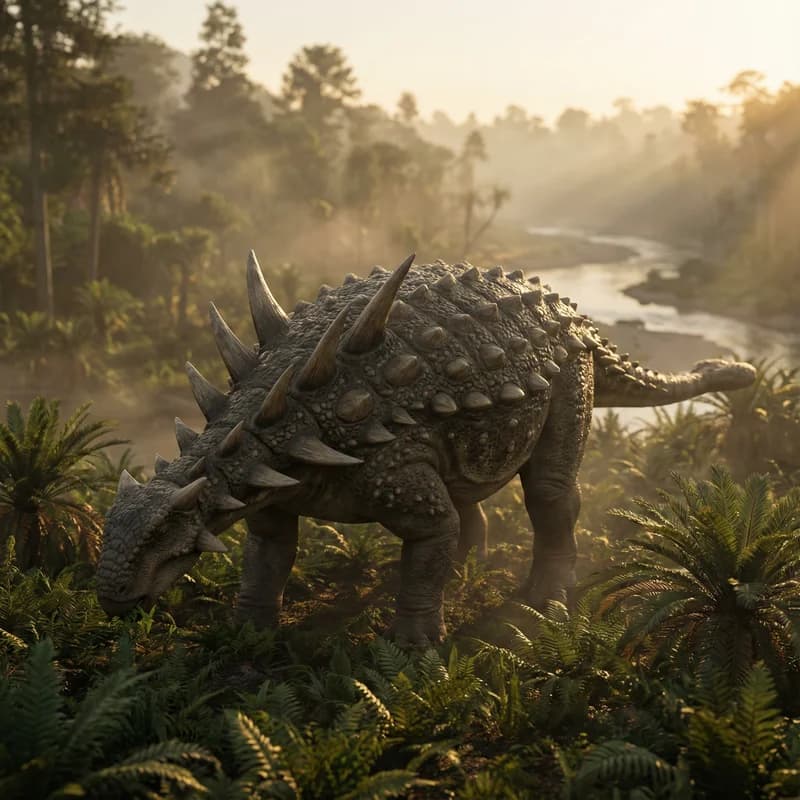
Sauropelta
Sauropelta edwardsorum
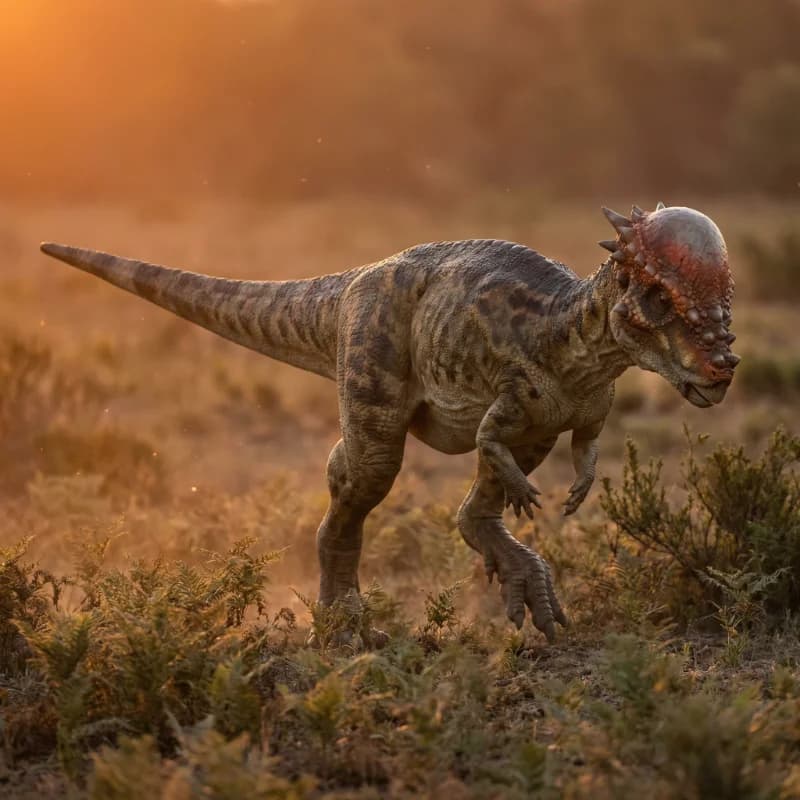
Pachycephalosaurus
Pachycephalosaurus wyomingensis
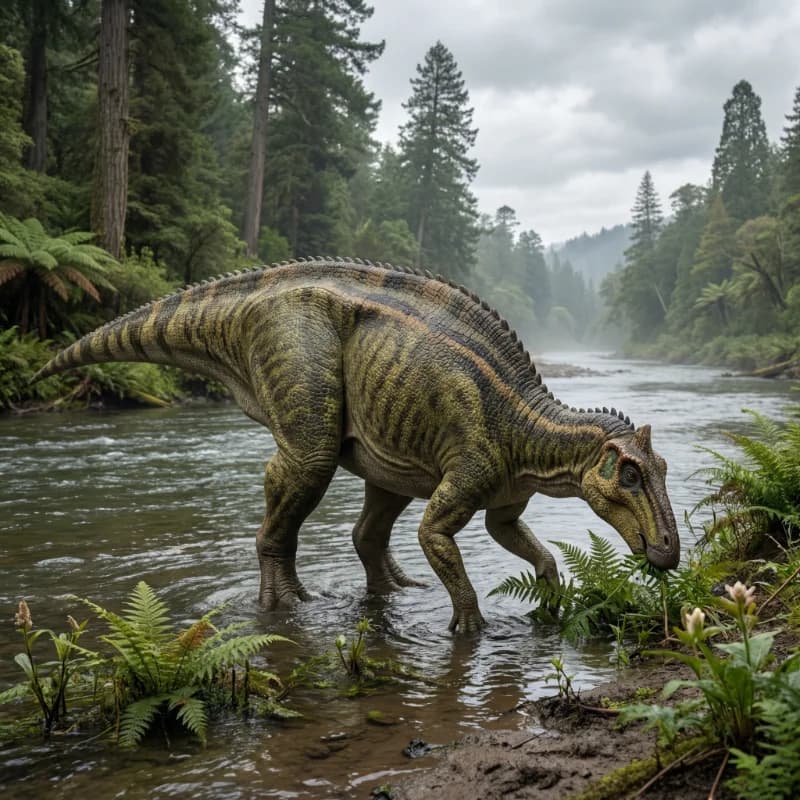
Hadrosaurus
Hadrosaurus foulkii

Regaliceratops
Regaliceratops peterhewsi
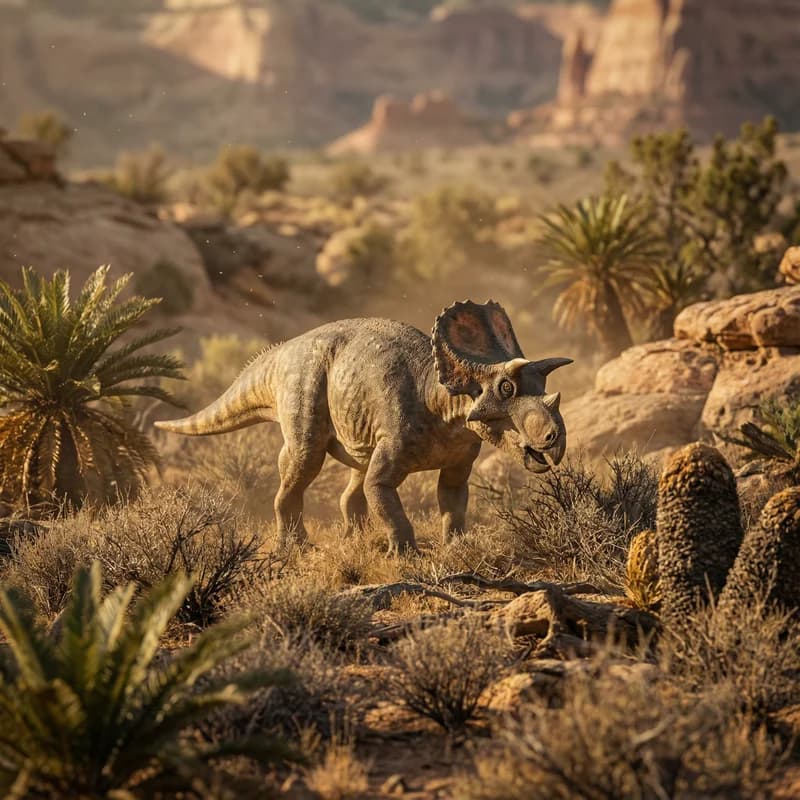
Zuniceratops
Zuniceratops christopheri
Hypsilophodon
Hypsilophodon foxii
Pentaceratops
Pentaceratops sternbergii
Parasaurolophus
Parasaurolophus walkeri