Einiosaurus
Cretaceous Period Herbivore Creature Type
Einiosaurus procurvicornis
Scientific Name: "Einiosaurus (Blackfeet 'eini' = bison + Greek 'sauros' = lizard → 'bison lizard') + procurvicornis (Latin 'procurvus' = forward-curving + 'cornu' = horn → 'with a forward-curving horn')"
Local Name: Einiosaurus
Physical Characteristics
Discovery
Habitat

Einiosaurus (Einiosaurus procurvicornis Sampson, 1995) is a medium-sized centrosaurine ceratopsian dinosaur from the Late Cretaceous (late Campanian, approximately 74.5–74 Ma) of northwestern Montana, USA. It belongs to the family Ceratopsidae within the order Ornithischia and the clade Ceratopsia. The generic name is derived from the Blackfeet (Siksiká) word eini ('American bison') and the Latinized Greek sauros ('lizard'), meaning 'bison lizard.' The specific epithet procurvicornis comes from the Latin procurvus ('forward-curving') and cornu ('horn'), referring to the animal's most distinctive feature: a strongly forward-curving nasal horn. Namer Scott D. Sampson chose the name both to honour the Blackfeet tribe, who granted access to the reservation for fossil excavation, and to reflect his view that ceratopsids were 'the buffalo of the Cretaceous,' living in herds and leading complex social lives (Sampson, 1995).
All known Einiosaurus fossils come from the upper Two Medicine Formation at Landslide Butte on the Blackfeet Indian Reservation in Glacier County, Montana. Jack Horner discovered two monospecific bonebeds at the site in 1985, and excavations from 1985 to 1989 yielded at least 15 individuals of varying ages, including three adult skulls and hundreds of cranial and postcranial elements (Sampson, 1995). This abundant fossil record strongly suggests that Einiosaurus lived in herds and suffered catastrophic drought-related mass mortality events (Rogers, 1990). Gregory S. Paul (2010) estimated a body length of approximately 4.5 m and a body mass of about 1.3 tonnes, placing Einiosaurus within the typical size range of the Centrosaurinae.
Phylogenetically, Einiosaurus is placed within the tribe Pachyrhinosaurini. It has long been discussed as a potential ancestor or close sister taxon of Achelousaurus and Pachyrhinosaurus. Horner et al. (1992) proposed that Einiosaurus represented an intermediate stage in an anagenetic evolutionary lineage from Styracosaurus to Pachyrhinosaurus, a hypothesis subsequently refined by the description of Stellasaurus (Wilson et al., 2020). In this evolutionary context, Einiosaurus occupies a pivotal position for understanding the evolution of horn and frill ornamentation in ceratopsians.
Overview
Name and Etymology
The generic name Einiosaurus combines the Blackfeet (Siksiká) word eini ('American bison') with the Latinized Ancient Greek sauros ('lizard'). According to Sampson, the correct pronunciation is 'eye-knee-o-saurus.' The specific epithet procurvicornis is derived from Latin procurvus ('bent forward') and cornu ('horn'), meaning 'with a forward-curving horn' (Sampson, 1995). The name was chosen to honour the Blackfeet tribe for granting excavation access, and to express the idea that ceratopsids were 'the buffalo of the Cretaceous'—herd-living animals with complex social behaviour.
Taxonomic Status
Einiosaurus is a valid genus containing a single species, E. procurvicornis. Sampson first announced the name in a 1994 abstract at the annual meeting of the Society of Vertebrate Paleontology, but did not designate a holotype until the formal description was published in 1995 in the Journal of Vertebrate Paleontology (Sampson, 1995). In 2010, Gregory S. Paul reassigned Einiosaurus to the genus Centrosaurus as Centrosaurus procurvicornis (Paul, 2010), but this has not been accepted by other researchers, and subsequent taxonomic assessments have consistently retained the name Einiosaurus (McDonald & Farke, 2011; Farke et al., 2011; Wilson et al., 2020).
Key Distinguishing Feature
The single most diagnostic trait of Einiosaurus is its forward-curving (procurved) nasal horncore. This horn has a long anteroposterior base, is transversely compressed, and in some adults curves strongly forward, giving it a shape often compared to a bottle opener. The parietal frill bears a single pair of large, posteriorly projecting spikes (third epiparietals) (Sampson, 1995).
Temporal and Stratigraphic Context
Age Range
Einiosaurus fossils are known from the upper part of the Two Medicine Formation, dating to the late Campanian stage of the Late Cretaceous. Recent CA-ID-TIMS U-Pb geochronology and lithostratigraphic revision indicate that the Two Medicine Formation as a whole spans approximately 82.4–74.4 Ma (Rogers et al., 2024). The Einiosaurus bonebeds occur approximately 45 m below the base of the overlying Bearpaw Formation, corresponding to an age of roughly 74.5–74 Ma (Sampson, 1995; Horner et al., 1992). This places Einiosaurus stratigraphically between the older Stellasaurus (~60 m below Bearpaw) and the younger Achelousaurus (~20 m below Bearpaw).
Formation and Lithology
The Two Medicine Formation is an Upper Cretaceous rock unit distributed across northwestern Montana and into southern Alberta, Canada. It consists predominantly of bentonitic siltstones and mudstones with occasional sandstone lenses. The Einiosaurus-bearing horizon is a brown paleosol composed of clay mixed with coalified wood fragments, closely resembling the deposits of modern seasonally dry swamps (Rogers, 1990). The surrounding environment likely included conifer forests up to approximately 25 m in height (Horner & Dobb, 1997).
Depositional Environment and Paleoenvironment
The Two Medicine Formation was deposited on the eastern coast of the Laramidia island continent, adjacent to the Western Interior Seaway. The high western cordillera (proto-Rocky Mountains, reaching 3–4 km in elevation) combined with predominantly westerly winds created a rain-shadow effect, limiting annual precipitation. Rainfall was concentrated during summer convective storms, producing a strongly seasonal climate with prolonged dry seasons and short wet seasons—a warm semi-arid regime (Rogers, 1990). The monospecific Einiosaurus bonebeds are interpreted as the result of drought-related mass mortality: herds concentrated around the last available water sources (oxbow lakes) during severe droughts and perished there en masse (Rogers, 1990).
Specimens and Diagnostic Traits
Holotype
The holotype specimen, MOR 456-8-9-6-1, was recovered from a layer of the Two Medicine Formation dating to the late Campanian. It consists of a partial adult skull, including the nasal horncore, the supraorbital area, and part of the parietal bone of the skull frill. All known Einiosaurus specimens are housed at the Museum of the Rockies (MOR) in Bozeman, Montana (Sampson, 1995).
| Specimen | Composition | Locality | Notes |
|---|---|---|---|
| MOR 456-8-9-6-1 | Partial skull (nasal horncore, supraorbital area, parietal) | Canyon Bone Bed | Holotype, adult |
| MOR 456 skull #2 | Maxilla, nasal, lacrimal, postorbital, etc. | Canyon Bone Bed | Referred, adult |
| MOR 456 skull #3 | Partial skull | Canyon Bone Bed | Referred, adult |
| MOR 456 (misc.) | Numerous isolated cranial and postcranial elements | Canyon Bone Bed | Various age classes |
| MOR 373 | ~200+ disarticulated bones | Dino Ridge Quarry | Various age classes |
| MOR 456 8-8-87-1 | Articulated subadult skull | Canyon Bone Bed | Subadult; described by Wilson & Scannella (2021) |
Diagnosis
Sampson (1995) identified the following diagnostic traits: the nasal horncore has an anteroposteriorly elongate base, is transversely compressed, and is strongly procurved in some adults. The supraorbital ('brow') horncores, where present, are low, elongate, and rounded with a convex medial surface. The parietal portion of the frill's posterior margin bears a single pair of large, curved spikes projecting posteriorly. Einiosaurus is distinguished from all other known Centrosaurinae by a longer-based and more procurved nasal horncore, and by supraorbital horncores that are longer-based and more rounded in lateral view. It differs from Achelousaurus specifically in having large parietal spikes that project posteriorly without significant lateral deflection (Sampson, 1995).
Limitations of the Fossil Material
Sampson (1995) did not describe the postcranial skeleton in detail, noting that centrosaurine postcrania are 'conservative' and differ only slightly between species. He could not identify postcranial traits distinguishing Einiosaurus from a generalized centrosaurine. Consequently, whole-body reconstructions rely heavily on cranial material, with some uncertainty remaining in overall body proportions.
Morphology and Function
Body Size and Build
Gregory S. Paul (2010) estimated Einiosaurus at approximately 4.5 m in body length and 1.3 tonnes in body mass. It was similar in size to Achelousaurus but considerably less robust (Sampson, 1995). Shoulder height is estimated at approximately 1.5 m. As a typical centrosaurine, Einiosaurus was an obligate quadruped with a large head bearing a keratinous beak, a moderately sized frill, a short powerful neck, muscular forelimbs, a deep torso, strong hindlimbs, and a relatively short tail.
Nasal Horn
The most distinctive anatomical structure of Einiosaurus is the forward-curving nasal horn. In addition to the holotype, eight additional nasal horncores were recovered from the two bonebeds, two from subadults and six from adults. Subadult horncores were transversely compressed and relatively small, not exceeding 12 cm in height. Adult horncores displayed two distinct morphotypes: two were small and erect (vertically oriented), while four were large and strongly procurved (Sampson, 1995). This variation may reflect individual variation, sexual dimorphism, or ontogenetic differences, but this remains unresolved. Einiosaurus nasal horncores are clearly more laterally compressed than the more oval-sectioned horns of Centrosaurus, and much shorter than the elongate (up to 50 cm), erect or slightly recurved horns of Styracosaurus (Sampson, 1995).
Supraorbital Horns
Nine subadult and adult supraorbital horncores were recovered. All share a low, elongate, rounded morphology, which differs from the typical pointed horns with an oval base seen in most centrosaurines, and also from the bosses (rounded rugose masses) seen in Achelousaurus and Pachyrhinosaurus. Some older individuals showed the horn replaced by a low rounded mass, sometimes with a large pit at the usual horn-point location. The large holotype has a rounded mass above the left orbit but a pit (85 mm × 64 mm) on the right side. Sampson interpreted this as reflecting a general centrosaurine tendency toward brow horn resorption in later life (Sampson, 1995).
Skull Frill
The Einiosaurus frill is relatively small compared to chasmosaurines, but features a characteristic single pair of large, curved spikes (third epiparietals) that project posteriorly from the rear edge. Smaller osteoderms adorn the frill margin, while the first epiparietals are largely absent or greatly reduced (Sampson, 1995; Hieronymus et al., 2009). These frill ornaments likely served in species recognition and sexual display.
Skull and Dentition
The holotype skull is the largest known and measures approximately 1.56 m in total length. The snout is relatively narrow and pointed. Like all ceratopsians, Einiosaurus possessed a keratinous beak optimized for cropping vegetation, and complex cheek-tooth dental batteries capable of processing even the toughest plants (Sampson, 1995).
Internal Skull Architecture
As in all centrosaurines, the frontal bones are folded to create a double roof with a supracranial cavity between the layers. In Einiosaurus, this cavity extends laterally into the interior of the brow horn—broader than in Centrosaurus or Styracosaurus but comparable to Pachyrhinosaurus. At the frontal–parietal suture, a large foramen pierces the cavity floor into the braincase (the 'pineal opening'), the function of which remains unknown (Sampson, 1995).
Diet and Ecology
Feeding Habits
Einiosaurus was a herbivore equipped with a complex dental battery for efficient processing of tough vegetation. Mallon et al. (2013) determined that ceratopsid herbivores on Laramidia were restricted to feeding on vegetation approximately 1 m or lower in height. Henderson (2010) found through biomechanical analysis that the skull of Einiosaurus had substantially less bending strength and torsion resistance than that of Achelousaurus. Ultimate tensile strength at the maxillary tooth row was 10.3 N/mm² and 6.40 N/mm² at the beak for Einiosaurus, compared to 30.5 N/mm² and 18 N/mm², respectively, for Achelousaurus. This marked difference suggests potential niche partitioning through dietary differentiation between the two taxa (Henderson, 2010).
Function of Skull Ornamentation
Sampson (1995) concluded, building on prior research, that ceratopsian horns and frills most likely functioned primarily in intraspecific display and combat, and were therefore products of sexual selection. Horner (1997) similarly argued that such ornamentation was used by males to establish dominance, with females preferring well-ornamented males. Dodson (1996) noted that in the Centrosaurinae generally, the display value of the frill was reduced relative to the nasal and supraorbital ornamentation. Sampson (1995) rejected the possibility that the differences between Einiosaurus and Achelousaurus represented sexual dimorphism for three reasons: first, the extensive Einiosaurus bonebeds contained no specimens with bosses; second, the two taxa occur in strata of different ages; and third, both taxa independently developed their own distinct sets of secondary sexual characters.
Social Behaviour and Herding
The two Einiosaurus bonebeds (Canyon Bone Bed and Dino Ridge Quarry) are both low-diversity, monospecific assemblages containing at least 15 individuals spanning multiple age classes. This strongly suggests that Einiosaurus lived in herds (Rogers, 1990). Such monospecific bonebeds are characteristic of centrosaurine ceratopsians (also seen in Centrosaurus and Pachyrhinosaurus) and are interpreted as analogous to the herding behaviour of modern bison or wildebeest (Hunt & Farke, 2010). In contrast, chasmosaurine ceratopsids such as Triceratops and Torosaurus are typically found as isolated individuals, suggesting different social strategies within the Ceratopsidae.
Growth and Metabolism
Reizner (2010) conducted a bone-histological study of Einiosaurus individuals from the Dino Ridge Quarry, analyzing an ontogenetic series of 16 animals. The results showed that Einiosaurus grew rapidly until approximately 3–5 years of age, after which growth slowed markedly. Reizner hypothesized that this growth deceleration corresponds to the onset of sexual maturity. The oldest individual in the sample was estimated at approximately 6 years of age (Reizner, 2010). Separately, an oxygen-isotope study by Barrick et al. (1996) of ornithischian dinosaurs from the Two Medicine Formation (including the juvenile ceratopsian MOR 591, possibly Einiosaurus or Achelousaurus) found δ¹⁸O variation consistent with homeothermic endothermy, though the metabolic rate was likely intermediate between modern mammals/birds and ectotherms.
Distribution and Paleogeography
Geographic Range
Einiosaurus is an exclusively Montanan dinosaur. All confirmed specimens come from the Blackfeet Indian Reservation in Glacier County, northwestern Montana, and are housed at the Museum of the Rockies. Some indeterminate specimens from the Two Medicine Formation (such as fragmentary skull MOR 464 or snout MOR 449) may belong to Einiosaurus but could also belong to Achelousaurus or Rubeosaurus/Styracosaurus ovatus and remain unassigned (McDonald & Horner, 2010).
Paleogeography
During the late Campanian (~74 Ma), the Montana region lay on the eastern coastal plain of the Laramidia island continent, at an approximate paleolatitude of 55°N. The Western Interior Seaway bordered Laramidia to the east, while the proto-Rocky Mountain cordillera rose to the west. The Bearpaw Transgression was progressively reducing the width of the coastal habitat from approximately 300 km to as little as 30 km (Horner et al., 1992). This habitat contraction may have created population bottlenecks and increased selection pressures, potentially accelerating evolutionary change in ceratopsian populations.
Phylogeny and Taxonomic Debates
Phylogenetic Position
Sampson (1995) formally placed Einiosaurus within the Ceratopsidae, subfamily Centrosaurinae, and conducted a cladistic analysis that recovered an evolutionary tree in which Achelousaurus branched off between Einiosaurus and Pachyrhinosaurus. All subsequent analyses have placed Einiosaurus and Achelousaurus within the clade Pachyrhinosaurini (Fiorillo & Tykoski, 2012). The most recent comprehensive analysis (Wilson et al., 2020) recovered Einiosaurus as sister to Stellasaurus, outside the clade Pachyrostra (which unites Achelousaurus and Pachyrhinosaurus).
| Taxon | Phylogenetic Position | Source |
|---|---|---|
| Einiosaurus procurvicornis | Pachyrhinosaurini, sister to Pachyrostra | Wilson et al., 2020 |
| Achelousaurus horneri | Pachyrostra (sister to Pachyrhinosaurus) | Fiorillo & Tykoski, 2012 |
| Stellasaurus ancellae | Sister to Einiosaurus | Wilson et al., 2020 |
| Pachyrhinosaurus spp. | Within Pachyrostra | Fiorillo & Tykoski, 2012 |
The Anagenesis Hypothesis
Horner et al. (1992) proposed that the three ceratopsian morphs found in the upper Two Medicine Formation (Taxon A, B, C) represented an anagenetic evolutionary lineage from Styracosaurus to Pachyrhinosaurus. Over a geologically short interval (~500,000 years), the nasal horn morphology appeared to transform gradually from erect spikes to procurved horns to flattened bosses, with the populations never splitting but evolving in place. Sampson (1995) did not fully adopt this hypothesis but acknowledged that the rate of speciation must have been very high. Wilson & Scannella (2016, 2021) supported the anagenesis interpretation based on the strong morphological similarity between subadult Einiosaurus and subadult Achelousaurus specimens, concluding that the differences between the adult forms were likely due to heterochrony. Wilson et al. (2020) found the description of Stellasaurus (Horner's 'Taxon A') to be consistent with a transitional position between Styracosaurus and Einiosaurus, further supporting this hypothesis.
Counterarguments
Dodson (1996) raised two objections. First, the single pair of parietal spikes in Einiosaurus appeared more basal than the three pairs in Styracosaurus albertensis, suggesting the Einiosaurus–Achelousaurus lineage might be a separate branch rather than a continuation of the Styracosaurus line. Second, he raised the possibility that Einiosaurus and Achelousaurus might represent sexual dimorphism within a single species, given the short stratigraphic interval separating them (~250,000 years by his estimate). However, Sampson (1995) had already rejected the sexual-dimorphism hypothesis on three grounds: no boss-bearing specimens were found in the Einiosaurus bonebeds; the two taxa occur in different-aged strata; and both independently developed distinct suites of secondary sexual characters.
Reconstruction and Uncertainty
Confirmed
That Einiosaurus is a medium-sized, quadrupedal, herbivorous centrosaurine ceratopsian with a diagnostic forward-curving nasal horn and a single pair of large posteriorly projecting parietal spikes is firmly established by multiple specimens. Herding behaviour is strongly supported by two monospecific bonebeds. The temporal range (late Campanian, ~74.5–74 Ma) and provenance (upper Two Medicine Formation) are well constrained.
Well-Supported Hypotheses
Einiosaurus's phylogenetic position within Pachyrhinosaurini as a close relative of Achelousaurus + Pachyrhinosaurus is consistently recovered across multiple independent cladistic analyses (Sampson, 1995; Wilson et al., 2020). The interpretation of drought-related mass mortality as the taphonomic origin of the bonebeds is strongly supported by sedimentological and taphonomic evidence (Rogers, 1990).
Hypothetical or Uncertain
The anagenesis hypothesis—a direct ancestor–descendant relationship in the series Stellasaurus → Einiosaurus → Achelousaurus → Pachyrhinosaurus—is compelling but remains debated. Whether the variation in nasal horn morphology (erect vs. procurved) among adults represents sexual dimorphism, individual variation, or ontogenetic change is unresolved. Because the postcranial skeleton has not been described in detail, full-body proportions carry some uncertainty. Paul's (2010) mass estimate of 1.3 tonnes is a single-point estimate without a published error range.
Popular Media vs. Scientific Understanding
Einiosaurus is often depicted as universally possessing a strongly procurved nasal horn, but in fact some adult horncores were small and erect, revealing considerable intraspecific variation (Sampson, 1995). Additionally, some popular sources incorrectly classify Einiosaurus as a theropod; it is an ornithischian ceratopsian.
Comparison with Related and Contemporary Taxa
| Taxon | Age (Ma) | Body length (m) | Mass (t) | Nasal horn | Supraorbital horns | Parietal spikes |
|---|---|---|---|---|---|---|
| Styracosaurus albertensis | ~75.5 | ~5.5 | ~2.7 | Large, erect to slightly recurved | Small | 4–6 pairs, elongate |
| Stellasaurus ancellae | ~75 | Undetermined | Undetermined | Moderate, incipiently procurved | Small | 3 pairs |
| Einiosaurus procurvicornis | ~74.5–74 | ~4.5 | ~1.3 | Strongly procurved | Low, rounded | 1 pair, large |
| Achelousaurus horneri | ~74 | ~6 | ~3 | Flattened boss | Rounded bosses | 1 pair, large |
| Pachyrhinosaurus lakustai | ~73.5 | ~5–8 | ~4 | Large flattened boss | Large bosses | Multiple |
This comparison illustrates a morphological trend from pointed, erect horns to procurved horns to flattened bosses, accompanied by a reduction in the number of parietal spikes. This trend forms the core evidence for the anagenesis hypothesis, though cladogenetic alternatives remain possible.
Discovery and Research History
The discovery of Einiosaurus traces back to Jack Horner's explorations of the Blackfeet Indian Reservation. In 1985, after losing access to the Willow Creek 'Egg Mountain' site, Horner obtained permission from the Blackfeet Tribal Council to prospect at Landslide Butte. That year, Horner's associate Bob Makela discovered the Dino Ridge Quarry, containing extensive ceratopsid remains. In late August 1986, Horner and preparator Carrie Ancell discovered the Canyon Bone Bed approximately 1.6 km away, yielding two relatively complete skulls. These skulls were so heavy (about half a tonne in plaster jackets) that they had to be airlifted by a U.S. Army National Guard UH-1 Iroquois helicopter (Horner & Dobb, 1997).
During the 1985–1989 excavation campaigns, the fossils were initially thought to represent Styracosaurus ovatus. They were also informally called 'Styracosaurus makeli' in honour of Bob Makela, who died in a traffic accident in June 1987 (this name was a nomen nudum, lacking any formal description). Horner et al. (1992) published the fossils as three unnamed 'transitional taxa,' deliberately declining to formally name them. Scott Sampson, working as a doctoral student, ultimately named Taxon B as Einiosaurus procurvicornis at the 1994 SVP meeting and published the formal description in 1995 (Sampson, 1995). Taxon C was simultaneously named Achelousaurus horneri, and Taxon A was later described as Stellasaurus ancellae by Wilson et al. (2020).
Subsequent key studies include Reizner's (2010) bone-histological growth analysis; Henderson's (2010) cranial biomechanical comparison; Wilson et al.'s (2020) description of Stellasaurus and updated phylogenetic analysis; and Wilson & Scannella's (2021) comparative cranial osteology of subadult eucentrosaurans.
Fun Facts
FAQ
📚References
- Sampson, S. D. (1995). Two new horned dinosaurs from the Upper Cretaceous Two Medicine Formation of Montana; with a phylogenetic analysis of the Centrosaurinae. Journal of Vertebrate Paleontology, 15(4), 743–760. https://doi.org/10.1080/02724634.1995.10011259
- Horner, J. R., Varricchio, D. J., & Goodwin, M. B. (1992). Marine transgressions and the evolution of Cretaceous dinosaurs. Nature, 358(6381), 59–61. https://doi.org/10.1038/358059a0
- Rogers, R. R. (1990). Taphonomy of three dinosaur bone beds in the Upper Cretaceous Two Medicine Formation of northwestern Montana: evidence for drought-related mortality. Palaios, 5(5), 394–413. https://doi.org/10.2307/3514834
- Paul, G. S. (2010). The Princeton Field Guide to Dinosaurs. Princeton University Press. p. 262.
- Wilson, J. P., Ryan, M. J., & Evans, D. C. (2020). A new, transitional centrosaurine ceratopsid from the Upper Cretaceous Two Medicine Formation of Montana and the evolution of the 'Styracosaurus-line' dinosaurs. Royal Society Open Science, 7(4), 200284. https://doi.org/10.1098/rsos.200284
- Wilson, J. P., & Scannella, J. B. (2021). Comparative cranial osteology of subadult eucentrosauran ceratopsid dinosaurs from the Two Medicine Formation, Montana, indicates sequence of ornamentation development and complex supraorbital ontogenetic change. Acta Palaeontologica Polonica, 66(4), 797–814. https://doi.org/10.4202/app.00797.2020
- Dodson, P. (1996). The Horned Dinosaurs: A Natural History. Princeton University Press. pp. 193–197.
- Horner, J. R., & Dobb, E. (1997). Dinosaur Lives: Unearthing an Evolutionary Saga. HarperCollins.
- Reizner, J. (2010). An ontogenetic series and population histology of the ceratopsid dinosaur Einiosaurus procurvicornis. M.Sc. thesis, Montana State University, Bozeman.
- Henderson, D. M. (2010). Skull shapes as indicators of niche partitioning by sympatric chasmosaurine and centrosaurine dinosaurs. In M. J. Ryan, B. J. Chinnery-Allgeier, & D. A. Eberth (Eds.), New Perspectives on Horned Dinosaurs (pp. 293–307). Indiana University Press.
- McDonald, A. T., & Horner, J. R. (2010). New material of 'Styracosaurus' ovatus from the Two Medicine Formation of Montana. In M. J. Ryan, B. J. Chinnery-Allgeier, & D. A. Eberth (Eds.), New Perspectives on Horned Dinosaurs (pp. 156–168). Indiana University Press.
- Hieronymus, T. L., Witmer, L. M., Tanke, D. H., & Currie, P. J. (2009). The facial integument of centrosaurine ceratopsids: morphological and histological correlates of novel skin structures. The Anatomical Record, 292(9), 1370–1396. https://doi.org/10.1002/ar.20985
- Fiorillo, A. R., & Tykoski, R. S. (2012). A new Maastrichtian species of the centrosaurine ceratopsid Pachyrhinosaurus from the North Slope of Alaska. Acta Palaeontologica Polonica, 57(3), 561–573. https://doi.org/10.4202/app.2011.0033
- Mallon, J. C., Evans, D. C., Ryan, M. J., & Anderson, J. S. (2013). Feeding height stratification among the herbivorous dinosaurs from the Dinosaur Park Formation (upper Campanian) of Alberta, Canada. BMC Ecology, 13, 14. https://doi.org/10.1186/1472-6785-13-14
- Farke, A. A., Ryan, M. J., Barrett, P. M., Tanke, D. H., Braman, D. R., Loewen, M. A., & Graham, M. R. (2011). A new centrosaurine from the Late Cretaceous of Alberta, Canada, and the evolution of parietal ornamentation in horned dinosaurs. Acta Palaeontologica Polonica, 56(4), 691–702. https://doi.org/10.4202/app.2010.0121
- Barrick, R. E., Showers, W. J., & Fischer, A. G. (1996). Comparison of thermoregulation of four ornithischian dinosaurs and a varanid lizard from the Cretaceous Two Medicine Formation: evidence for variability in dinosaur physiology. Palaios, 11(4), 295–305.
- Rogers, R. R., Foreman, B. Z., & Seymour, K. R. (2024). Updating the Upper Cretaceous (Campanian) Two Medicine Formation of Montana: lithostratigraphic revisions, new CA-ID-TIMS U-Pb ages, and a calibrated framework for dinosaur occurrences. GSA Bulletin, 137(1–2), 315–341. https://doi.org/10.1130/B37274.1
- McDonald, A. T., & Farke, A. A. (2011). Assessment of holotype material of centrosaurine ceratopsids from the Dinosaur Park Formation. In P. J. Currie, W. Langston, & D. H. Tanke (Eds.), A Day in the Cretaceous.
Gallery
5 images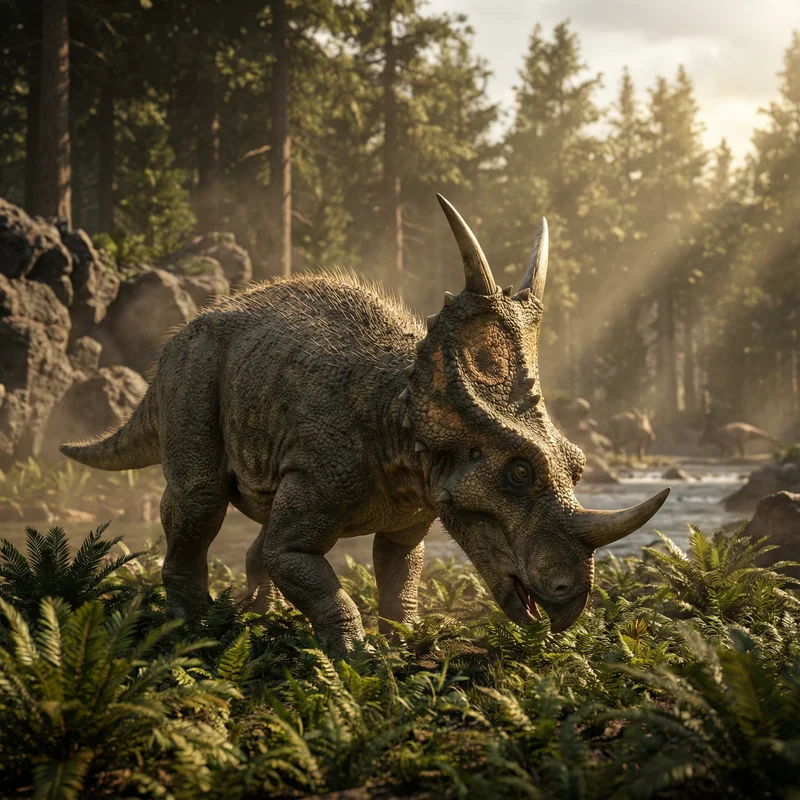 Einiosaurus
Einiosaurus · Cretaceous Period · Herbivore
 Einiosaurus
Einiosaurus · Cretaceous Period · Herbivore
 Einiosaurus
Einiosaurus · Cretaceous Period · Herbivore
 Einiosaurus
Einiosaurus · Cretaceous Period · Herbivore
 Einiosaurus
Einiosaurus · Cretaceous Period · Herbivore
🔗Related Creatures
Lambeosaurus
Lambeosaurus lambei

Diabloceratops
Diabloceratops eatoni

Triceratops
Triceratops

Edmontosaurus
Edmontosaurus
Pachyrhinosaurus
Pachyrhinosaurus
Torosaurus
Torosaurus latus

Argentinosaurus
Argentinosaurus huinculensis
Amargasaurus
Amargasaurus cazaui