Hadrosaurus
Cretaceous Period Herbivore Creature Type
Hadrosaurus foulkii
Scientific Name: "Greek ἁδρός (hadros, 'bulky, large') + σαῦρος (sauros, 'lizard') = 'bulky lizard'; species epithet foulkii honors discoverer William Parker Foulke"
Local Name: Hadrosaurus
Physical Characteristics
Discovery
Habitat
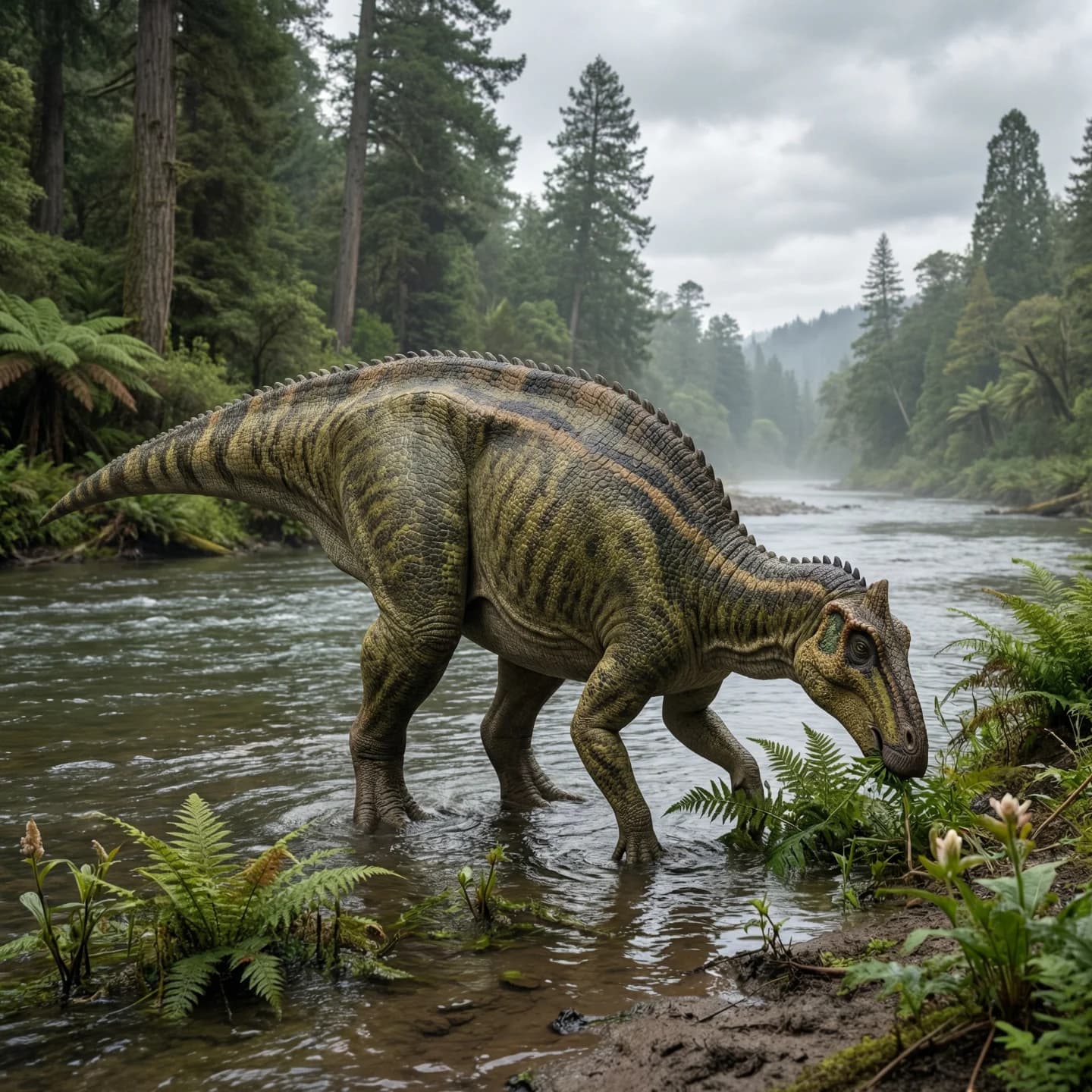
Hadrosaurus (Hadrosaurus foulkii Leidy, 1858) is a hadrosaurid ornithopod dinosaur from the Late Cretaceous (Campanian stage, approximately 83.6–77.9 Ma) of eastern North America. The holotype specimen was recovered from the Woodbury Formation in Haddonfield, New Jersey, USA. The genus name derives from the Greek ἁδρός (hadros, 'bulky' or 'large') and σαῦρος (sauros, 'lizard'), meaning 'bulky lizard,' while the species epithet foulkii honors William Parker Foulke, the naturalist who excavated the skeleton. The name also functioned as a play on the discovery locality, Haddonfield. Hadrosaurus foulkii holds an extraordinary place in the history of paleontology: it was the first dinosaur described outside Europe from partially complete skeletal remains, and in 1868 it became the first dinosaur skeleton ever mounted for public exhibition.
The animal was a large herbivore estimated at 7–8 m (23–26 ft) in total length and 2–4 metric tons in body mass (Paul, 2016; Holtz, 2007). Most of the preserved postcranial elements are remarkably robust, with the fibula being among the most heavily built within Hadrosauridae (Prieto-Márquez et al., 2006). Hadrosaurus possessed a keratinous beak for cropping vegetation and a complex dental battery for processing fibrous plant matter, typical of hadrosaurid dinosaurs. The skull, however, is known only from fragmentary maxillary pieces and isolated teeth, severely limiting direct knowledge of cranial morphology.
Despite being the type genus of Hadrosauridae Cope, 1869, and Hadrosaurinae Lambe, 1918, the incomplete nature of the holotype fueled decades of taxonomic controversy. Prieto-Márquez et al. (2006) declared H. foulkii a nomen dubium due to the absence of clear autapomorphies, but the same lead author reversed this judgment in 2011 after identifying a unique combination of appendicular characters that renders the taxon diagnosable (Prieto-Márquez, 2011). Phylogenetic analyses consistently recover Hadrosaurus as a basal member of Hadrosauridae, more primitive than both Saurolophinae and Lambeosaurinae, which led to the renaming of the traditional crestless 'hadrosaurine' clade as Saurolophinae.
Overview
Name and Etymology
The genus name Hadrosaurus was coined by Joseph Leidy in 1858 and derives from the Greek ἁδρός (hadros, meaning 'bulky,' 'stout,' or 'large') combined with σαῦρος (sauros, 'lizard'). The name also served as a portmanteau referencing Haddonfield, the New Jersey town where the skeleton was found, making it both a scientific descriptor and a geographical tribute. The species name foulkii is a Latinized genitive honoring William Parker Foulke, the amateur naturalist and member of the Academy of Natural Sciences of Philadelphia who supervised the 1858 excavation. Leidy himself noted this dual meaning, and the full binomial thus translates roughly as 'Foulke's bulky lizard.'
Taxonomic Status
Hadrosaurus is the type genus of both the family Hadrosauridae (Cope, 1869) and the subfamily Hadrosaurinae (Lambe, 1918). This nomenclatural significance made the question of its validity critically important for dinosaur systematics. In 2006, a comprehensive redescription concluded that the holotype lacked unequivocal autapomorphies, leading to a nomen dubium designation (Prieto-Márquez et al., 2006). However, in a 2011 reassessment published in Zootaxa, Prieto-Márquez identified a diagnostic combination of plesiomorphic and derived appendicular characters — including a shortened deltopectoral crest, distinctive iliac supraacetabular crest morphology, and specific proportions of the humeral shaft — that collectively distinguish H. foulkii from all other hadrosaurids. The taxon is now predominantly regarded as valid in the current literature.
Historical Significance
Hadrosaurus foulkii was the first dinosaur known from partially complete skeletal remains discovered outside Europe, fundamentally demonstrating that giant reptiles had existed in the New World. The specimen was also the first ever fully assembled and mounted for public display, at the Academy of Natural Sciences of Philadelphia (ANSP) in 1868, by a team led by English sculptor and naturalist Benjamin Waterhouse Hawkins. In 1991, Hadrosaurus foulkii was designated the official state dinosaur of New Jersey.
Age, Stratigraphy, and Depositional Environment
Temporal Range
The holotype derives from the Woodbury Formation of New Jersey, which belongs to the Matawan Group. Radiometric dating of bivalve shells from the formation yielded an age range of approximately 80.5–78.5 Ma (Gallagher, 2005), while a broader stratigraphic assessment places the formation within the early to middle Campanian, roughly 83.6–77.9 Ma (Stringer et al., 2016). Hadrosaurus therefore lived during the early to middle Campanian stage of the Late Cretaceous.
Formation and Lithology
The Woodbury Formation is part of the Matawan Group in the New Jersey Coastal Plain. It consists predominantly of massive dark gray clays and silts with carbonized wood fragments, pyrite, siderite, and minor amounts of glauconite. The formation is approximately 15 m thick and is underlain by the Merchantville Formation and overlain by the Englishtown Formation.
Paleoenvironment
The depositional environment of the Woodbury Formation is interpreted as an inner continental shelf embayment to prodelta setting — a shallow marine environment. Benthic foraminifera indicate inner to middle neritic paleodepths of approximately 40–80 m (Miller et al., 2004). Otolith assemblages and sedimentological data suggest a shallow marine setting (less than 100 m depth) influenced by major rivers (Stringer et al., 2016). New Jersey fossil site descriptions characterize the Woodbury as representing inner shelf embayment-type conditions. The discovery of a terrestrial herbivorous dinosaur in marine sediments is explained by fluvial transport: the carcass was carried by a river and deposited on the floor of the Cretaceous sea (Leidy, 1858; Prieto-Márquez et al., 2006).
| Item | Details |
|---|---|
| Formation | Woodbury Formation (Matawan Group) |
| Age | Early–middle Campanian (~83.6–77.9 Ma) |
| Lithology | Massive dark gray clay and silt; carbonized wood, pyrite, siderite, minor glauconite |
| Depositional setting | Inner shelf embayment / prodelta shallow marine (~40–80 m paleodepth) |
| Taphonomic interpretation | Carcass transported by river, deposited in marine sediments |
Specimens and Diagnostic Characters
Holotype
The sole known specimen of Hadrosaurus foulkii was excavated in 1858 by William Parker Foulke from a marl pit along a tributary of the Cooper River in Haddonfield, Camden County, New Jersey, and described by Joseph Leidy. All material is housed at the Academy of Natural Sciences of Philadelphia (ANSP).
Cranial material: ANSP 9203 (fragment of the lateral wall of the middle region of a right maxilla), ANSP 9204 (lateral portion of a left ectopterygoid shelf of maxilla), ANSP 9202 (dental lamina fragments and edentulous alveoli), and ANSP 9201 (isolated maxillary and dentary teeth).
Postcranial skeleton (ANSP 10005): Three partial cranial dorsal vertebrae, three proximal caudal centra, nine proximal-to-middle caudal centra (including one nearly complete middle caudal vertebra) and numerous vertebral fragments, a partial right coracoid, a complete left humerus (555 mm), left radius (520 mm), left ulna (590 mm), left ilium, right ischium, right partial pubis, and a partial left hindlimb comprising a femur (~1,050 mm), tibia (933 mm), nearly complete fibula, metatarsals II and IV, and pedal phalanx III-1.
Diagnostic Characters
According to the revised diagnosis by Prieto-Márquez (2011), H. foulkii is diagnosable by a unique combination of appendicular characters: (1) a shortened deltopectoral crest that is slightly over 40% of total humeral length; (2) a deltopectoral crest that develops from the humeral shaft causing the laterodistal border to display a broad lateral facet; (3) the lowest point of the supraacetabular crest situated above the lateral edge from the rear to the bottom on the posterior tuberosity of the ischial peduncle of the ilium; (4) a shortened supraacetabular crest with its anteroposterior breadth being half the length of the middle iliac plate. These are not individual autapomorphies but collectively constitute a unique character combination.
Limitations of the Holotype
The skull is represented only by maxillary fragments and isolated teeth, precluding any direct assessment of cranial morphology. It is impossible to determine whether Hadrosaurus bore a cranial crest. Furthermore, portions of the ilium — particularly the craniodorsal outline of the preacetabular process — include plaster reconstruction, requiring caution in morphological interpretation.
Morphology and Function
Body Size
Hadrosaurus foulkii was a large-bodied dinosaur estimated at 7–8 m (23–26 ft) in total length, approximately 3 m in hip height, and 2–4 metric tons (2,000–4,000 kg) in body mass (Paul, 2016; Holtz, 2007). The holotype individual was relatively large at the time of death, as evidenced by a femur approximately 1.05 m long and a tibia measuring 933 mm. Leidy (1858) originally estimated total length at about 25 feet (~7.6 m) based on vertebral proportions of extant crocodilians and iguanas, while Cope (1868) revised this to 28–30 feet (~8.4–9 m). Modern estimates converge on the 7–8 m range.
Limb Proportions and Locomotion
One of the most anatomically striking features of Hadrosaurus is the pronounced disparity between the forelimb and hindlimb. The humerus (555 mm) is only about 53% the length of the femur (~1,050 mm). In 1858, Leidy used this disparity to infer that Hadrosaurus adopted a bipedal, kangaroo-like posture for feeding — a revolutionary conclusion that overturned the prevailing view of dinosaurs as obligate quadrupeds. Modern interpretations suggest that hadrosaurid dinosaurs were facultative bipeds, employing quadrupedal locomotion at low speeds and switching to bipedal running when moving rapidly.
Skeletal Robustness
Most preserved elements are remarkably robust. The fibula is among the most heavily built in the entire family, and the radius has a length-to-minimum-shaft-thickness ratio of approximately 12.5, considerably stouter than the typical hadrosaurid range of 15 to nearly 19 (Prieto-Márquez et al., 2006). The humerus has a deltopectoral crest that does not extend to the midshaft, unlike most euhadrosaurians but similar to the condition in Telmatosaurus transsylvanicus, representing a plesiomorphic trait.
Ischial Morphology
The ischial shaft curves caudodorsally, which contrasts with the straight or slightly caudoventrally deflected condition seen in most other hadrosaurids (Prieto-Márquez et al., 2006). This unusual curvature is one of the distinctive morphological features of the skeleton.
Dentition
Dentary teeth have elongated diamond-shaped crowns with a length-to-breadth ratio of approximately 2.65. A single longitudinal carina bisects each crown, and denticles are present only on the edges of the apical half. The crown-to-root angle is approximately 125°, distinguishing H. foulkii from Brachylophosaurus canadensis (140°) and Edmontosaurus sp. (135°), but comparable to Prosaurolophus blackfeetensis (120°) (Prieto-Márquez et al., 2006). In maxillary teeth, denticles are restricted to the ventral half of the crown, and the median carina does not reach the apex — unlike in the dentary teeth.
Diet and Paleoecology
Feeding
Hadrosaurus was an herbivore equipped with the characteristic hadrosaurid feeding apparatus: a keratinous beak for cropping plant material and a complex dental battery for grinding fibrous vegetation. Cope (1883) speculated that hadrosaur dentitions were too weak for hard plant material and concluded that these animals fed on soft vegetation. Modern research has demonstrated that hadrosaurid dental batteries were actually highly efficient food-processing structures capable of handling tough plant tissues (Erickson et al., 2012). No direct evidence of stomach contents has been found for Hadrosaurus.
Pathology
Rothschild et al. (2003) surveyed over 10,000 dinosaur vertebrae using fluoroscopy and CT scanning and found that tumors were restricted exclusively to Cretaceous hadrosaurs. Evidence of hemangiomas, desmoplastic fibroma, metastatic cancer, and osteoblastoma was identified in specimens of Hadrosaurus, along with several other hadrosaurids including Brachylophosaurus, Edmontosaurus, and Gilmoreosaurus. The tumors were confined to caudal vertebrae and may have been caused by environmental factors or genetic predisposition.
Ecological Role
Hadrosaurus inhabited the eastern landmass of Appalachia during the Late Cretaceous, when North America was bisected by the Western Interior Seaway into the western continent Laramidia and the eastern continent Appalachia. As one of the largest known herbivores on Appalachia, Hadrosaurus would have been a significant primary consumer in its ecosystem. Known large predators from this same region and time include the tyrannosauroid Dryptosaurus aquilunguis.
Distribution and Paleogeography
Known Localities
Hadrosaurus foulkii is known from a single locality: a marl pit near a tributary of the Cooper River in Haddonfield, Camden County, New Jersey, USA. The site, now designated a National Historic Landmark, lies within the outcrop belt of the Woodbury Formation. Some hadrosaurid material has been reported from the Tar Heel/Coachman Formation (Brownstein, 2018), but none has been definitively attributed to H. foulkii beyond the Haddonfield holotype.
Paleogeographic Setting
During the Campanian, the New Jersey region was situated on the eastern coast of Appalachia, isolated from western North America (Laramidia) by the Western Interior Seaway. The paleolatitude was approximately 45.26°N, placing it in a warm subtropical to warm temperate climatic zone. Coastal deltas and shallow marine environments coexisted in this region, and the carcass of Hadrosaurus was transported via river systems into the nearshore marine setting where it was buried.
Phylogeny and Taxonomic Debates
Phylogenetic Position within Hadrosauridae
Prieto-Márquez et al. (2006) placed H. foulkii within Euhadrosauria, tentatively within Hadrosaurinae. Subsequent analyses from 2008 onward consistently recovered Hadrosaurus in a more basal position than both Saurolophinae and Lambeosaurinae. The description of Yamatosaurus izanagii (Kobayashi et al., 2021) yielded a topology of Hadrosaurus foulkii + (Yamatosaurus izanagii + (Saurolophinae + Lambeosaurinae)), further supporting its basal placement.
As a consequence of this basal position, the name Hadrosaurinae became restricted to Hadrosaurus alone, and the traditional grouping of crestless hadrosaurs was renamed Saurolophinae (Prieto-Márquez, 2013).
Relationship to Gryposaurus and Kritosaurus
Baird & Horner (1977) suggested that Hadrosaurus might be synonymous with Gryposaurus (then referred to as Kritosaurus) from the Western Interior, but provided no supporting characters. The 2006 redescription by Prieto-Márquez et al. demonstrated morphological differences in the humerus, ischium, and other elements, concluding that Hadrosaurus is not congeneric with Gryposaurus or Kritosaurus.
Other Species Formerly Referred to Hadrosaurus
Several species once assigned to Hadrosaurus — including H. tripos, H. minor, H. cavatus, H. breviceps, and H. paucidens — have all been found to lack diagnostic characters and are treated as Hadrosauridae indeterminate; H. paucidens is referrable to Lambeosaurinae indeterminate (Prieto-Márquez et al., 2006). Ornithotarsus immanis is likewise considered a nomen dubium.
Reconstruction and Uncertainty
Confirmed
It is firmly established that Hadrosaurus is a large herbivorous ornithopod belonging to Hadrosauridae. The holotype includes a substantial portion of the postcranial skeleton, and a unique combination of appendicular characters has been confirmed (Prieto-Márquez, 2011). The Campanian age and marine-sediment provenance of the Woodbury Formation are well established.
Well-Supported Inferences
The basal position within Hadrosauridae (more primitive than both Saurolophinae and Lambeosaurinae) is consistently supported across multiple phylogenetic analyses. The body size estimate of 7–8 m and 2–4 t is agreed upon by multiple researchers, though inherent uncertainty exists due to the incomplete skeleton.
Uncertain
Cranial morphology cannot be confidently reconstructed from the fragmentary maxillary material. Whether Hadrosaurus bore a nasal crest cannot be directly assessed. The Gryposaurus-like or Brachylophosaurus-like skulls commonly used in popular reconstructions are speculative, and the plaster skull sculpted by Waterhouse Hawkins for the 1868 mount was entirely imaginary. Specific dietary preferences, the ratio of bipedal to quadrupedal locomotion, and social behavior all lack direct evidence.
Comparison with Related and Contemporaneous Taxa
The following table compares Hadrosaurus foulkii with other hadrosaurid or hadrosaurid-grade taxa known from the Late Cretaceous of Appalachia (eastern North America).
| Taxon | Formation | Age | Total length | Notes |
|---|---|---|---|---|
| Hadrosaurus foulkii | Woodbury Fm. (NJ) | Campanian (~83.6–77.9 Ma) | 7–8 m | Basal hadrosaurid; valid taxon |
| Eotrachodon orientalis | Mooreville Chalk (AL) | Santonian–Campanian | ~6 m | Basal hadrosaurid; Appalachian |
| Hadrosaurus minor | Navesink Fm. (NJ) | Maastrichtian | Unknown | Nomen dubium; Hadrosauridae indet. |
| Ornithotarsus immanis | Monmouth Fm. (NJ) | Campanian–Maastrichtian | Unknown | Nomen dubium; larger hadrosaur |
Compared to contemporaneous hadrosaurs from Laramidia (western North America) such as Gryposaurus notabilis and Prosaurolophus maximus, Hadrosaurus has a shorter deltopectoral crest with a more gracile humeral shaft, and a uniquely caudodorsally curved ischial shaft.
Discovery and Research History
Initial Discovery and Naming (1858)
In 1838, John Estaugh Hopkins discovered large bones while digging in a marl pit in Haddonfield, New Jersey, and displayed them at his home. Twenty years later, in the summer of 1858, visiting naturalist William Parker Foulke became intrigued, re-excavated the site, and uncovered additional fossil material. Foulke contacted Joseph Leidy at the Academy of Natural Sciences of Philadelphia, and together they studied the finds. On December 14, 1858, Foulke (1859) described the geological context while Leidy (1858) formally named and described Hadrosaurus foulkii at an ANSP meeting, published in the Proceedings of the Academy of Natural Sciences of Philadelphia, volume 10, pages 213–218.
First Mounted Skeleton (1868)
Leidy's more detailed monograph was written in 1860 but delayed by the American Civil War until publication in 1865 as Cretaceous Reptiles of the United States. In 1868, English sculptor Benjamin Waterhouse Hawkins led a team that fully assembled and mounted the skeleton at ANSP — making it the first-ever dinosaur skeleton on public display. A sculpted plaster skull was created by Hawkins for the mount, as no complete skull was preserved.
Modern Reassessment (2006, 2011)
Prieto-Márquez, Weishampel, & Horner (2006) published a comprehensive redescription in Acta Palaeontologica Polonica, concluding that H. foulkii was a nomen dubium due to the absence of autapomorphies. In 2011, Prieto-Márquez published a revised diagnosis in Zootaxa, recognizing a unique combination of appendicular characters that renders both H. foulkii and Claosaurus agilis diagnosable as valid taxa.
Fun Facts
FAQ
📚References
- Leidy, J. (1858). Hadrosaurus foulkii, a new saurian from the Cretaceous of New Jersey, related to Iguanodon. Proceedings of the Academy of Natural Sciences of Philadelphia, 10, 213–218.
- Leidy, J. (1865). Cretaceous Reptiles of the United States. Smithsonian Contributions to Knowledge, 14, 1–135.
- Cope, E.D. (1869). Synopsis of the extinct Batrachia, Reptilia, and Aves of North America. Transactions of the American Philosophical Society, 14, 1–252.
- Lull, R.S. & Wright, N.E. (1942). Hadrosaurian dinosaurs of North America. Geological Society of America Special Papers, 40, 1–242.
- Prieto-Márquez, A., Weishampel, D.B., & Horner, J.R. (2006). The dinosaur Hadrosaurus foulkii, from the Campanian of the East Coast of North America, with a reevaluation of the genus. Acta Palaeontologica Polonica, 51(1), 77–98.
- Prieto-Márquez, A. (2011). Revised diagnoses of Hadrosaurus foulkii Leidy, 1858 (the type genus and species of Hadrosauridae Cope, 1869) and Claosaurus agilis Marsh, 1872 (Dinosauria: Ornithopoda) from the Late Cretaceous of North America. Zootaxa, 2765, 61–68. doi:10.11646/zootaxa.2765.1.6
- Prieto-Márquez, A. (2013). Skeletal morphology of Kritosaurus navajovius (Dinosauria: Hadrosauridae) from the Late Cretaceous of the North American south-west, with an evaluation of the phylogenetic systematics and biogeography of Kritosaurini. Journal of Systematic Palaeontology, 12(2), 133–175. doi:10.1080/14772019.2013.770417
- Paul, G.S. (2016). The Princeton Field Guide to Dinosaurs (2nd ed.). Princeton University Press, p. 330.
- Holtz, T.R. & Rey, L.V. (2007). Dinosaurs: The Most Complete, Up-to-Date Encyclopedia for Dinosaur Lovers of All Ages. Random House.
- Gallagher, W.B. (2005). Recent mosasaur discoveries from New Jersey and Delaware, USA: stratigraphy, taphonomy and implications for mosasaur extinction. Netherlands Journal of Geosciences, 84(3), 241–245.
- Stringer, G.L., Oman, L.D., & Badger, R.F. (2016). Woodbury Formation (Campanian) in New Jersey yields largest known Cretaceous otolith assemblage of teleostean fishes in North America. Proceedings of the Academy of Natural Sciences of Philadelphia, 165(1), 15–36. doi:10.1635/053.165.0101
- Miller, K.G., Sugarman, P.J., Browning, J.V., et al. (2004). Upper Cretaceous sequences and sea-level history, New Jersey Coastal Plain. Geological Society of America Bulletin, 116(3–4), 368–393.
- Erickson, G.M., Hamilton, M., Sawyer, W.G., et al. (2012). Complex dental structure and wear biomechanics in hadrosaurid dinosaurs. Science, 338(6103), 98–101. doi:10.1126/science.1224495
- Rothschild, B.M., Tanke, D.H., Helbling, M. II, & Martin, L.D. (2003). Epidemiologic study of tumors in dinosaurs. Naturwissenschaften, 90(11), 495–500. doi:10.1007/s00114-003-0473-9
- Kobayashi, Y., Takasaki, R., Kubota, K., & Fiorillo, A.R. (2021). A new basal hadrosaurid (Dinosauria: Ornithischia) from the latest Cretaceous Kita-ama Formation in Japan implies the origin of hadrosaurids. Scientific Reports, 11, 8547. doi:10.1038/s41598-021-87719-5
- Brownstein, C. (2018). The biogeography and ecology of the Cretaceous non-avian dinosaurs of Appalachia. Palaeontologia Electronica, 21(1), 1–56. doi:10.26879/801
- Ramírez-Velasco, A.A., Benammi, M., Prieto-Márquez, A., et al. (2012). Huehuecanauhtlus tiquichensis, a new hadrosauroid dinosaur (Ornithischia: Ornithopoda) from the Santonian (Late Cretaceous) of Michoacán, Mexico. Canadian Journal of Earth Sciences, 49(2), 379–395. doi:10.1139/e11-062
- Baird, D. & Horner, J.R. (1977). A fresh look at the dinosaurs of New Jersey. New Jersey Academy of Science Bulletin, 22, 50.
Gallery
5 images Hadrosaurus
Hadrosaurus · Cretaceous Period · Herbivore
 Hadrosaurus
Hadrosaurus · Cretaceous Period · Herbivore
 Hadrosaurus
Hadrosaurus · Cretaceous Period · Herbivore
 Hadrosaurus
Hadrosaurus · Cretaceous Period · Herbivore
 Hadrosaurus
Hadrosaurus · Cretaceous Period · Herbivore
🔗Related Creatures
Polacanthus
Polacanthus foxii

Argentinosaurus
Argentinosaurus huinculensis
Dongbeititan
Dongbeititan dongi

Triceratops
Triceratops

Edmontosaurus
Edmontosaurus
Alamosaurus
Alamosaurus sanjuanensis
Utahceratops
Utahceratops gettyi
Nigersaurus
Nigersaurus taqueti