Nigersaurus
Cretaceous Period Herbivore Creature Type
Nigersaurus taqueti
Scientific Name: "Niger (country name) + saurus (Greek: lizard) = "Niger lizard"; the specific name taqueti honours Philippe Taquet, who first discovered the remains"
Local Name: Nigersaurus
Physical Characteristics
Discovery
Habitat
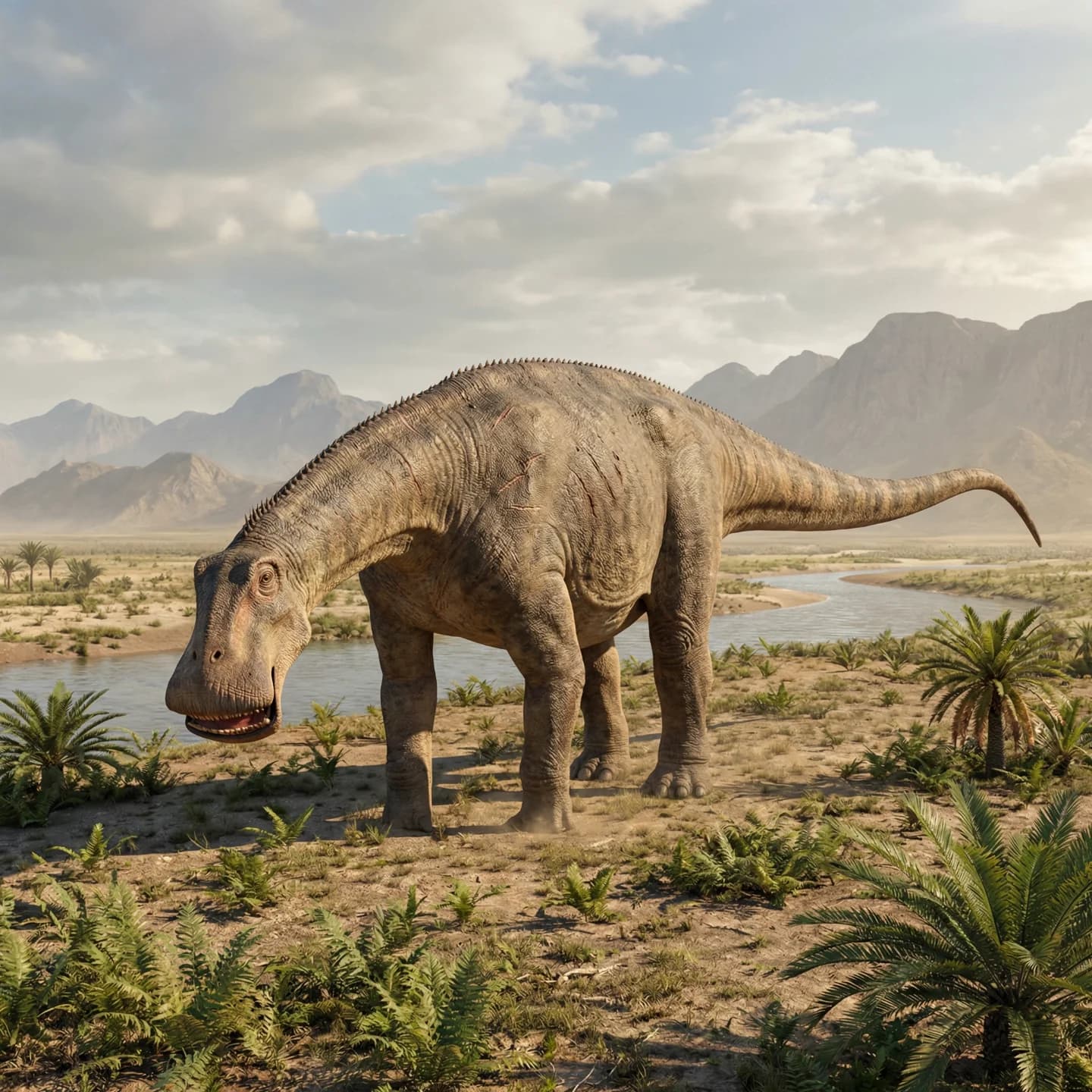
Nigersaurus taqueti (Sereno et al., 1999) is a small to medium-sized rebbachisaurid sauropod dinosaur from the Early Cretaceous (Aptian–Albian, approximately 115–105 Ma). It was discovered in the Elrhaz Formation at Gadoufaoua in the Ténéré Desert of the Republic of Niger. Fossils were first collected during 1965–1972 expeditions led by French palaeontologist Philippe Taquet and briefly described in 1976, but the genus was not formally named until 1999, when Paul C. Sereno and colleagues described more complete specimens recovered during expeditions in 1997 and 2000. The genus name Nigersaurus combines the country name Niger with the Greek sauros (lizard), meaning "Niger lizard," while the specific name taqueti honours Taquet for his pioneering work in Niger.
Small for a sauropod, Nigersaurus was approximately 9–14.1 m long and weighed an estimated 1.9–4 tonnes, comparable to a modern African elephant (Sereno et al., 2007; Campione & Evans, 2020). Its most remarkable feature is an extraordinarily specialised skull and dental apparatus. The front of the mouth held more than 500 slender teeth arranged in a "dental battery," with each tooth replaced approximately every 14 days—the fastest known replacement rate of any dinosaur (D'Emic et al., 2013). The broad, flat muzzle has been likened to a vacuum cleaner or lawn mower, and is interpreted as an adaptation for efficiently harvesting soft vegetation near ground level. Grooves at the front ends of the jaws indicate the presence of a keratinous sheath in life (Sereno et al., 2007). These unique features have earned Nigersaurus the nickname "the Mesozoic cow."
The skeleton of Nigersaurus is extremely pneumatised (permeated by air spaces connected to air sacs), and some skull bones are so thin that strong light can pass through them. As a result, no intact skulls or articulated skeletons have ever been found, yet disarticulated fossils are among the most common vertebrate remains at the site and provide the most complete known record of any rebbachisaurid (Sereno et al., 2007; Wilson & Sereno, 2005).
Overview
Name and Etymology
The genus name Nigersaurus combines the name of the Republic of Niger, where the fossils were found, with the Greek sauros (lizard), meaning "Niger lizard." The specific epithet taqueti honours French palaeontologist Philippe Taquet, who led the 1965–1972 expeditions to Niger and first collected remains of this dinosaur (Sereno et al., 1999).
Taxonomic Status
Nigersaurus belongs to the Sauropoda within Saurischia, and more specifically to the family Rebbachisauridae of the superfamily Diplodocoidea. Rebbachisauridae was a group of relatively small sauropods that flourished during the Cretaceous, most with short necks and body lengths of 10 m or less. Only Rebbachisaurus and Maraapunisaurus approached the sizes of larger sauropods (Sereno et al., 2007; Carpenter, 2018).
Whitlock (2011b) named the subfamily Nigersaurinae to include Nigersaurus and its closest relatives. However, Wilson & Allain (2015) and Fanti et al. (2015) found that Rebbachisaurus itself grouped within this clade, meaning the name Rebbachisaurinae would take priority. Conversely, Mannion et al. (2019) argued that because Nigersaurus is recovered as the sister taxon to all other nigersaurines in some analyses, the position of Rebbachisaurus could shift in future studies, and they therefore supported continued use of Nigersaurinae for all rebbachisaurids more closely related to Nigersaurus than to Limaysaurus. The subfamilial nomenclature thus remains under active debate.
Scientific Significance
Nigersaurus represents one of the most extreme examples of morphological and functional specialisation in sauropod evolution. Its dental battery of more than 500 teeth, the fastest known tooth replacement rate among dinosaurs (14 days), transversely rotated tooth rows, extremely pneumatised skeleton, and possible keratinous jaw sheath all represent unique adaptations. CT scan studies of the skull have revealed detailed endocast and inner ear morphology, providing crucial data for research on dinosaurian head posture and sensory capabilities (Sereno et al., 2007).
Geological Setting
Temporal Range
Nigersaurus dates to the Early Cretaceous Aptian–Albian stages, approximately 115–105 Ma. The overall age range of the Elrhaz Formation has been debated—Taquet (1976) considered it Barremian to late Albian and suggested an Aptian age—but most researchers assign the Nigersaurus-bearing horizons to the Aptian–Albian (Sereno et al., 1999; 2007). The broader formation range is sometimes cited as approximately 125–112 Ma.
Formation and Lithology
Nigersaurus is found in the Elrhaz Formation of the Tegama Group in the Iullemmeden Basin, Republic of Niger. The formation consists primarily of fluvial sandstone, coarse- to medium-grained, with almost no fine-grained horizons. Cross-bedding is well developed, indicating deposition by flowing rivers. Much of the formation is obscured by modern desert sand dunes, limiting outcrop exposure (Sereno et al., 1999; Sereno & Brusatte, 2008).
Depositional Environment and Palaeoenvironment
The Elrhaz Formation represents an inland floodplain and riparian (riverbank) environment. During the Aptian–Albian, the region was a lush, wet landscape with trees, vegetation, and broad rivers. Palaeogeographic reconstructions place the area near the equator (approximately 3.1°N, 4.9°E), within a tropical to subtropical climate zone. The Albian was one of the hottest intervals of the Phanerozoic, and this environmental context is relevant to the skeletal pneumaticity observed in rebbachisaurids, which may have assisted with thermoregulation (Ibiricu et al., 2017).
The principal fossil locality, Gadoufaoua (Tuareg for "the place where camels fear to go"), is today extremely hot and arid, but approximately 110 million years ago it supported broad river systems and abundant plant life.
Specimens and Diagnosis
Holotype and Key Specimens
The holotype (MNN GAD512) consists of a partial skull and neck. Limb bones and a scapula found nearby were also referred to the same individual. These specimens are housed in the National Museum of Niger (Sereno et al., 1999). The more detailed 2007 description was based on a specimen discovered in 1997, which was used to create a reconstructed skeleton mount and a plastic model of the head and neck, subsequently exhibited at the National Geographic Society in Washington, D.C. (Sereno et al., 2007).
Nigersaurus is one of the most commonly found vertebrates in the Elrhaz Formation. However, its skull and skeleton are so lightweight and pneumatised that fossils readily disarticulate and fragment. Some skull bones are so thin that strong light is visible through them. Consequently, no intact skull or articulated skeleton has been recovered, yet these specimens collectively represent the most complete known rebbachisaurid material (Sereno et al., 2007).
Diagnostic Features
According to Sereno et al. (1999, 2007), Nigersaurus is diagnosed by the following combination of characters. The four lateral skull fenestrae are proportionally larger than in other sauropodomorphs, with the total cross-sectional area of bone connecting the muzzle to the braincase only approximately 1.0 cm². The supratemporal fenestra is closed, unique among sauropodomorphs. The tooth rows are transversely rotated 90° so that all teeth face directly forward. The muzzle is wider than the skull. The dental batteries contain more than 500 teeth, with up to nine replacement teeth stacked beneath each active tooth. The frontal bone is elongate (much narrower than long) and bears a marked cerebral fossa. Paired pneumatic spaces occur at the base of the neural spines of dorsal vertebrae. The entire skeleton is extremely pneumatised. Grooves at the front of the jaws suggest the presence of a keratinous sheath.
Morphology and Function
Body Size
Nigersaurus was small for a sauropod, with an estimated body length of approximately 9–14.1 m and a femur length of only about 1 m. Body mass estimates range from approximately 1.9–4 tonnes, comparable to a modern elephant (Sereno et al., 2007; Campione & Evans, 2020; Henderson, 2013). The neck was short for a sauropod, comprising 13 cervical vertebrae. The forelimbs were about two-thirds the length of the hind limbs, as in most diplodocoids (Sereno et al., 2007).
Skull and Dentition
The skull of Nigersaurus is extremely specialised for feeding. The lateral fenestrae are very large and the bones very thin; the struts connecting the muzzle to the back of the skull are mostly less than 2 mm thick. The bony nostrils are elongated and positioned closer to the snout tip than in other diplodocoids. The snout is proportionately shorter and not prognathous (Wilson & Sereno, 2005). Despite its delicacy, the skull was structurally resistant to sustained shearing forces during feeding (Sereno et al., 2007).
The most striking feature is the dental apparatus. The tooth rows of both the maxilla and dentary are transversely rotated 90°, placing all teeth at the very front of the mouth—a configuration seen in no other tetrapod. The muzzle is wider than the skull, exceeding even the breadth of "duck-billed" hadrosaur snouts (Sereno et al., 2007).
The individual teeth are slender with slightly curved crowns, oval in cross-section, and bearing prominent ridges on the margins. Lower jaw teeth may have been 20–30% smaller than upper jaw teeth, but few are known and their maturity is uncertain (Sereno et al., 1999). With 68 tooth columns in the upper jaws and 60 in the lower jaws, each with up to nine replacement teeth stacked beneath the active tooth, the dental batteries contained more than 500 active and replacement teeth in total. The batteries erupted in unison rather than as individual columns (Sereno et al., 1999). Tooth enamel is highly asymmetric, up to ten times thicker on the labial (outer) side than on the lingual (inner) side. This extreme asymmetry is otherwise known only in advanced ornithischians, representing convergent evolution (D'Emic et al., 2013; Sereno et al., 1999).
The tooth replacement rate was the fastest known for any dinosaur. D'Emic et al. (2013) estimated replacement at approximately every 14 days, double the speed of a prior estimate of 30 days (based on transverse thin sections in Sereno et al., 2007). D'Emic and colleagues noted that longitudinal thin sections provide more accurate counts of von Ebner incremental lines, and that transverse sections may underestimate replacement rates due to the limited number of lines exposed in any given plane.
The lower jaw is L-shaped, with a subcylindrical transverse ramus bearing the teeth and a more lightweight posterior ramus for muscle attachment. The jaws contain five fenestrae not present in other sauropods, and grooves at the front ends indicate a keratinous sheath was present in life (Sereno et al., 2007).
Postcranial Skeleton
The dorsal (back) vertebrae are distinctive in having paired pneumatic spaces at the base of the neural spines. The presacral vertebrae are so heavily pneumatised that each is essentially a hollow shell, bisected by a thin central septum. There is little to no cancellous bone; the centra consist of thin bone plates surrounding air spaces. The vertebral arches are so extensively pierced by extensions of external air sacs that little remains of the lateral walls except intersecting laminae approximately 2 mm thick. In contrast, the caudal (tail) vertebrae have solid centra (Sereno et al., 2007).
The pelvic and pectoral girdle bones are also very thin, often only several millimetres thick. A prominent rugosity on the midline of the scapular blade base is a distinguishing feature. As in other sauropods, the limbs are robustly built, contrasting sharply with the extremely lightweight rest of the skeleton (Sereno et al., 1999; 2007).
Head Posture Debate
Sereno et al. (2007) CT-scanned skull elements of the holotype to create a "prototype" skull, then analysed the brain endocast and semicircular canals of the inner ear. Finding the semicircular canals oriented horizontally and the occiput and cervical vertebrae limiting vertical movement, they concluded that the head and muzzle were habitually oriented approximately 67° downward, close to ground level—unlike other sauropods, typically restored with more horizontal head postures.
Taylor et al. (2009) challenged this interpretation, noting that the "neutral" head posture of modern animals does not necessarily match their habitual posture and that semicircular canal orientation varies significantly within extant species. Marugán-Lobón et al. (2013) further criticised the precision of Sereno's methods, suggesting Nigersaurus may have held its head like other sauropods. Benoit et al. (2020) tested lateral semicircular canal correlation to head posture in modern mammals and found significant correlation, but the canal plane was not held exactly horizontal at rest. They also found that diet correlated strongly with canal orientation but not with head posture, while both head posture and canal orientation were strongly correlated with phylogeny. The exact habitual head posture of Nigersaurus therefore remains debated.
Diet and Ecology
Feeding Strategy
Nigersaurus is interpreted as a ground-level, non-selective browser that fed on soft vegetation within approximately 1 m of the surface. The wide muzzle and transversely oriented tooth rows would have enabled efficient gathering and cropping of food close to the ground (Sereno et al., 2007; Wilson & Sereno, 2005). Wear facets on the labial side of the upper teeth—similar to those in Dicraeosaurus and Diplodocus—indicate that food or substrate (soil/sand) abraded the teeth during feeding. Low-angle tooth-to-tooth wear on the inner surfaces of the maxillary crowns suggests jaw motion was limited to precise up-and-down movements (Sereno et al., 2007; Whitlock, 2011a).
The jaw adductor muscles appear to have attached to the quadrate rather than the supratemporal fenestra, and were likely weak, giving Nigersaurus one of the weakest bites among sauropods (Sereno et al., 2007). The small, nearly parallel tooth scratches and pits (caused by ingested grit, which is less commonly obtained by high-browsers) are consistent with consumption of relatively soft, herbaceous vegetation such as low-growing ferns (Whitlock, 2011a). The transverse orientation of the teeth would have precluded chewing (Wilson & Sereno, 2005).
Grass did not evolve until the Late Cretaceous, so ferns, horsetails, and angiosperms (already diversifying by the mid-Cretaceous) were likely food sources. Conifers, cycads, and aquatic vegetation are considered unlikely due to their height, rigid structure, and lack of appropriate habitat, respectively (Sereno et al., 2007). Hallett & Wedel (2016) also suggested the evenly spaced teeth could have functioned like a comb, straining aquatic plants or invertebrates similar to flamingos, and that Nigersaurus may have browsed on low-growing conifers.
Senses and Behaviour
Despite large nostrils and a fleshy snout, Nigersaurus had an underdeveloped olfactory region and thus likely lacked a keen sense of smell. Its brain-to-body mass ratio was average for a reptile, smaller than in ornithischians and non-coelurosaurian theropods. The cerebrum comprised approximately 30% of brain volume, comparable to many other dinosaurs (Sereno et al., 2007).
Hallett & Wedel (2016) observed that the eyes of Nigersaurus were positioned further toward the top of the skull than in most sauropods, above the muzzle, providing overlapping fields of view and a visual field at or close to 360°. Such panoramic vision would have been important for a vulnerable prey animal whose short neck precluded detecting predators from afar.
Function of Skeletal Pneumaticity
Ibiricu et al. (2017) examined postcranial pneumaticity in rebbachisaurids and proposed it reduced skeletal density, thereby decreasing the muscular energy and heat required to move the body. For animals inhabiting tropical to subtropical latitudes during the hot mid-Cretaceous, pneumaticity may have been a thermoregulatory advantage. This adaptation may explain why Rebbachisauridae was the only diplodocoid lineage to survive into the Late Cretaceous. Pneumatisation evolved progressively within the family, culminating in the nigersaurines (Fanti et al., 2013).
Lefebvre et al. (2023) examined the microanatomical structure of Nigersaurus limb bones via CT scans—the first such study of a sauropod. While other heavy animals (e.g., rhinoceroses) have thick, variable bone cortices, the cortex of Nigersaurus was comparatively thin. The authors suggested that sauropod limb bone microanatomy was not subjected to drastic selective pressure from weight bearing, and that columnar limbs, pneumaticity, fleshy foot pads, and cartilage relaxed stress on the bones. They concluded that sauropods may have been lighter than expected for their size, supporting the lowest body mass estimates.
Distribution and Palaeogeography
Known Distribution
Nigersaurus is currently confirmed only from the Elrhaz Formation at Gadoufaoua in the Ténéré Desert, Republic of Niger, where it is one of the most commonly found vertebrate fossils.
Teeth similar to those of Nigersaurus have been reported from the Isle of Wight (England) and Brazil, but whether they belong to relatives of Nigersaurus or to titanosaurs found nearby remains unclear. A lower jaw assigned to the titanosaur Antarctosaurus also resembles that of Nigersaurus, but may represent convergent evolution (Wilson & Sereno, 2005).
Palaeogeographic Context
During the Aptian–Albian, Africa was still part of Gondwana and not yet fully separated from South America. Palaeocoordinate reconstructions place the Elrhaz Formation near the equator (approximately 3.1°N, 4.9°E) in a tropical to subtropical climate.
The distribution of Nigersaurinae (or Rebbachisaurinae) is predominantly restricted to North Africa and Europe, suggesting that carbonate platforms bridging the Tethys Sea connected these landmasses (Fernández-Baldor et al., 2011; Fanti et al., 2013). In South America, the sister clade Limaysaurinae is known primarily from Argentina. The recent description of Itapeuasaurus from Brazil as a nigersaurine (Lindoso et al., 2019) suggests this lineage may have had a broader distribution than previously thought, complicating palaeobiogeographic hypotheses.
Phylogeny and Taxonomic Debate
Classification History
The remains of Nigersaurus were initially described by Taquet (1976) as belonging to Dicraeosauridae, but Sereno et al. (1999) reclassified it as a rebbachisaurid diplodocoid. These researchers speculated that the short neck and small size known among basal diplodocoids might be ancestral features of the group.
Whitlock (2011b) named Nigersaurinae to include Nigersaurus and closely related genera. Wilson & Allain (2015) and Fanti et al. (2015) found that Rebbachisaurus itself grouped within this clade, making Rebbachisaurinae the senior synonym. Fanti et al. (2015) recovered Nigersaurus as the basalmost member of this "Euro-African" subclade.
Recent Phylogenetic Analyses
Fanti et al. (2013, 2015) placed Nigersaurus at the base of a "Euro-African clade" closely related to Demandasaurus from Spain and Tataouinea from Tunisia. Notably, the African Tataouinea is recovered closer to the European Demandasaurus than to the African Nigersaurus, suggesting dispersal across the Tethys Sea.
Mannion et al. (2019) noted that because Nigersaurus is the sister taxon of all other nigersaurines in some analyses, a Rebbachisaurinae clade might not necessarily include Nigersaurus itself if the position of Rebbachisaurus shifts. They therefore supported continued use of Nigersaurinae for all rebbachisaurids more closely related to Nigersaurus than to Limaysaurus. Lindoso et al. (2019) followed this recommendation and placed Itapeuasaurus from Brazil within Nigersaurinae, thereby expanding the known distribution of this lineage.
| Taxon | Family | Age | Region | Est. Length | Key Features |
|---|---|---|---|---|---|
| Nigersaurus taqueti | Rebbachisauridae | Aptian–Albian (115–105 Ma) | Africa (Niger) | 9–14.1 m | 500+ teeth, wide muzzle, ground-level feeder |
| Rebbachisaurus garasbae | Rebbachisauridae | Cenomanian (100–94 Ma) | Africa (Morocco) | 14 m | Larger size, longer neck |
| Demandasaurus darwini | Rebbachisauridae | Barremian–Aptian (130–120 Ma) | Europe (Spain) | 12 m | Evidence for Euro-African connection |
| Tataouinea hannibalis | Rebbachisauridae | Albian (113–100 Ma) | Africa (Tunisia) | Unknown | Extreme pneumatisation |
| Diplodocus longus | Diplodocidae | Kimmeridgian–Tithonian (154–150 Ma) | North America | 25 m | Long neck, whip-like tail |
Reconstruction and Uncertainty
Confirmed
The following are supported by direct fossil evidence: Nigersaurus inhabited a floodplain/riparian environment in Africa during the Early Cretaceous (~115–105 Ma); it belongs to Rebbachisauridae; it possessed dental batteries containing more than 500 teeth with a replacement rate of approximately 14 days; its tooth rows were transversely rotated so all teeth faced forward; its skeleton was extremely pneumatised; and grooves at the jaw tips strongly suggest a keratinous sheath.
Probable Hypotheses
Body length of approximately 9–14.1 m and mass of approximately 1.9–4 tonnes are well-supported estimates but are based on incomplete material. The inference that it fed primarily on soft, herbaceous plants (ferns, horsetails, angiosperms) near ground level is strongly supported by tooth wear patterns and microwear analysis but is not definitively confirmed.
Uncertain
The exact habitual head posture (approximately 67° downward vs. near-horizontal as in other sauropods) remains actively debated (Sereno et al., 2007 vs. Taylor et al., 2009; Marugán-Lobón et al., 2013; Benoit et al., 2020). Because no intact skull or articulated skeleton has been found, there is some uncertainty in overall body reconstruction. Soft-tissue features such as colouration and integument texture are unknown.
Coexisting Fauna
Nigersaurus was the second most common megaherbivore in the Elrhaz Formation, after the iguanodontian Lurdusaurus. Other herbivorous dinosaurs from the same formation include Ouranosaurus, Elrhazosaurus, and an unnamed titanosaur. This assemblage represents one of the few known megaherbivore communities with a balance of sauropods and large ornithopods.
Coexisting theropods include the baryonychine spinosaurid Suchomimus, the abelisaurid Kryptops, Eocarcharia, and Afromimus. Crocodylomorphs include the giant "SuperCroc" Sarcosuchus imperator, Anatosuchus, Araripesuchus, and Stolokrosuchus. A pterosaur, chelonians, fish, a hybodont shark, and freshwater bivalves have also been recovered. The aquatic fauna consists entirely of freshwater inhabitants (Sereno et al., 2007; Sereno & Brusatte, 2008; Sereno, 2017).
Fun Facts
FAQ
📚References
- Sereno, P. C., Beck, A. L., Dutheil, D. B., Larsson, H. C., Lyon, G. H., Moussa, B., Sadleir, R. W., Sidor, C. A., Varricchio, D. J., Wilson, G. P., & Wilson, J. A. (1999). Cretaceous sauropods from the Sahara and the uneven rate of skeletal evolution among dinosaurs. Science, 286(5443), 1342–1347. https://doi.org/10.1126/science.286.5443.1342
- Sereno, P. C., Wilson, J. A., Witmer, L. M., Whitlock, J. A., Maga, A., Ide, O., & Rowe, T. A. (2007). Structural extremes in a Cretaceous dinosaur. PLOS ONE, 2(11), e1230. https://doi.org/10.1371/journal.pone.0001230
- Wilson, J. A., & Sereno, P. C. (2005). Structure and evolution of a sauropod tooth battery. In K. Curry Rogers & J. A. Wilson (Eds.), The Sauropods: Evolution and Paleobiology (pp. 157–177). University of California Press.
- Taquet, P. (1976). Géologie et paléontologie du gisement de Gadoufaoua (Aptien du Niger). Cahiers de Paléontologie. Paris.
- D'Emic, M. D., Whitlock, J. A., Smith, K. M., Fisher, D. C., & Wilson, J. A. (2013). Evolution of high tooth replacement rates in sauropod dinosaurs. PLOS ONE, 8(7), e69235. https://doi.org/10.1371/journal.pone.0069235
- Whitlock, J. A. (2011a). Inferences of diplodocoid (Sauropoda: Dinosauria) feeding behavior from snout shape and microwear analyses. PLOS ONE, 6(4), e18304. https://doi.org/10.1371/journal.pone.0018304
- Whitlock, J. A. (2011b). A phylogenetic analysis of Diplodocoidea (Saurischia: Sauropoda). Zoological Journal of the Linnean Society, 161(4), 872–915. https://doi.org/10.1111/j.1096-3642.2010.00665.x
- Fanti, F., Cau, A., Hassine, M., & Contessi, M. (2013). A new sauropod dinosaur from the Early Cretaceous of Tunisia with extreme avian-like pneumatization. Nature Communications, 4, 2080. https://doi.org/10.1038/ncomms3080
- Fanti, F., Cau, A., Cantelli, L., Hassine, M., & Auditore, M. (2015). New information on Tataouinea hannibalis from the Early Cretaceous of Tunisia and implications for the tempo and mode of rebbachisaurid sauropod evolution. PLOS ONE, 10(4), e0123475. https://doi.org/10.1371/journal.pone.0123475
- Wilson, J. A., & Allain, R. (2015). Osteology of Rebbachisaurus garasbae Lavocat, 1954, a diplodocoid (Dinosauria, Sauropoda) from the early Late Cretaceous–aged Kem Kem beds of southeastern Morocco. Journal of Vertebrate Paleontology, 35(4), e1000701. https://doi.org/10.1080/02724634.2014.1000701
- Taylor, M. P., Wedel, M. J., & Naish, D. (2009). Head and neck posture in sauropod dinosaurs inferred from extant animals. Acta Palaeontologica Polonica, 54(2), 213–220. https://doi.org/10.4202/app.2009.0007
- Marugán-Lobón, J. S., Chiappe, L. M., & Farke, A. A. (2013). The variability of inner ear orientation in saurischian dinosaurs: Testing the use of semicircular canals as a reference system for comparative anatomy. PeerJ, 1, e124. https://doi.org/10.7717/peerj.124
- Benoit, J., Legendre, L. J., Farke, A. A., Neenan, J. M., Mennecart, B., Costeur, L., Merigeaud, S., & Manger, P. R. (2020). A test of the lateral semicircular canal correlation to head posture, diet and other biological traits in "ungulate" mammals. Scientific Reports, 10(1), 19602. https://doi.org/10.1038/s41598-020-76757-0
- Campione, N. E., & Evans, D. C. (2020). The accuracy and precision of body mass estimation in non-avian dinosaurs. Biological Reviews, 95(6), 1759–1797. https://doi.org/10.1111/brv.12638
- Henderson, D. M. (2013). Sauropod necks: Are they really for heat loss? PLOS ONE, 8(10), e77108. https://doi.org/10.1371/journal.pone.0077108
- Ibiricu, L., Lamanna, M., Martinez, R., Casal, G., Cerda, I., Martinez, G., & Salgado, L. (2017). A novel form of postcranial skeletal pneumaticity in a sauropod dinosaur: Implications for the paleobiology of Rebbachisauridae. Acta Palaeontologica Polonica, 62. https://doi.org/10.4202/app.00316.2016
- Lefebvre, R., Allain, R., & Houssaye, A. (2023). What's inside a sauropod limb? First three-dimensional investigation of the limb long bone microanatomy of a sauropod dinosaur, Nigersaurus taqueti (Neosauropoda, Rebbachisauridae), and implications for the weight-bearing function. Palaeontology, 66(4), e12670. https://doi.org/10.1111/pala.12670
- Hallett, M., & Wedel, M. J. (2016). The Sauropod Dinosaurs: Life in the Age of Giants. Johns Hopkins University Press.
- Mannion, P. D., Upchurch, P., Schwarz, D., & Wings, O. (2019). Taxonomic affinities of the putative titanosaurs from the Late Jurassic Tendaguru Formation of Tanzania: Phylogenetic and biogeographic implications for eusauropod dinosaur evolution. Zoological Journal of the Linnean Society, 185(3), 784–909. https://doi.org/10.1093/zoolinnean/zly068
- Lindoso, R. M., Medeiros, M. A. A., Carvalho, I. d. S., Pereira, A. A., Mendes, I. D., Iori, F. V., Sousa, E. P., Souza Arcanjo, S. H., & Madeira Silva, T. C. (2019). A new rebbachisaurid (Sauropoda: Diplodocoidea) from the middle Cretaceous of northern Brazil. Cretaceous Research, 104, 104191. https://doi.org/10.1016/j.cretres.2019.104191
- Fernández-Baldor, F. T., Canudo, J. I., Huerta, P., Montero, D., Suberbiola, X. P., & Salgado, L. (2011). Demandasaurus darwini, a new rebbachisaurid sauropod from the Early Cretaceous of the Iberian Peninsula. Acta Palaeontologica Polonica, 56(3), 535–552. https://doi.org/10.4202/app.2010.0003
- Carpenter, K. (2018). Maraapunisaurus fragillimus, N.G. (formerly Amphicoelias fragillimus), a basal Rebbachisaurid from the Morrison Formation (Upper Jurassic) of Colorado. Geology of the Intermountain West, 5, 227–244. https://doi.org/10.31711/giw.v5i0.28
- Sereno, P. C., & Brusatte, S. L. (2008). Basal abelisaurid and carcharodontosaurid theropods from the Lower Cretaceous Elrhaz Formation of Niger. Acta Palaeontologica Polonica, 53(1), 15–46. https://doi.org/10.4202/app.2008.0102
- Sereno, P. C. (2017). Early Cretaceous ornithomimosaurs (Dinosauria: Coelurosauria) from Africa. Ameghiniana, 54(5), 576–616. https://doi.org/10.5710/AMGH.23.10.2017.3155
- D'Emic, M. D. (2024). Increased sampling reveals the complex evolution of sauropod dinosaur tooth replacement rates. Journal of Anatomy. https://doi.org/10.1111/joa.14169
Gallery
5 images Nigersaurus
Nigersaurus · Cretaceous Period · Herbivore
 Nigersaurus
Nigersaurus · Cretaceous Period · Herbivore
 Nigersaurus
Nigersaurus · Cretaceous Period · Herbivore
 Nigersaurus
Nigersaurus · Cretaceous Period · Herbivore
 Nigersaurus
Nigersaurus · Cretaceous Period · Herbivore
🔗Related Creatures

Edmontosaurus
Edmontosaurus

Nasutoceratops
Nasutoceratops titusi
Zuniceratops
Zuniceratops christopheri
Einiosaurus
Einiosaurus procurvicornis

Iguanodon
Iguanodon bernissartensis
Peloroplites
Peloroplites cedrimontanus

Corythosaurus
Corythosaurus casuarius

Diabloceratops
Diabloceratops eatoni