Sarcosuchus
Cretaceous Period Carnivore Creature Type
Sarcosuchus imperator
Scientific Name: "Sarcosuchus: Ancient Greek σάρξ (sárx, 'flesh') + Σοῦχος (Soûkhos, Egyptian crocodile god Sobek) = 'flesh crocodile'; imperator: Latin 'emperor, commander'"
Local Name: Sarcosuchus
Physical Characteristics
Discovery
Habitat
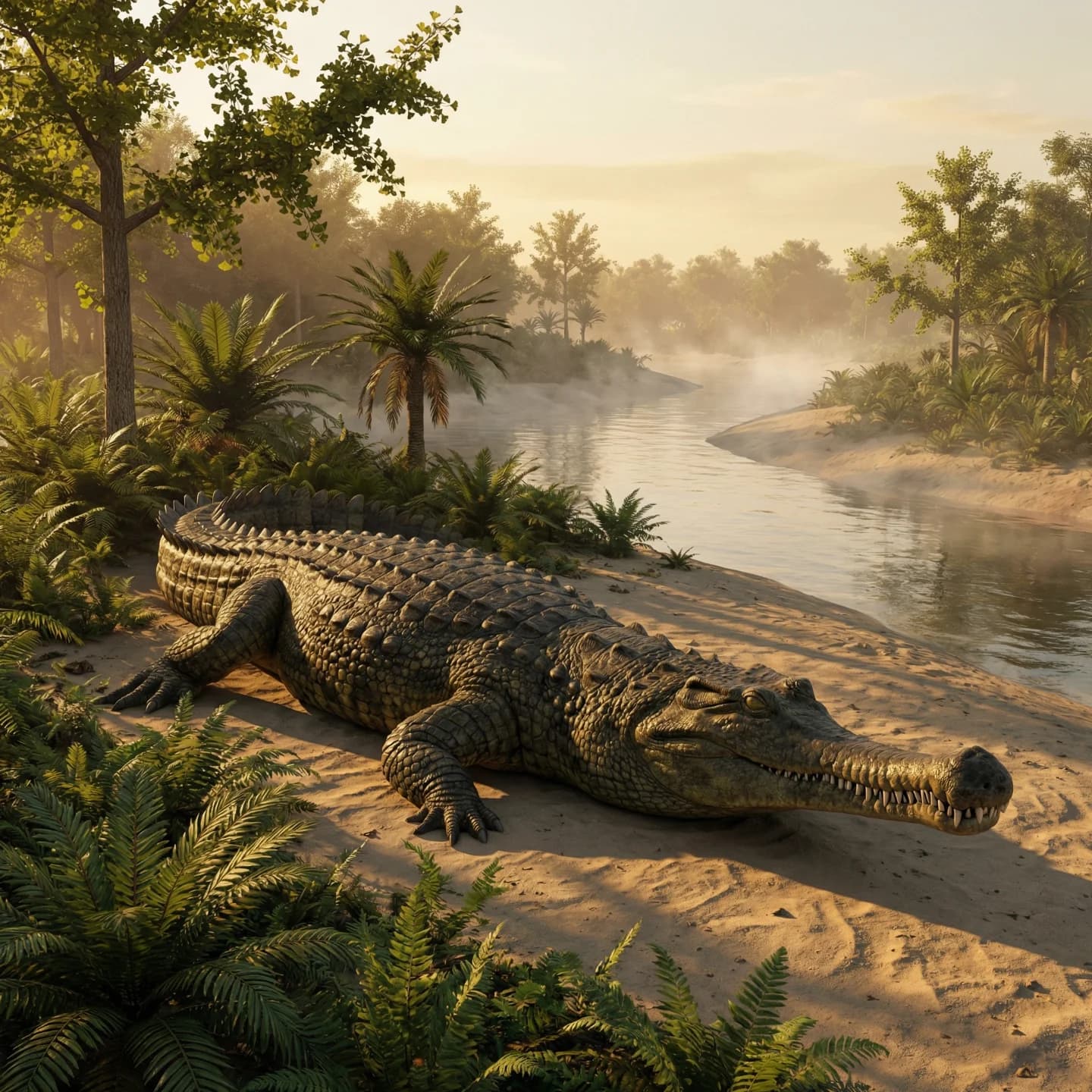
Sarcosuchus imperator (Broin & Taquet, 1966) is a giant crocodyliform that lived during the Early Cretaceous, from the late Hauterivian to the early Albian stages, approximately 130 to 112 million years ago, in what is now Africa and South America. Although superficially resembling modern crocodilians, Sarcosuchus is classified as a neosuchian crocodyliform outside of Crocodylia (the crown group containing living crocodiles, alligators, and gharials), placed within the family Pholidosauridae or the broader clade Tethysuchia. It is therefore not a direct ancestor of any living crocodilian but rather a distant relative that shared the same Cretaceous ecosystems.
Sarcosuchus was one of the largest pseudosuchians ever to have lived, with the largest specimen of S. imperator estimated to have reached approximately 9–9.5 metres (29.5–31.2 ft) in total length and 3.45–4.3 metric tons (3.80–4.74 short tons) in weight (O'Brien et al., 2019). Earlier estimates by Sereno et al. (2001), based on skull length-to-body length regressions from extant gharials and saltwater crocodiles, suggested a maximum body length of 11–12 metres and a body mass of approximately 8 metric tons. However, O'Brien et al. (2019) applied head width allometric equations more appropriate for longirostrine crocodyliforms, yielding the more conservative estimates that are now more widely accepted. Two species are recognised: the type species S. imperator from the early Albian Elrhaz Formation of Niger, and S. hartti from the late Hauterivian Ilhas Group in northeastern Brazil.
Popularly nicknamed "SuperCroc," this animal gained worldwide fame following the publication by Paul Sereno and colleagues in Science in 2001, which described new skulls and partial skeletons from Niger. Calcium isotope analysis has since shown that Sarcosuchus was a generalist predator that consumed both fish and herbivorous dinosaurs (Hassler et al., 2018), partitioning ecological niches with co-occurring spinosaurid theropods that shared the same waterways.
Overview
Name and Etymology
The genus name Sarcosuchus is derived from the Ancient Greek σάρξ (sárx, meaning "flesh") and Σοῦχος (Soûkhos, referring to the Egyptian crocodile god Sobek), translating to "flesh crocodile." The species epithet imperator is Latin for "emperor" or "commander," reflecting the animal's enormous size. The name was coined in 1966 by French palaeontologists France de Broin and Philippe Taquet, based on a nearly complete skull discovered in the Gadoufaoua region of the Ténéré Desert, Niger (de Broin & Taquet, 1966). The second species, S. hartti, is named in honour of American naturalist Charles Hartt, who first collected crocodyliform teeth in Brazil in 1867. These teeth were originally described by O. C. Marsh (1869) as Crocodylus hartti and were later reassigned to Sarcosuchus by Buffetaut & Taquet (1977).
Taxonomic Status
Two species of Sarcosuchus are currently considered valid. The type species S. imperator is known primarily from Niger, with additional material from Algeria, Mali, Tunisia, Morocco, and possibly Libya. The second species, S. hartti, is known from the Recôncavo Basin of northeastern Brazil. Although some authors previously synonymised the two species, the systematic revision by Souza et al. (2019) confirmed that S. hartti is a valid separate species, diagnosed by a unique anastomosing ornamentation pattern on the enamel surface and other autapomorphies of the mandible.
Scientific Significance
Sarcosuchus represents a striking example of the extreme body sizes that non-crocodylian crocodyliforms could achieve during the Mesozoic. It also demonstrates the ecological diversity within Tethysuchia/Pholidosauridae: whereas most pholidosaurids were slender-snouted piscivorous specialists adapted to near-shore marine habitats, Sarcosuchus evolved as a broad-snouted generalist predator thriving in inland freshwater environments (Sereno et al., 2001).
Geological Setting and Palaeoenvironment
Temporal Range
The genus Sarcosuchus spans from the late Hauterivian to the early Albian, approximately 130–112 million years ago. S. imperator is primarily known from the Elrhaz Formation (Tegama Group) in Niger, dated to the late Aptian–early Albian (approximately 115–112 Ma) (Sereno et al., 2001, 2007). S. hartti occurs in the Ilhas Group of the Recôncavo Basin in Brazil, dated to the late Hauterivian–early Barremian (approximately 130–125 Ma) (Souza et al., 2019). Additional Sarcosuchus material has been reported from the Aïn el Guettar Formation (Oum Ed Dhiab Member) in Tunisia, of Aptian–Albian age (Dridi, 2018), and tooth enamel identified as cf. Sarcosuchus from the Ifezouane Formation (lower Kem Kem beds) of Morocco may extend the temporal range into the Cenomanian (Amiot et al., 2010).
Stratigraphy and Lithology
The principal fossil-bearing unit for S. imperator, the Elrhaz Formation, is composed almost exclusively of cross-bedded medium-grained fluvial sandstones with two clay member intervals. The most productive locality is Gadoufaoua (Tuareg for "the place where camels fear to go") in the Ténéré Desert of Niger, where numerous skulls and partial skeletons have been recovered. The Ilhas Group of Brazil, which yields S. hartti, comprises a succession of conglomerates, sandstones, and highly fossiliferous shales interpreted as prograding deltaic deposits (Souza et al., 2019).
Palaeoenvironment
The sedimentary facies and associated aquatic fauna of the Elrhaz Formation — including the coelacanth Mawsonia, the holostean fish Lepidotus, and diverse freshwater turtles — indicate an inland freshwater fluvial environment under a humid tropical climate (Sereno et al., 2001; Sereno et al., 2007). There is no evidence of marine influence at the Elrhaz fossil sites, establishing the habitat as entirely freshwater. This contrasts sharply with most other pholidosaurid relatives, which are typically found in coastal or marine settings, and underscores the unique ecological niche occupied by Sarcosuchus.
Specimens and Diagnostic Features
Holotype and Key Specimens
The holotype of S. imperator is a nearly complete skull discovered in 1964 by a French CEA (Commissariat à l'énergie atomique) survey team in the Gadoufaoua region of Niger. It was shipped to Paris for study and became the basis for the formal naming of the genus and species (de Broin & Taquet, 1966). This skull measures approximately 1.6 m in total length (1.5 m along the midline) and is the largest verified S. imperator skull on record. Sereno et al. (2001) reported six additional specimens from the 1997 and 2000 expeditions, including MNN 604 (adult skull and mandible), MNN 605 (juvenile skull, cervical vertebrae, and osteoderms), MNN 606 (subadult posterior dorsal vertebrae and pelvis), and MNN 607 (subadult with osteoderms). One specimen preserved approximately half the skeleton including most of the spine.
The lectotype of S. hartti is YPM 516 (a tooth housed at the Yale Peabody Museum), designated by Norell & Storrs (1989) and formally confirmed as the lectotype by Souza et al. (2019). Referred specimens include BMNH R3423 (a large incomplete mandible with teeth), BMNH R3224 (a dorsal osteoderm), and BMNH R3079 (a tooth), all in the Natural History Museum, London. Specimens MN 7459-V, MN 7460-V, and MN 7461-V from the Museu Nacional in Rio de Janeiro were tragically lost in the devastating fire of September 2018 (Souza et al., 2019).
| Specimen | Species | Elements | Repository | Reference |
|---|---|---|---|---|
| Holotype skull (MNN) | S. imperator | Nearly complete skull (160 cm) | Musée National du Niger | de Broin & Taquet, 1966 |
| MNN 604 | S. imperator | Adult skull and mandible | Musée National du Niger | Sereno et al., 2001 |
| MNN 605 | S. imperator | Juvenile skull, cervicals, osteoderms | Musée National du Niger | Sereno et al., 2001 |
| MNN 606 | S. imperator | Subadult posterior dorsals, pelvis | Musée National du Niger | Sereno et al., 2001 |
| YPM 516 | S. hartti | Tooth (lectotype) | Yale Peabody Museum | Marsh, 1869; Souza et al., 2019 |
| BMNH R3423 | S. hartti | Incomplete mandible with teeth | Natural History Museum, London | Mawson & Woodward, 1907 |
Diagnosis
The revised diagnosis of S. imperator by Sereno et al. (2001) includes the following features: a premaxillary narial bulla is present; the maxillae expand approximately 25% in width anteriorly; and the anterior maxillary teeth are reduced in size. At the genus level, Souza et al. (2019) emended the diagnosis of Sarcosuchus to include a combination of features such as enlarged dentary teeth 3 and 4; a diastema between dentary teeth 4 and 5; a fan-shaped distal expansion of the dentary reaching a width 50% greater than the narrowest portion of the rami; and the dentary symphysis extending posteriorly to approximately dentary tooth 20.
Limitations of the Fossil Record
No single complete skeleton of Sarcosuchus has been found. Body length and mass estimates are based on composite reconstructions from multiple incomplete specimens. For S. hartti, only fragmentary material is known — teeth, mandible fragments, and isolated osteoderms — so the complete cranial morphology of this species remains undocumented.
Morphology and Functional Anatomy
Skull Architecture
The skull of S. imperator reached up to 1.5 m along the midline (1.6 m total) in the largest known specimen. The snout is proportionately long, comprising approximately 75% of the total skull length (Sereno et al., 2001). The orbits are dorsally oriented and moderately telescoped, enabling the animal to observe above the water surface while most of the body remained submerged. A distinctive feature is the bulla — a rounded expansion at the end of the snout surrounding the external naris. This structure has been compared to the ghara of male gharials, but unlike the ghara, which is present only in males and serves as a sexual display organ, the bulla appears in all known Sarcosuchus skulls regardless of inferred sex. Its function remains unknown.
A remarkable ontogenetic transformation is documented: juvenile individuals possess a narrow, gharial-like snout, while in fully grown adults the snout becomes considerably broader and more robust (Sereno et al., 2001, Table 1). The upper jaw is noticeably longer than the lower jaw, creating an overbite with a gap of approximately 10 cm between the premaxillary tooth row and the anterior margin of the mandible.
Dentition
There are 35 teeth on each side of the upper jaw (5 premaxillary + 30 maxillary) and 31 on each side of the lower jaw, for a total of approximately 132 teeth. The third and fourth premaxillary teeth and the 10th maxillary tooth are enlarged. The tooth crowns are smooth and remarkably stout, bearing carinae (keels) along their anterior and posterior edges but otherwise lacking denticles. Critically, the teeth do not interlock when the jaws are closed, contrasting with the elongate, interlocking dentition of specialised piscivorous crocodyliformes such as the gharial. This non-interlocking arrangement, combined with the broad snout of adults, suggests a generalist diet analogous to that of the Nile crocodile (Crocodylus niloticus), which routinely takes large terrestrial prey (Sereno et al., 2001).
Osteoderms
The osteoderms (dermal scutes) of Sarcosuchus formed a continuous armoured surface extending from the posterior part of the neck to the middle of the tail. This pattern is similar to that of basal crocodyliforms like Araripesuchus and contrasts with modern crocodilians, which exhibit a discontinuity between the cervical and trunk armour. The osteoderms bear low, laterally positioned keels and hook-shaped anterolateral processes with overlapping articular surfaces. Thin sections of trunk osteoderms from a subadult individual (approximately 80% of estimated maximum adult size) revealed approximately 40 lines of arrested growth (LAGs), suggesting that S. imperator took 50–60 years to reach full adult size (Sereno et al., 2001).
Body Size Estimates
Sereno et al. (2001) used the largest known skull (midline length 150 cm) with regression equations derived from captive gharials (Gavialis gangeticus, n=17) and wild saltwater crocodiles (Crocodylus porosus, n=28) to estimate maximum body length at approximately 11.65 m (mean of both regressions) and body mass at approximately 8 metric tons. However, O'Brien et al. (2019) demonstrated that skull-length-based regressions significantly overestimate body size in longirostrine forms. Using head width allometry and phylogenetically conserved body proportions, they estimated the largest S. imperator at nearly 9 metres (mean) with an upper quartile estimate of 9.5 metres, and body mass at 3.45 metric tons (upper quartile 4.3 metric tons). Femur circumference-based extrapolation from a subadult individual yielded a scaled-up adult mass of approximately 3,215 kg, broadly consistent with the head-width method. The more conservative estimates of O'Brien et al. (2019) are currently more widely accepted in the literature.
| Study | Estimated max. length | Estimated max. mass | Method |
|---|---|---|---|
| Sereno et al. (2001) | ~11–12 m | ~8 t | Gharial/saltwater croc skull length–body length regression |
| O'Brien et al. (2019) median | ~9 m | ~3.45 t | Longirostrine croc head width–body length allometry |
| O'Brien et al. (2019) upper quartile | ~9.5 m | ~4.3 t | Upper quartile estimate |
Vertebral Column and Limbs
All vertebral centra are amphicoelous (biconcave), contrasting with the procoelous condition seen in crown-group Crocodylia. The cervical vertebrae have shallow ventral keels and short overlapping ribs. The dorsal vertebrae bear long transverse processes and stout neural spines. The scapulae, coracoids, and pubes are strongly flared, indicating a robust build. Only the femur is known among the limb bones, limiting precise reconstruction of locomotion.
Diet and Palaeoecology
Feeding Ecology (Evidence-Based)
Multiple lines of evidence converge on a generalist predatory ecology for Sarcosuchus. First, the broad adult snout and non-interlocking, stout-crowned teeth are morphologically consistent with a mixed diet of fish and large terrestrial prey, analogous to the extant Nile crocodile (Sereno et al., 2001). Second, calcium isotope analysis (δ⁴⁴/⁴²Ca) of tooth enamel by Hassler et al. (2018) revealed that S. imperator had an intermediate isotopic signature: fish constituted approximately 58% of its calcium fraction, with the remainder derived from herbivorous dinosaurs such as Nigersaurus and Ouranosaurus. This isotopic profile is distinct from co-occurring spinosaurids (predominantly aquatic foragers) and abelisaurids/carcharodontosaurids (almost exclusively feeding on herbivorous dinosaurs), providing direct geochemical evidence of niche partitioning.
Death Roll Capability
Blanco et al. (2014/2015) developed a biomechanical model to assess the capability of giant fossil crocodyliforms to withstand the torsional stresses associated with the "death roll" — the spinning manoeuvre used by extant crocodilians to dismember prey. Their analysis suggested that while Deinosuchus could likely perform a death roll, the longirostrine skull of Sarcosuchus was structurally inadequate to withstand such forces. This implies that if S. imperator preyed on large terrestrial animals, it likely employed a different method of prey processing than that used by modern broad-snouted crocodilians.
Co-occurring Fauna
The Elrhaz Formation preserves a remarkably diverse vertebrate assemblage. Herbivorous dinosaurs included the iguanodontians Lurdusaurus (the most common dinosaur in the formation) and Ouranosaurus, as well as the rebbachisaurid sauropod Nigersaurus. Large predators included the baryonychine spinosaurid Suchomimus, the abelisaurid Kryptops, and possible carcharodontosaurid material. Aquatic fauna included the coelacanth Mawsonia and the holostean fish Lepidotus, as well as multiple species of freshwater turtles. Calcium isotope data demonstrate resource partitioning among these predators: spinosaurids primarily foraged in aquatic environments, abelisaurids and carcharodontosaurids fed almost exclusively on terrestrial herbivores, and Sarcosuchus occupied an intermediate niche (Hassler et al., 2018).
Growth Strategy
The approximately 40 LAGs counted in the osteoderms of a subadult S. imperator (approximately 80% maximum adult size) indicate that full adult size was reached only after 50–60 years (Sereno et al., 2001). Since extant wild crocodilians rarely sustain active growth or survive to such advanced ages (Woodward et al., 1995), Sereno et al. (2001) proposed that S. imperator achieved its enormous size by extending the duration of rapid juvenile growth rather than accelerating the rate of bone deposition. A similar growth strategy has been proposed for the equally gigantic Deinosuchus (Erickson & Brochu, 1999).
Biogeography and Palaeogeography
Geographic Distribution
Fossils of Sarcosuchus have been recovered from across Africa (Niger, Algeria, Mali, Tunisia, Morocco, and possibly Libya) and South America (northeastern Brazil). The richest locality is Gadoufaoua in Niger. In Tunisia, Dridi (2018) described new Sarcosuchus material from the Oum Ed Dhiab Member of the Aïn el Guettar Formation in the Tataouine Basin. Material from the Cabao Formation of northwestern Libya (Le Loeuff et al., 2010) may also be referable to S. imperator, though this requires confirmation. In Morocco, tooth enamel from the Ifezouane Formation (lower Kem Kem beds) has been tentatively assigned to cf. Sarcosuchus (Amiot et al., 2010).
Palaeogeographic Context
During the Early Cretaceous, Africa and South America were still part of Gondwana and had not yet fully separated. Souza et al. (2019) proposed that the two species of Sarcosuchus may represent the products of a cladogenesis event triggered by the progressive rifting of Gondwana. The approximate palaeocoordinates for the Elrhaz Formation are 3.1°N, 4.9°E, placing the fossil locality very close to the equator in a humid tropical setting.
Phylogeny and Classification
Traditional Classification: Pholidosauridae
In the maximum parsimony analysis of Sereno et al. (2001), Sarcosuchus was recovered as the closest relative of the North American genus Terminonaris, with these two genera united by seven unambiguous synapomorphies. Together with the European Pholidosaurus and Dyrosaurus, they formed a clade positioned as basal neosuchians, allied with but outside Crocodylia and the radiation that gave rise to all living crocodilians. Fortier et al. (2011) recovered a similar topology in their phylogenetic analysis.
Alternative Classification: Tethysuchia
The systematic revision by Souza et al. (2019) included a novel phylogenetic analysis with 50 ingroup taxa, in which Sarcosuchus was recovered in a more derived position within Tethysuchia, phylogenetically closer to Dyrosauridae than to the traditional Pholidosauridae core. This analysis also defined a new clade, "Tethysuchoidea." The monophyly of Pholidosauridae and the precise phylogenetic placement of Sarcosuchus remain debated, as results vary depending on taxon and character sampling.
Relationship to Modern Crocodilians
Sarcosuchus is not a member of the crown group Crocodylia. Crocodylia is defined as the clade comprising Gavialis gangeticus, Crocodylus niloticus, and all descendants of their most recent common ancestor (Sereno, 1999). Sarcosuchus falls outside this definition as a non-crocodylian neosuchian. The superficial resemblance to modern crocodilians is due to convergent evolution and shared ancestral body-plan constraints common to semi-aquatic archosaurs.
Reconstruction and Uncertainties
Confirmed
Skull morphology (longirostrine with narial bulla, overbite), dentition arrangement (approximately 132 teeth, non-interlocking), continuous osteoderm armour, amphicoelous vertebral centra, and LAG-based longevity (50–60 years) are directly confirmed by fossil evidence.
Well-Supported Inferences
The generalist predator ecology (jaw morphology + calcium isotope evidence), freshwater fluvial habitat (sedimentary facies + associated fossils), and the revised body size of approximately 9–9.5 m / 3.45–4.3 t (O'Brien et al., 2019) are supported by multiple converging lines of evidence.
Hypothetical
The function of the narial bulla (vocalisation resonator? olfactory enhancement?), precise hunting behaviour (alternative prey-processing methods given the inability to perform a death roll), degree of social behaviour, and the timing of divergence between S. imperator and S. hartti remain at the hypothesis level.
Popular Media vs. Scientific Consensus
The "SuperCroc" moniker and the early estimates of 12 m and 8 t are still widely cited in popular media and museum displays. However, since 2019, the scientific consensus has shifted toward the considerably smaller estimates of 9–9.5 m and 3.45–4.3 t. Additionally, although Sarcosuchus is popularly referred to as a "crocodile," it is technically not a member of Crocodylia and is better described as a distant relative of modern crocodilians.
Comparative Table
The following table compares Sarcosuchus with other giant crocodyliforms of similar ecological roles.
| Taxon | Age | Region | Est. max. length | Est. max. mass | Diet | Classification |
|---|---|---|---|---|---|---|
| Sarcosuchus imperator | Early Cretaceous (Aptian–Albian) | Africa (Niger etc.) | ~9–9.5 m | ~3.45–4.3 t | Generalist (fish + terrestrial vertebrates) | Pholidosauridae / Tethysuchia |
| Deinosuchus | Late Cretaceous (Campanian) | North America | ~10–12 m | ~2.5–5 t | Generalist | Alligatoroidea (Crocodylia) |
| Purussaurus brasiliensis | Miocene | South America | ~10–12.5 m | ~5–8.4 t | Generalist | Caimaninae (Crocodylia) |
| Machimosaurus rex | Late Jurassic | Tunisia | ~6–7 m | Unknown | Generalist / durophagous | Teleosauroidea (Thalattosuchia) |
Sarcosuchus is often compared with Deinosuchus, but the two belong to entirely different lineages (Sarcosuchus = non-crocodylian neosuchian; Deinosuchus = crown Crocodylia, Alligatoroidea) separated by approximately 30–40 million years. Based on current estimates, Purussaurus may have been the heaviest crocodyliform of all time.
Discovery and Research History
The discovery of Sarcosuchus traces back to the Saharan expeditions (1946–1959) led by French palaeontologist Albert-Félix de Lapparent. Skull fragments, teeth, osteoderms, and vertebrae were collected from Foggara Ben Draou in Mali, near the town of Aoulef in Algeria (informally dubbed the "Aoulef Crocodile"), and from the Aïn el Guettar Formation at Gara Kamboute in southern Tunisia. In 1957, isolated teeth of great size were found by H. Faure in the region now recognised as the Elrhaz Formation; these were identified by France de Broin as belonging to a long-snouted crocodyliform. The breakthrough came in 1964, when a French CEA team discovered a nearly complete skull at Gadoufaoua in Niger. This skull was transported to Paris and became the holotype of Sarcosuchus imperator in 1966 (de Broin & Taquet, 1966).
In 1977, Buffetaut & Taquet recognised a second species, S. hartti, from 19th-century Brazilian material originally described by Marsh (1869) as Crocodylus hartti and later reassigned to Goniopholis by Mawson & Woodward (1907). The most significant subsequent discoveries came during Paul Sereno's expeditions to Niger in 1997 and 2000, which yielded partial skeletons, numerous skulls, and approximately 20 tons of assorted fossils from the Elrhaz Formation. Sereno also collected material from the Aoufous Formation of Morocco in 1995. In 2018, Dridi reported new Sarcosuchus fossils from Tunisia, and in 2019, Souza et al. published a comprehensive systematic revision of S. hartti.
Fun Facts
FAQ
📚References
- de Broin, F. & Taquet, P. (1966). Découverte d'un Crocodilien nouveau dans le Crétacé inférieur du Sahara. Comptes Rendus de l'Académie des Sciences, Paris, 262(D), 2326–2328.
- Buffetaut, E. & Taquet, P. (1977). The giant crocodilian Sarcosuchus in the Early Cretaceous of Brazil and Niger. Palaeontology, 20(1), 203–208.
- Sereno, P. C., Larsson, H. C. E., Sidor, C. A. & Gado, B. (2001). The giant crocodyliform Sarcosuchus from the Cretaceous of Africa. Science, 294(5546), 1516–1519. doi:10.1126/science.1066521
- O'Brien, H. D., Lynch, L. M., Vliet, K. A., Brueggen, J., Erickson, G. M. & Gignac, P. M. (2019). Crocodylian head width allometry and phylogenetic prediction of body size in extinct crocodyliforms. Integrative Organismal Biology, 1(1), obz006. doi:10.1093/iob/obz006
- Souza, R. G., Figueiredo, R. G., Azevedo, S. A. K., Riff, D. & Kellner, A. W. A. (2019). Systematic revision of Sarcosuchus hartti (Crocodyliformes) from the Recôncavo Basin (Early Cretaceous) of Bahia, north-eastern Brazil. Zoological Journal of the Linnean Society, 188(2), 552–578. doi:10.1093/zoolinnean/zlz057
- Hassler, A., Martin, J. E., Amiot, R., Tacail, T., Arnaud Godet, F., Allain, R. & Balter, V. (2018). Calcium isotopes offer clues on resource partitioning among Cretaceous predatory dinosaurs. Proceedings of the Royal Society B, 285(1876), 20180197. doi:10.1098/rspb.2018.0197
- Blanco, R. E., Jones, W. W. & Villamil, J. N. (2015). The 'death roll' of giant fossil crocodyliforms (Crocodylomorpha: Neosuchia): allometric and skull strength analysis. Historical Biology, 27(5), 514–524. doi:10.1080/08912963.2014.893300
- Fortier, D., Perea, D. & Schultz, C. (2011). Redescription and phylogenetic relationships of Meridiosaurus vallisparadisi, a pholidosaurid from the Late Jurassic of Uruguay. Zoological Journal of the Linnean Society, 163(S1), S257–S272. doi:10.1111/j.1096-3642.2011.00722.x
- Sereno, P. C., Wilson, J. A., Witmer, L. M., Whitlock, J. A., Maga, A., Ide, O. & Rowe, T. A. (2007). Structural extremes in a Cretaceous dinosaur. PLoS ONE, 2(11), e1230. doi:10.1371/journal.pone.0001230
- Dridi, J. (2018). New fossils of the giant pholidosaurid genus Sarcosuchus from the Early Cretaceous of Tunisia. Journal of African Earth Sciences, 147, 268–280. doi:10.1016/j.jafrearsci.2018.06.023
- Amiot, R., Wang, X., Lécuyer, C., Buffetaut, E., Boudad, L., Cavin, L., Ding, Z., Fluteau, F., Kellner, A. W. A., Tong, H. & Zhang, F. (2010). Oxygen and carbon isotope compositions of middle Cretaceous vertebrates from North Africa and Brazil: ecological and environmental significance. Palaeogeography, Palaeoclimatology, Palaeoecology, 297(2), 439–451. doi:10.1016/j.palaeo.2010.08.027
- Erickson, G. M. & Brochu, C. A. (1999). How the 'terror crocodile' grew so big. Nature, 398(6724), 205. doi:10.1038/18343
- Marsh, O. C. (1869). Notice of some new reptilian remains from the Cretaceous of Brazil. American Journal of Science, 47(141), 390–392. doi:10.2475/ajs.s2-47.141.390
- Taquet, P. (2015). Du crocodile d'Aoulef au Sarcosuchus imperator. Comptes Rendus Palevol, 14(6–7), 483–492. doi:10.1016/j.crpv.2015.04.007
- Le Loeuff, J., Métais, E., Dutheil, D. B., Rubino, J. L., Buffetaut, E., Lafont, F., Cavin, L., Moreau, F., Tong, H., Blanpied, C. & Sbeta, A. (2010). An Early Cretaceous vertebrate assemblage from the Cabao Formation of NW Libya. Geological Magazine, 147(5), 750–759. doi:10.1017/S0016756810000178
- Woodward, A. R., White, J. H. & Linda, S. B. (1995). Maximum size of the alligator (Alligator mississippiensis). Journal of Herpetology, 29(4), 507–513. doi:10.2307/1564733
- Mawson, J. & Woodward, A. S. (1907). On the Cretaceous formation of Bahia (Brazil) and on vertebrate fossils collected therein. Quarterly Journal of the Geological Society of London, 63(1–4), 128–139. doi:10.1144/GSL.JGS.1907.063.01-04.11
Gallery
5 images Sarcosuchus
Sarcosuchus · Cretaceous Period · Carnivore
 Sarcosuchus
Sarcosuchus · Cretaceous Period · Carnivore
 Sarcosuchus
Sarcosuchus · Cretaceous Period · Carnivore
 Sarcosuchus
Sarcosuchus · Cretaceous Period · Carnivore
 Sarcosuchus
Sarcosuchus · Cretaceous Period · Carnivore
🔗Related Creatures
Deinosuchus
Deinosuchus
Kaprosuchus
Kaprosuchus saharicus
Calsoyasuchus
Calsoyasuchus valliceps
Metriorhynchus
Metriorhynchus brevirostris

Stomatosuchus
Stomatosuchus inermis
Simosuchus
Simosuchus clarki
Purussaurus
Purussaurus

Tyrannosaurus Rex
Tyrannosaurus rex