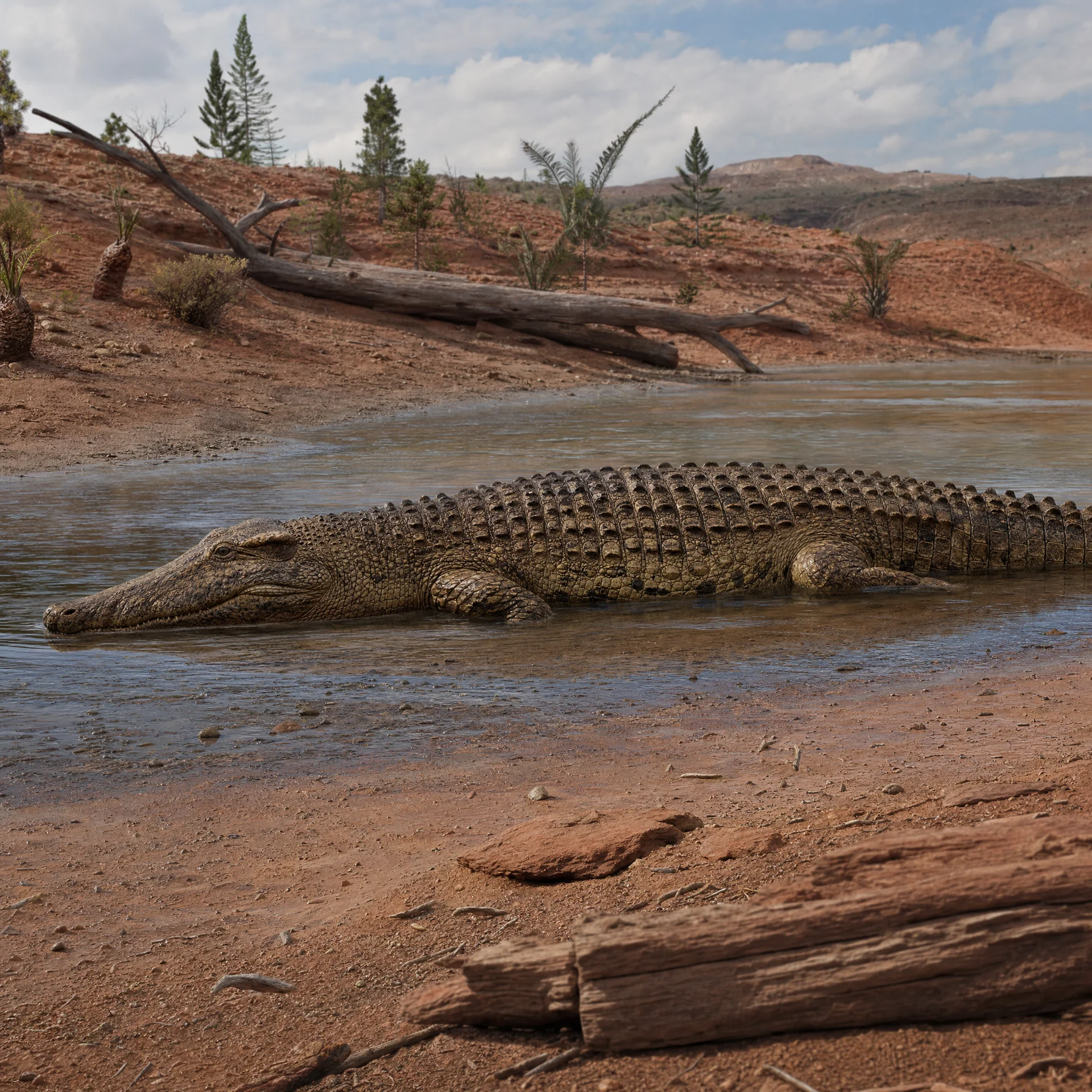
Calsoyasuchus
Calsoyasuchus valliceps
⏳ Jurassic Period🍽️ CarnivoreDinosaurs
Physical Characteristics
⏳
PeriodJurassic Period
🍽️
DietCarnivore
Classification
GEN
GenusCalsoyasuchus
SP
SpeciesC. valliceps
Calsoyasuchus valliceps
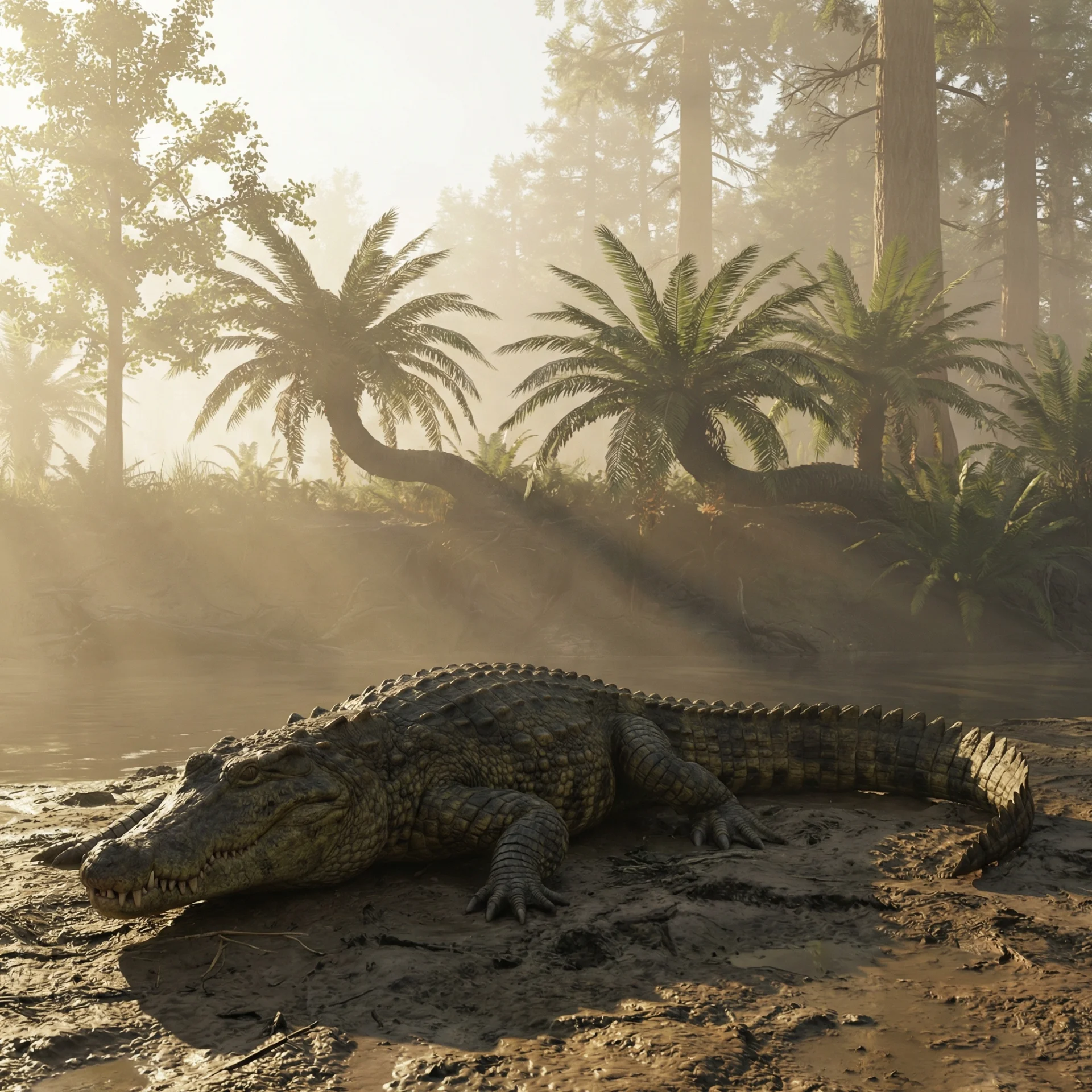
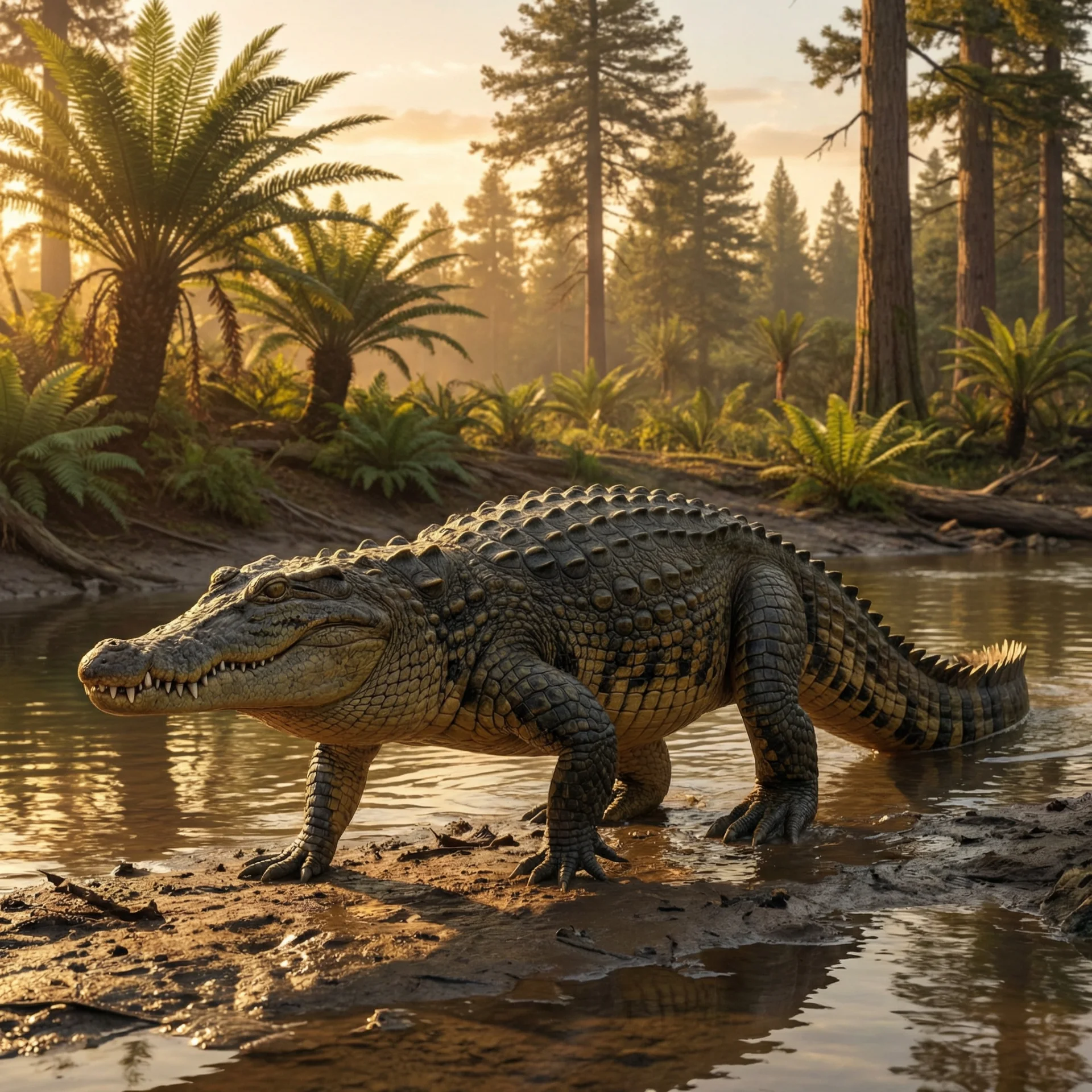
Calsoyasuchus (Calsoyasuchus valliceps Tykoski, Rowe, Ketcham & Colbert, 2002) is a medium-sized crocodyliform archosaur from the Early Jurassic (Sinemurian–Pliensbachian, approximately 196–183 Ma) of western North America. It is known from an incomplete skull (holotype TMM 43631-1) recovered from the Kayenta Formation on Navajo Nation land in northeastern Arizona. At the time of its discovery, it was recognized as a remarkably derived crocodyliform for such an ancient geological horizon, possessing features previously known only from Late Jurassic and younger forms.
The most distinctive external feature of this genus is a deep, narrow median valley along the dorsal surface of the nasal and frontal bones — the source of the specific name valliceps ('valley head'). High-resolution X-ray CT scanning revealed that the elongate snout houses an extensive paranasal pneumatic cavity system and a double-walled secondary palate strikingly similar to those of modern crocodylians. This provided crucial evidence that such key anatomical structures had already evolved by the Early Jurassic, far earlier than previously documented in the crocodyliform fossil record.
The phylogenetic position of Calsoyasuchus has been the subject of ongoing debate since its original description. The 2002 analysis recovered it as the oldest known member of Goniopholididae, a clade of basal neosuchians closely related to extant crocodylians. However, subsequent analyses have placed it as the sister taxon of Hsisosuchus (Wilberg et al., 2019), as the sister group of Thalattosuchia (Ruebenstahl et al., 2022), or have reaffirmed its position as a basal goniopholidid (De Andrade et al., 2011; Yoshida et al., 2021). A second specimen preserving more of the posterior skull was reported in 2016 (Cloos & Busbey) and was said to further support the basal goniopholidid placement. Since no postcranial material is known, whole-body size and proportions remain entirely unknown; the preserved skull length of approximately 38 cm indicates a moderately sized animal.
The genus name Calsoyasuchus honors Dr. Kyril Calsoyas, former principal of the Seba Dalkai Navajo Tribal School and a key supporter of the 1997 field expedition, combined with the Greek-derived souchos (from Egyptian, meaning 'crocodile'). The specific epithet valliceps is composed of Latin valles ('valley') and Greek cephale ('head'), referring to the deep median groove on the dorsal surface of the nasals and frontal (Tykoski et al., 2002).
Calsoyasuchus is currently recognized as a valid monotypic genus, with C. valliceps as the sole species. It was originally classified within Goniopholididae (Cope, 1875), placed as a member of Mesoeucrocodylia within Crocodyliformes. However, its precise phylogenetic position has varied across different analyses, largely because of the high proportion of missing data — only about 35% of the total characters (approximately 43% of cranial characters) could be scored from the incomplete holotype. This incompleteness causes it to behave as a 'wildcard taxon' that shifts position depending on the analytical method and taxon sample.
A surprisingly derived Early Jurassic crocodyliform from the Kayenta Formation that possesses a paranasal pneumatic system and secondary palate resembling those of modern crocodylians.
The Kayenta Formation has traditionally been assigned a Sinemurian–Pliensbachian age (approximately 199–183 Ma) based on vertebrate biostratigraphy and magnetostratigraphy (Clark & Fastovsky, 1986; Sues et al., 1994; Steiner & Tanner, 2014). More recent detrital zircon U-Pb dating has yielded ages of 183.7 ± 2.7 Ma for parts of the formation, suggesting a Pliensbachian–Toarcian age for the upper layers (Marsh et al., 2014), while samples from the lower sections in Colorado and Arizona have yielded approximately 197–195 Ma (middle Sinemurian; Marsh, 2018). The Calsoyasuchus locality lies within the middle third of the silty facies of the Kayenta Formation, placing it broadly within the Sinemurian–Pliensbachian interval (approximately 196–183 Ma).
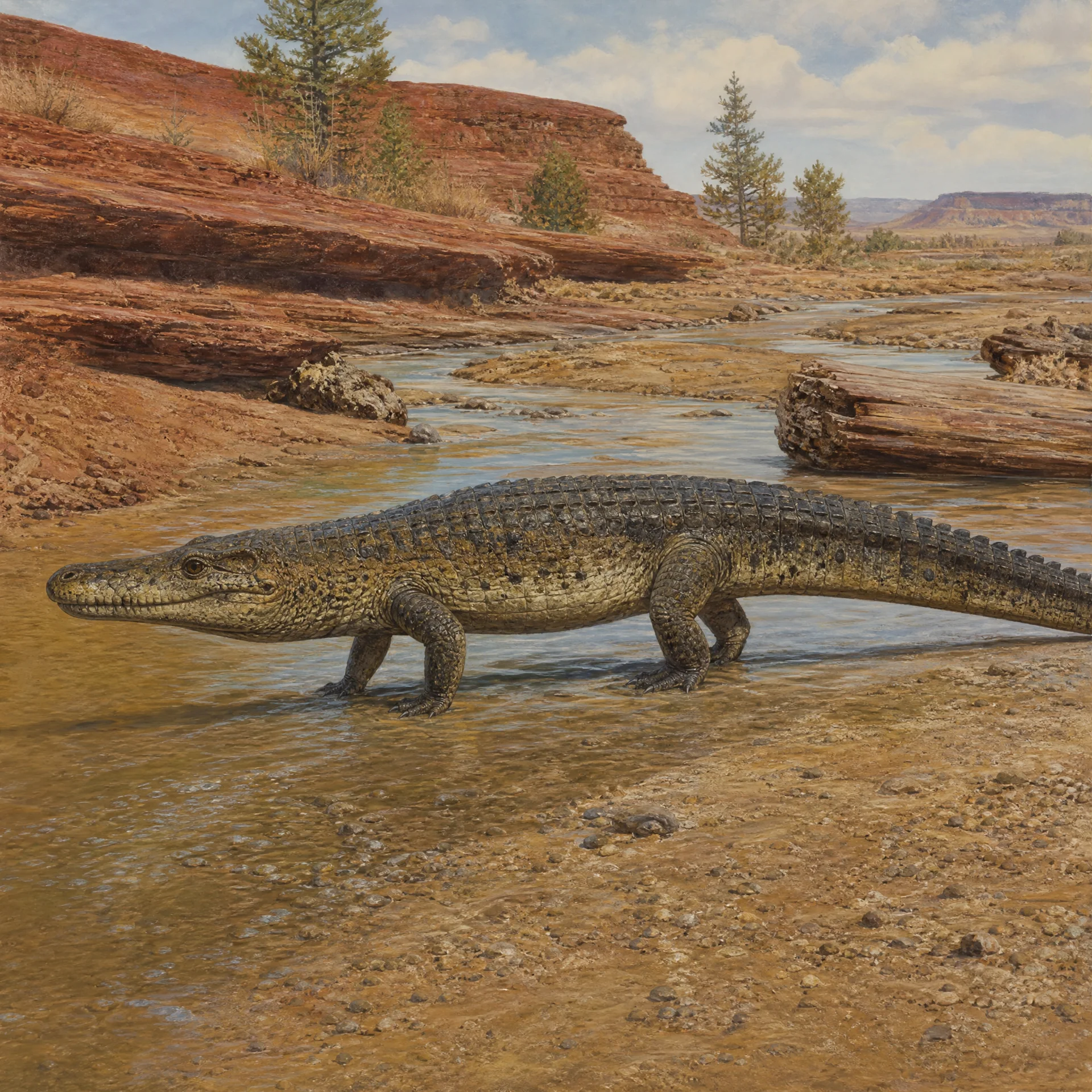
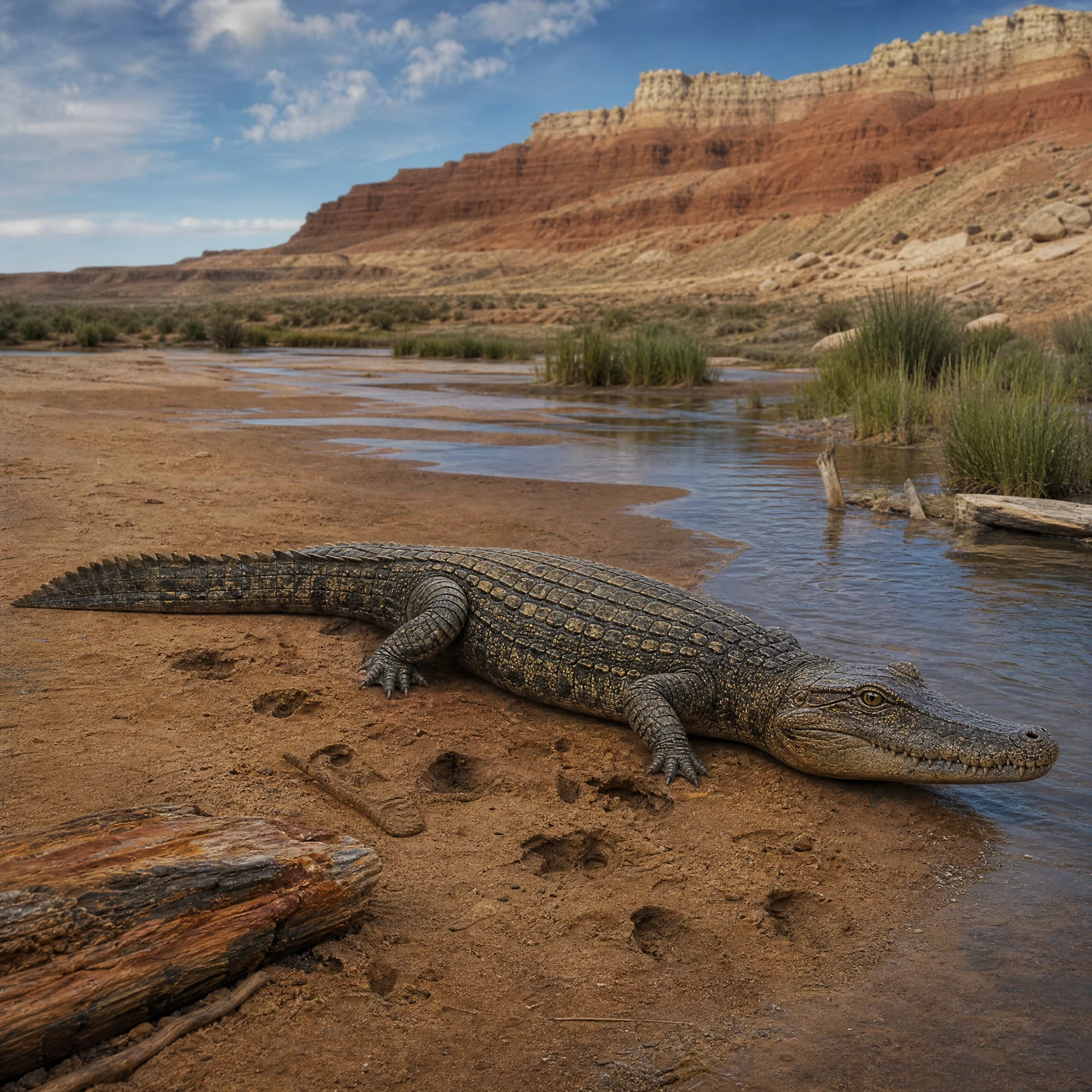
The Kayenta Formation is the middle unit of the Glen Canyon Group, sandwiched between the underlying Wingate Sandstone and the overlying Navajo Sandstone. It consists predominantly of red-brown to pink sandstone, siltstone, mudstone, and minor limestone lenses, deposited in shifting fluvial systems (Harshbarger et al., 1957). The unit typically forms broken ledges between the massive cliff-forming sandstones above and below.
The holotype was preserved in light-green, medium- to coarse-grained sandstone with a hematitic crust, found at the base of a trough scour within a thick, cross-bedded channel sandstone bed, wedged between two pieces of petrified wood with its palatal surface facing upward (Tykoski et al., 2002).
The Kayenta Formation records a low- to moderate-energy fluvial depositional system dominated by braided-stream channel deposits and associated floodplain sediments. Fossil mudcracks, freshwater gastropods and bivalves, lungfish tooth plates, and coelacanth remains indicate a seasonally variable, semi-arid to sub-humid climate. Paleomagnetic data indicate a paleolatitude of approximately 15–20°N for the depositional area, placing it in a subtropical climate belt analogous to modern-day Senegal, with wet summers and dry winters near the southern margin of a large desert system.
The holotype, TMM 43631-1, was discovered in the summer of 1997 during a joint expedition by the Texas Memorial Museum (TMM) of the University of Texas at Austin, the Museum of Comparative Zoology (MCZ) at Harvard University, and the Seba Dalkai Navajo Nation School. It is housed at TMM. The type locality is TMM 43631 (informally called 'Calsoyasuchus Hill'), field number TR 97/09, in the northern part of the Gold Spring drainage basin near the Adeii Eechii Cliffs, Navajo Nation, Coconino County, Arizona.
As preserved, the skull measures approximately 380 mm from the anterior tip of the rostrum to the most posterior preserved edge of the parietal. The occiput, braincase, most of the suspensorium, the posterior palate, and all mandibular elements were lost to erosion prior to discovery. No postcranial elements were found.
At the 2016 GSA South-Central Section meeting, Cloos & Busbey reported a second specimen containing a more complete posterior portion of the skull, including the braincase, cheek region, and partial suspensorium. This specimen overlaps with the posterior portion of the holotype and provides additional character states from the quadrate, quadratojugal, squamosal, pterygoid, basisphenoid, basioccipital, otoccipital, and supraoccipital. The new material was reported to further support the basal goniopholidid position recovered in earlier analyses.
The original diagnosis by Tykoski et al. (2002) identified the following autapomorphies based on their phylogenetic analysis:
| Feature | Description |
|---|---|
| Lacrimal-nasal contact | Occurs only along the anterior edge of the lacrimal |
| Frontal exclusion | Frontal does not reach the supratemporal fenestra |
| Fine serrations | Teeth bear fine serrations on both mesial and distal edges |
| Internal antorbital fenestra | Long, narrow; length slightly less than the orbit diameter |
| Downward-bowed snout | Snout curves downward from orbits, then rises so tip is as high as or higher than the skull table (when table is held horizontal) |
| Internarial process | A spike-like process rises from the narial floor to partially divide the external naris |
| Median maxillary palatal ridge | Medial edges of maxillary palatal processes curve ventrally, forming a ridge descending below the alveolar border |
| Dorsal median valley | A deep, narrow median valley on the posterior nasals and anterior third of the frontal |
Three key limitations constrain interpretation. First, only cranial material is known, precluding any estimate of body proportions, locomotion, or overall morphology. Second, extensive weathering destroyed the posterior skull, braincase, and ear region of the holotype (partially remedied by the second specimen). Third, most cranial sutures are tightly fused, making precise identification of bone boundaries difficult. These factors result in a high proportion of missing data in phylogenetic analyses, which is the primary source of taxonomic instability.
The skull is long and low in lateral view, with a distinctive curvature: it bows downward from the orbits and then rises toward the rostral tip until the tip sits at or above the level of the skull table. The premaxillae are enlarged, forming a wide snout tip that accentuates a constriction at the premaxilla-maxilla junction. The orbits are nearly circular and dorsolaterally oriented. The supratemporal fenestra measures only about half the diameter of the orbit, in marked contrast to the other known Kayenta crocodylomorph, Eopneumatosuchus colberti, which has much larger supratemporal fenestrae.
The most significant finding from CT scanning is the extensive paranasal pneumatic cavity system within the snout. The maxillary palatal processes form an elongated secondary palate beneath the nasal cavity proper, terminating posteriorly at the primary choanae. This double-walled secondary palate is a hallmark of extant crocodylians. Its presence in the Early Jurassic demonstrates that this respiratory and feeding adaptation is far older than previously documented, and it may have evolved independently in multiple crocodyliform lineages. Most individual pneumatic cavities interconnect and become confluent with the nasal cavity proper near the primary choanae (Tykoski et al., 2002).
An elongate external antorbital fenestra excavates the posterior quarter of the snout, and a narrow, elliptical internal antorbital fenestra perforates the skull in its center. Both fenestrae face more dorsally than laterally. The retention of external antorbital fenestrae distinguishes Calsoyasuchus from derived neosuchians in which this opening is typically closed.
The more complete left maxilla preserves at least 29 alveoli. The left premaxilla has five alveoli, and the right has at least four. Alveoli 5–8 in the maxilla are the largest and deepest, causing the maxilla to swell slightly outward in that region. CT imagery shows these alveoli arc posteriorly within the bone, indicating they housed the longest maxillary teeth. The partial crown of the 11th maxillary tooth is short, shows little labiolingual compression, and bears fine serrations on both mesial and distal edges (Tykoski et al., 2002).
No postcranial elements are known, so quantitative estimation of total body length and mass is currently impossible. Based on the preserved skull length of approximately 38 cm, comparison with closely related goniopholidids (e.g., Amphicotylus milesi, skull approximately 43 cm, total length estimated at approximately 2–3 m) suggests a moderate-sized crocodyliform, but this is an informal inference with high uncertainty, not a formal estimate.
The conical teeth with fine serrations and the long, low snout morphology are generally associated with piscivory or generalist carnivory in crocodyliforms. However, no direct dietary evidence — such as gut contents, coprolites, bite marks, or stable isotope data — is available for Calsoyasuchus, so its diet remains an inference from morphological analogy.
The taphonomic context (recovery from within a channel sandstone) combined with the presence of a secondary palate and pneumatic system suggests a semi-aquatic or at least water-margin-associated lifestyle. However, without postcranial material, direct indicators of aquatic adaptation (limb proportions, tail morphology, osteoderm configuration) cannot be assessed. Yoshida et al. (2021) demonstrated that basal goniopholidids like Amphicotylus milesi had acquired key respiratory innovations (pterygoid secondary palate, modified ceratobranchials for a gular valve) for semi-aquatic life, and it is plausible that Calsoyasuchus shared some of these adaptations, though this remains hypothetical.
The Kayenta Formation preserves a remarkably diverse Early Jurassic vertebrate assemblage. The major co-occurring taxa are summarized below:
| Group | Representative Taxa |
|---|---|
| Theropod dinosaurs | Dilophosaurus wetherilli, Coelophysis kayentakatae |
| Sauropodomorph dinosaurs | Sarahsaurus aurifontanalis |
| Ornithischian dinosaurs | Scutellosaurus lawleri, Heterodontosauridae indet. |
| Other crocodyliforms | Eopneumatosuchus colberti, Kayentasuchus walkeri, undescribed protosuchians |
| Pterosaurs | Rhamphinion jenkinsi |
| Turtles | Kayentachelys aprix |
| Amphibians | Prosalirus bitis (frog), Eocaecilia micropodia (caecilian) |
| Mammaliaform relatives | Kayentatherium wellesi, Oligokyphus, Morganucodon |
| Fishes | Semionotidae, Ceratodus (lungfish), Coelacanthidae |
Calsoyasuchus is definitively known only from a single locality (TMM 43631) in the Kayenta Formation, and the additional specimen reported by Cloos & Busbey (2016) is also from the same formation. The known distribution is therefore restricted to the Colorado Plateau region of western North America.
During the Sinemurian–Pliensbachian interval, the Kayenta Formation depositional area lay at approximately 15–20°N paleolatitude, based on paleomagnetic data. This placed it within western Laurasia, on the supercontinent Pangaea prior to its full breakup. The region experienced a subtropical to tropical semi-arid climate, comparable to the modern Sahel zone, with seasonal precipitation patterns.
The phylogenetic position of Calsoyasuchus is one of the most debated issues in early crocodyliform systematics. Below is a summary of the major analyses and their findings.
Using a modified version of the Buckley et al. (2000) data matrix with 27 taxa and 119 characters, three runs (unordered and partially ordered) all recovered the same topology. Calsoyasuchus was placed within a monophyletic Goniopholididae as the sister taxon of Eutretauranosuchus from the Late Jurassic Morrison Formation. This result nearly doubled the known duration of goniopholidid history, extending it from the Late Jurassic back into the Early Jurassic.
In their description of Goniopholis kiplingi and review of the genus, Calsoyasuchus was recovered as the basalmost goniopholidid, sister to all other members of the family.
A broad-scale analysis of crocodylomorph habitat transitions recovered Calsoyasuchus as the sister taxon of the basal mesoeucrocodyliform Hsisosuchus — a novel topology not found in any prior published analysis. This would remove it from Goniopholididae entirely.
In their description of Amphicotylus milesi using a large matrix of 486 characters and 104 taxa, Calsoyasuchus was recovered within Goniopholididae as a basal member, again sister to Eutretauranosuchus, consistent with the original placement.
In a re-analysis of early diverging crocodylomorphs (Junggarsuchus and Dibothrosuchus), Calsoyasuchus was recovered as the sister group of Thalattosuchia. However, this relationship was weakly supported and was noted to be potentially based on homoplastic characters.
A doctoral dissertation focused on North American goniopholidids also recovered Calsoyasuchus as sister to Thalattosuchia in some analyses, though with weak support, further highlighting the persistent instability of its placement.
The majority of analyses recover Calsoyasuchus within or near Goniopholididae, but the high proportion of missing data (approximately 57–65% of characters unscorable) makes it a classic 'wildcard' taxon. Resolution of this problem will likely require discovery and description of additional, more complete material.
Calsoyasuchus appears in the 2026 Netflix documentary series The Dinosaurs, Episode 2 ('Conquest'). In the series, it is not identified by name (referred to as an 'unspecified reptile') and is portrayed through live-action footage of Australian freshwater crocodiles rather than CGI, in a scene depicting it ambushing dimorphodont-like pterosaurs. This footage was adapted from BBC stock footage of freshwater crocodiles catching flying foxes and does not directly represent the actual ecology or behavior of Calsoyasuchus.
| Taxon | Age | Locality | Skull Length | Phylogenetic Position |
|---|---|---|---|---|
| Calsoyasuchus valliceps | Early Jurassic (Sinemurian–Pliensbachian) | North America (Kayenta Fm.) | ~38 cm | Basal Goniopholididae or unstable |
| Eutretauranosuchus delfsi | Late Jurassic (Kimmeridgian) | North America (Morrison Fm.) | ~40 cm | Basal Goniopholididae |
| Amphicotylus milesi | Late Jurassic (Kimmeridgian) | North America (Morrison Fm.) | ~43 cm | Goniopholididae |
| Goniopholis simus | Late Jurassic–Early Cretaceous | Europe | ~50 cm | Derived Goniopholididae |
| Eopneumatosuchus colberti | Early Jurassic | North America (Kayenta Fm.) | Smaller | Protosuchian-grade |
| Kayentasuchus walkeri | Early Jurassic | North America (Kayenta Fm.) | Unknown | Basal crocodylomorph |
Calsoyasuchus is the only taxon from the Kayenta Formation that exhibits a mesoeucrocodylian-grade morphology. The co-occurrence of at least five to six distinct crocodylomorph taxa in the same formation indicates substantial phylogenetic diversity among early crocodyliforms by the Early Jurassic — a picture consistent with the deep divergence times implied by the derived anatomy of Calsoyasuchus itself.
The holotype of Calsoyasuchus was found in 1997 wedged palate-side-up between two pieces of petrified wood at the base of a stream-channel scour.
The genus name honors Dr. Kyril Calsoyas, the former principal of a Navajo tribal school who served as a generous host and champion of education for the field team.
The CT scan dataset of the Calsoyasuchus skull was among the first ever published for a fossil crocodyliform and remains freely accessible on the Digimorph website.
The discovery of Calsoyasuchus nearly doubled the known duration of goniopholidid history, extending it from the Late Jurassic back approximately 50 million years into the Early Jurassic.
Despite living in the Early Jurassic, Calsoyasuchus already possessed a double-walled secondary palate and paranasal pneumatic system closely resembling those of living crocodylians.
At least five to six distinct crocodylomorph taxa are known from the Kayenta Formation, making it one of the most diverse Early Jurassic crocodylomorph assemblages in the world.
The species name valliceps means 'valley head,' referring to the deep, narrow groove running along the midline of the nasal and frontal bones — the most distinctive external feature of the skull.
In the 2026 Netflix series The Dinosaurs (Episode 2, 'Conquest'), Calsoyasuchus is depicted using live-action footage of Australian freshwater crocodiles catching flying foxes, adapted from BBC stock footage.
No postcranial material has ever been found for Calsoyasuchus, meaning its total body length and mass have never been formally estimated.
Over more than two decades of study, Calsoyasuchus has been placed as a basal goniopholidid, a relative of Hsisosuchus, and a sister group of Thalattosuchia in different phylogenetic analyses — making it one of the most positionally unstable crocodyliform taxa.
The total body length and mass of Calsoyasuchus are currently unknown because no postcranial material (body, limbs, tail) has ever been found. The preserved skull is approximately 38 cm long. By comparison with closely related goniopholidids such as Amphicotylus milesi (skull approximately 43 cm, total length estimated at roughly 2–3 m), Calsoyasuchus was likely a moderate-sized crocodyliform, but this is an informal inference, not a formal estimate.
Calsoyasuchus belongs to Crocodyliformes, a major clade within the broader group Crocodylomorpha that also includes all living crocodilians (Crocodylia). In the original description, it was placed in Goniopholididae, a family of basal neosuchians — a group more closely related to modern crocodylians than several lineages known only from the Cretaceous and younger. However, some analyses have recovered it in more basal positions outside of Neosuchia.
The main reason is specimen incompleteness. Only a partial skull is known, and much of the posterior skull was lost to erosion. In the original analysis, only about 35% of the total characters in the data matrix could be scored. This high proportion of missing data causes Calsoyasuchus to behave as a 'wildcard taxon' — its position shifts depending on the analytical method, character list, and taxon sample used.
The Kayenta Formation preserves one of the most diverse Early Jurassic vertebrate assemblages in the world. Notable co-occurring taxa include the theropods Dilophosaurus and Coelophysis kayentakatae, the sauropodomorph Sarahsaurus, the ornithischian Scutellosaurus, the turtle Kayentachelys, early frogs (Prosalirus) and caecilians (Eocaecilia), mammaliaform relatives such as Kayentatherium and Morganucodon, and at least four to five other crocodylomorph species.
The secondary palate separates the nasal passage from the oral cavity, allowing crocodylians to breathe while their mouths are open underwater — a key adaptation for semi-aquatic life. Finding a double-walled secondary palate with pneumatic sinuses in an Early Jurassic crocodyliform pushed back the known origin of this system by tens of millions of years, and raised the possibility that it evolved independently in multiple crocodyliform lineages.
Yes. It appears in Episode 2 ('Conquest') of the 2026 Netflix documentary series The Dinosaurs. It is not identified by species name in the show (it is referred to as an 'unspecified reptile') and is portrayed using live-action footage of Australian freshwater crocodiles rather than CGI, in a scene depicting it ambushing pterosaurs.
Most Early Jurassic crocodyliforms belong to protosuchian-grade or sphenosuchian-grade lineages that have relatively simple skull architecture. Calsoyasuchus, in contrast, possesses advanced features — such as a secondary palate, an extensive paranasal pneumatic system, and a long flat snout — that were previously known only from Late Jurassic and younger goniopholidids. Its discovery demonstrated that the crocodyliform evolutionary timeline was far less complete than previously believed.
The high-resolution X-ray CT scan of the holotype was one of the first CT datasets ever published for a fossil crocodyliform skull. It revealed the internal anatomy of the pneumatic paranasal cavities, helped distinguish cracks from sutures, and generated volumetric 3D reconstructions. The data were made publicly available on the Digimorph website and an accompanying CD-ROM, becoming an important reference for comparative studies of crocodyliform cranial anatomy.
5images