Purussaurus
Cenozoic Era Carnivore Creature Type
Purussaurus
Scientific Name: "Purus (Purus River, Brazil) + saurus (Greek σαύρος, 'lizard/reptile') — 'Purus River lizard'"
Local Name: Purussaurus
Physical Characteristics
Discovery
Habitat

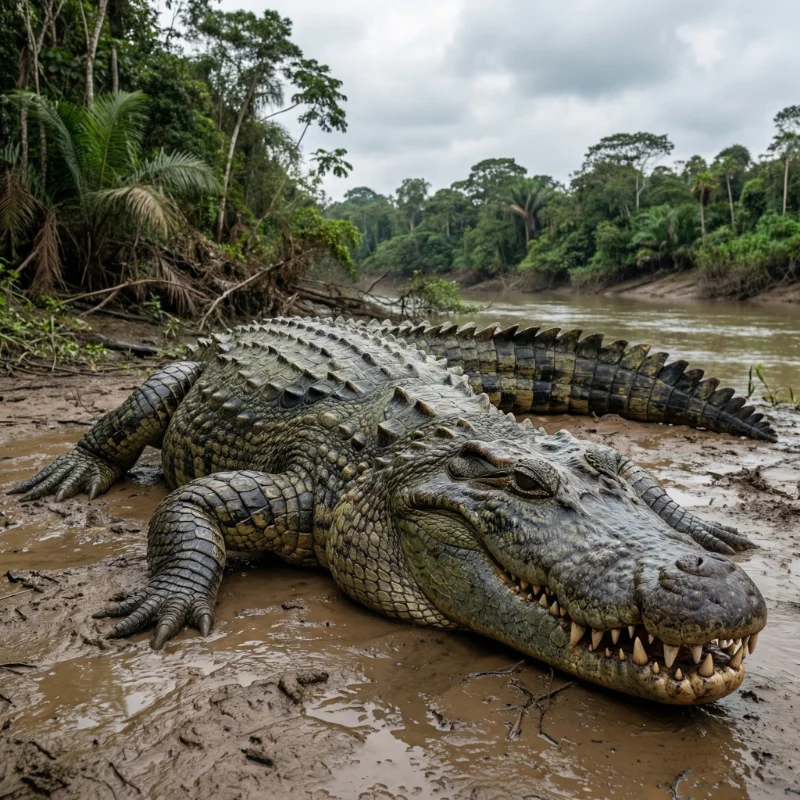
Purussaurus (Barbosa-Rodrigues, 1892) is an extinct genus of giant caiman belonging to the family Alligatoridae, subfamily Caimaninae, within the order Crocodilia. It thrived across the vast wetland systems of South America during the Miocene epoch (approximately 16–5.3 Ma), and ranks among the largest crocodyliforms ever to have existed. The holotype — a right hemimandible — was described in 1892 by the Brazilian naturalist João Barbosa-Rodrigues from sediments along the Purus River in Acre State, Brazil, establishing the type species P. brasiliensis.
Purussaurus is not a dinosaur; it is a Cenozoic crocodilian. The order Crocodilia and the clade Dinosauria both belong to Archosauria but represent separate evolutionary lineages. Purussaurus lived during the Miocene, more than 50 million years after the end-Cretaceous mass extinction that wiped out non-avian dinosaurs (ca. 66 Ma). It is classified within the same subfamily as living caimans (Caiman, Melanosuchus, Paleosuchus), and phylogenetic analyses recover it as the sister group to Mourasuchus (Scheyer et al., 2019).
The best-known skull of the type species, P. brasiliensis (specimen UFAC 1403), has a maximal skull length of approximately 1,400 mm. Body size estimates based on this specimen vary considerably depending on methodology. Aureliano et al. (2015) estimated a total length of about 12.5 m and body mass of about 8.4 tonnes, whereas Betancourt (2015) revised this downward to approximately 10.9 m and 5.6 t. More recently, Paiva et al. (2022) used phylogenetic and non-phylogenetic approaches to estimate lengths of 7.6–10 m and masses of 2–5 t, and Walter et al. (2025) proposed an average total length of approximately 7.8 m based on head-width allometry. There is thus substantial uncertainty in the size estimates, but all studies agree that Purussaurus was significantly larger than any living crocodilian.
Despite this debate over maximum size, there is broad consensus that Purussaurus was the undisputed apex predator of Miocene freshwater ecosystems in South America. Its powerful bite force — estimated at approximately 69,000 N (about 7 t-force) by Aureliano et al. (2015), or approximately 52,500 N after Betancourt's (2015) correction — combined with a broad, robust snout and pseudoziphodont conical teeth made it superbly adapted for capturing large vertebrate prey. Direct evidence of predation was confirmed by Pujos & Salas-Gismondi (2020), who documented 46 bite marks on a tibia of the mylodontid ground sloth Pseudoprepotherium from a 13 Ma bonebed in the Peruvian Amazon, attributable to a sub-adult Purussaurus.
Overview
Name and etymology
The genus name Purussaurus is a combination of Purus, referring to the Purus River — a major tributary of the Amazon in western Brazil where the first fossils were discovered — and the Greek σαύρος (sauros, meaning 'lizard' or 'reptile'). The name thus translates to 'Purus River lizard' (Croft, 2016).
Taxonomic status
Three species are currently recognized as valid:
| Species | Author(s) / Year | Principal locality | Age (SALMA) |
|---|---|---|---|
| P. brasiliensis (type species) | Barbosa-Rodrigues, 1892 | Brazil (Solimões Fm.), Bolivia (Cobija Fm.) | Late Miocene (Huayquerian) |
| P. neivensis | Mook, 1941 | Colombia (Honda Group, La Venta), Peru (Pebas Fm.) | Middle Miocene (Laventan) |
| P. mirandai | Aguilera et al., 2006 | Venezuela (Urumaco Fm.) | Late Miocene (Huayquerian) |
Dinosuchus neivensis Langston, 1965 is treated as a junior synonym of P. neivensis. In 2023, isolated teeth referable to Purussaurus sp. were reported for the first time from the Ituzaingó Formation of Argentina (Bona et al., 2023), extending the known geographic range of the genus southward.
One-sentence summary
The largest known crown-group crocodilian — a giant caiman that dominated the mega-wetlands of Miocene South America as an unchallenged apex predator.
Temporal range, stratigraphy, and depositional environment
Temporal range
The stratigraphic range of Purussaurus spans from the Friasian to the Huayquerian South American Land Mammal Ages, corresponding to approximately 16–5.3 Ma (Rio & Mannion, 2021). The oldest records pertain to P. neivensis from the Middle Miocene of Colombia (La Venta fauna, ca. 13 Ma); the youngest records belong to P. brasiliensis (Solimões Formation, Brazil) and P. mirandai (Urumaco Formation, Venezuela) from the Late Miocene. The genus is thought to have gone extinct in the early Pliocene in conjunction with the collapse of the Amazonian mega-wetland systems.
Formations and lithology
The principal formation yielding P. brasiliensis is the Solimões Formation of western Brazilian Amazonia, which consists of mudstones, sandy mudstones, clayey siltstones, and fine- to medium-grained sandstones deposited in shallow lacustrine, swamp, and floodplain environments (Hoorn, 1994). P. mirandai derives from the Urumaco Formation of Falcón State, Venezuela, representing tropical coastal and swampy depositional settings. P. neivensis is known from the Honda Group (La Venta locality) of Colombia, a Middle Miocene tropical fluvial-floodplain sequence.
Paleoenvironment
During the middle to late Miocene, western and northern South America hosted the enormous Pebas Mega-Wetland System and the Acre Mega-Wetland System — a vast complex of deltaic, estuarine, swamp, lacustrine, and fluvial habitats spanning roughly one million square kilometres (Hoorn et al., 2010). These mega-wetlands were created and maintained by Andean tectonic uplift, which blocked westward drainage. Purussaurus inhabited freshwater to brackish rivers and lakes throughout this system. During the latest Miocene to early Pliocene, accelerated Andean orogeny reorganized the Amazon drainage eastward into its modern configuration, destroying the mega-wetlands and driving Purussaurus and other giant crocodilians to extinction (Aureliano et al., 2015).
Specimens and diagnostic features
Holotype and key specimens
The holotype of P. brasiliensis — a right hemimandible described in 1892 — was long housed at the Museu Nacional in Rio de Janeiro but was subsequently lost (Souza-Filho et al., 2021). However, the validity of the species was upheld through redescription of specimen DGM 527-R. The most important specimens include:
| Specimen | Elements | Max skull length | Repository |
|---|---|---|---|
| UFAC 1403 | Nearly complete skull + mandible | ca. 1,400 mm (maximal skull length) | UFAC, Brazil |
| DGM 527-R | Mandible (+ skull fragments) | ca. 1,453 mm (skull); 1,750 mm (mandible) | DGM, Brazil |
| MCNC-URU specimens | Skull, postcranial elements, limbs | ca. 1,260 mm (P. mirandai) | Venezuela |
| UCMP 39704 | Skull (P. neivensis) | ca. 857 mm | UCMP, USA |
The P. mirandai material from the Urumaco Formation is especially significant because it preserves postcranial elements — vertebrae, limb bones, and osteoderms — providing the only window into the post-cranial anatomy of the genus (Scheyer et al., 2019).
Diagnostic features
Key diagnostic features of Purussaurus include: (1) an enormous external naris occupying roughly two-thirds of the rostral length, with extreme posterior retraction of the nasals (in P. brasiliensis and P. mirandai); (2) a broad, short, deep snout (brevirostrine morphotype); (3) conical teeth bearing pseudoziphodont carinae along two edges; (4) pronounced heterodonty — tall, pointed anterior teeth grading into lower, more globular posterior teeth; and (5) in P. mirandai, three sacral vertebrae — a unique condition among crown crocodilians, which universally possess only two (Scheyer et al., 2019).
The species are distinguished from one another primarily by cranial proportions: P. mirandai has a larger, more elongated and flatter skull than P. brasiliensis (Aguilera et al., 2006), while P. neivensis lacks the extreme nasal retraction and has relatively short, wide nares.
Specimen limitations
Although the holotype of P. brasiliensis has been lost, DGM 527-R serves as a validating specimen. Postcranial data are limited to P. mirandai; the limb and axial anatomy of the other two species remains essentially unknown.
Morphology and functional anatomy
Body size
Size estimates for P. brasiliensis diverge substantially depending on methodology:
| Study | Specimen | Method | Est. total length | Est. body mass |
|---|---|---|---|---|
| Aureliano et al. (2015) | UFAC 1403 | OLS regression on extant crocodilians | ca. 12.5 m (range 9.9–15.8 m) | ca. 8.4 t (range 5.6–12.6 t) |
| Betancourt (2015) correction | UFAC 1403 | Revised DCL interpretation (1.22 m) | ca. 10.9 m | ca. 5.6 t |
| Moreno-Bernal (2007) | UFAC 1403 / DGM 527-R | DSL-based | ca. 9.5 m / ca. 10.3 m | ca. 4 t / ca. 5.16 t |
| Paiva et al. (2022) | Multiple specimens | Phylogenetic/non-phylogenetic approaches | ca. 7.6–10 m | ca. 2–5 t |
| Walter et al. (2025) | Head-width allometry | Cranial width scaling | avg. ca. 7.8 m | not detailed |
The main sources of discrepancy include: (1) differing definitions of skull length measurements (maximal skull length vs. dorsal cranial length); (2) uncertainty inherent in extrapolating allometric equations far beyond the body size range of living species; and (3) differing choices of reference taxa. What can be stated with confidence is that P. brasiliensis was substantially larger than any extant crocodilian.
P. mirandai is estimated at an average of approximately 6.55 m, and P. neivensis at approximately 4.58 m (Walter et al., 2025), indicating substantial size variation within the genus.
Skull and snout
The skull of Purussaurus is broad, short, and extremely robust (brevirostrine morphotype). In P. brasiliensis and P. mirandai, the nasals are retracted far posteriorly, producing an enormous external naris that occupies roughly two-thirds of the rostral length — a condition unmatched in any other crocodilian. Aureliano et al. (2015) proposed that this unique morphology functions as a stress dissipation mechanism (a "flying buttress") to withstand the massive forces generated by bites of approximately 7 t-force. The deeply concave dorsal surfaces of the frontals and prefrontals in the antorbital region may serve as anchor points for compressive forces transmitted along the rostrum during biting.
Dentition
Teeth are consistently conical, approximately 50 mm long, and slightly recurved posteriorly. Crown height in P. brasiliensis reaches approximately 100 mm in the largest caniniform anterior teeth. Distinct mesial and distal carinae — termed pseudoziphodont ridges — are present along two edges, aiding in puncturing and drawing through flesh. A gradual transition from tall, sharply pointed anterior teeth to lower, more globular posterior teeth (pronounced heterodonty) indicates both piercing and crushing capabilities, consistent with the "macro-generalist" ecomorph identified by Drumheller & Wilberg (2020). The teeth are subcircular at the base and slightly flattened at the crown, conferring high resistance to bending and breakage against hard materials such as bone.
Postcranial anatomy
The associated skeleton of P. mirandai described by Scheyer et al. (2019) represents a landmark discovery in crocodilian evolution. This specimen preserves three sacral vertebrae — two true sacrals and one non-pathological, functional dorsosacral — making it the first and only known crown-group crocodilian to deviate from the ancestral two-sacral condition that has been conserved for approximately 200 million years. This additional sacral is interpreted as a functional adaptation to reinforce the pelvic girdle in order to support the animal's enormous body mass. Additionally, certain limb elements suggest adaptations for more upright limb orientation or enhanced weight support.
Bite force and the death roll
Aureliano et al. (2015) estimated a sustained bite force of approximately 69,000 N (ca. 7 t-force) for P. brasiliensis, exceeding the estimated bite force of Tyrannosaurus rex (ca. 35,000–57,000 N). Betancourt's (2015) revised estimate of approximately 52,500 N (ca. 5.3 t-force) remains among the highest values calculated for any terrestrial or semi-aquatic predator. A biomechanical skull-strength analysis by Blanco et al. (2014) concluded that Purussaurus was capable of performing the death roll — the violent axial rotation used by extant crocodilians to subdue and dismember prey.
Diet and ecology
Dietary evidence
The diet of Purussaurus is supported by both direct and indirect evidence:
Direct evidence (bite marks): (1) A tibia of the mylodontid ground sloth Pseudoprepotherium (MUSM 1587) from a ca. 13 Ma bonebed in the Peruvian Amazon (Pebas Formation) preserves 46 bite marks — round and bisected pits and punctures consistent with caimanine teeth. Based on puncture size and tooth spacing, the perpetrator is estimated to have been a sub-adult Purussaurus approximately 4 m in total length (Pujos & Salas-Gismondi, 2020). (2) A giant turtle (Podocnemis) carapace from Peru bears an approximately 60 cm bite scar attributable to an adult-sized Purussaurus brasiliensis. (3) Bite marks on a phorusrhacid (terror bird) tibia from the Middle Miocene La Venta locality of Colombia are consistent with a caimanine, possibly a juvenile Purussaurus (Link et al., 2025).
Indirect evidence (tooth morphology and ecological inference): The broad, short snout and robust conical teeth correspond to the "macro-generalist" ecomorph, indicating the ability to prey on a wide range of vertebrate species. Applying body-length–diet relationships from extant crocodilians, adult P. brasiliensis would have been capable of taking prey exceeding 1 tonne in mass (Aureliano et al., 2015).
Ecological status and food web
Adult Purussaurus was an unchallenged apex predator in its ecosystem. During the Miocene, South America was an island continent; placental carnivorans had not yet arrived, and the large carnivore niche was occupied by marsupial borhyaenids — none of which could compete with Purussaurus in aquatic environments.
The coexisting crocodilian fauna of the Solimões Formation included Caiman brevirostris, Mourasuchus amazonensis, M. nativus, Gryposuchus jessei, Hesperogavialis, and Charactosuchus, but all differed markedly in size and cranial morphology, indicating well-partitioned feeding niches. Potential prey items included the giant turtle Stupendemys souzai (carapace length exceeding 3.1 m), large rodents related to Josephoartigasia (up to ca. 700 kg), giant xenarthrans (ground sloths), notoungulates, and river dolphins.
Ontogenetic dietary shifts
As in extant crocodilians, Purussaurus is inferred to have undergone substantial dietary changes through ontogeny. Juveniles (ca. 1–2 m) likely fed on invertebrates, molluscs, and small fish; sub-adults (ca. 3–5 m) transitioned to capybara-sized mammals — as evidenced by the sloth tibia bite marks; and adults (ca. 7–12 m) consumed giant turtles, large mammals, and other large vertebrates. This ontogenetic dietary partitioning would have reduced intraspecific competition (Aureliano et al., 2015).
Distribution and paleogeography
Geographic distribution
Fossils of Purussaurus have been reported from at least six countries:
| Country | Formation(s) | Species |
|---|---|---|
| Brazil | Solimões Formation | P. brasiliensis |
| Venezuela | Urumaco Formation, Socorro Formation | P. mirandai |
| Colombia | Honda Group (La Venta), Castilletes Formation | P. neivensis, Purussaurus sp. |
| Peru | Pebas Formation, Fitzcarrald Arch | P. neivensis, Purussaurus sp. |
| Panama | Culebra Formation | Purussaurus sp. |
| Argentina | Ituzaingó Formation | Purussaurus sp. (Bona et al., 2023) |
This broad distribution reflects the interconnected nature of the enormous Miocene inland waterways of South America.
Paleogeography and paleolatitude
During the Miocene, the principal Purussaurus localities occupied equatorial to low subtropical latitudes (ca. 0°–10°S), within a climate that was warmer and more humid than at present. This is consistent with the pattern observed in extant giant crocodilians, which are restricted to tropical regions.
Phylogenetics and taxonomic debates
Phylogenetic position
Purussaurus is placed within the clade Jacarea in the Caimaninae. Scheyer et al. (2019) recovered Purussaurus as monophyletic and as the sister taxon to Mourasuchus. Together, these two genera form a clade within Caimaninae that is relatively closely related to living caimans (Caiman, Melanosuchus). An earlier analysis by Aguilera et al. (2006) placed Purussaurus as sister to Nettosuchidae, but as Nettosuchidae has subsequently been subsumed within the Mourasuchus lineage, this relationship is broadly consistent.
The expanded phylogenetic analysis by Walter et al. (2025) corroborated the position of Purussaurus within Caimaninae and, by reinterpreting Deinosuchus as a stem-group crocodylian (outside crown Crocodylia), further underscored Purussaurus as the largest known member of the crown group.
Size estimation debate
The most active controversy concerns body size. The large estimates of Aureliano et al. (2015) — 12.5 m / 8.4 t — have been challenged by Paiva et al. (2022) and Walter et al. (2025), who favour substantially smaller dimensions (7.6–10 m / 2–5 t). The key points of contention are: (1) the correct skull-length measurement for UFAC 1403 (maximal skull length vs. dorsal cranial length), and (2) the validity of extrapolating allometric equations derived from extant caimans to an animal many times their size.
Restoration and uncertainty
Confirmed / Probable / Hypothetical
Confirmed: Purussaurus is an extinct giant caimanine from the Miocene of South America. Three species are valid, and P. brasiliensis is the largest. It was a macropredatory apex predator that consumed large vertebrates.
Probable: Total length was at least 7–10 m or more. Bite force exceeded that of any living animal (minimum ca. 52,500 N). It was capable of performing the death roll. It went extinct in the early Pliocene following the collapse of the mega-wetlands.
Hypothetical / Under debate: The maximum body length of 12.5 m proposed by Aureliano et al. (2015) has been criticized on methodological grounds; real maximum size may have been closer to 10 m or even below. The hypothesis that the enormous external naris functioned as a flying buttress for stress dissipation has not yet been verified through finite-element analysis (FEA).
Popular media vs. scientific consensus
Popular media frequently depict Purussaurus as a "12-metre, 8-tonne super-croc," but more recent studies (Paiva et al., 2022; Walter et al., 2025) suggest considerably smaller dimensions. Additionally, depictions implying that Purussaurus fought dinosaurs are chronologically impossible — it lived more than 50 million years after the extinction of non-avian dinosaurs.
Comparison with related and contemporary taxa
| Taxon | Age | Max estimated length | Classification | Distribution |
|---|---|---|---|---|
| Purussaurus brasiliensis | Miocene (ca. 8–5 Ma) | ca. 7.8–12.5 m (debated) | Caimaninae (crown Crocodylia) | South America |
| Deinosuchus | Late Cretaceous (ca. 82–73 Ma) | ca. 7.6–10.6 m | Stem-group Crocodylia (Walter et al., 2025) | North America |
| Sarcosuchus | Early Cretaceous (ca. 112 Ma) | ca. 9–11 m | Pholidosauridae (non-crocodylian neosuchian) | Africa, South America |
| Rhamphosuchus | Miocene | ca. 8–10 m (revised) | Gavialidae | India |
| Mourasuchus | Miocene | ca. 4–5 m | Caimaninae | South America |
Purussaurus had a much broader and shorter snout than Sarcosuchus or Deinosuchus, meaning that at comparable body lengths, its skull was heavier and its bite force likely greater. Mourasuchus, though belonging to the same subfamily and recovered as its sister taxon, occupied an entirely different ecological niche as a probable filter-feeder with a long, flat rostrum and diminutive teeth.
Fun Facts
FAQ
📚References
- Barbosa-Rodrigues, J. (1892). Les reptiles fossils de la Vallée de L'Amazone. Vellosia, Contribuições do Museu Botânico do Amazonas, 2, 41–60.
- Mook, C. C. (1941). A new fossil from Colombia. Proceedings of the United States National Museum, 91, 55–61. https://doi.org/10.5479/si.00963801.91-3122.55
- Aguilera, O. A., Riff, D., & Bocquentin-Villanueva, J. (2006). A new giant Purussaurus (Crocodyliformes, Alligatoridae) from the Upper Miocene Urumaco Formation, Venezuela. Journal of Systematic Palaeontology, 4(3), 221–232. https://doi.org/10.1017/S147720190600188X
- Moreno-Bernal, J. (2007). Size and Palaeoecology of Giant Miocene South American Crocodiles (Archosauria: Crocodylia). Journal of Vertebrate Paleontology, 27(3 suppl.), A120.
- Aureliano, T., Ghilardi, A. M., Guilherme, E., Souza-Filho, J. P., Cavalcanti, M., & Riff, D. (2015). Morphometry, Bite-Force, and Paleobiology of the Late Miocene Caiman Purussaurus brasiliensis. PLoS ONE, 10(2), e0117944. https://doi.org/10.1371/journal.pone.0117944
- Scheyer, T. M., Hutchinson, J. R., Strauss, O., Delfino, M., Carrillo-Briceño, J. D., Sánchez, R., & Sánchez-Villagra, M. R. (2019). Giant extinct caiman breaks constraint on the axial skeleton of extant crocodylians. eLife, 8, e49972. https://doi.org/10.7554/eLife.49972
- Pujos, F., & Salas-Gismondi, R. (2020). Predation of the giant Miocene caiman Purussaurus on a mylodontid ground sloth in the wetlands of proto-Amazonia. Biology Letters, 16(8), 20200239. https://doi.org/10.1098/rsbl.2020.0239
- Paiva, A. L. S., Godoy, P. L., Souza, R. B. B., Klein, W., & Hsiou, A. S. (2022). Body size estimation of Caimaninae specimens from the miocene of South America. Journal of South American Earth Sciences, 118, 103970. https://doi.org/10.1016/j.jsames.2022.103970
- Hoorn, C., Wesselingh, F. P., ter Steege, H., et al. (2010). Amazonia through time: Andean uplift, climate change, landscape evolution, and biodiversity. Science, 330(6006), 927–931. https://doi.org/10.1126/science.1194585
- Blanco, R. E., Jones, W. W., & Villamil, J. N. (2014). The 'death roll' of giant fossil crocodyliforms (Crocodylomorpha: Neosuchia): Allometric and skull strength analysis. Historical Biology, 27(5), 514–524. https://doi.org/10.1080/08912963.2014.893300
- Rio, J. P., & Mannion, P. D. (2021). Phylogenetic analysis of a new morphological dataset elucidates the evolutionary history of Crocodylia and resolves the long-standing gharial problem. PeerJ, 9, e12094. https://doi.org/10.7717/peerj.12094
- Bona, P., Pol, D., et al. (2023). The first record of Purussaurus (Crocodylia, Alligatoridae) in the Late Miocene of Argentina. Revista del Museo Argentino de Ciencias Naturales, nueva serie, 25(1), 71–84.
- Souza-Filho, J. P., et al. (2021). The history, importance and anatomy of the specimen that validated the giant Purussaurus brasiliensis Barbosa-Rodrigues 1892 (Crocodylia: Caimaninae). Anais da Academia Brasileira de Ciências, 93(3), e20201380. https://doi.org/10.1590/0001-3765202120201380
- Walter, J. D., Massonne, T., Paiva, A. L. S., Martin, J. E., Delfino, M., & Rabi, M. (2025). Expanded phylogeny elucidates Deinosuchus relationships, crocodylian osmoregulation and body-size evolution. Communications Biology, 8(1), 611. https://doi.org/10.1038/s42003-025-07653-4
- Langston, W., Jr. (1965). Fossil crocodilians from Colombia and the Cenozoic history of the Crocodilia in South America. University of California Publications in Geological Sciences, 52, 1–169.
- Croft, D. A. (2016). Horned Armadillos and Rafting Monkeys: The Fascinating Fossil Mammals of South America. Indiana University Press. ISBN 978-0-253-02094-9.
- Salas-Gismondi, R., Flynn, J. J., Baby, P., Tejada-Lara, J. V., Wesselingh, F. P., & Antoine, P.-O. (2015). A Miocene hyperdiverse crocodylian community reveals peculiar trophic dynamics in proto-Amazonian mega-wetlands. Proceedings of the Royal Society B, 282, 20142490. https://doi.org/10.1098/rspb.2014.2490
- Link, A., Moreno-Bernal, J. W., Degrange, F. J., et al. (2025). Direct evidence of trophic interaction between a crocodyliform and a large terror bird in the Middle Miocene of La Venta, Colombia. Biology Letters, 21(7), 20250113. https://doi.org/10.1098/rsbl.2025.0113
Gallery
5 images Purussaurus
Purussaurus · Cenozoic Era · Carnivore
 Purussaurus
Purussaurus · Cenozoic Era · Carnivore
 Purussaurus
Purussaurus · Cenozoic Era · Carnivore
 Purussaurus
Purussaurus · Cenozoic Era · Carnivore
 Purussaurus
Purussaurus · Cenozoic Era · Carnivore
🔗Related Creatures
Calsoyasuchus
Calsoyasuchus valliceps
Kaprosuchus
Kaprosuchus saharicus
Metriorhynchus
Metriorhynchus brevirostris
Deinosuchus
Deinosuchus
Sarcosuchus
Sarcosuchus imperator

Stomatosuchus
Stomatosuchus inermis
Simosuchus
Simosuchus clarki
Smilodon
Smilodon