Simosuchus
Cretaceous Period Herbivore Creature Type
Simosuchus clarki
Scientific Name: "From Greek simos (pug-nosed, snub-nosed) + souchos (the Egyptian crocodile-headed god Sobek) = 'pug-nosed crocodile'. The species name clarki honors James M. Clark for his contributions to crocodyliform systematics"
Local Name: Simosuchus
Physical Characteristics
Discovery
Habitat
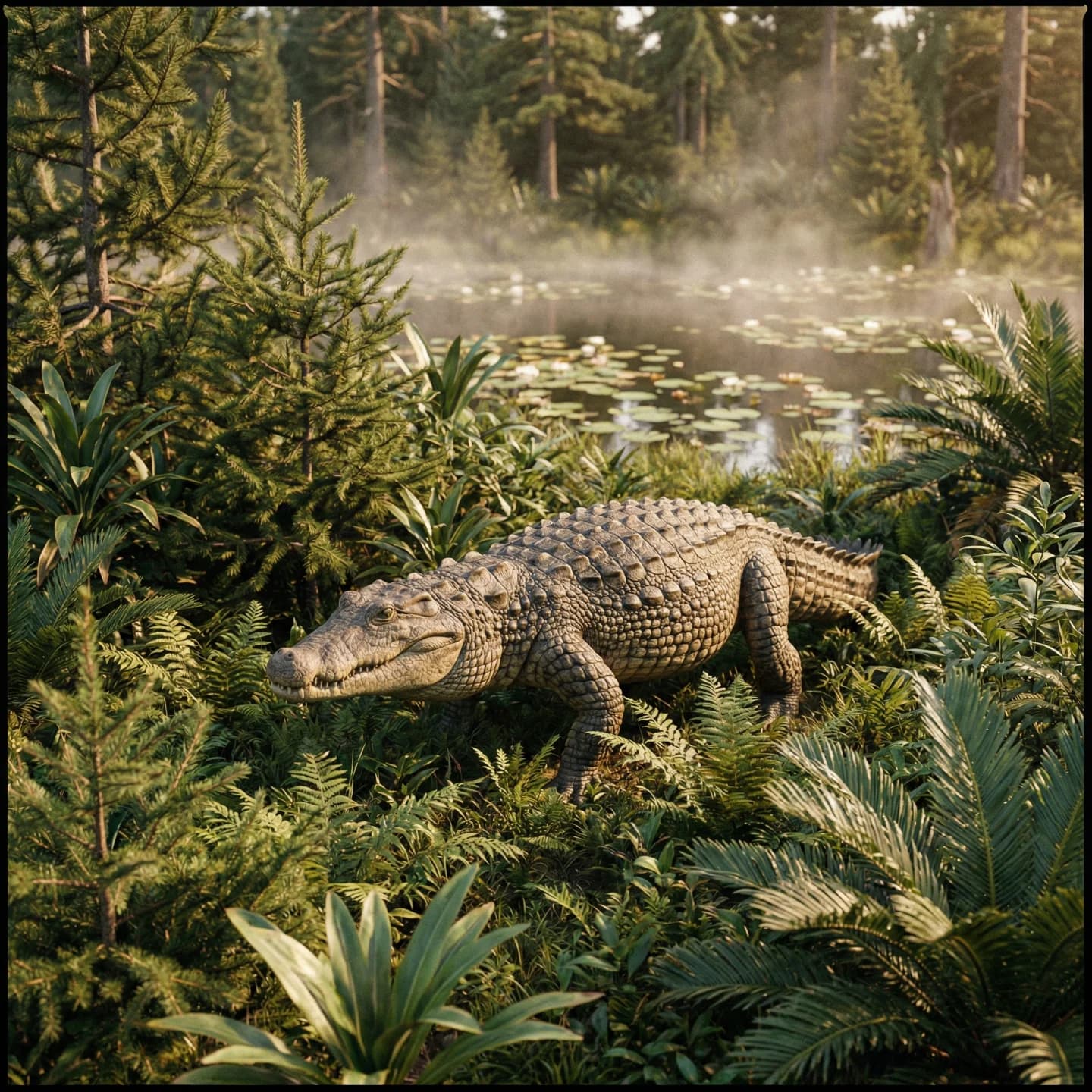
Simosuchus clarki Buckley, Brochu, Krause & Pol, 2000 is a small notosuchian crocodyliform from the Late Cretaceous (Maastrichtian, approximately 70–66 Ma) of northwestern Madagascar. Its name, derived from the Greek simos (pug-nosed) and souchos (the Egyptian crocodile-headed god Sobek), aptly describes this animal's most striking feature: an extraordinarily short, blunt snout unlike that of any other known crocodyliform. The species name clarki honors paleontologist James M. Clark for his contributions to crocodyliform systematics (Buckley et al., 2000).
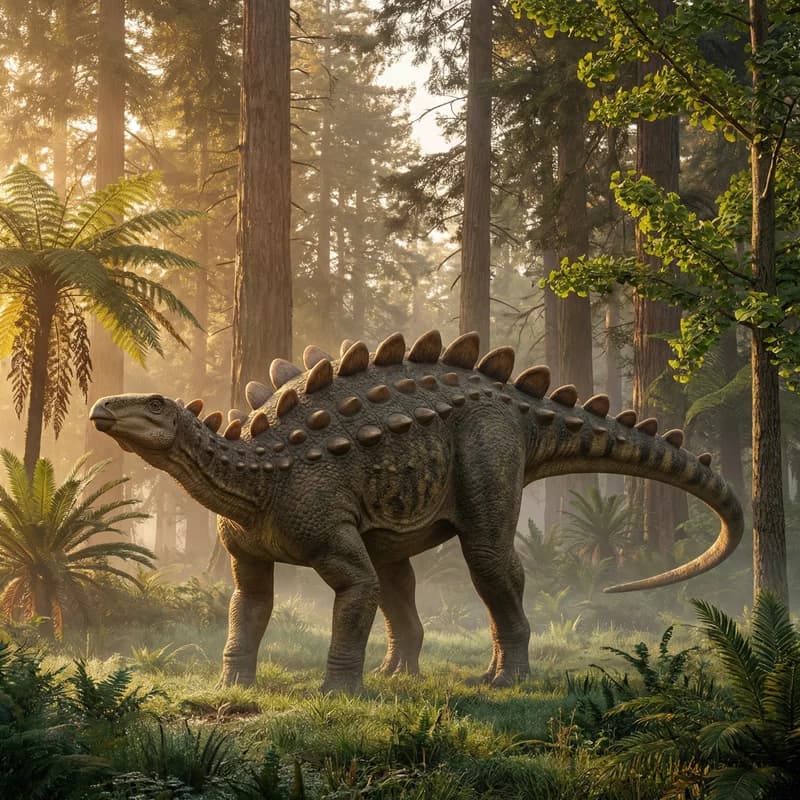
What makes Simosuchus so remarkable is its profound departure from the crocodyliform body plan. Rather than possessing the elongate snout, conical teeth, and aquatic adaptations typical of the group, Simosuchus had a tall, rounded skull with clove-shaped, multicuspid teeth arranged in a single longitudinal row — a dentition more reminiscent of herbivorous ornithischian dinosaurs such as ankylosaurs and stegosaurs than of any crocodilian (Buckley et al., 2000; Melstrom & Irmis, 2019). Fully grown adults measured only about 0.75 m (range ~0.68–0.90 m) in total length, roughly the size of a small dog, with an estimated body mass of approximately 5–8 kg. The entire body was encased in an extensive armor of interlocking bony plates (osteoderms) covering the back, belly, tail, and limbs, producing a convergent resemblance to armored dinosaurs (Hill, 2010).
Importantly, Simosuchus was not a dinosaur. It belongs to Crocodyliformes within the pseudosuchian (crocodilian-line) archosaurs, but to the entirely extinct clade Notosuchia — a diverse group of predominantly terrestrial crocodyliforms that thrived in Gondwana during the Mesozoic. Unlike modern crocodilians, Simosuchus was fully terrestrial and almost certainly herbivorous, making it one of the most ecologically unusual members of Crocodylomorpha ever discovered. It inhabited the semi-arid, seasonally dry alluvial plains of the Maevarano Formation, alongside the apex predator Majungasaurus, the bizarre noasaurid Masiakasaurus, the titanosaur Rapetosaurus, and the giant frog Beelzebufo (Rogers et al., 2007; Krause et al., 2006).
The monographic treatment of Simosuchus published in 2010 as Society of Vertebrate Paleontology Memoir 10 — spanning over 230 pages across six papers — makes it one of the most thoroughly described fossil crocodyliforms, providing an unprecedented level of anatomical detail for a single species (Krause et al., 2010; Kley et al., 2010; Georgi & Krause, 2010; Sertich & Groenke, 2010; Hill, 2010; Turner & Sertich, 2010).
Overview
Name and Etymology
The genus name Simosuchus combines the Greek simos (σιμός, meaning snub-nosed or pug-nosed) with souchos (σοῦχος, the Greek rendition of the Egyptian crocodile-headed deity Sobek). The species name clarki is a patronym honoring James M. Clark, a paleontologist recognized for foundational work on crocodyliform phylogenetics (Buckley et al., 2000). The full meaning of the binomial is thus "Clark's pug-nosed crocodile."
Taxonomic Status
Simosuchus clarki is the sole species currently recognized within the genus. It was originally placed in the family Notosuchidae (Buckley et al., 2000), and subsequent comprehensive phylogenetic analyses have consistently recovered it within the notosuchian subclade Ziphosuchia, typically as the sister taxon of Libycosuchus from the Cenomanian of Egypt (Turner & Sertich, 2010). An alternative analysis by Carvalho et al. (2004) placed Simosuchus outside Notosuchia and allied it with the Chinese genus Chimaerasuchus in a family Chimaerasuchidae, though this topology has not been widely replicated.
Scientific Significance
Simosuchus demonstrates that the ecological and morphological diversity of crocodyliforms during the Mesozoic far exceeded the range seen in modern crocodilians. Its herbivorous adaptation, fully terrestrial lifestyle, and convergent similarities with ankylosaur dinosaurs make it a keystone taxon for understanding the ecological radiation of Gondwanan crocodyliforms.
Age, Stratigraphy, and Depositional Environment
Age Range
Simosuchus is Maastrichtian in age (approximately 70–66 Ma). The dating of the Maevarano Formation rests on its stratigraphic relationship with the overlying marine Berivotra Formation and paleomagnetic data. A magnetic reversal near the top of the Berivotra Formation, interpreted as the Chron 30N–29R transition (approximately 65.8 Ma), indicates that the Maevarano fauna persisted until shortly before the Cretaceous–Paleogene (K–Pg) extinction event (Rogers et al., 2007).
Formation and Lithology
The Maevarano Formation crops out in the Mahajanga Basin of northwestern Madagascar and is subdivided into three members. The basal Masorobe Member consists of reddish, poorly sorted coarse-grained sandstone, at least 80 m thick. The Anembalemba Member, the principal fossil-bearing unit, comprises fine- to coarse-grained, clay-rich sandstone — whitish to light grey with cross-bedding in the lower portion, and light olive-grey and massive in the upper portion. Most vertebrate fossils, including Simosuchus, come from the upper Anembalemba Member. The uppermost Miadana Member is an intermittent unit of claystone, siltstone, and sandstone (Rogers et al., 2000; Rogers et al., 2007). Simosuchus is documented from both the Anembalemba and Masorobe Members (Krause et al., 2010).
Paleoenvironment
The Maevarano Formation is interpreted as a low-relief alluvial plain traversed by broad, shallow rivers flowing northwestward from central highlands. Evidence for debris flows indicates highly variable discharge. Paleosols are reddish and contain root casts, suggesting well-drained floodplains with vegetation adapted to a relatively dry, strongly seasonal climate (alternating wet and dry seasons), at times semi-arid — not unlike the modern climate of the same region. At the time of deposition, Madagascar's paleolatitude was approximately 25–30°S (Rogers et al., 2007). The commonly repeated characterization of Simosuchus as living in a "pond" environment lacks support in the primary literature; the Formation's sedimentology consistently indicates an alluvial setting with episodic river flow, not a permanent lacustrine environment.
Specimens and Diagnostic Features
Holotype
The holotype, UA 8679 (Université d'Antananarivo), was discovered by L. L. Randriamiaramanana at field locality MAD98-17, southeast of the village of Berivotra, Mahajanga Basin, northwestern Madagascar. It comprises a fully articulated skull (anteroposterior length ~12.6 cm, maximum transverse width ~8.2 cm) and lower jaw, cervical and anterior dorsal vertebrae, cervical and anterior dorsal osteoderms, and a complete pectoral girdle with both forelimbs (Buckley et al., 2000; Kley et al., 2010). Neurocentral suture fusion confirms the holotype represents an adult individual (Brochu, 1996).
Referred Specimens
Five additional specimens and numerous isolated teeth have been referred to S. clarki, collectively representing the vast majority of the skeleton.
| Specimen | Repository | Principal Elements | Notes |
|---|---|---|---|
| UA 8679 (holotype) | Univ. of Antananarivo | Skull + mandible, anterior axial skeleton, pectoral girdle + forelimbs | Adult; neurocentral suture fusion confirmed |
| FMNH PR 2596 | Field Museum of Natural History | Nearly complete skull + mandible | Second fully preserved skull |
| FMNH PR 2597 | Field Museum of Natural History | Skull + mandible, postcranial fragments | Third complete skull; osteoderm histology shows 5 growth zones |
| FMNH PR 2598 | Field Museum of Natural History | Partial postcranial skeleton including axis | ~14% smaller than UA 8679 |
| FMNH PR 2785 | Field Museum of Natural History | Partial skeleton with osteoderms | Additional anatomical data |
Considerable variation in skull ornamentation and bony projections among specimens may represent sexual dimorphism, though this remains unconfirmed (Kley et al., 2010).
Diagnosis (Autapomorphies)
The original description listed eight autapomorphic features (Buckley et al., 2000). Subsequent detailed work by Kley et al. (2010) identified 45 autapomorphies in the skull alone, making Simosuchus one of the most morphologically distinctive crocodyliforms known. Key diagnostic features include: entire dentition composed of clove-shaped, multicuspid teeth with cusps in a single longitudinal row; maxillae not meeting on the palatal midline; broad internarial bar formed by the ascending premaxillary process; internal nares larger than and adjacent to suborbital fenestrae; two ossifications capping each supratemporal fenestra; quadrate rami projecting anteroventrally; and 14 contiguous quadrilateral osteoderms per mediolateral row in the dorsal shield.
Morphology and Functional Anatomy
Body Size
Adult Simosuchus measured approximately 0.75 m in total length based on skeletal reconstructions (Georgi & Krause, 2010), with individual variation likely spanning ~0.68–0.90 m. Skull length is ~12.6 cm and width ~8.2 cm. No formal body mass estimate has been published for Simosuchus in the primary literature, but scaling from body length and overall build suggests a mass in the range of approximately 5–8 kg — comparable to a large iguana or a small dog.
Skull and Dentition
The skull of Simosuchus is dramatically unlike that of all other crocodyliforms: it is dorsoventrally tall (vaulted), anteroposteriorly abbreviated, and has a nearly flat anterior face, producing the pug-like profile. The external nares face anterolaterally and the orbits face laterally, contrasting with the dorsally positioned nares and orbits of semi-aquatic crocodilians — evidence that Simosuchus was not adapted for floating at the water surface (Buckley et al., 2000; Kley et al., 2010).
The dentition is heterodont but uniformly clove-shaped and multicuspid. There are 16 tooth positions per upper jaw quadrant (5 premaxillary + 11 maxillary) and 15 per mandibular ramus. Anteriormost teeth have a large central cusp flanked by lower accessory cusps; moving posteriorly, cusp number increases and cusp size becomes more uniform; the most posterior teeth are smaller with fewer cusps. All teeth are strongly buccolingually compressed with a marked constriction at the crown base (Buckley et al., 2000). This morphology closely parallels the dentition of herbivorous iguanids and of ornithischian dinosaurs such as stegosaurs and ankylosaurs.
The jaw articulation is displaced far anteriorly compared to other crocodyliforms, and the glenoid fossa is narrow anteroposteriorly, suggesting limited propalinal (fore-and-aft) jaw motion but a wide gape. The mechanics of jaw adduction may have more closely resembled those of turtles than of modern crocodilians (Buckley et al., 2000).
Postcranial Skeleton
The vertebral column comprises 8 cervical, at least 15 dorsal, 2 sacral, and no more than 20 caudal vertebrae. The very low caudal count gives Simosuchus an exceptionally short tail compared to other crocodyliforms, rendering it poorly suited for aquatic propulsion (Georgi & Krause, 2010). The limbs are robust. The scapula is broad and tripartite, the deltopectoral crest on the humerus is small, and the glenohumeral condyle has a distinctive rounded ellipsoid shape. The forefeet are small with large claws; the hindfeet are also reduced. The hindlimbs held a semi-erect posture, unlike the fully erect stance of most other notosuchians (Sertich & Groenke, 2010).
Osteoderm Armor
The entire body of Simosuchus was extensively armored with osteoderms. The dorsal paravertebral shield consists of four rows of tightly interlocking paramedial osteoderms along either side of the midline, flanked by an additional four rows of accessory parasagittal osteoderms. A ventral shield of plate-like osteoderms (with spongy diploë-like internal structure) covers the belly. Uniquely among crocodyliforms, osteoderms also extensively cover the limbs. Dorsal, caudal, and appendicular osteoderms are light and porous, contrasting with the denser ventral plates (Hill, 2010). This rigid armor restricted lateral body flexibility and is interpreted as an adaptation to a fully terrestrial lifestyle.
Diet and Ecology
Evidence for Herbivory
The case for herbivory in Simosuchus rests on multiple lines of morphological evidence. The clove-shaped, multicuspid teeth are structurally suited for puncturing, shearing, and processing plant tissue (Buckley et al., 2000). Melstrom & Irmis (2019) applied quantitative dental complexity analysis (Orientation Patch Count Rotated, OPCR) across extinct Crocodyliformes and confirmed that Simosuchus falls firmly within the herbivorous range, alongside taxa such as Chimaerasuchus and sphagesaurids. The anteriorly displaced jaw joint and shortened mandible suggest that Simosuchus emphasized neither bite force nor speed typical of predatory crocodilians, instead resembling the jaw mechanics of turtles. Nevertheless, the original description did not entirely exclude the possibility of supplementary consumption of arthropods, other invertebrates, or small vertebrates such as frogs (Buckley et al., 2000).
Terrestrial Lifestyle
Simosuchus was unambiguously terrestrial. Multiple features rule out an aquatic or semi-aquatic lifestyle: the very short tail (unsuitable for swimming), the anterolateral/lateral orientation of the nares and orbits (unsuitable for floating at the water surface), and the rigid osteoderm shield (restricting the lateral undulation used in swimming by extant crocodilians). Robust limbs with semi-erect hindlimb posture further support terrestrial locomotion (Sertich & Groenke, 2010).
The Burrowing Hypothesis
Buckley et al. (2000) proposed a possible fossorial (burrowing) lifestyle based on the short, flat, shovel-like snout; the tall cranium with posteroventrally directed occipital condyle; the short underslung lower jaw; and expanded muscle attachment areas on the cervical vertebrae and occiput. However, Kley et al. (2010) argued against head-first burrowing, noting that the snout lacks a dorsoventrally narrow cutting edge — instead having a broad, flat anterior surface — and that the relatively large orbits would be at risk during burrowing. Additionally, the premaxillary teeth and lower jaw would not be adequately protected from burrowing reaction forces. Sertich & Groenke (2010) and Georgi & Krause (2010) countered that the appendicular skeleton does not specifically preclude burrowing ability, noting that many extant crocodilians capable of digging lack specialized morphological adaptations. The hypothesis remains unresolved.
Predation
LaDuke et al. (2010) suggested that the large madtsoiid snake Madtsoia madagascariensis from the Maevarano Formation may have preyed upon adult Simosuchus, though such large prey would likely have caused injuries to the snake. The apex predator Majungasaurus crenatissimus (~6–7 m) was also a potential threat.
Distribution and Paleogeography
Geographic Distribution
All skeletal material of Simosuchus derives from the Maevarano Formation in the Mahajanga Basin of northwestern Madagascar, specifically from the Berivotra and Masiakakoho study areas, within both the Anembalemba and Masorobe Members (Krause et al., 2010). Numerous isolated teeth have also been collected across the Mahajanga Basin.
A single isolated multicuspid tooth (DUGF/48) from the Kallamedu Formation (Maastrichtian) of the Cauvery Basin in Tamil Nadu, southern India, has been referred to cf. Simosuchus sp. on the basis of its characteristic clove-shaped, buccolingually compressed morphology with cusps in a single row (Prasad et al., 2013). If confirmed, this would extend the genus's range to the Indian subcontinent.
Paleogeographic Interpretation
At the time of deposition, Madagascar had separated from India approximately 88 million years ago and was drifting northward, with the Maevarano Formation located at approximately 25–30°S paleolatitude. How Simosuchus reached Madagascar is uncertain. Its closest recovered phylogenetic relatives — Libycosuchus (Egypt) and Uruguaysuchus (Uruguay) — are distributed across Gondwana, leading to the hypothesis that dispersal occurred via land connections through Antarctica during the Late Cretaceous (Buckley et al., 2000; Turner & Sertich, 2010). The potential Indian occurrence further supports a biogeographic linkage between Madagascar and the Indian subcontinent during the Maastrichtian (Prasad et al., 2013).
Phylogeny and Taxonomic Debates
Original Placement
In their phylogenetic analysis (22 ingroup taxa, 117 characters), Buckley et al. (2000) recovered Simosuchus within Notosuchidae as the sister taxon of Uruguaysuchus, with the pair united by two unambiguous synapomorphies: internal nares divided by a septum, and strongly spatulate posterior teeth. This clade was in turn sister to Malawisuchus.
Turner & Sertich (2010): Comprehensive Analysis
The most thorough phylogenetic treatment of Simosuchus, by Turner & Sertich (2010), expanded the dataset significantly and recovered Simosuchus within Ziphosuchia as the sister taxon of Libycosuchus, in a more derived position than previously suggested. Uruguaysuchus was placed in a more basal position outside this clade.
Alternative Hypothesis: Chimaerasuchidae
Carvalho et al. (2004), using different character codings, placed Simosuchus outside Notosuchia entirely, as the sister taxon of the Chinese Early Cretaceous genus Chimaerasuchus in the family Chimaerasuchidae. Both genera share short snouts and probable herbivory. This topology was placed within the broader clade Gondwanasuchia. This result has not been replicated in most subsequent analyses.
Current Consensus
Most recent phylogenetic analyses recover Simosuchus within Ziphosuchia, allied with Libycosuchus, in a relatively basal position among ziphosuchians. The extreme autapomorphic nature of the skull (45 autapomorphies) has been flagged as a potential source of long-branch attraction artifacts in parsimony analyses (Turner & Sertich, 2010).
Reconstruction and Uncertainty
Confirmed
The following are well-established by multiple lines of evidence: Simosuchus is a notosuchian crocodyliform from the Late Cretaceous of Madagascar; it possesses a uniquely shortened, vaulted skull with clove-shaped multicuspid dentition unlike any other crocodyliform; total body length was approximately 0.75 m; it was fully terrestrial; and its body was encased in extensive osteoderm armor.
Strongly Supported
Herbivory (or at minimum, predominantly herbivorous diet with possible omnivory) is strongly supported by tooth morphology, jaw mechanics, and quantitative dental complexity analysis (Melstrom & Irmis, 2019). Placement within Ziphosuchia is supported by most recent phylogenetic analyses.
Unresolved
Whether Simosuchus was fossorial remains debated, with morphological evidence being equivocal. Precise body mass has not been formally estimated in the primary literature. The Indian tooth's attribution to Simosuchus requires further confirmation. Reproductive behavior, social structure, and ontogenetic patterns remain unknown.
Common Misconceptions
Simosuchus is sometimes mistakenly described as a dinosaur; it is a crocodyliform, not a dinosaur. Although the term "crocodile" in its name evokes modern semi-aquatic crocodilians, Simosuchus was fully terrestrial and ecologically more comparable to a small herbivorous reptile than to any living crocodilian. The description of its habitat as a "pond environment" found in some popular sources is not supported by primary geological literature, which consistently describes a semi-arid alluvial plain.
Comparisons with Contemporaries
Four notosuchian crocodyliforms are recognized from the Maevarano Formation, representing a remarkable degree of ecological partitioning within a single formation.
| Taxon | Body length (m) | Inferred diet | Ecology | Key features |
|---|---|---|---|---|
| Simosuchus clarki | ~0.75 | Herbivore (strongly supported) | Fully terrestrial | Pug snout, multicuspid teeth, extensive armor |
| Araripesuchus tsangatsangana | ~0.6 | Omnivore (inferred) | Terrestrial | Heterodont, elongate snout |
| Miadanasuchus oblita | ~2.0 | Carnivore (inferred) | Semi-aquatic (inferred) | Longirostrine, conical teeth |
| Mahajangasuchus insignis | ~3.0 | Carnivore | Semi-aquatic (inferred) | Large, powerful jaws |
This comparison demonstrates clear niche partitioning: Simosuchus was the only small-bodied herbivore among a community of crocodyliforms spanning a broad range of body sizes and dietary niches (Rakotozafy et al., 2024).
Fun Facts
FAQ
📚References
- Buckley, G. A., Brochu, C. A., Krause, D. W., & Pol, D. (2000). A pug-nosed crocodyliform from the Late Cretaceous of Madagascar. Nature, 405(6789), 941–944. https://doi.org/10.1038/35016061
- Krause, D. W., Sertich, J. J. W., Rogers, R. R., Kast, S. C., Rasoamiaramanana, A. H., & Buckley, G. A. (2010). Overview of the discovery, distribution, and geological context of Simosuchus clarki (Crocodyliformes: Notosuchia) from the Late Cretaceous of Madagascar. Journal of Vertebrate Paleontology, 30(6, Supplement), 4–12. https://doi.org/10.1080/02724634.2010.516784
- Kley, N. J., Sertich, J. J. W., Turner, A. H., Krause, D. W., O'Connor, P. M., & Georgi, J. A. (2010). Craniofacial morphology of Simosuchus clarki (Crocodyliformes: Notosuchia) from the Late Cretaceous of Madagascar. Journal of Vertebrate Paleontology, 30(6, Supplement), 13–98. https://doi.org/10.1080/02724634.2010.532674
- Georgi, J. A., & Krause, D. W. (2010). Postcranial axial skeleton of Simosuchus clarki (Crocodyliformes: Notosuchia) from the Late Cretaceous of Madagascar. Journal of Vertebrate Paleontology, 30(6, Supplement), 99–121. https://doi.org/10.1080/02724634.2010.519172
- Sertich, J. J. W., & Groenke, J. R. (2010). Appendicular skeleton of Simosuchus clarki (Crocodyliformes: Notosuchia) from the Late Cretaceous of Madagascar. Journal of Vertebrate Paleontology, 30(6, Supplement), 122–153. https://doi.org/10.1080/02724634.2010.516902
- Hill, R. V. (2010). Osteoderms of Simosuchus clarki (Crocodyliformes: Notosuchia) from the Late Cretaceous of Madagascar. Journal of Vertebrate Paleontology, 30(6, Supplement), 154–176. https://doi.org/10.1080/02724634.2010.518110
- Turner, A. H., & Sertich, J. J. W. (2010). Phylogenetic history of Simosuchus clarki (Crocodyliformes: Notosuchia) from the Late Cretaceous of Madagascar. Journal of Vertebrate Paleontology, 30(6, Supplement), 177–236. https://doi.org/10.1080/02724634.2010.532348
- Rogers, R. R., Krause, D. W., Rogers, K. C., Rasoamiaramanana, A. H., & Rahantarisoa, L. (2007). Paleoenvironment and paleoecology of Majungasaurus crenatissimus (Theropoda: Abelisauridae) from the Late Cretaceous of Madagascar. Journal of Vertebrate Paleontology, 27(sup2), 21–31. https://doi.org/10.1671/0272-4634(2007)27[21:PAPOMC]2.0.CO;2
- Melstrom, K. M., & Irmis, R. B. (2019). Repeated evolution of herbivorous crocodyliforms during the age of dinosaurs. Current Biology, 29(14), 2389–2395.e3. https://doi.org/10.1016/j.cub.2019.05.076
- Prasad, G. V. R., Verma, O., Flynn, J. J., & Goswami, A. (2013). A new Late Cretaceous vertebrate fauna from the Cauvery Basin, South India: Implications for Gondwanan paleobiogeography. Journal of Vertebrate Paleontology, 33(6), 1260–1268. https://doi.org/10.1080/02724634.2013.777348
- Carvalho, I. S., Ribeiro, L. C. B., & Avilla, L. S. (2004). Uberabasuchus terrificus sp. nov., a new Crocodylomorpha from the Bauru Basin (Upper Cretaceous), Brazil. Gondwana Research, 7(4), 975–1002. https://doi.org/10.1016/S1342-937X(05)71079-0
- LaDuke, T. C., Krause, D. W., Scanlon, J. D., & Kley, N. J. (2010). A Late Cretaceous (Maastrichtian) snake assemblage from the Maevarano Formation, Mahajunga Basin, Madagascar. Journal of Vertebrate Paleontology, 30(1), 109–138. https://doi.org/10.1080/02724630903409188
- Krause, D. W., O'Connor, P. M., Rogers, K. C., Sampson, S. D., Buckley, G. A., & Rogers, R. R. (2006). Late Cretaceous terrestrial vertebrates from Madagascar: Implications for Latin American biogeography. Annals of the Missouri Botanical Garden, 93(2), 178–208. https://doi.org/10.3417/0026-6493(2006)93[178:LCTVFM]2.0.CO;2
- Rakotozafy, B., Ranivoharimanana, L., Krause, D. W., & Sertich, J. J. W. (2024). Late Cretaceous notosuchians of the Maevarano Formation, Mahajanga Basin: An ecomorphological perspective. Journal of Vertebrate Paleontology. https://doi.org/10.1080/02724634.2024.2366568
- Rogers, R. R., Hartman, J. H., & Krause, D. W. (2000). Stratigraphic analysis of Upper Cretaceous rocks in the Mahajanga Basin, northwestern Madagascar: Implications for ancient and modern faunas. The Journal of Geology, 108(3), 275–301. https://doi.org/10.1086/314403
Gallery
5 images Simosuchus
Simosuchus · Cretaceous Period · Herbivore
 Simosuchus
Simosuchus · Cretaceous Period · Herbivore
 Simosuchus
Simosuchus · Cretaceous Period · Herbivore
 Simosuchus
Simosuchus · Cretaceous Period · Herbivore
 Simosuchus
Simosuchus · Cretaceous Period · Herbivore
🔗Related Creatures
Sarcosuchus
Sarcosuchus imperator

Stomatosuchus
Stomatosuchus inermis
Deinosuchus
Deinosuchus
Kaprosuchus
Kaprosuchus saharicus
Pachycephalosaurus
Pachycephalosaurus wyomingensis

Corythosaurus
Corythosaurus casuarius
Magyarosaurus
Magyarosaurus dacus
Wuerhosaurus
Wuerhosaurus homheni