Wuerhosaurus
Cretaceous Period Herbivore Creature Type
Wuerhosaurus homheni
Scientific Name: "Wuerho (city in Xinjiang, China) + Greek sauros (lizard) = 'Wuerho lizard'"
Local Name: Wuerhosaurus
Physical Characteristics
Discovery
Habitat
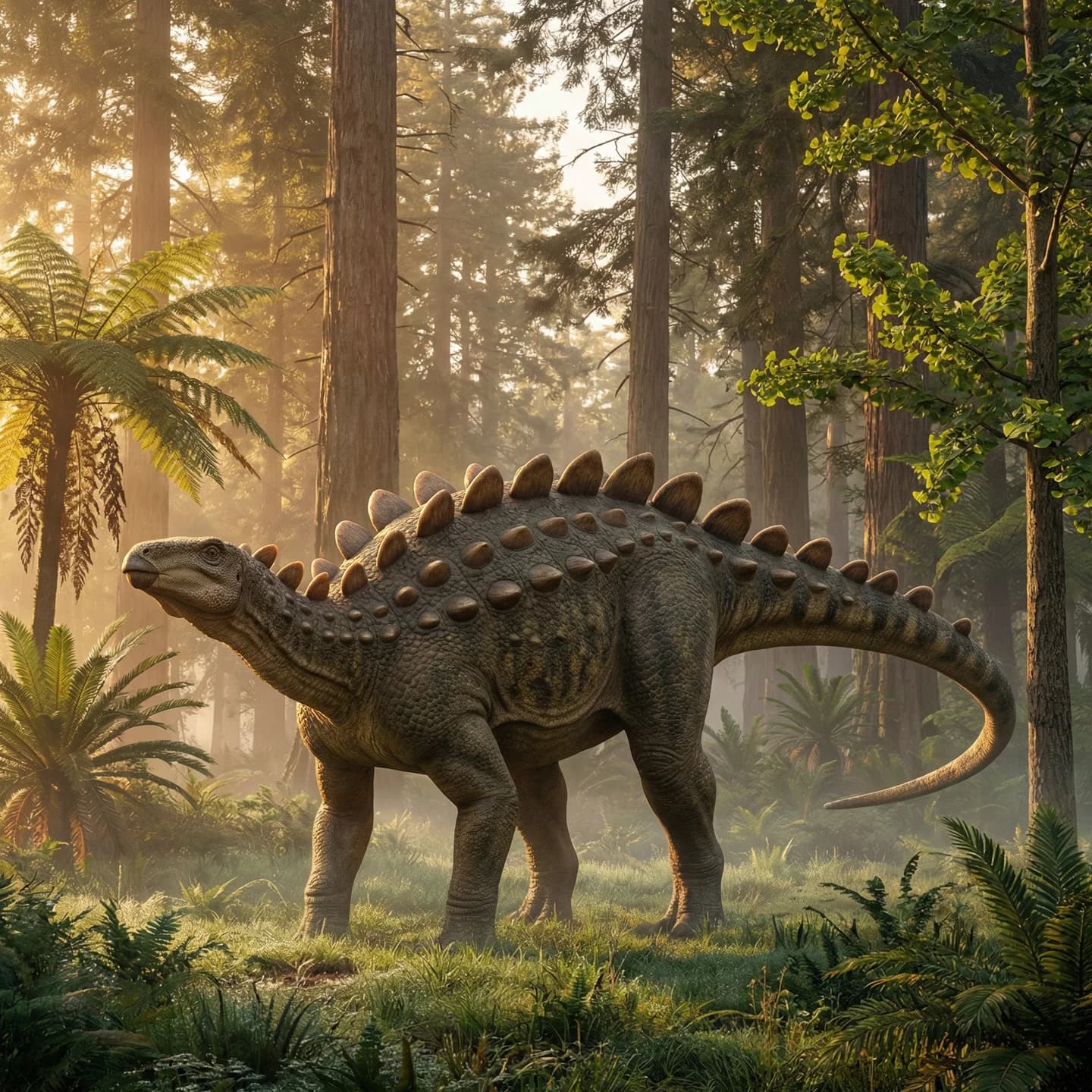
Wuerhosaurus (Wuerhosaurus Dong, 1973) is a genus of stegosaurine stegosaurid dinosaur from the Early Cretaceous (approximately 135–125 Ma) of what is now the Xinjiang Uygur Autonomous Region and Inner Mongolia Autonomous Region of China. It is one of the youngest (most recent) known stegosaurs in the fossil record, surviving well into the Early Cretaceous at a time when most stegosaurs had already disappeared by the end of the Late Jurassic. This makes Wuerhosaurus a critically important taxon for understanding the final chapter of stegosaur evolution.
The genus name Wuerhosaurus derives from the city of Wuerho (烏爾禾) in northwestern Xinjiang Province, near where the type species was discovered, combined with the Greek σαῦρος (sauros, 'lizard'), meaning 'Wuerho lizard.' The type species W. homheni was described by Chinese paleontologist Dong Zhiming in 1973, while the second species W. ordosensis was named by the same author in 1993 based on a specimen from the Ordos Basin in Inner Mongolia. Neither species preserves a skull, and both are known from partial postcranial skeletons, placing significant limitations on full-body reconstruction.
In terms of size, W. homheni is estimated to have reached approximately 7 m (23 ft) in length and 4 metric tons in body mass (Paul, 2016), while W. ordosensis was considerably smaller at about 5 m (16 ft) and 1.2 metric tons. The dorsal plates of Wuerhosaurus were initially interpreted as being flatter and more rectangular than those of other stegosaurids, but Maidment et al. (2008) reinterpreted this as an illusion caused by breakage—the actual plate shape remains unknown. Phylogenetic analyses consistently recover Wuerhosaurus as closely related to Stegosaurus (Raven & Maidment, 2017), and although Maidment et al. (2008) proposed synonymy with Stegosaurus, Carpenter (2010) rebutted this, and Wuerhosaurus is maintained as a separate genus by most subsequent workers.
Overview
Name and Etymology
The genus name Wuerhosaurus is composed of 'Wuerho' (烏爾禾), a city in the northwestern Junggar Basin of Xinjiang Province, China, and the Greek σαῦρος (sauros, 'lizard'), yielding 'lizard from Wuerho.' The specific epithet homheni was not explicitly explained in the original description but is thought to derive from a local toponym or personal name. The second species name ordosensis refers to the Ordos Basin in Inner Mongolia, where its holotype was recovered.
Taxonomic Status
Two species are currently recognized as valid within Wuerhosaurus: the type species W. homheni Dong, 1973 and W. ordosensis Dong, 1993. A third species, 'W. mongoliensis,' named by Ulansky in 2014, is considered an invalid nomen nudum and was formally redescribed as the separate genus Mongolostegus exspectabilis by Tumanova & Alifanov (2018). Maidment et al. (2008) proposed that W. homheni be reassigned as Stegosaurus homheni and that W. ordosensis be treated as a nomen dubium, but Carpenter (2010) argued convincingly that sufficient morphological differences exist to maintain Wuerhosaurus as a distinct genus. Most subsequent phylogenetic analyses (Raven & Maidment, 2017; Jia et al., 2024) continue to treat Wuerhosaurus as a valid separate genus.
Scientific Significance
Wuerhosaurus is one of the key taxa that extends the temporal range of Stegosauria into the Early Cretaceous. While most stegosaurs flourished during the Late Jurassic (approximately 155–150 Ma), Wuerhosaurus persisted until at least 125 Ma. Together with the recently described Yanbeilong ultimus (Jia et al., 2024) and Mongolostegus (Tumanova & Alifanov, 2018), it demonstrates that stegosaurs continued to exist in Asia throughout the Early Cretaceous, long after their apparent disappearance elsewhere.
Stratigraphy and Depositional Environment
Age Range
The type species W. homheni was recovered from the Lianmuqin Formation of the Tugulu Group in the northwestern Junggar Basin, Xinjiang. Uranium-lead (U-Pb) dating by Zheng et al. (2021, 2023) yielded a maximum depositional age of approximately 135.2 ± 0.9 Ma for the lower Lianmuqin Formation, placing the fossil-bearing horizon in the late Valanginian to early Hauterivian. W. ordosensis comes from the Ejinhoro Formation in the Ordos Basin of Inner Mongolia, dated to the Barremian (approximately 129–125 Ma) based on biostratigraphic and correlation data (Cuenca-Bescós & Canudo, 2003; Zheng et al., 2023). Some workers have suggested the Ejinhoro Formation may extend into the Aptian, but this remains debated.
Lithology
The Lianmuqin Formation consists of interbedded greyish-green sandstone and red-brown to light-red mudstone, with a total thickness of 213–360 m (Lucas, 2001). It represents the uppermost unit of the Tugulu Group within the Junggar Basin. The Ejinhoro Formation is dominated by sandstone with interbedded mudstone and siltstone, deposited within the Ordos Basin.
Paleoenvironment
The depositional setting of the Lianmuqin Formation reflects a mosaic of episodic fluvial channels, overbank mudflats, and lacustrine influences. Paleoclimate reconstructions indicate semi-arid to sub-humid conditions in a continental interior basin setting. The Ejinhoro Formation is similarly interpreted as a terrestrial fluvial-lacustrine environment. The accompanying fauna from both formations—including pterosaurs, ceratopsians (Psittacosaurus), theropods, troodontids (Sinornithoides), crocodylomorphs, and turtles—confirms a diverse terrestrial ecosystem.
Specimens and Diagnostic Features
Holotype and Key Specimens
The holotype of W. homheni, IVPP V.4006, is a skull-less fragmentary skeleton comprising a mostly complete pelvis and sacrum (lacking the ischium), the first caudal vertebra, two dorsal vertebrae, a scapulocoracoid, a humerus, a phalanx, and two dermal plates (Dong, 1973). The paratype IVPP V.4007 consists of three posterior caudal vertebrae and a partial ulna from a second individual. A partial ischium from a third locality was also referred to Wuerhosaurus.
The holotype of W. ordosensis, IVPP V.6877, is considerably more complete: an articulated torso comprising three cervical vertebrae, all eleven dorsal vertebrae (with attached ribs), a complete sacrum with right ilium, and the first five caudal vertebrae (Dong, 1993). An additional dorsal vertebra and a dermal plate (IVPP V.6878) were referred to this species.
| Species | Specimen | Composition | Locality / Formation | Reference |
|---|---|---|---|---|
| W. homheni (holotype) | IVPP V.4006 | Pelvis, sacrum, 2 dorsals, 1 caudal, scapulocoracoid, humerus, phalanx, 2 plates | Wuerho Valley, Xinjiang / Lianmuqin Fm. | Dong, 1973 |
| W. homheni (paratype) | IVPP V.4007 | 3 posterior caudals, partial ulna | Wuerho Valley, Xinjiang / Lianmuqin Fm. | Dong, 1973 |
| W. ordosensis (holotype) | IVPP V.6877 | 3 cervicals, 11 dorsals (with ribs), sacrum, right ilium, 5 caudals | Ordos Basin, Inner Mongolia / Ejinhoro Fm. | Dong, 1993 |
| W. ordosensis (referred) | IVPP V.6878 | 1 dorsal, 1 plate | Ordos Basin, Inner Mongolia / Ejinhoro Fm. | Dong, 1993 |
Diagnostic Features
W. homheni is distinguished by the strongly laterally flared anterior ilia, indicating a very broad abdomen, and by the exceptionally tall neural spines on the proximal caudal vertebrae (Dong, 1973; Carpenter, 2010). W. ordosensis differs from W. homheni in its smaller overall size, relatively longer neck, and shorter neural spines (Dong, 1993; Hou & Ji, 2017).
Limitations of the Material
Neither species preserves a skull, and the material of W. homheni consists of only scattered postcranial elements, making full skeletal reconstruction highly uncertain. The original shape of the dorsal plates is unknown due to breakage of the dorsal margins (Maidment et al., 2008; Hone, 2010).
Morphology and Function
Body Size
Paul (2016) estimated W. homheni at approximately 7 m (23 ft) in length and 4 metric tons (approximately 4,000 kg) in body mass, comparable to or slightly smaller than Stegosaurus stenops (approximately 7–9 m). W. ordosensis was substantially smaller, estimated at about 5 m (16 ft) and 1.2 metric tons (approximately 1,200 kg).
Pelvic Structure and Body Shape
The strongly outward-flaring anterior ilia of W. homheni indicate an exceptionally broad body, suggesting accommodation of a large gut for processing large quantities of plant material. W. ordosensis also possesses a broad pelvis but with shorter neural spines.
Dorsal Plates
Three dorsal plates are known from Wuerhosaurus: two from W. homheni (IVPP V.4006) and one from W. ordosensis (IVPP V.6878). These plates were initially interpreted as being flatter and more rectangular than those of other stegosaurids, which became a defining feature of popular reconstructions. However, Maidment (2008) and Hone (2010) reinterpreted the upper edges of these plates as broken rather than naturally shaped, meaning the actual plate morphology remains unknown. The paleontology writer Abdale (2022) has noted that all three plates exhibiting the same pattern of breakage would be a remarkable coincidence, suggesting the original low-and-broad shape cannot be entirely ruled out.
Tail and Defense
Although tail-tip spines (the thagomizer, characteristic of Stegosauridae) have not been directly preserved in any Wuerhosaurus specimen, their presence is strongly inferred from the phylogenetic position within Stegosauridae. The exceptionally tall neural spines on the proximal caudal vertebrae of W. homheni suggest large muscle attachment areas, consistent with the ability to deliver powerful tail swings as a defensive mechanism. Dong (1973) interpreted a separate bone element as a shoulder spine, but this interpretation remains uncertain.
Locomotion
Like other stegosaurs, Wuerhosaurus was almost certainly a quadrupedal animal with forelimbs shorter than the hindlimbs. The head was likely held close to the ground, a posture well suited for feeding on low-growing vegetation such as ferns and cycads.
Diet and Ecology
Diet
No teeth or stomach contents are directly preserved for Wuerhosaurus, but as a member of Stegosauridae it is firmly established as an herbivore. By analogy with the closely related Stegosaurus, whose skull biomechanics have been studied by Reichel (2010), Wuerhosaurus likely fed on relatively soft vegetation such as ferns and horsetails. The broad pelvic structure suggests a large hindgut fermentation chamber capable of processing large volumes of low-nutrient plant matter.
Ecological Context
The Lianmuqin Formation fauna that coexisted with W. homheni includes theropods (Kelmayisaurus, Tugulusaurus), ceratopsians (Psittacosaurus xinjiangensis), pterosaurs (Dsungaripterus, Noripterus), crocodylomorphs (Edentosuchus), and turtles. The Ejinhoro Formation fauna accompanying W. ordosensis includes Psittacosaurus neimongoliensis, the troodontid Sinornithoides youngi, sauropods (Chiayusaurus sp.), and various pterosaurs. Large theropods such as Kelmayisaurus were potential predators.
Behavioral Inferences
The world's smallest known stegosaur footprint (5.7 cm in length) was discovered in the Tugulu Group of Xinjiang and attributed to W. homheni individuals (Xing et al., 2021). This tiny track suggests a cat-sized juvenile that may have walked bipedally, potentially indicating an ontogenetic shift from bipedal to quadrupedal locomotion during growth. Larger adult-sized stegosaur tracks from the same deposits confirm that individuals of multiple age classes occupied the same environment.
Distribution and Paleogeography
Geographic Range
W. homheni was found in the Wuerho Valley of the northwestern Junggar Basin in Xinjiang, while W. ordosensis was recovered from near Yang-paul village in the Ordos Basin, Inner Mongolia. These two localities are separated by more than 2,000 km in a straight line, indicating that stegosaurs were widely distributed across inland China during the Early Cretaceous.
Paleocoordinates
The Lianmuqin Formation type locality has approximate paleocoordinates of 45.0°N, 81.9°E, while the Ejinhoro Formation type locality plots at approximately 40.5°N, 105.5°E. Both locations represent mid-latitude continental interior settings that would have experienced warmer subtropical to warm-temperate climates during the Early Cretaceous.
Phylogeny and Taxonomic Debates
Phylogenetic Position
The phylogenetic placement of Wuerhosaurus varies somewhat among analyses. Carpenter et al. (2001) recovered it as a basal stegosaurid, closely related to Hesperosaurus and Dacentrurus. Maidment et al. (2008) placed it within derived Stegosaurinae, most closely related to Hesperosaurus and then Stegosaurus. The most recent major analysis by Raven & Maidment (2017) recovered Wuerhosaurus homheni as the sister taxon of Stegosaurus stenops, with Hesperosaurus being more closely allied to Miragaia. Jia et al. (2024) similarly recovered Wuerhosaurus in a clade with Stegosaurus, with their newly described Yanbeilong ultimus as the sister taxon to that clade.
The Stegosaurus Synonymy Debate
Maidment et al. (2008) proposed that W. homheni should be reassigned as Stegosaurus homheni because the holotype material appeared similar to Stegosaurus and fell phylogenetically between two taxa they considered species of Stegosaurus (S. stenops and Hesperosaurus = S. mjosi). They also treated W. ordosensis as a nomen dubium on the grounds that the holotype could not be located in the IVPP collections and lacked valid diagnostic features. Carpenter (2010) countered that the diagnoses used by Maidment et al. were inconsistent and overly generalized, and that W. homheni bore numerous distinguishing differences. Hou & Ji (2017) described additional material referable to W. ordosensis, including a sacrum with paired ilia, supporting the validity of this species. The prevailing consensus today is that Wuerhosaurus is a valid separate genus.
Reconstruction and Uncertainty
Confirmed
It is well established that Wuerhosaurus is a stegosaurid (Stegosauridae, Stegosaurinae) from the Early Cretaceous of China, that it possessed broad ilia and tall proximal caudal neural spines, and that two species are known from different regions of China (Xinjiang and Inner Mongolia).
Hypothetical or Uncertain
The original shape of the dorsal plates (flat/rectangular vs. Stegosaurus-like diamond shape) remains undetermined due to breakage. The presence of a thagomizer is strongly inferred but not directly preserved. Body coloration, detailed behavior, and social habits are entirely speculative. The possibility that juveniles were bipedal is suggested by track evidence but not confirmed by skeletal data.
Popular Media vs. Science
In popular media (video games, toys, etc.), Wuerhosaurus is commonly depicted with distinctive low, flat, rectangular plates. This iconic image is based on the initial (now questioned) interpretation of the broken plate fossils—the actual plate shape is unknown. Additionally, some popular sources erroneously classify Wuerhosaurus as a theropod, which is incorrect; it belongs to Ornithischia, Thyreophora, Stegosauria.
Comparison with Related Taxa
| Taxon | Age | Locality | Est. Length | Est. Mass | Plate Shape | Notes |
|---|---|---|---|---|---|---|
| Wuerhosaurus homheni | Early Cretaceous (~135 Ma) | Xinjiang, China | ~7 m | ~4 t | Unknown (broken) | Tall proximal caudal neural spines |
| Wuerhosaurus ordosensis | Early Cretaceous (Barremian) | Inner Mongolia, China | ~5 m | ~1.2 t | Unknown | Relatively longer neck |
| Stegosaurus stenops | Late Jurassic (~155–150 Ma) | North America | ~7–9 m | ~5 t | Large diamond-shaped | Most famous stegosaur |
| Yanbeilong ultimus | Early Cretaceous (Aptian–Albian) | Shanxi, China | Unknown | Unknown | Unknown | One of the last stegosaurs |
| Mongolostegus exspectabilis | Early Cretaceous (Aptian–Albian) | Mongolia | Unknown | Unknown | Unknown | Formerly 'W. mongoliensis' |
Fun Facts
FAQ
📚References
- Dong, Z. (1973). "Dinosaurs from Wuerho." Reports of Paleontological Expedition to Sinkiang (II): Pterosaurian Fauna from Wuerho, Sinkiang. Memoirs of the Institute of Vertebrate Paleontology and Paleoanthropology, Academia Sinica, 11, 45–52.
- Dong, Z. (1993). "A new species of stegosaur (Dinosauria) from the Ordos Basin, Inner Mongolia, People's Republic of China." Canadian Journal of Earth Sciences, 30(10), 2174–2176. doi:10.1139/e93-188
- Dong, Z. (1990). "Stegosaurs of Asia." In Carpenter, K. & Currie, P.J. (eds.), Dinosaur Systematics: Approaches and Perspectives, Cambridge University Press, 255–268.
- Maidment, S.C.R., Norman, D.B., Barrett, P.M. & Upchurch, P. (2008). "Systematics and phylogeny of Stegosauria (Dinosauria: Ornithischia)." Journal of Systematic Palaeontology, 6(4), 367–407. doi:10.1017/S1477201908002459
- Carpenter, K. (2010). "Species concept in North American stegosaurs." Swiss Journal of Geosciences, 103(2), 155–162. doi:10.1007/s00015-010-0020-6
- Raven, T.J. & Maidment, S.C.R. (2017). "A new phylogeny of Stegosauria (Dinosauria, Ornithischia)." Palaeontology, 60(3), 401–408. doi:10.1111/pala.12291
- Paul, G.S. (2016). The Princeton Field Guide to Dinosaurs (2nd ed.). Princeton University Press, p. 248.
- Carpenter, K., Miles, C.A. & Cloward, K. (2001). "New primitive stegosaur from the Morrison Formation, Wyoming." In Carpenter, K. (ed.), The Armored Dinosaurs, Indiana University Press, 55–75.
- Tumanova, T.A. & Alifanov, V.R. (2018). "First Record of Stegosaur (Ornithischia, Dinosauria) from the Aptian–Albian of Mongolia." Paleontological Journal, 52(14), 1771–1779. doi:10.1134/S0031030118140186
- Jia, L., Li, N., Dong, L., Shi, J., Kang, Z., Wang, S., Xu, S. & You, H. (2024). "A new stegosaur from the late Early Cretaceous of Zuoyun, Shanxi Province, China." Historical Biology, 37(2), 420–429. doi:10.1080/08912963.2024.2308214
- Zheng, D., Chang, S.-C., Ramezani, J. et al. (2023). "Calibrating the Early Cretaceous Urho Pterosaur Fauna in Junggar Basin and implications for the evolution of the Jehol Biota." GSA Bulletin, 136(1–2), 765–773. doi:10.1130/B36795.1
- Xing, L., Lockley, M.G., Persons, W.S., Klein, H., Romilio, A., Wang, D. & Wang, M. (2021). "Stegosaur Track Assemblage from Xinjiang, China, Featuring the Smallest Known Stegosaur Record." PALAIOS, 36(2), 68–76. doi:10.2110/palo.2020.036
- Hou, Y. & Ji, S. (2017). "New findings of stegosaurs from the Lower Cretaceous Luohandong Formation in the Ordos Basin, Inner Mongolia." Geological Bulletin of China, 36(7), 1097–1103.
- Lucas, S.G. (2001). Chinese Fossil Vertebrates. Columbia University Press, pp. 158–159.
- Galton, P.M. & Carpenter, K. (2016). "The plated dinosaur Stegosaurus longispinus Gilmore, 1914 (Dinosauria: Ornithischia; Upper Jurassic, western USA), type species of Alcovasaurus n. gen." Neues Jahrbuch für Geologie und Paläontologie – Abhandlungen, 279(2), 185–208. doi:10.1127/njgpa/2016/0551
Gallery
5 images Wuerhosaurus
Wuerhosaurus · Cretaceous Period · Herbivore
 Wuerhosaurus
Wuerhosaurus · Cretaceous Period · Herbivore
 Wuerhosaurus
Wuerhosaurus · Cretaceous Period · Herbivore
 Wuerhosaurus
Wuerhosaurus · Cretaceous Period · Herbivore
 Wuerhosaurus
Wuerhosaurus · Cretaceous Period · Herbivore
🔗Related Creatures

Regaliceratops
Regaliceratops peterhewsi
Therizinosaurus
Therizinosaurus cheloniformis
Sauropelta
Sauropelta edwardsorum
Pentaceratops
Pentaceratops sternbergii
Amargasaurus
Amargasaurus cazaui
Parasaurolophus
Parasaurolophus walkeri
Hypsilophodon
Hypsilophodon foxii
Nigersaurus
Nigersaurus taqueti