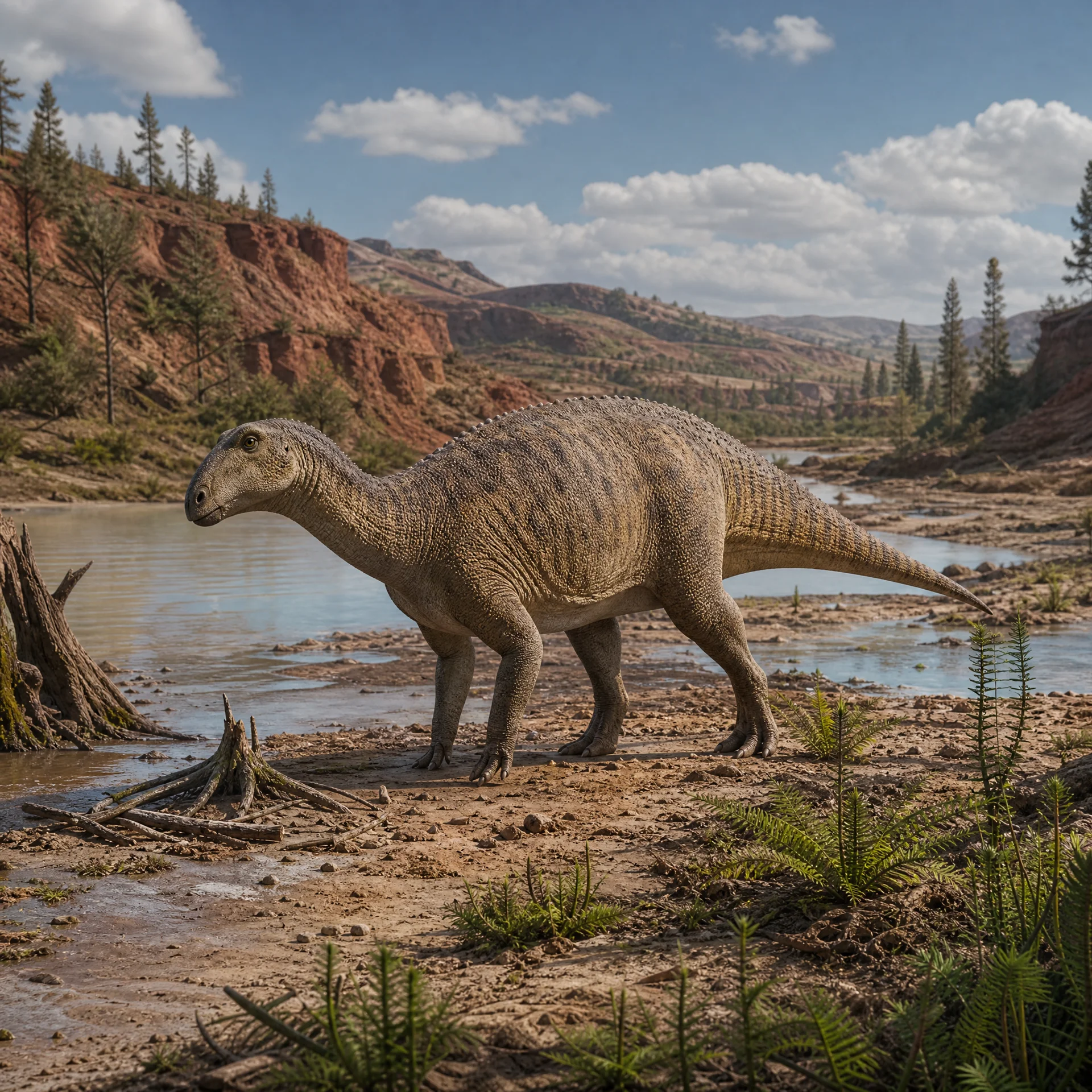
Yanbeilong
Yanbeilong ultimus
⏳ Cretaceous Period🍽️ HerbivoreDinosaurs
Physical Characteristics
⏳
PeriodCretaceous Period
🍽️
DietHerbivore
📏
Size5~6.5m
⚖️
Weight2000~3000kg
Classification
GEN
GenusYanbeilong
SP
SpeciesY. ultimus
Yanbeilong ultimus
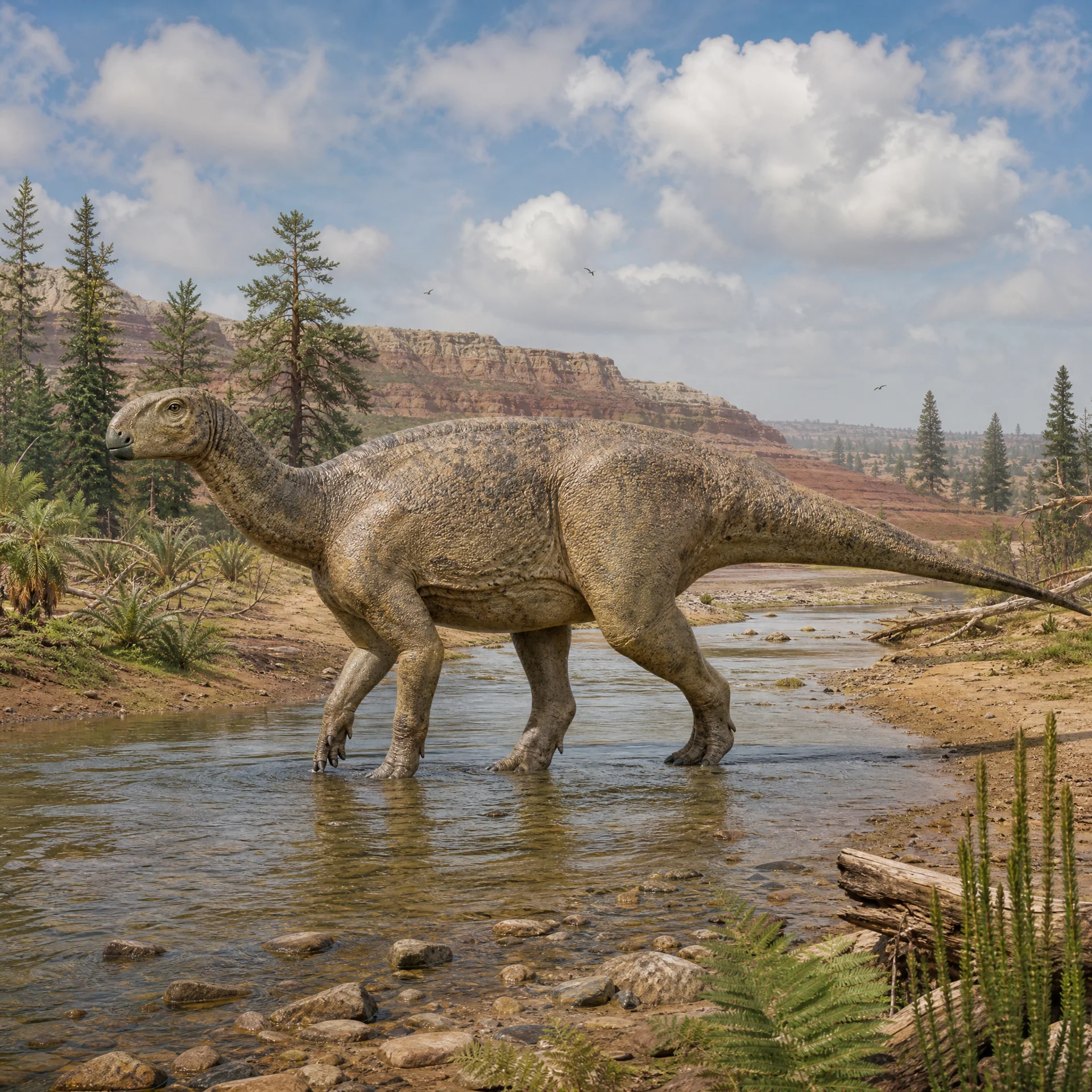
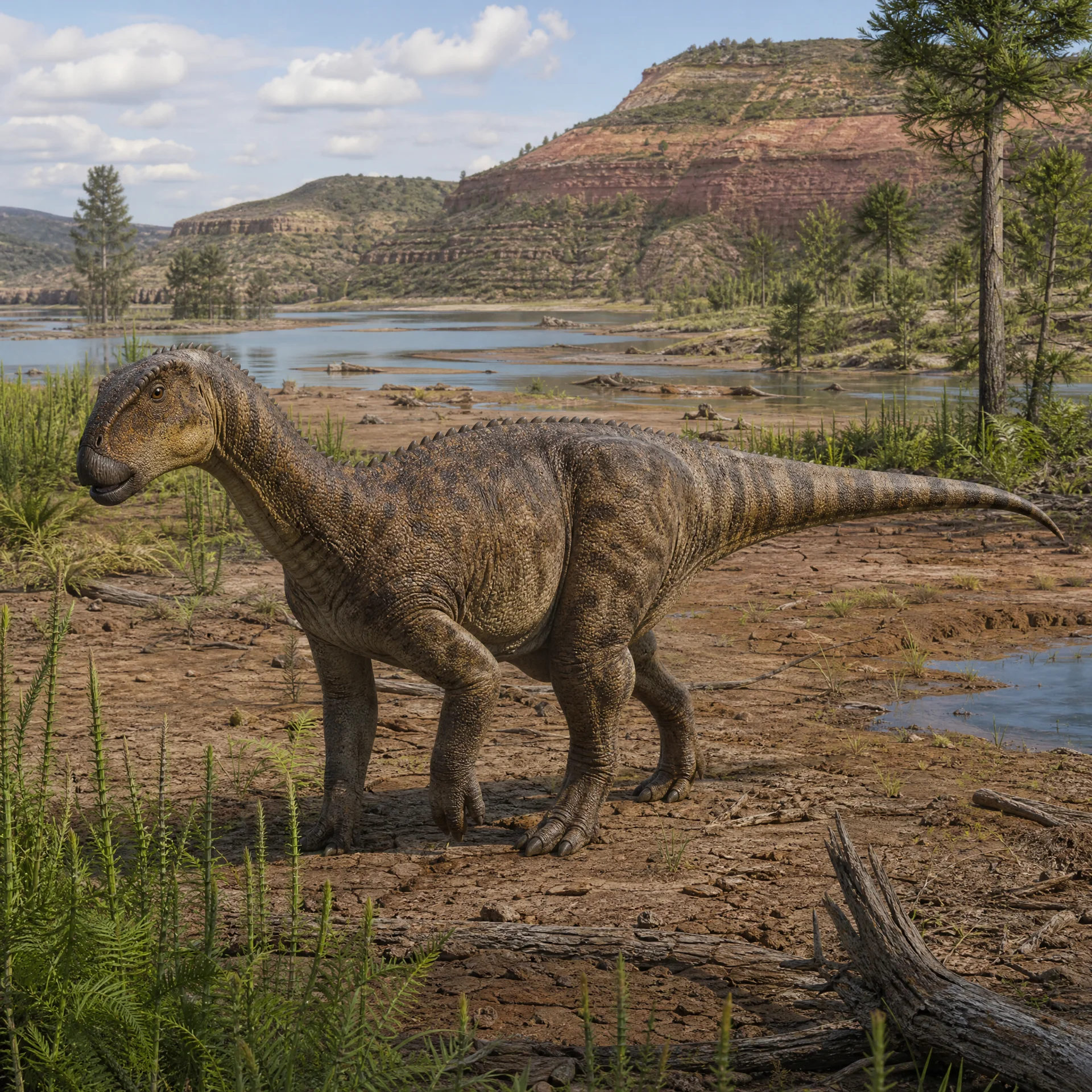
Yanbeilong (Yanbeilong ultimus Jia et al., 2024) is a stegosaurian dinosaur from the Early Cretaceous (Albian stage, approximately 113–100 Ma) Zuoyun Formation of Zuoyun County, Shanxi Province, China. The holotype specimen was excavated in 2011 and formally described as a new genus and species in 2024 by Jia Lei and colleagues in the journal Historical Biology. In a global context where stegosaurian fossil records from the Cretaceous are exceptionally rare, Yanbeilong stands as one of the latest-surviving stegosaurs known to science, making it a taxon of considerable paleontological significance.
The holotype (SXMG V 00006) consists of a partial skeleton comprising dorsal vertebrae, the sacrum, a caudal vertebra, and pelvic elements (ilia, ischium, pubis). No cranial material or the characteristic dermal plates and tail spikes (thagomizer) were preserved. Despite this incompleteness, several autapomorphic features—including an unusually high neural arch with a proportionally small neural canal in the dorsal vertebrae and a reduced number of fenestrae in the ilio-sacral block—justified the erection of the new genus and species. Phylogenetic analyses consistently recover Yanbeilong as a deeply nested member of Stegosaurinae, recovered as the sister taxon to a clade containing Stegosaurus stenops and Wuerhosaurus homheni, highlighting its position within a late-surviving East Asian stegosaur lineage.
Based on proportional scaling with closely related stegosaurs, Yanbeilong is estimated to have reached a body length of approximately 5–6.5 m and a body mass of roughly 2–3 tonnes, placing it within the range of a medium-sized stegosaur. The taxon gained broader public recognition through its appearance in the Netflix documentary series The Dinosaurs (2026), Episode 3 "Empire," where it was depicted as a CGI stegosaur in a scene set in Early Cretaceous China at approximately 113 million years ago.
The generic name "Yanbeilong" is derived from the Mandarin Chinese "Yanbei" (雁北), meaning "north of Yanmen Pass"—a reference to the historically significant Yanmen Pass on the Great Wall of China, near the fossil discovery locality in northern Shanxi Province—combined with "long" (龍), the Mandarin word for "dragon." The specific epithet "ultimus" is Latin for "last," reflecting this taxon's status as one of the most recent-surviving members of the stegosaur lineage (Jia et al., 2024).
Yanbeilong has been accepted as a valid genus and species since its formal description in 2024, and no subsequent studies have challenged its validity. The sole type species is Yanbeilong ultimus. In the taxonomic hierarchy, it is placed within Ornithischia > Thyreophora > Stegosauria > Stegosauridae > Stegosaurinae.
Yanbeilong is a late Early Cretaceous (Albian) stegosaur that significantly extends the temporal range of the Stegosauria, a clade that reached peak diversity in the Late Jurassic but became exceptionally rare in the Cretaceous.
The Zuoyun Formation, from which Yanbeilong was recovered, is assigned to the Albian stage of the Early Cretaceous, corresponding to approximately 113–100 Ma. This age assignment is based on biostratigraphic correlations using charophyte, ostracod, and conchostracan assemblages, as well as regional lithostratigraphic comparisons (Dong et al., 2018; Jia et al., 2024).
The Zuoyun Formation is a Lower Cretaceous stratigraphic unit exposed in Zuoyun County, Shanxi Province, northwestern China. Its lithology is dominated by red mudstones interbedded with sandstones and minor conglomerates. These facies are interpreted as representing a continental fluvial-lacustrine depositional environment, comprising river channels, floodplain fines, and lacustrine margin deposits (Dong et al., 2018). The Zuoyun Formation was deposited as part of the broader Ordos Basin system during a phase of intracontinental extension and rifting of the North China Craton.
Sedimentary facies analysis and sporomorph data indicate that the Zuoyun area experienced a subtropical climate during the Early Cretaceous, characterized by irregular alternation between arid and humid phases. Periodic catastrophic flooding events produced thick proluvial fan conglomerate-mudstone deposits (Dong et al., 2018). The flora was dominated by gymnosperms, including conifers, cycadophytes, and ferns, as evidenced by the Cicatricosisporites–Crybelosporites–Tricolpites sporopollen assemblage (Yu, 1986; Dong et al., 2018). Aquatic biota included charophytes (Euaelistochara mundula, Aclistochara bransoni), bivalves (Lepesthes sp.), conchostracans (Yanjiestheria sp.), and ostracods (Ziziphocypris costata, Timiriasevia princepalis, Cypridea tera, Rhinocypris tugurigensis), indicating stable lacustrine and riverine niches with seasonal water-level fluctuations.
The holotype of Yanbeilong, SXMG V 00006, was discovered in 2011 in sediments of the Zuoyun Formation near Madaotou Township, Zuoyun County, Datong City, Shanxi Province, China. It is housed at the Shanxi Museum of Geology (SXMG). The specimen represents a partial skeleton of a single individual, comprising the following elements (Jia et al., 2024):
| Element | Preservation Details |
|---|---|
| Dorsal vertebrae | 7 vertebrae (5 found in association with the ilio-sacral block, 2 isolated) |
| Sacrum | Complete sacrum |
| Caudal vertebra | 1 anterior caudal vertebra |
| Pelvis | Both ilia, left ischium, right pubis |
| Ribs | Dorsal ribs, sacral ribs |
Some sources (e.g., Grokipedia) additionally list a right humerus, partial radius and ulna, right astragalus and calcaneum, and one osteoderm among the preserved elements, though these are not uniformly mentioned across all references and require verification against the full published description.
Jia et al. (2024) identified the following autapomorphic features distinguishing Yanbeilong from all other known stegosaurs:
| Character | Description |
|---|---|
| Neural arch height of dorsal vertebrae | Significantly taller than in other stegosaurs |
| Neural canal size of dorsal vertebrae | Proportionally smaller; the neural arch-to-neural canal height ratio exceeds 4 (ranging from 4.16–5.64), a value not observed in any other stegosaur |
| Ilio-sacral block | Fewer fused vertebrae/sacrals and fewer fenestrae in the sacral ribs compared to closely related taxa |
| Multiple additional features | Differences from Stegosaurus stenops and Wuerhosaurus homheni in dorsosacral vertebral ribs, sacral ribs, caudal vertebrae, and ilium morphology |
This combination of features is unique to Yanbeilong and forms the basis for its recognition as a distinct genus.
The holotype lacks the skull, dermal plates, and tail spikes (thagomizer)—the most iconic elements of stegosaurian anatomy. Limb bones are incompletely known, precluding precise gait analysis or detailed body proportions. These limitations introduce substantial uncertainty into reconstructions of Yanbeilong's external appearance.
Body length is estimated at approximately 5–6.5 m based on proportional scaling of the preserved dorsal and sacral vertebrae relative to those of closely related stegosaurs, particularly Stegosaurus. Skeletal reconstructions by paleoartist SlvrHwk estimate the holotype individual at approximately 6.5 m in length, suggesting a fairly large individual. Body mass is estimated at roughly 2–3 tonnes, though this figure carries considerable uncertainty given the incompleteness of the skeleton and the indirect nature of the estimation method.
The dorsal vertebrae exhibit bifurcated neural spines divided by a V-shaped notch, a structure interpreted as providing attachment and support for the rows of dermal plates along the back. The centra are robust and amphicoelous, with pronounced postspinal laminae suggesting structural reinforcement of the vertebral column. The preacetabular process of the ilium is elongated while the postacetabular process is shortened, consistent with the typical stegosaurian pelvic morphology. The ischium and pubis are notably thicker and longer, respectively, than in most other stegosaurs, potentially enhancing pelvic stability.
Based on the preserved vertebral and pelvic morphology, Yanbeilong was a quadrupedal dinosaur, consistent with all known stegosaurs. The hindlimbs were likely longer than the forelimbs, giving the animal a characteristic downward-sloping anterior profile. The bifurcated neural spines and tall neural arches suggest the presence of relatively large dorsal plates, which may have served thermoregulatory functions (through vascularized forced convection) or played a role in intraspecific display for mating or dominance—hypotheses analogous to those proposed for Stegosaurus plate function (Main et al., 2005).
As a stegosaurian, Yanbeilong is classified as an obligate herbivore. Stegosaurs in general possess small heads with peg-like teeth and a jaw mechanism limited to simple orthal (vertical) biting, lacking the capacity for lateral or propalinal jaw movement. This functional limitation suggests a diet focused on relatively soft, low-growing vegetation such as ferns, cycads, and horsetails (Lautenschlager et al., 2016). However, some studies have suggested that stegosaurs may have possessed a higher bite force than previously estimated, with a potential preference for tougher vegetation such as cycads (Lautenschlager et al., 2016).
No direct dietary evidence (skull, tooth morphology, gut contents, stable isotope data) is available for Yanbeilong itself, as the cranium was not preserved.
Within the Zuoyun Formation, Yanbeilong co-occurred with unidentified sauropod remains, indicating the presence of diverse large-bodied herbivores in this Albian-age ecosystem. Adjacent and slightly younger Cretaceous formations in the Zuoyun area have yielded the hadrosauroid Zuoyunlong huangi and unidentified ankylosaur remains, illustrating the herbivorous dinosaur diversity of the region during the Early to early Late Cretaceous transition. Yanbeilong likely occupied the niche of a low-level primary browser, comparable to the ecological role inferred for its close relative Wuerhosaurus.
Although the dermal plates and thagomizer were not preserved in the holotype, the close phylogenetic relationship with Stegosaurus and Wuerhosaurus strongly suggests that Yanbeilong possessed rows of dorsal plates and terminal tail spikes. The thagomizer in particular is well-documented as a defensive weapon in stegosaurs, while the plates may have served dual functions in thermoregulation and intraspecific display.
Yanbeilong is currently known exclusively from a single locality: the Zuoyun Formation near Madaotou Township, Zuoyun County, Datong City, Shanxi Province, China. However, a stegosaurian specimen (GSAU 201201) from the similarly aged Hekou Group of Gansu Province shares notable similarities with Yanbeilong in dorsal vertebral morphology—specifically, a neural arch-to-neural canal height ratio exceeding 5 and a unique protuberance on the anterior face of the centrum above the neural canal. This specimen was formally reported as Stegosaurus sp. by Li et al. (2024), but has been informally referred to as "cf. ?Yanbeilong sp." by some researchers (SlvrHwk, 2024). The limited overlap in comparable skeletal elements prevents a definitive taxonomic assignment.
The estimated paleocoordinates for the Zuoyun Formation during the Early Cretaceous are approximately 42.4°N, 104.1°E (Paleobiology Database). This corresponds roughly to the modern Mongolia–Inner Mongolia border region and reflects the semi-arid subtropical continental interior environment of Early Cretaceous East Asia.
In the original description, Jia et al. (2024) conducted a cladistic analysis using a morphological data matrix derived from prior stegosaur studies. The strict consensus tree recovered Yanbeilong as a derived member of Stegosauridae, placed within Stegosaurinae as the sister taxon to a clade uniting Stegosaurus stenops (Late Jurassic, North America) and Wuerhosaurus homheni (Early Cretaceous, China). Key synapomorphies supporting this placement include specific vertebral configurations in the dorsal vertebrae and a reduced number of fenestrae in the sacral region.
In 2025, Sánchez-Fenollosa & Cobos published an expanded and updated stegosaurian phylogenetic analysis in Vertebrate Zoology (75: 147–171), accompanying the description of the most complete stegosaurian skull from Europe. This analysis recovered similar results, with Yanbeilong placed as the sister taxon to Wuerhosaurus homheni within a Chinese clade of Stegosaurinae that also includes Jiangjunosaurus and an unnamed stegosaur from the Hekou Group. These consistent results across two independent analyses strengthen confidence in Yanbeilong's phylogenetic position.
No fundamental challenges to Yanbeilong's placement within Stegosaurinae have been published to date. However, given the incomplete nature of the holotype specimen, the precise phylogenetic position may be refined with the discovery of additional material, particularly cranial elements and limb bones. The relationship between Yanbeilong and the Hekou Group specimen (GSAU 201201) also remains to be resolved with further comparative study.
| Aspect | Confidence Level | Basis |
|---|---|---|
| Stegosaurian (Stegosauria) affinity | Confirmed | Vertebral and pelvic morphology, cladistic analysis (Jia et al., 2024) |
| Stegosaurinae placement | Well-supported | Two independent phylogenetic analyses in agreement (Jia et al., 2024; Sanchez-Fenollosa & Cobos, 2025) |
| Albian age (ca. 113–100 Ma) | Well-supported | Biostratigraphic and regional lithostratigraphic correlations |
| Body length ca. 5–6.5 m | Estimated (proportional scaling) | Comparison with closely related stegosaur vertebral dimensions |
| Presence of dorsal plates | Hypothetical (phylogenetic inference) | No direct plate fossils preserved; inferred from bifurcated neural spines and stegosaurian synapomorphies |
| Presence of thagomizer (tail spikes) | Hypothetical (phylogenetic inference) | No direct evidence; inferred from stegosaurian shared derived characters |
| Herbivorous diet | Well-supported (clade-level) | Universal in Stegosauria; no direct gut content or dental evidence for this taxon |
In the 2026 Netflix documentary series The Dinosaurs, Episode 3 "Empire," Yanbeilong appears as a fully reconstructed CGI stegosaur in a scene set approximately 113 million years ago in China. The documentary depicts the animal with characteristic dorsal plates and tail spikes in a typical stegosaurian body plan. It is important to note that these ornamental structures were not directly preserved in the fossil record—the reconstruction is a reasonable inference based on close relatives (Stegosaurus, Wuerhosaurus) but is not confirmed for this specific taxon. Additionally, the narrative of stegosaur decline linked to the spread of flowering plants, as presented in the documentary, represents a correlation-level hypothesis rather than an established causal relationship (Butler et al., 2009).
Cretaceous stegosaurs are exceedingly rare globally. The following table summarizes all currently recognized Cretaceous stegosaurian taxa alongside Yanbeilong:
| Taxon | Temporal Range | Geographic Range | Formation | Notes |
|---|---|---|---|---|
| Paranthodon africanus | Early Cretaceous (Valanginian–Hauterivian?) | South Africa | Kirkwood Fm. | Partial snout and teeth; taxonomic placement debated |
| Wuerhosaurus homheni | Early Cretaceous (Valanginian–Albian) | Xinjiang, China | Lianmuqin Fm. | One of the best-known Cretaceous stegosaurs |
| Wuerhosaurus ordosensis | Early Cretaceous (Aptian–Albian) | Inner Mongolia, China | Luohandong Fm. | Articulated dorsal vertebral series preserved |
| Mongolostegus exspectabilis | Early Cretaceous (Aptian–Albian) | Mongolia | Khukhtekskaya Fm. | Described in 2018; similar temporal range to Yanbeilong |
| Yanbeilong ultimus | Early Cretaceous (Albian) | Shanxi, China | Zuoyun Fm. | One of the latest-surviving stegosaurs worldwide |
| Hekou Group stegosaur (GSAU 201201) | Early Cretaceous (Aptian–Albian) | Gansu, China | Hekou Group | Reported as Stegosaurus sp.; shares similarities with Yanbeilong |
| Specimen Number | Repository | Preserved Elements | Formation | Reference |
|---|---|---|---|---|
| SXMG V 00006 | Shanxi Museum of Geology (SXMG) | 7 dorsal vertebrae, sacrum, 1 caudal vertebra, both ilia, left ischium, right pubis, ribs | Zuoyun Fm. (Albian) | Jia et al., 2024 |
| GSAU 201201 (informal reference) | Gansu Agricultural University (GSAU) | Dorsal vertebrae, sacrum, other fragments | Hekou Group (Aptian–Albian) | Li et al., 2024 (cf. ?Yanbeilong sp., informal) |
| Parameter | Details | Basis |
|---|---|---|
| Age | Early Cretaceous, Albian (ca. 113–100 Ma) | Biostratigraphy (charophyte, ostracod, conchostracan assemblages), regional correlation |
| Formation | Zuoyun Formation | Jia et al., 2024; Dong et al., 2018 |
| Lithology | Red mudstones interbedded with sandstones and minor conglomerates | Dong et al., 2018 |
| Depositional environment | Continental fluvial-lacustrine: river channels, floodplains, lacustrine margins | Sedimentary facies analysis, Dong et al., 2018 |
| Paleoclimate | Subtropical; irregular arid–humid alternation with episodic catastrophic flooding | Sporopollen analysis, sedimentary facies analysis |
The Yanmen Pass (雁門關) referenced in Yanbeilong's name is one of the most historically significant passes on the Great Wall of China, serving as a key military gateway for thousands of years.
Yanbeilong was the first of three new stegosaurian genera named in 2024, preceding Thyreosaurus and Baiyinosaurus—an unprecedented year for stegosaur taxonomy, as never before had even two new genera been named in a single year.
Stegosaurs peaked in diversity during the Late Jurassic but dwindled to fewer than five valid taxa worldwide during the entire Cretaceous Period; Yanbeilong is among the very last of its kind.
The neural arch-to-neural canal height ratio in Yanbeilong's dorsal vertebrae ranges from 4.16 to 5.64—the highest value recorded in any known stegosaur.
Despite being a stegosaur, the holotype of Yanbeilong lacks the group's most iconic features: no dermal plates and no thagomizer (tail spikes) were preserved, making its external appearance largely hypothetical.
The Zuoyun Formation where Yanbeilong was found preserves evidence of a semi-arid subtropical environment with episodic catastrophic flooding events during the Early Cretaceous.
Yanbeilong appeared as a CGI stegosaur in the Netflix documentary series 'The Dinosaurs' (2026), Episode 3 'Empire,' gaining broader public recognition.
The Albian stage when Yanbeilong lived (approximately 113–100 Ma) is some 42–55 million years later than the time of Stegosaurus (approximately 155 Ma), representing an extraordinarily late survival record for the stegosaur lineage.
Unidentified sauropod fossils have also been found in the Zuoyun Formation, indicating that Yanbeilong shared its ecosystem with large-bodied herbivorous dinosaurs.
The species name 'ultimus' (Latin for 'last') was deliberately chosen by the describers to emphasize Yanbeilong's position as one of the final members of the stegosaur lineage in the fossil record.
Yanbeilong (Yanbeilong ultimus) is a stegosaurian dinosaur—a member of the same group of plated, herbivorous dinosaurs that includes the famous Stegosaurus. It is classified within the derived family Stegosauridae and subfamily Stegosaurinae (Jia et al., 2024).
The holotype specimen (SXMG V 00006) was excavated in 2011 from the Zuoyun Formation near Madaotou Township, Zuoyun County, Datong City, Shanxi Province, China. It was formally described as a new genus and species in 2024 by Jia Lei and colleagues in the journal Historical Biology.
The generic name 'Yanbeilong' combines Mandarin Chinese 'Yanbei' (雁北, 'north of Yanmen Pass')—referencing the historically important Yanmen Pass on the Great Wall of China near the discovery site—with 'long' (龍, 'dragon'). The species name 'ultimus' is Latin for 'last,' reflecting the taxon's status as one of the latest-surviving stegosaurs.
Based on proportional scaling of preserved vertebrae against closely related stegosaurs such as Stegosaurus, Yanbeilong is estimated at approximately 5–6.5 meters in length and 2–3 tonnes in weight. These are indirect estimates and carry significant uncertainty due to the incompleteness of the specimen.
Stegosaurs reached their peak diversity in the Late Jurassic and declined dramatically in the Cretaceous, with fewer than five valid Cretaceous taxa known worldwide before Yanbeilong's description. Dating to the Albian stage (approximately 113–100 Ma), Yanbeilong represents one of the latest-surviving stegosaurs in the global fossil record, significantly extending the known temporal range of the group.
No dermal plates or tail spikes (thagomizer) were preserved in the holotype specimen. However, the bifurcated neural spines on the dorsal vertebrae are interpreted as structures that supported dorsal plates, and phylogenetic inference from close relatives strongly suggests that Yanbeilong possessed both dorsal plates and a thagomizer. This remains a hypothesis based on phylogenetic reasoning, not direct fossil evidence.
Phylogenetic analysis by Jia et al. (2024) recovered Yanbeilong as the sister taxon to a clade containing Stegosaurus stenops and Wuerhosaurus homheni. An updated analysis by Sánchez-Fenollosa & Cobos (2025) placed it as the sister taxon to Wuerhosaurus within a Chinese clade of Stegosaurinae that also includes Jiangjunosaurus.
The causes of stegosaur decline remain unresolved. Proposed hypotheses include competitive replacement by ankylosaurs and ornithopods, the simple jaw mechanics of stegosaurs (limited to vertical biting) reducing their ability to adapt to changing vegetation, and the decline of preferred food sources (such as cycads) due to the diversification of flowering plants (angiosperms). These are correlation-level hypotheses; causal relationships have not been established (Butler et al., 2009; Lautenschlager et al., 2016).
Yes. Yanbeilong was featured in the Netflix documentary series 'The Dinosaurs' (2026), Episode 3 'Empire,' in a segment set approximately 113 million years ago in Early Cretaceous China. It was depicted as a CGI stegosaur in a narrative about the last stegosaurs struggling to survive as flowering plants took over the landscape.
This cannot be confirmed. GSAU 201201 was reported as Stegosaurus sp. by Li et al. (2024), but it shares key similarities with Yanbeilong, including a neural arch-to-neural canal height ratio exceeding 5 and a unique protuberance on the anterior centrum. However, the limited overlap in comparable skeletal elements prevents definitive taxonomic assignment, and the specimen has only been informally referred to as 'cf. ?Yanbeilong sp.'
5images