Pentaceratops
Cretaceous Period Herbivore Creature Type
Pentaceratops sternbergii
Scientific Name: "Greek penta (five) + keras (horn) + ops (face) = 'five-horned face.' In reality, only three are true horn cores (one nasal, two brow); the remaining two are enlarged epijugal projections of the cheekbones."
Local Name: Pentaceratops
Physical Characteristics
Discovery
Habitat
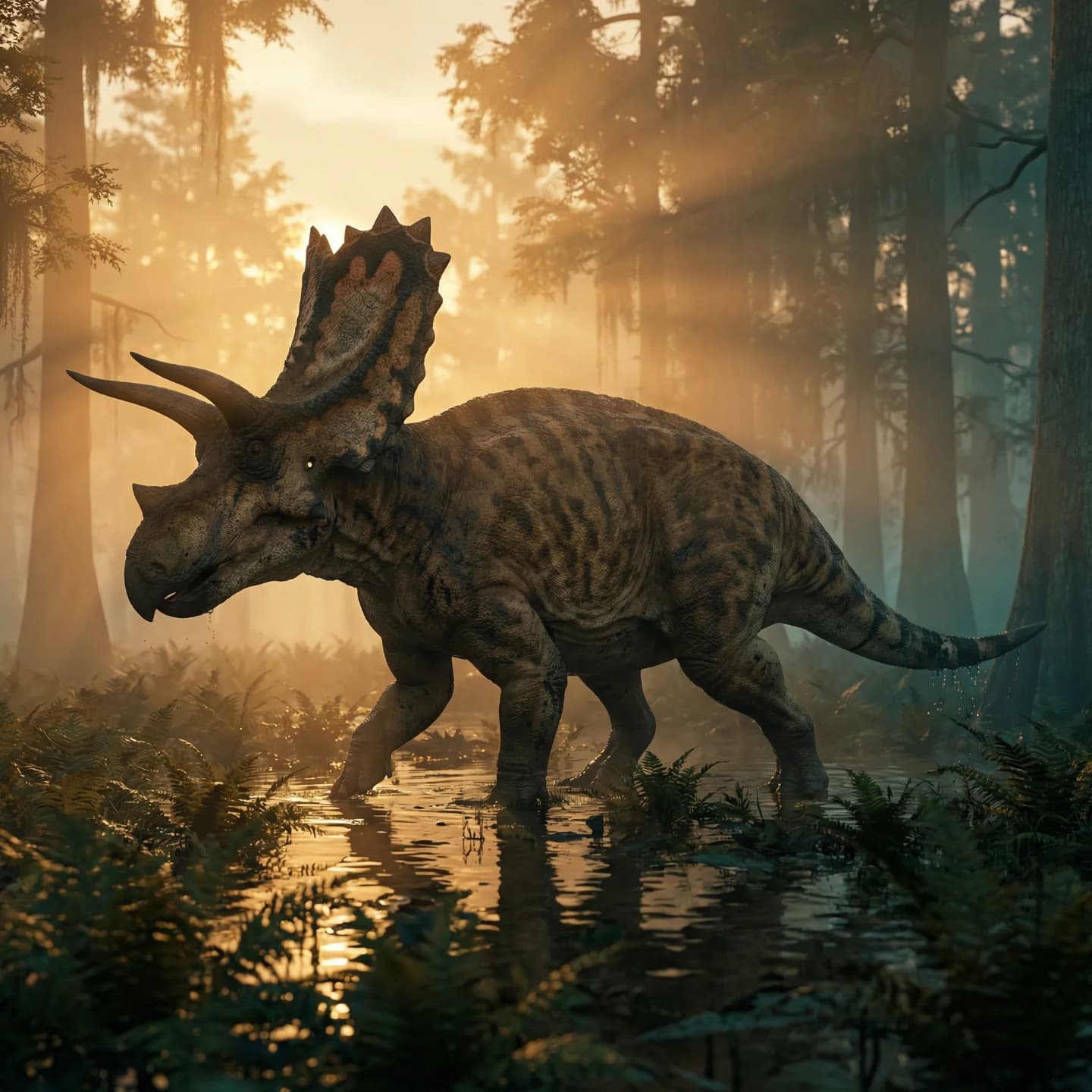
Pentaceratops (Pentaceratops sternbergii Osborn, 1923) is a large herbivorous ceratopsid dinosaur belonging to the subfamily Chasmosaurinae (family Ceratopsidae, clade Ceratopsia, clade Ornithischia). It lived during the late Campanian stage of the Late Cretaceous, approximately 76–73 million years ago (Ma), in what is now western North America. The generic name derives from the Greek penta (five), keras (horn), and ops (face), meaning "five-horned face." However, the animal possessed only three true horn cores — one nasal horn and two supraorbital (brow) horns — with the remaining two "horns" being elongated, sharply pointed epijugal projections of the jugal (cheekbone) bones. Such epijugals are present in most ceratopsids, but in Pentaceratops they are exceptionally large and prominent, leading the original describer to count them as horns.
Fossils of Pentaceratops are primarily known from the Fruitland and Kirtland Formations in the San Juan Basin of New Mexico, with a juvenile specimen also recovered from the Williams Fork Formation of Colorado. About a dozen skulls and partial skeletons have been described, providing a relatively thorough anatomical understanding of this genus. The body length has been estimated at approximately 5.5–6 m, with a mass of about 2.5 metric tons (Paul, 2016). Skull lengths of known specimens range from 2.16 to 2.3 m, and the skull is distinguished by a very long, rectangular parietosquamosal frill bearing two large parietal fenestrae and a characteristic U-shaped midline embayment at the posterior margin.
Pentaceratops is a biostratigraphically significant taxon: its appearance in the fossil record defines the start of the Kirtlandian land-vertebrate "age" (LVA), marking the boundary with the preceding Judithian LVA (Sullivan & Lucas, 2006). Recent taxonomic revisions by Fowler & Freedman Fowler (2020) have reassigned several Kirtland Formation specimens formerly attributed to Pentaceratops to the new genera Navajoceratops and Terminocavus, narrowing the confirmed range of P. sternbergii specimens primarily to the Fruitland Formation. These reclassifications have significantly reshaped understanding of chasmosaurine evolution in the late Campanian.
Overview
Etymology and Naming History
The generic name Pentaceratops is composed of three Greek roots: penta (πέντα, five), keras (κέρας, horn), and ops (ὤψ, face), yielding "five-horned face." The name was suggested to Henry Fairfield Osborn by William Diller Matthew. The specific epithet sternbergii honors Charles Hazelius Sternberg, the fossil collector who first discovered the specimens. According to Sullivan & Lucas (2011), the naming served in part as a consolation to the nearly bankrupt Sternberg, whose 1923 finds were initially not acquired by the American Museum of Natural History (AMNH), which was directing its budget toward processing the fossils from Roy Chapman Andrews' Central Asiatic Expeditions.
Despite the name suggesting five horns, the animal had only three true horn cores: a short nasal horn pointing upward and backward, and two long, strongly forward-curving brow horns above the eyes. The two additional "horns" are in fact the epijugal projections — sharply pointed extensions of the jugal bones that project outward from below the eyes. While epijugals are common among ceratopsids, those of Pentaceratops are unusually large and conspicuous, explaining why Osborn counted them as horns.
Taxonomic Status
Pentaceratops is classified within the Ornithischia, Ceratopsia, Ceratopsidae, and subfamily Chasmosaurinae. The type species is P. sternbergii Osborn, 1923. A second species, P. fenestratus, was named by Wiman (1930) based on specimens Sternberg collected in 1921 (PMU R.200 and PMU R.286). The specific name referred to a hole in the left squamosal, which was traditionally considered an injury artifact, making P. fenestratus a junior synonym of P. sternbergii. However, Fowler & Freedman Fowler (2020) regarded P. fenestratus as potentially distinct from P. sternbergii, possibly identical to Navajoceratops or Terminocavus, though the preservation state prevents a definitive determination.
In 2014, Longrich named P. aquilonius based on fragmentary fossils from near Manyberries, Alberta, Canada. Mallon et al. (2016) found P. aquilonius to be morphologically similar to Spiclypeus shipporum and considered it a nomen dubium.
Key Diagnostic Features
Pentaceratops is diagnosed by the following combination of features: a long, rectangular frill with two large parietal fenestrae; a deep U-shaped midline embayment at the posterior margin of the parietal with the first epiparietals (ep1) pointing forward within the notch; up to twelve episquamosals along the squamosal margin; three epiparietals at the parietal bone; and very thick jugals that do not contact the squamosals — a possible autapomorphy (Longrich, 2011).
Stratigraphy, Age, and Depositional Environment
Temporal Range and Stratigraphy
Pentaceratops fossils are found primarily in the Fruitland Formation and the overlying Kirtland Formation in the San Juan Basin of northwestern New Mexico. Radiometric dating from 23 m above the base of the Fruitland Formation has yielded an age of 76.03 ± 0.41 Ma, while an ash bed at the upper boundary with the Kirtland Formation dates to approximately 75.02 ± 0.13 Ma (Fowler, 2017). The Kirtland Formation's Hunter Wash Member spans approximately 75.0–74.0 Ma, the Farmington Member approximately 74.0–73.83 Ma, and the De-na-zin Member approximately 73.83–73.49 Ma.
The holotype AMNH 6325 was collected from the Fruitland Formation, dating to approximately 75 Ma. Fowler & Freedman Fowler (2020) restricted confirmed P. sternbergii specimens to the Fruitland Formation (approximately 74.7–75 Ma), with several Kirtland Formation specimens reassigned to Navajoceratops and Terminocavus.
Pentaceratops serves as the index fossil for the Kirtlandian land-vertebrate "age" (LVA), a biostratigraphic interval equivalent to approximately 2.2 million years of late Campanian time (Sullivan & Lucas, 2006).
Depositional Environment and Lithology
The Fruitland Formation was deposited along the retreating shoreline of the Western Interior Seaway (WIS) during the late Campanian. It consists of interbedded sandstones, mudstones, shales, and coal seams, reflecting a mosaic of coastal plain, swamp, and floodplain environments. The coal deposits indicate the presence of extensive wetlands. Streams flowed northeastward toward the retreating shoreline (Fassett & Hinds, 1971).
The Kirtland Formation (originally named the "Kirtland Shale") consists primarily of alluvial mudstones, shales, and channel sandstones — the products of overbank floods and multiple channel systems draining a broad coastal plain. Together, these formations represent a subtropical to warm-temperate floodplain environment with extensive forests and wetlands bordering the western coast of the WIS.
Specimens and Diagnostic Characters
Holotype and Key Specimens
The holotype, AMNH 6325, is a nearly complete skull lacking the rostral bone and lower jaws, collected by Charles H. Sternberg in 1922 from the Fossil Forest area in San Juan County, New Mexico. It was described by Henry Fairfield Osborn in 1923. Importantly, the diagnostic posterior end of the parietal is not preserved on the holotype, which complicates reliable referral of other specimens to the taxon (Fowler & Freedman Fowler, 2020).
Key referred and associated specimens include:
| Specimen | Repository | Composition | Formation | Notes |
|---|---|---|---|---|
| AMNH 6325 (holotype) | AMNH | Nearly complete skull (rostral and mandible lacking) | Fruitland Fm. | Osborn, 1923 |
| AMNH 1624 | AMNH | Smaller skull | Fruitland Fm. | Skull length 2.3 m |
| AMNH 1625 | AMNH | Frill fragment | Fruitland Fm. | - |
| PMU R.200 | Uppsala Univ. | Skull | Kirtland Fm. | Skull length 2.16 m; Wiman, 1930 |
| UKVP 16100 | Univ. of Kansas | Complete skull | Kirtland Fm. | Rowe et al., 1981; first recognition of U-shaped embayment |
| MNA Pl.1747 | MNA | Partial skeleton with skull | Kirtland Fm. | Reassigned to aff. Pentaceratops n. sp. by Fowler & Freedman Fowler, 2020 |
| NMMNH P-27468 | NMMNH | Partial skeleton with skull | Kirtland Fm. | Reclassified as Terminocavus sealeyi holotype (2020) |
| OMNH 10165 | Sam Noble Museum | Very large skull + skeleton | Fruitland/Kirtland Fm. | Lehman, 1998; reclassified as Titanoceratops ouranos (Longrich, 2011) |
| SDMNH 43470 | SDMNH | Juvenile partial skull | Williams Fork Fm., CO | Lucas et al., 2006 |
Diagnostic Characters
Based on Lehman (1993) and subsequent studies, the key diagnostic features of Pentaceratops include: a long, rectangular frill with two large parietal fenestrae; a deep U-shaped midline embayment at the posterior margin of the parietal, with the first epiparietals pointing forward within the notch; up to 12 triangular episquamosals along the squamosal; 3 epiparietals along the parietal; a well-developed postfrontal fontanelle; and very thick jugals not contacting the squamosals — a possible autapomorphy.
Specimen Limitations
The absence of the diagnostic posterior parietal bar on the holotype makes species-level referrals challenging. The progressive reassignment of Kirtland Formation specimens to Navajoceratops, Terminocavus, and Bisticeratops is steadily narrowing the range of confirmed P. sternbergii material, mostly to the Fruitland Formation.
Morphology and Functional Anatomy
Overall Size and Body Plan
Dodson (1996) estimated the body length of Pentaceratops at approximately 6 m, while Paul (2016) estimated it at 5.5 m with a mass of approximately 2.5 metric tons. The torso was tall and wide, with the posterior dorsal vertebrae bearing elongated neural spines from which ligaments may have run anteriorly to support the heavy frill (Paul, 2010).
The exceptionally large specimen OMNH 10165, with a total body length of approximately 6.8 m and a skull height (with frill) of approximately 3.2 m, was once attributed to Pentaceratops and held the Guinness World Record for the largest skull of any land vertebrate (Lehman, 1998). However, this specimen was reclassified as Titanoceratops ouranos by Longrich (2011), so this record can no longer be attributed to Pentaceratops proper.
Horns and Frill
The nasal horn is short and points upward and backward. The two brow horns are very long and curve strongly forward. The epijugal projections are thick and protrude laterally from beneath the eyes, giving rise to the "five-horned" name.
The parietosquamosal frill is considerably longer than that of Triceratops and tilts slightly upward. It is broadly rectangular in outline, adorned by large triangular osteoderms: up to 12 episquamosals along the squamosals and 3 epiparietals along the parietal. These osteoderms are largest at the posterior corners of the frill and are separated by a large U-shaped notch at the midline — a feature not recognized until Rowe et al. (1981) described specimen UKVP 16100. Within the notch, the first epiparietals (ep1) point forward. Two large parietal fenestrae perforate the frill, reducing its overall weight.
Skull and Dentition
The skull is long and low, narrowly triangular when viewed from above. Pentaceratops possesses a well-developed postfrontal fontanelle and a braincase structure similar to that of other chasmosaurines (Lehman, 1993). The anterior end bore a parrot-like beak (rostral bone plus predentary) for cropping vegetation, and the jaws contained self-sharpening dental batteries with continuous cutting edges suited for shearing plant material.
Limbs and Tail
The forelimbs were relatively short and robust, while the hindlimbs were longer — a typical ceratopsid body plan. In smaller specimens, the femur bows outward (Paul, 2010). The prepubis was long and the ischium was long and strongly curved forward. The tail was relatively short, as in other ceratopsids, and helped to balance the massive body. Pentaceratops was an obligate quadruped.
Diet and Ecology
Diet (Evidence)
The dental morphology (self-sharpening tooth batteries), the parrot-like rostral beak, and the cranial biomechanics of ceratopsids collectively confirm that Pentaceratops was unequivocally herbivorous. The Late Cretaceous flora of New Mexico was dominated by ferns, cycads, and conifers, with angiosperms (flowering plants) beginning to diversify. Pentaceratops likely used its sharp beak to crop branches and its dental batteries to shred leaves and needles, with the bulk of digestion occurring in a large gut via hindgut fermentation.
Ecological Role and Associated Fauna
Pentaceratops was a key component of the large-herbivore community in the Fruitland and Kirtland Formations. Coexisting fauna from the same formations include: the hadrosaurid Parasaurolophus (P. tubicen and P. cyrtocristatus); the pachycephalosaurids Sphaerotholus and Stegoceras novomexicanum; the ankylosaurids Nodocephalosaurus and Ziapelta; and the apex predator, the large tyrannosauroid Bistahieversor sealeyi. Ecological niche partitioning among these herbivores would have arisen from differences in body size, feeding apparatus, and microhabitat preferences.
Behavioral Inferences
Multiple hypotheses have been proposed for the function of the horns and frill: defense against predators, intraspecific combat, species recognition, sexual display, and thermoregulation. Current consensus favors species recognition and display as the primary functions, based on the species-specific ornamentation patterns (number and arrangement of epiparietals and episquamosals). Direct evidence for gregarious behavior (such as bonebeds) is lacking for Pentaceratops specifically, although group behavior in other ceratopsids suggests that some degree of social aggregation is plausible (hypothesis).
Distribution and Paleogeography
Geographic Distribution
Confirmed localities are concentrated in the San Juan Basin of northwestern New Mexico, spanning the Fruitland and Kirtland Formations. In 2006, a juvenile specimen (SDMNH 43470) was reported from the Williams Fork Formation of Colorado, slightly extending the geographic range (Lucas et al., 2006). Longrich (2014) named P. aquilonius from fragmentary material near Manyberries, Alberta, Canada, dramatically extending the distribution northward, but the validity of this species is disputed.
Paleogeographic Context
During the late Campanian, the San Juan Basin lay on the western coast of the Western Interior Seaway in the southern part of the island continent of Laramidia. The paleocoordinates of the Kirtland Formation are approximately 42.6°N, 76.3°W (reconstructed paleoposition). This places Pentaceratops in the southern Laramidian faunal province, geographically separated from roughly contemporaneous chasmosaurines such as Utahceratops and Kosmoceratops in Utah, leading Sampson et al. (2010) to propose a model of intracontinental dinosaur endemism with latitudinally distinct faunal provinces.
Phylogeny and Taxonomic Debates
Phylogenetic Position
Within the Chasmosaurinae, Pentaceratops is positioned as more derived than Chasmosaurus but more basal than the Anchiceratops–Triceratops lineage. In the cladistic analysis by Sampson et al. (2010), Pentaceratops was recovered as sister taxon to Utahceratops gettyi. Longrich (2014) obtained a similar topology, with P. aquilonius recovered as sister to a clade containing P. sternbergii + Utahceratops.
The Navajoceratops–Terminocavus Anagenesis Hypothesis
Fowler & Freedman Fowler (2020) described Navajoceratops sullivani and Terminocavus sealeyi from the Kirtland Formation as stratigraphic and morphological intermediates between Pentaceratops and Anchiceratops. Their hypothesis proposes an anagenetic (unbranching) evolutionary series in which the U-shaped midline embayment of the parietal posterior bar progressively deepened and eventually closed over approximately 2 million years. Geometric morphometric analysis of the parietal supported this trend, although the cladistic analysis was less conclusive and requires further testing.
The Titanoceratops Debate
The very large specimen OMNH 10165, originally described as Pentaceratops by Lehman (1998), was renamed Titanoceratops ouranos by Longrich (2011). Longrich argued that the specimen's more derived morphology, similarities to Triceratops, and lack of unique Pentaceratops-specific features warranted generic separation. Fowler & Freedman Fowler (2020), however, continued to treat this specimen as aff. Pentaceratops sp., leaving the debate unresolved.
Restoration and Uncertainty
Confirmed Facts
Pentaceratops is a large chasmosaurine ceratopsid with three true horn cores (one nasal, two brow horns) and prominent epijugal projections. Its long frill bears two large parietal fenestrae. It is known primarily from the Fruitland and Kirtland Formations (late Campanian) of the San Juan Basin, New Mexico. It was herbivorous.
Well-Supported Estimates
Body length of approximately 5.5–6 m and mass of approximately 2.5 metric tons. It inhabited subtropical floodplain and forested environments on the western coastal plain of Laramidia. The frill ornamentation likely functioned in species recognition and intraspecific display.
Hypotheses Requiring Further Evidence
The exact mode of social behavior (gregarious or solitary), precise locomotor speed, the role of the frill in thermoregulation, and the validity of P. aquilonius remain at the hypothesis stage. The anagenetic lineage from Pentaceratops through Navajoceratops and Terminocavus to Anchiceratops is well-supported morphometrically but not fully corroborated by cladistic analysis.
Common Misconceptions
The most widespread misconception is that Pentaceratops had five true horns — in reality, it had three horn cores, with two enlarged epijugal projections. The Guinness World Record for the "largest skull of any land vertebrate" (skull height ~3.2 m) was attributed to Pentaceratops based on specimen OMNH 10165, but this specimen is now classified as Titanoceratops ouranos. Previous data sources listing the body mass at approximately 5.5 tons are significantly overestimated compared to Paul's (2016) well-supported estimate of approximately 2.5 metric tons.
Comparison with Related and Contemporaneous Taxa
| Taxon | Age (Ma) | Locality | Body Length | Mass | Key Differences |
|---|---|---|---|---|---|
| Pentaceratops sternbergii | ~76–73 | NM, Fruitland/Kirtland Fm. | 5.5–6 m | ~2.5 t | Long frill with U-shaped embayment, large epijugals |
| Utahceratops gettyi | ~76–75 | UT, Kaiparowits Fm. | ~6–7 m | ~3–4 t | Short brow horns, broad frill |
| Chasmosaurus belli | ~76.5–75.5 | AB, Dinosaur Park Fm. | ~5–6 m | ~2 t | Shorter frill, triangular outline |
| Anchiceratops ornatus | ~72–71 | AB, Horseshoe Canyon Fm. | ~5–6 m | ~2 t | Posterior embayment closed, rectangular frill |
| Titanoceratops ouranos | ~74–73 | NM, Fruitland/Kirtland Fm. | ~6.8 m | ~5–6 t | Very large, more derived toward Triceratops |
| Triceratops horridus | ~68–66 | MT/WY/SD, Hell Creek Fm. | ~8–9 m | ~6–12 t | Solid frill (no fenestrae), most derived chasmosaurine |
Fun Facts
FAQ
📚References
- Osborn, H.F. (1923). A new genus and species of Ceratopsia from New Mexico, Pentaceratops sternbergii. American Museum Novitates, 93: 1–3.
- Wiman, C. (1930). Über Ceratopsia aus der Oberen Kreide in New Mexico. Nova Acta Regiae Societatis Scientiarum Upsaliensis, Series 4, 7(2): 1–19.
- Lehman, T.M. (1993). New data on the ceratopsian dinosaur Pentaceratops sternbergii Osborn from New Mexico. Journal of Paleontology, 67(2): 279–288. https://doi.org/10.1017/S0022336000032200
- Dodson, P. (1996). The Horned Dinosaurs. Princeton University Press. ISBN 978-0-691-05900-6.
- Lehman, T.M. (1998). A gigantic skull and skeleton of the horned dinosaur Pentaceratops sternbergi from New Mexico. Journal of Paleontology, 72(5): 894–906. https://doi.org/10.1017/S0022336000027220
- Rowe, T., Colbert, E.H. & Nations, J.D. (1981). The occurrence of Pentaceratops with a description of its frill. In: Lucas, S.G., Rigby, J.K. & Kues, B.S. (eds.), Advances in San Juan Basin Paleontology, pp. 29–48. University of New Mexico Press.
- Sullivan, R.M. & Lucas, S.G. (2006). The Kirtlandian land-vertebrate "age" – faunal composition, temporal position and biostratigraphic correlation in the nonmarine Upper Cretaceous of western North America. NMMNH&S Bulletin, 35: 7–29.
- Lucas, S.G., Sullivan, R.M. & Hunt, A.P. (2006). Re-evaluation of Pentaceratops and Chasmosaurus (Ornithischia, Ceratopsidae) in the Upper Cretaceous of the Western Interior. NMMNH&S Bulletin, 35: 367–370.
- Paul, G.S. (2010). The Princeton Field Guide to Dinosaurs. Princeton University Press, p. 272.
- Sampson, S.D., Loewen, M.A., Farke, A.A., Roberts, E.M., Forster, C.A., Smith, J.A. & Titus, A.L. (2010). New horned dinosaurs from Utah provide evidence for intracontinental dinosaur endemism. PLoS ONE, 5(9): e12292. https://doi.org/10.1371/journal.pone.0012292
- Longrich, N.R. (2011). Titanoceratops ouranos, a giant horned dinosaur from the late Campanian of New Mexico. Cretaceous Research, 32(3): 264–276. https://doi.org/10.1016/j.cretres.2010.12.007
- Sullivan, R.M. & Lucas, S.G. (2011). Charles Hazelius Sternberg and his San Juan Basin Cretaceous dinosaur collections: Correspondence and photographs (1920–1925). NMMNH&S Bulletin, 53: 429–471.
- Longrich, N.R. (2014). The horned dinosaurs Pentaceratops and Kosmoceratops from the upper Campanian of Alberta and implications for dinosaur biogeography. Cretaceous Research, 51: 292–308. https://doi.org/10.1016/j.cretres.2014.06.011
- Paul, G.S. (2016). The Princeton Field Guide to Dinosaurs, 2nd ed. Princeton University Press, p. 298.
- Mallon, J.C., Ott, C.J., Larson, P.L., Iuliano, E.M. & Evans, D.C. (2016). Spiclypeus shipporum gen. et sp. nov., a boldly audacious new chasmosaurine ceratopsid from the Judith River Formation of Montana, USA. PLoS ONE, 11(5): e0154218. https://doi.org/10.1371/journal.pone.0154218
- Fowler, D.W. (2017). Revised geochronology, correlation, and dinosaur stratigraphic ranges of the Santonian–Maastrichtian (Late Cretaceous) formations of the Western Interior of North America. PLoS ONE, 12(11): e0188426. https://doi.org/10.1371/journal.pone.0188426
- Fowler, D.W. & Freedman Fowler, E.A. (2020). Transitional evolutionary forms in chasmosaurine ceratopsid dinosaurs: evidence from the Campanian of New Mexico. PeerJ, 8: e9251. https://doi.org/10.7717/peerj.9251
- Fassett, J.E. & Hinds, J.S. (1971). Geology and fuel resources of the Fruitland Formation and Kirtland Shale of the San Juan Basin, New Mexico and Colorado. USGS Professional Paper, 676: 1–76.
Gallery
5 images Pentaceratops
Pentaceratops · Cretaceous Period · Herbivore
 Pentaceratops
Pentaceratops · Cretaceous Period · Herbivore
 Pentaceratops
Pentaceratops · Cretaceous Period · Herbivore
 Pentaceratops
Pentaceratops · Cretaceous Period · Herbivore
 Pentaceratops
Pentaceratops · Cretaceous Period · Herbivore
🔗Related Creatures
Saltasaurus
Saltasaurus loricatus
Yanbeilong
Yanbeilong ultimus

Regaliceratops
Regaliceratops peterhewsi
Magyarosaurus
Magyarosaurus dacus
Protoceratops
Protoceratops andrewsi
Nigersaurus
Nigersaurus taqueti
Thescelosaurus
Thescelosaurus neglectus
Tenontosaurus
Tenontosaurus tilletti