Protoceratops
Cretaceous Period Herbivore Creature Type
Protoceratops andrewsi
Scientific Name: "Greek protos (first) + keras (horn) + ops (face) = 'first horned face'; named as it was believed to represent a primitive ancestor of ceratopsids"
Local Name: Protoceratops
Physical Characteristics
Discovery
Habitat

Protoceratops (Protoceratops Granger & Gregory, 1923) is a genus of small protoceratopsid ceratopsian dinosaur from the Late Cretaceous (Campanian stage, approximately 75–71 million years ago) of Asia. Classified within Ornithischia–Ceratopsia–Coronosauria–Protoceratopsidae, it is one of the most abundantly recovered dinosaurs from the Djadokhta Formation of the Gobi Desert, Mongolia. Since the 1920s, hundreds of specimens spanning complete growth series—from hatchlings to senescent adults—have been collected, making Protoceratops an exceptionally important taxon for understanding morphological variation, ontogeny, and behavior in non-ceratopsid ceratopsians.
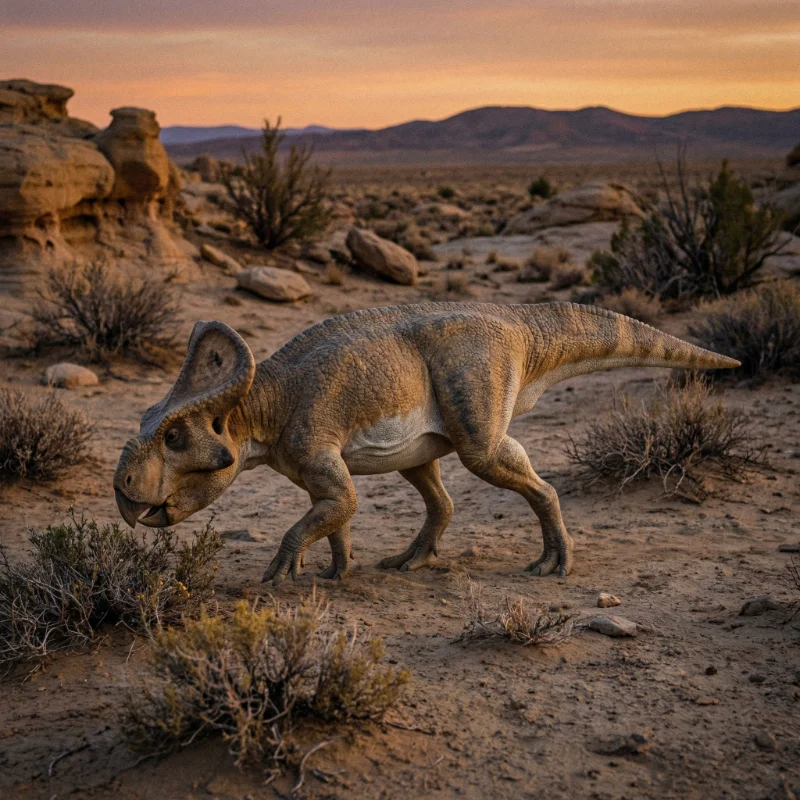
Two species are currently recognized as valid. The type species, P. andrewsi Granger & Gregory, 1923, is known from numerous localities in the Djadokhta Formation (Bayn Dzak, Tugrikin Shireh, Ukhaa Tolgod) of Mongolia, while the larger P. hellenikorhinus Lambert et al., 2001, was described from the Bayan Mandahu Formation of Inner Mongolia, China. Protoceratops is characterized by a proportionally large skull, a short and stiff neck, and a well-developed parietal–squamosal neck frill, but it lacks the prominent horns seen in ceratopsids such as Triceratops. A small bump is present over the nose in P. andrewsi, which becomes a double, paired nasal horn structure in P. hellenikorhinus.
Protoceratops is connected to several landmark discoveries in paleontology. The "Fighting Dinosaurs" specimen, discovered in 1971, preserves a Protoceratops and Velociraptor locked in combat, providing direct evidence of predator–prey interaction in non-avian dinosaurs. A nest containing 15 articulated juveniles (MPC-D 100/530), reported by Fastovsky et al. (2011), offers evidence of communal nesting behavior. In 2020, Norell et al. demonstrated that Protoceratops laid soft-shelled eggs, fundamentally reshaping our understanding of dinosaur egg evolution. Furthermore, Hone et al. (2016) reported that the frill exhibits positive allometry during growth, consistent with a socio-sexual signaling function.
Overview
Name and Etymology
The generic name Protoceratops is derived from Greek protos (πρῶτος, "first") + keras (κέρας, "horn") + ops (ὤψ, "face"), meaning "first horned face." This reflects the original interpretation that Protoceratops represented a primitive ancestor of larger ceratopsids such as Triceratops (Granger & Gregory, 1923). The specific epithet andrewsi honors explorer Roy Chapman Andrews, who led the Central Asiatic Expeditions during which the type material was discovered. The second species, P. hellenikorhinus, takes its name from Greek hellenikos ("Greek") + rhis ("nose"), alluding to the broad, angular snout reminiscent of the straight profiles of ancient Greek sculptures (Lambert et al., 2001).
Taxonomic Status and Valid Species
Two species are currently recognized within Protoceratops.
| Species | Authors and Year | Holotype | Formation | Notes |
|---|---|---|---|---|
| P. andrewsi | Granger & Gregory, 1923 | AMNH 6251 (juvenile skull) | Djadokhta Fm., Mongolia | Type species; hundreds of specimens known |
| P. hellenikorhinus | Lambert et al., 2001 | IMM 95BM1/1 (large skull) | Bayan Mandahu Fm., Inner Mongolia, China | Larger; double nasal horns |
The former P. kozlowskii Maryańska & Osmólska, 1975 is now either reassigned to Breviceratops kozlowskii or considered a juvenile of Bagaceratops, though Czepiński (2019) argued Breviceratops is anatomically distinct. Bainoceratops efremovi Tereshchenko & Alifanov, 2003 is widely regarded as a probable synonym of P. andrewsi, as its diagnostic features likely fall within the range of intraspecific variation (Makovicky & Norell, 2006).
Key Significance (One-Line Summary)
Protoceratops is a cornerstone taxon for understanding non-ceratopsid ceratopsian morphology, behavior, and reproductive biology, owing to its unparalleled specimen abundance, complete growth series, the Fighting Dinosaurs fossil, and the discovery of soft-shelled eggs.
Stratigraphy, Age, and Depositional Environment
Age Range
The Djadokhta Formation, from which the majority of Protoceratops fossils have been recovered, is Late Cretaceous in age and corresponds to the Campanian stage, with magnetostratigraphic age estimates of approximately 75–71 Ma (Dashzeveg et al., 2005). The Bayan Mandahu Formation, yielding P. hellenikorhinus, is correlated to the same Campanian interval.
Formation and Lithology
The Djadokhta Formation is composed predominantly of reddish to orange fine-grained arkose sandstone, representing alternating aeolian (wind-deposited) dune and interdune facies (Loope et al., 1998; Jerzykiewicz, 2000). The Bayan Mandahu Formation is lithologically similar, also comprising aeolian sandstones.
Depositional Environment and Paleoenvironment
The depositional environment of the Djadokhta Formation is interpreted as a semi-arid to arid aeolian dune field. Many Protoceratops specimens are found in an articulated state, and some are preserved in an upright "standing" posture, strongly suggesting rapid burial by dune collapse or sandstorms (Jerzykiewicz et al., 1993; Loope et al., 1998). The Fighting Dinosaurs specimen is also widely interpreted as having been buried alive by a collapsing dune (Osmólska, 1993; Unwin et al., 1995). Ephemeral water sources and low-growing vegetation in interdune areas are thought to have sustained herbivorous dinosaurs in this otherwise arid landscape.
Specimens and Diagnosis
Holotype and Key Specimens
The holotype of P. andrewsi is AMNH 6251, a partial juvenile skull discovered on 2 September 1922 by photographer James B. Shackelford in reddish sandstones of the Flaming Cliffs (Bayn Dzak), Djadokhta Formation, Gobi Desert, Mongolia, during the Third Central Asiatic Expedition organized by the American Museum of Natural History. Over 100 individuals were subsequently collected during the 1922–1925 field seasons (Andrews, 1932; Brown & Schlaikjer, 1940).
Key specimens include:
| Specimen Number | Content | Locality / Formation | Significance |
|---|---|---|---|
| AMNH 6251 | Juvenile skull (holotype) | Bayn Dzak, Djadokhta Fm. | Type specimen |
| MPC-D 100/512 + MPC-D 100/25 | Fighting Dinosaurs | Tugrikin Shireh, Djadokhta Fm. | Direct evidence of Protoceratops–Velociraptor predation |
| MPC-D 100/530 | Nest with 15 juveniles | Tugrikin Shireh, Djadokhta Fm. | Evidence of communal nesting (Fastovsky et al., 2011) |
| MPC-D 100/1021 | Embryo-bearing egg clutch (12+ eggs) | Ukhaa Tolgod, Djadokhta Fm. | Soft-shelled eggs discovery (Norell et al., 2020) |
| ZPAL MgD-II/3 | Articulated subadult skeleton | Bayn Dzak, Djadokhta Fm. | Detailed appendicular skeleton description (Czepiński et al., 2019) |
| IMM 95BM1/1 | Large skull (P. hellenikorhinus holotype) | Bayan Mandahu, Bayan Mandahu Fm. | Second species (Lambert et al., 2001) |
Diagnosis
Protoceratops andrewsi is distinguished from other protoceratopsids by the following combination of features (Brown & Schlaikjer, 1940; revised by Czepiński, 2019): a relatively large parietal–squamosal frill with two large fenestrae, a single nasal bump, a pair of cylindrical blunt teeth near the tip of the premaxilla, wide and flat shovel-like pedal unguals, and tall caudal neural spines forming a tail sail.
P. hellenikorhinus is differentiated by its larger overall size, a double (paired) nasal horn structure, strongly developed mandibular adductor musculature attachment areas, and a broad, angular snout as cranial autapomorphies (Lambert et al., 2001).
Morphology and Function
Body Size
Adult P. andrewsi reached a total body length of approximately 1.5–2 m, with a hip height of roughly 0.6–0.75 m. P. hellenikorhinus was approximately 20–30% larger, with a reported maximum length of about 2.5 m. Using the stylopodial limb bone circumference scaling relationship of Campione & Evans (2012), adult body mass for P. andrewsi is estimated at approximately 62–104 kg. The frequently cited figure of 180 kg (or 400 lb) in popular sources represents an older estimate or may conflate data from the larger P. hellenikorhinus. The AMNH has cited a maximum of approximately 225 kg, though this likely pertains to the upper extreme of the genus.
Skull and Frill
The skull of Protoceratops is proportionally very large, roughly one-fifth of total body length. The most conspicuous feature is the parietal–squamosal neck frill, which extends posteriorly from the skull roof. The frill bears two large fenestrae that were likely covered by skin in life. Frill size and shape are highly variable among individuals, but systematic sexual dimorphism has not been statistically supported (Maiorino et al., 2015). Hone, Wood & Knell (2016) demonstrated that the frill exhibits positive allometry, growing disproportionately faster than overall body size, a pattern consistent with a socio-sexual signaling function. Additional proposed functions include jaw muscle attachment, neck protection, and use in intraspecific combat.
A robust parrot-like beak is present at the tip of the jaws, covered in keratinous tissue and well-suited for cropping vegetation. P. andrewsi uniquely possesses a pair of cylindrical teeth near the tip of the upper jaw.
Dentition
The dentary and maxillary teeth of Protoceratops are leaf-shaped, with multiple denticles (serrations) along their edges. Each tooth crown is divided into two lobes separated by a central primary ridge. This dentition was effective for shearing and processing tough plant matter.
Limbs and Locomotion
Adult Protoceratops were primarily quadrupedal, but the subadult skeleton ZPAL MgD-II/3 analyzed by Czepiński et al. (2019) indicates that juveniles and subadults retained the capacity for facultative bipedalism. The hindlimbs are longer than the forelimbs, and the tibia-to-femur ratio decreases through ontogeny, reflecting a gradual shift toward obligate quadrupedality in adults. The feet are broad, with four toes bearing flat, shovel-like unguals that would have been useful for digging through sand (fossorial behavior).
Tail Sail
Gregory & Mook (1925) noted the presence of tall neural spines on the caudal (tail) vertebrae, which create a sail-like structure. The neural spines increase in height up to approximately caudal vertebra 14, encompassing about two-thirds of the tail length. Tereschenko & Singer (2013) proposed that this structure may relate to aquatic locomotion or display, but given the arid aeolian depositional context, a display function is considered more likely. Hypotheses involving thermoregulation or fat storage have also been proposed.
Diet and Ecology
Diet
Protoceratops was an herbivore, equipped with a powerful parrot-like beak and leaf-shaped cheek teeth capable of cropping and processing a variety of plant material. The dental morphology (broad crowns, denticles, primary ridge) is suited for handling tough vegetation such as shrubs and woody plants. The animals likely fed on low-growing vegetation in interdune areas of the arid dune field environment. A recent craniomandibular ontogeny study (2025) suggests that bite force and foraging range increased during growth, raising the possibility of an ontogenetic dietary shift between juveniles and adults.
Social Behavior
Multiple lines of evidence indicate that Protoceratops exhibited gregarious behavior. The nest of 15 juveniles reported by Fastovsky et al. (2011) suggests post-hatching parental care or at least prolonged nest residency. Hone et al. (2014) described a new mass mortality of multiple juvenile Protoceratops of varying sizes, proposing that these dinosaurs engaged in size-segregated aggregation behavior throughout ontogeny. The dense concentration of articulated specimens at Tugrikin Shireh further supports some level of sociality.
Activity Pattern
Protoceratops possesses a large sclerotic ring, which was originally interpreted as evidence for nocturnality. However, the scleral ring and orbit morphometry analysis of Schmitz & Motani (2011) reclassified Protoceratops as cathemeral (active at irregular intervals throughout the day and night, with peaks at dawn and dusk).
Predation
The primary predator of Protoceratops was the contemporaneous dromaeosaurid Velociraptor mongoliensis. The Fighting Dinosaurs specimen (MPC-D 100/512 + MPC-D 100/25) captures a Velociraptor attacking a Protoceratops, with the Protoceratops biting down on the Velociraptor's forelimb in a defensive counterattack (Barsbold, 1974; Barsbold et al., 2016). Hone et al. (2010) additionally reported Velociraptor tooth marks on Protoceratops bones, confirming a trophic relationship.
Distribution and Paleogeography
Geographic Distribution
Protoceratops is known from the present-day Gobi Desert of Mongolia and Inner Mongolia, China.
P. andrewsi principal localities: Bayn Dzak (Flaming Cliffs), Tugrikin Shireh, and Ukhaa Tolgod — all within the Djadokhta Formation, Mongolia.
P. hellenikorhinus principal locality: Bayan Mandahu — within the Bayan Mandahu Formation, Inner Mongolia, China.
Paleogeography
During the Campanian (~75–71 Ma), the Mongolian and Inner Mongolian regions occupied a position at roughly 40–45°N paleolatitude, situated within an interior continental arid climate belt. The landscape was dominated by desert to semi-desert conditions, with the aeolian dune fields of the Djadokhta and Bayan Mandahu formations reflecting this arid inland environment.
Phylogeny and Taxonomic Debates
Phylogenetic Position
Protoceratops is placed within Ornithischia → Ceratopsia → Coronosauria → Protoceratopsidae (Sereno, 2000; You & Dodson, 2004). Protoceratopsidae, together with Ceratopsidae (which includes Triceratops and kin), constitutes Coronosauria. Leptoceratopsidae is recovered as the sister group to Coronosauria in most analyses.
Recent phylogenetic analyses (Morschhauser et al., 2019; Czepiński, 2020) place Protoceratops, Bagaceratops, and Breviceratops within Protoceratopsidae, and it has been proposed that populations of P. andrewsi may have evolved into Bagaceratops through anagenesis.
Taxonomic Debates
The validity of Bainoceratops efremovi (Tereshchenko & Alifanov, 2003) remains contested. Based on a few dorsal vertebrae from Bayn Dzak, Makovicky & Norell (2006) argued that its purported diagnostic features fall within the intraspecific variation of P. andrewsi. Additionally, the relationship between Breviceratops and Bagaceratops—whether the former is a junior synonym representing juvenile specimens of the latter (Sereno, 2000) or a distinct taxon (Czepiński, 2019)—continues to be debated.
Reconstruction and Uncertainties
Established Facts
That Protoceratops was a small, frilled, primarily quadrupedal herbivorous ceratopsian is firmly established by abundant fossil evidence. Its extreme abundance in the Djadokhta Formation (Campanian), its predator–prey relationship with Velociraptor, and the production of soft-shelled eggs are all well documented.
Hypotheses and Ongoing Debates
The precise function of the frill (display vs. defense vs. thermoregulation) remains debated; positive allometry supports a display role, but a multifunctional interpretation is likely. The function of the tail sail is also unresolved, with competing hypotheses of display, swimming, and metabolic regulation. Sexual dimorphism has not been statistically supported in recent studies (Maiorino et al., 2015). The popular hypothesis that Protoceratops fossils inspired the griffin myth (Mayor, 2000) has been increasingly challenged on geographic and anatomical grounds (Witton, 2016; Witton et al., 2024).
Common Misconceptions in Popular Media
Protoceratops is often depicted as a "hornless primitive Triceratops," but in reality it possesses a small nasal bump, and P. hellenikorhinus bears well-developed double nasal horns. The elongated eggs once attributed to Protoceratops (elongatoolithid eggs) were shown in 1994 to belong to oviraptorid theropods (Norell et al., 1994), and actual Protoceratops eggs were soft-shelled (Norell et al., 2020). Body mass is also commonly overestimated in popular sources at 400 kg, whereas current scientific estimates range from 62–104 kg for P. andrewsi.
Comparison with Related and Contemporary Taxa
| Taxon | Age | Locality | Length (m) | Mass (kg) | Frill/Horn Features |
|---|---|---|---|---|---|
| Protoceratops andrewsi | Campanian, ~75-71 Ma | Mongolia | 1.5-2 | 62-104 | Small-moderate frill, nasal bump |
| Protoceratops hellenikorhinus | Campanian | Inner Mongolia, China | ~2-2.5 | unknown (larger) | Larger frill, paired nasal horns |
| Bagaceratops rozhdestvenskyi | Campanian | Mongolia | ~0.5-1 | ~10-20 | Small frill, triangular projection |
| Psittacosaurus mongoliensis | Early Cretaceous | Mongolia/China | 1-2 | 20-80 | No frill, jugal horns |
| Triceratops horridus | Maastrichtian | North America | 8-9 | 6,000-12,000 | Massive frill, three large horns |
Fun Facts
FAQ
📚References
- Granger, W. & Gregory, W. K. (1923). Protoceratops andrewsi, a pre-ceratopsian dinosaur from Mongolia. American Museum Novitates, 72, 1–9.
- Brown, B. & Schlaikjer, E. M. (1940). The structure and relationships of Protoceratops. Annals of the New York Academy of Sciences, 40(3), 133–266.
- Lambert, O., Godefroit, P., Li, H., Shang, C.-Y. & Dong, Z.-M. (2001). A new species of Protoceratops (Dinosauria, Neoceratopsia) from the Late Cretaceous of Inner Mongolia (P. R. China). Bulletin de l'Institut Royal des Sciences Naturelles de Belgique, Sciences de la Terre, 71(supplement), 5–28.
- Dashzeveg, D., Dingus, L., Loope, D. B., Swisher III, C. C., Dulam, T. & Sweeney, M. R. (2005). New stratigraphic subdivision, depositional environment, and age estimate for the Upper Cretaceous Djadokhta Formation, southern Ulan Nur Basin, Mongolia. American Museum Novitates, 3498, 1–31. https://doi.org/10.1206/0003-0082(2005)498[0001:NSSDEA]2.0.CO;2
- Czepiński, Ł., Fostowicz-Frelik, Ł. & Słowiak, J. (2019). Appendicular skeleton of Protoceratops andrewsi (Dinosauria, Ornithischia): comparative morphology, ontogenetic changes, and the implications for non-ceratopsid ceratopsian locomotion. PeerJ, 7, e7324. https://doi.org/10.7717/peerj.7324
- Fastovsky, D. E., Weishampel, D. B., Watabe, M., Barsbold, R., Tsogtbaatar, Kh. & Narmandakh, P. (2011). A nest of Protoceratops andrewsi (Dinosauria, Ornithischia). Journal of Paleontology, 85(6), 1035–1041. https://doi.org/10.1666/11-008.1
- Hone, D. W. E., Farke, A. A., Watabe, M., Shigeru, S. & Tsogtbaatar, Kh. (2014). A new mass mortality of juvenile Protoceratops and size-segregated aggregation behaviour in juvenile non-avian dinosaurs. PLoS ONE, 9(11), e113306. https://doi.org/10.1371/journal.pone.0113306
- Hone, D. W. E., Wood, D. & Knell, R. J. (2016). Positive allometry for exaggerated structures in the ceratopsian dinosaur Protoceratops andrewsi supports socio-sexual signaling. Palaeontologia Electronica, 19.1.5A, 1–13. https://doi.org/10.26879/571
- Norell, M. A., Balanoff, A. M., Barta, D. E. & Erickson, G. M. (2020). The first dinosaur egg was soft. Nature, 583, 406–410. https://doi.org/10.1038/s41586-020-2412-8
- Schmitz, L. & Motani, R. (2011). Nocturnality in dinosaurs inferred from scleral ring and orbit morphology. Science, 332(6030), 705–708. https://doi.org/10.1126/science.1200043
- Maiorino, L., Farke, A. A., Kotsakis, T. & Piras, P. (2015). Re-evaluating sexual dimorphism in skulls of Protoceratops andrewsi by applying two-dimensional geometric morphometrics. PLoS ONE, 10(5), e0126464. https://doi.org/10.1371/journal.pone.0126464
- Campione, N. E. & Evans, D. C. (2012). A universal scaling relationship between body mass and proximal limb bone dimensions in quadrupedal terrestrial tetrapods. BMC Biology, 10, 60. https://doi.org/10.1186/1741-7007-10-60
- Barsbold, R. (1974). Saurornithoididae, a new family of small theropod dinosaurs from Central Asia and North America. Palaeontologia Polonica, 30, 5–22.
- Makovicky, P. J. & Norell, M. A. (2006). Yamaceratops dorngobiensis, a new primitive ceratopsian (Dinosauria: Ornithischia) from the Cretaceous of Mongolia. American Museum Novitates, 3530, 1–42.
- Tereschenko, V. S. & Singer, T. (2013). Structural features of neural spines of the caudal vertebrae of protoceratopoids (Ornithischia: Neoceratopsia). Paleontological Journal, 47(6), 618–630.
- Czepiński, Ł. (2020). New protoceratopsid specimens improve the age correlation of the Upper Cretaceous Gobi Desert strata. Acta Palaeontologica Polonica, 65(3), 481–497. https://doi.org/10.4202/app.00701.2019
- Erickson, G. M., Zelenitsky, D. K., Kay, D. I. & Norell, M. A. (2017). Dinosaur incubation periods directly determined from growth-line counts in embryonic teeth show reptilian-grade development. Proceedings of the National Academy of Sciences, 114(3), 540–545. https://doi.org/10.1073/pnas.1613716114
- Loope, D. B., Dingus, L., Swisher III, C. C. & Minjin, C. (1998). Life and death in a Late Cretaceous dune field, Nemegt Basin, Mongolia. Geology, 26(1), 27–30.
- Andrews, R. C. (1932). The New Conquest of Central Asia. American Museum of Natural History, New York.
- Witton, M. P., O'Sullivan, M. & Mayall, A. L. (2024). Did the horned dinosaur Protoceratops inspire the griffin? Interdisciplinary Science Reviews, 49(3). https://doi.org/10.1177/03080188241255543
Gallery
5 images Protoceratops
Protoceratops · Cretaceous Period · Herbivore
 Protoceratops
Protoceratops · Cretaceous Period · Herbivore
 Protoceratops
Protoceratops · Cretaceous Period · Herbivore
 Protoceratops
Protoceratops · Cretaceous Period · Herbivore
 Protoceratops
Protoceratops · Cretaceous Period · Herbivore
🔗Related Creatures
Chasmosaurus
Chasmosaurus belli
Thescelosaurus
Thescelosaurus neglectus
Lambeosaurus
Lambeosaurus lambei
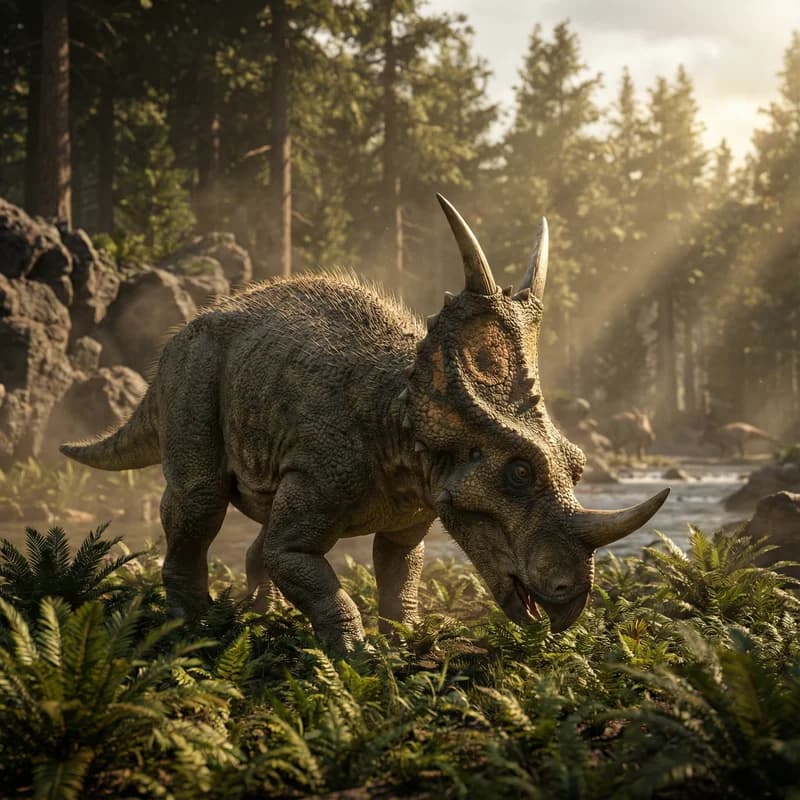
Einiosaurus
Einiosaurus procurvicornis
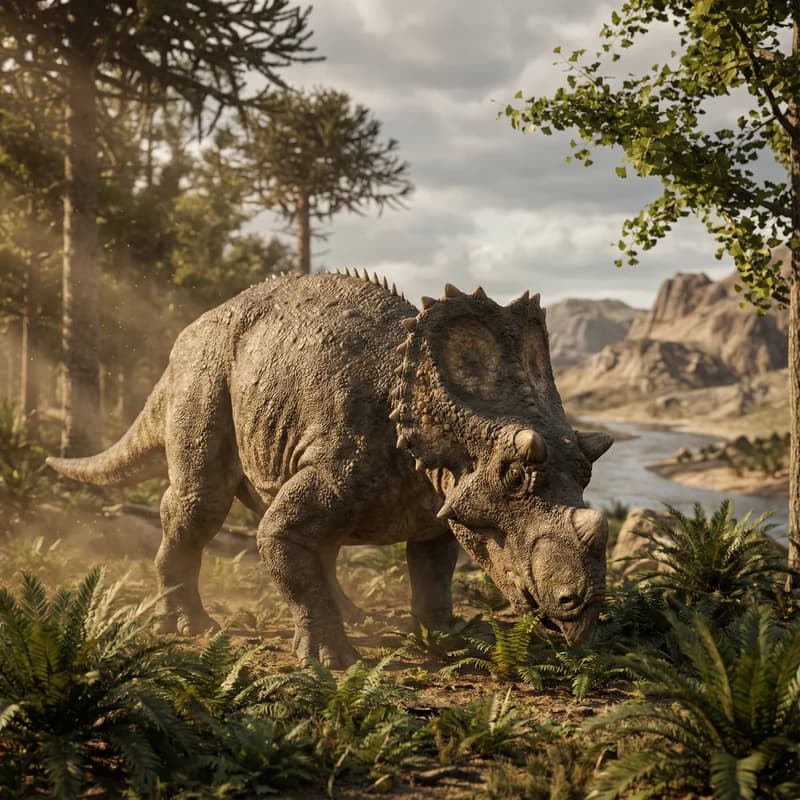
Achelousaurus
Achelousaurus horneri

Diabloceratops
Diabloceratops eatoni
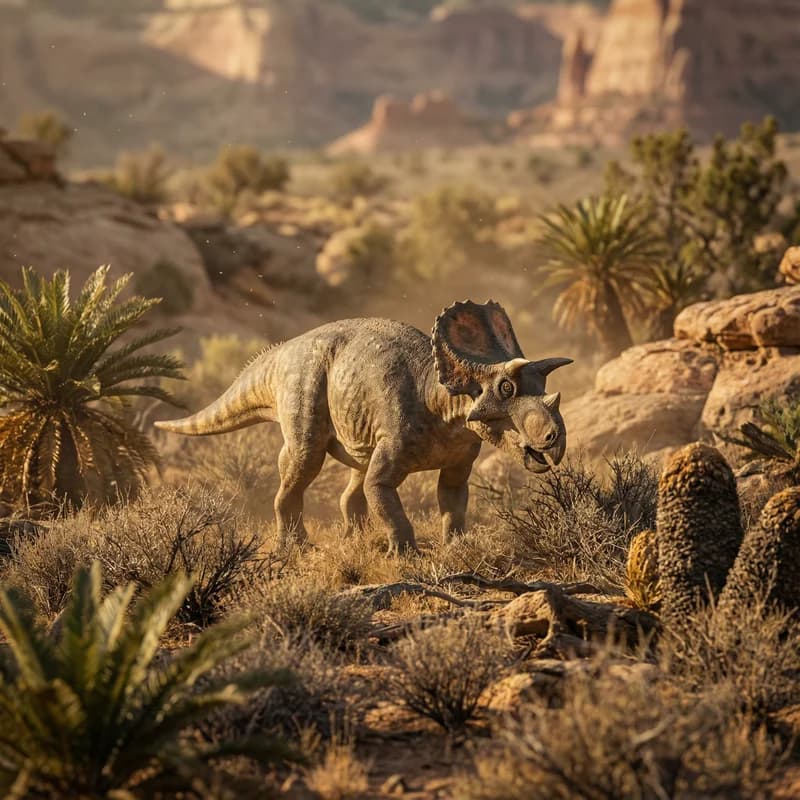
Zuniceratops
Zuniceratops christopheri

Edmontosaurus
Edmontosaurus