Thescelosaurus
Cretaceous Period Herbivore Creature Type
Thescelosaurus neglectus
Scientific Name: "θέσκελος (theskelos, 'marvelous/wondrous') + σαῦρος (sauros, 'lizard/reptile') = 'marvelous lizard'. The specific name neglectus is Latin for 'neglected/overlooked', referring to the type specimen sitting unopened in a packing crate for over 20 years."
Local Name: Thescelosaurus
Physical Characteristics
Discovery
Habitat
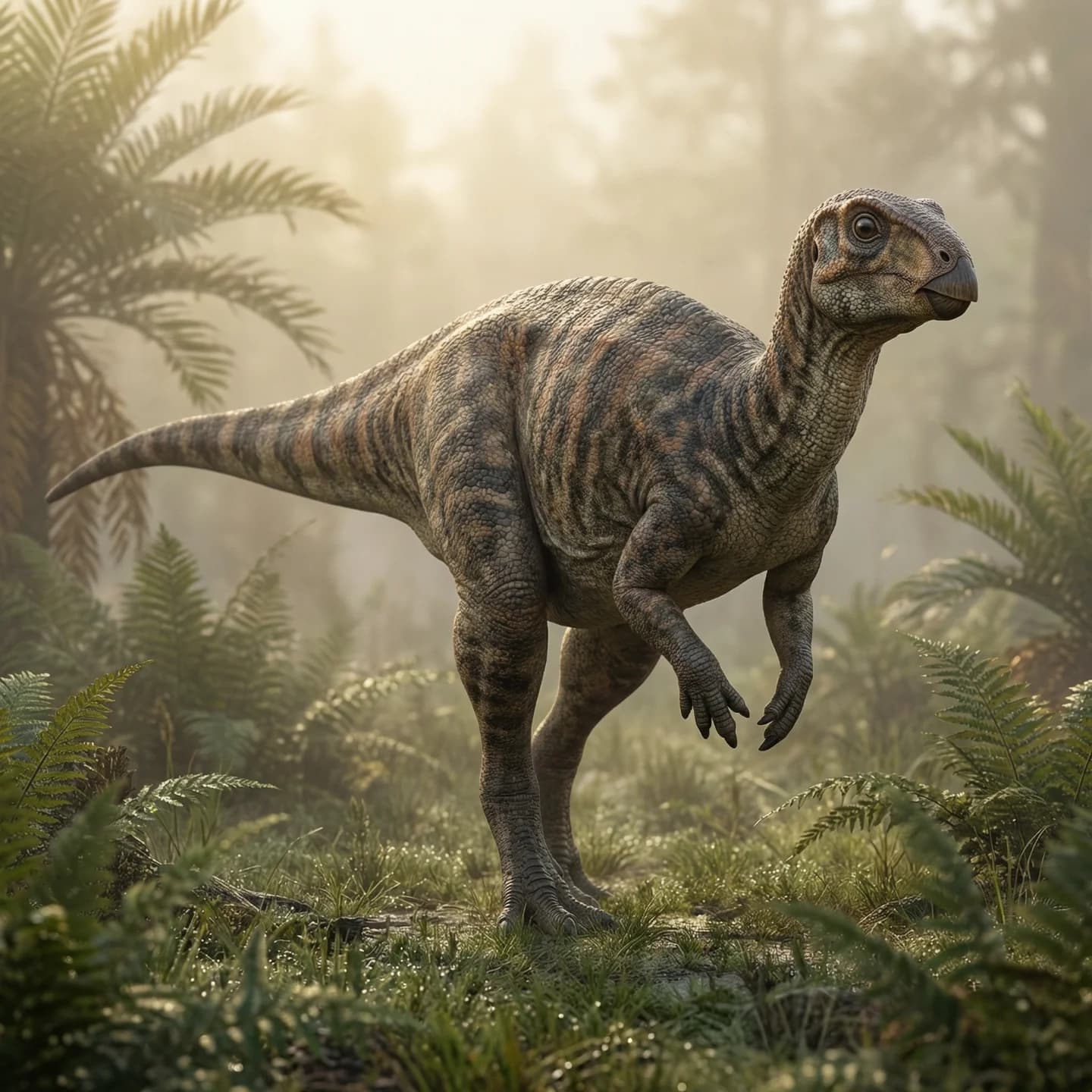
Thescelosaurus (Thescelosaurus Gilmore, 1913) is a genus of ornithischian (Neornithischia) dinosaur that lived during the late Maastrichtian stage of the Late Cretaceous, approximately 69.4–66.04 million years ago, in western North America. The genus includes the type species T. neglectus along with at least two other valid species, T. garbanii and T. assiniboiensis, and is the eponymous member of the family Thescelosauridae, subfamily Thescelosaurinae. Adults measured roughly 2.5–4 m in body length with an estimated mass of 200–300 kg, making it the largest known thescelosaurid. The type specimen of T. garbanii was even larger, estimated at 4–4.5 m.
The generic name derives from the Ancient Greek θέσκελος (theskelos, 'marvelous' or 'wondrous') and σαῦρος (sauros, 'lizard'), meaning 'marvelous lizard'. The specific name neglectus is Latin for 'neglected' or 'overlooked' — a reference to the remarkable history of the type specimen (USNM 7757), which was collected in 1891 but sat in an unlabelled packing crate at the Smithsonian Institution for over 20 years before paleontologist Charles W. Gilmore opened it in 1913 and recognized it as a new dinosaur. Thescelosaurus was among the very last non-avian dinosaurs, persisting until the Cretaceous–Paleogene (K–Pg) mass extinction event approximately 66 million years ago.
Thescelosaurus has attracted considerable scientific and public attention for several reasons. In 2000, a structure in the chest cavity of the specimen nicknamed "Willo" (NCSM 15728) was interpreted as a fossilized four-chambered heart, generating widespread media coverage. However, subsequent studies demonstrated that the object is an ironstone concretion rather than a preserved organ. In 2022, a remarkably preserved leg with scale impressions was reported from the Tanis fossil site in North Dakota, a locality thought to record the immediate aftermath of the Chicxulub asteroid impact. Most recently, a 2023 neuroanatomical study by Button & Zanno revealed that Thescelosaurus possessed a highly developed sense of smell but poor hearing — a sensory profile consistent with burrowing behavior — raising the possibility that this dinosaur was semi-fossorial.
Overview
Name and etymology
The genus name Thescelosaurus is derived from the Ancient Greek θέσκελος (theskelos), meaning 'marvelous', 'wondrous', or 'godlike', combined with σαῦρος (sauros), 'lizard' or 'reptile' (Gilmore, 1913). The specific name neglectus comes from the Latin for 'neglected' or 'overlooked', reflecting the fact that the type specimen had languished in a packing crate at the Smithsonian's National Museum of Natural History (USNM) for over two decades before being described.
Taxonomic status
Three species of Thescelosaurus are currently regarded as valid: the type species T. neglectus Gilmore, 1913; T. garbanii Morris, 1976; and T. assiniboiensis Brown et al., 2011. The genus Bugenasaura infernalis Galton, 1995, was reassigned to Thescelosaurus by Boyd et al. (2009) as T. infernalis, but it is now considered a nomen dubium (undiagnosable name). Similarly, T. edmontonensis Sternberg, 1940, is treated as a nomen dubium.
The higher-level classification of Thescelosaurus remains debated. It was traditionally assigned to the basal Ornithopoda, but Boyd (2015) recovered Thescelosauridae outside Ornithopoda, placing it within a broader clade of non-ornithopod neornithischians. Fonseca et al. (2024) obtained similar results and coined the name Pyrodontia for the clade uniting thescelosaurids with Marginocephalia and Ornithopoda. Some other analyses continue to support placement within Ornithopoda, and the question remains unresolved.
Key characteristics in brief
The largest known member of Thescelosauridae; a bipedal herbivore characterized by a toothless beak, diverse tooth types, a long tail stiffened by ossified tendons, and robust limbs.
Stratigraphy, age, and depositional environment
Temporal range
Thescelosaurus is definitively known from the late Maastrichtian age of the Late Cretaceous. The deposition of the Lance Formation began approximately 69.42 Ma; the Hell Creek Formation began at least 67.2 Ma; and the Scollard and Frenchman Formations began around 66.88 Ma. All confirmed specimens predate the K–Pg boundary at approximately 66.04 Ma, with the latest occurrence (AMNH 5034) found just 1.5 m below the Fort Union Formation.
Previous reports of Thescelosaurus from the Horseshoe Canyon Formation (Campanian–early Maastrichtian) and Prince Creek Formation (Alaska) have since been reassigned to Parksosaurus.
Formations and lithology
| Formation | Region | Primary lithology | Key species |
|---|---|---|---|
| Lance Formation | Niobrara County, Wyoming | Fine- to medium-grained sandstone, mudstone, siltstone | T. neglectus (holotype USNM 7757) |
| Hell Creek Formation | Montana, South Dakota, North Dakota | Mudstone, siltstone, sandstone, carbonaceous shale | T. neglectus, T. garbanii |
| Frenchman Formation | Saskatchewan, Canada | Claystone, siltstone, sandstone | T. assiniboiensis |
| Scollard Formation | Alberta, Canada | Sandstone, mudstone | T. edmontonensis (nomen dubium) |
Paleoenvironment
The Hell Creek and Lance Formations were deposited primarily in inland floodplain settings, with alternating overbank mudstones and siltstones intercalated with meandering-river channel sandstones. The climate was significantly warmer and more humid than today, supporting subtropical to warm-temperate ecosystems with dense coniferous and angiosperm forests, wetlands, and broad open plains. The Frenchman Formation represents a similar inland floodplain environment.
Specimens and diagnostic features
Key specimens
| Specimen | Species | Composition | Locality / Formation | Notes |
|---|---|---|---|---|
| USNM 7757 (holotype) | T. neglectus | Near-complete postcranial skeleton (skull and neck lost to erosion) | Doegie Creek, Wyoming; Lance Fm. | Collected 1891 by Hatcher & Utterback; described 1913 by Gilmore |
| USNM 7758 (paratype) | T. neglectus | Fragmentary skeleton + partial skull | Niobrara County, Wyoming; Lance Fm. | Skull elements rediscovered by Boyd et al. (2009) |
| NCSM 15728 ("Willo") | T. neglectus | Near-complete skeleton + complete skull | Harding County, South Dakota; upper Hell Creek Fm. | Discovered 1999 by Michael Hammer; ironstone concretion in chest |
| LACM 33542 (holotype) | T. garbanii | Cervical and dorsal vertebrae, near-complete lower leg + partial femur | Garfield County, Montana; Hell Creek Fm. | Described by Morris (1976) |
| RSM P 1225.1 (holotype) | T. assiniboiensis | Fragmentary skull, most vertebral column, pelvis, hind limbs | Saskatchewan; Frenchman Fm. | Discovered 1968 by Albert Swanston; described by Brown et al. (2011) |
| CMN 8537 | T. edmontonensis | Most vertebral column, pelvis, limbs, partial skull incl. complete mandible | Rumsey, Alberta; Scollard Fm. | Described by Sternberg (1940); currently nomen dubium |
| MOR 979 | Thescelosaurus sp. | Near-complete skull + skeleton | Montana; Hell Creek Fm. | Reported by Boyd et al. (2009) |
Diagnostic features (autapomorphies)
According to Boyd (2014), the autapomorphies of Thescelosaurus are predominantly cranial: (1) the frontal bones are widest at the mid-orbit level and narrow posteriorly; (2) the maxillary ridge bears small, oblique ridges on its posterior surface; (3) the anterior ribs are flattened and concave, with roughened posterior margins at their lower ends (attachment sites for intercostal plates); (4) six premaxillary teeth on each side — a primitive trait otherwise seen only in much more basal ornithischians such as Lesothosaurus and Scutellosaurus. T. assiniboiensis is distinguished from T. neglectus by several braincase features, including a foramen piercing the braincase roof (absent in T. neglectus), a flattened anterior surface of the basioccipital (V-shaped in T. neglectus), and the trigeminal foramen piercing both the prootic and laterosphenoid (restricted to the prootic in T. neglectus).
Limitations of the material
The holotype USNM 7757 lacks the skull and cervical series due to erosion, leaving cranial anatomy unknown until the discovery of complete skulls in NCSM 15728 ("Willo") and MOR 979, as well as the rediscovery of skull elements in paratype USNM 7758 (Boyd et al., 2009). The holotype of T. garbanii is fragmentary, consisting mainly of lower-leg and partial femoral material, limiting direct comparison with other species.
Morphology and function
Body size
Body length across the genus ranges from approximately 2.5–4.0 m (Galton, 1974), with a mass estimate of about 200–300 kg (Holtz, 2012). The T. garbanii type specimen was the largest individual at an estimated 4–4.5 m (Morris, 1976), while T. assiniboiensis was relatively small at around 3 m (Royal Saskatchewan Museum). Thescelosaurus is the largest known thescelosaurid (Brown et al., 2011).
Skull and dentition
The skull was long and low, terminating in a toothless beak formed by the predentary and premaxilla. The orbit and infratemporal fenestra were proportionally large, while the external naris was small. Rod-like palpebral bones extended across the orbits, creating prominent bony eyebrows.
The dentition was heterodont: the premaxilla bore six small, pointed teeth on each side (an unusually primitive trait), while the maxilla and dentary each carried up to 20 leaf-shaped cheek teeth per side — again a high count compared to other neornithischians. Prominent ridges on the maxilla and dentary, combined with the deeply set position of the teeth, suggest the presence of muscular cheeks.
Trunk and tail
The presacral vertebral count was 27 (cervical + dorsal), and there were 6 sacral vertebrae. The tail constituted roughly half of total body length and was braced by rod-like ossified tendons from its midpoint to the tip, substantially reducing flexibility. The ribcage was broad, and thin, flat mineralized intercostal plates were found adjacent to the ribs. Originally interpreted as osteoderms (defensive armor), histological analysis revealed Sharpey's fibres on both surfaces — indicating they were completely embedded within musculature — and endochondral ossification, ruling out an osteoderm identity. A respiratory or thoracic-stiffening function has been proposed (Organ & Adams, 2005; Poole, 2022).
Limbs and locomotion
The limbs were generally robust. The femur was longer than the tibia, a proportion that distinguishes Thescelosaurus from closely related genera and suggests it was not specifically adapted for fast running. This contrasts with Gilmore's (1915) original interpretation of the animal as an agile runner; Sternberg (1940) instead emphasized the robust, heavily built body.
Button & Zanno (2023) found that while Thescelosaurus was less adapted for running than other thescelosaurids, it nonetheless possessed two traits common in cursorial animals: (1) the fourth trochanter of the femur was relatively proximal, favoring speed over power; and (2) the anterior semicircular canal of the inner ear was greatly enlarged, suggesting acute balance sensitivity.
The hand (manus) had five short, broad digits, with the second finger longest. The foot (pes) was functionally four-toed, with the first metatarsal reduced to half the length of the third and the fifth metatarsal vestigial. The central three digits bore most of the body weight. Galton (1974) suggested occasional quadrupedal locomotion based on the relatively long arms and broad hands, but Senter & Mackey (2023) demonstrated that in a quadrupedal posture the fingers would have pointed laterally, making forward propulsion impossible, and concluded quadrupedal locomotion was unlikely.
Integument
For most of its research history, the integument of Thescelosaurus remained unknown. Gilmore (1915) described patches of carbonized material near the shoulders as possible epidermis, and Morris (1976) interpreted small scutes along the neck midline as armor, but Galton (2008) argued these scutes were crocodilian in origin. In 2022, a Thescelosaurus specimen from the Tanis site in North Dakota was reported to preserve scale impressions on a leg, confirming that at least parts of the body were covered in scales.
Diet and ecology
Feeding strategy
Like other ornithischians, Thescelosaurus was almost certainly herbivorous. The diverse tooth morphology and narrow snout suggest it was a selective feeder, in contrast to the contemporary pachycephalosaur Stegoceras, which was probably a more indiscriminate browser. This ecological partitioning (niche partitioning) would have allowed both taxa to coexist in the same environment without direct competition for food resources (Boyd, 2014).
Senses and cognition
Button & Zanno (2023) reconstructed the endocast (brain cavity) of the Willo specimen (NCSM 15728) using CT scanning. The brain was small relative to most other neornithischian dinosaurs — comparable to that of ceratopsids such as Triceratops — suggesting cognitive abilities within the range of modern reptiles. The olfactory bulbs were remarkably well-developed, constituting approximately 3% of the endocast volume, comparable to modern rodents and lagomorphs and exceeding that of birds. In contrast, hearing was poor, with an estimated best range of approximately 296–2,150 Hz, narrower than the related genus Dysalotosaurus.
Semi-fossorial behavior hypothesis
The combination of acute smell and poor hearing is characteristic of modern burrowing animals. Button & Zanno (2023) proposed that Thescelosaurus may have been semi-fossorial, citing additional anatomical evidence: (1) robust forelimbs suitable for digging; (2) fused premaxillae reinforcing the beak tip for excavation; and (3) broad scapulae providing a larger attachment area for scratch-digging muscles. Burrowing has been confirmed in the closely related Oryctodromeus, and the newly described Fona herzogae (Zanno et al., 2024) from the Cenomanian also shows semi-fossorial traits, suggesting this ecology may have been widespread in Thescelosaurinae.
However, Button & Zanno also offered an alternative interpretation: Thescelosaurus may have inherited burrowing-associated traits from fossorial ancestors without itself digging burrows. The relatively large body size does not necessarily preclude burrowing, but some specific adaptations seen in Oryctodromeus are absent in Thescelosaurus.
Sociality
The small brain size suggests social interactions may have been relatively simple, or that the animal lived in small groups. At localities of the related Oryctodromeus, typically two to three individuals are found together, and Thescelosaurus may have lived in similarly small groups. However, Button & Zanno (2023) cautioned that the evidence for such claims remains weak.
Geographic distribution and paleogeography
Distribution
Confirmed specimens span a wide range across western North America. The first specimens came from the Lance Formation of Niobrara County, Wyoming. Subsequent discoveries have been made in the Hell Creek Formation of Montana, South Dakota, and North Dakota; the Frenchman Formation of Saskatchewan; and the Scollard Formation of Alberta. Equivocal material has also been reported from the Laramie Formation (Colorado), the Ferris, Medicine Bow, and Almond Formations (Wyoming), and the Willow Creek Formation (Montana), all of similar late Maastrichtian age.
Abundance
Thescelosaurus was historically considered relatively uncommon, but this may reflect collection bias against small-bodied dinosaurs. In the Frenchman Formation, it may have been the most common dinosaur (Brown et al., 2011), and recent reassessments suggest higher overall abundance than previously estimated.
Coexisting fauna
Thescelosaurus shared its environment with a diverse assemblage of latest Cretaceous dinosaurs, including the theropods Tyrannosaurus rex, Dakotaraptor, and Acheroraptor; the ceratopsians Triceratops and Torosaurus; the ankylosaurs Ankylosaurus and Denversaurus; the pachycephalosaurs Pachycephalosaurus and Stegoceras; and the hadrosaurid Edmontosaurus. This fauna represents one of the last non-avian dinosaur communities before the K–Pg extinction.
Phylogeny and classification debate
Classification history
Gilmore (1913) initially placed Thescelosaurus within Camptosauridae, then reassigned it to Hypsilophodontidae in 1915. Hypsilophodontidae remained the standard assignment for decades until it was recognized as paraphyletic in the late 1990s by Scheetz (1999) and others, effectively dismantling the traditional family concept. Sternberg (1937) had earlier separated Thescelosaurus and Parksosaurus into their own family, Thescelosauridae, and Brown et al. (2013) formally reintroduced this family name, subdividing it into Thescelosaurinae and Orodrominae.
Modern phylogenetic analyses
Boyd (2015) conducted the largest phylogenetic analysis to date for basal ornithischians (255 characters, 65 terminal taxa) and recovered Thescelosauridae outside Ornithopoda, within a broader assemblage of non-ornithopod neornithischians. Fonseca et al. (2024) recovered the Late Jurassic Nanosaurus as the earliest thescelosaurid, shortening the family's ghost lineage, and named the clade Pyrodontia for the group uniting Thescelosauridae with Marginocephalia and Ornithopoda.
Within Thescelosaurinae, T. neglectus, T. garbanii, and T. assiniboiensis form a monophyletic group, with Parksosaurus as the sister taxon (Boyd, 2014; Fonseca et al., 2024). Orodrominae includes Orodromeus, Oryctodromeus, Zephyrosaurus, Koreanosaurus, and Albertadromeus.
Reconstruction and uncertainties
Established facts
Thescelosaurus was a bipedal herbivore; the long tail was stiffened by ossified tendons; at least parts of the body were covered in scales (Tanis specimen, 2022); and it is the eponymous member of Thescelosauridae within Thescelosaurinae.
Probable but unconfirmed
Semi-fossorial behavior is supported by neuroanatomical and morphological evidence (Button & Zanno, 2023) but no direct association with burrow trace fossils has been found for Thescelosaurus itself. The selective-feeder interpretation is based on tooth morphology and snout shape but lacks direct evidence such as stomach contents.
Hypotheses rejected or unresolved
The fossilized-heart hypothesis of Fisher et al. (2000) was rejected by Cleland et al. (2011), who identified the chest structure as an ironstone concretion. Morris's (1976) proposed neck-midline armor has been reinterpreted as crocodilian scutes by Galton (2008) and is no longer accepted.
Popular depictions vs. science
Thescelosaurus is often depicted as a small, agile runner in popular media, but scientific studies indicate it had robust limbs with a femur-to-tibia ratio inconsistent with cursorial specialization, suggesting it was a relatively slow animal. Additionally, the "dinosaur with a fossilized heart" narrative persists in popular culture despite being rejected by the scientific community.
Comparison with related and contemporary taxa
| Taxon | Classification | Age | Body length | Key features |
|---|---|---|---|---|
| Thescelosaurus neglectus | Thescelosaurinae | Late Maastrichtian | 3–4 m | Robust limbs, acute smell, largest thescelosaurid |
| Parksosaurus warreni | Thescelosaurinae | Campanian–Maastrichtian | ~2.5 m | Sister taxon to Thescelosaurus; Horseshoe Canyon Fm., Alberta |
| Oryctodromeus cubicularis | Orodrominae | Cenomanian | ~2.1 m | Confirmed burrowing with associated burrow trace fossil |
| Fona herzogae | Thescelosaurinae | Cenomanian | Small (size uncertain) | Described 2024; semi-fossorial traits; Cedar Mountain Fm. |
| Orodromeus makelai | Orodrominae | Campanian | ~2.5 m | Known from nesting sites; Two Medicine Fm. |
| Changmiania liaoningensis | Thescelosaurinae | Early Cretaceous | ~1.2 m | Found in apparent burrowing posture; Liaoning, China |
Discovery and research history
Initial discovery and naming (1891–1915)
The holotype USNM 7757 was collected in July 1891 by fossil hunter John Bell Hatcher and his assistant William H. Utterback along Doegie Creek, Niobrara County, Wyoming, from rocks of the Lance Formation. They had been hired by Othniel Charles Marsh during the Bone Wars era. The nearly complete, articulated skeleton was shipped to the Smithsonian Institution, where it remained in an unlabelled packing crate. In 1903, Charles W. Gilmore was hired to work through the Marsh collection, but it was not until 1913 that he opened the crate and recognized the new dinosaur.
Gilmore published a preliminary description in Smithsonian Miscellaneous Collections (vol. 61, no. 5) in 1913, naming the genus and species Thescelosaurus neglectus. A comprehensive osteological description followed in 1915 in Proceedings of the United States National Museum (vol. 49, no. 2127).
Major revisions (1974–2014)
Galton (1974) conducted the first major revision, recognizing 15 specimens. Morris (1976) described T. garbanii based on specimens from the Hell Creek Formation of Montana. Galton (1995) erected Bugenasaura infernalis, but Boyd et al. (2009) reassigned it to Thescelosaurus, concluding that the species was undiagnosable. Brown et al. (2011) described T. assiniboiensis from the Frenchman Formation of Saskatchewan. Boyd (2014) published the first complete description of the cranial anatomy of T. neglectus based on the Willo specimen and MOR 979.
Recent research (2023–2024)
Button & Zanno (2023) published a neuroanatomical analysis of the Willo specimen in Scientific Reports, revealing acute smell and poor hearing, and proposing the semi-fossorial hypothesis. Zanno et al. (2024) described Fona herzogae, a new semi-fossorial thescelosaurine from the Cenomanian of Utah, in Anatomical Record, strengthening the case for widespread burrowing ecology within the subfamily.
Fun Facts
FAQ
📚References
- Gilmore, C. W. (1913). A new dinosaur from the Lance Formation of Wyoming. Smithsonian Miscellaneous Collections, 61(5): 1–5.
- Gilmore, C. W. (1915). Osteology of Thescelosaurus, an orthopodous dinosaur from the Lance Formation of Wyoming. Proceedings of the United States National Museum, 49(2127): 591–616. https://doi.org/10.5479/si.00963801.49-2127.591
- Sternberg, C. M. (1940). Thescelosaurus edmontonensis, n. sp., and classification of the Hypsilophodontidae. Journal of Paleontology, 14(5): 481–494.
- Galton, P. M. (1974). Notes on Thescelosaurus, a conservative ornithopod dinosaur from the Upper Cretaceous of North America, with comments on ornithopod classification. Journal of Paleontology, 48(5): 1048–1067.
- Morris, W. J. (1976). Hypsilophodont dinosaurs: A new species and comments on their systematics. In: Churcher, C. S. (ed.), Athlon: Essays on Palaeontology in Honour of Loris Shano Russell, Royal Ontario Museum Life Sciences Miscellaneous Publication: 93–113.
- Galton, P. M. (1995). The species of the basal hypsilophodontid dinosaur Thescelosaurus Gilmore (Ornithischia: Ornithopoda) from the Late Cretaceous of North America. Neues Jahrbuch für Geologie und Paläontologie, Abhandlungen, 198: 297–311.
- Boyd, C. A., Brown, C. M., Scheetz, R. D. & Clarke, J. A. (2009). Taxonomic revision of the basal neornithischian taxa Thescelosaurus and Bugenasaura. Journal of Vertebrate Paleontology, 29(3): 758–770. https://doi.org/10.1671/039.029.0328
- Brown, C. M., Boyd, C. A. & Russell, A. P. (2011). A new basal ornithopod dinosaur (Frenchman Formation, Saskatchewan, Canada), and implications for late Maastrichtian ornithischian diversity in North America. Zoological Journal of the Linnean Society, 163(4): 1157–1198. https://doi.org/10.1111/j.1096-3642.2011.00735.x
- Brown, C. M., Evans, D. C., Ryan, M. J. & Russell, A. P. (2013). New data on the diversity and abundance of small-bodied ornithopods (Dinosauria, Ornithischia) from the Belly River Group (Campanian) of Alberta. Journal of Vertebrate Paleontology, 33(3): 495–520.
- Boyd, C. A. (2014). The cranial anatomy of the neornithischian dinosaur Thescelosaurus neglectus. PeerJ, 2: e669. https://doi.org/10.7717/peerj.669
- Boyd, C. A. (2015). The systematic relationships and biogeographic history of ornithischian dinosaurs. PeerJ, 3: e1523. https://doi.org/10.7717/peerj.1523
- Fisher, P. E., Russell, D. A., Stoskopf, M. K., Barrick, R. E., Hammer, M. & Kuzmitz, A. A. (2000). Cardiovascular evidence for an intermediate or higher metabolic rate in an ornithischian dinosaur. Science, 288(5465): 503–505. https://doi.org/10.1126/science.288.5465.503
- Cleland, T. P., Stoskopf, M. K. & Schweitzer, M. H. (2011). Histological, chemical, and morphological reexamination of the \"heart\" of a small Late Cretaceous Thescelosaurus. Naturwissenschaften, 98: 203–211. https://doi.org/10.1007/s00114-010-0760-1
- Button, D. J. & Zanno, L. E. (2023). Neuroanatomy of the Late Cretaceous Thescelosaurus neglectus (Neornithischia: Thescelosauridae) reveals novel ecological specialisations within Dinosauria. Scientific Reports, 13: 19224. https://doi.org/10.1038/s41598-023-45658-3
- Zanno, L. E., Gates, T. A., Avrahami, H. M., Tucker, R. T. & Makovicky, P. J. (2024). A new semi-fossorial thescelosaurine dinosaur from the Cenomanian-age Mussentuchit Member of the Cedar Mountain Formation, Utah. Anatomical Record, 307: 3357–3395. https://doi.org/10.1002/ar.25505
- Fonseca, A. O., Reid, I. J., Venner, A., Duncan, R. J., Garcia, M. S., Müller, R. T. & Butler, R. J. (2024). Systematics of Thescelosauridae and reconstruction of the evolution of Ornithischia. Journal of Systematic Palaeontology, 22(1): 2346577. https://doi.org/10.1080/14772019.2024.2346577
- Senter, P. & Mackey, J. (2023). Forelimb range of motion in two small ornithischian dinosaurs and its bearing on quadrupedality. Acta Palaeontologica Polonica, 68(2): 279–289.
- Holtz, T. R. Jr. (2012). Dinosaurs: The Most Complete, Up-to-Date Encyclopedia for Dinosaur Lovers of All Ages. Appendix (online supplement), Random House.
Gallery
5 images Thescelosaurus
Thescelosaurus · Cretaceous Period · Herbivore
 Thescelosaurus
Thescelosaurus · Cretaceous Period · Herbivore
 Thescelosaurus
Thescelosaurus · Cretaceous Period · Herbivore
 Thescelosaurus
Thescelosaurus · Cretaceous Period · Herbivore
 Thescelosaurus
Thescelosaurus · Cretaceous Period · Herbivore
🔗Related Creatures
Parasaurolophus
Parasaurolophus walkeri
Therizinosaurus
Therizinosaurus cheloniformis
Hadrosaurus
Hadrosaurus foulkii

Diabloceratops
Diabloceratops eatoni
Peloroplites
Peloroplites cedrimontanus
Torosaurus
Torosaurus latus
Utahceratops
Utahceratops gettyi
Pachyrhinosaurus
Pachyrhinosaurus