Velociraptor
Cretaceous Period Carnivore Creature Type
Velociraptor mongoliensis
Scientific Name: "velox (swift, Latin) + raptor (robber/plunderer, Latin) — 'swift robber'"
Local Name: Velociraptor
Physical Characteristics
Discovery
Habitat

Velociraptor mongoliensis (Osborn, 1924) is a small dromaeosaurid theropod dinosaur that lived during the Late Cretaceous Campanian stage (approximately 75–71 Ma) in what is now Mongolia and northern China. The holotype specimen (AMNH 6515) was discovered on 11 August 1923 by Peter Kaisen, a veteran fossil collector working with the American Museum of Natural History's (AMNH) Central Asiatic Expeditions, led by Roy Chapman Andrews, at the Flaming Cliffs (Bayn Dzak) in the Gobi Desert of Mongolia. It consists of a laterally crushed but complete skull and an articulated ungual and penultimate phalanx of manual digit III. In 1924, Henry Fairfield Osborn — then president of the AMNH — combined the Latin words velox ('swift') and raptor ('robber' or 'plunderer') to erect Velociraptor mongoliensis (Osborn, 1924).
Two species are currently recognized: V. mongoliensis (the type species) and V. osmolskae (Godefroit et al., 2008). However, multiple phylogenetic analyses have failed to recover V. osmolskae in a monophyletic clade with V. mongoliensis, instead finding it closer to Linheraptor, leading to a growing consensus that it should be transferred to a separate genus (Evans et al., 2013; Czepiński, 2023; Bindellini et al., 2025). A third potential species is represented by specimen MPC-D 100/982, which differs markedly from V. mongoliensis in pelvic and neurocranial anatomy. Powers (2020) named this specimen Velociraptor vadarostrum in his M.Sc. thesis and provided a character-based diagnosis, but because the thesis does not constitute a valid publication under the ICZN, this binomen is a nomen nudum (Bindellini et al., 2025). Adult Velociraptor measured approximately 1.5–2.07 m in total length, about 0.5 m at the hip, and weighed roughly 14.1–19.7 kg — comparable to a modern wild turkey (Paul, 1988; Turner et al., 2012). With more than a dozen reported specimens, Velociraptor is among the best-represented dromaeosaurid genera in the fossil record. Its most celebrated fossil is the 'Fighting Dinosaurs' specimen (MPC-D 100/25), which preserves a Velociraptor locked in mortal combat with a Protoceratops, providing one of the most dramatic direct records of predatory behavior among dinosaurs.
Overview
Name and Etymology
The generic name Velociraptor combines the Latin velox ('swift') and raptor ('robber' or 'plunderer'), meaning 'swift robber.' The specific epithet mongoliensis refers to Mongolia, where the first specimen was found. Prior to the formal description, Osborn informally referred to the animal as "Ovoraptor djadochtari" in a popular press article published earlier in 1924; the name was changed to Velociraptor mongoliensis in the formal publication (Osborn, 1924). In popular culture, the animal is widely known by the abbreviation 'raptor.'
Taxonomic Status
Velociraptor belongs to Theropoda, Dromaeosauridae, Eudromaeosauria, and is the type genus of the subfamily Velociraptorinae. Velociraptorinae was erected by Barsbold (1983) and phylogenetically defined by Sereno (1998) as 'all dromaeosaurids more closely related to Velociraptor than to Dromaeosaurus.' The subfamily typically includes Tsaagan and Linheraptor, with Deinonychus also recovered within it in some analyses (Napoli et al., 2021; Wang et al., 2022). However, the monophyly of Velociraptorinae itself has not been consistently recovered; some analyses suggest it represents a paraphyletic grade giving rise to Dromaeosaurinae (Godefroit et al., 2013; DePalma et al., 2015).
One-Line Summary
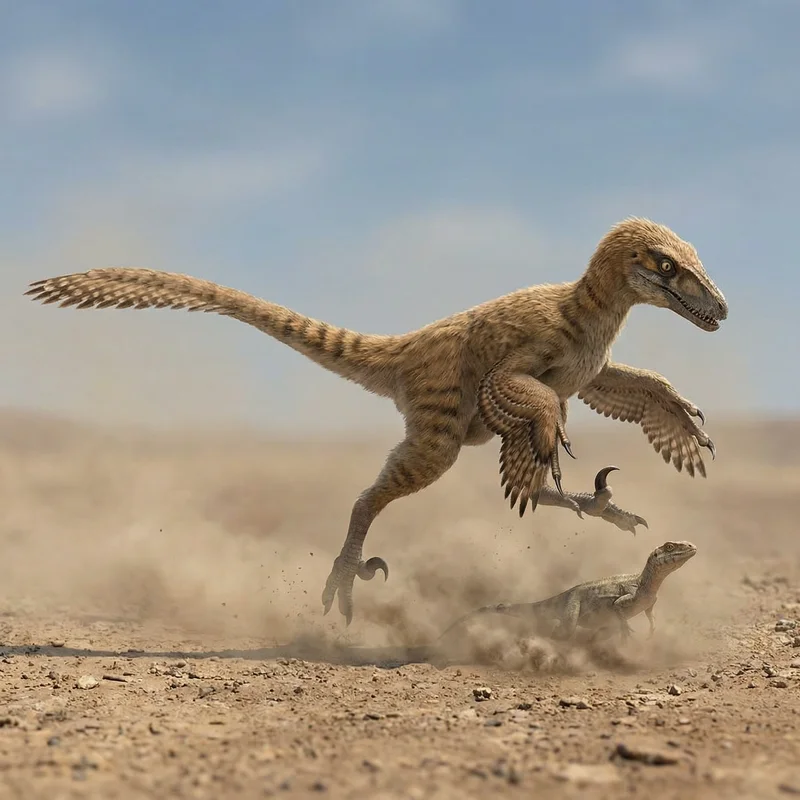
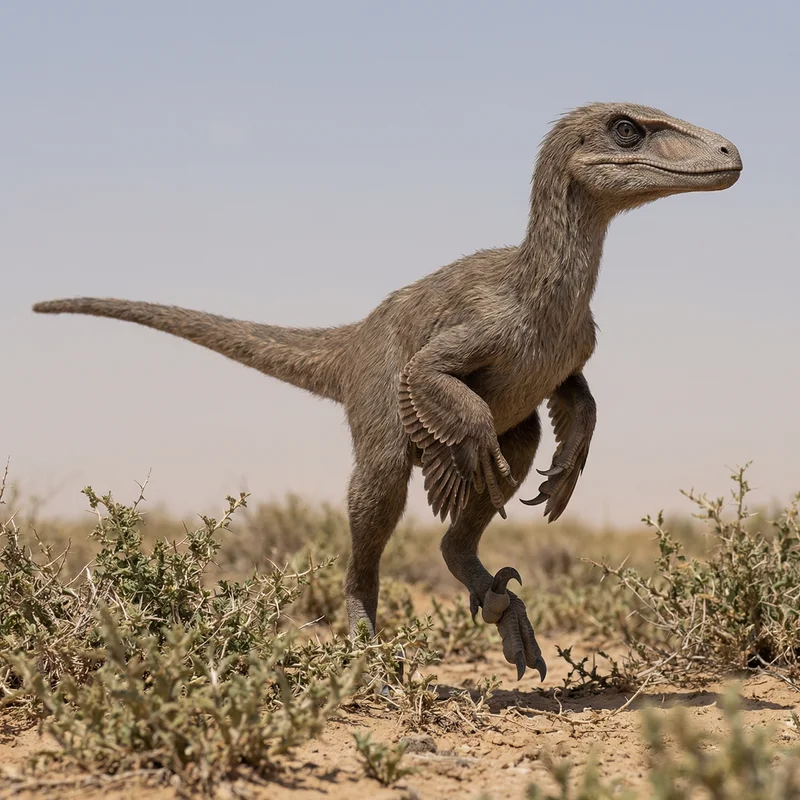
Velociraptor was a feathered, turkey-sized predator from the semi-arid Late Cretaceous of Mongolia, armed with a sickle-shaped toe claw and keen senses that made it an agile and effective carnivore.
Age, Stratigraphy, and Depositional Setting
Temporal Range
Fossils of V. mongoliensis come from the Djadokhta Formation, which corresponds to the Late Cretaceous Campanian stage. Magnetostratigraphic studies constrain the formation to approximately 75–71 Ma (Loope et al., 2005; Dingus et al., 2008). V. osmolskae was recovered from the Bayan Mandahu Formation of Inner Mongolia, China, which is broadly correlative with the Djadokhta Formation and likewise Campanian in age (Jerzykiewicz et al., 1993). Earlier age estimates ranged from Cenomanian to earliest Maastrichtian, but post-2000 magnetostratigraphic data firmly support a Campanian age.
Formation and Lithology
The Djadokhta Formation is composed predominantly of medium- to fine-grained sandstones, red to buff in color, with minor interbedded mudstones. Key collecting localities include Bayn Dzak (Flaming Cliffs), Tugrugeen Shireh (Tugrik), Chimney Buttes, and Zos Wash. Sedimentological analysis by Loope et al. (1998, 2005) indicates that much of the sandstone represents aeolian (wind-blown) dune deposits, with subordinate interdune and small-channel facies.
Paleoenvironment
The depositional environment of the Djadokhta Formation is interpreted as a semi-arid inland aeolian dune system with seasonal rainfall. This interpretation is based on large-scale cross-bedding, mixed alluvial-aeolian facies, and trace fossils including Entradichnus within dune deposits (Loope et al., 1998; Dingus et al., 2008). The 'Fighting Dinosaurs' specimen and numerous Protoceratops found in upright burial postures at Djadokhta localities are interpreted as having been buried alive by sandstorms or rain-saturated dune collapses (Norell & Makovicky, 2004). The climate was warmer than the present-day Gobi Desert, and seasonal water sources sustained a diverse fauna despite the overall arid setting.
Specimens and Diagnostic Characters
Holotype and Key Specimens
The holotype AMNH 6515 consists of a laterally crushed but complete skull and an ungual and penultimate phalanx of manual digit III. Osborn originally interpreted the claw as belonging to the hand, though it has since been suggested that it may represent the sickle claw of pedal digit II. The specimen was collected by Peter Kaisen on 11 August 1923 at Bayn Dzak. Key specimens are summarized below.
| Specimen | Locality / Formation | Principal Elements | Notes |
|---|---|---|---|
| AMNH 6515 | Bayn Dzak, Djadokhta Fm. | Complete skull + manual ungual | Holotype |
| MPC-D 100/25 | Tugrugeen Shireh, Djadokhta Fm. | Nearly complete skeleton | 'Fighting Dinosaurs'; with Protoceratops |
| MPC-D 100/24 | Mongolia | Incomplete skeleton + nearly complete skull | Barsbold & Osmolska, 1999 |
| MPC-D 100/985 | Tugrugeen Shireh, Djadokhta Fm. | Well-preserved postcranium | Norell & Makovicky, 1997 |
| MPC-D 100/986 | Chimney Buttes, Djadokhta Fm. | Well-preserved skeleton | Norell & Makovicky, 1997 |
| MPC-D 100/982 | Bayn Dzak ('Volcano'), Djadokhta Fm. | Skull + well-preserved skeleton | Unnamed new species candidate (Velociraptor sp.); informally named 'V. vadarostrum' by Powers (2020, nomen nudum) |
| MPC-D 100/54 | Tugrugeen Shireh, Djadokhta Fm. | Subadult skeleton | Pterosaur bone in gut contents |
| MPC-D 100/2000 | Tugrugeen Shireh, Djadokhta Fm. | Complete juvenile skeleton | Barsbold & Osmolska, 1999 |
| IGM 100/3503 | Zos Wash, Djadokhta Fm. | Fragmentary skeleton (incl. ulna) | Quill knobs reported; originally listed as IGM 100/981 (Turner et al., 2007); corrected and reassigned to Velociraptorinae indet. or ?Velociraptor (Napoli et al., 2021) |
| PIN 3143/8 | Mongolia | Nearly complete skull | Barsbold & Osmolska, 1999 |
Diagnostic Characters
The most commonly cited features distinguishing Velociraptor from other dromaeosaurids are concentrated in the skull: a long, low cranium; an upturned snout (concave dorsal curvature of the nasals); and a very elongate facial region, with the preorbital area comprising about 60% of total skull length (Sues, 1977; Barsbold & Osmólska, 1999). However, Bindellini et al. (2025) emphasized that no updated, comprehensive diagnosis of Velociraptor currently exists. In the analysis by Czepiński (2023), only tooth denticle size (character 85) was optimized as a unique autapomorphy across all most parsimonious trees, while Wang et al. (2022) identified 12 cranial diagnostic characters — yet there is almost no overlap between the two character lists. This inconsistency highlights ongoing uncertainty regarding the formal diagnostic framework of the genus, a situation that can only be resolved through the formal description of additional specimens such as MPC-D 100/982 and updated phylogenetic analyses (Bindellini et al., 2025).
Limitations of the Specimens
Most V. mongoliensis specimens exhibit lateral compression or weathering-related distortion; the holotype AMNH 6515 is severely laterally crushed. The quill-knob specimen was originally reported as IGM 100/981 (Turner et al., 2007), later corrected to IGM 100/3503 (Napoli et al., 2021), and its referral to Velociraptor requires reevaluation — Napoli et al. (2021) suggested it be regarded as Velociraptorinae indet. or ?Velociraptor. Consequently, the statement that 'Velociraptor possessed quill knobs' depends more on phylogenetic bracketing from closely related feathered dromaeosaurids (Microraptor, Zhenyuanlong, Daurlong) than on direct evidence.
Morphology and Functional Anatomy
Body Size
Adult Velociraptor reached a total length of approximately 1.5–2.07 m and stood about 0.5 m high at the hip (Paul, 1988; Norell & Makovicky, 1999). Body mass is estimated at 14.1–19.7 kg, comparable to a modern wild turkey. Bindellini et al. (2025) cited a standing height of 'around 1 m' referencing Kielan-Jaworowska & Barsbold (1972) and Norell & Makovicky (1997, 1999), which likely refers to total standing height (top of the head) rather than hip height. The approximately 2 m tall, 90 kg 'raptors' depicted in the Jurassic Park film franchise more closely resemble the related Deinonychus or Utahraptor in body proportions.
Skull and Dentition
The skull of Velociraptor is elongated and low, reaching up to approximately 23 cm in length (Barsbold & Osmólska, 1999). The snout is upturned, rendering the dorsal surface concave and the ventral surface convex. The snout constitutes about 60% of total skull length and is formed primarily by the nasal, premaxilla, and maxilla. The orbit is large and nearly circular.
The dentition is fairly homodont: four premaxillary, 11 maxillary, and 14–15 dentary tooth positions (Barsbold & Osmólska, 1999). The premaxillary teeth are weakly curved, with the first two being the largest. The maxillary teeth are more slender, posteriorly recurved, and have more prominent serrations on the distal margin than the mesial. This tooth morphology is termed ziphodont and is typical of Dromaeosauridae (Hendrickx et al., 2019). According to Bindellini et al. (2025), the anteriormost premaxillary tooth (Rpm1) of Velociraptor (AMNH 6515) bears 3 to 6 longitudinal flutes on the labial surface, a feature also documented in Ceratosaurus and Scipionyx.
The Sickle Claw of Pedal Digit II
The most iconic feature of Velociraptor is the enlarged, sickle-shaped claw (ungual) on pedal digit II, which could grow to over 6.5 cm along the outer perimeter in adult specimens (Norell & Makovicky, 1997). During locomotion, digit II was held retracted off the ground and the animal walked on digits III and IV only, as confirmed by articulated specimens and trackway evidence (Li et al., 2007).
The function of this claw has been debated for decades. Ostrom (1969) originally interpreted the equivalent claw of Deinonychus as a slashing weapon capable of disemboweling prey. Subsequent biomechanical analyses, however, showed that the claw's cross-sectional geometry is more suited to piercing and pinning than slashing (Manning et al., 2009). Fowler et al. (2011) proposed the 'Raptor Prey Restraint' (RPR) model, in which dromaeosaurids used their sickle claws to grip and pin prey under their body weight — analogous to the predatory strategy of extant accipitrid raptors — then began feeding while the prey was still alive. The posture of the 'Fighting Dinosaurs' specimen, with the Velociraptor's right sickle claw embedded in the Protoceratops' neck and its left claw in the abdomen, is consistent with this RPR model.
Forelimbs and Feathers
Velociraptor possessed three elongated manual digits with strongly curved unguals. Digit II was the longest and digit I the shortest. Carpal (wrist) structure prevented pronation, meaning the palms faced inward (medially) rather than downward — ruling out the 'turning doorknobs' posture portrayed in films.
Turner et al. (2007) reported 6 quill knobs on the ulna of specimen IGM 100/981 (later corrected to IGM 100/3503; Napoli et al., 2021), estimating a total of 14 secondary remiges (wing feathers). However, the referral of this specimen to Velociraptor is not secure; Napoli et al. (2021) recommended treating it as Velociraptorinae indet. or ?Velociraptor. The presence of feathers in Velociraptor therefore relies primarily on phylogenetic inference from close relatives in which feathers are directly preserved (Microraptor, Zhenyuanlong, Daurlong, among others). Bindellini et al. (2025) characterized this evidence as 'compelling.' These feathers could not have been used for flight given the animal's body mass and limb proportions; proposed functions include thermoregulation, display and communication, and brooding (Hopp & Orsen, 2004; Zhang et al., 2010).
Tail
The tail of Velociraptor featured elongated prezygapophyses on the caudal vertebrae extending forward to brace 4–10 adjacent vertebrae, along with ossified tendons on the ventral surface. This was once thought to make the tail fully rigid, functioning as a single rod-like unit. However, at least one specimen (MPC-D 100/985) preserves the caudal series in an S-shaped curve, suggesting greater lateral flexibility than previously assumed (Norell & Makovicky, 1997). The long tail likely served as a dynamic counterbalance during high-speed running and rapid turning.
Locomotion Speed
Sellers & Manning (2007) used evolutionary robotics modeling to estimate a maximum running speed of approximately 10.8 m/s (~39 km/h) for Velociraptor (assuming a body mass of ~20 kg). This is slower than a modern ostrich (~18 m/s) but relatively fast for an animal of its size, and some analyses suggest Velociraptor could have sustained this speed aerobically (Pontzer et al., 2009). However, more recent studies on extant bird trackways have identified a tendency for traditional speed-estimation equations (derived from Alexander, 1976) to overestimate running speeds, so the true maximum may have been lower.
Diet and Ecology
Evidence for Carnivory
Velociraptor's carnivorous diet is supported by multiple lines of direct fossil evidence.
First, the 'Fighting Dinosaurs' specimen (MPC-D 100/25) preserves a Velociraptor in the act of attacking a Protoceratops. The Velociraptor's sickle claws are embedded in the Protoceratops' neck and abdomen, while the Protoceratops has the Velociraptor's right forearm clamped in its beak (Carpenter, 1998; Norell & Makovicky, 2004).
Second, Hone et al. (2010) reported velociraptorine tooth drag marks on a Protoceratops dentary. Because little muscle is attached to the dentary in life, this was interpreted as late-stage scavenging behavior.
Third, Hone et al. (2012) reported a ~75 mm pterosaur long bone inside the gut of a subadult Velociraptor specimen (MPC-D 100/54). This represents the first confirmed case of a theropod consuming a pterosaur, and the pterosaur's size and incomplete state suggest it was scavenged rather than actively preyed upon.
Ecological Role and Trophic Strategy
King et al. (2020) reconstructed the endocast and endosseous labyrinth of Velociraptor (specimen IGM 100/976) using μCT scanning and analyzed its sensory capabilities. The mean hearing frequency was estimated at approximately 2,368 Hz, with an upper limit of approximately 3,965 Hz, comparable to modern ravens (Corvus corax) and African penguins (Spheniscus demersus). The flocculus of the cerebellum was highly developed, indicating strong vestibulo-ocular and vestibulocollic reflexes — advantageous for visually tracking fast-moving prey. Bindellini et al. (2025) endorsed these neuroanatomical findings as strong support for Velociraptor's role as an active predator. Overall, the evidence indicates a complex trophic ecology combining active predation with opportunistic scavenging (King et al., 2020).
The Pack-Hunting Question
Pack-hunting behavior in Velociraptor was popularized by the film Jurassic Park but is not supported by direct fossil evidence. The 'Fighting Dinosaurs' specimen records a one-on-one encounter, not group behavior. For dromaeosaurids in general, Roach & Brinkman (2007) argued that 'mob feeding' — multiple individuals independently converging on a carcass, as seen in extant Komodo dragons — must be distinguished from true cooperative pack hunting. Bindellini et al. (2025) also noted that 'direct evidence of pack hunting remains elusive.' While Velociraptor's speed and well-developed senses make group behavior theoretically possible, behavior does not fossilize and remains at the hypothesis level.
Contemporary Fauna
Representative taxa coexisting with Velociraptor in the Djadokhta Formation include the small ceratopsian Protoceratops andrewsi, the oviraptorosaur Oviraptor philoceratops, the troodontid Byronosaurus, insectivorous mammals such as Deltatheridium, diverse lizards (Gobinatus, Estesia, and others), and small pterosaurs. This fauna represents an ecosystem adapted to semi-arid conditions, in which Velociraptor occupied the small to medium-sized predator niche.
Distribution and Paleogeography
Geographic Range
V. mongoliensis is most abundantly found in the Djadokhta Formation across the southern Gobi Desert of Mongolia. Principal collecting localities include Bayn Dzak (Flaming Cliffs), Tugrugeen Shireh (Tugrik), Chimney Buttes, and Zos Wash. 'V.' osmolskae is known from the Bayan Mandahu Formation in Inner Mongolia, China, approximately 300 km southeast of Bayn Dzak.
Paleogeographic Interpretation
During the Late Cretaceous Campanian, southern Mongolia was located deep within the interior of the Eurasian landmass, far from the Tethys Sea, in a semi-arid to arid climatic zone. Precise paleocoordinate values vary between plate tectonic reconstruction models, and no single widely agreed-upon set of coordinates exists; specific values are therefore omitted here.
Phylogeny and Taxonomic Debates
Intra-generic Classification
Two species are currently recognized, though the taxonomic status of each is fluid.
V. mongoliensis (Osborn, 1924): the type species. Known from the Djadokhta Formation, Mongolia. The most specimen-rich species.
'V.' osmolskae (Godefroit et al., 2008): from the Bayan Mandahu Formation, China. Described from paired maxillae and a partial lacrimal only. Multiple phylogenetic analyses (Evans et al., 2013; Czepiński, 2023; Bindellini et al., 2025) have failed to recover it as sister to V. mongoliensis, instead placing it closer to Linheraptor. Bindellini et al. (2025) explicitly stated: 'we once again support the proposal to establish a new genus for "Velociraptor" osmolskae.'
Velociraptor sp. (Powers, 2020, nomen nudum): specimen MPC-D 100/982, from the 'Volcano' sub-locality at Bayn Dzak. Powers (2020) named this specimen Velociraptor vadarostrum in his M.Sc. thesis and provided a character-based diagnosis, but the thesis does not qualify as a valid publication under the ICZN, rendering the name a nomen nudum (Bindellini et al., 2025). The specimen differs distinctly from V. mongoliensis in maxillary morphology, pelvic anatomy, and neurocranial structure (Norell & Makovicky, 1999; Kundrát, 2004; Powers et al., 2020, 2021), and morphometric analyses place it outside the intraspecific variability of V. mongoliensis (Powers et al., 2021; Ruebenstahl et al., 2023). It awaits formal peer-reviewed description.
Latest Phylogenetic Analyses
Bindellini et al. (2025) reanalyzed the data matrices of Wang et al. (2022) and Czepiński (2023) in their centenary review. In the Wang matrix (Analysis A), Velociraptorinae was recovered as the sister group to Saurornitholestinae + Dromaeosaurinae, whereas in the Czepiński matrix (Analysis B), Dromaeosaurinae was basal and Saurornitholestinae + Velociraptorinae were sister taxa — demonstrating that the internal topology of Eudromaeosauria remains unstable. In neither analysis did 'V.' osmolskae form a monophyletic clade with V. mongoliensis and/or Velociraptor sp. Furthermore, in Analysis B, Velociraptor sp. (MPC-D 100/982) was not recovered as sister to V. mongoliensis but instead as the basalmost member of Velociraptorinae — a result attributed to the poorly resolved topology of Eudromaeosauria and the absence of a formal description of that specimen.
Reconstruction and Uncertainty
Confirmed
That Velociraptor was a small bipedal dromaeosaurid theropod with a sickle-shaped pedal digit II claw, a long snout with serrated ziphodont teeth, and multiple well-preserved specimens from the Djadokhta Formation (Campanian) is firmly established. Its predation on and/or scavenging of Protoceratops is directly confirmed by fossil evidence.
Strongly Supported Hypotheses
The presence of feathers is not directly confirmed in Velociraptor itself (the quill-knob specimen's referral is uncertain), but is strongly supported by phylogenetic inference from multiple feathered close relatives and is widely treated as near-certain. The RPR model for sickle-claw function (grasping/pinning rather than slashing) is supported by multiple biomechanical studies but is not definitively confirmed.
Hypothetical / Speculative
Pack-hunting behavior lacks direct evidence and remains hypothetical. No information exists regarding coloration or feather patterning. Whether Velociraptor was nocturnal, diurnal, or cathemeral cannot be determined — Schmitz & Motani's (2011) scleral-ring analysis suggesting nocturnality was reassessed by Choiniere et al. (2021), who concluded the method was inconclusive for Velociraptor.
Popular Media vs. Science
The 'Velociraptor' of the Jurassic Park films (1993 onward) differs dramatically from the real animal in size (~2 m tall, ~90 kg), skin covering (scales rather than feathers), and behavior (cooperative pack hunting). Michael Crichton adopted the name 'Velociraptor' after Gregory Paul's (1988) informal synonymy of Deinonychus with Velociraptor, a proposal not widely accepted by the scientific community (Bindellini et al., 2025). The real Velociraptor was a turkey-sized, feathered dinosaur. Bindellini et al. (2025) noted in their centenary review that palaeoartists such as Paul (1988) and Bakker (1986) had already depicted Velociraptor as feathered a full decade before the film's release, and emphasized the importance of bridging the gap between public perception and scientific reality.
Comparison with Related and Contemporary Taxa
| Taxon | Age / Locality | Total Length (m) | Body Mass (kg) | Key Differences |
|---|---|---|---|---|
| Velociraptor mongoliensis | Campanian, Mongolia | 1.5–2.07 | 14.1–19.7 | Long, low skull with upturned snout |
| Deinonychus antirrhopus | Aptian–Albian, North America | ~3.4 | ~70–100 | Larger body, taller snout |
| Tsaagan mangas | Campanian, Mongolia | ~2 | Not confirmed | Close relative; nasal differences |
| Linheraptor exquisitus | Campanian, China | ~2.2 | ~25 | Maxillary proportional differences |
| Utahraptor ostrommaysi | Barremian, North America | ~5–7 | ~300–500 | Large-bodied dromaeosaurid |
| Shri devi | Campanian, Mongolia | ~2 | Not confirmed | Originally referred to V. mongoliensis; separated as distinct taxon in 2021 (Turner et al., 2021) |
Fun Facts
FAQ
📚References
- Osborn, H. F. (1924). Three new Theropoda, Protoceratops zone, central Mongolia. American Museum Novitates, 144, 1–12.
- Barsbold, R. (1983). Carnivorous dinosaurs from the Cretaceous of Mongolia. Joint Soviet-Mongolian Paleontological Expedition Transactions, 19, 5–119. [in Russian]
- Barsbold, R. & Osmólska, H. (1999). The skull of Velociraptor (Theropoda) from the Late Cretaceous of Mongolia. Acta Palaeontologica Polonica, 44(2), 189–219.
- Norell, M. A. & Makovicky, P. J. (1997). Important features of the dromaeosaur skeleton: information from a new specimen. American Museum Novitates, 3215, 1–28.
- Norell, M. A. & Makovicky, P. J. (1999). Important features of the dromaeosaurid skeleton II: information from newly collected specimens of Velociraptor mongoliensis. American Museum Novitates, 3282, 1–45.
- Norell, M. A. & Makovicky, P. J. (2004). Dromaeosauridae. In Weishampel, D. B., Dodson, P. & Osmólska, H. (eds.), The Dinosauria (2nd ed.), pp. 196–209. University of California Press.
- Sues, H.-D. (1977). The skull of Velociraptor mongoliensis, a small Cretaceous theropod dinosaur from Mongolia. Paläontologische Zeitschrift, 51(3–4), 173–184.
- Turner, A. H., Makovicky, P. J. & Norell, M. A. (2007). Feather quill knobs in the dinosaur Velociraptor. Science, 317(5845), 1721. DOI: 10.1126/science.1145076
- Godefroit, P., Currie, P. J., Li, H., Shang, C. Y. & Dong, Z. (2008). A new species of Velociraptor (Dinosauria: Dromaeosauridae) from the Upper Cretaceous of northern China. Journal of Vertebrate Paleontology, 28(2), 432–438.
- Fowler, D. W., Freedman, E. A., Scannella, J. B. & Kambic, R. E. (2011). The predatory ecology of Deinonychus and the origin of flapping in birds. PLoS ONE, 6(12), e28964. DOI: 10.1371/journal.pone.0028964
- Manning, P. L., Margetts, L., Johnson, M. R., Withers, P. J., Sellers, W. I., Falkingham, P. L., et al. (2009). Biomechanics of dromaeosaurid dinosaur claws: application of X-ray microtomography, nanoindentation, and finite element analysis. Anatomical Record, 292(9), 1397–1405.
- King, J. L., Sipla, J. S., Georgi, J. A., Balanoff, A. M. & Neenan, J. M. (2020). The endocranium and trophic ecology of Velociraptor mongoliensis. Journal of Anatomy, 237(5), 861–869. DOI: 10.1111/joa.13253
- Hone, D., Choiniere, J., Sullivan, C., Xu, X., Pittman, M. & Tan, Q. (2010). New evidence for a trophic relationship between the dinosaurs Velociraptor and Protoceratops. Palaeogeography, Palaeoclimatology, Palaeoecology, 291(3–4), 488–492.
- Hone, D., Tsuihiji, T., Watabe, M. & Tsogtbaatar, K. (2012). Pterosaurs as a food source for small dromaeosaurs. Palaeogeography, Palaeoclimatology, Palaeoecology, 331–332, 27–30.
- Sellers, W. I. & Manning, P. L. (2007). Estimating dinosaur maximum running speeds using evolutionary robotics. Proceedings of the Royal Society B, 274(1626), 2711–2716. DOI: 10.1098/rspb.2007.0846
- Loope, D. B., Dingus, L., Swisher, C. C. III & Minjin, C. (1998). Life and death in a Late Cretaceous dune field, Nemegt basin, Mongolia. Geology, 26(1), 27–30.
- Dingus, L., Loope, D. B., Dashzeveg, D., Swisher, C. C. III, Minjin, C., Novacek, M. J. & Norell, M. A. (2008). The geology of Ukhaa Tolgod (Djadokhta Formation, Upper Cretaceous, Nemegt Basin, Mongolia). American Museum Novitates, 3616, 1–40.
- Napoli, J. G., Ruebenstahl, A. A., Bhullar, B.-A. S., Turner, A. H. & Norell, M. A. (2021). A new dromaeosaurid (Dinosauria: Coelurosauria) from Khulsan, central Mongolia. American Museum Novitates, 3982, 1–48.
- Carpenter, K. (1998). Evidence of predatory behavior by carnivorous dinosaurs. Gaia, 15, 135–144.
- Roach, B. T. & Brinkman, D. L. (2007). A reevaluation of cooperative pack hunting and gregariousness in Deinonychus antirrhopus and other nonavian theropod dinosaurs. Bulletin of the Peabody Museum of Natural History, 48(1), 103–138.
- Paul, G. S. (1988). Predatory Dinosaurs of the World. Simon & Schuster, New York.
- Evans, D. C., Larson, D. W. & Currie, P. J. (2013). A new dromaeosaurid (Dinosauria: Theropoda) with Asian affinities from the latest Cretaceous of North America. Naturwissenschaften, 100(11), 1041–1049.
- Czepiński, Ł. (2023). New dromaeosaurid (Dinosauria: Theropoda) from the Late Cretaceous of Mongolia and its systematic implications. Cretaceous Research, 145, 105473.
- Bindellini, G., Moscarella, A., Makovicky, P., Manucci, F. & Romano, M. (2025). Velociraptor: the state of the art 100 years after the discovery of this iconic dinosaur. Italian Journal of Geosciences, 144(3), 460–486. DOI: 10.3301/IJG.2025.22
- Powers, M. J. (2020). A new species of eudromaeosaurian dinosaur from the Campanian of Mongolia: CT scans assist in testing and constructing morphological characters. M.Sc. thesis, University of Alberta.
- Powers, M. J., Sullivan, C., Currie, P. J. & Falkingham, P. L. (2021). A new hypothesis of eudromaeosaurian evolution: CT scans assist in testing and constructing morphological characters. Journal of Vertebrate Paleontology, Program and Abstracts, 2021.
- Ruebenstahl, A. A., Powers, M. J., Norell, M. A. & Turner, A. H. (2023). Evaluating morphological variation among velociraptorine specimens from the Djadokhta Formation. Journal of Vertebrate Paleontology, Program and Abstracts, 2023.
- Hendrickx, C., Mateus, O. & Araújo, R. (2019). A proposed terminology of theropod teeth (Dinosauria, Saurischia). Journal of Vertebrate Paleontology, 35(5), e982797.
- Schmitz, L. & Motani, R. (2011). Nocturnality in dinosaurs inferred from scleral ring and orbit morphology. Science, 332(6030), 705–708.
- Choiniere, J. N., Neenan, J. M., Schmitz, L., Ford, D. P., Chapelle, K. E. J., et al. (2021). Evolution of vision and hearing modalities in theropod dinosaurs. Science, 372(6542), 610–613.
- Wang, S., Stiegler, J., Wu, P., Clulow, C., Shu, D. & Clark, J. M. (2022). A new dromaeosaurid from the Late Cretaceous Wulansuhai Formation of Inner Mongolia, China. Journal of Vertebrate Paleontology, 42(5), e2196327.
- Loope, D. B., Dingus, L., Swisher, C. C. III & Minjin, C. (2005). New stratigraphic subdivision, depositional environment, and age estimate for the Upper Cretaceous Djadokhta Formation, southern Ulan Nur Basin, Mongolia. American Museum Novitates, 3498, 1–31.
- Turner, A. H., Montanari, S. & Norell, M. A. (2021). A new dromaeosaurid from the Late Cretaceous Khulsan locality of Mongolia. American Museum Novitates, 3965, 1–48.
- Li, R., Lockley, M. G., Makovicky, P. J., Matsukawa, M., Norell, M. A., Harris, J. D. & Liu, M. (2007). Behavioral and faunal implications of Early Cretaceous deinonychosaur trackways from China. Naturwissenschaften, 95(3), 185–191.
- DePalma, R. A., Burnham, D. A., Martin, L. D., Larson, P. L. & Bakker, R. T. (2015). The first giant raptor (Theropoda: Dromaeosauridae) from the Hell Creek Formation. Paleontological Contributions, 14, 1–16.
- Romano, M. & Novacek, M. J. (2023). Roy Chapman Andrews: explorer, adventurer, and the real-life Indiana Jones? Historical Biology, 35(12), 2397–2408.
Gallery
5 images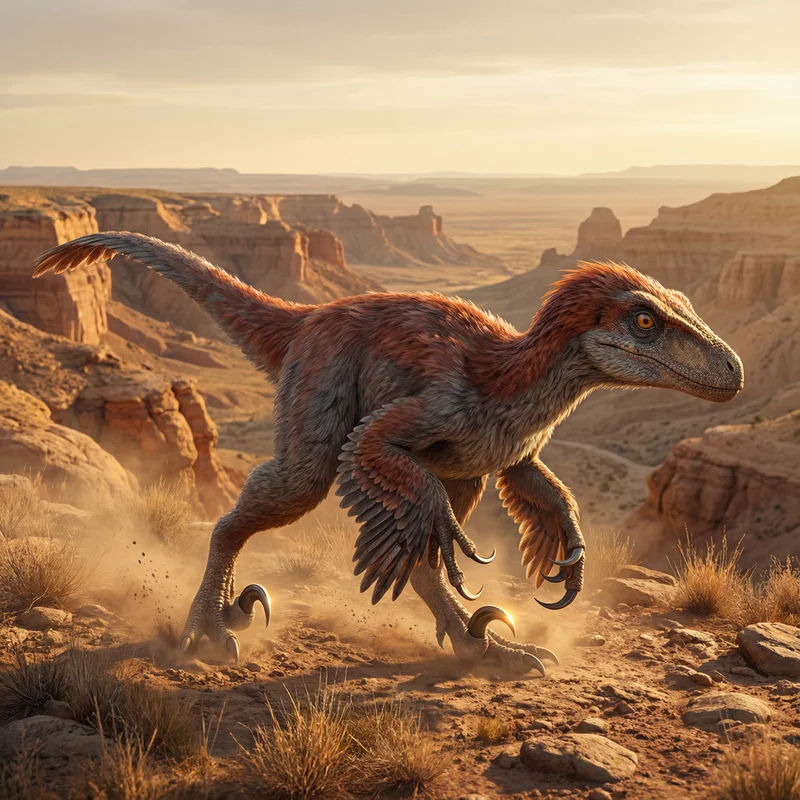 Velociraptor
Velociraptor · Cretaceous Period · Carnivore
 Velociraptor
Velociraptor · Cretaceous Period · Carnivore
 Velociraptor
Velociraptor · Cretaceous Period · Carnivore
 Velociraptor
Velociraptor · Cretaceous Period · Carnivore
 Velociraptor
Velociraptor · Cretaceous Period · Carnivore
🔗Related Creatures

Tyrannosaurus Rex
Tyrannosaurus rex

Nanotyrannus
Nanotyrannus lancensis

Australovenator
Australovenator wintonensis
Abelisaurus
Abelisaurus comahuensis

Tarbosaurus
Tarbosaurus bataar
Sinosauropteryx
Sinosauropteryx prima

Deinonychus
Deinonychus antirrhopus
Rajasaurus
Rajasaurus narmadensis