Utahraptor
Cretaceous Period Carnivore Creature Type
Utahraptor ostrommaysi
Scientific Name: "Utah (U.S. state) + raptor (Latin for 'robber/plunderer') — 'Utah's plunderer'. The species name ostrommaysi honors John Ostrom and Chris Mays"
Local Name: Utahraptor
Physical Characteristics
Discovery
Habitat

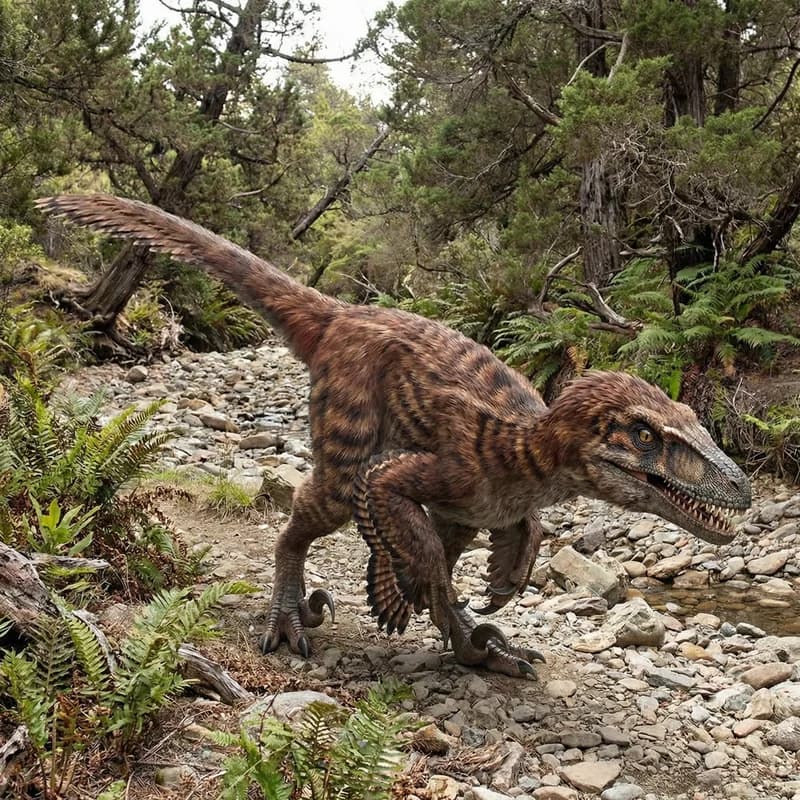
Utahraptor ostrommaysi (Kirkland, Gaston & Burge, 1993) is a large dromaeosaurid theropod dinosaur from the Early Cretaceous (Berriasian–Valanginian, approximately 139–134.6 Ma) of what is now eastern Utah, United States. Classified within Saurischia, Theropoda, family Dromaeosauridae, and subfamily Dromaeosaurinae, it is the largest known member of the dromaeosaurid family. Adults are estimated to have reached 5–7 m in total length, with body mass estimates ranging from approximately 280–500 kg for most specimens, and up to 777 kg for the largest known individual (BYUVP 7510-18078; Pintore et al., 2024).
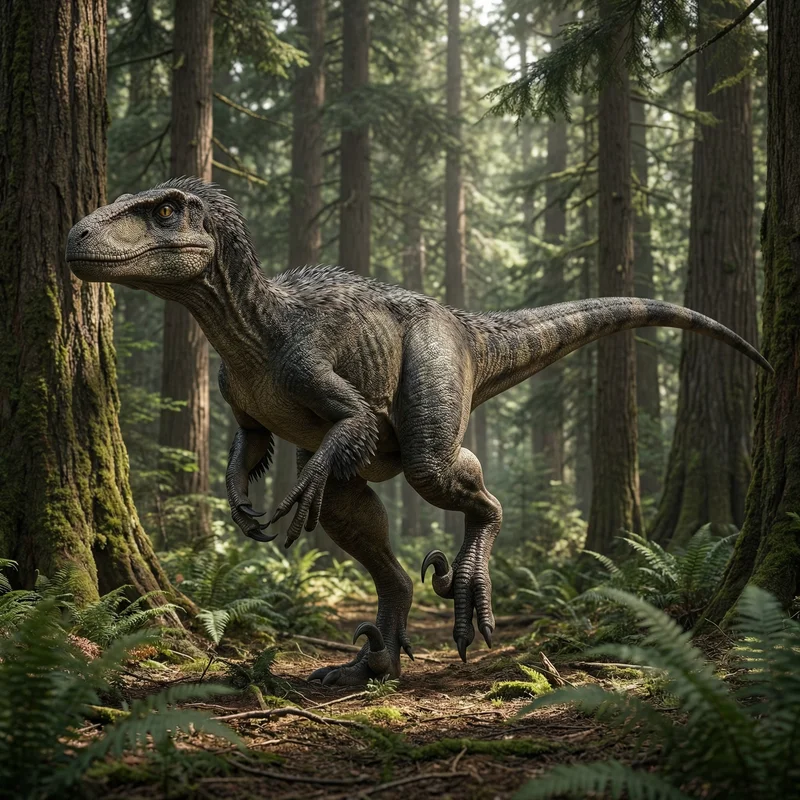
The most striking feature of Utahraptor is the enormous sickle-shaped claw on the second toe of each foot. The holotype's second pedal ungual (CEUM 184v.86) measures approximately 22 cm along its outer curve, with an estimated total length of about 24 cm including the keratinous sheath in life (Kirkland et al., 1993). This is the largest such claw among all known dromaeosaurids, suggesting that Utahraptor was a powerful predator capable of subduing large prey. Its overall build was notably robust and stocky compared to other dromaeosaurids such as Velociraptor and Deinonychus, with limb proportions converging on those of much larger theropods rather than those of its close relatives.
Utahraptor was first brought to scientific attention after Carl Limone discovered a large claw in October 1991 in Grand County, Utah. James Kirkland, Robert Gaston, and Donald Burge subsequently recovered further material and formally described the genus and species in June 1993 — coincidentally the same year as the release of the film Jurassic Park, which brought enormous public attention to the discovery. The subsequent discovery of a massive 9-ton sandstone block (the 'Utahraptor megablock') at Stikes Quarry in 2001, containing the remains of at least 7–14 individuals from hatchlings to adults, has become a focal point for ongoing research into the species' social behavior and ontogeny.
Overview
Name and etymology
The genus name Utahraptor combines the state name Utah with the Latin raptor ('robber' or 'plunderer'). Kirkland stated in the original description that the name meant "Utah's predator," though the precise Latin meaning of raptor is 'robber' or 'plunderer' rather than 'predator' (Kirkland et al., 1993). The specific epithet ostrommaysi honors John Ostrom, the American paleontologist renowned for his work on Deinonychus and the dinosaur–bird connection, and Chris Mays, founder of the Dinamation organization, who helped fund Utahraptor research. The species was originally intended to be named "U. spielbergi" after film director Steven Spielberg, but this was changed due to friction with Universal Studios over the use of the name "Jurassic" by museums affiliated with Dinamation (Kirkland, pers. comm.).
In 2000, George Olshevsky emended the specific epithet to the plural genitive ostrommaysorum. However, Costa & David (2019) argued that, under the International Code of Zoological Nomenclature, the original spelling ostrommaysi should be regarded as an arbitrary combination of letters with no need for emendation. Both spellings currently appear in the literature.
Taxonomic status
Utahraptor ostrommaysi is a valid monotypic genus. Within Dromaeosauridae, it is placed in the subfamily Dromaeosaurinae and the clade Eudromaeosauria. Phylogenetic analyses consistently recover it as closely related to Dromaeosaurus, Achillobator, and Dakotaraptor (DePalma et al., 2015; Cau et al., 2017). There are no major synonymy disputes or reclassification controversies surrounding the genus.
Key summary
Utahraptor is the largest and heaviest known dromaeosaurid, and one of the apex predators of the Early Cretaceous North American ecosystem.
Stratigraphy, Age, and Depositional Environment
Temporal range
All Utahraptor fossils are recovered from the Yellow Cat Member of the Cedar Mountain Formation in eastern Utah. The age of this unit was historically assigned to the Barremian–Aptian (approximately 125–130 Ma). However, U-Pb zircon geochronology and carbon-isotope stratigraphy by Joeckel et al. (2019, 2023) revised the age of the Yellow Cat Member to the Berriasian–late Valanginian (approximately 139 ± 1.3 to 134.6 ± 1.7 Ma). This means Utahraptor lived roughly 10 million years earlier than previously thought. Notably, Utahraptor fossils have been found only in the upper Yellow Cat Member (Kirkland et al., 2016), so the exact stratigraphic placement within the revised dating framework retains some uncertainty.
Formation and lithology
The Yellow Cat Member of the Cedar Mountain Formation crops out in eastern Utah, near present-day Arches National Park. It consists predominantly of drab-colored mudstone, siltstone, and sandstone of fluvial (river-deposited) origin. The member overlies the Jurassic Morrison Formation across an unconformity represented by a carbonate paleosol reflecting an approximately 25-million-year depositional hiatus. Key Utahraptor localities include the Gaston Quarry, Dalton Wells Quarry (one of North America's most productive dinosaur bone beds with over 5,500 catalogued bones), and the Stikes Quarry ('Utahraptor Ridge').
Paleoenvironment
During the Berriasian–Valanginian, the Yellow Cat depositional area was a semiarid inland environment with floodplain prairies, riverine forests, and open woodlands. Palynological data indicate a flora dominated by conifers (Pinophyta), ferns (Polypodiopsida), and hornworts (Anthocerotophyta) (Joeckel et al., 2019). A short wet season is inferred, with evidence of ancient wildfires during dry periods from charred spores and carbonized plant debris (Paul, 2016; Joeckel et al., 2019). The description of Mierasaurus from the same member interpreted localized waterlogged, bog-like conditions (Torres et al., 2017). The Stikes Quarry 'megablock' itself formed in a quicksand environment, with fine-grained sandstone sills interconnected by sandstone pipes and dikes (Suarez et al., 2016).
Specimens and Diagnostic Features
Holotype and key specimens
The holotype of Utahraptor is CEUM 184v.86, a single second pedal ungual, housed at the Prehistoric Museum at Utah State University Eastern, Price, Utah. Elements potentially assigned in the original description include pedal ungual CEUM 184v.294, tibia CEUM 184v.260, and premaxilla CEUM 184v.400 (Kirkland et al., 1993). Brigham Young University (BYU) houses the largest collection of Utahraptor material, including specimens originally collected by Jim Jensen at Dalton Wells in 1975.
The largest known specimen is BYUVP 15465, with a femoral length of 56.5–60 cm. In the 2024 study by Pintore et al., specimen BYUVP 7510-18078 was estimated at approximately 777 kg based on femoral morphology. The Stikes Quarry megablock contains the remains of at least 7–14 individuals ranging from hatchlings (approximately 1 m in length) to adults (approximately 4.8 m), along with at least one iguanodont (Kirkland et al., 2016).
| Specimen | Elements | Estimated length | Repository | Notes |
|---|---|---|---|---|
| CEUM 184v.86 | Pedal ungual II (holotype) | ~5.2 m | USU Eastern Prehistoric Museum | Original description specimen |
| CEUM 184v.260 | Tibia | ~5.0 m | USU Eastern Prehistoric Museum | Assigned in original description |
| BYUVP 15465 | Femur | — | BYU Museum of Paleontology | Largest femur (56.5–60 cm) |
| BYUVP 7510-18078 | Femur and other elements | — | BYU Museum of Paleontology | ~777 kg (Pintore et al., 2024) |
| UMNH VP 20501 | Dentary | — | UMNH | Adult specimen from megablock |
Diagnostic features
Key diagnostic features of Utahraptor include: a premaxilla that is exceptionally large among dromaeosaurids (approximately 250% larger than that of Deinonychus), with the subnarial process of the premaxilla contacting the nasal to completely exclude the maxilla from the naris margin; a second pedal ungual measuring approximately 22 cm along the outer curve (the largest in Dromaeosauridae), with greatly enlarged flexor tubercles indicating a powerful grip; a very robust tibia with a circumference/length index of 40, between Ceratosaurus and Torvosaurus; and manual unguals that are more laterally compressed and blade-like than in other dromaeosaurids (Kirkland et al., 1993; Britt et al., 2001).
Specimen limitations
The holotype consists of a single pedal ungual, with additional elements assigned from separate individuals, which introduces some taxonomic uncertainty. The lacrimal bone originally referred to Utahraptor (CEUM 184v.83) was later reidentified as a postorbital of the ankylosaur Gastonia. Several bones initially identified as manual unguals (M184v.294, BYU 9438, BYU 13068) were reinterpreted as pedal unguals by Britt et al. (2001) and confirmed by Senter (2007).
Morphology and Function
Overall body size
Adult Utahraptor specimens indicate a total length of approximately 5–7 m, a hip height of approximately 1.5 m, and a maximum height of approximately 1.8–2 m with the head raised. Body mass estimates vary considerably depending on the method and specimen used.
| Study | Method | Estimated mass | Specimen |
|---|---|---|---|
| Kirkland et al. (1993) | Original estimate | Under ~500 kg | Holotype-based |
| Zanno & Makovicky (2013) | Femoral length regression | ~290 kg | Tibia-to-femur ratio estimate |
| Molina-Perez & Larramendi (2019) | Composite estimate | ~280 kg | BYUVP 15465 (4.9 m individual) |
| Pintore et al. (2024) | Femoral morphology | ~391–777 kg | BYUVP 2536, 1833, 7510-18078 |
The wide range of mass estimates (approximately 250–777 kg) reflects differences in specimen size, estimation methodology, and the challenge of applying regression equations calibrated on more gracile dromaeosaurids to the uniquely robust build of Utahraptor.
Skull and dentition
The skull of Utahraptor was boxy and elongated, similar to Dromaeosaurus and Velociraptor. The premaxillary alveolar process was approximately 75 mm in length. The maxilla bore a rugose lateral surface with ridges and grooves extending from neurovascular foramina, indicating substantial soft tissue coverage in life. The mandible was robust with a downturned tip, resulting in notably procumbent anterior teeth (UMNH VP 20501). The quadratojugal was L-shaped and lacked a posterior process. The teeth exhibited minimal density differences between anterior and posterior denticles, most closely resembling those of Achillobator and Dromaeosaurus. The premaxillary tooth carinae showed a counterclockwise twist, producing strongly asymmetric cross-sections (Kirkland et al., 1993).
The sickle claw
The second pedal ungual — the sickle claw — is the most iconic feature of Utahraptor. The bony core measured approximately 22 cm along its outer curve in the holotype, with an estimated total of approximately 24 cm including the keratinous covering. This claw was retracted off the ground during locomotion and bore greatly enlarged flexor tubercles, indicating a proportionally stronger grip than that of Deinonychus (Kirkland et al., 1993). Functionally, it was likely used to pin down or pierce prey, analogous to the raptor prey restraint (RPR) model proposed for dromaeosaurids based on comparison with modern accipitrids (Fowler et al., 2011). The manual unguals were also more laterally compressed and blade-like than in other dromaeosaurids, potentially adapted for slashing.
Postcranial skeleton
The dorsal vertebrae lacked pleurocoels (pneumatic fossae), making them less weight-reduced than in many other theropods. The caudal vertebrae resembled those of Deinonychus but were much larger and bore shortened chevrons and prezygapophyses, increasing tail flexibility relative to most dromaeosaurids — a condition termed 'hemicaudothecal.' This is also observed in Achillobator and has been hypothesized as a prerequisite for the evolution of large body size in dromaeosaurids. The largest known femur (BYUVP 15465) measured 56.5–60 cm, with a well-developed notch between the lesser and greater trochanters. The tibia was stout and straight-shafted with a prominent cnemial crest.
Feathers
No direct feather impressions have been found with Utahraptor material to date. However, feathers are documented in other dromaeosaurids (Microraptor, Zhenyuanlong, Dakotaraptor among others), and phylogenetic bracketing strongly supports the inference that Utahraptor was feathered. Utah State Paleontologist James Kirkland has expressed confidence in this interpretation. Given Utahraptor's large body size, the feathers likely served functions such as thermoregulation, display, and brooding rather than flight, though the specific morphology and distribution remain speculative.
Diet and Ecology
Hunting strategy and ecological role
Utahraptor was a carnivorous predator. Its robust build and low tibial-to-femoral ratio suggest it was not a pursuit predator like Velociraptor or Deinonychus, but rather an ambush predator (Kirkland et al., 1993; Paul, 2016). The thickness of the tibia indicates significant leg-strike force, and the heavy build would have allowed powerful kicks without loss of balance, freeing the forelimbs for prey manipulation. Gregory Paul (2016) suggested that, like other dromaeosaurines, Utahraptor relied more heavily on its jaws in dispatching prey than did velociraptorines.
Prey and food web
The primary prey of Utahraptor likely included medium- to large-bodied herbivorous dinosaurs from the upper Yellow Cat fauna. Contemporaneous taxa from the same deposits include the ankylosaur Gastonia, iguanodonts (Hippodraco, Iguanacolossus, Cedrorestes), therizinosaurs (Falcarius), and sauropods (Mierasaurus, Moabosaurus). Kirkland et al. (1993) estimated that Utahraptor could attack prey larger than itself, and if group hunting occurred, packs of individuals measuring at least 3.5 m and 70 kg could have subdued prey weighing 1–2 tonnes.
Social behavior and the megablock
The approximately 9-ton sandstone block discovered at Stikes Quarry in 2001 (the 'Utahraptor megablock') is the key piece of evidence for social behavior in Utahraptor. The block contains intermingled bones of at least one adult, multiple juveniles, and at least three hatchlings (approximately 1 m), along with iguanodont remains. Kirkland proposed a 'predator trap' scenario in which Utahraptor individuals were successively lured into quicksand by a mired herbivore (Kirkland et al., 2016). If this interpretation is correct, Utahraptor exhibited gregariousness with a degree of post-nestling parental care. Whether all individuals were trapped simultaneously or drawn in sequentially remains unresolved. Additionally, Frederickson et al. (2020) demonstrated differing dietary preferences between adult and juvenile Deinonychus, casting doubt on mammal-like pack hunting in dromaeosaurids, but the same authors acknowledged that gregariousness was still plausible for Utahraptor given the megablock evidence.
Distribution and Paleogeography
Geographic range
All confirmed Utahraptor specimens come exclusively from the upper Yellow Cat Member of the Cedar Mountain Formation in Grand County, Utah, near Arches National Park. Key localities include Gaston Quarry, Dalton Wells Quarry, and Stikes Quarry (Utahraptor Ridge). In May 2025, this area was officially opened as Utahraptor State Park.
Paleogeographic position
Paleomagnetic analysis places the Utahraptor locality at approximately 37°N paleolatitude and approximately −44.7°W paleolongitude during the Early Cretaceous. At this time, the Western Interior Seaway had not yet fully formed, and the region occupied a continental interior position within a semiarid climatic zone.
Phylogeny and Classification
Phylogenetic position
Utahraptor is classified within Dromaeosauridae, subfamily Dromaeosaurinae, clade Eudromaeosauria. In the phylogenetic analysis of DePalma et al. (2015), it formed a clade with Dromaeosaurus, Achillobator, and Dakotaraptor. Cau et al. (2017) recovered a similar topology. The small dromaeosaurid Yurgovuchia doellingi (Senter et al., 2012), also from the Yellow Cat Member, was likewise placed within the Utahraptor–Achillobator–Dromaeosaurus clade.
Evolution of gigantism
Gigantism within Dromaeosauridae evolved convergently multiple times. Utahraptor and Achillobator share a hemicaudothecal tail condition, suggesting that increased tail flexibility may be linked to the evolution of large body size in dromaeosaurids. Utahraptor's robust build and low tibial-to-femoral ratio sharply distinguish it from smaller dromaeosaurids and show convergence with the limb proportions of large non-dromaeosaurid theropods (e.g., Ceratosaurus, Torvosaurus).
Restoration and Uncertainty
Established facts
The following are confirmed by direct fossil evidence: Utahraptor was a large dromaeosaurid theropod with a sickle claw on the second toe measuring approximately 22–24 cm; it is known exclusively from the Yellow Cat Member of the Cedar Mountain Formation; it lived during the Early Cretaceous.
Probable inferences
Feather coverage (no direct evidence but strongly supported by phylogenetic bracket), adult body length of approximately 5–7 m (based on multiple specimens), and an ambush-style predatory strategy (based on tibial morphology) are considered probable.
Hypothetical elements
Pack hunting behavior (the megablock is the sole line of evidence and interpretation is ongoing), precise body mass (estimates range from approximately 250 to 777 kg depending on method and specimen), the specific morphology and distribution of feathers, and exact maximum locomotor speed remain hypothetical or uncertain.
Popular media vs. science
The 'Velociraptors' depicted in the 1993 film Jurassic Park were far closer in size to Utahraptor or Deinonychus than to the real Velociraptor (which was approximately turkey-sized). Popular depictions often show Utahraptor weighing 500–700+ kg, but the majority of recent studies support a range of approximately 250–500 kg for typical adult specimens, with the 777 kg estimate representing an exceptionally large individual.
Comparison with Related and Contemporaneous Taxa
| Taxon | Family | Age | Region | Estimated length | Estimated mass | Notes |
|---|---|---|---|---|---|---|
| Utahraptor ostrommaysi | Dromaeosauridae | Early Cretaceous (~139–134.6 Ma) | North America (Utah) | 5–7 m | 250–777 kg | Largest known dromaeosaurid |
| Achillobator giganticus | Dromaeosauridae | Late Cretaceous (~90–83 Ma) | Mongolia | ~5 m | 350–450 kg | Most similar build to Utahraptor |
| Dakotaraptor steini | Dromaeosauridae | Late Cretaceous (~66 Ma) | North America (South Dakota) | ~5.5 m | ~350 kg | Late Cretaceous giant dromaeosaurid |
| Deinonychus antirrhopus | Dromaeosauridae | Early Cretaceous (~115–108 Ma) | North America (Montana, Wyoming) | ~3.4 m | ~73 kg | Smaller, pursuit-adapted |
| Velociraptor mongoliensis | Dromaeosauridae | Late Cretaceous (~75–71 Ma) | Mongolia | ~2 m | ~15–20 kg | Turkey-sized |
Fun Facts
FAQ
📚References
- Kirkland, J.I., Burge, D., & Gaston, R. (1993). A large dromaeosaur (Theropoda) from the Lower Cretaceous of eastern Utah. Hunteria, 2(10), 1–16.
- Britt, B.B., Chure, D.J., Stadtman, K.L., Madsen, J.H., Scheetz, R.D., & Burge, D.L. (2001). New osteological data and the affinities of Utahraptor from the Cedar Mountain Fm. (Early Cretaceous) of Utah. Journal of Vertebrate Paleontology, 21(3, supplement), 36A.
- Senter, P. (2007). A new look at the phylogeny of Coelurosauria (Dinosauria: Theropoda). Journal of Systematic Palaeontology, 5(4), 429–463. https://doi.org/10.1017/S1477201907002143
- Senter, P., Kirkland, J.I., DeBlieux, D.D., Madsen, S., & Toth, N. (2012). New dromaeosaurids (Dinosauria: Theropoda) from the Lower Cretaceous of Utah, and the evolution of the dromaeosaurid tail. PLoS ONE, 7(5), e36790. https://doi.org/10.1371/journal.pone.0036790
- Zanno, L.E., & Makovicky, P.J. (2013). Neovenatorid theropods are apex predators in the Late Cretaceous of North America. Nature Communications, 4, 2827. https://doi.org/10.1038/ncomms3827
- DePalma, R.A., Burnham, D.A., Martin, L.D., Larson, P.L., & Bakker, R.T. (2015). The first giant raptor (Theropoda: Dromaeosauridae) from the Hell Creek Formation. Paleontological Contributions, 2015(14), 1–16. https://doi.org/10.17161/paleo.1808.18764
- Kirkland, J.I., Suarez, M., Suarez, C., & Hunt-Foster, R. (2016). The Lower Cretaceous in east-central Utah — the Cedar Mountain Formation and its bounding strata. Geology of the Intermountain West, 3, 101–228. https://doi.org/10.31711/giw.v3.pp101-228
- Suarez, C.A., Frederickson, J.A., Cifelli, R.L., Pittman, J.G., Dunagan, S.P., Langston, W., & Kirkland, J.I. (2016). Depositional constraints on the Lower Cretaceous Stikes Quarry dinosaur site: upper Yellow Cat Member, Cedar Mountain Formation, Utah. PALAIOS, 31(9), 421–439. https://doi.org/10.2110/palo.2016.041
- Cau, A., Beyrand, V., Voeten, D., Fernandez, V., Tafforeau, P., Stein, K., Barsbold, R., Tsogtbaatar, K., Currie, P.J., & Godefroit, P. (2017). Synchrotron scanning reveals amphibious ecomorphology in a new clade of bird-like dinosaurs. Nature, 552(7685), 395–399. https://doi.org/10.1038/nature24679
- Joeckel, R.M., Ludvigson, G.A., Kirkland, J.I., et al. (2019). Chronostratigraphy and terrestrial palaeoclimatology of Berriasian–Hauterivian strata of the Cedar Mountain Formation, Utah, USA. Geological Society, London, Special Publications, 498, 75–113. https://doi.org/10.1144/SP498-2018-133
- Costa, T.V.V., & David, N. (2019). Commentaries on different uses of the specific epithet of the large dromaeosaurid Utahraptor Kirkland et al., 1993 (Dinosauria, Theropoda). Bulletin of Zoological Nomenclature, 76, 7–13. https://doi.org/10.21805/bzn.v76.a007
- Molina-Pérez, R., & Larramendi, A. (2019). Dinosaur Facts and Figures: The Theropods and Other Dinosauriformes. Princeton University Press.
- Joeckel, R.M., Ludvigson, G.A., Möller, A., Hotton, C.L., Suarez, M.B., Suarez, C.A., Sames, B., Kirkland, J.I., & Hendrix, B. (2023). Berriasian–Valanginian Geochronology and Carbon-Isotope Stratigraphy of the Yellow Cat Member, Cedar Mountain Formation, Eastern Utah, USA. Geosciences, 13(2), 32. https://doi.org/10.3390/geosciences13020032
- Pintore, R., Houssaye, A., Nesbitt, S.J., & Hutchinson, J.R. (2024). The evolution of femoral morphology in giant non-avian theropod dinosaurs. Paleobiology, 50(4), 1–22. https://doi.org/10.1017/pab.2024.6
- Fowler, D.W., Freedman, E.A., Scannella, J.B., & Kambic, R.E. (2011). The predatory ecology of Deinonychus and the origin of flapping in birds. PLoS ONE, 6(12), e28964. https://doi.org/10.1371/journal.pone.0028964
- Paul, G.S. (2016). The Princeton Field Guide to Dinosaurs (2nd ed.). Princeton University Press.
- Frederickson, J.A., Engel, M.H., & Cifelli, R.L. (2020). Niche partitioning in theropod dinosaurs: Diet and habitat preference in predators from the uppermost Cedar Mountain Formation (Utah, U.S.A.). Scientific Reports, 10, 5627. https://doi.org/10.1038/s41598-020-61480-7
- Torres, C.R., Norell, M.A., & Clarke, J.A. (2017). Mierasaurus bobyoungi, a new sauropod dinosaur from the Early Cretaceous of Utah. Acta Palaeontologica Polonica, 62(4), 687–697.
Gallery
5 images Utahraptor
Utahraptor · Cretaceous Period · Carnivore
 Utahraptor
Utahraptor · Cretaceous Period · Carnivore
 Utahraptor
Utahraptor · Cretaceous Period · Carnivore
 Utahraptor
Utahraptor · Cretaceous Period · Carnivore
 Utahraptor
Utahraptor · Cretaceous Period · Carnivore
🔗Related Creatures
Gorgosaurus
Gorgosaurus libratus

Giganotosaurus
Giganotosaurus carolinii

Nanotyrannus
Nanotyrannus lancensis
Rajasaurus
Rajasaurus narmadensis
Abelisaurus
Abelisaurus comahuensis
Dromaeosaurus
Dromaeosaurus albertensis

Carcharodontosaurus
Carcharodontosaurus saharicus

Tyrannosaurus Rex
Tyrannosaurus rex