Kosmoceratops
Cretaceous Period Herbivore Creature Type
Kosmoceratops richardsoni
Scientific Name: "From Ancient Greek kosmos ('ornamented') + ceratops ('horned face') — 'ornate horned face'. The specific name richardsoni honors Scott Richardson, the volunteer who discovered the holotype."
Local Name: Kosmoceratops
Physical Characteristics
Discovery
Habitat

Kosmoceratops richardsoni (Sampson et al., 2010) is a chasmosaurine ceratopsid dinosaur from the Late Cretaceous (late Campanian, approximately 76.4–75.5 Ma) of southern Laramidia, the island continent that formed western North America when the Western Interior Seaway divided the continent. All confirmed specimens come from the Kaiparowits Formation in the Grand Staircase–Escalante National Monument (GSENM) of southern Utah, USA. It was described in 2010 by Scott D. Sampson and colleagues alongside Utahceratops gettyi (also from the Kaiparowits Formation) and Vagaceratops irvinensis (reassigned from Chasmosaurus irvinensis, from the Dinosaur Park Formation of Alberta).
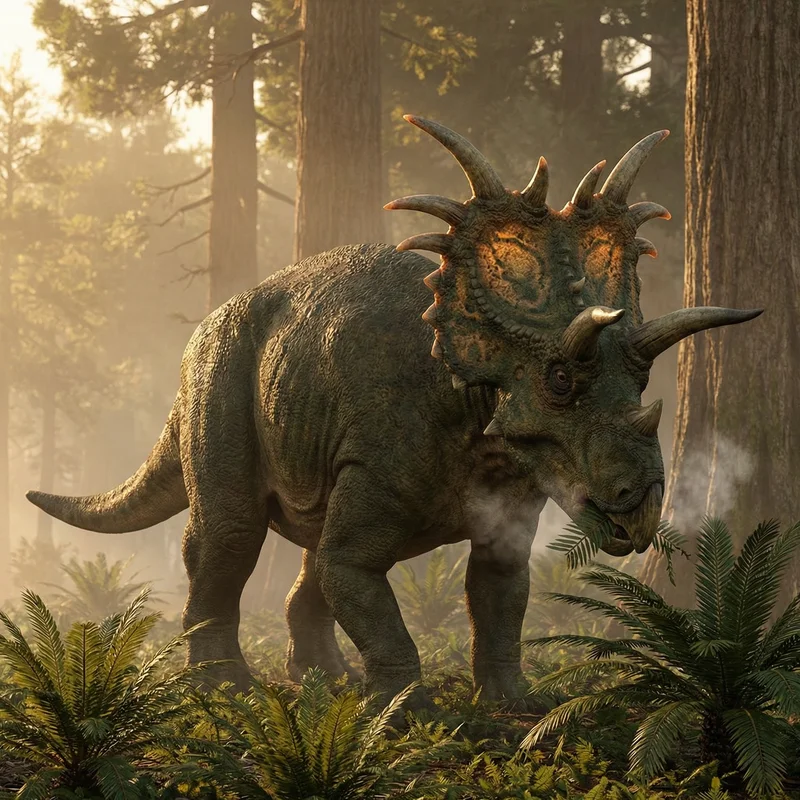
The most striking feature of Kosmoceratops is its extraordinarily elaborate skull ornamentation — the most ornate of any known dinosaur species. It possessed a total of fifteen well-developed horns and horn-like structures: one blade-like nasal horncore on the nose, two elongate supraorbital horncores above the eyes (curving upward and then downward, superficially resembling bison horns), two epijugal ossifications on the cheeks, and ten hook-like epiossifications lining the rear margin of the neck frill. The frill itself was remarkably short from front to back yet very broad (width approximately twice its length), giving Kosmoceratops the shortest frill relative to width among all chasmosaurines and the smallest parietal fenestrae relative to total frill area of any ceratopsid.
Estimated at approximately 4.5 m in length and 1.2 tonnes in mass, Kosmoceratops was a medium-sized ceratopsid. Like all ceratopsids, it was an obligate quadruped with a robustly built skeleton, a large pelvis, and a relatively short tail. Bone histology studies indicate rapid, sustained growth and an elevated metabolism consistent with homeothermic endothermy, comparable to modern birds and mammals. The discovery of Kosmoceratops played a central role in the debate over dinosaur "provincialism" on Laramidia — the hypothesis that latitudinally distinct dinosaur communities with endemic species existed on the island continent during the Campanian — making it one of the most paleobiogeographically significant ceratopsians ever described.
Overview
Name and Etymology
The generic name Kosmoceratops derives from the Ancient Greek kosmos ('ornamented') and ceratops ('horned face'), translating to 'ornate horned face.' The specific epithet richardsoni honors Scott Richardson, a volunteer field crew member who discovered the holotype and numerous other significant fossils from GSENM during the 2006 and 2007 field seasons (Sampson et al., 2010).
Taxonomic Status
Kosmoceratops richardsoni belongs to Ornithischia → Ceratopsia → Ceratopsidae → Chasmosaurinae. It is currently regarded as a valid monotypic genus. In the original description, it was recovered as the sister taxon to Vagaceratops irvinensis, a relationship supported by several subsequent analyses (Wick & Lehman, 2013; Mallon et al., 2016) but challenged by others who place Vagaceratops closer to Chasmosaurus (Longrich, 2014; Campbell et al., 2016, 2019). Fowler & Fowler (2020) recovered Kosmoceratops as the most derived member of a Chasmosaurus lineage. Only one species, K. richardsoni, is currently recognized.
Key Summary
Kosmoceratops possessed the most ornate skull of any known dinosaur, with fifteen horns and horn-like structures on its head.
Temporal Range, Stratigraphy, and Depositional Environment
Temporal Range
Kosmoceratops dates to the late Campanian age of the Late Cretaceous. Its specimens occur in the upper part of the lower unit to the upper part of the middle unit of the Kaiparowits Formation, in sediments dated to approximately 76.4–75.5 Ma based on laser-fusion 40Ar/39Ar ages (Roberts et al., 2005; Sampson et al., 2010). Revised uranium–lead stratigraphic data suggest the fossil-bearing portion of the Kaiparowits Formation spans approximately 77.24–75.02 Ma, with the temporal range of Kosmoceratops itself potentially narrowed to around 76–75.9 Ma (Roberts et al., 2013).
Formation and Lithology
The Kaiparowits Formation is an unusually thick (~860 m) Upper Cretaceous sedimentary succession exposed on the Kaiparowits Plateau in southern Utah. It is composed predominantly of fluvial and floodplain deposits. The holotype (UMNH VP 17000) was recovered from a silty sandstone channel lithofacies, consistent with the carcass having been washed into a river channel and rapidly buried. The subadult specimen UMNH VP 16878 was found dispersed across approximately 3 m² of silty mudstone lithofacies, with extensive disarticulation and breakage indicating skeletonization and decomposition prior to burial. Specimen UMNH VP 21339 was preserved in stacked siltstones and mudstones with minor sandstones, suggesting deposition in a pond environment (Getty et al., 2010; Levitt, 2013).
Paleoenvironment
The Kaiparowits Formation was deposited on the eastern margin of Laramidia, within approximately 100 km of the Western Interior Seaway, in an alluvial-to-coastal plain setting at roughly 45°N paleolatitude (Sampson et al., 2010). The environment was wet, humid, and subtropical, dominated by large, deep channels with stable banks and perennial wetland swamps, ponds, and lakes. Rivers generally flowed westward across the plains and drained into the Western Interior Seaway; the modern-day swamplands of Louisiana have been proposed as an analogous environment (Roberts, 2007). Wetlands were dominated by cypress trees up to 30 m tall, ferns, and floating angiosperms such as giant duckweed and water lettuce. Better-drained areas supported 10–20 m dicot forests with an understory of ferns, while well-drained areas farther from water were dominated by conifers up to 30 m, with an understory of cycads, small dicot trees, and ferns (Miller et al., 2013).
Specimens and Diagnostic Features
Holotype and Referred Specimens
| Specimen | Composition | Ontogenetic Stage | Locality | Notes |
|---|---|---|---|---|
| UMNH VP 17000 (holotype) | Nearly complete adult skull + substantial axial skeleton + partial pelvic girdle + limb elements (~45% of postcranium preserved) | Adult | UMNH Locality VP 890 | Predentary and small portion of left face/frill missing; snout deflected to right by postmortem distortion |
| UMNH VP 16878 | Disarticulated subadult skull (premaxilla, rostral, predentary missing); approximately half the size of the adult | Subadult | UMNH Locality VP 951 | Same epiossification count and pattern as adult |
| UMNH VP 21339 | Disarticulated subadult or adult individual | Subadult–adult | — | All bones broken prior to deposition; pond environment matrix |
A total of four specimens have been reported (Sampson et al., 2010; Getty et al., 2010; Levitt, 2013).
Diagnosis (Autapomorphies)
The original diagnosis (Sampson et al., 2010) identified the following autapomorphies distinguishing Kosmoceratops from other chasmosaurines: (1) internal naris rostrocaudally abbreviated and caudodorsally inclined; (2) nasal horncore transversely constricted, long-based, and blade-like, with a flattened distal portion; (3) supraorbital horncores directed dorsolaterally proximally, curving ventrally distally and tapering to a point; (4) parietosquamosal frill relatively short and broad (maximum width approximately twice maximum length), with small, caudally positioned parietal fenestrae; (5) ten well-developed hook-like epiossifications on the caudal frill margin (per side: three procurved epiparietals ep1–3, one procurved epiparietosquamosal esp, and one laterally to rostrolaterally directed episquamosal es1).
Limitations of the Material
Although the holotype skull is nearly complete, postmortem distortion has deflected the snout to the right, and the left jugal, portions of the left squamosal and parietal, and the predentary are missing. Much of the postcranial skeleton was still under preparation at the time of the 2010 description. The subadult UMNH VP 16878, while highly disarticulated, critically confirmed that the number and pattern of epiossifications are consistent across growth stages, helping differentiate subadult Kosmoceratops from Utahceratops (Sampson et al., 2010; Campbell, 2014).
Morphology and Functional Anatomy
Body Size
Kosmoceratops is estimated to have been approximately 4.5 m long and to have weighed approximately 1.2 tonnes (Paul, 2016). The skull itself (including the frill) was approximately 2 m in length (NHMU). This makes it a medium-sized ceratopsid, considerably smaller than Triceratops (8–9 m) but comparable to Chasmosaurus (4.3–4.8 m).
Cranial Features
Nasal horncore: Unlike most chasmosaurines, the nasal horncore of Kosmoceratops is blade-like, with an elongated base that is narrow from side to side, and a flattened upper portion. It is positioned relatively far back on the snout.
Supraorbital horncores: While most chasmosaurines have brow horns oriented forward or backward, those of Kosmoceratops project upward and to the sides, then curve downward, ending in pointed tips — superficially reminiscent of modern bison horns. They are more elongate and slender than those of the co-occurring Utahceratops, which has short, blunt brow horns.
Naris: The bony nostril opening is distinctly elliptical (rather than near-circular), tall, relatively narrow from front to back, and markedly inclined backward — a feature unique among ceratopsids.
Frill: The parietosquamosal neck frill is extraordinarily short from front to back and very broad, with its width approximately double its length. This gives Kosmoceratops the shortest frill relative to width among all chasmosaurines, despite the subfamily traditionally being considered the "long-frilled" ceratopsids. The parietal fenestrae are the smallest relative to total frill area of any ceratopsid, and they are positioned far back on the frill.
Frill epiossifications: Ten well-developed hook-like epiossifications line the rear margin of the frill, five per side: three forward-curving epiparietals (ep1–3) on the parietal bone, one forward-curving epiparietosquamosal (esp) on the parietal-squamosal boundary, and one episquamosal (es1) directed laterally and downward. The medial eight curve forward, while the lateral two project to the sides. The bases of the forward-curving epiparietals are coalesced and bear prominent sulci (grooves). This pattern is shared with Vagaceratops but is more extreme in Kosmoceratops. Note that Fowler & Fowler (2020) proposed an alternate numbering system in which epiparietals 1–3 collectively represent a single expanded ep1, the epiparietosquamosal becomes ep2, and the episquamosal becomes ep3.
Dentition and Feeding Apparatus
Like all ceratopsids, Kosmoceratops had an edentulous (toothless) beak at the front of the jaws, behind which were complex slicing dental batteries containing hundreds of continuously replaced teeth adapted to processing large quantities of fibrous plant material. The upper premaxillary beak was triangular, and the rostral bone was pointed, projecting forward and downward.
Locomotion
Kosmoceratops was an obligate quadruped, as is the case for all ceratopsids. It had a heavily constructed skeleton, a large pelvis, and a relatively shortened tail. Claims sometimes encountered in popular media that it could run bipedally have no basis in the scientific literature.
Diet and Ecology
Dietary Evidence
Kosmoceratops was an herbivore. The complex shearing dental batteries of ceratopsids were well-suited for processing large volumes of fibrous plant material. Large coprolites (fossilized dung) from the Kaiparowits Formation, which based on their size may have been produced by ceratopsians, hadrosaurs, or ankylosaurs, contain fragments of angiosperm wood, demonstrating that large herbivorous dinosaurs in this ecosystem consumed woody angiosperms. Additional inclusions of mollusc shell, arthropod cuticle, and lizard bone in the coprolites were likely incidentally ingested along with plant material. Other coprolites from the same formation contain conifer wood, suggesting dietary niche partitioning or seasonal variation among the herbivore community (Ridgwell, 2017).
Ecological Context
The Kaiparowits Formation harbored a diverse assemblage of large herbivorous dinosaurs alongside Kosmoceratops: the chasmosaurine Utahceratops, the centrosaurine Nasutoceratops, the hadrosaurs Gryposaurus and Parasaurolophus, and the ankylosaurid Akainacephalus. Major predators included the tyrannosaurid Teratophoneus and the giant crocodilian Deinosuchus. The two most common groups of large vertebrates in the formation are hadrosaurs and ceratopsians (the latter comprising approximately 14% of associated vertebrate fossils), which may reflect either genuine abundance or preservation bias due to the robust skeletal elements of these groups (Getty et al., 2010).
Bone Histology and Growth
Histological study of long bones (femora) from the holotype and specimen UMNH VP 21339 revealed a high density of osteocytes (bone cells) and a dense network of blood vessels including radially oriented vascular canals, indicating sustained rapid growth and an elevated metabolism consistent with homeothermic endothermy comparable to that of modern birds and mammals (Levitt, 2013; Frederickson et al., 2019). Notably, the sampled Kosmoceratops and Utahceratops bones lacked lines of arrested growth (LAGs, annual growth marks), in contrast to more northerly ceratopsids such as Pachyrhinosaurus, Centrosaurus, and Einiosaurus. This may indicate that Kosmoceratops could sustain year-round growth due to the more equable climate of southern Laramidia. The absence of LAGs also means individual ages cannot be directly estimated, but Levitt determined the specimens were subadult to adult, refuting Fowler et al.'s (2011) suggestion that Kosmoceratops specimens represented immature Vagaceratops.
Distribution and Paleogeography
Geographic Distribution
All confirmed specimens of Kosmoceratops come from the Kaiparowits Formation on the Kaiparowits Plateau, within GSENM, southern Utah, at approximately 45°N paleolatitude in the southern part of Laramidia (Sampson et al., 2010).
The Canadian Specimen Controversy
A partial skull (CMN 8801) discovered in 1928 by Charles M. Sternberg in the Dinosaur Park Formation of Alberta was originally assigned to Chasmosaurus russelli, then reassigned to Kosmoceratops sp. by Longrich (2014) based on similarities in snout features. However, Campbell et al. (2016) rejected this assignment, arguing that the features in question were either taphonomically influenced or fell within the variation of Chasmosaurus. Fowler & Fowler (2020) concluded that reliable assignment should be deferred until the anterior skull anatomy of chasmosaurines is better understood. Consequently, the confirmed distribution of Kosmoceratops remains restricted to Utah.
The Laramidian Provincialism Debate
The discovery of Kosmoceratops and Utahceratops was presented by Sampson et al. (2010) as the strongest evidence then available for latitudinally arrayed dinosaur "provinces" on Laramidia during the late Campanian. The two new Utah taxa were distinct from the contemporaneous Chasmosaurus and Mojoceratops from the Dinosaur Park Formation of Alberta, despite apparently overlapping in time. Sampson and colleagues proposed that a dispersal barrier — likely paleoclimatic or paleoenvironmental rather than physical — had isolated northern and southern chasmosaurine faunas between approximately 77.0 and 75.7 Ma, leading to independent diversification. They further suggested that the Kosmoceratops lineage subsequently dispersed northward (represented by Vagaceratops), ultimately giving rise to all later chasmosaurines including Triceratops.
This hypothesis has been challenged on several grounds. Lucas et al. (2016) criticized the provincialism concept due to sampling biases, the diachroneity of most fossil assemblages, the lack of identified topographic barriers, and the reliance on a small number of chasmosaurine taxa. Fowler (2017) questioned the precise contemporaneity of the Kaiparowits and Dinosaur Park formations after revised geochronological data. Longrich (2014), having assigned skull CMN 8801 to Kosmoceratops sp. from Alberta, argued that dinosaur lineages could disperse long distances and that endemism was maintained by competition rather than geographic barriers — though his reassignment was subsequently rejected (Campbell et al., 2016).
Phylogenetics and Taxonomic Debates
Original Phylogenetic Position (Sampson et al., 2010)
The original cladistic analysis recovered Kosmoceratops as the sister taxon to Vagaceratops irvinensis, with this clade placed as sister to a group of derived chasmosaurines from the latest Campanian and Maastrichtian that included Triceratops. Chasmosaurus was recovered as a more basal taxon, not closely related to Kosmoceratops.
Mallon et al. (2016)
The description of Spiclypeus shipporum from the Judith River Formation of Montana recovered it as the sister taxon to the Kosmoceratops + Vagaceratops clade. Spiclypeus appeared transitional in frill morphology, with some epiossifications beginning to curl forward, suggesting that the distinctive forward-curving epiossifications of Kosmoceratops evolved in a stepwise fashion.
Fowler & Fowler (2020)
Using a revised epiossification homology scheme, Fowler & Fowler proposed a deep split within Chasmosaurinae between a Chasmosaurus lineage and a Pentaceratops lineage. Contrary to most previous analyses, Kosmoceratops was recovered closer to Chasmosaurus, with Kosmoceratops and Vagaceratops together representing the most derived and youngest members of that lineage. Under this interpretation, Kosmoceratops evolved from Vagaceratops, which in turn evolved from Chasmosaurus.
Alternative Hypotheses
Longrich (2011, 2014) returned Vagaceratops to Chasmosaurus and found Kosmoceratops did not cluster closely with other taxa. Campbell et al. (2016, 2019) also found Vagaceratops closer to Chasmosaurus than to Kosmoceratops, considering V. irvinensis a species of Chasmosaurus. Paul (2016) suggested that Kosmoceratops and Vagaceratops may not be sufficiently distinct from Chasmosaurus to warrant separate genera. Fowler et al. (2011) proposed in a conference abstract that Kosmoceratops was an immature ontogenetic morph of C. irvinensis, but this was refuted by Levitt's (2013) bone histology demonstrating the largest Kosmoceratops specimens were adults.
Function of Skull Ornamentation
The possible functions of ceratopsian horns and frills have been extensively debated. Sampson (2010) suggested that the elaborate ornamentation was used primarily for intrasexual competition (intimidating or fighting rivals) and mate attraction, rather than defense against predators. Padian & Horner (2011) proposed a species recognition hypothesis, arguing that the structures served to differentiate between sympatric species. Knell & Sampson (2011) countered that sexual selection was a more parsimonious explanation given the high developmental cost and within-species variability of these structures. Hone & Naish (2013) further criticized the species recognition hypothesis, noting that no extant animals use such structures primarily for species recognition and that the redundancy of multiple elaborate features (nasal horn, brow horns, cheek bosses, frill margins) would be excessive for identification alone. Knapp et al. (2018) found no statistical correlation between ornamental divergence and sympatricity among ceratopsians, undermining the species recognition hypothesis.
Raia et al. (2015) demonstrated that Kosmoceratops had the highest fractal dimension values of frill margin complexity among ceratopsians, and found that ornament complexity correlated with body size, suggesting that increasing complexity may be a byproduct of Cope's rule rather than directly driven by sexual selection, though the size of ornaments may still be under sexual selection.
Reconstruction and Uncertainties
Confirmed Features
The number and arrangement of fifteen horns and horn-like structures have been verified in both adult and subadult specimens. The shortest frill-to-width ratio among chasmosaurines and the smallest relative parietal fenestrae among ceratopsids are firmly established. Obligate quadrupedality and herbivorous diet are universal ceratopsid characteristics.
Well-Supported Estimates
The size estimate of approximately 4.5 m in length and approximately 1.2 tonnes in mass is widely cited (Paul, 2016), though based on an incomplete postcranial skeleton. The sister-taxon relationship with Vagaceratops is supported by multiple analyses but remains debated. The sexual selection function of horns and frill is the dominant hypothesis, supported by multiple lines of evidence.
Hypothetical or Uncertain Areas
The exact contemporaneity of the Kaiparowits and Dinosaur Park formations is debated depending on geochronological interpretation. The Laramidian provincialism hypothesis itself faces both support and challenge. The assignment of Canadian specimen CMN 8801 to Kosmoceratops is not currently supported, and the genus's occurrence outside Utah remains unconfirmed.
Common Misconceptions
Kosmoceratops is often described in popular media as having "15 horns," but more precisely it possesses fifteen horns and horn-like structures: one nasal horncore, two supraorbital horncores, two epijugals, and ten frill epiossifications. It is sometimes misclassified as a theropod in non-specialist sources; it is in fact an ornithischian ceratopsian. The claim sometimes encountered that it could run bipedally has no scientific basis — all ceratopsids were obligate quadrupeds.
Comparison with Related and Contemporary Taxa
| Taxon | Age (Ma) | Locality | Frill Characteristics | Brow Horn Orientation | Notes |
|---|---|---|---|---|---|
| Kosmoceratops richardsoni | ~76–75.9 | Utah (Kaiparowits Fm.) | Very short, very broad; 10 hook-like epiossifications | Dorsolateral, curving downward | Most ornate dinosaur skull known |
| Vagaceratops irvinensis | ~75.3–74.8 | Alberta (Dinosaur Park Fm.) | Short and broad; 10 epiossifications (less distinct) | — | Sister taxon to Kosmoceratops (debated) |
| Spiclypeus shipporum | ~76 | Montana (Judith River Fm.) | Moderate length; some epiossifications curving | — | Transitional form in Kosmoceratops lineage |
| Utahceratops gettyi | ~76.4–75.5 | Utah (Kaiparowits Fm.) | Tapers posteriorly; deep median embayment | Dorsolateral (short, blunt) | Co-occurring with Kosmoceratops |
| Chasmosaurus russelli | ~76.5–75.5 | Alberta (Dinosaur Park Fm.) | Long frill; large parietal fenestrae | Forward or backward | Basal chasmosaurine |
| Triceratops horridus | ~68–66 | Western N. America (Hell Creek Fm. etc.) | Large frill; fenestrae closed | Forward | Most famous ceratopsian |
Fun Facts
FAQ
📚References
- Sampson, S. D., Loewen, M. A., Farke, A. A., Roberts, E. M., Forster, C. A., Smith, J. A., & Titus, A. L. (2010). New horned dinosaurs from Utah provide evidence for intracontinental dinosaur endemism. PLoS ONE, 5(9), e12292. https://doi.org/10.1371/journal.pone.0012292
- Getty, M. A., Loewen, M. A., Roberts, E., Titus, A. L., & Sampson, S. D. (2010). Taphonomy of horned dinosaurs (Ornithischia: Ceratopsidae) from the late Campanian Kaiparowits Formation, Grand Staircase–Escalante National Monument, Utah. In M. J. Ryan, B. J. Chinnery-Allgeier, & D. A. Eberth (Eds.), New Perspectives on Horned Dinosaurs (pp. 478–494). Indiana University Press.
- Roberts, E. M. (2007). Facies architecture and depositional environments of the Upper Cretaceous Kaiparowits Formation, southern Utah. Sedimentary Geology, 197(3–4), 207–233. https://doi.org/10.1016/j.sedgeo.2006.10.001
- Roberts, E. M., Deino, A. L., & Chan, M. A. (2005). 40Ar/39Ar age of the Kaiparowits Formation, southern Utah, and correlation of contemporaneous Campanian strata and vertebrate faunas along the margin of the Western Interior Basin. Cretaceous Research, 26(2), 307–318. https://doi.org/10.1016/j.cretres.2005.01.002
- Levitt, C. G. (2013). Bone histology and growth of chasmosaurine ceratopsid dinosaurs from the late Campanian Kaiparowits Formation, southern Utah. M.S. Thesis, University of Utah.
- Paul, G. S. (2016). The Princeton Field Guide to Dinosaurs (2nd ed.). Princeton University Press.
- Mallon, J. C., Ott, C. J., Larson, P. L., Iuliano, E. M., & Evans, D. C. (2016). Spiclypeus shipporum gen. et sp. nov., a boldly audacious new chasmosaurine ceratopsid (Dinosauria: Ornithischia) from the Judith River Formation (Upper Cretaceous: Campanian) of Montana, USA. PLoS ONE, 11(5), e0154218. https://doi.org/10.1371/journal.pone.0154218
- Fowler, D. W., & Freedman Fowler, E. A. (2020). Transitional evolutionary forms in chasmosaurine ceratopsid dinosaurs: evidence from the Campanian of New Mexico. PeerJ, 8, e9251. https://doi.org/10.7717/peerj.9251
- Longrich, N. R. (2014). The horned dinosaurs Pentaceratops and Kosmoceratops from the upper Campanian of Alberta and implications for dinosaur biogeography. Cretaceous Research, 51, 292–308. https://doi.org/10.1016/j.cretres.2014.06.011
- Campbell, J. A., Ryan, M. J., Holmes, R. B., & Schröder-Adams, C. J. (2016). A re-evaluation of the chasmosaurine ceratopsid genus Chasmosaurus (Dinosauria: Ornithischia) from the Upper Cretaceous (Campanian) Dinosaur Park Formation of western Canada. PLoS ONE, 11(1), e0145805. https://doi.org/10.1371/journal.pone.0145805
- Miller, I. M., Johnson, K. R., Kline, D. E., Nichols, D. J., & Barclay, R. S. (2013). A late Campanian flora from the Kaiparowits Formation, southern Utah, and a brief overview of the widely sampled but little-known Campanian vegetation of the Western Interior of North America. In A. L. Titus & M. A. Loewen (Eds.), At the Top of the Grand Staircase (pp. 107–131). Indiana University Press.
- Knell, R. J., & Sampson, S. D. (2011). Bizarre structures in dinosaurs: species recognition or sexual selection? A response to Padian and Horner. Journal of Zoology, 283(1), 18–22. https://doi.org/10.1111/j.1469-7998.2010.00758.x
- Hone, D. W. E., & Naish, D. (2013). The 'species recognition hypothesis' does not explain the presence and evolution of exaggerated structures in non-avialan dinosaurs. Journal of Zoology, 290(3), 172–180. https://doi.org/10.1111/jzo.12035
- Knapp, A., Knell, R. J., Farke, A. A., Loewen, M. A., & Hone, D. W. E. (2018). Patterns of divergence in the morphology of ceratopsian dinosaurs: sympatry is not a driver of ornament evolution. Proceedings of the Royal Society B, 285(1873), 20180312. https://doi.org/10.1098/rspb.2018.0312
- Raia, P., Passaro, F., Carotenuto, F., Maiorino, L., Piras, P., Teresi, L., Meiri, S., Itescu, Y., Novosolov, M., Baiano, M. A., Martinez, R., & Fortelius, M. (2015). Cope's rule and the universal scaling law of ornament complexity. American Naturalist, 186(2), 165–175. https://doi.org/10.1086/682011
- Ridgwell, N. M. (2017). Taphonomic and paleontological analysis of coprolites from the Upper Cretaceous (Campanian) Kaiparowits Formation of southern Utah. M.S. Thesis, James Cook University.
- Lucas, S. G., Sullivan, R. M., Lichtig, A. J., Dalman, S. G., & Jasinski, S. E. (2016). Late Cretaceous dinosaur biogeography and endemism in the Western Interior Basin, North America: A critical re-evaluation. New Mexico Museum of Natural History and Science Bulletin, 71, 195–213.
- Frederickson, J. A., Tumarkin-Deratzian, A. R., & Heizler, M. (2019). Filling in gaps in the ceratopsid histologic database: Histology of two southern Laramidian ceratopsids. Anatomical Record, 303(4), 1022–1036. https://doi.org/10.1002/ar.24099
Gallery
5 images Kosmoceratops
Kosmoceratops · Cretaceous Period · Herbivore
 Kosmoceratops
Kosmoceratops · Cretaceous Period · Herbivore
 Kosmoceratops
Kosmoceratops · Cretaceous Period · Herbivore
 Kosmoceratops
Kosmoceratops · Cretaceous Period · Herbivore
 Kosmoceratops
Kosmoceratops · Cretaceous Period · Herbivore
🔗Related Creatures
Zuniceratops
Zuniceratops christopheri

Edmontosaurus
Edmontosaurus
Achelousaurus
Achelousaurus horneri
Ouranosaurus
Ouranosaurus nigeriensis

Regaliceratops
Regaliceratops peterhewsi

Medusaceratops
Medusaceratops lokii

Muttaburrasaurus
Muttaburrasaurus langdoni

Nasutoceratops
Nasutoceratops titusi