Kaprosuchus
Cretaceous Period Carnivore Creature Type
Kaprosuchus saharicus
Scientific Name: "Greek kapros (κάπρος, 'boar') + soukhos (σοῦχος, 'crocodile') = 'boar crocodile', referring to the hypertrophied tusk-like caniniform teeth resembling boar tusks. The specific epithet saharicus refers to the Sahara Desert."
Local Name: Kaprosuchus
Physical Characteristics
Discovery
Habitat
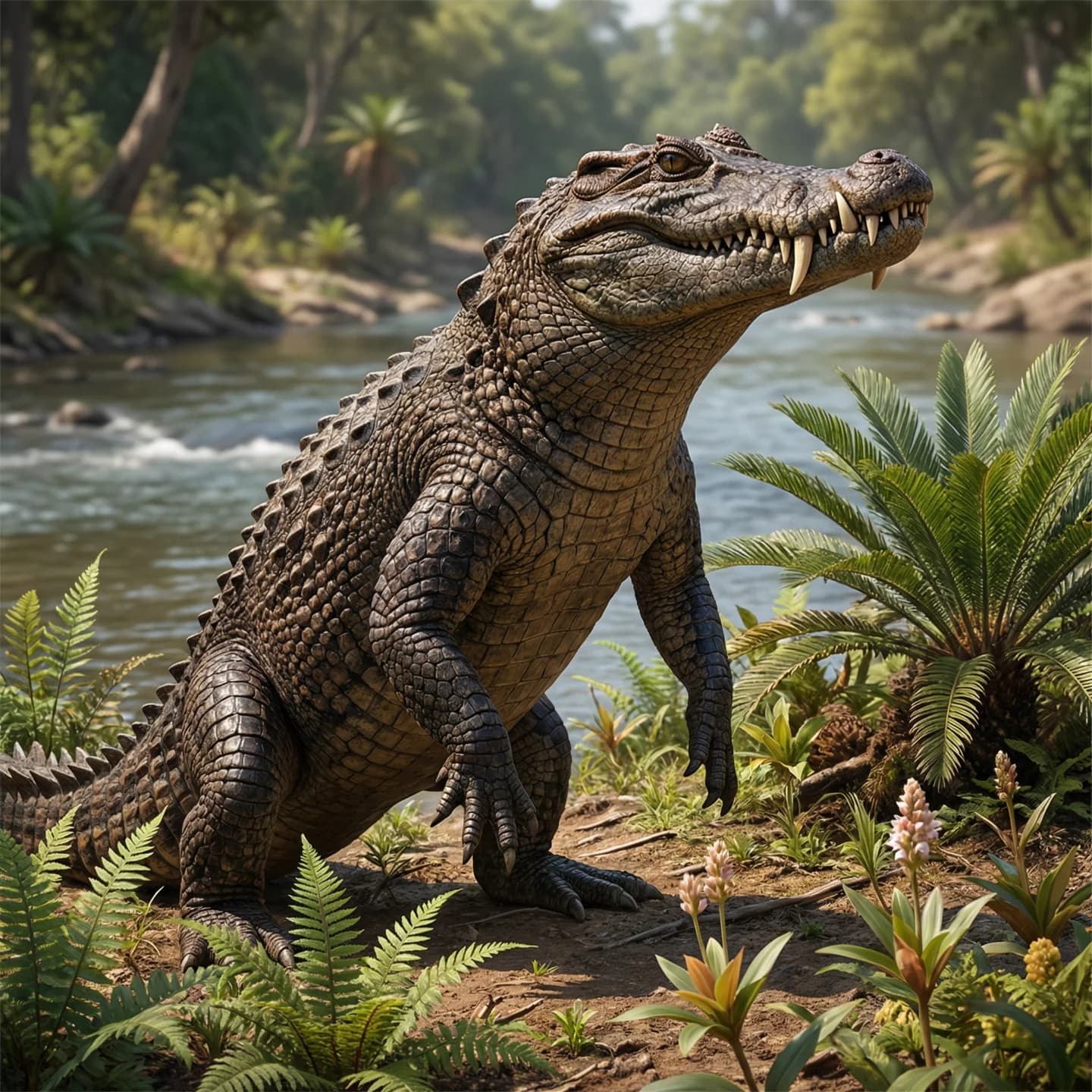
Kaprosuchus (Kaprosuchus saharicus Sereno & Larsson, 2009) is an extinct genus of mahajangasuchid crocodyliform from the Late Cretaceous (Cenomanian, approximately 95 million years ago) of what is now the Sahara Desert in Niger. It is known exclusively from a single, nearly complete skull — the holotype MNN IGU12 — collected from the Upper Cretaceous Echkar Formation in the Agadez Region of Niger. The name derives from the Greek kapros (boar) and soukhos (crocodile), referring to the animal's remarkably enlarged, tusk-like caniniform teeth that resemble the tusks of a wild boar. The genus was first described by Paul Sereno and Hans Larsson in a comprehensive 2009 monograph published in ZooKeys, alongside other Saharan crocodyliforms such as Anatosuchus and Laganosuchus. Sereno popularized the nickname "BoarCroc" for this distinctive animal.
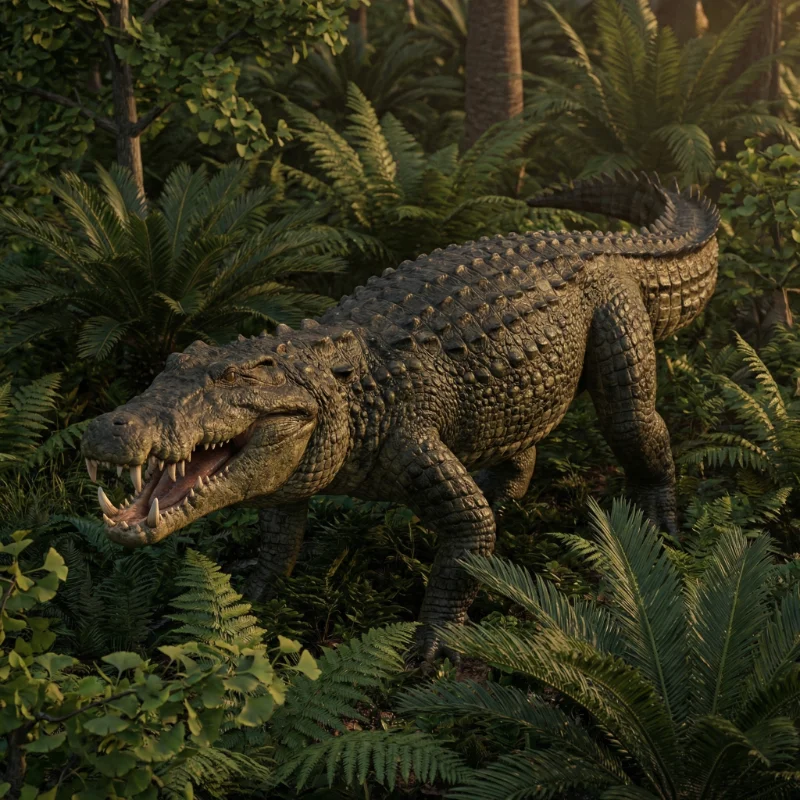
The most striking feature of Kaprosuchus is its dentition: three sets of hypertrophied caniniform teeth project above and below the skull, with the lower caniniforms fitting into notches in the upper jaw — a dental arrangement unknown in any other crocodyliform. Additional autapomorphies include large, rugose horn-like projections formed by the squamosal and parietal bones at the back of the skull, and laterally (rather than dorsally) oriented orbits angled slightly forward, suggesting possible stereoscopic vision. The rugose premaxillary surface, with elevated edges flanking a smooth midline, is interpreted as having supported a keratinous shield at the tip of the snout.
Body length estimates for Kaprosuchus have varied dramatically. The original description (Sereno & Larsson, 2009) diagnosed it as a "mid-sized (~6 m) neosuchian," but this figure was based on scaling relationships derived from extant crocodylians, which have fundamentally different body proportions from notosuchians. Gayford et al. (2024) revised the estimate to approximately 2.42–3.77 m, and Paiva et al. (2026), using phylogenetically informed Bayesian inference based on dorso-cranial length, estimated a total body length of approximately 2.33 m (75% confidence interval: 1.76–3.06 m). Since only the skull is preserved, no reliable body mass estimates have been published. The ecology of Kaprosuchus has also been debated: while originally interpreted as a primarily terrestrial predator based on its laterally oriented orbits and blade-like teeth, more recent analyses (Wilberg et al., 2019) suggest a semiaquatic lifestyle is more likely, consistent with cranial adaptations shared with other "definitively semiaquatic" crocodylomorphs.
Overview
Name and Etymology
The genus name Kaprosuchus is a compound of the Greek κάπρος (kapros, "boar") and σοῦχος (soukhos, "crocodile"), highlighting the boar-tusk-like caniniform teeth that are the animal's most conspicuous feature. The specific epithet saharicus refers to the Sahara Desert, where the holotype was discovered. Sereno and Larsson also bestowed the popular nickname "BoarCroc" upon the animal, making it one of five Saharan crocodyliforms given colloquial names for the 2009 National Geographic feature and documentary "When Crocs Ate Dinosaurs," alongside "RatCroc" (Araripesuchus rattoides), "DogCroc" (Araripesuchus wegeneri), "DuckCroc" (Anatosuchus minor), and "PancakeCroc" (Laganosuchus thaumastos).
Taxonomic Status
Kaprosuchus is currently recognized as a valid monotypic genus containing a single species, K. saharicus. No synonymies or questionable referrals have been proposed. While the original description placed the family Mahajangasuchidae within Neosuchia, subsequent phylogenetic analyses (Turner, 2010; Pol et al., 2014; Nicholl et al., 2021; Young et al., 2024) have consistently recovered Mahajangasuchidae as an early-diverging branch of Notosuchia, forming a sister clade to Peirosauridae. This reclassification is now the prevailing consensus.
One-Sentence Summary
Kaprosuchus is a Late Cretaceous notosuchian crocodyliform from Niger characterized by three pairs of hypertrophied tusk-like teeth and horn-like skull projections, known from a single nearly complete skull.
Age, Stratigraphy, and Depositional Environment
Temporal Range
The Kaprosuchus holotype was recovered from the Echkar Formation in the Agadez Region of Niger. This formation is dated to the Late Albian–Cenomanian interval, approximately 100–95 Ma (latest Early to earliest Late Cretaceous). The Echkar Formation is part of the Tegama Group within the Iullemmeden Basin and overlies the Elrhaz Formation while being overlain by the Farak Formation.
Lithology
The Echkar Formation is composed primarily of coarse feldspathic sandstones with subordinate claystones, exhibiting cross-stratification indicative of fluvial depositional processes. This lithological character reflects a river-channel and floodplain environment.
Paleoenvironment
During the Cenomanian, the type locality occupied a near-equatorial position (paleolatitude ~2.8°N, paleolongitude ~0.4°E), placing it in a warm, humid subtropical to tropical climate with extensive river systems and associated floodplains. The rich vertebrate fauna recovered from the Echkar Formation supports the interpretation of a diverse, well-watered ecosystem. Associated taxa include large theropod dinosaurs (Carcharodontosaurus iguidensis, Rugops primus, Spinosaurus sp.), sauropods (Aegyptosaurus, Rebbachisaurus), multiple other crocodyliforms (Araripesuchus rattoides, Laganosuchus thaumastos, Elosuchus sp.), and fish (Onchopristis numida, Ceratodus sp.), reflecting a complex food web with diverse ecological niches.
Specimens and Diagnostic Features
Holotype
| Field | Details |
|---|---|
| Specimen number | MNN IGU12 |
| Repository | Musee National du Niger, Niamey |
| Preserved elements | Nearly complete skull (cranium + lower jaws) — missing only portions of the right postorbital, squamosal, and the middle third of the braincase |
| Cranial length | ~507 mm (dorso-cranial length) |
| Mandible length | ~603 mm |
| Locality | Near Iguidi, Agadez Region, Niger |
| Formation | Echkar Formation (Tegama Group) |
Kaprosuchus is known solely from this single skull specimen. No postcranial material has been recovered, meaning that body proportions, limb structure, body mass, and locomotor mode remain entirely unknown from direct evidence.
Diagnosis
The following diagnostic features were established in the original description (Sereno & Larsson, 2009):
- Parasagittal premaxillary rugosities separated by smooth margins near the midline, giving a "moustache"-like appearance in anterior view — inferred to have supported a keratinous shield
- Three sets of hypertrophied caniniform teeth in the premaxillae, maxillae, and dentaries, projecting well above and below the skull margins; the lower caniniforms interlock into notches in the upper jaw
- Large, rugose horn-like projections of the squamosal and parietal bones extending posteriorly from the skull
- Laterally and slightly anteriorly oriented orbits (contrasting with the dorsally oriented orbits typical of aquatic crocodyliforms)
- Telescoped, dorsally positioned external nares
- Fused nasal bones providing reinforcement against compressive bite forces
- Great depth of the posterior portion of the skull relative to other crocodyliforms with dorsoventrally compressed snouts
Limitations of the Material
With only a single skull preserved and no postcranial skeleton, reconstructions of body shape, limb morphology, dermal armor (osteoderms), pelvic and vertebral structure, and locomotor capability are entirely speculative. Body length and mass estimates depend on statistical extrapolation from phylogenetically distant comparisons and carry high uncertainty.
Morphology and Functional Anatomy
Skull Architecture
The skull of Kaprosuchus is approximately 507 mm in dorso-cranial length, with the lower jaw measuring about 603 mm, placing it in the medium-sized range among crocodyliforms. The snout displays generalized proportions, but the posterior portion of the skull is notably deep (dorsoventrally), distinguishing it from other crocodyliforms with dorsoventrally compressed snouts. The premaxillary surfaces are rugose, with elevated bone edges suggesting the presence of a keratinous shield covering the snout tip. Along the interpremaxillary suture, the surface is smooth, producing a bilateral rugosity pattern resembling a moustache when viewed anteriorly.
Dentition
The most distinctive feature of Kaprosuchus is its three pairs of hypertrophied caniniform teeth. These teeth are labiolingually (laterally) compressed with sharp edges and are relatively straight — markedly different from the subconical, recurved, fluted teeth of aquatic crocodyliforms. The long retroarticular process of the lower jaw indicates that the jaws could open rapidly with a wide gape, necessary for the opposing caniniforms to clear each other during mouth opening and closing.
Sensory Capabilities
The orbits face laterally and are angled slightly forward, suggesting an overlapping visual field between the two eyes (stereoscopic vision). This is in stark contrast to most extant crocodylians and many fossil neosuchians, in which the orbits face dorsally — an adaptation allowing the animal to hold its head underwater while the eyes remain above the surface. The laterally oriented orbits of Kaprosuchus were initially interpreted as evidence for terrestrial predation (Sereno & Larsson, 2009).
Body Size Estimation
Body size estimates have been revised significantly since the original description:
| Study | Estimated total length | Method |
|---|---|---|
| Sereno & Larsson (2009) | ~6 m | Extrapolation from extant crocodylian skull-body ratios |
| Gayford et al. (2024) | 2.42–3.77 m | Critical review of body size proxy methods |
| Paiva et al. (2026) | ~2.33 m (1.76–3.06 m, 75% CI) | Phylogenetic Bayesian inference based on dorso-cranial length |
The original ~6 m estimate applied scaling relationships derived from extant crocodylians, which have substantially different body proportions from notosuchians (the clade to which Kaprosuchus actually belongs). The most recent phylogenetically informed estimates suggest a total length of approximately 2–4 m. No reliable body mass estimates exist because no postcranial material is known. The widely cited figures of 200–400 kg found in popular sources have no published academic basis.
Diet and Ecology
Diet
The hypertrophied, labiolingually compressed caniniform teeth with sharp edges, combined with the reinforced skull architecture (fused nasals, deep posterior skull), strongly indicate that Kaprosuchus was an active carnivorous predator. The tooth morphology is adapted for slicing rather than crushing or gripping, suggesting predation on relatively large prey rather than fish. However, no direct dietary evidence (stomach contents, bite marks, stable isotope analysis) has been reported.
Terrestrial vs. Semiaquatic Debate
The ecological lifestyle of Kaprosuchus is one of the most actively debated aspects of its biology:
Terrestrial predator hypothesis (Sereno & Larsson, 2009): Multiple cranial features were interpreted as adaptations for land-based predation. These include (1) laterally oriented orbits enabling stereoscopic vision for judging distance to prey on land; (2) straight, blade-like caniniforms unlike the recurved teeth of aquatic crocodyliforms; (3) dorsally positioned, telescoped nares interpreted as protection against snout impact during ramming prey; (4) a keratinous snout shield providing additional protection; and (5) a long retroarticular process enabling rapid jaw opening. Sereno reconstructed Kaprosuchus as an upright, galloping terrestrial predator.
Semiaquatic hypothesis (Wilberg et al., 2019 and subsequent work): The closely related Mahajangasuchus insignis has been suggested to be a primarily aquatic predator, and both genera share cranial adaptations found in "definitively semiaquatic" crocodylomorphs, including elongate snouts, dorsally positioned orbits and/or nares. Wilberg et al. (2019), in their comprehensive analysis of habitat shifts across Crocodylomorpha, inferred a semiaquatic ancestral condition for the mahajangasuchid + peirosaurid clade. The semiaquatic interpretation is currently gaining broader acceptance, although the absence of postcranial material prevents definitive resolution.
Ecological Niche
Within the Echkar Formation ecosystem, Kaprosuchus coexisted with several other crocodyliforms that appear to have partitioned the available ecological space: Araripesuchus rattoides (small, omnivorous, with buck-teeth for digging), Laganosuchus thaumastos (large, flat-headed, passive fish-eater), and Elosuchus (aquatic). Among these, Kaprosuchus was likely the most active large-prey predator, occupying a distinct trophic role.
Distribution and Paleogeography
Locality
Kaprosuchus is known only from the type locality near Iguidi in the Agadez Region of Niger. The modern coordinates are approximately 17.9°N, 5.6°E, but during the Cenomanian (~95 Ma), the paleocoordinates were approximately 2.8°N, 0.4°E, placing the site near the equator.
Paleogeographic Context
During the Cenomanian, the breakup of Gondwana was underway. Africa had begun separating from South America, but was still relatively proximate to Madagascar. The fact that Kaprosuchus's closest relative, Mahajangasuchus insignis, is known from the Maastrichtian (~70–66 Ma) Maevarano Formation of Madagascar strongly supports a biogeographic connection between Africa and Madagascar during the Cretaceous. This trans-oceanic relationship, spanning approximately 25 million years, provides important evidence for understanding faunal exchange patterns during Gondwanan fragmentation.
Phylogeny and Systematic Debates
Summary of Phylogenetic Analyses
The systematic position of Kaprosuchus and Mahajangasuchidae has undergone significant revision since the original description:
- Sereno & Larsson (2009): Placed Mahajangasuchidae within Neosuchia
- Turner & Buckley (2008): Found Mahajangasuchus in an uncertain phylogenetic position, but consistently distant from Eusuchia
- Turner (2010, JVP): Recovered Mahajangasuchus insignis and Kaprosuchus saharicus as sister taxa forming Mahajangasuchidae; this clade grouped with Peirosauridae, and together with uruguaysuchids (Anatosuchus, Araripesuchus), formed an early-diverging branch within Notosuchia
- Nicholl et al. (2021): Reconfirmed the mahajangasuchid + peirosaurid clade within Notosuchia in the context of a new peirosaurid from the Kem Kem Group of Morocco
- Young et al. (2024): Recovered Mahajangasuchidae (comprising Anatosuchus, Kaprosuchus, and Mahajangasuchus) as one of three clades within a notosuchian polytomy
The current consensus places Kaprosuchus firmly within Notosuchia (Mahajangasuchidae), and the original neosuchian placement is considered superseded.
Alternative Hypotheses
The initial instability in the phylogenetic placement of Mahajangasuchidae stems from the mosaic character distribution in the skull, combining features of both neosuchians and notosuchians. In particular, convergent evolution of a eusuchian-style secondary palate complicated phylogenetic inference. With expanded taxon sampling and character matrices in post-2010 analyses, the notosuchian affinity has been consistently supported.
Reconstruction and Uncertainty
Confidence Levels
| Level | Content |
|---|---|
| Confirmed | Three pairs of hypertrophied caniniform teeth; horn-like squamosal/parietal projections; laterally oriented orbits; classification within Mahajangasuchidae |
| Probable | Active carnivorous predator; notosuchian (non-neosuchian) classification; semiaquatic lifestyle; presence of keratinous snout shield |
| Hypothetical | Upright/galloping locomotion (no postcranial evidence); stereoscopic vision capability; head-butting prey capture; original ~6 m body length |
| Unknown | Exact body length and mass; limb structure and locomotor posture; presence of osteoderms; growth rate; social behavior; sexual dimorphism |
Popular Media vs. Scientific Consensus
In popular media, Kaprosuchus is typically depicted as a ~6-meter-long, upright-walking terrestrial predator, most notably in the 2009 National Geographic documentary "When Crocs Ate Dinosaurs" and various video game appearances. However, the current scientific picture differs substantially: (1) body length has been revised downward to approximately 2–4 m; (2) there is no postcranial evidence supporting upright or galloping locomotion; and (3) a semiaquatic lifestyle is now considered more likely than obligate terrestrial predation. The "galloping land predator" reconstruction, while compelling, remains an unsupported hypothesis based on available evidence.
Comparison with Related and Contemporary Taxa
| Taxon | Family | Age | Locality | Estimated length | Diet | Ecology |
|---|---|---|---|---|---|---|
| Kaprosuchus saharicus | Mahajangasuchidae | Cenomanian (~95 Ma) | Niger | ~2–4 m | Carnivore | Semiaquatic (probable) |
| Mahajangasuchus insignis | Mahajangasuchidae | Maastrichtian (~70 Ma) | Madagascar | ~2.9 m (FL-based) | Carnivore | Semiaquatic (probable) |
| Laganosuchus thaumastos | Uncertain | Cenomanian (~95 Ma) | Niger, Morocco | ~6 m | Piscivore | Aquatic |
| Araripesuchus rattoides | Uruguaysuchidae | Cenomanian (~95 Ma) | Morocco | ~0.9 m | Omnivore | Terrestrial |
| Hamadasuchus rebouli | Peirosauridae | Albian–Cenomanian | Morocco | ~0.9 m (DCL-based) | Carnivore | Terrestrial |
Data Tables
Specimen Summary
| Specimen | Elements | Locality | Formation | Reference |
|---|---|---|---|---|
| MNN IGU12 (holotype) | Nearly complete skull (cranium + mandible) | Near Iguidi, Niger | Echkar Formation | Sereno & Larsson (2009) |
Stratigraphic Summary
| Field | Details | Basis |
|---|---|---|
| Age | Late Cretaceous, Cenomanian (~95 Ma) | Echkar Formation stratigraphy |
| Formation | Echkar Formation, Tegama Group | Iullemmeden Basin, Niger |
| Lithology | Coarse feldspathic sandstone, claystone | Kogbe (1991) |
| Depositional environment | Fluvial / floodplain | Cross-stratification, associated fauna |
| Paleocoordinates | ~2.8°N, 0.4°E | Echkar Fm. paleocoordinate estimates |
Fun Facts
FAQ
📚References
- Sereno, P. C. & Larsson, H. C. E. (2009). Cretaceous crocodyliforms from the Sahara. ZooKeys, 28, 1–143. doi:10.3897/zookeys.28.325
- Turner, A. H. & Buckley, G. A. (2008). Mahajangasuchus insignis (Crocodyliformes: Mesoeucrocodylia) cranial anatomy and new data on the origin of the eusuchian-style palate. Journal of Vertebrate Paleontology, 28(2), 382–408. doi:10.1671/0272-4634(2008)28[382:MICMCA]2.0.CO;2
- Wilberg, E. W., Turner, A. H. & Brochu, C. A. (2019). Evolutionary structure and timing of major habitat shifts in Crocodylomorpha. Scientific Reports, 9, 514. doi:10.1038/s41598-018-36795-1
- Nicholl, C. S. C., Hunt, E. S. E., Ouarhache, D. & Mannion, P. D. (2021). A second peirosaurid crocodyliform from the Mid-Cretaceous Kem Kem Group of Morocco and the diversity of Gondwanan notosuchians outside South America. Royal Society Open Science, 8(10), 211254. doi:10.1098/rsos.211254
- Gayford, J. H., Engelman, R. K., Sternes, P. C., Itano, W. M., Bazzi, M., Collareta, A., Salas-Gismondi, R. & Shimada, K. (2024). Cautionary tales on the use of proxies to estimate body size and form of extinct animals. Ecology and Evolution, 14(9), e70218. doi:10.1002/ece3.70218
- Paiva, A. L. S., Godoy, P. L., dos Santos, D. M., Langer, M. C. & Mannion, P. D. (2026). Phylogenetically-informed estimates of notosuchian (Archosauria, Crocodylomorpha) body size and the challenges of inferring macroevolutionary patterns in extinct groups. Manuscript, UCL Discovery.
- Young, M. T., Hastings, A. K., Allain, R. & Smith, T. J. (2024). The history, systematics, and nomenclature of Thalattosuchia. Zoological Journal of the Linnean Society, 200(2), 547–652. doi:10.1093/zoolinnean/zlad165
- Cubo, J., Sena, M. V. A., Aubier, P., Houee, G., Claisse, P., Faure-Brac, M. G., Allain, R., Andrade, R. C. L. P., Sayao, J. M. & Oliveira, G. R. (2020). Were Notosuchia (Pseudosuchia: Crocodylomorpha) warm-blooded? A palaeohistological analysis suggests ectothermy. Biological Journal of the Linnean Society, 131(1), 154–162. doi:10.1093/biolinnean/blaa081
- Rakotozafy, B. et al. (2024). Late Cretaceous Notosuchians of the Maevarano Formation, Mahajanga Basin: An ecomorphological perspective. NSF Public Access.
- Pol, D., Nascimento, P. M., Carvalho, A. B., Riccomini, C., Pires-Domingues, R. A. & Zaher, H. (2014). A new notosuchian from the Late Cretaceous of Brazil and the phylogeny of advanced notosuchians. PLoS ONE, 9(4), e93105. doi:10.1371/journal.pone.0093105
- Brusatte, S. L. & Sereno, P. C. (2007). A new species of Carcharodontosaurus (Dinosauria: Theropoda) from the Cenomanian of Niger and a revision of the genus. Journal of Vertebrate Paleontology, 27(4), 902–916.
- Kogbe, C. A. (1991). Stratigraphy and tectonic history of the Iullemmeden Basin in West Africa. Journal of African Earth Sciences, 13(3–4), 593–602.
- Bravo, G. G. et al. (2025). A new notosuchian crocodyliform from the Early Palaeocene of Patagonia and the survival of a large-bodied terrestrial lineage across the K–Pg mass extinction. Proceedings of the Royal Society B, 292(2043), 20241980. doi:10.1098/rspb.2024.1980
- Fachini, T. S. et al. (2025). Cranial morphology and phylogenetic reassessment of Barreirosuchus franciscoi. Anatomical Record. doi:10.1002/ar.25607
Gallery
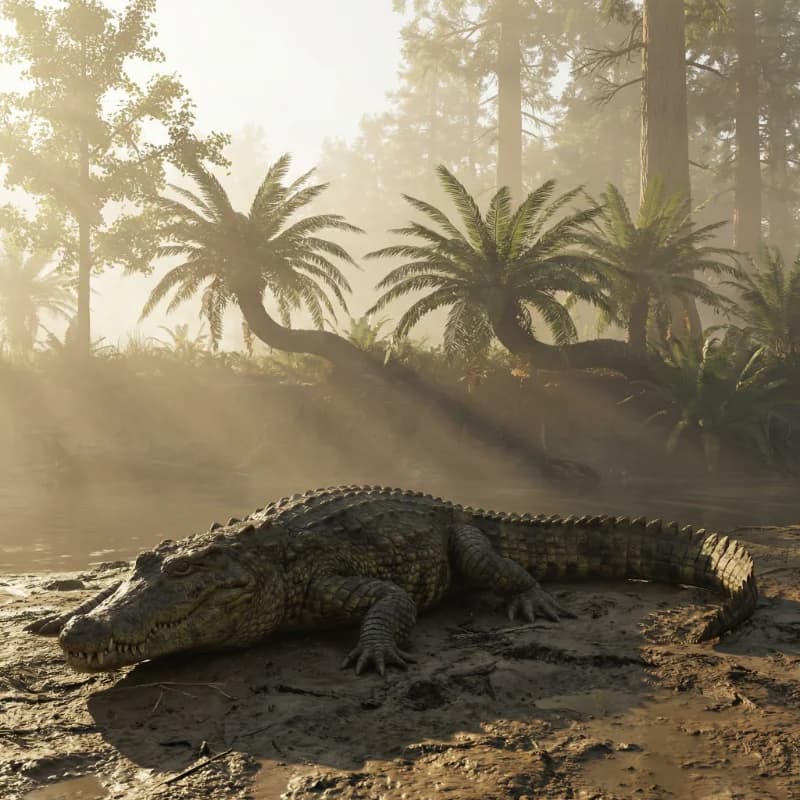
5 images Kaprosuchus
Kaprosuchus · Cretaceous Period · Carnivore
 Kaprosuchus
Kaprosuchus · Cretaceous Period · Carnivore
 Kaprosuchus
Kaprosuchus · Cretaceous Period · Carnivore
 Kaprosuchus
Kaprosuchus · Cretaceous Period · Carnivore
 Kaprosuchus
Kaprosuchus · Cretaceous Period · Carnivore
🔗Related Creatures
Deinosuchus
Deinosuchus
Sarcosuchus
Sarcosuchus imperator
Calsoyasuchus
Calsoyasuchus valliceps

Stomatosuchus
Stomatosuchus inermis
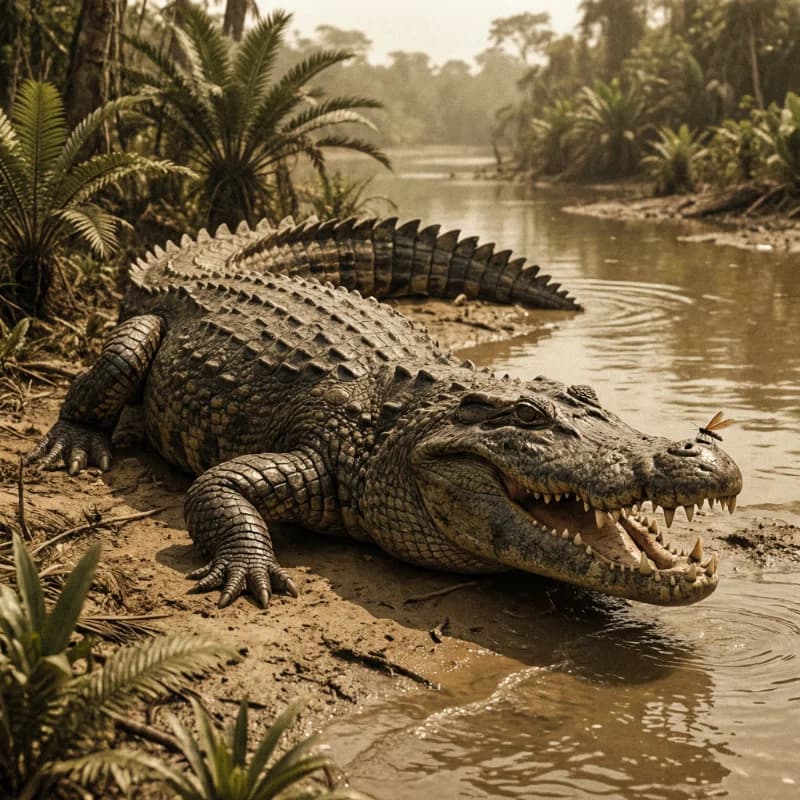
Purussaurus
Purussaurus
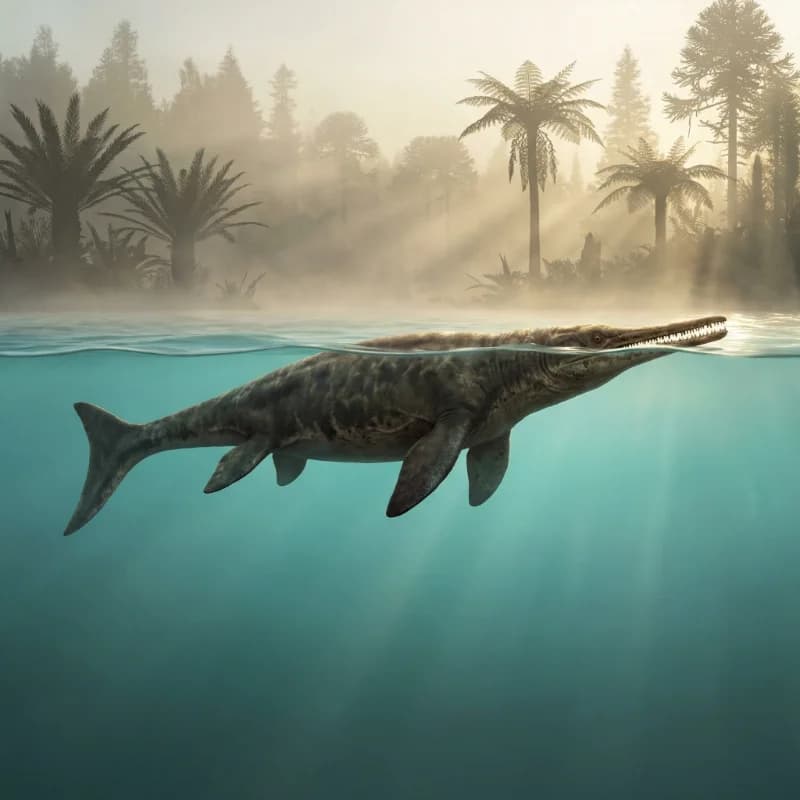
Metriorhynchus
Metriorhynchus brevirostris
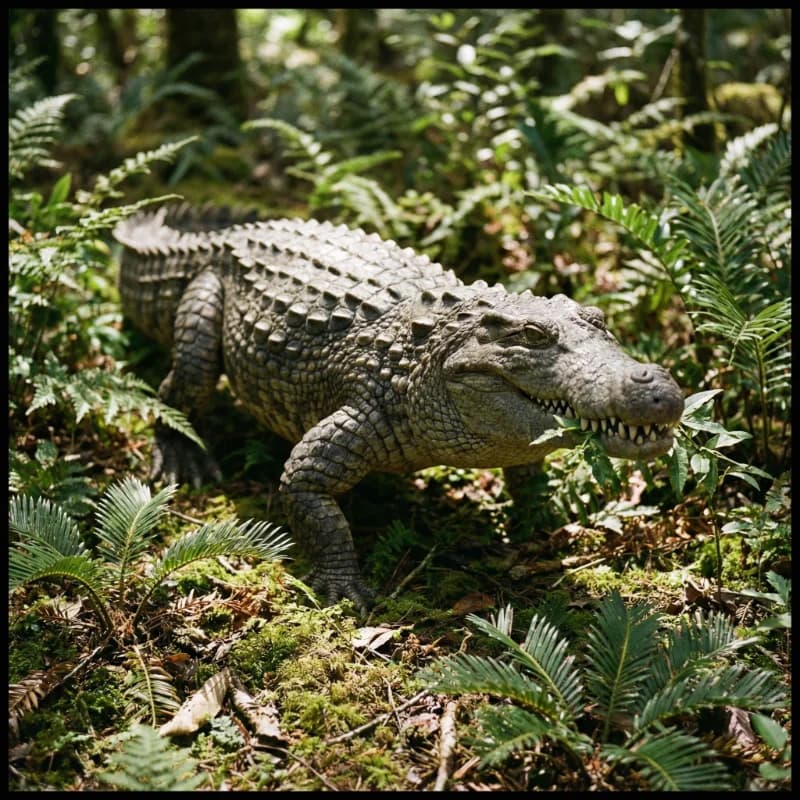
Simosuchus
Simosuchus clarki

Microraptor
Microraptor zhaoianus