Nyctosaurus
Cretaceous Period Piscivore Creature Type
Nyctosaurus gracilis
Scientific Name: "Nyctosaurus: from Greek nyx (night) + sauros (lizard) = 'night lizard'; gracilis: Latin for 'slender'"
Local Name: Nyctosaurus
Physical Characteristics
Discovery
Habitat
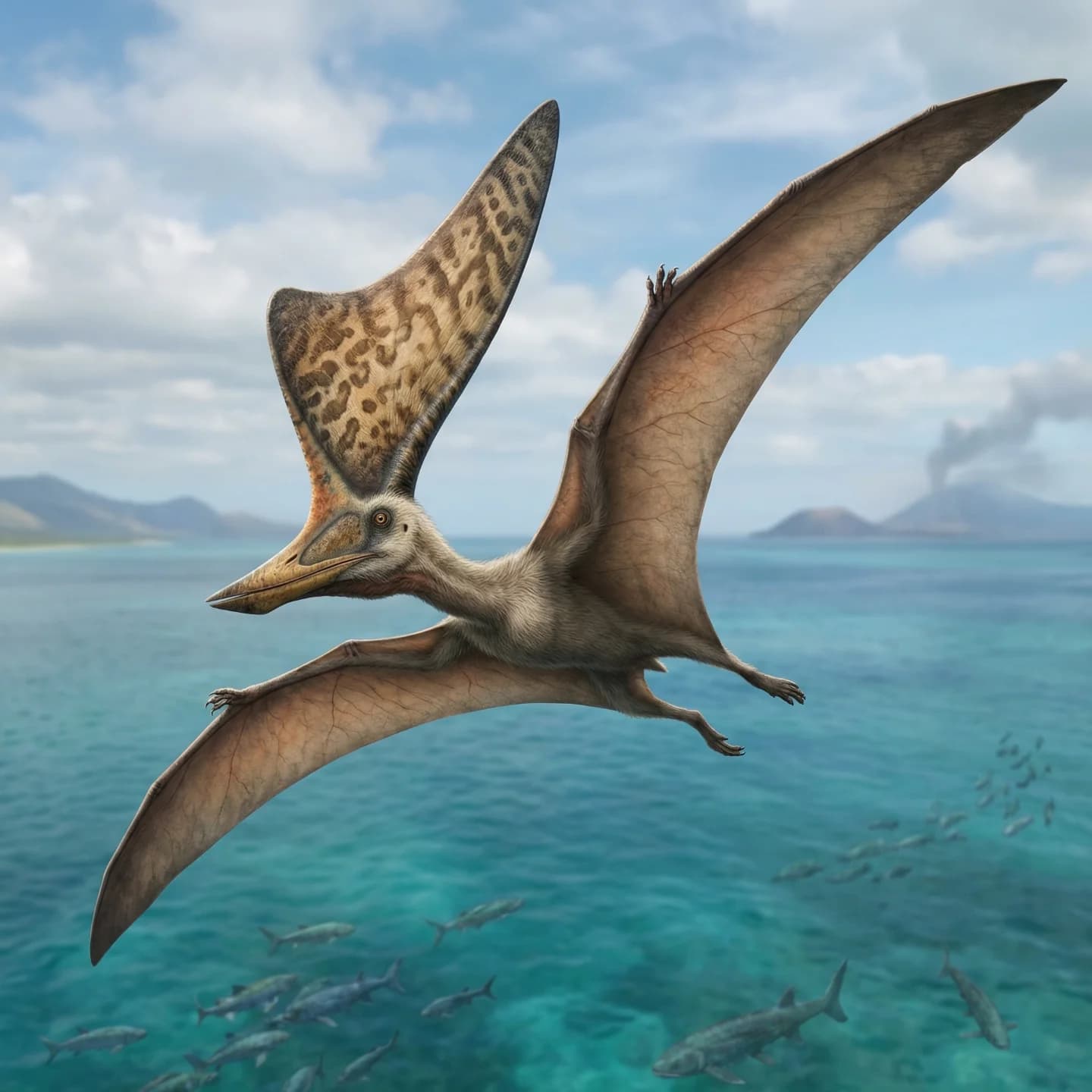
Nyctosaurus gracilis Marsh, 1876 is a nyctosaurid pterosaur from the Late Cretaceous (late Santonian to early Campanian, approximately 85–84.5 Ma) of the Smoky Hill Chalk Member, Niobrara Formation, in western Kansas, United States. The genus name derives from the Greek nyx (night) and sauros (lizard), meaning "night lizard," while the specific epithet gracilis is Latin for "slender." Othniel Charles Marsh first described the holotype specimen YPM 1178 in 1876 as Pteranodon gracilis, then erected the new genus Nyctosaurus later that same year based on differences in the scapulocoracoid articulation (Marsh, 1876a, 1876b). With an estimated adult wingspan of approximately 2–2.9 m, body length of about 37.6 cm, and mass of roughly 1.86 kg (Chatterjee & Templin, 2004; Wellnhofer, 1991), Nyctosaurus was considerably smaller than its contemporary relative Pteranodon (wingspan 5–7 m) but shares many convergent features related to marine soaring flight.
Two features make Nyctosaurus extraordinary among all pterosaurs. First, at least some mature adults bore an enormous antler-like cranial crest composed of two diverging bony spars — one projecting upward (at least 42 cm long) and one backward (at least 32 cm long) — that together exceeded the total body length by a factor of three (Bennett, 2003). Second, Nyctosaurus is the only known pterosaur to have completely lost its non-wing fingers (digits I–III) and their claws, a condition that would have severely impaired terrestrial locomotion and suggests a nearly entirely aerial lifestyle (Witton, 2013). It is essential to note that Nyctosaurus was not a dinosaur: pterosaurs constitute a separate lineage of flying reptiles within Archosauria, distinct from the dinosaurian clade.
All confirmed Nyctosaurus fossils come from a narrow stratigraphic interval within the Smoky Hill Chalk, characterized by the abundance of the ammonite Spinaptychus sternbergi (Carpenter, 2003). These chalk deposits were laid down in the open waters of the Western Interior Seaway during a marine regression event between approximately 85 and 84.5 Ma. This restricted temporal range indicates that Nyctosaurus was a comparatively short-lived genus, in stark contrast to Pteranodon, which persisted across nearly 7.5 million years (approximately 88–80.5 Ma).
Overview
Name and Etymology
The generic name Nyctosaurus combines Greek nyx (νύξ, "night") and sauros (σαῦρος, "lizard"), yielding "night lizard." The reason Marsh chose this name remains unclear, as there is no evidence linking the animal to nocturnal habits. The specific epithet gracilis is Latin for "slender," referring to the animal's delicate skeletal proportions. Marsh initially described the holotype as Pteranodon gracilis in June 1876 (Marsh, 1876a) but later that year separated it into the distinct genus Nyctosaurus, based on the non-fused scapula and coracoid (Marsh, 1876b). In 1881, Marsh mistakenly believed the name Nyctosaurus was preoccupied and renamed it Nyctodactylus, which is now treated as an unnecessary junior synonym (Marsh, 1881).
Taxonomic Status and Valid Species
Two species are currently recognized within Nyctosaurus: the type species N. gracilis Marsh, 1876, and N. nanus (Marsh, 1881). The latter was originally described as Pteranodon nanus and transferred to Nyctosaurus by Schoch (1984), though its validity remains subject to further study (Bennett, 2003). A third species, "N." lamegoi Price, 1953, based on a partial humerus (DGM 238-R) from Brazil with an estimated wingspan of approximately 4 m, is now generally considered to belong to a different genus, possibly Simurghia (Pêgas, 2024). The species N. bonneri (Miller, 1972), based on specimen FHSM VP-2148, is currently treated as a junior synonym of N. gracilis (Bennett, 2003).
Key Significance
Nyctosaurus is the only pterosaur known to have completely lost its non-wing digits, and it possessed one of the most extreme cranial ornaments relative to body size of any flying vertebrate — features that make it a critical taxon for understanding the limits of aerial adaptation and the role of sexual or social display in pterosaur evolution.
Stratigraphy, Age, and Depositional Environment
Temporal Range
The confirmed temporal range of Nyctosaurus is extremely narrow: late Santonian to earliest Campanian, approximately 85–84.5 Ma. This dating is based on the restriction of all Nyctosaurus specimens to a specific biostratigraphic zone within the Smoky Hill Chalk, defined by the abundance of the ammonite Spinaptychus sternbergi (Carpenter, 2003). The brevity of this range contrasts sharply with Pteranodon, which spans nearly the entire Niobrara Formation and extends into the overlying Pierre Shale (approximately 88–80.5 Ma).
Formation and Lithology
All confirmed Nyctosaurus specimens originate from the Smoky Hill Chalk Member of the Niobrara Formation in western Kansas. The Smoky Hill Chalk is composed predominantly of fine-grained calcium carbonate (chalk and chalky limestone) deposited in the open waters of the Western Interior Seaway during the Upper Cretaceous (Coniacian–Campanian, approximately 87–82 Ma). The lithology consists of alternating layers of chalk and marly chalk, with minor shale interbeds.
Paleoenvironment
During the late Santonian, the site of fossil deposition lay approximately at paleolatitude 40.5°N in the central portion of the Western Interior Seaway, a vast epicontinental sea that divided North America from north to south. The climate was warm subtropical to warm temperate, with nutrient-rich marine waters supporting an exceptionally diverse vertebrate fauna. The depositional environment was offshore marine, far from any shoreline, consistent with the interpretation of Nyctosaurus as a pelagic or semi-pelagic flyer that rarely came to land (Carpenter, 2003).
Specimens and Diagnostic Characters
Key Specimens
| Specimen | Repository | Preserved Elements | Notes |
|---|---|---|---|
| YPM 1178 | Yale Peabody Museum | Partial postcranial skeleton (scapulae, cervical and dorsal vertebrae) | Holotype; Marsh, 1876 |
| FMNH P 25026 | Field Museum of Natural History | Nearly complete skeleton with skull | Immature; no crest; described by Williston 1902–1903 |
| UNSM 93000 | University of Nebraska State Museum | Most complete skeleton known | Brown, 1978 |
| FHSM VP-2148 | Fort Hays State University | Skeleton with crushed skull | Discovered by Sternberg, 1962; originally named N. bonneri (now synonym of N. gracilis) |
| CM 11422 | Carnegie Museum of Natural History | Postcranial skeleton + crushed skull | Crest presence uncertain due to crushing |
| KJ1 | Private collection (Texas) | Partial skeleton with complete crest | Bennett, 2003; first confirmed giant crest |
| KJ2 | Smithsonian (donated 2024) | Partial skeleton with complete crest | Bennett, 2003; donated to NMNH in 2024 |
Diagnostic Characters (Autapomorphies)
Nyctosaurus is distinguished from all other pterosaurs by the following combination of features (Bennett, 2003; Witton, 2013): (1) scapula and coracoid unfused (unlike the fused scapulocoracoid of Pteranodon); (2) wing finger composed of only three phalanges rather than the four typical of other pterodactyloids; (3) complete loss of non-wing digits (digits I–III) and their claws; (4) hatchet-shaped deltopectoral crest of the humerus; (5) pteroid with a nearly straight articular head. Additionally, the upper arm and forearm tendons were mineralized, a feature shared only with the related Muzquizopteryx within Nyctosauridae.
Limitations of the Fossil Record
Approximately 10–15 individual Nyctosaurus specimens are currently known, most of them partial skeletons. Complete skulls are rare, and only two specimens (KJ1 and KJ2) preserve the giant crest. Whether the crestless specimens represent subadults, females, or a different species remains debated, though Bennett (2003) favored the subadult interpretation based on skeletal maturity indicators.
Morphology and Function
Body Size
According to Chatterjee & Templin (2004), an adult N. gracilis had an estimated body length of approximately 37.6 cm, wingspan of approximately 2.72 m, and mass of approximately 1.86 kg. Bennett (2003) cited adult wingspans of slightly over 2 m, while Wellnhofer (1991) estimated some specimens at up to approximately 2.9 m. By comparison, Pteranodon adults had wingspans of 5.6–7.25 m and masses estimated at 16–25 kg, making Nyctosaurus dramatically smaller.
Skull and Crest
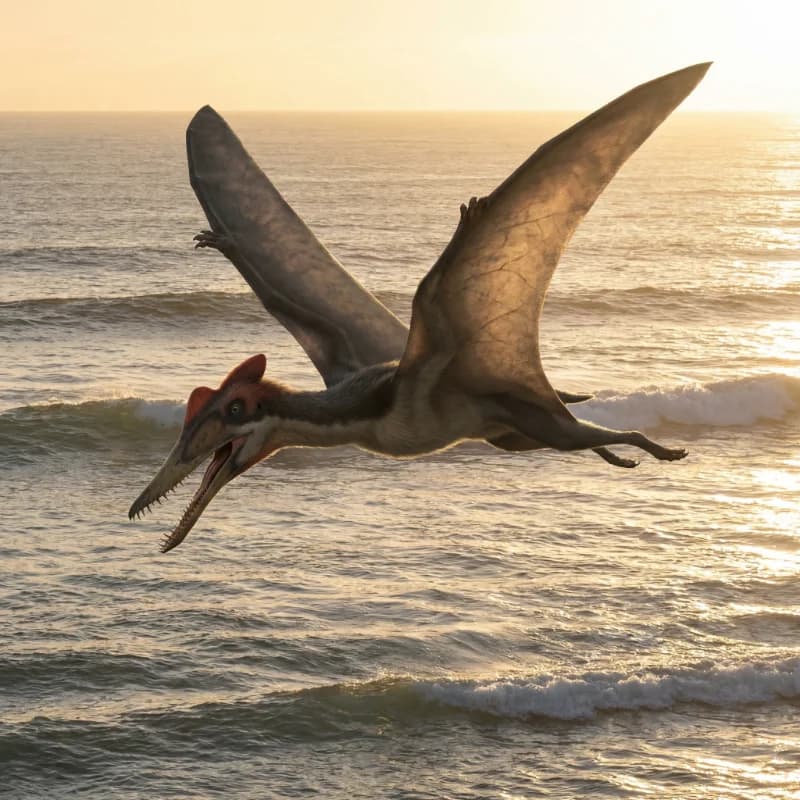
The most spectacular feature of Nyctosaurus is the antler-like cranial crest documented in specimens KJ1 and KJ2 (Bennett, 2003). The crest originates from the posterior dorsal surface of the skull and diverges into two elongate, grooved spars: one projecting upward (at least 42 cm) and one projecting posteriorly (at least 32 cm). Both spars were approximately as long as or longer than the total body length, making the crest over three times the skull length. The bone surfaces of the crest spars are smooth and rounded, lacking any rugosity or scarring that would indicate soft-tissue attachment. Bennett (2003) compared this condition to the jagged bone-to-soft-tissue transitions seen in crested tapejarids and concluded that the Nyctosaurus crest lacked a membranous "headsail," functioning instead as a display structure. Xing et al. (2009) conducted aerodynamic analyses showing that while a headsail would have provided some flight stability benefits, the bare bony crest alone imposed no significant aerodynamic penalty.
Jaws
The jaws of Nyctosaurus were long, narrow, and completely edentulous (toothless). The jaw tips were extremely thin and needle-sharp; they are frequently broken off in fossil specimens, giving the misleading impression that the upper and lower jaws were of different lengths, though in life they were probably equal (Bennett, 2003).
Wing Structure and Digit Loss
Nyctosaurus possessed long, narrow wings with a high aspect ratio and low wing loading, structurally analogous to those of modern albatrosses (Witton, 2013). The wing metacarpal was unusually elongate, measuring approximately 2.5 times the humerus length — a proportion seen elsewhere only in pteranodontids and azhdarchids. The wing finger occupied about 55% of total wing length. Most remarkably, the first through third metacarpals had lost contact with the carpus, and their corresponding digits had been entirely lost. This makes Nyctosaurus (and possibly other nyctosaurids) the only pterosaurs to have completely lost the non-wing clawed fingers (Witton, 2013; Bennett, 2003). Without claws, Nyctosaurus could not have gripped surfaces such as cliffs or tree trunks, strongly suggesting an almost exclusively aerial existence.
Hindlimbs
In contrast to its elongate forelimbs, Nyctosaurus had proportionally the shortest hindlimbs of any known pterosaur, at only approximately 16% of wing length (Witton, 2013). This extreme disproportion further supports the interpretation of a highly aerial lifestyle with minimal terrestrial capability.
Flight Mechanics
Chatterjee & Templin (2004) used complete specimens to estimate total wing area, body mass, and wing loading, and calculated a cruising speed of approximately 9.6 m/s (approximately 34.5 km/h or 21.4 mph) for N. gracilis. The high-aspect-ratio wing planform was well suited for dynamic soaring — the technique used by modern albatrosses to cover vast distances with minimal flapping by exploiting wind gradients over the ocean surface.
Diet and Ecology
Dietary Evidence
Nyctosaurus is interpreted as a piscivore (fish-eater) based on multiple lines of evidence: (1) its long, pointed, toothless jaws are morphologically suited to capturing fish; (2) all specimens occur exclusively in marine sediments; (3) abundant fish fossils (including Xiphactinus, Ichthyodectes, Gillicus, Enchodus, Pachyrhizodus, and Cimolichthys) co-occur in the same deposits; (4) the wing morphology closely resembles that of modern marine soaring birds that feed on fish (Witton, 2013). No direct stomach contents have yet been reported for Nyctosaurus.
Ecological Niche
Within the Western Interior Seaway ecosystem, Nyctosaurus occupied the niche of a small aerial marine predator. It coexisted with the much larger Pteranodon longiceps (wingspan approximately 5.6 m), and the substantial size difference between the two likely facilitated niche partitioning by prey size. The seaway teemed with marine reptiles — mosasaurs (Tylosaurus, Platecarpus, Clidastes, Ectenosaurus, Eonatator, Halisaurus), plesiosaurs (Dolichorhynchops, Polycotylus), and sea turtles (Toxochelys, Ctenochelys) — as well as the toothed bird Ichthyornis and the flightless diving bird Parahesperornis (Carpenter, 2003).
Life History and Growth
Nyctosaurus appears to have grown rapidly after hatching. Fully adult specimens are not substantially larger than some immature individuals (e.g., FMNH P 25026), suggesting that adult wingspan (2 m or more) was reached within the first year of life (Bennett, 2003). Subadult skulls preserved in nearly pristine condition show no trace of a crest, indicating that the giant crest began developing only after the first year. Bennett (2003) speculated that the crest may have continued to elaborate as the animal aged, and that the fully crested KJ1 and KJ2 specimens may have been 5–10 years old at death, though no histological age studies have yet been conducted on these individuals.
Distribution and Paleogeography
Geographic Range
All confirmed Nyctosaurus specimens come from western Kansas (primarily Gove County and surrounding areas) within the Smoky Hill Chalk Member of the Niobrara Formation. The Brazilian species "N." lamegoi (DGM 238-R, a partial humerus from Paraíba state) is now generally regarded as belonging to a separate genus, possibly Simurghia (Pêgas, 2024), restricting the confirmed distribution of Nyctosaurus sensu stricto to North America.
Paleogeographic Setting
Paleogeographic reconstructions place the Kansas fossil sites at approximately 40.5°N, -58.8°W during the late Santonian — far out in the open waters of the Western Interior Seaway, hundreds of kilometers from the nearest shoreline. This offshore setting is consistent with the interpretation that Nyctosaurus was a pelagic or semi-pelagic animal that spent the vast majority of its life over open water.
Phylogeny and Taxonomic Debates
Position of Nyctosauridae
In the phylogenetic analysis of Andres & Myers (2013), Nyctosaurus was placed within the family Nyctosauridae alongside Muzquizopteryx coahuilensis as its sister taxon. Nyctosauridae in turn formed a clade with Pteranodontidae within the larger group Pteranodontia. A more comprehensive analysis by Longrich et al. (2018) expanded Nyctosauridae to include Alamodactylus, Volgadraco, Cretornis, Alcione, Simurghia, Muzquizopteryx, and Barbaridactylus, with N. gracilis occupying the most derived position within the family.
Relationship to Pteranodon
Although historically treated as a species of Pteranodon (as P. gracilis and P. nanus), Nyctosaurus is now recognized as belonging to a separate family. Key distinguishing features include the unfused scapulocoracoid, the loss of non-wing digits, the three-phalanx wing finger (vs. four in Pteranodon), and the distinctive crest morphology. In most recent analyses, Pteranodontidae and Nyctosauridae are sister families within Pteranodontia, rather than one being ancestral to the other.
Species-Level Questions
Whether N. gracilis and N. nanus represent truly distinct species or merely ontogenetic or individual variation remains unresolved. Bennett (2003) noted that all then-known Nyctosaurus species were extremely similar and declined to assign the crested KJ1/KJ2 specimens to a specific species pending further comparative study. Schoch (1984) had suggested that N. nanus might be better placed in Pteranodon, but subsequent workers have generally retained it in Nyctosaurus.
Restoration and Uncertainties
Established Facts
The following are confirmed by direct fossil evidence: (1) edentulous pterosaur restricted to the Smoky Hill Chalk of the Niobrara Formation; (2) complete loss of non-wing fingers and claws (unique among all pterosaurs); (3) three-phalanx wing finger construction; (4) presence of a massive bifurcating cranial crest in at least some mature adults; (5) unfused scapula and coracoid.
Well-Supported Interpretations
The following are strongly supported by evidence but remain indirect: (1) piscivorous diet (marine depositional context + jaw morphology); (2) albatross-like dynamic soaring flight (wing morphology); (3) display function of the crest (comparative anatomy; Bennett, 2003); (4) near-exclusive aerial lifestyle (digit and claw loss).
Hypothetical or Speculative
The following remain at the hypothesis or speculation level: (1) the headsail hypothesis (membrane stretched between crest spars) — rejected by Bennett (2003) based on bone surface texture, though aerodynamically plausible per Xing et al. (2009); (2) precise cruising speed (approximately 34.5 km/h) — model-dependent estimate; (3) growth rate and lifespan (adult size in under one year, crest maturation at 5–10 years) — inferred indirectly without histological confirmation.
Popular Media vs. Science
Nyctosaurus is best known to the general public through its appearance as the villain "Thunderclap" in the Pixar film The Good Dinosaur (2015). The cinematic depiction differs substantially from paleontological reconstructions: the real animal was much smaller (wingspan approximately 2–3 m), lacked feathers (pterosaurs had patagia and possibly pycnofibers, not feathers), and almost certainly could not have walked on the ground with the ease shown in the film.
Comparison with Related and Contemporary Taxa
| Taxon | Family | Wingspan | Age | Locality | Key Features |
|---|---|---|---|---|---|
| Nyctosaurus gracilis | Nyctosauridae | ~2–2.9 m | Late Santonian (~85 Ma) | Kansas, Niobrara Fm. | Giant bifurcating crest; complete digit loss |
| Pteranodon longiceps | Pteranodontidae | ~5.6 m | Santonian–Campanian (~86–80.5 Ma) | Kansas, Niobrara Fm. | Posterior crest; large body size |
| Muzquizopteryx coahuilensis | Nyctosauridae | ~2 m | Turonian–Coniacian (~89 Ma) | Coahuila, Mexico | Sister taxon to Nyctosaurus |
| Barbaridactylus grandis | Nyctosauridae | ~3–5 m | Maastrichtian (~67 Ma) | Morocco | Large-bodied nyctosaurid |
| Alcione elainus | Nyctosauridae | ~1.5 m | Maastrichtian (~67 Ma) | Morocco | Small-bodied nyctosaurid |
Nyctosaurus coexisted with Pteranodon longiceps in the same formation but was dramatically smaller. Within Nyctosauridae, it is the best-known genus, and the family as a whole persisted until the end-Cretaceous mass extinction, as demonstrated by Maastrichtian-age nyctosaurids from Morocco (Longrich et al., 2018).
Fun Facts
FAQ
📚References
- Marsh, O. C. (1876a). Notice of a new sub-order of Pterosauria. American Journal of Science, Series 3, 11(3): 507–509.
- Marsh, O. C. (1876b). Principal characters of American pterodactyls. American Journal of Science, Series 3, 12: 479–480.
- Marsh, O. C. (1881). Note on American pterodactyls. American Journal of Science, Series 3, 21: 342–343.
- Williston, S. W. (1903). On the osteology of Nyctosaurus (Nyctodactylus), with notes on American pterosaurs. Field Columbian Museum Publication (Geological Series), 2(3): 125–163.
- Bennett, S. C. (2003). New crested specimens of the Late Cretaceous pterosaur Nyctosaurus. Paläontologische Zeitschrift, 77: 61–75. doi:10.1007/BF03004560
- Carpenter, K. (2003). Vertebrate Biostratigraphy of the Smoky Hill Chalk (Niobrara Formation) and the Sharon Springs Member (Pierre Shale). High-Resolution Approaches in Stratigraphic Paleontology, 21: 421–437. doi:10.1007/978-1-4020-9053-0
- Chatterjee, S. & Templin, R. J. (2004). Posture, Locomotion, and Paleoecology of Pterosaurs. Geological Society of America Special Paper 376, 64 pp. ISBN 978-0-8137-2376-1
- Schoch, R. M. (1984). Notes on the type specimens of Pteranodon and Nyctosaurus (Pterosauria, Pteranodontidae) in the Yale Peabody Museum Collections. Postilla, 194: 1–23.
- Xing, L., Wu, J., Lu, Y., Lu, J. & Ji, Q. (2009). Aerodynamic characteristics of the crest with membrane attachment on Cretaceous pterodactyloid Nyctosaurus. Acta Geologica Sinica, 83(1): 25–32. doi:10.1111/j.1755-6724.2009.00003.x
- Witton, M. P. (2013). Pterosaurs: Natural History, Evolution, Anatomy. Princeton University Press. ISBN 978-0-691-15061-1
- Andres, B. & Myers, T. S. (2013). Lone Star Pterosaurs. Earth and Environmental Science Transactions of the Royal Society of Edinburgh, 103(3–4): 383–398. doi:10.1017/S1755691013000303
- Longrich, N. R., Martill, D. M., Andres, B. & Penny, D. (2018). Late Maastrichtian pterosaurs from North Africa and mass extinction of Pterosauria at the Cretaceous-Paleogene boundary. PLOS Biology, 16(3): e2001663. doi:10.1371/journal.pbio.2001663
- Price, L. I. (1953). A presença de Pterosauria no Cretáceo Superior do Estado da Paraíba. Notas Preliminares e Estudos, Divisão de Geologia e Mineralogia, Brasil, 71: 1–10.
- Carpenter, K., Dilkes, D. W. & Weishampel, D. B. (1995). The dinosaurs of the Niobrara Chalk Formation (Upper Cretaceous, Kansas). Journal of Vertebrate Paleontology, 15(2): 275–297.
- Brown, G. W. (1978). Preliminary report on an articulated specimen of Pteranodon (Nyctosaurus) gracilis. Proceedings of the Nebraska Academy of Science, 88: 39.
- Pêgas, R. V. (2024). A taxonomic note on the tapejarid pterosaurs from the Pterosaur Graveyard site (Caiuá Group, ?Early Cretaceous of Southern Brazil): evidence for the presence of two species. Historical Biology, 1–22. doi:10.1080/08912963.2024.2355664
- Frey, E., Elgin, R. A., Stinnesbeck, W., Padilla-Gutiérrez, J. M., Ifrim, C., Giersch, S. & González-González, A. H. (2012). A new specimen of nyctosaurid pterosaur, cf. Muzquizopteryx sp. from the Late Cretaceous of northeast Mexico. Revista Mexicana de Ciencias Geológicas, 29(1): 131–139.
- Wellnhofer, P. (1991). The Illustrated Encyclopedia of Pterosaurs. Crescent Books, New York.
Gallery
5 images Nyctosaurus
Nyctosaurus · Cretaceous Period · Piscivore
 Nyctosaurus
Nyctosaurus · Cretaceous Period · Piscivore
 Nyctosaurus
Nyctosaurus · Cretaceous Period · Piscivore
 Nyctosaurus
Nyctosaurus · Cretaceous Period · Piscivore
 Nyctosaurus
Nyctosaurus · Cretaceous Period · Piscivore
🔗Related Creatures
Guidraco
Guidraco venator
Coloborhynchus
Coloborhynchus clavirostris
Anhanguera
Anhanguera blittersdorffi
Ferrodraco
Ferrodraco lentoni
Ornithocheirus
Ornithocheirus simus
Tropeognathus
Tropeognathus mesembrinus
Cearadactylus
Cearadactylus atrox

Pteranodon
Pteranodon