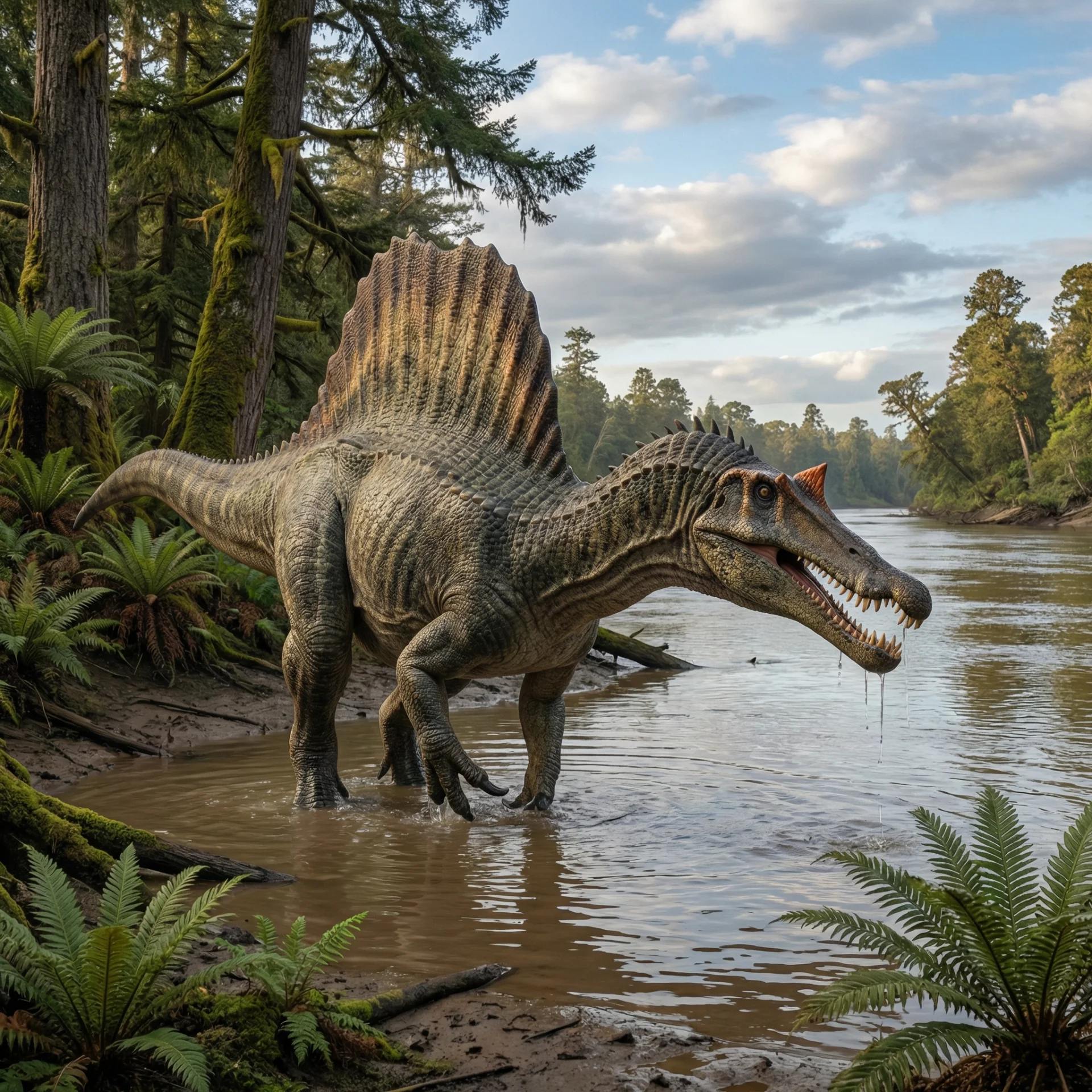
Spinosaurus mirabilis
Spinosaurus mirabilis
⏳ Cretaceous Period🍽️ PiscivoreDinosaurs
Physical Characteristics
⏳
PeriodCretaceous Period
🍽️
DietPiscivore
📏
Size10~14m
⚖️
Weight5000~7000kg
Classification
GEN
GenusSpinosaurus
SP
SpeciesS. mirabilis
Spinosaurus mirabilis
Spinosaurus mirabilis (Sereno et al., 2026) is a large spinosaurid theropod dinosaur from the Late Cretaceous (Cenomanian, approximately 95 million years ago) Farak Formation of central Niger, in the Sahara Desert. Published on February 19, 2026, in the journal Science, this species represents only the second species assigned to the genus Spinosaurus since Ernst Stromer named Spinosaurus aegyptiacus in 1915 — a gap of 111 years — making it one of the most significant dinosaur discoveries in recent memory.
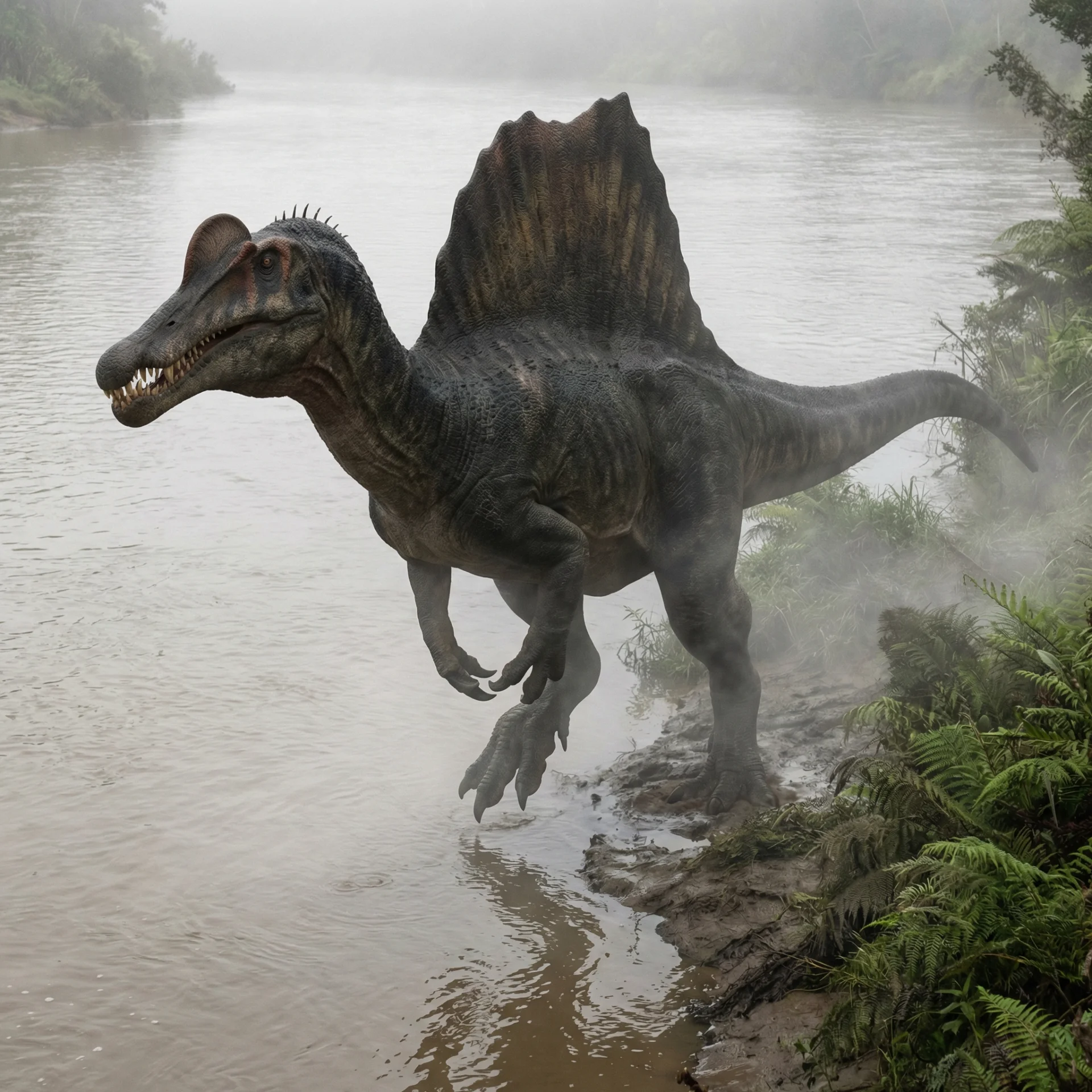
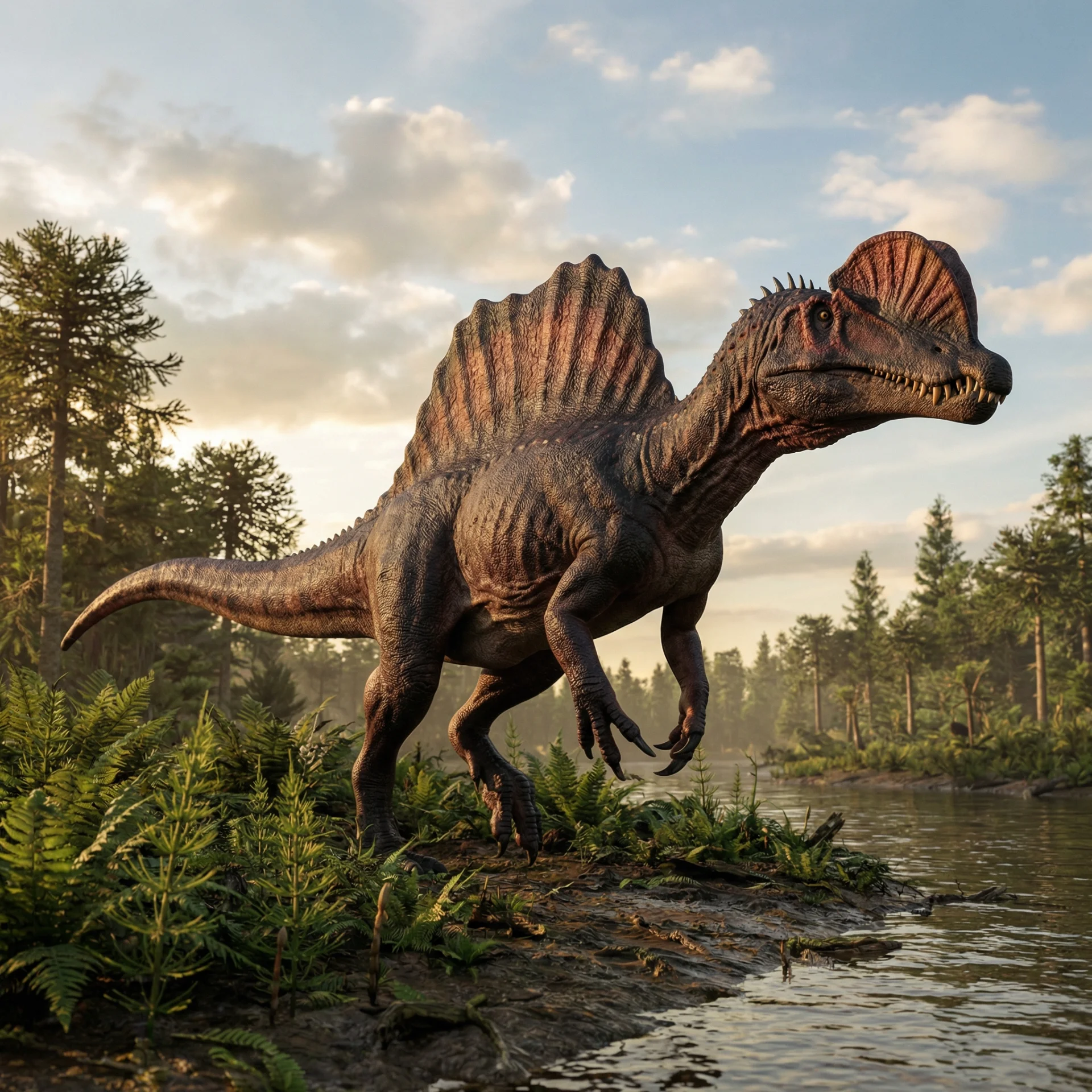
The most striking feature of S. mirabilis is an enormous scimitar-shaped bony crest on top of the skull, formed by the fused nasal and prefrontal bones. Rising approximately 50 cm (20 inches) above the skull in bone alone, and likely extended even further by a keratinous sheath in life, this crest is the tallest known in any non-avian dinosaur. Surface textures and internal vascular canals suggest it was brightly colored in life and functioned primarily as a visual display structure for sexual selection, territorial competition, or species recognition. Lead author Paul Sereno of the University of Chicago described the animal as a "hell heron" — a massive wading predator that stalked shallow inland rivers for large fish.
The holotype specimen (MNBH JEN1) belongs to a subadult individual estimated at roughly 8 m in total body length. Because all known specimens are immature, adult size remains uncertain. New Scientist reported adult estimates of approximately 10–14 m, while Reuters cited a figure of roughly 12 m (40 ft) and 5–7 tonnes, though the original paper explicitly declined to fix an adult size. Crucially, the fossils were recovered from fluvial sediments approximately 500–1,000 km inland from the nearest Cretaceous marine shoreline, providing powerful evidence against the hypothesis that Spinosaurus was a fully aquatic, open-water pursuit predator, and instead supporting a semi-aquatic, shallow-water ambush model.
The genus name Spinosaurus derives from the Latin spina ("spine, thorn") and the Greek sauros ("lizard"), meaning "spine lizard" — a reference to the dramatically elongated neural spines forming the dorsal sail. The specific epithet mirabilis is Latin for "astonishing" or "wondrous," chosen in allusion to the remarkably enlarged nasal-prefrontal crest that distinguishes this species (Sereno et al., 2026). The research team also gave it the informal nickname "hell heron," reflecting the ecological interpretation that it hunted large fish from shallow river margins in the manner of a modern heron, albeit at a vastly greater scale.
S. mirabilis is currently a valid species placed within Spinosauridae > Spinosaurinae > Spinosaurini > Spinosaurus. In the Bayesian phylogenetic analysis published by Sereno et al. (2026), S. mirabilis was consistently recovered as the sister taxon to S. aegyptiacus, supporting their assignment to the same genus. The genus Spinosaurus now comprises two species: S. aegyptiacus (Egypt, Morocco) and S. mirabilis (Niger).
A large semi-aquatic piscivorous theropod from inland Late Cretaceous river systems of central North Africa, distinguished by the tallest cranial crest known in any non-avian dinosaur.
S. mirabilis dates to the Cenomanian stage of the Late Cretaceous, within an interval of approximately 100–95 Ma. The Farak Formation is assigned an Early Cenomanian age of roughly 100.2–97.2 Ma (LeBlanc, 2022). The describing paper summarizes the age as approximately 95 Ma.
The Farak Formation lies within the Iullemmeden Basin of Niger and sits stratigraphically above the Echkar Formation within the Tégama Group. It represents a transitional sequence between the continental deposits of the underlying Tégama Group and the marine deposits of the Cenomanian–Turonian. Its lithology comprises a shaly sequence with kaolin-cemented sandstone intercalations: fine-grained sandstone and massive clays interbedded with coarse sandstone lenses, grey-greenish shales, fine-grained white micaceous sandstones, and argillaceous mottled sandstones, reaching a total thickness of approximately 190 m (Faure, 1962; Greigert, 1966; LeBlanc, 2022). The uppermost portion contains lacustrine limestones that have yielded fish, crocodylomorph, and dinosaur fossils.
The depositional setting of the Farak Formation is interpreted as continental to transitional continental-marine. The S. mirabilis fossil localities at Jenguebi are specifically fluvial (river) deposits, situated approximately 500–1,000 km from the nearest Cenomanian marine shoreline. Co-occurring fossils include partial skeletons of rebbachisaurid and titanosaurian sauropods, all buried in river sediments, indicating a forested inland habitat dissected by rivers (Sereno et al., 2026). Freshwater bivalves (Unio, Cyrena) from the upper Farak Formation further support a continental fluvial-lacustrine paleoenvironment.
The holotype is MNBH JEN1 (Musée National Boubou Hama, Niamey, Niger), comprising a fragmentary skull: right premaxilla, both maxillae, fused nasal crest, part of the right dentary, and five maxillary teeth. It was collected from the Jenguebi locality (Sirig Taghat, Agadez Region, Niger) from fluvial sandstones of the Farak Formation during the 2019 and 2022 expeditions.
Additional specimens include:
| Specimen | Locality | Key Elements |
|---|---|---|
| MNBH JEN1 (holotype) | Jenguebi | Right premaxilla, both maxillae, nasal crest, part of right dentary, 5 maxillary teeth |
| MNBH JEN2 | Jenguebi | Partial left maxilla, nasal crest, cervical and dorsal vertebrae fragments, partial left ischium and femur |
| MNBH JEN3–9 | Jenguebi | Left maxilla, isolated teeth, nasal crest, right dentary, dorsal and caudal vertebrae, chevron, left tibia, pedal phalanges |
| MNBH IGU11, 25, 38–40 | Iguidi | Isolated tooth crowns, dorsal vertebrae fragments, caudal vertebra, pedal phalanx |
Specimen MNBH IGU11, an anterior dorsal centrum originally collected in 2000, was initially identified as a mid-cervical centrum of Carcharodontosaurus iguidensis (Brusatte & Sereno, 2007), then reinterpreted as Sigilmassasaurus (Evers et al., 2015) or Spinosaurus sp. (Sereno et al., 2022), before its definitive referral to S. mirabilis in 2026. The Iguidi material is temporarily on loan to Sereno's Fossil Lab at the University of Chicago, while all other specimens including the holotype are held at Abdou Moumouni University in Niger.
The following autapomorphies distinguish S. mirabilis from all other spinosaurids (Sereno et al., 2026):
All known specimens are subadult or immature individuals, so the full adult morphology and size remain uncertain. Postcranial material is fragmentary; while elongated neural spines of the dorsal vertebrae imply the presence of a trunk sail, its precise shape is unknown.
The holotype (MNBH JEN1) is a subadult estimated at approximately 8 m total body length. This is roughly 15% smaller than FSAC-KK-11888, the proposed neotype of S. aegyptiacus (also a subadult), and about 61% the size of MSMN V4047 (a partial snout), one of the largest known S. aegyptiacus specimens (Sereno et al., 2026). Adult size estimates for S. mirabilis vary: New Scientist reported approximately 10–14 m, Reuters cited roughly 12 m (40 ft) and 5–7 tonnes, and Smithsonian Magazine reported 4,500–6,350 kg (10,000–14,000 lbs). However, the original paper explicitly did not fix an adult size estimate because all specimens are immature.
The defining feature of S. mirabilis is the scimitar-shaped midline cranial crest, formed by fusion of the nasal and prefrontal bones. This crest curves posterodorsally (upward and rearward) and reaches approximately 50 cm (20 inches) in bony height alone. Its surface is covered with longitudinal and crisscrossing striations and grooves, while internally it contains a dense network of vascular canals. These features closely parallel the condition seen in extant birds with bony casques — such as the cassowary (Casuarius), helmeted guinea fowl (Numida meleagris), and maleo (Macrocephalon maleo) — in which the bony core is encased in a keratinous sheath that significantly extends the structure's total height and may have been vividly colored (Sereno et al., 2026). The crest was almost certainly a display structure, functioning in sexual selection, territorial competition, and species recognition. It appears too fragile to have served as a weapon, despite being composed of solid bone without the pneumatic air sacs found in some other dinosaur crests.
The snout is elongated and narrow, resembling that of a crocodilian, but differs from S. aegyptiacus in the more arched premaxillary tip and lower overall snout profile with parallel dorsal and ventral margins. The upper and lower tooth rows exhibit interdigitation: the lower jaw teeth protrude outward and between the upper teeth during occlusion, forming a "fish trap" optimally designed for piercing and retaining slippery prey. The teeth are large, conical, and lack serrations — classic adaptations for piscivory shared convergently with ichthyosaurs, crocodilians, and pterosaurs (Vidal in Sereno et al., 2026). A diastema (gap) in the upper jaw accommodates three large lower jaw teeth.
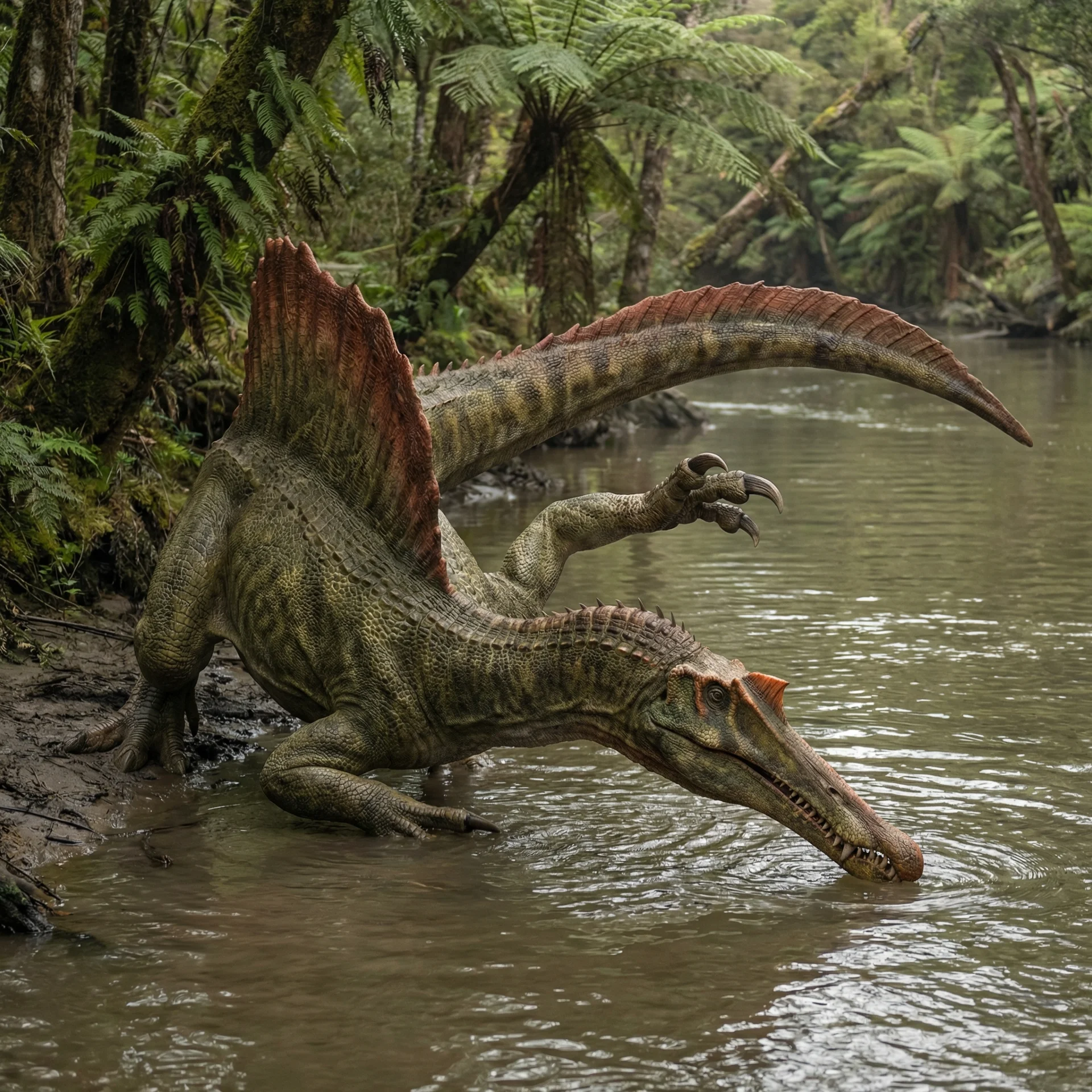
The external nostrils are positioned further back on the snout than usual, enabling the animal to submerge most of its snout underwater while breathing normally — a key adaptation for a stalking ambush predator that needed to wait motionless for fish.
Specimen MNBH JEN4, which preserves a dentary and tibia, allows direct comparison of hindlimb proportions. The tibia-to-dentary length ratio suggests that the hindlimbs of S. mirabilis may have been proportionally slightly longer than those of S. aegyptiacus (Sereno et al., 2026). The morphology of preserved dorsal vertebrae implies the presence of a trunk sail formed by greatly elongated neural spines, though the sail's precise height and shape remain unknown due to the fragmentary nature of the postcranial material.
S. mirabilis exhibits some of the most extreme piscivorous adaptations of any dinosaur (Vidal in Sereno et al., 2026). Unserated large conical teeth, interdigitating upper and lower tooth rows, a long crocodilian-like snout, and retracted nostrils all point to a specialized fish-eating ecology. Co-occurring fish fauna include the large coelacanth Mawsonia, which was depicted as prey in the paleoart reconstruction accompanying the Science cover.
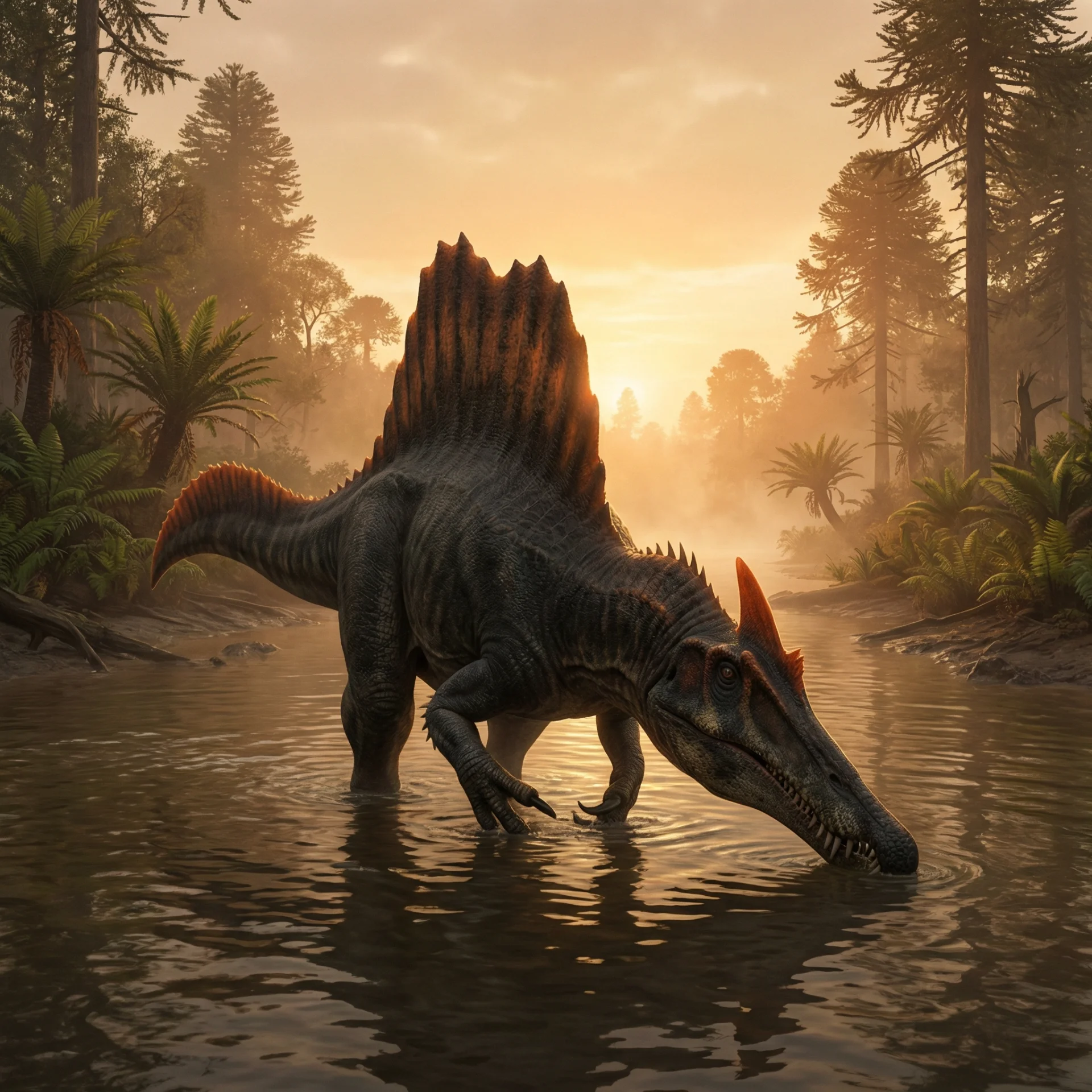
Sereno et al. (2026) described S. mirabilis as a "hell heron" — a massive wading predator that "had no problem wading on its sturdy legs into two meters of water but probably spent most of its time stalking shallower traps for the many large fish of the day." This interpretation directly challenges the "fully aquatic pursuit predator" hypothesis advanced by Ibrahim et al. (2020), which was based on the elongated tail neural spines and chevrons of S. aegyptiacus. The key counter-evidence includes: (1) the inland fluvial setting of the S. mirabilis fossils, 500–1,000 km from any marine shoreline; (2) bone density and tail morphology arguments against effective aquatic propulsion (Sereno et al., 2022); and (3) the general body plan being ill-suited for open-water swimming. Baumgart (UF Health, 2026) noted that both whales and plesiosaurs underwent complete anatomical transformation for aquatic life (developing flippers and streamlined bodies), whereas Spinosaurus retained a fundamentally terrestrial body plan.
However, the debate is not entirely settled. Fabbri et al. (2022) published bone density data suggesting subaqueous foraging capability, and Matt Lamanna (Carnegie Museum of Natural History) proposed that the truth may lie in a middle ground: "What if it's doing both? What if it's wading sometimes? What if it's getting into the water and swimming around some?" (Smithsonian Magazine, 2026).
The Farak Formation has yielded a diverse vertebrate assemblage alongside S. mirabilis:
| Taxon | Type | Notes |
|---|---|---|
| Carcharodontosaurus iguidensis | Large theropod | Carcharodontosaurid apex predator |
| Rebbachisaurus tamesnensis | Sauropod | Rebbachisaurid diplodocoid |
| Aegyptosaurus baharijensis | Sauropod | Titanosaurian |
| Bahariasaurus ingens | Theropod | Enigmatic large theropod |
| Fortignathus felixi | Crocodylomorph | Possible itasuchid |
| Mawsonia | Coelacanth fish | Large-bodied potential prey item |
S. mirabilis is known from two localities in central Niger, Agadez Region:
| Locality | Location | Key Specimens |
|---|---|---|
| Jenguebi (Sirig Taghat) | Central Sahara, Agadez Region | MNBH JEN1 (holotype) and JEN2–9 |
| Iguidi | Agadez Region | MNBH IGU11, 25, 38–40 |
Both localities expose outcrops of the Farak Formation and lie in the heart of the modern Sahara Desert.
During the Cenomanian (approximately 95 Ma), the Niger fossil sites lay near the equator at approximately 5°N paleolatitude. Africa was still in the process of separating from South America as the Atlantic Ocean widened. The region lay hundreds of kilometers inland from the southern Tethys Sea margin, in a warm, humid environment with extensive river systems and forests. The inland distribution of S. mirabilis demonstrates that spinosaurids were not restricted to coastal settings but also inhabited interior fluvial ecosystems.
Sereno et al. (2026) conducted a Bayesian phylogenetic analysis using an updated version of the character matrix from Sereno et al. (2022). The results are summarized as follows:
The paper identifies three evolutionary phases in spinosaurid evolution:
S. mirabilis represents the culmination of this third phase — one of the last-surviving and most derived spinosaurid species.
The ecology of Spinosaurus remains one of the most actively debated topics in dinosaur paleontology. Ibrahim et al. (2020) proposed an "aquatic pursuit predator" model based on the high neural spines and chevrons of the S. aegyptiacus tail. Sereno et al. (2022) countered with bone density and hydrodynamic arguments favoring a semi-aquatic wading model, a position strongly reinforced by the inland discovery of S. mirabilis. Fabbri et al. (2022) published bone compactness data suggesting subaqueous foraging capability. David Hone (Queen Mary University of London), who was not involved in the 2026 study, acknowledged the importance of the crest discovery and inland habitat confirmation but cautioned that "we need to discover better preserved specimens to find out more about these poorly known dinosaurs" (NHM, 2026).
Some media reports described S. mirabilis as having a "horn" on its head; more accurately, it possesses a midline cranial crest. Additionally, the widely reported adult size figures (12 m, 5–7 tonnes) derive from media estimates and general comparisons, not from the original paper, which explicitly did not fix adult dimensions given the immaturity of all known specimens.
| Taxon | Age | Locality | Estimated Length | Key Features |
|---|---|---|---|---|
| Spinosaurus mirabilis | Cenomanian (ca. 95 Ma) | Niger (Farak Fm.) | Subadult ca. 8 m; adult est. 10–14 m | Massive scimitar-shaped cranial crest; inland fluvial habitat |
| Spinosaurus aegyptiacus | Cenomanian (ca. 95–100 Ma) | Egypt, Morocco | ca. 12–15 m (adult) | Smaller cranial crest; coastal depositional settings; tail sail |
| Suchomimus tenerensis | Aptian (ca. 112 Ma) | Niger (Elrhaz Fm.) | ca. 9.5–11 m | Low cranial crest; elongated snout; large thumb claw |
| Baryonyx walkeri | Barremian (ca. 125 Ma) | England | ca. 7.5–10 m | Large thumb claw; stomach contents include juvenile Iguanodon and fish |
| Irritator challengeri | Albian (ca. 110 Ma) | Brazil | ca. 6–8 m | Sagittal crest; South American spinosaurine |
| Specimen | Locality | Elements | Notes |
|---|---|---|---|
| MNBH JEN1 | Jenguebi | Right premaxilla, both maxillae, nasal crest, partial right dentary, 5 maxillary teeth | Holotype |
| MNBH JEN2 | Jenguebi | Partial left maxilla, nasal crest, cervical and dorsal vertebrae fragments, partial left ischium and femur | Referred |
| MNBH JEN3–9 | Jenguebi | Left maxilla, isolated teeth, nasal crest, right dentary, dorsal and caudal vertebrae, chevron, left tibia, pedal phalanges | Multiple individuals |
| MNBH IGU11, 25, 38–40 | Iguidi | Isolated tooth crowns, dorsal vertebrae fragments, caudal vertebra, pedal phalanx | Collected 2000; originally referred to C. iguidensis |
| Category | Details |
|---|---|
| Formation | Farak Formation |
| Group | Tegama Group, Iullemmeden Basin |
| Age | Late Cretaceous, Cenomanian (ca. 100–95 Ma) |
| Lithology | Shales, fine- to coarse-grained sandstone (kaolin-cemented), micaceous sandstone, lacustrine limestone (upper portion) |
| Depositional Environment | Continental to transitional (fluvial); 500–1,000 km inland from the Cenomanian shoreline |
The cranial crest of Spinosaurus mirabilis is the tallest known in any non-avian dinosaur, reaching approximately 50 cm (20 inches) in bone alone and likely even taller when covered by its keratinous sheath.
The species name 'mirabilis' means 'astonishing' in Latin — a name inspired by the researchers' disbelief when they first pulled the crest from the sand and could not identify what it was.
It is only the second species ever assigned to the genus Spinosaurus, described 111 years after Ernst Stromer named S. aegyptiacus in 1915.
The Jenguebi fossil site's local Tuareg name, 'Sirig Taghat,' translates to 'no water, no goat' — a testament to the extreme desert conditions of the modern Sahara.
During the 2022 expedition, the research team assembled a 3D digital skull model of S. mirabilis on a laptop powered by solar panels in the middle of the Sahara Desert.
The interlocking (interdigitating) teeth of S. mirabilis form a 'fish trap' — the same adaptation evolved independently in ichthyosaurs, crocodilians, and pterosaurs.
The Farak Formation fossils were deposited 500–1,000 km from the nearest Cretaceous marine shoreline, strongly arguing against the idea that Spinosaurus was an open-ocean swimmer.
The trail leading to this discovery was a single sentence in a 1950s monograph by French geologist Hugues Faure, mentioning a scimitar-shaped tooth — a site no scientist had revisited in over 70 years.
The retracted nostrils of S. mirabilis allowed it to submerge most of its snout underwater while continuing to breathe normally — perfect for patiently waiting for fish to swim within striking range.
CT scanning revealed a dense network of blood vessels inside the crest, paralleling the condition in modern cassowaries, suggesting the crest may have been vividly colored in life.
Paul Sereno's team has excavated over 100 tonnes of fossils from the Sahara over 30 years, and is building the world's first zero-energy natural history museum — the Museum of the River — on an island in Niger's capital, Niamey.
The discovery graced the cover of Science magazine, featuring paleoart by Dani Navarro of Madrid depicting two S. mirabilis individuals sparring over a coelacanth carcass.
Fossils were collected during expeditions in 2019 and 2022 at the Jenguebi and Iguidi localities in central Niger's Sahara Desert, led by Paul Sereno of the University of Chicago. The species was formally described and published in the journal Science on February 19, 2026.
The holotype is a subadult estimated at approximately 8 m in total body length. Because all known specimens are immature, adult size is uncertain. New Scientist reported adult estimates of roughly 10–14 m, Reuters cited approximately 12 m (40 ft) and 5–7 tonnes, though the original paper explicitly declined to fix an adult size. It likely rivaled Tyrannosaurus rex in overall dimensions.
A massive scimitar-shaped bony crest formed by the fused nasal and prefrontal bones, reaching approximately 50 cm (20 inches) in bone alone. Surface textures and internal vascular canals indicate it was covered in a keratinous sheath in life, making it even taller. It is the tallest cranial crest known in any non-avian dinosaur and likely functioned as a visual display structure.
Lead author Paul Sereno coined this nickname because the animal's ecology resembles that of a modern heron — wading into shallow water to ambush large fish — but at a vastly larger and more formidable scale. The 'hell' modifier reflects its massive size and the harsh Cretaceous environment it inhabited.
S. mirabilis is distinguished by its much larger scimitar-shaped cranial crest, a more arched premaxillary tip, wider spacing of the rear maxillary teeth, proportionally slightly longer hindlimbs, and its inland fluvial habitat. S. aegyptiacus is known from coastal deposits in Egypt and Morocco and has a much smaller cranial crest.
This remains debated. Ibrahim et al. (2020) proposed a swimming pursuit predator model based on the tail sail of S. aegyptiacus, but Sereno et al. (2022, 2026) argue that bone density, limited tail propulsion, and the inland discovery of S. mirabilis support a semi-aquatic wading model instead. Some researchers suggest the truth may lie somewhere in between.
It was a specialized piscivore (fish-eater). Unserrated large conical teeth, interdigitating jaw structure forming a 'fish trap,' retracted nostrils, and a long crocodilian-like snout all point to fish-hunting specialization. The large coelacanth Mawsonia, found in the same deposits, is considered a likely prey item.
The paper interprets the crest as a visual display structure for sexual selection, territorial competition, and species recognition. Despite being solid bone, it appears too structurally fragile to have served as a weapon. Analogous keratinous-sheathed crests in living birds like the cassowary serve similar display functions.
With the description of S. mirabilis, the genus Spinosaurus now contains two valid species: S. aegyptiacus (Stromer, 1915) from Egypt and Morocco, and S. mirabilis (Sereno et al., 2026) from Niger. S. mirabilis is the first new species added to the genus in 111 years.
The trail began with a single sentence in a 1950s geological monograph mentioning a saber-shaped tooth in the Sahara. In 2019, Sereno's team was led to the remote Jenguebi site by a local Tuareg guide on a motorbike. They found the first crest fragment and jaw bones. A larger 20-person team returned in 2022 and recovered two additional crests and numerous other fossils, confirming the new species.
5images