Baryonyx
Cretaceous Period Piscivore Creature Type
Baryonyx walkeri
Scientific Name: "βαρύς (barys, 'heavy') + ὄνυξ (onyx, 'claw') = 'heavy claw'; the specific name walkeri honours discoverer William J. Walker"
Local Name: Baryonyx
Physical Characteristics
Discovery
Habitat

Baryonyx (Baryonyx walkeri Charig & Milner, 1986) is a large spinosaurid theropod dinosaur that lived during the early Barremian stage of the Early Cretaceous period (approximately 130–125 million years ago) in what is now southeastern England. The genus name derives from the Ancient Greek βαρύς (barys, 'heavy') and ὄνυξ (onyx, 'claw'), referring to the animal's enormous first-finger claw measuring about 31 cm along its curve. The specific name walkeri honours William J. Walker, the amateur fossil collector and plumber who first discovered the holotype specimen in January 1983 at the Smokejack Clay Pit near Ockley, Surrey. The dinosaur was formally named and described in a preliminary paper by palaeontologists Alan J. Charig and Angela C. Milner in 1986, with a comprehensive monograph following in 1997.
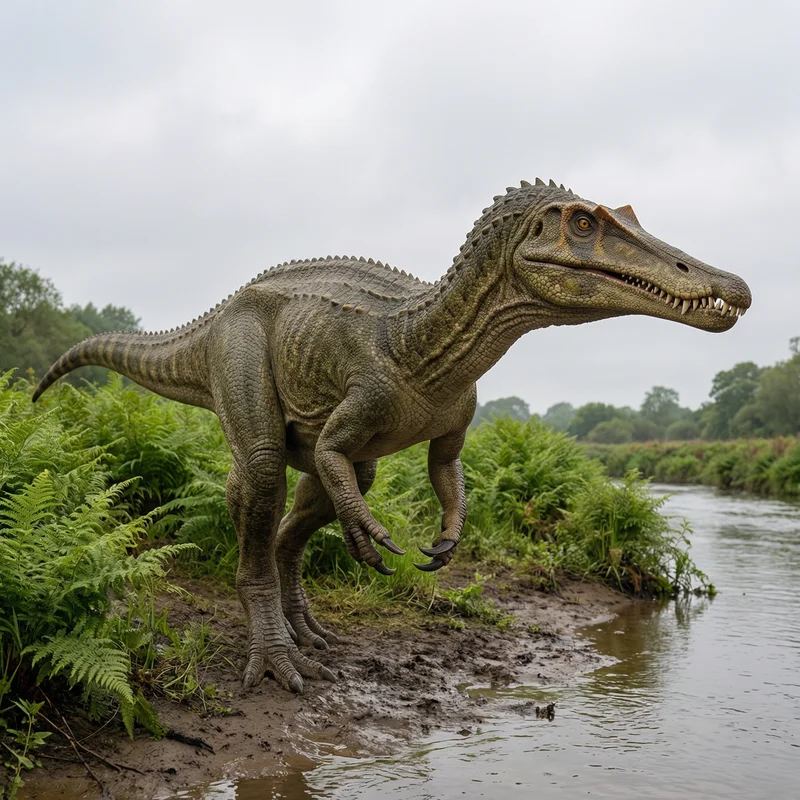
Baryonyx was the first theropod dinosaur for which piscivory (fish-eating) was directly demonstrated through stomach contents. The thoracic region of the holotype preserved acid-etched scales and teeth of the fish Scheenstia mantelli (then classified as Lepidotes), as well as bones of a juvenile iguanodontid, providing direct evidence that Baryonyx fed primarily on fish while also opportunistically consuming terrestrial animals (Charig & Milner, 1997). Its long, low, gharial-like snout, approximately 96 finely serrated conical teeth, robust forelimbs, and massive thumb claws are interpreted as specialised adaptations for catching fish.
The holotype specimen (NHMUK PV R9951) preserves approximately 65% of the skeleton and remains the most complete theropod skeleton ever found in the United Kingdom, as well as the most complete spinosaurid skeleton known worldwide (Charig & Milner, 1997; Barker et al., 2021). The animal is estimated to have been between 7.5 and 10 metres long, approximately 2.5 metres tall at the hip, and to have weighed between 1.2 and 2 tonnes, though the holotype individual may not have been fully grown, meaning the maximum adult size could have been larger.
Overview
Name and Etymology
The genus name Baryonyx is a compound of the Ancient Greek βαρύς (barys, 'heavy, strong') and ὄνυξ (onyx, 'claw'), emphasising the most striking feature noted at the time of discovery: the enormous first-finger claw. The specific name walkeri honours William J. Walker, a plumber and amateur fossil collector, who found the initial claw fragment at the Smokejack Clay Pit in January 1983. Charig and Milner formally named the genus and species in a 1986 paper in Nature, with a detailed monographic description published in the Bulletin of the Natural History Museum, Geology Series in 1997.
Taxonomic Status
Baryonyx is the type genus of the subfamily Baryonychinae within the family Spinosauridae (Saurischia: Theropoda). In their original description, Charig & Milner (1986) erected the separate family Baryonychidae for the genus, as its affinities were then obscure. Subsequent discoveries—particularly Suchomimus tenerensis from Niger (Sereno et al., 1998)—clarified that Baryonyx belonged within the Spinosauridae, and Baryonychidae was subsumed as a subfamily (Holtz et al., 2004). Baryonychinae is characterised by serrated teeth, a terminal rosette dentition, and lower neural spines, distinguishing it from Spinosaurinae (Spinosaurus, Irritator), which has unserrated teeth and more prominent dorsal sails (Sereno et al., 1998; Barker et al., 2021).
Some researchers (Sues et al., 2002; Milner, 2003) have argued that Suchomimus tenerensis from Niger should be synonymised with Baryonyx, but most subsequent studies have maintained them as separate genera (Candeiro et al., 2017; Barker et al., 2021). The 1841 taxon Suchosaurus cultridens, named by Richard Owen from a single tooth found in Sussex, has been proposed as a potential senior synonym of Baryonyx (Buffetaut, 2007), but is widely treated as a nomen dubium because its holotype tooth is not considered diagnostic (Mateus et al., 2011; Barker et al., 2023).
Scientific Significance
Baryonyx is scientifically important for several reasons. First, it was the first theropod whose fish-eating diet was directly proven through stomach contents. Second, it is the most complete theropod skeleton from the UK and the most complete spinosaurid skeleton known. Third, it is a key taxon for understanding the early evolution and palaeobiogeography of Spinosauridae, with recent studies supporting a European origin for the family (Barker et al., 2021).
Stratigraphy and Palaeoenvironment
Geological Age
Baryonyx is dated to the early Barremian stage of the Early Cretaceous period (approximately 130–125 Ma). The holotype was recovered from the upper part of the Weald Clay Formation at the Smokejack Clay Pit near Ockley, Surrey, England. According to Charig & Milner (1997), the 23 metres of exposed sediment at the site belong entirely to the Upper Weald Clay, indicating an early Barremian age (absolute age approximately 130 million years).
Formation and Lithology
The Weald Clay Formation is a non-marine Lower Cretaceous sedimentary unit developed across the Weald Basin of southeastern England, ranging from Hauterivian (Lower Weald Clay) to Barremian (Upper Weald Clay) age. It consists primarily of thinly bedded mudstone, siltstone, and clay, and is broadly contemporaneous with the Wessex Formation of the Isle of Wight. Most of the holotype bones were found encased in siltstone nodules surrounded by fine sand and silt, with the remainder lying in clay. The exceptional hardness of the siltstone matrix and the presence of siderite made specimen preparation extremely difficult, requiring nearly six years of almost continuous work, ending with dental tools and air mallets used under a microscope (Charig & Milner, 1997).
Palaeoenvironment
The Early Cretaceous depositional environment of the Weald Basin is interpreted as a subtropical delta-floodplain setting. Associated fossils include Iguanodon, pterosaurs, crocodilians, turtles, fishes (Scheenstia/Lepidotes and others), and various insects, indicating a diverse fluvio-lacustrine (river-lake) ecosystem (Charig & Milner, 1997). The stomach contents of Baryonyx—fish scales and juvenile iguanodontid bones—directly demonstrate that it exploited both aquatic and terrestrial food sources within this environment.
Palaeolatitude
The precise palaeolatitude of Early Cretaceous (Barremian) England varies somewhat between published reconstructions but is generally estimated at approximately 30–35°N, placing the Weald Basin in a subtropical climatic zone.
Specimens and Diagnosis
Holotype
The holotype specimen is NHMUK PV R9951 (formerly BMNH R9951). The discovery began in January 1983 when William Walker found a large claw at the Smokejack Clay Pit. After piecing it together at home and realising the tip was missing, he returned weeks later and recovered the missing fragment after an hour of searching, along with a phalanx bone and part of a rib. Walker's son-in-law brought the claw to the Natural History Museum of London, where palaeontologists Charig and Milner identified it as a theropod dinosaur. A team of eight museum staff and volunteers excavated approximately 2 tonnes of rock matrix in 54 blocks over a three-week period in May–June 1983. Walker donated the claw and the Ockley Brick Company donated the rest of the skeleton and provided equipment (Charig & Milner, 1997).
The specimen preserves approximately 65% of the skeleton, including: partial skull bones (both premaxillae, left maxilla, both nasals, left lacrimal, left prefrontal, left postorbital, braincase including occiput); both dentaries and various posterior mandibular elements; teeth; cervical, dorsal, and caudal vertebrae; ribs; sternum; both scapulae and coracoids; both humeri; left radius and ulna; manual phalanges and unguals (including the large first-finger claw); pelvic elements (ilium, ischium, pubis); proximal left femur and distal right femur; right fibula; and pedal elements (Charig & Milner, 1997).
Diagnosis
Baryonyx is distinguished from other theropods and spinosaurids by the following combination of anatomical features (Charig & Milner, 1997; Sereno et al., 1998; Barker et al., 2021).
First, a long, low, and narrow snout (rostrum) resembling that of a gharial, with the front approximately 13 cm expanding laterally into a spatulate "terminal rosette." Second, a "subrostral notch" behind the premaxilla that accommodates the enlarged front teeth of the lower jaw. Third, approximately 96 finely serrated (approximately 6–8 denticles per mm) conical teeth—about 1.5 times the number found in most other theropods—with 6–7 teeth in each premaxilla and 32 in each dentary. Fourth, a large ungual (claw) on the first finger measuring approximately 31 cm along its curve, bilaterally symmetric, slightly laterally compressed, smoothly curved, and sharply pointed. Fifth, fused nasal bones bearing a triangular sagittal crest that terminates posteriorly in a cross-shaped process, differing from other spinosaurids. Sixth, a unique peg-and-notch articulation between the coracoid and scapula, found in no other spinosaurid. Seventh, an exceptionally shallow fibular fossa on the fibula, also unique within Spinosauridae.
Limitations of the Specimen
Significant portions of the middle and posterior skull are missing, and some bones were disturbed by a bulldozer or damaged by mechanical equipment before collection. The skull sutures and some vertebral neurocentral sutures are not fully fused, suggesting the individual may not have been fully mature. However, the fused sternum indicates substantial growth had occurred, creating uncertainty about the precise ontogenetic stage (Charig & Milner, 1997).
Morphology and Function
Body Size
Baryonyx is estimated at approximately 7.5–10 m in total length, 2.5 m in hip height, and 1.2–2 tonnes in body mass (Charig & Milner, 1997). Because the holotype may not have been fully grown, the maximum adult size could have been substantially larger. Some informal estimates suggest a total length of approximately 9.75 m and a body mass of 1.7–2.7 tonnes for a mature individual.
Skull and Dentition
The skull was elongated, low, and narrow. Total skull length is estimated at 91–95 cm based on comparison with the related genus Suchomimus, which was approximately 20% larger (Charig & Milner, 1997). The premaxillae measured approximately 17 cm in length, with the front approximately 13 cm forming the spatulate terminal rosette. The front approximately 7 cm of the premaxillary lower margin was hooked downward, while the anterior maxillary lower margin curved upward, creating a sigmoid or S-shaped upper tooth row margin. Extensive foramina on the snout served as exits for blood vessels and nerves, and the maxilla appears to have housed sinuses.
Baryonyx possessed a rudimentary secondary palate similar to that of crocodilians but unlike most theropod dinosaurs. Finite element analysis by Rayfield et al. (2007) demonstrated that this secondary palate provided resistance to bending and torsion of the tubular snout, making it more effective for catching fish. A rugose surface on the palate suggests the possible presence of a horny pad in the roof of the mouth.
The teeth numbered approximately 96, with 6–7 in each premaxilla (asymmetric: 6 left, 7 right in the holotype), approximately 26 in each maxilla, and 32 in each dentary. They were conical, slightly recurved, and finely serrated (approximately 6–8 denticles per mm on both carinae). The front teeth were the largest (the second and third being the largest overall), decreasing in size posteriorly. Some teeth bore 6–8 longitudinal flutes on their inner surface, while others lacked them—a variation possibly related to tooth position or ontogeny (Charig & Milner, 1997).
Forelimbs and Claws
The forelimbs were short relative to body size but robust and powerful. The humerus was short, stout, and broadly expanded at both ends. The radius was short and less than half the length of the humerus, while the slightly longer ulna bore a powerful olecranon process. The three-fingered hand carried a large claw on the first finger measuring approximately 31 cm along its curve. The claw was bilaterally symmetric, slightly laterally compressed, and sharply pointed, with a longitudinal groove for the keratinous sheath that would have extended its length in life. The claws on the other two digits were considerably smaller (Charig & Milner, 1997).
Neck and Vertebral Column
The neck of Baryonyx formed an S-shape, though it was straighter than in most other theropods. Cervical vertebrae tapered toward the head and progressively lengthened from front to back, with well-developed epipophyses. The dorsal neural spines changed from short and stout anteriorly to tall and broad posteriorly. One isolated dorsal neural spine was moderately elongated and slender, suggesting that Baryonyx may have had a low ridge or hump along the centre of its back—though this structure was incipiently developed compared to the prominent sails of other spinosaurids such as Spinosaurus (Charig & Milner, 1997).
Diet and Ecology
Stomach Contents Evidence
The thoracic region of the holotype yielded the following direct dietary evidence (Charig & Milner, 1997). Acid-etched scales and teeth of the fish Scheenstia mantelli (then classified as Lepidotes) were found, constituting the first direct evidence of piscivory in any theropod dinosaur. Additionally, abraded or etched bones of a juvenile iguanodontid were discovered alongside the fish remains, demonstrating that Baryonyx consumed both aquatic and terrestrial prey. An apparent gastrolith was also found with the specimen, though Wings (2007) suggested that the small number of stones found in theropods such as Baryonyx could have been ingested accidentally.
Taken together, these findings indicate that Baryonyx was primarily a fish-eater that also functioned as an opportunistic predator and/or scavenger of terrestrial animals.
Feeding Behaviour
Charig & Milner (1997) proposed that Baryonyx caught fish using crocodilian-like methods: gripping them with the snout's rosette and notch (giving the teeth a stabbing function), tilting the head backward, and swallowing fish headfirst, with larger fish processed using the large claws. Therrien et al. (2005) analysed the related Suchomimus using beam theory and suggested that spinosaurids captured prey with the front part of their jaws, but larger prey would have been subdued with the forelimbs rather than the bite alone. Rayfield et al. (2007) found the biomechanics of Baryonyx's snout most similar to a gharial, supporting a piscivorous diet, while Cuff & Rayfield (2013) concluded that Baryonyx showed relatively high resistance to dorsoventral bending compared to the gharial, indicating spinosaurids were not exclusive fish-eaters and that diet may have been determined by individual body size.
Anduza & Fowler (2014) challenged the early "gaffing" hypothesis by noting that grizzly bears do not actually gaff fish, and suggested instead that Baryonyx used lateral sweeps of the jaws (like a gharial) to catch fish, with the hand claws used to stamp down and impale large fish before manipulating them with the jaws. Hendrickx et al. (2016) reported that adult spinosaurids could splay their mandibular rami sideways when depressing the jaw, widening the pharynx in a mechanism similar to pelicans, which would have facilitated swallowing large prey whole.
Buffetaut et al. (2004) reported a pterosaur cervical vertebra from Brazil with an embedded spinosaurid tooth, confirming that spinosaurids were not exclusively piscivorous—consistent with the iguanodontid remains found in the Baryonyx holotype.
Aquatic Adaptations
Fabbri et al. (2022, Nature) analysed bone compactness across a large sample of extant and extinct taxa and found that both Spinosaurus and Baryonyx possessed dense, compact bone throughout the postcranial skeleton, consistent with subaqueous foraging. However, the closely related Suchomimus had a lighter bone structure, suggesting different degrees of aquatic adaptation even within Baryonychinae. This study has been debated: some researchers have questioned the choice of bone density metric and its correlation with lifestyle.
Barker et al. (2023) used CT scanning to reconstruct braincase endocasts of Baryonyx and Ceratosuchops. They found that the brain anatomy of these baryonychines was similar to that of other non-maniraptoriform theropods, with unexceptional neurosensory capabilities (hearing, olfaction) and less developed gaze stabilisation than spinosaurines. This suggests that the behavioural adaptations of baryonychines were broadly comparable to those of other large-bodied terrestrial theropods.
Distribution and Palaeobiogeography
Fossil Localities
The only unambiguous occurrence of Baryonyx is the holotype from the Upper Weald Clay Formation (Barremian) of Surrey, England. Previously, specimens from the Isle of Wight (Wessex Formation) and the Iberian Peninsula (Spain and Portugal) were referred to Baryonyx, but most have since been reassigned to new genera. Isle of Wight material was reclassified as Ceratosuchops inferodios and Riparovenator milnerae by Barker et al. (2021). The Portuguese specimen (ML1190) from the Papo Seco Formation was made the basis of Iberospinus natarioi by Mateus & Estraviz-López (2022). Spanish material has been reassigned to Vallibonavenatrix, Protathlitis, and Riojavenatrix lacustris (Isasmendi et al., 2024). Notably, Isasmendi et al. (2024) comprehensively reviewed the spinosaurid fossil record of Iberia and concluded that no specimens from the Iberian Peninsula could be confidently assigned to Baryonyx. Additionally, Barker et al. (2023) found that isolated teeth from the Wealden Supergroup previously attributed to Baryonyx likely do not belong to the genus based on morphology and geological age.
Consequently, the confirmed distribution of Baryonyx is currently restricted to the Upper Weald Clay Formation of Surrey.
Palaeobiogeography
Spinosaurids were widespread from the Barremian to the Cenomanian stages (approximately 130–95 Ma), with fossils known from Europe, Africa, South America, and Asia, and the oldest tentative remains dating to the Middle Jurassic. Sereno et al. (1998) proposed that spinosaurids were initially distributed across Pangaea, subsequently splitting with the opening of the Tethys Sea: spinosaurines evolved in the south (Gondwana) and baryonychines in the north (Laurasia), with Suchomimus representing a single north-to-south dispersal event. Barker et al. (2021) found support for a European origin of Spinosauridae, with at least two dispersal events from Europe to Africa during the Early Cretaceous. Milner (2003) and Buffetaut (2007) suggested that the Iberian Peninsula served as a geographical stepping stone between Europe and Africa.
Phylogeny and Taxonomic Debates
Position within Spinosauridae
Baryonyx is the type genus of the subfamily Baryonychinae within Spinosauridae. In the phylogenetic analysis of Barker et al. (2021), Spinosauridae splits into Baryonychinae and Spinosaurinae, with Baryonyx recovered as the sister taxon to the clade Ceratosuchopsini (Suchomimus, Riparovenator, Ceratosuchops). However, Sales & Schultz (2017) noted that serrated teeth may be an ancestral trait among spinosaurids, potentially weakening support for the monophyly of Baryonychinae.
| Taxon | Subfamily | Length (m) | Mass (t) | Age (Ma) | Locality | Notes |
|---|---|---|---|---|---|---|
| Baryonyx walkeri | Baryonychinae | 7.5–10 | 1.2–2 | ~130 | England (Surrey) | Most complete spinosaurid |
| Suchomimus tenerensis | Baryonychinae | ~10–11 | ~2.5–5.2 | ~112 | Niger | ~20% larger than Baryonyx |
| Ceratosuchops inferodios | Baryonychinae | ~8–9 | unknown | ~125 | England (Isle of Wight) | Named 2021 |
| Riparovenator milnerae | Baryonychinae | ~9 | unknown | ~125 | England (Isle of Wight) | Named 2021; honours Milner |
| Spinosaurus aegyptiacus | Spinosaurinae | ~14–18 | ~6–9 | ~99–93.5 | North Africa | Largest; prominent sail |
| Irritator challengeri | Spinosaurinae | ~6–8 | ~1 | ~110 | Brazil | Unserrated teeth |
Relationship with Suchomimus
Suchomimus tenerensis from the Aptian of Niger is very similar to Baryonyx, leading Sues et al. (2002) and Milner (2003) to argue they should be synonymised. Candeiro et al. (2017) characterised this debate as more semantic than scientific, noting general agreement that B. walkeri and S. tenerensis are distinct, related species. In Barker et al.'s (2021) phylogenetic analysis, Suchomimus was recovered as closer to Riparovenator and Ceratosuchops than to Baryonyx, further supporting their separation.
The Suchosaurus Synonymy Issue
Suchosaurus cultridens, named by Richard Owen in 1841 from a single tooth found in Tilgate Forest, Sussex, has tooth morphology nearly identical to that of Baryonyx, raising the possibility that it is a senior synonym (Buffetaut, 2007). However, because the holotype consists of only a single tooth and is not considered diagnostic, most authors treat Suchosaurus as a nomen dubium (Mateus et al., 2011; Barker et al., 2023). Buffetaut (2007) himself acknowledged that retaining the name Baryonyx is more practical given the far more complete holotype skeleton.
Reconstruction and Uncertainty
Established Facts
Baryonyx's placement within Spinosauridae (Baryonychinae) and its fish-eating diet (direct stomach contents evidence) are firmly established. The following anatomical features are confirmed from the holotype: a large first-finger claw (~31 cm), a long narrow gharial-like snout, approximately 96 finely serrated conical teeth, robust forelimbs, a rudimentary secondary palate, fused nasals with a sagittal crest, and a unique peg-and-notch coracoid-scapula articulation.
Well-Supported Hypotheses
The interpretation that Baryonyx was primarily a fish-eater that opportunistically consumed terrestrial animals (such as juvenile iguanodontids) is well supported but the relative proportions of hunting versus scavenging are unknown. The presence of a low dorsal ridge or hump is likely but its exact shape and extent remain uncertain. Semi-aquatic habits supported by high bone density (Fabbri et al., 2022) are plausible but debated.
Speculative and Uncertain Aspects
The early hypothesis that Baryonyx "gaffed" fish with its claws like a grizzly bear (Charig & Milner, 1986) has been challenged, as grizzly bears do not actually perform this behaviour (Anduza & Fowler, 2014). Whether Baryonyx was nocturnal or diurnal, the extent of its swimming ability, and its precise locomotion remain poorly constrained by direct evidence.
Differences from Popular Media
In popular media (such as the Jurassic World franchise), Baryonyx is often depicted as a purely aquatic predator or an extremely aggressive carnivore, with an exaggerated body size and shortened snout. In reality, Baryonyx was not a fully aquatic animal and its size is often overstated in fiction. Scientific reconstructions emphasise the long, narrow crocodilian snout, relatively robust forelimbs, and a subtle dorsal ridge rather than a prominent sail.
Contemporary Fauna Comparison
During the Barremian of England, Baryonyx coexisted with ornithopods such as Iguanodon, the ankylosaur Polacanthus, various crocodilians, turtles, pterosaurs, and bony fishes. Within this fluvio-lacustrine ecosystem, Baryonyx likely occupied the niche of a top or near-top aquatic-edge predator specialising in fish, while also competing with or supplementing its diet by preying on smaller terrestrial vertebrates.
| Taxon | Subfamily | Length (m) | Mass (t) | Age (Ma) | Locality | Notes |
|---|---|---|---|---|---|---|
| Baryonyx walkeri | Baryonychinae | 7.5–10 | 1.2–2 | ~130 | England (Surrey) | Most complete spinosaurid |
| Suchomimus tenerensis | Baryonychinae | ~10–11 | ~2.5–5.2 | ~112 | Niger | Closely related; larger |
| Spinosaurus aegyptiacus | Spinosaurinae | ~14–18 | ~6–9 | ~99–93.5 | North Africa | Largest known; large sail |
| Ceratosuchops inferodios | Baryonychinae | ~8–9 | unknown | ~125 | England (Isle of Wight) | Named 2021 |
| Riparovenator milnerae | Baryonychinae | ~9 | unknown | ~125 | England (Isle of Wight) | Named 2021; honours Milner |
| Iberospinus natarioi | Spinosauridae | unknown | unknown | ~129–125 | Portugal | Former "Portuguese Baryonyx" |
| Riojavenatrix lacustris | Spinosauridae | unknown (large) | unknown | ~120 | Spain (La Rioja) | Named 2024; latest Iberian spinosaurid |
Fun Facts
FAQ
📚References
- Charig, A. J., & Milner, A. C. (1986). Baryonyx, a remarkable new theropod dinosaur. Nature, 324, 359–361. https://doi.org/10.1038/324359a0
- Charig, A. J., & Milner, A. C. (1997). Baryonyx walkeri, a fish-eating dinosaur from the Wealden of Surrey. Bulletin of the Natural History Museum, Geology Series, 53, 11–70.
- Sereno, P. C., Beck, A. L., Dutheil, D. B., Gado, B., Larsson, H. C. E., Lyon, G. H., Marcot, J. D., Rauhut, O. W. M., Sadleir, R. W., Sidor, C. A., Varricchio, D. D., Wilson, G. P., & Wilson, J. A. (1998). A long-snouted predatory dinosaur from Africa and the evolution of spinosaurids. Science, 282, 1298–1302. https://doi.org/10.1126/science.282.5392.1298
- Buffetaut, E. (2007). The spinosaurid dinosaur Baryonyx (Saurischia, Theropoda) in the Early Cretaceous of Portugal. Geological Magazine, 144, 1021–1025. https://doi.org/10.1017/S0016756807003883
- Rayfield, E. J., Milner, A. C., Xuan, V. B., & Young, P. G. (2007). Functional morphology of spinosaur 'crocodile-mimic' dinosaurs. Journal of Vertebrate Paleontology, 27, 892–901. https://doi.org/10.1671/0272-4634(2007)27[892:FMOSCD]2.0.CO;2
- Cuff, A. R., & Rayfield, E. J. (2013). Feeding mechanics in spinosaurid theropods and extant crocodilians. PLoS ONE, 8, e65295. https://doi.org/10.1371/journal.pone.0065295
- Mateus, O., Araújo, R., Natário, C., & Castanhinha, R. (2011). A new specimen of the theropod dinosaur Baryonyx from the early Cretaceous of Portugal and taxonomic validity of Suchosaurus. Zootaxa, 2827, 54–68. https://doi.org/10.11646/zootaxa.2827.1.3
- Barker, C. T., Hone, D. W. E., Naish, D., Sherrington, K., Sherrington, E., Sherrington, M., & Sherrington, N. (2021). New spinosaurids from the Wessex Formation (Early Cretaceous, UK) and the European origins of Spinosauridae. Scientific Reports, 11, 19340. https://doi.org/10.1038/s41598-021-97870-8
- Fabbri, M., Navalón, G., Benson, R. B. J., Pol, D., O'Connor, J., Bhullar, B.-A. S., Erickson, G. M., Norell, M. A., Orkney, A., Lamanna, M. C., Zouhri, S., Becker, J., Emke, A., Dal Sasso, C., Bindellini, G., Maganuco, S., Auditore, M., & Ibrahim, N. (2022). Subaqueous foraging among carnivorous dinosaurs. Nature, 603, 852–857. https://doi.org/10.1038/s41586-022-04528-0
- Barker, C. T., Naish, D., Newham, E., Katsamenis, O. L., & Dyke, G. (2023). Modified skulls but conservative brains? The palaeoneurology and endocranial anatomy of baryonychine dinosaurs (Theropoda: Spinosauridae). Journal of Anatomy, 242, 1–21. https://doi.org/10.1111/joa.13837
- Barker, C. T., Naish, D., Mayell, S., & Sherrington, K. (2023). A problematic "Baryonyx" tooth from the Upper Weald Clay (Barremian) of the United Kingdom. Cretaceous Research, 144, 105446. https://doi.org/10.1016/j.cretres.2022.105446
- Isasmendi, E., Cuesta, E., Díaz-Martínez, I., Company, J., Sáez-Benito, P., Viera, L. I., Pereda-Suberbiola, X., & Torices, A. (2024). Increasing the theropod record of Europe: a new basal spinosaurid from the Enciso Group (Barremian–Aptian) of La Rioja (Iberian Peninsula). Zoological Journal of the Linnean Society, 202(3), zlad193. https://doi.org/10.1093/zoolinnean/zlad193
- Mateus, O., & Estraviz-López, D. (2022). A new theropod dinosaur from the early Cretaceous (Barremian) of Cabo Espichel, Portugal: implications for spinosaurid evolution. PLoS ONE, 17, e0262614. https://doi.org/10.1371/journal.pone.0262614
- Sues, H.-D., Frey, E., Martill, D. M., & Scott, D. M. (2002). Irritator challengeri, a spinosaurid (Dinosauria: Theropoda) from the Lower Cretaceous of Brazil. Journal of Vertebrate Paleontology, 22, 535–547. https://doi.org/10.1671/0272-4634(2002)022[0535:ICASDT]2.0.CO;2
- Candeiro, C. R. A., Fanti, F., Therrien, F., & Lamanna, M. C. (2017). Continental Cretaceous biogeography of spinosaurid theropods. Cretaceous Research, 71, 1–6. https://doi.org/10.1016/j.cretres.2016.10.012
- Milner, A. C. (2003). Fish-eating theropods: a short review of the systematics, biology and palaeobiogeography of spinosaurs. In Actas de las II Jornadas Internacionales sobre Paleontología de Dinosaurios y su Entorno, 129–138.
- Buffetaut, E., Martill, D., & Escuillié, F. (2004). Pterosaurs as part of a spinosaur diet. Nature, 430, 33. https://doi.org/10.1038/430033a
- Therrien, F., Henderson, D. M., & Ruff, C. B. (2005). Bite me: biomechanical models of theropod mandibles and implications for feeding behavior. In K. Carpenter (Ed.), The Carnivorous Dinosaurs (pp. 179–237). Indiana University Press.
- Hendrickx, C., Mateus, O., & Buffetaut, E. (2016). Super-large spinosaurid teeth from the Barremian of the Iberian Peninsula. PeerJ, 4, e2459. https://doi.org/10.7717/peerj.2459
- Sales, M. A. F., & Schultz, C. L. (2017). Spinosaur taxonomy and evolution of craniodental features: evidence from Brazil. PLoS ONE, 12, e0187070. https://doi.org/10.1371/journal.pone.0187070
- Anduza, D., & Fowler, D. W. (2014). A comparison of spinosaurid hunting strategies. Journal of Vertebrate Paleontology, 34 (Suppl.), 81A.
Gallery
5 images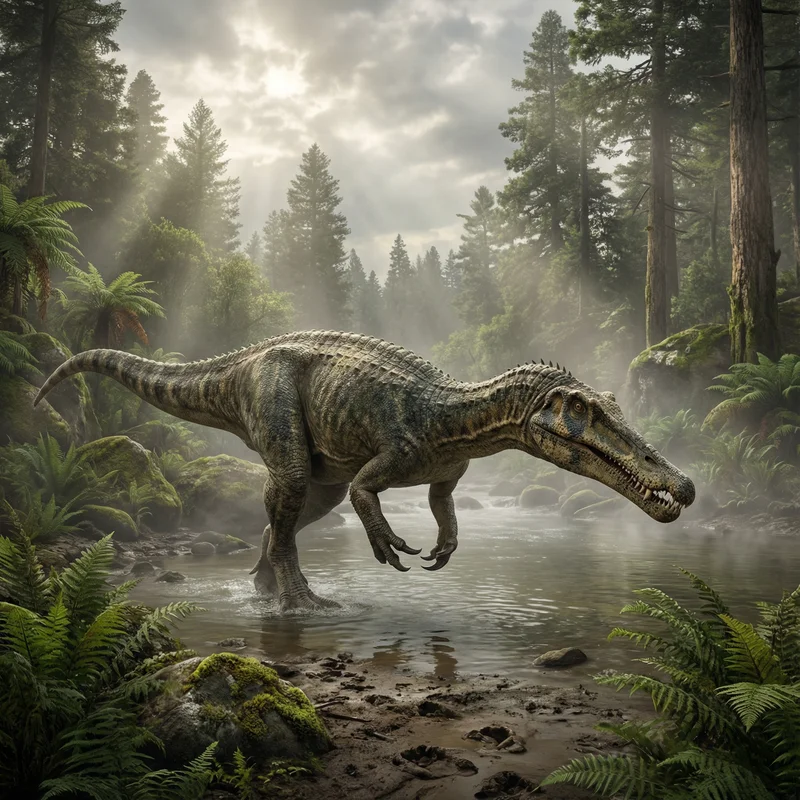 Baryonyx
Baryonyx · Cretaceous Period · Piscivore
 Baryonyx
Baryonyx · Cretaceous Period · Piscivore
 Baryonyx
Baryonyx · Cretaceous Period · Piscivore
 Baryonyx
Baryonyx · Cretaceous Period · Piscivore
 Baryonyx
Baryonyx · Cretaceous Period · Piscivore
🔗Related Creatures

Spinosaurus
Spinosaurus aegyptiacus
Suchomimus
Suchomimus tenerensis
Spinosaurus mirabilis
Spinosaurus mirabilis
Hesperornis
Hesperornis regalis
Irritator
Irritator challengeri

Triceratops
Triceratops
Struthiomimus
Struthiomimus altus

Australovenator
Australovenator wintonensis