Kronosaurus
Cretaceous Period Carnivore Creature Type
Kronosaurus queenslandicus
Scientific Name: "Kronos (Titan from Greek mythology) + sauros (lizard) = 'lizard of Kronos'"
Local Name: Kronosaurus
Physical Characteristics
Discovery
Habitat
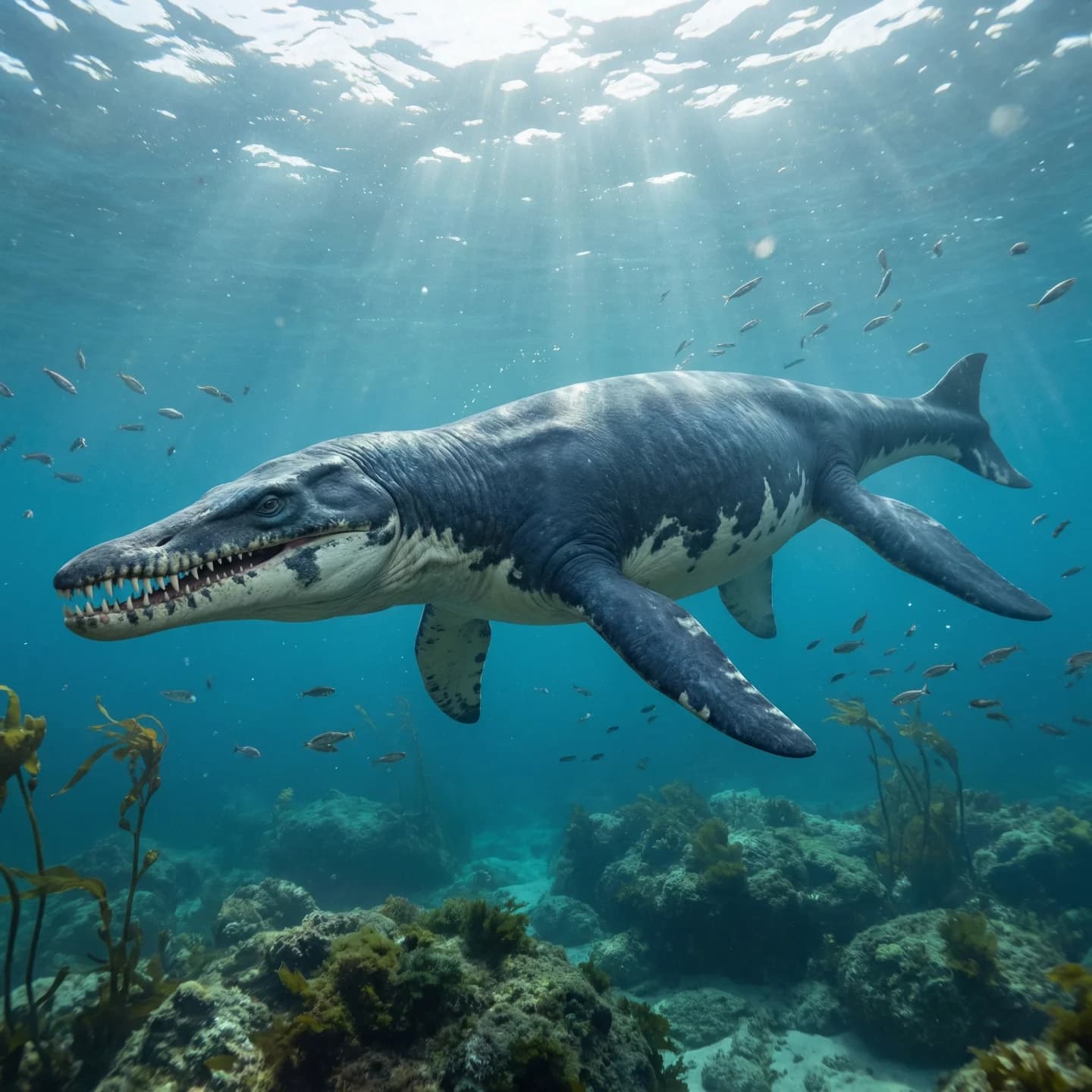
Kronosaurus (Kronosaurus queenslandicus Longman, 1924) is an extinct genus of large, short-necked pliosaurid marine reptile that inhabited the Eromanga Sea of Australia during the Aptian to Albian stages of the Early Cretaceous, approximately 125 to 100 million years ago. The genus name derives from Kronos (Κρόνος), the Titan of Greek mythology infamous for devouring his own children, combined with the Ancient Greek σαῦρος (sauros, 'lizard'), alluding to the animal's imposing size and presumed ferocity. The species epithet queenslandicus refers to Queensland, the Australian state where the holotype was most likely discovered.
Kronosaurus ranks among the largest known pliosaurs. Initial size estimates of around 12.8 m (42 ft) based on the famous Harvard skeleton were later revised downward after it was recognized that the mounted specimen contained at least seven to eight extra vertebrae added in plaster. Revised estimates from the early 2000s onward place the maximum body length at approximately 9 to 10.5 m (30–34 ft), with a body mass of up to 11 tonnes (McHenry, 2009). The skulls of the largest known specimens dwarf those of the biggest theropod dinosaurs, with estimated cranial lengths reaching 2.2 to 2.85 m. Kronosaurus propelled itself through the water using four large paddle-like flippers in a mode of lift-based aquatic flight, with the hind flippers exceeding the fore flippers in size. In the largest individuals, the flipper span would have exceeded 5 m.
Kronosaurus is not a dinosaur but a marine reptile, belonging to the order Plesiosauria, family Pliosauridae, and subfamily Brachaucheninae. It was the apex predator of the Eromanga Sea, a cool-to-cold epicontinental sea that flooded much of inland Australia during the Early Cretaceous. Fossil stomach contents and bite marks provide direct evidence that it preyed upon sea turtles, elasmosaurid plesiosaurs, and possibly sharks. The taxonomic validity of the genus has been debated because the holotype specimen (QM F1609) is non-diagnostic, but the majority of researchers continue to use the name Kronosaurus pending formal designation of a neotype.
Overview
Name and Etymology
The generic name Kronosaurus is composed of Kronos (Κρόνος), a Titan from Greek mythology, and Ancient Greek σαῦρος (sauros, 'lizard'), literally meaning 'lizard of Kronos.' Albert Heber Longman coined the name in 1924 to evoke the animal's great size and possible ferocity, drawing a parallel to Kronos's mythological reputation for devouring his own offspring (Longman, 1924). The specific epithet queenslandicus references Queensland, Australia, the provenance of the holotype.
Taxonomic Status and Validity Debate
The holotype QM F1609 consists only of a fragmentary mandibular symphysis with six conical teeth and does not preserve features diagnostic at the genus or species level. As early as 1962, Samuel Welles treated Kronosaurus as a nomen vanum and recommended the designation of a neotype (Welles, 1962). In 2022, Noè and Gómez-Pérez formally regarded Kronosaurus as a nomen dubium and erected a new genus, Eiectus longmani, based on the Harvard skeleton (MCZ 1285) as its holotype. However, Poropat et al. (2023) maintained K. queenslandicus as a nominally valid taxon, arguing on the basis of McHenry's (2009) conclusion that only one species of large pliosaur exists in the Toolebuc Formation. These authors recommended specimen QM F18827 as a neotype candidate. No formal ICZN petition has yet been submitted, and the name Kronosaurus continues to be used in the majority of the literature.
Summary
Kronosaurus was the apex predator of Australia's Early Cretaceous Eromanga Sea, one of the largest known pliosaurs, and is world-famous through the Harvard 'Plasterosaurus' skeleton.
Age, Stratigraphy, and Depositional Environment
Temporal Range
Kronosaurus fossils span from the Aptian to the Late Albian, approximately 125 to 100 Ma. The Harvard specimens (MCZ 1284, MCZ 1285) come from the Doncaster Member of the Wallumbilla Formation, dated to the Late Aptian (ca. 115–112 Ma). The holotype and the majority of other attributed specimens derive from the Toolebuc Formation, dated to the Albian (ca. 105–100 Ma). Additional material has been recovered from the Allaru Mudstone (Late Albian).
Formations and Lithology
All formations yielding Kronosaurus fossils belong to the Rolling Downs Group within the Great Artesian Basin of Australia.
| Formation | Age | Lithology | Key Specimens |
|---|---|---|---|
| Wallumbilla Fm. (Doncaster Mbr.) | Late Aptian (~115–112 Ma) | Marine mudstone, siltstone, fine-grained sandstone | MCZ 1284, MCZ 1285 |
| Toolebuc Fm. | Albian (~105–100 Ma) | Limey shales, limestone, mudstone | QM F1609 (holotype), QM F10113, QM F18827, and others |
| Allaru Mudstone | Late Albian | Mudstone | KK F0630 and others |
| Bulldog Shale | Aptian | Shale | Two indeterminate specimens |
Paleoenvironment
During the Early Cretaceous, much of inland Australia was inundated by the Eromanga Sea, a shallow epicontinental sea. Sedimentary records indicate that this sea was relatively shallow, muddy, and stagnant. At a paleolatitude of approximately 50°–55°S, the region experienced cool-to-cold conditions. During the Aptian, sea temperatures may have approached near-freezing in winter, as indicated by the presence of glendonites and possible ice-rafted boulders (Kear et al., 2006). Albian sea temperatures were somewhat warmer but remained within a cool-temperate range.
Specimens and Diagnostic Features
Holotype
The holotype, QM F1609, was collected by Andrew Crombie in 1899 from an unknown locality near Hughenden, Queensland, and deposited at the Queensland Museum. It consists of a partial mandibular symphysis bearing six conical teeth. Charles De Vis initially considered the specimen to be ichthyosaurian, but Longman (1924) correctly identified it as pliosaurid. Critically, this specimen does not preserve any features diagnostic at the genus or species level, making it the focal point of ongoing taxonomic debate.
Harvard Specimen (MCZ 1285)
The most famous attributed specimen, representing approximately 60% of a skeleton, was discovered by rancher Ralph William Haslam Thomas at Army Downs near Richmond, Queensland. It was collected in 1931–1932 by William E. Schevill during the Harvard Australian Expedition and shipped to the United States in 86 crates weighing a total of 6 tonnes. Alfred Sherwood Romer and Arnold Lewis prepared and mounted the skeleton, which was first exhibited on 10 June 1958 (Romer & Lewis, 1959). The restoration included extensive plaster additions — roughly one-third of the exhibited mount — earning the specimen its 'Plasterosaurus' nickname among paleontologists. The skull was given a non-anatomical bulbous sagittal crest, and at least seven to eight extra vertebrae were inserted into the spine, inflating the total mounted length to 12.8 m. The actual length is estimated at approximately 10–10.5 m.
Neotype Candidates
| Specimen | Repository | Composition | Est. Length | Est. Mass |
|---|---|---|---|---|
| QM F18827 | Queensland Museum | Partial skeleton including skull | ~8.9 m | ~6.7 t |
| QM F10113 | Queensland Museum | Most complete known specimen (skull + postcranium) | ~8.6 m | ~5.7 t |
QM F18827 preserves all key features — premaxillary tooth count, mandibular symphysis morphology, tooth shape and ornamentation, anisodonty of the tooth row, and vertebral centra morphology — that distinguish the Toolebuc Formation large pliosaur taxon from all other described pliosaur species. Poropat et al. (2023) strongly recommended it as a neotype candidate.
Diagnostic Features
Key features identified across attributed specimens include the following: the premaxilla bears only four caniniform teeth, in contrast to five or more in other pliosaurids; the teeth are conical, roughly ridged, and lack distinct carinae; the dentition is heterodont (anisodont), with large caniniform teeth anteriorly and smaller, more sharply recurved teeth posteriorly; the mandibular symphysis is elongated and spatulate (spoon-shaped), containing up to six pairs of teeth.
Morphology and Functional Anatomy
Body Form and Size
Kronosaurus exhibits the 'pliosauromorph' body plan — a large head, short neck, massive trunk, four flippers, and a short tail. Revised estimates by McHenry (2009) place the maximum body length of the largest individual (MCZ 1285) at approximately 9 to 10.5 m, with a body mass of roughly 11 tonnes. Zhao (2024) re-measured MCZ 1285 at 10.3 m. There is considerable individual variation across known specimens: the holotype individual is estimated at about 5.9 m and 1.9 t; the proposed neotype QM F18827 at about 8.9 m and 6.7 t; the most complete specimen QM F10113 at about 8.6 m and 5.7 t. The largest Toolebuc Formation specimens, QM F2446 and QM F2454, may have reached 10.2–10.5 m with body masses of 9.9 to 15.5 t.
Skull
The skulls of the largest Kronosaurus specimens surpass those of any known theropod dinosaur in size. The rostrum (snout) and mandibular rostrum are long and narrow, and the rostrum is arched with a distinct median dorsal crest. The eye sockets are located laterally on the anterior half of the skull and face obliquely posteriorly. The temporal fossae are very large. The frontal bones do not contact the margin of the eye sockets due to the connection between the postfrontal and prefrontal bones. The hyoid bones are robust. In adults, the premaxillae and nasal bones forming the dorsal crest surface are fused.
Postcranial Skeleton
McHenry (2009) estimates at least 35 presacral vertebrae, including thirteen cervical and five pectoral vertebrae. Unlike Pliosaurus, the cervical centra are wider than the dorsals. The ribs are robust and single-headed. The femur is longer and more robust than the humerus, indicating that the hind flippers exceeded the forelimbs in size. The largest individuals would have had rear flippers forming a span exceeding 5 m. Although the tail is unknown from articulated specimens, it was likely short and may have supported a small caudal fin, as postulated for other plesiosaurs.
Locomotion
Kronosaurus used lift-based appendicular locomotion, a form of underwater flight employing all four flippers for propulsion. This mode of swimming is analogous to that of sea turtles, sea lions, and penguins, but the simultaneous use of both forelimbs and hindlimbs is unique to plesiosaurs. Pliosaurids like Kronosaurus were likely capable of sustained high-speed cruising, unlike the more maneuverable but slower elasmosaurids.
Diet and Ecology
Feeding Evidence
Kronosaurus was the apex predator of the Eromanga Sea. The most direct dietary evidence comes from specimen QM F10113, which preserves stomach contents containing the remains of a sea turtle. The turtle's measurements are consistent with the protostegid Notochelone, the most widespread sea turtle in Queensland's Albian strata (McHenry, 2009). In 1993, Thulborn and Turner reported multiple bite marks on the skull of the elasmosaurid Eromangasaurus that match the dentition of Kronosaurus, providing the first recorded evidence of a pliosaur attacking an elasmosaurid. Some specimens also contain shark vertebrae as stomach contents, and possible tooth marks have been reported on the gladii of the squid-like Boreopeltis soniae.
Bite Force
Biomechanical analysis by McHenry (2009), based on specimen QM F10113 (skull length ~1.85 m), estimated a bite force of approximately 16,000–23,000 N. Foffa et al. (2014) revised the estimate to approximately 15,000–27,000 N, comparable to the closely related Jurassic Pliosaurus kevani. This is roughly twice the bite force of a large saltwater crocodile but far below estimates for Otodus megalodon (93,000–182,000 N). Simulations indicate that Kronosaurus was adapted for simple open-and-shut biting but was poorly suited for twisting prey.
Intraspecific Aggression
The smallest attributed specimen, QM F51291, bears bite marks on its skull. McHenry (2009) interpreted this as a juvenile fatally attacked by an adult, drawing parallels with intraspecific aggression commonly observed in modern crocodilians. This may represent evidence of cannibalism within the genus, though post-mortem biting cannot be excluded.
Physiological Adaptations
Plesiosaurs grew at rates comparable to birds and had high metabolisms, strongly suggesting homeothermy or even endothermy. Given the cold waters of the Eromanga Sea, endothermy is considered especially likely for high-latitude plesiosaurs including Kronosaurus (Kear et al., 2006). Fleischle et al. (2019) found that plesiosaurs possessed enlarged red blood cells, based on vascular canal morphology, which would have aided oxygen transport during diving.
Distribution and Paleogeography
Geographic Distribution
Kronosaurus fossils are concentrated in eastern Australia. The primary collecting areas are in Queensland — around the towns of Hughenden, Richmond, Julia Creek, and Boulia. Isolated teeth referable to Kronosaurus have also been reported from the Wallumbilla Formation at White Cliffs, New South Wales, and from the Bulldog Shale in northern South Australia.
Paleogeographic Setting
During the Early Cretaceous, the Eromanga Basin occupied a paleolatitude of approximately 50°–55°S (the Toolebuc Formation paleocoordinates are approximately 52.7°S, 132.5°E). This was a significantly more southerly position than today, placing the region in a cool-to-cold, high-latitude marine setting with seasonal near-freezing conditions. Some outlying localities may have been as far south as ~71°S.
Phylogeny and Taxonomic Debate
Phylogenetic Position
Since Longman (1924) placed Kronosaurus in the Pliosauridae, this family-level assignment has been upheld by the majority of subsequent studies. In modern systematics, Kronosaurus is classified within Plesiosauria → Pliosauridae → Thalassophonea → Brachaucheninae. Following Benson and Druckenmiller (2013), who united Cretaceous pliosaurids within the Brachaucheninae, subsequent phylogenetic analyses consistently recover Kronosaurus as a derived member of this subfamily, closely related to Brachauchenius and Megacephalosaurus (Madzia et al., 2018).
Key Debates and Alternative Hypotheses
Most brachauchenines display a trend toward a gracile rostrum and uniformly sized teeth, suggesting specialization for smaller prey. Kronosaurus is a notable exception, retaining strongly heterodont dentition adapted for capturing large prey. This indicates a unique ecological niche within the subfamily.
The Colombian species K. boyacensis, described by Hampe (1992), was re-described by Noè and Gómez-Pérez (2022) and reassigned to a new genus, Monquirasaurus boyacensis. Therefore, only a single species — K. queenslandicus — is currently recognized within Kronosaurus. The broader question of generic validity remains unresolved, with some authors preferring to refer to the relevant fossils as 'Kronosaurus-Eiectus' (Fischer et al., 2023) pending a formal ICZN resolution.
Restoration and Uncertainty
Confirmed, Probable, and Hypothetical
Confirmed facts include that Kronosaurus is a large, short-necked pliosaurid belonging to the Brachaucheninae; it inhabited the Eromanga Sea; and stomach contents directly confirm predation on sea turtles and elasmosaurids. Probable estimates include a total body length of 9–10.5 m, a body mass of approximately 5.7–11 t, and a bite force of 15,000–27,000 N. Hypothetical aspects include intraspecific cannibalism, the buoyancy-regulation function of gastroliths found in some specimens, and the presence of a small caudal fin.
Popular Media vs. Scientific Consensus
The Harvard 'Plasterosaurus' mount, at 12.8 m with an artificially bulbous sagittal crest, has been widely reproduced in popular media but does not reflect the current scientific consensus. Since the early 2000s, the accepted maximum size has been revised downward to 9–10.5 m. Kronosaurus was formerly described as 'the largest marine reptile,' but this claim was based on exaggerated measurements. The largest marine reptile currently recognized is the Late Triassic ichthyosaur Ichthyotitan, estimated at approximately 25 m.
Comparison with Related and Contemporaneous Taxa
| Taxon | Age | Est. Length | Classification | Habitat |
|---|---|---|---|---|
| Kronosaurus queenslandicus | Aptian–Albian (~125–100 Ma) | 9–10.5 m | Brachaucheninae | Eromanga Sea (high-latitude, cold, shallow) |
| Brachauchenius lucasi | Turonian (~94–90 Ma) | ~6 m | Brachaucheninae | Western Interior Seaway |
| Megacephalosaurus eulerti | Turonian (~94–90 Ma) | ~6–7 m | Brachaucheninae | Western Interior Seaway |
| Pliosaurus kevani | Kimmeridgian (~155–150 Ma) | ~10–12 m | Thalassophonea (non-Brachaucheninae) | Northern European seas |
| Liopleurodon ferox | Callovian (~166–163 Ma) | ~5–7 m | Thalassophonea | Northern European seas |
| Monquirasaurus boyacensis | Aptian (~120–112 Ma) | ~8 m (subadult) | Brachaucheninae (?) | Peri-Gondwanan seas (Colombia) |
Kronosaurus was one of the largest members of the Brachaucheninae, distinguished by its strongly heterodont dentition adapted for large prey. Within the contemporaneous Eromanga Sea, it coexisted with the ichthyosaur Platypterygius australis, the elasmosaurid Eromangasaurus, the protostegid sea turtles Notochelone, Bouliachelys, and Cratochelone, and a diverse assemblage of sharks and bony fish — many of which likely served as its prey.
Fun Facts
FAQ
📚References
- Longman, H. A. (1924). A new gigantic marine reptile from the Queensland Cretaceous, Kronosaurus queenslandicus new genus and species. Memoirs of the Queensland Museum, 8, 26–28.
- Longman, H. A. (1930). Kronosaurus queenslandicus: A gigantic Cretaceous pliosaur. Memoirs of the Queensland Museum, 10, 1–7.
- White, T. E. (1935). On the skull of Kronosaurus queenslandicus Longman. Occasional Papers of the Boston Society of Natural History, 8, 219–228.
- Romer, A. S. & Lewis, A. D. (1959). A mounted skeleton of the giant plesiosaur Kronosaurus. Breviora, 112, 1–15.
- McHenry, C. R. (2009). Devourer of Gods: the palaeoecology of the Cretaceous pliosaur Kronosaurus queenslandicus. PhD thesis, University of Newcastle, Australia.
- Holland, T. (2018). The mandible of Kronosaurus queenslandicus Longman, 1924 (Pliosauridae, Brachaucheniinae), from the Lower Cretaceous of Northwest Queensland, Australia. Journal of Vertebrate Paleontology, 38(6), e1511569. https://doi.org/10.1080/02724634.2018.1511569
- Noè, L. F. & Gómez-Pérez, M. (2022). Giant pliosaurids (Sauropterygia; Plesiosauria) from the Lower Cretaceous peri-Gondwanan seas of Colombia and Australia. Cretaceous Research, 132, 105122. https://doi.org/10.1016/j.cretres.2021.105122
- Poropat, S. F. et al. (2023). An annotated checklist of Australian Mesozoic tetrapods. Alcheringa: An Australasian Journal of Palaeontology, 47(2), 129–205. https://doi.org/10.1080/03115518.2023.2228367
- Kear, B. P. (2003). Cretaceous marine reptiles of Australia: a review of taxonomy and distribution. Cretaceous Research, 24, 277–303. https://doi.org/10.1016/S0195-6671(03)00044-3
- Kear, B. P., Schroeder, N. I., Vickers-Rich, P. & Rich, T. H. (2006). Early Cretaceous high latitude marine reptile assemblages from southern Australia. Paludicola, 5, 200–205.
- Thulborn, T. & Turner, S. (1993). An elasmosaur bitten by a pliosaur. Modern Geology, 18, 489–501.
- Foffa, D., Cuff, A. R., Sassoon, J., Rayfield, E. J., Mavrogordato, M. N. & Benton, M. J. (2014). Functional anatomy and feeding biomechanics of a giant Upper Jurassic pliosaur (Reptilia: Sauropterygia) from Weymouth Bay, Dorset, UK. Journal of Anatomy, 225(2), 209–219. https://doi.org/10.1111/joa.12200
- Benson, R. B. J. & Druckenmiller, P. S. (2013). Faunal turnover of marine tetrapods during the Jurassic–Cretaceous transition. Biological Reviews, 89(1), 1–23. https://doi.org/10.1111/brv.12038
- Madzia, D., Sachs, S. & Lindgren, J. (2018). Morphological and phylogenetic aspects of the dentition of Megacephalosaurus eulerti, a pliosaurid from the Turonian of Kansas, USA, with remarks on the cranial anatomy of the taxon. Geological Magazine, 156(7), 1163–1175. https://doi.org/10.1017/S0016756818000523
- Fleischle, C. V., Wintrich, T. & Sander, P. M. (2019). Quantitative histological models suggest endothermy in plesiosaurs. PeerJ, 6, e4955. https://doi.org/10.7717/peerj.4955
- Hampe, O. (1992). Ein grosswüchsiger Pliosauride (Reptilia: Plesiosauria) aus der Unterkreide (oberes Aptium) von Kolumbien. Courier Forschungsinstitut Senckenberg, 145, 1–32.
- Welles, S. P. (1962). A new species of elasmosaur from the Aptian of Colombia and a review of the Cretaceous plesiosaurs. University of California Publications in Geological Sciences, 44, 1–96.
- Zhao, R. J. (2024). Body reconstruction and size estimation of plesiosaurs. bioRxiv preprint. https://doi.org/10.1101/2024.02.15.578844
Gallery
5 images Kronosaurus
Kronosaurus · Cretaceous Period · Carnivore
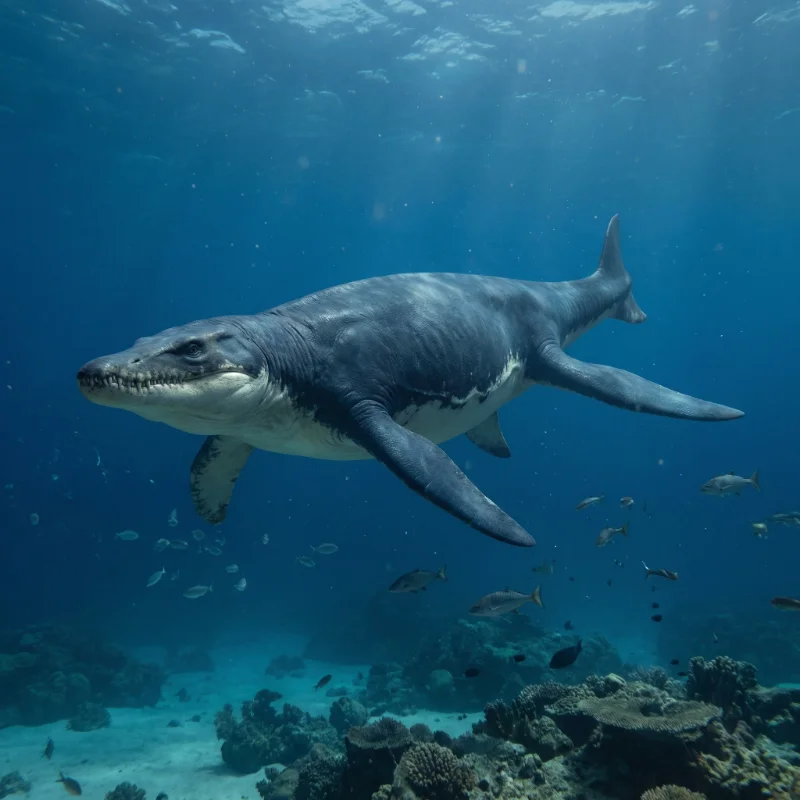 Kronosaurus
Kronosaurus · Cretaceous Period · Carnivore
 Kronosaurus
Kronosaurus · Cretaceous Period · Carnivore
 Kronosaurus
Kronosaurus · Cretaceous Period · Carnivore
 Kronosaurus
Kronosaurus · Cretaceous Period · Carnivore
🔗Related Creatures
Prognathodon
Prognathodon
Tylosaurus
Tylosaurus proriger
Mosasaurus
Mosasaurus hoffmannii
Elasmosaurus
Elasmosaurus platyurus
Liopleurodon
Liopleurodon ferox
Luperosuchus
Luperosuchus fractus
Thalattoarchon
Thalattoarchon saurophagis
Shonisaurus
Shonisaurus popularis