Shonisaurus
Triassic Period Carnivore Creature Type
Shonisaurus popularis
Scientific Name: "Shonisaurus = 'Shoshone lizard' (Greek sauros 'lizard' + Shoshone Mountains, Nevada); popularis = 'common, popular' (Latin, referring to the abundance of individuals found together)"
Local Name: Shonisaurus
Physical Characteristics
Discovery
Habitat
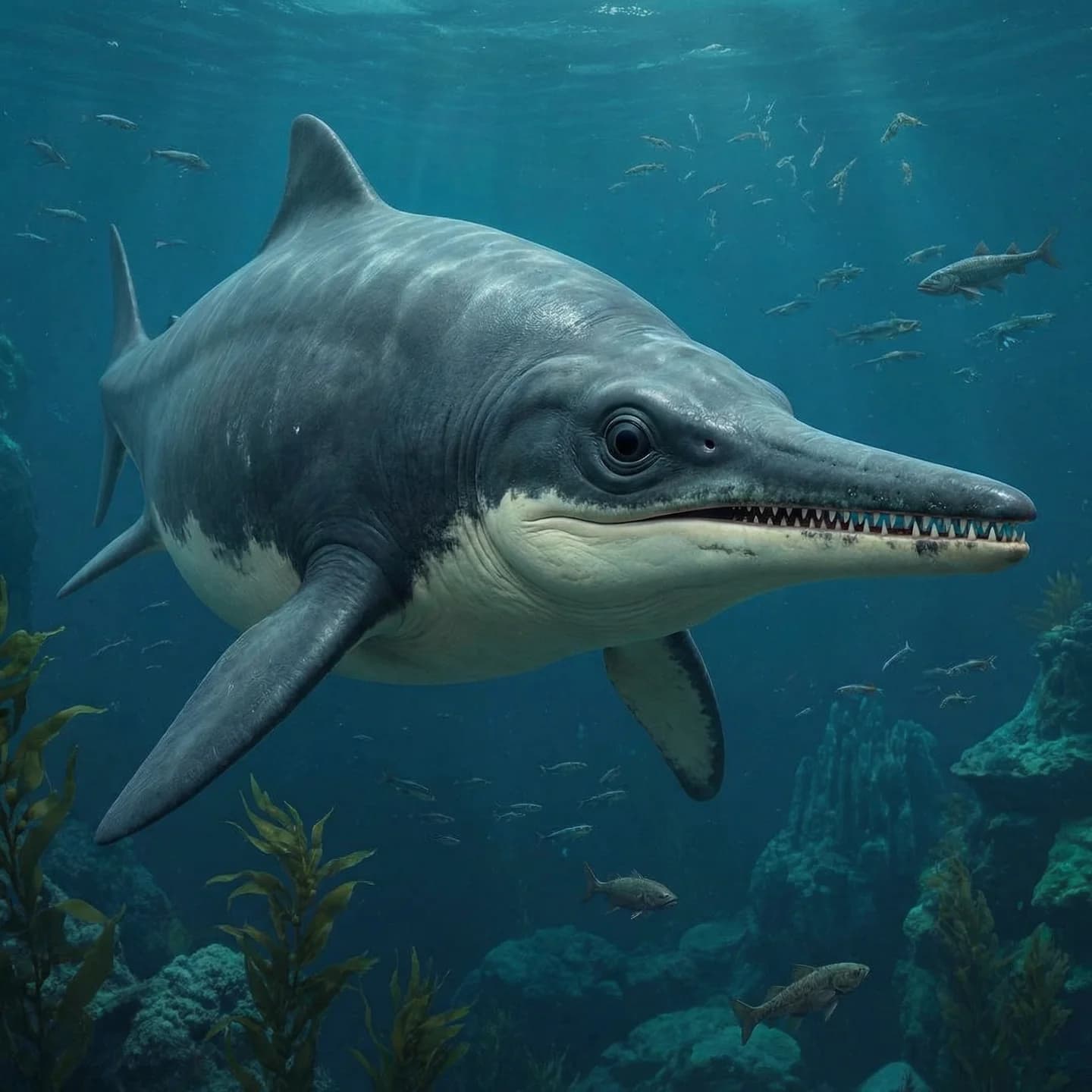
Shonisaurus popularis Camp, 1976 is a giant ichthyosaur (Ichthyosauria: Shastasauridae) from the Late Triassic (late Carnian–early Norian, approximately 237–227 Ma) of western North America. The genus name derives from the Shoshone Mountains of central Nevada, where fossils were first discovered, combined with Greek sauros ('lizard'), while the species epithet popularis ('common') reflects the remarkable abundance of individuals found at a single locality. At least 37 incomplete specimens of S. popularis have been recovered from the Luning Formation in Nye County, Nevada, and the fossil site is now preserved within Berlin-Ichthyosaur State Park.
Crucially, Shonisaurus is not a dinosaur but an ichthyosaur — a member of an entirely separate lineage of diapsid reptiles that returned to the sea during the Mesozoic. Ichthyosaurs convergently evolved streamlined, dolphin-like body plans, but they are phylogenetically distinct from dinosaurs (Dinosauria). Shonisaurus was among the largest marine predators of the Triassic, and a landmark 2022 study by Kelley et al. revealed that it possessed robust sectorial teeth and consumed vertebrates and shelled cephalopods, overturning the long-held image of a toothless, soft-prey specialist and re-establishing Shonisaurus as a macrophagous raptorial predator.
The type species S. popularis reached an estimated total length of approximately 13.5–15 m and a body mass of roughly 21.6–29.7 tonnes (Sander et al., 2021), comparable to a modern humpback whale. The skull alone measured about 2.75 m in length, and the animal's four flippers were unusually similar in size — a distinctive trait that sets it apart from most other ichthyosaurs. A second, much larger species, S.? sikanniensis (Nicholls & Manabe, 2004), from British Columbia, is estimated at 21 m in length and 81.5 tonnes, though its generic assignment remains actively debated between Shonisaurus and Shastasaurus.
Overview
Name and Etymology
'Shonisaurus' combines the Shoshone Mountains of Nevada with Greek sauros ('lizard'), meaning 'Shoshone lizard.' The species name popularis is Latin for 'common' or 'popular,' a reference to the many individuals found together at a single bone bed. Fossils were first discovered in Nevada in 1920, and systematic excavation began in 1954 under the direction of Charles L. Camp and Samuel Welles of the University of California, Berkeley. Camp formally named Shonisaurus popularis in 1976 (Camp, 1976) and published a detailed description in 1980 in Palaeontographica (Camp, 1980).
Taxonomic Status
Shonisaurus is a valid genus within Ichthyosauria, family Shastasauridae. The type and currently only uncontested species is S. popularis. The second species, S. sikanniensis, described in 2004 from British Columbia, has been alternatively placed in Shastasaurus by some phylogenetic analyses (Sander et al., 2011) and retained in Shonisaurus by others (Ji et al., 2013). The most recent studies continue to find support for both hypotheses (Moon, 2019; Bindellini et al., 2021), leaving the assignment of this species unresolved.
One-Line Summary
The largest ichthyosaur of the Late Triassic of North America, recently reinterpreted as a macrophagous apex predator armed with robust sectorial teeth.
Age, Stratigraphy, and Depositional Environment
Temporal Range
The type species S. popularis ranges from the late Carnian to early Norian stages of the Late Triassic, approximately 237–227 Ma. Balini et al. (2015) conducted a detailed ammonite biostratigraphic study at Berlin-Ichthyosaur State Park, demonstrating that the main ichthyosaur bone bed lies near the Carnian/Norian boundary. Shonisaurus fossils occur through nearly the entire Luning Formation, but the densest concentration is within the lowest 50 m of the calcareous member (Balini et al., 2015). The disputed species S.? sikanniensis comes from the Pardonet Formation of British Columbia, dating to the middle Norian (approximately 215–210 Ma; Nicholls & Manabe, 2004).
Formation and Lithology
The Luning Formation is an Upper Triassic marine succession in Nye County, central Nevada, composed primarily of calcareous mudstone, limestone, and marlstone. Most ichthyosaur fossils derive from the calcareous mudstone facies of the upper carbonate member. The Pardonet Formation of northeastern British Columbia consists of similar marine mudstone and limestone, yielding ammonites, bivalves, the coelacanth Whiteia banffensis, and other ichthyosaurs including Macgowania and Callawayia (Nicholls & Manabe, 2004; Yabumoto & Neuman, 2004).
Depositional Environment and Paleoenvironment
According to PBDB data and Hogler (1992), the Shonisaurus occurrence in the Luning Formation represents an open shallow subtidal setting — a relatively shallow shelf environment under normal marine salinity conditions with dominant calcareous sedimentation. Kelley et al. (2022) further characterized the ichthyosaur aggregation sites as moderately deep, low-diversity marine environments, where the dense concentrations of Shonisaurus occurred in the absence of abundant prey resources. This observation underpins the hypothesis that Shonisaurus used these areas as birthing grounds, analogous to the reproductive aggregation behavior observed in modern cetaceans.
Specimens and Diagnostic Features
Holotype and Key Specimens
| Specimen | Composition | Locality / Formation | Notes |
|---|---|---|---|
| UNLV FZVE-1 (holotype) | Skull, limbs, girdles, vertebrae, ribs, gastralia — largely preserved | Luning Fm, Nevada, Quarry 5 | Most complete individual (McGowan & Motani, 1999) |
| UNLV FZVE-2 (paratype) | Partial skeleton | Luning Fm, Quarry 5 | Designated by Camp, 1976 |
| UNLV FZVE-E (paratype) | Partial skeleton | Luning Fm, Quarry 5 | Designated by Camp, 1976 |
| TMP 94.378.2 (holotype of S.? sikanniensis) | Incomplete skull + articulated skeleton | Pardonet Fm, BC, Canada | Estimated length 21 m (Nicholls & Manabe, 2004) |
| UAMES 2437 | Partial skeleton + gut contents | Hound Island, Alaska | First confirmed ichthyosaur from Alaska; dietary evidence (Druckenmiller et al., 2014) |
At least 37 incomplete specimens have been recovered from the Luning Formation, spanning a range of ontogenetic stages from juveniles to adults.
Diagnosis (Revised by McGowan & Motani, 1999)
Large ichthyosaurs reaching up to 15 m in total length. Presacral vertebrae exceeding 50, centra amphicoelous. Fore- and hindpaddles similar in size and shape, both elongate and narrow. Humerus anteroposteriorly flattened with an unexpanded distal end, distinguishing Shonisaurus from other shastasaurid ichthyosaurs.
Limitations of the Material
Most specimens are incomplete and were found disarticulated within a dense bone bed. Camp's original description (1976, 1980) was based on elements from multiple individuals in a commingled assemblage, which led to several inaccuracies. McGowan & Motani (1999) reinterpreted the genus by focusing on the holotype specimen, correcting numerous anatomical details and producing a revised diagnosis.
Morphology and Function
Body Shape and Size
S. popularis had an estimated total length of approximately 13.5–15 m, with a skull length of about 2.75 m (McGowan & Motani, 1999; Sander et al., 2021). Body mass estimates based on digital volumetric models range from approximately 21.6 to 29.7 tonnes (Sander et al., 2021). Early reconstructions by Camp (1980) depicted an extremely rotund animal, but Kosch (1990) re-measured the ribs and intergirdle distance and demonstrated that the body was considerably more slender than originally portrayed. Nicholls & Manabe (2004) noted, however, that Shonisaurus still had a relatively deep body compared with other closely related marine reptiles.
S.? sikanniensis was far larger, with an estimated total length of approximately 21 m and a body mass of roughly 81.5 tonnes (Sander et al., 2021), making it one of the largest marine reptiles known from the fossil record.
Skull and Dentition
The skull of Shonisaurus features a characteristically long, narrow snout. For decades, the prevailing view was that adults were edentulous (toothless), since Camp (1976, 1980) and McGowan & Motani (1999) found teeth only in very small juveniles at the tips of the jaws. This interpretation was fundamentally revised by Kelley et al. (2016, 2022), who demonstrated that teeth were present at all ontogenetic stages in newly discovered specimens, and that these teeth were robust and sectorial (blade-like) in form. This evidence has recast Shonisaurus as a macrophagous raptorial predator rather than a soft-bodied prey specialist.
Flippers and Tail
One of the most distinctive features of Shonisaurus is that all four flippers are approximately equal in size. In most ichthyosaurs, the forelimbs are substantially larger than the hindlimbs, but in Shonisaurus both pairs are elongate, narrow paddles of similar proportions. This unusual configuration may have enhanced vertical-plane maneuverability, allowing the animal to change depth rapidly — a potential advantage when pursuing cephalopod prey that migrate vertically through the water column.
The tail shows that the vertebral column curves downward into the lower lobe of the caudal fin, producing a hypocercal configuration (the opposite of the heterocercal tail seen in sharks). The lower lobe was likely somewhat larger than the upper lobe, suggesting a cruising swimming style rather than burst-speed pursuit.
The presence or absence of a dorsal fin remains unresolved. No skeletal element supporting a dorsal fin has been found in association with Shonisaurus, and other shastasaurids are also inferred to have lacked dorsal fins. More derived Jurassic and Cretaceous ichthyosaurs clearly possessed them, but whether Shonisaurus had a cartilaginous or soft-tissue dorsal fin cannot be confirmed or refuted at present.
Diet and Ecology
Dietary Reinterpretation
Understanding of Shonisaurus diet has undergone a dramatic shift. The earlier interpretation, based on the apparent absence of teeth in adults, held that Shonisaurus was a specialist feeder on soft-bodied prey such as squid-like cephalopods (Palmer, 1999). Kelley et al. (2022), publishing in Current Biology, overturned this view entirely. Newly discovered specimens revealed robust sectorial teeth present in adults, and gut contents containing vertebrate bone fragments and cephalopod shell material. Shonisaurus is now understood to have been a macrophagous raptorial predator capable of consuming large-bodied prey.
Additional support comes from a large ichthyosaur identified as Shonisaurus sp. (UAMES 2437) from Norian deposits in Alaska's Brooks Range, which also preserved gut contents (Druckenmiller et al., 2014).
Ecological Role
With a body length of up to 15 m, a mass of approximately 25 tonnes, and powerful dentition, S. popularis was one of the apex predators of the late Carnian–early Norian marine ecosystem. Co-occurring fauna in the Luning Formation includes ammonites, bivalves, and other marine vertebrates.
Grouping Behavior and Birthing Grounds
Kelley et al. (2022) analyzed the recurring pattern of Shonisaurus mass accumulations at multiple stratigraphic horizons in the Luning Formation and proposed that these represent evidence of reproductive grouping behavior — congregations for the purpose of giving birth. The key lines of evidence are as follows. First, adult and very young (neonate-grade) individuals occur together at the same horizons. Second, the aggregation sites are in low-diversity environments lacking abundant prey, ruling out feeding aggregations. Third, this pattern repeats across at least three ammonoid zones spanning considerable time. These findings parallel the behavior of modern whales, which return to specific sheltered areas to give birth (philopatric behavior), and suggest that such behavior extends back at least 230 million years.
Distribution and Paleogeography
Geographic Range
All confirmed occurrences of S. popularis are restricted to the Luning Formation in Nye County, Nevada. S.? sikanniensis is known from the Pardonet Formation in northeastern British Columbia, and large ichthyosaur remains identified as Shonisaurus sp. have been reported from Norian strata at Hound Island, Alaska (Adams, 2009; Druckenmiller et al., 2014).
Paleogeographic Interpretation
PBDB paleocoordinate reconstructions place the Luning Formation locality at approximately 15.9°N paleolatitude and 42.8°W paleolongitude during the Late Triassic, positioning it along the western margin of Pangaea in a subtropical marine setting — roughly comparable in latitude to the modern Caribbean. The Pardonet Formation locality also falls along the Late Triassic western margin of North America. Together, these occurrences suggest that Shonisaurus ranged along the Pacific coast of Pangaea in warm, shallow seas.
Phylogeny and Taxonomic Debate
Position within Shastasauridae
Shonisaurus is consistently recovered within Shastasauridae in phylogenetic analyses. This family represents a clade of large-bodied Triassic ichthyosaurs that also includes Shastasaurus, Guanlingsaurus, and Besanosaurus, among others.
The S. sikanniensis Controversy
The generic assignment of S. sikanniensis is the most actively debated taxonomic question surrounding Shonisaurus. Nicholls & Manabe (2004) placed this species in Shonisaurus in the original description. Sander et al. (2011) performed a phylogenetic analysis that recovered S. sikanniensis as more closely related to Shastasaurus than to Shonisaurus, and reclassified it as Shastasaurus sikanniensis. Ji et al. (2013) subsequently found support for the original classification, recovering it closer to Shonisaurus. Later studies by Moon (2019) and Bindellini et al. (2021) have alternately supported each hypothesis. This instability reflects broader difficulties in resolving internal relationships within Shastasauridae, and resolution will likely require additional character data and expanded taxon sampling.
Reconstruction and Uncertainty
Confirmed
The following aspects of Shonisaurus biology are well established: it was a large shastasaurid ichthyosaur from the Luning Formation (late Carnian–early Norian); at least 37 individuals have been recovered from a single locality; all four paddles were elongate, narrow, and approximately equal in size; and recently discovered specimens preserve robust sectorial teeth and gut contents at all ontogenetic stages.
Probable but Requiring Further Confirmation
The body mass estimate of approximately 21.6–29.7 tonnes for S. popularis, the macrophagous predatory ecology, and the birthing-ground hypothesis are each supported by multiple independent lines of evidence but remain at the status of well-supported hypotheses pending additional data.
Common Misconceptions (Popular Media vs. Science)
Shonisaurus is often cited in popular media as a 21 m, 'largest-ever ichthyosaur.' This figure refers to S.? sikanniensis, not the type species S. popularis, which maxed out at approximately 15 m. The rotund body shape and prominent dorsal fin seen in many older reconstructions are not supported by current evidence. Likewise, the long-standing image of Shonisaurus as a gentle, toothless filter feeder was overturned by the Kelley et al. (2022) study, which revealed it was a powerful macropredator.
Comparison with Related and Contemporaneous Taxa
| Taxon | Family | Age | Estimated length | Estimated mass | Diet | Type locality |
|---|---|---|---|---|---|---|
| Shonisaurus popularis | Shastasauridae | Late Carnian–early Norian | 13.5–15 m | 21.6–29.7 t | Macrophagous predator | Nevada, USA |
| S.? sikanniensis | Shastasauridae | Middle Norian | ~21 m | ~81.5 t | Uncertain (teeth ambiguous) | British Columbia, Canada |
| Shastasaurus pacificus | Shastasauridae | Norian | ~8 m | Unknown | Suction feeding (inferred) | California, USA |
| Cymbospondylus youngorum | Cymbospondylidae | Carnian | ~17.5 m | ~45 t | Carnivorous (inferred) | Nevada, USA |
| Temnodontosaurus | Temnodontosauridae | Early Jurassic | ~9–12 m | Unknown | Macrophagous | Europe |
Fun Facts
FAQ
📚References
- Camp, C. L. (1976). Vorläufige Mitteilung über grosse Ichthyosaurier aus der oberen Trias von Nevada. Sitzungsberichte der Österreichischen Akademie der Wissenschaften, Mathematisch-naturwissenschaftliche Klasse, 185, 125–134.
- Camp, C. L. (1980). Large ichthyosaurs from the Upper Triassic of Nevada. Palaeontographica, Abteilung A, 170, 139–200.
- Kosch, B. F. (1990). A revision of the skeletal reconstruction of Shonisaurus popularis (Reptilia: Ichthyosauria). Journal of Vertebrate Paleontology, 10(4), 512–514. doi:10.1080/02724634.1990.10011833
- Hogler, J. A. (1992). Taphonomy and paleoecology of Shonisaurus popularis (Reptilia: Ichthyosauria). PALAIOS, 7(1), 108–117. doi:10.2307/3514800
- McGowan, C. & Motani, R. (1999). A reinterpretation of the Upper Triassic ichthyosaur Shonisaurus. Journal of Vertebrate Paleontology, 19(1), 42–49. doi:10.1080/02724634.1999.10011121
- Nicholls, E. L. & Manabe, M. (2004). Giant ichthyosaurs of the Triassic — A new species of Shonisaurus from the Pardonet Formation (Norian: Late Triassic) of British Columbia. Journal of Vertebrate Paleontology, 24(4), 838–849. doi:10.1671/0272-4634(2004)024[0838:GIOTTN]2.0.CO;2
- Adams, T. L. (2009). Deposition and taphonomy of the Hound Island Late Triassic vertebrate fauna: Fossil preservation within subaqueous gravity flows. PALAIOS, 24(9), 603–615. doi:10.2110/palo.2009.p09-010r
- Sander, P. M., Chen, X., Cheng, L. & Wang, X. (2011). Short-snouted toothless ichthyosaur from China suggests Late Triassic diversification of suction feeding ichthyosaurs. PLOS ONE, 6(5), e19480. doi:10.1371/journal.pone.0019480
- Ji, C., Jiang, D. Y., Motani, R., Hao, W. C., Sun, Z. Y. & Cai, T. (2013). A new juvenile specimen of Guanlingsaurus (Ichthyosauria, Shastasauridae) from the Upper Triassic of southwestern China. Journal of Vertebrate Paleontology, 33(2), 340–348. doi:10.1080/02724634.2013.723082
- Druckenmiller, P. S., Kelley, N., Whalen, M. T., McRoberts, C. & Carter, J. G. (2014). An Upper Triassic (Norian) ichthyosaur (Reptilia, Ichthyopterygia) from northern Alaska and dietary insight based on gut contents. Journal of Vertebrate Paleontology, 34(6), 1460–1465. doi:10.1080/02724634.2014.866573
- Balini, M., Jenks, J. F., Martin, R., McRoberts, C. A., Orchard, M. J. & Silberling, N. J. (2015). The Carnian/Norian boundary succession at Berlin-Ichthyosaur State Park (Upper Triassic, central Nevada, USA). Paläontologische Zeitschrift, 89(3), 399–433. doi:10.1007/s12542-014-0244-2
- Moon, B. (2019). A new phylogeny of ichthyosaurs (Reptilia: Diapsida). Journal of Systematic Palaeontology, 17(2), 129–155. doi:10.1080/14772019.2017.1394922
- Sander, P. M., Griebeler, E. M., Klein, N., Juarbe, J. V., Wintrich, T., Revell, L. J. & Schmitz, L. (2021). Early giant reveals faster evolution of large body size in ichthyosaurs than in cetaceans. Science, 374(6575), eabf5787. doi:10.1126/science.abf5787
- Bindellini, G., Wolniewicz, A. S., Miedema, F. & Scheyer, T. M. (2021). Cranial anatomy of Besanosaurus leptorhynchus Dal Sasso & Pinna, 1996 (Reptilia: Ichthyosauria) from the Middle Triassic Besano Formation of Monte San Giorgio, Italy/Switzerland. PeerJ, 9, e11179. doi:10.7717/peerj.11179
- Kelley, N. P., Irmis, R. B., dePolo, P. E., Noble, P. J., Montague-Judd, D., Little, H., Blundell, J., Rasmussen, C., Percival, L. M. E., Mather, T. A. & Pyenson, N. D. (2022). Grouping behavior in a Triassic marine apex predator. Current Biology, 32(24), 5398–5405.e3. doi:10.1016/j.cub.2022.11.005
- Sander, P. M., Romero Pérez de Villar, P., Furrer, H. & Wintrich, T. (2022). Giant Late Triassic ichthyosaurs from the Kössen Formation of the Swiss Alps and their paleobiological implications. Journal of Vertebrate Paleontology, 41(6), e2046017. doi:10.1080/02724634.2021.2046017
Gallery
5 images Shonisaurus
Shonisaurus · Triassic Period · Carnivore
 Shonisaurus
Shonisaurus · Triassic Period · Carnivore
 Shonisaurus
Shonisaurus · Triassic Period · Carnivore
 Shonisaurus
Shonisaurus · Triassic Period · Carnivore
 Shonisaurus
Shonisaurus · Triassic Period · Carnivore
🔗Related Creatures
Thalattoarchon
Thalattoarchon saurophagis
Luperosuchus
Luperosuchus fractus
Tylosaurus
Tylosaurus proriger
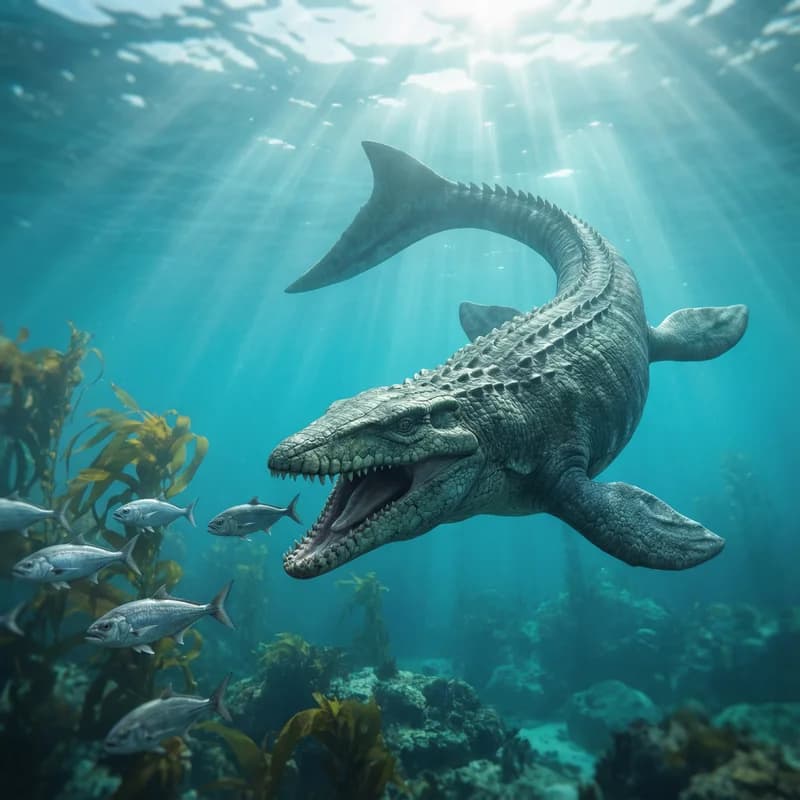
Mosasaurus
Mosasaurus hoffmannii
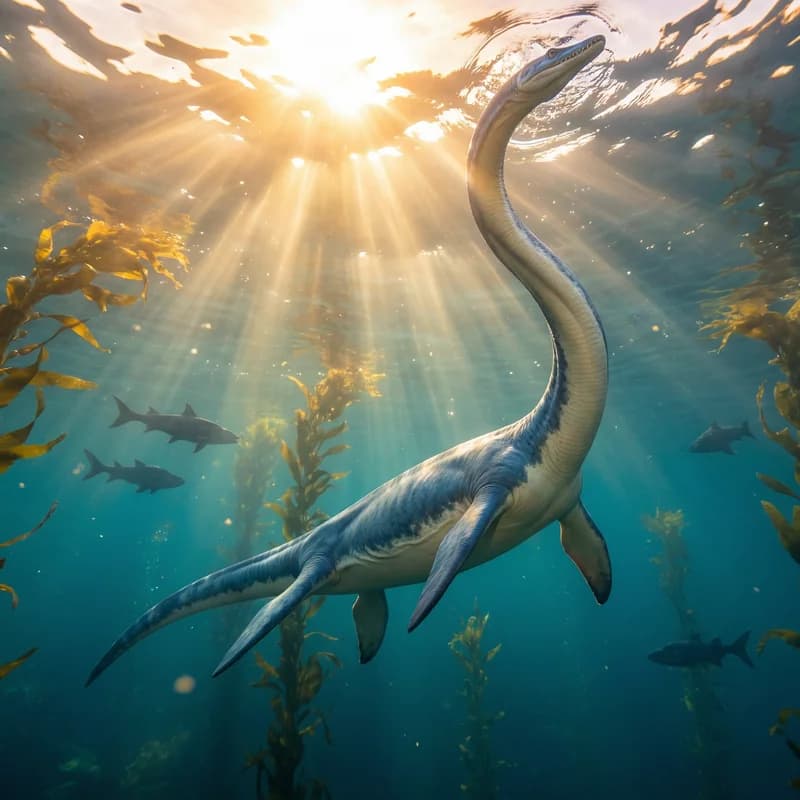
Tanystropheus
Tanystropheus longobardicus
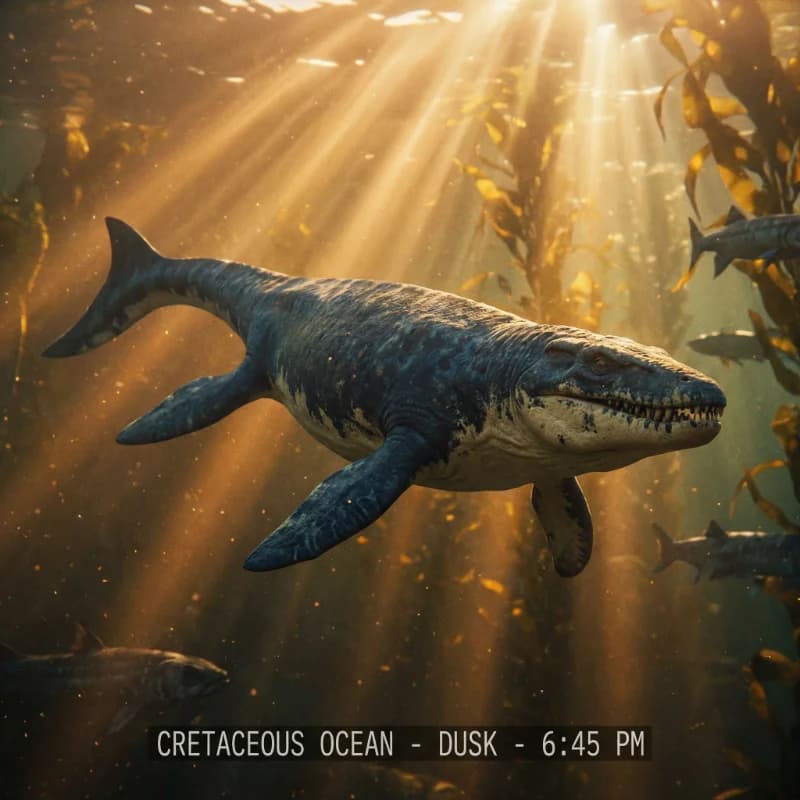
Prognathodon
Prognathodon
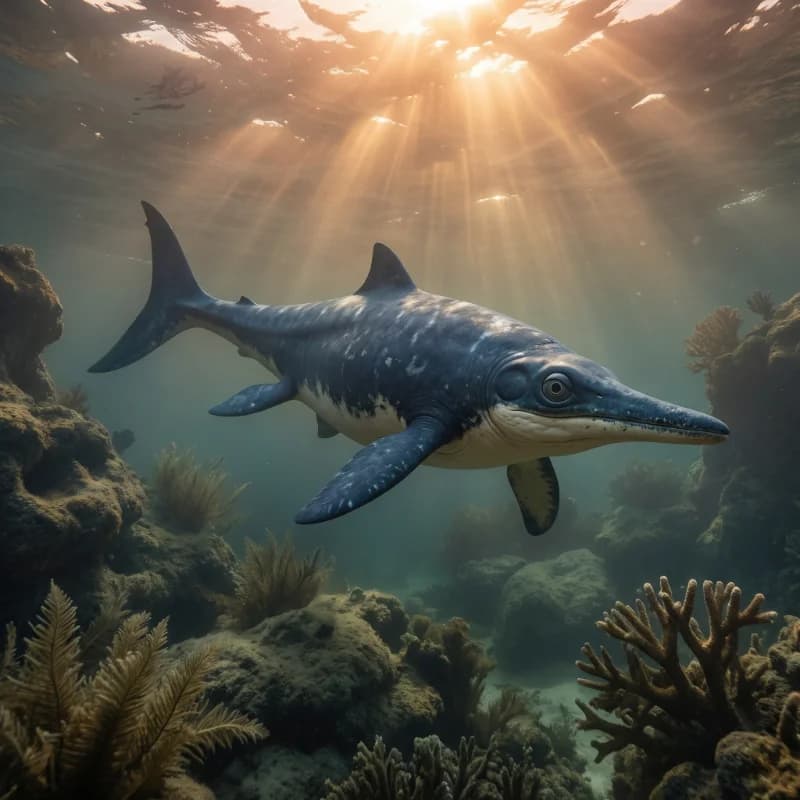
Temnodontosaurus
Temnodontosaurus
Rhynchosaurus
Rhynchosaurus articeps