Thalattoarchon
Triassic Period Carnivore Creature Type
Thalattoarchon saurophagis
Scientific Name: "Thalattoarchon: from Ancient Greek θάλαττα (thálatta, 'sea') + ἄρχων (árchon, 'ruler') = 'ruler of the seas'; saurophagis: from Greek σαῦρος (saûros, 'lizard/reptile') + φᾰγεῖν (phageîn, 'to eat') = 'lizard eater'"
Local Name: Thalattoarchon
Physical Characteristics
Discovery
Habitat
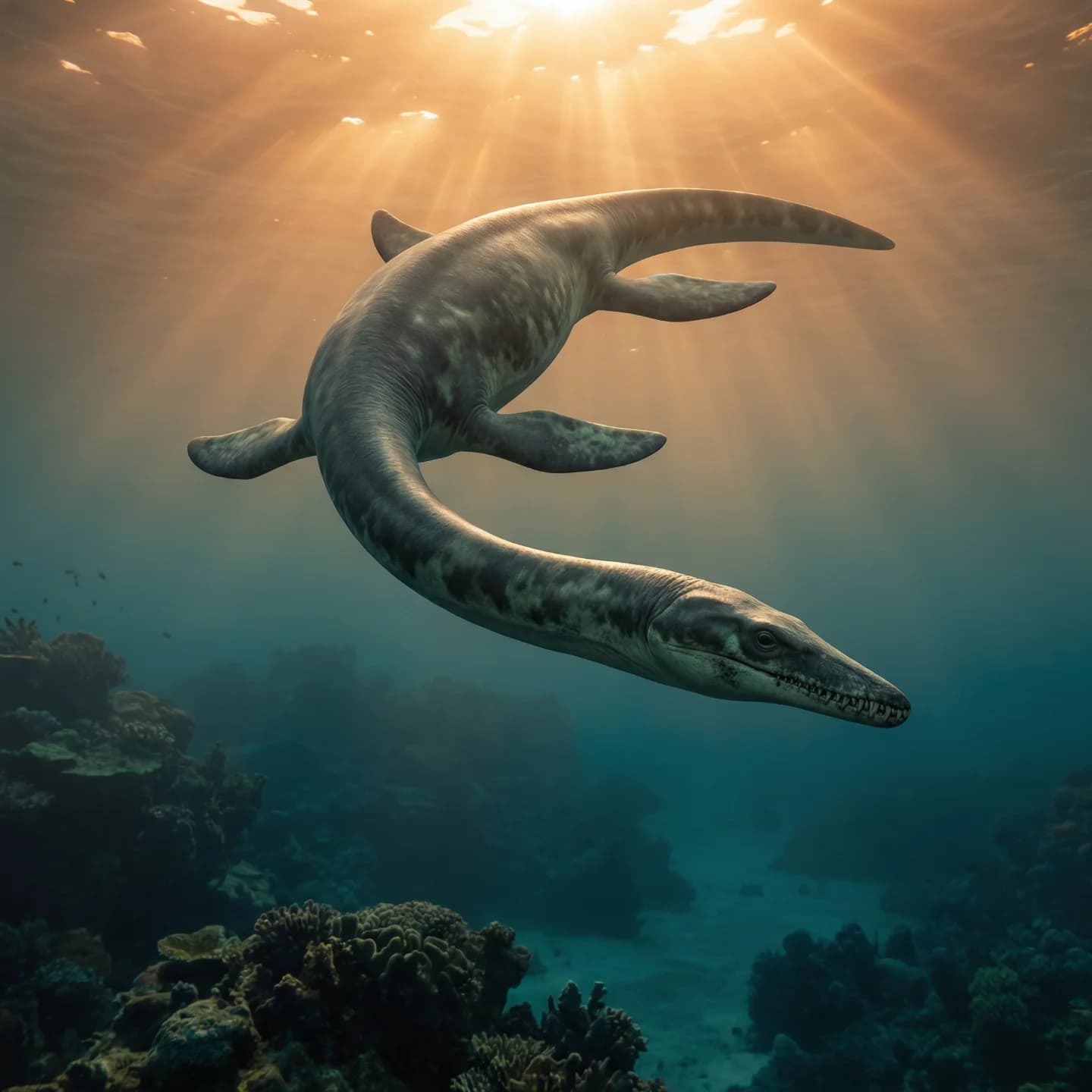
Thalattoarchon saurophagis Fröbisch et al., 2013 is a large ichthyosaur (Order Ichthyosauria) from the Middle Triassic (late Anisian, approximately 244.6 Ma) of what is now Nevada, North America. Its generic name translates to "ruler of the seas" and the specific epithet to "lizard eater," reflecting this animal's inferred role as the apex macropredator of the Triassic oceans. The taxon was formally described in 2013 by Nadia B. Fröbisch, Jörg Fröbisch, P. Martin Sander, Lars Schmitz, and Olivier Rieppel in the Proceedings of the National Academy of Sciences (Fröbisch et al., 2013).
Thalattoarchon is not a dinosaur but a marine reptile belonging to the Ichthyosauria. Ichthyosaurs were a group of reptiles that returned to the sea during the early Mesozoic, convergently evolving streamlined, fish-like body plans reminiscent of modern dolphins and tuna. With a conservatively estimated total length of over 8.6 m (Fröbisch et al., 2013), revised upward to approximately 9 m by Naish (2023), and an estimated body mass of around 4.3 metric tons (Sander et al., 2021), Thalattoarchon was comparable in size to a modern orca. It represents the oldest known macropredatory tetrapod in the marine fossil record, appearing only about 8 million years after the devastating Permian–Triassic mass extinction and just 4 million years after reptiles first invaded the sea.
The most striking feature of Thalattoarchon is its dentition: very large, labiolingually flattened teeth bearing two sharp cutting edges (bicarinate). The largest preserved tooth measures at least 12 cm in total height, with a crown height of 5 cm. This tooth morphology is consistent with a macropredatory feeding strategy targeting large vertebrate prey of comparable body size. The holotype specimen (FMNH PR 3032), housed at The Field Museum of Natural History in Chicago, comprises most of the skull, the nearly complete axial skeleton, parts of the pelvic girdle, and portions of the hind flippers, making it a relatively well-preserved partial skeleton despite the loss of the rostrum and forelimbs.
Overview
Name and Etymology
The genus name Thalattoarchon is derived from the Ancient Greek θάλαττα (thálatta, "sea, ocean") and ἄρχων (árchon, "ruler"), meaning "ruler of the seas." The specific epithet saurophagis combines the Greek σαῦρος (saûros, "lizard, reptile") with φᾰγεῖν (phageîn, "to eat"), meaning "lizard eater." This nomenclature directly reflects the animal's inferred ecological role as an apex predator that fed on other marine reptiles (Fröbisch et al., 2013).
Taxonomic Status
Thalattoarchon's phylogenetic placement within the Ichthyosauria has been contested since its original description. Fröbisch et al. (2013) recovered it as a basal member of Merriamosauria, more derived than Cymbospondylus and Mixosauridae. However, Ji et al. (2016) repositioned it within the more basal Cymbospondylidae, a placement subsequently supported by several studies (Jiang et al., 2016; Moon, 2017; Huang et al., 2020; Bindellini et al., 2021). Most recently, Sander et al. (2021) again recovered Thalattoarchon within Merriamosauria as the sister taxon of Shastasauridae. The instability of its phylogenetic position reflects sensitivity to character matrix composition and taxon sampling, and no consensus has yet been reached.
Key Significance
Thalattoarchon is the oldest known macropredatory tetrapod in the marine realm, appearing approximately 8 million years after the Permian–Triassic (P/T) mass extinction (ca. 252 Ma) and only about 4 million years after reptiles first entered the marine fossil record. Its discovery provides critical evidence that marine trophic networks recovered to full complexity far more rapidly than previously assumed.
Stratigraphy and Paleoenvironment
Temporal Range
Thalattoarchon dates to the late Anisian (early Middle Triassic), with a minimum geological age of 244.6 ± 0.36 Ma based on biostratigraphy of the Taylori Zone and radiometric dating (Fröbisch et al., 2013). Although the Fossil Hill Member as a whole spans the Anisian (approximately 244–242 Ma), the Thalattoarchon holotype derives specifically from the earlier part of this interval.
Formation and Lithology
The holotype (FMNH PR 3032) was collected from the Fossil Hill Member of the Favret Formation (Star Peak Group), at Favret Canyon in the Augusta Mountains, Pershing County, Nevada. The Fossil Hill Member also occurs as part of the Prida Formation further west in the Humboldt Range. In the Augusta Mountains, the member exceeds 250 m in thickness (Nichols & Silberling, 1977; Klein et al., 2020).
The dominant lithologies are calcareous shale with alternating facies of fissile shaley limestone and massive black limestones. Bioclastic beds dominated by the bivalve Daonella occur at multiple intervals. Compressed ammonoid fossils are common throughout (Nichols & Silberling, 1977).
Paleoenvironment
During the Anisian, the Fossil Hill Member represented the eastern margin of the Panthalassa Ocean, along the western coast of Pangaea. The prevalence of anoxic black shales and limestones, combined with the near-absence of benthic fauna (apart from halobiid bivalves), indicates a pelagic environment with oxygen-depleted bottom waters but well-aerated surface layers (Nichols & Silberling, 1977; Sander et al., 2021). The food web appears to have been ammonoid-based rather than supported by benthic productivity. The recently described pseudosuchian Benggwigwishingasuchus from the same formation suggests proximity to a paleoshoreline, as this archosaur shows no aquatic adaptations and was likely a terrestrial animal washed out to sea (Smith et al., 2024).
Specimen and Diagnostic Features
Holotype
| Category | Details |
|---|---|
| Specimen number | FMNH PR 3032 |
| Repository | The Field Museum of Natural History, Chicago, USA |
| Preserved elements | Most of the skull (rostrum/premaxillae missing), nearly complete axial skeleton, parts of the pelvic girdle, parts of the hind flippers |
| Locality | Favret Canyon, Augusta Mountains, Pershing County, Nevada |
| Horizon | Favret Formation, Fossil Hill Member, Taylori Zone |
| Discovery | Found in 1997 by Jim Holstein during a field expedition led by Martin Sander and Olivier Rieppel; fully excavated in 2008 (Fröbisch et al., 2013) |
Diagnosis
The autapomorphy of Thalattoarchon is the possession of very large, labiolingually flattened teeth bearing two cutting edges (bicarinate). Additionally, the original description identified six unambiguous but equivocal synapomorphies: postfrontal excluded from the upper temporal fenestra; postorbital triradiate in shape; anterior terrace of the upper temporal fenestra reaching the nasal; supratemporal lacking a ventral process; laterally compressed teeth; and tibia wider than long (Fröbisch et al., 2013).
Thalattoarchon differs from the contemporary Cymbospondylus in having a skull nearly twice as large for a given body length, a shallow lower temporal embayment, an upper tooth row extending nearly to the anterior margin of the orbit, rib articular facets not truncated by the anterior margin of the centrum, and bicipital posterior dorsals and anterior caudals. It differs from the Late Triassic Himalayasaurus tibetensis, which shares bicarinate cutting teeth, by the absence of longitudinal fluting on the tooth crowns (Fröbisch et al., 2013).
Limitations of the Holotype
The rostrum and premaxillae were destroyed by weathering, meaning the anterior portion of the dentition and the overall snout morphology remain unknown. The forelimbs and pectoral girdle are not preserved. Consequently, the total body length estimate of >8.6 m is conservative and may be revised with additional material (Fröbisch et al., 2013; Naish, 2023).
Morphology and Functional Anatomy
Body Size
Thalattoarchon was a large ichthyosaur with a long, slender body and a proportionally massive head. The conservative total body length estimate from the original description is >8.6 m (Fröbisch et al., 2013), with Naish (2023) suggesting approximately 9 m. Sander et al. (2021) estimated a body mass of approximately 4.3 metric tons, substantially higher than informal earlier estimates of around 2 tons. This size is comparable to that of some species of the contemporary Cymbospondylus and to a modern orca.
| Parameter | Value | Source |
|---|---|---|
| Total body length | >8.6–9 m | Fröbisch et al. (2013); Naish (2023) |
| Body mass | ca. 4.3 t | Sander et al. (2021) |
| Skull length (est.) | ca. 1.2 m | Fröbisch et al. (2013) |
| Orbit length | 29 cm | Fröbisch et al. (2013) |
| Largest tooth height | >12 cm | Fröbisch et al. (2013) |
Skull and Dentition
The skull was strongly dorsoventrally flattened by sediment compaction but was not crushed. The orbits are elongated (left orbit = 29 cm) with a well-preserved scleral ring. The upper temporal fenestrae are large and oval, reminiscent of Shastasaurus. The postorbital region is long, and the lower temporal embayment is very shallow. The maxillae extend well below the orbits and bear large teeth to their posterior extremity (Fröbisch et al., 2013).
The dentition is Thalattoarchon's most remarkable feature. Only the posterior maxillary teeth are preserved, but the largest fully preserved tooth measures at least 12 cm tall (with the root not fully exposed), and the crown is 5 cm high. The crown is labiolingually flattened, lingually recurved, and bears sharp anterior and posterior cutting edges without serrations. The labial and lingual surfaces are smooth. These teeth belong to the "cut" feeding guild among marine reptiles (Massare, 1987; Fröbisch et al., 2013). These posteriormost teeth are absolutely 45% larger than the largest documented teeth of the Early Jurassic Temnodontosaurus, which also reached about 9 m in length (Fröbisch et al., 2013).
Postcranial Skeleton
The presacral vertebral count is estimated at a minimum of 60. Anterior dorsal vertebrae are nearly round in anterior view, measuring 10 cm in diameter and 6 cm in length. Mid-dorsal vertebrae reach 12 cm in diameter. Neural spines of the anterior dorsals are tall (13–14 cm), laterally flattened, and larger than the centra themselves. The posterior dorsal and anterior caudal vertebrae possess facets for double-headed (bicipital) ribs, a trait also found in some basal ichthyosaurs and in neoichthyosaurians. The caudal vertebrae are laterally compressed and twice as tall as wide, gradually decreasing in length posteriorly. The tail appears straight with no visible curvature, lacking the downturn and bilobed caudal fin characteristic of more derived ichthyosaurs (Fröbisch et al., 2013).
Few elements of the pelvic girdle and hind limbs are preserved. The femur is broad and flattened, broader than that of Cymbospondylus. A preserved zeugopodial element (possibly a tibia or fibula) has a concave margin, enlarged ends, and is wider than long. The hind limbs and pelvic girdle are proportionally small relative to the body (Fröbisch et al., 2013).
Locomotion
As an intermediate-grade Triassic ichthyosaur, Thalattoarchon likely employed anguilliform (eel-like) or subcarangiform locomotion, swimming by undulating the entire body from side to side. This is consistent with its long tail lacking a strong downward bend and its elongated, flexible trunk. This mode of swimming contrasts with the more efficient, tail-driven (thunniform) locomotion inferred for the spindle-shaped parvipelvian ichthyosaurs of the Jurassic and Cretaceous (Sander, 2000; Gutarra et al., 2019).
Diet and Ecology
Feeding Strategy
The combination of large bicarinate cutting teeth and a disproportionately massive skull strongly indicates a macropredatory feeding strategy, in which Thalattoarchon hunted large vertebrate prey (marine reptiles, large fishes) of comparable body size. The original authors compared its ecological role to that of the modern orca (Fröbisch et al., 2013).
However, Sander et al. (2021) cautioned that direct predation on the largest contemporary Cymbospondylus species would have required pack-hunting behavior, for which there is no fossil evidence. They proposed instead that Thalattoarchon likely targeted medium-sized marine reptiles, juveniles, and carcasses, a feeding strategy more akin to that of the modern great white shark. Given its macropredatory adaptations, a diet based primarily on ammonites, squid, or small fish is considered unlikely (Sander et al., 2021).
Ecological Position and Food Web
Within the Fossil Hill Member fauna, Thalattoarchon occupied the apex predator position. The contemporary biota included the large generalist-feeding Cymbospondylus (2–4 species), the durophagous Omphalosaurus, the small mixosaurid Phalarodon, and the sauropterygian Augustasaurus. Each ichthyosaur taxon appears to have occupied a distinct feeding niche, minimizing competition: Cymbospondylus fed primarily on fish and cephalopods; Phalarodon had broad crushing teeth for shelled prey; Omphalosaurus was a bulk feeder likely specialized in ammonites; and Thalattoarchon occupied the top trophic tier as a macropredator of large vertebrates (Fröbisch et al., 2013; Sander et al., 2021).
Behavioral Inferences
With only a single known specimen, direct evidence for social behavior, reproductive strategies, or growth rates is absent. General ichthyosaur characteristics such as viviparity (live birth), elevated metabolic rates, and obligate air-breathing are plausibly applicable to Thalattoarchon but remain indirect inferences rather than confirmed facts for this taxon.
Distribution and Paleogeography
Geographic Range
Thalattoarchon is currently known exclusively from a single locality in the Augusta Mountains of Pershing County, Nevada, USA. Only one specimen (FMNH PR 3032) has been recovered. No additional occurrences have been reported from other regions.
Paleogeographic Setting
During the Anisian (ca. 244 Ma), the Nevada locality occupied the western margin of Pangaea, facing the eastern Panthalassa Ocean, at an estimated paleolatitude of approximately 15–20°N in a subtropical zone. The Fossil Hill Biota represents the first fully pelagic marine tetrapod assemblage known from the Mesozoic, as its marine reptiles are uniformly adapted to a fully marine lifestyle. This contrasts with contemporaneous localities in Europe and South China (Paleo-Tethys Sea), which preserve diverse communities of marine reptiles exhibiting varying degrees of marine adaptation, including semi-aquatic forms (Sander et al., 2021). The presence of the terrestrial pseudosuchian Benggwigwishingasuchus, interpreted as a carcass washed out to sea, confirms that a coastline was nevertheless in relative proximity (Smith et al., 2024).
Phylogenetic Debate
Original Placement
Fröbisch et al. (2013) conducted both parsimony-based (PAUP) and Bayesian (MrBayes) phylogenetic analyses. Both methods recovered Thalattoarchon as a basal member of Merriamosauria, more derived than Cymbospondylus and Mixosauridae. In the Bayesian analysis, it was positioned as more derived than Californosaurus, Toretocnemus, and Besanosaurus but basal to more derived merriamosaurs.
Subsequent Revisions
Ji et al. (2016), in a comprehensive phylogenetic analysis of Ichthyopterygia using 163 characters coded for 59 ingroup taxa, reclassified Thalattoarchon within the Cymbospondylidae, a more basal position outside Merriamosauria. This placement was broadly followed by Jiang et al. (2016), Moon (2017), Huang et al. (2020), and Bindellini et al. (2021).
Latest Analysis
Sander et al. (2021), in their description of Cymbospondylus youngorum, performed a new phylogenetic analysis that again recovered Thalattoarchon within Merriamosauria, this time as the sister taxon of Shastasauridae. Moon (2017) had previously noted that Thalattoarchon's position varied dramatically across different analyses, being recovered as: (1) closer to later-diverging ichthyosaurs; (2) more basal than Cymbospondylus; or (3) as the sister taxon of C. nichollsi. This instability means Thalattoarchon's phylogenetic placement remains one of the unresolved questions in ichthyosaur systematics.
Reconstruction and Uncertainty
Confirmed Facts
The following are supported by direct fossil evidence: Thalattoarchon was a large ichthyosaur with a minimum body length of >8.6 m; it possessed very large, labiolingually flattened, bicarinate cutting teeth unique among known ichthyosaurs for their size; it derives from the late Anisian Fossil Hill Member of the Favret Formation; and its skull was proportionally much larger than that of Cymbospondylus for a given body length.
Well-Supported Inferences
A macropredatory feeding ecology, a body mass of approximately 4.3 tons, and apex predator status within the Fossil Hill fauna are strongly supported by morphological and ecological evidence. However, no direct evidence (stomach contents, bite marks on prey) has yet been reported.
Hypothetical or Unresolved
The exact phylogenetic position (Merriamosauria vs. Cymbospondylidae), precise swimming speed, social behavior (including pack hunting), reproductive biology, and the full extent and morphology of the snout and anterior dentition all remain hypothetical or unresolved. The missing rostrum means the total tooth count and anterior jaw shape are unknown.
Common Misconceptions
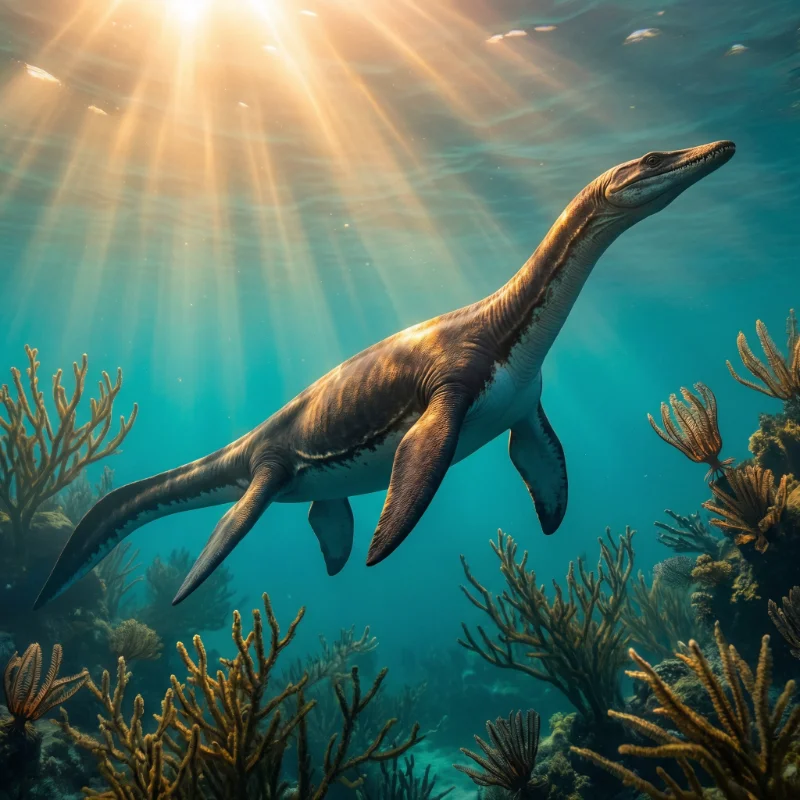
Some popular sources misclassify Thalattoarchon as a "plesiosaur" or a "dinosaur." It is neither. Thalattoarchon is an ichthyosaur (Ichthyosauria), a lineage entirely distinct from plesiosaurs (Sauropterygia) and dinosaurs (Dinosauria). Additionally, widely cited body mass estimates of "about 2 tons" are outdated; the most recent estimate by Sander et al. (2021) places the mass at approximately 4.3 metric tons.
Comparison with Related and Contemporary Taxa
| Taxon | Age | Est. body length | Feeding type | Key features |
|---|---|---|---|---|
| Thalattoarchon saurophagis | Anisian (ca. 244 Ma) | 8.6–9 m | Macropredator | Large bicarinate cutting teeth |
| Cymbospondylus youngorum | Anisian (ca. 246 Ma) | ca. 17 m | Generalist predator | Earliest known giant animal |
| Cymbospondylus petrinus | Anisian | 8–12 m | Generalist predator | Multiple well-preserved specimens |
| Himalayasaurus tibetensis | Norian (Late Triassic) | ca. 15 m (poorly constrained) | Macropredator (inferred) | Bicarinate teeth with longitudinal fluting |
| Temnodontosaurus | Early Jurassic | ca. 9 m | Predator | Some bicarinate teeth, but much smaller |
Thalattoarchon predates Himalayasaurus by at least 13 million years. No post-Triassic ichthyosaur evolved cutting teeth of comparable size. The macropredator niche in subsequent Mesozoic marine ecosystems was filled successively by pliosaurs, thalattosuchians, and mosasaurs (Fröbisch et al., 2013).
Scientific Significance
The discovery of Thalattoarchon provides crucial evidence regarding the pace of marine ecosystem recovery following the Permian–Triassic mass extinction (ca. 252 Ma), the most severe biotic crisis in Earth's history. Marine reptiles first entered the sea around 248 Ma (late Spathian). Thalattoarchon's appearance at approximately 244 Ma therefore places the establishment of a fully structured marine food web, complete with a top-tier macropredatory tetrapod, within only about 8 million years of the extinction event and roughly 4 million years of the initial marine reptile invasion. This suggests that marine trophic networks achieved a level of complexity comparable to modern ecosystems remarkably quickly (Fröbisch et al., 2013). By contrast, full ecological recovery on land may not have been achieved until the Carnian (ca. 237–227 Ma), some 15–25 million years after the extinction, suggesting that marine recovery outpaced terrestrial recovery.
Fun Facts
FAQ
📚References
- Fröbisch, N. B., Fröbisch, J., Sander, P. M., Schmitz, L., & Rieppel, O. (2013). Macropredatory ichthyosaur from the Middle Triassic and the origin of modern trophic networks. Proceedings of the National Academy of Sciences, 110(4), 1393–1397. https://doi.org/10.1073/pnas.1216750110
- Sander, P. M., Griebeler, E. M., Klein, N., Velez Juarbe, J., Wintrich, T., Revell, L. J., & Schmitz, L. (2021). Early giant reveals faster evolution of large body size in ichthyosaurs than in cetaceans. Science, 374(6575), eabf5787. https://doi.org/10.1126/science.abf5787
- Ji, C., Jiang, D.-Y., Motani, R., Rieppel, O., Hao, W.-C., & Sun, Z.-Y. (2016). Phylogeny of the Ichthyopterygia incorporating recent discoveries from South China. Journal of Vertebrate Paleontology, 36(1), e1025956. https://doi.org/10.1080/02724634.2015.1025956
- Moon, B. C. (2017). A new phylogeny of ichthyosaurs (Reptilia: Diapsida). Journal of Systematic Palaeontology, 17(2), 129–155. https://doi.org/10.1080/14772019.2017.1394922
- Naish, D. (2023). Shark-shaped reptiles: The ichthyosaurs and their kin. In Ancient Sea Reptiles: Plesiosaurs, Ichthyosaurs, Mosasaurs, and More (pp. 94–123). Smithsonian Books. ISBN 978-1-58834-727-5.
- Nichols, K. M., & Silberling, N. J. (1977). Stratigraphy and depositional history of the Star Peak Group (Triassic), northwestern Nevada. Geological Society of America Special Papers, 178, 1–74. https://doi.org/10.1130/SPE178-p1
- Klein, N., Schmitz, L., Wintrich, T., & Sander, P. M. (2020). A new cymbospondylid ichthyosaur (Ichthyosauria) from the Middle Triassic (Anisian) of the Augusta Mountains, Nevada, USA. Journal of Systematic Palaeontology, 18(14), 1167–1191. https://doi.org/10.1080/14772019.2020.1748132
- Smith, N. D., Klein, N., Sander, P. M., & Schmitz, L. (2024). A new pseudosuchian from the Favret Formation of Nevada reveals that archosauriforms occupied coastal regions globally during the Middle Triassic. Biology Letters, 20(7), 20240136. https://doi.org/10.1098/rsbl.2024.0136
- Sander, P. M. (2000). Ichthyosauria: their diversity, distribution, and phylogeny. Paläontologische Zeitschrift, 74(1), 1–35. https://doi.org/10.1007/BF02987949
- Gutarra, S., Moon, B. C., Rahman, I. A., Palmer, C., Lautenschlager, S., Brimacombe, A. J., & Benton, M. J. (2019). Effects of body plan evolution on the hydrodynamic drag and energy requirements of swimming in ichthyosaurs. Proceedings of the Royal Society B, 286(1898), 20182786. https://doi.org/10.1098/rspb.2018.2786
- Bindellini, G., Wolniewicz, A. S., Miedema, F., Scheyer, T. M., & Dal Sasso, C. (2021). Cranial anatomy of Besanosaurus leptorhynchus Dal Sasso & Pinna, 1996 (Reptilia: Ichthyosauria) from the Middle Triassic Besano Formation of Monte San Giorgio, Italy/Switzerland. PeerJ, 9, e11179. https://doi.org/10.7717/peerj.11179
- Jiang, D.-Y., Motani, R., Huang, J.-D., Tintori, A., Hu, Y.-C., Rieppel, O., Fraser, N. C., Ji, C., Kelley, N. P., Fu, W.-L., & Zhang, R. (2020). Evidence supporting predation of 4-m marine reptile by Triassic megapredator. iScience, 23(9), 101347. https://doi.org/10.1016/j.isci.2020.101347
- Massare, J. A. (1987). Tooth morphology and prey preference of Mesozoic marine reptiles. Journal of Vertebrate Paleontology, 7(2), 121–137.
- Motani, R. (2009). The evolution of marine reptiles. Evolution: Education and Outreach, 2, 224–235. https://doi.org/10.1007/s12052-009-0139-y
- Sander, P. M., Rieppel, O. C., & Bucher, H. (1994). New marine vertebrate fauna from the Middle Triassic of Nevada. Journal of Paleontology, 68(3), 676–680. https://doi.org/10.1017/S0022336000026020
Gallery
5 images Thalattoarchon
Thalattoarchon · Triassic Period · Carnivore
 Thalattoarchon
Thalattoarchon · Triassic Period · Carnivore
 Thalattoarchon
Thalattoarchon · Triassic Period · Carnivore
 Thalattoarchon
Thalattoarchon · Triassic Period · Carnivore
 Thalattoarchon
Thalattoarchon · Triassic Period · Carnivore
🔗Related Creatures
Shonisaurus
Shonisaurus popularis
Luperosuchus
Luperosuchus fractus
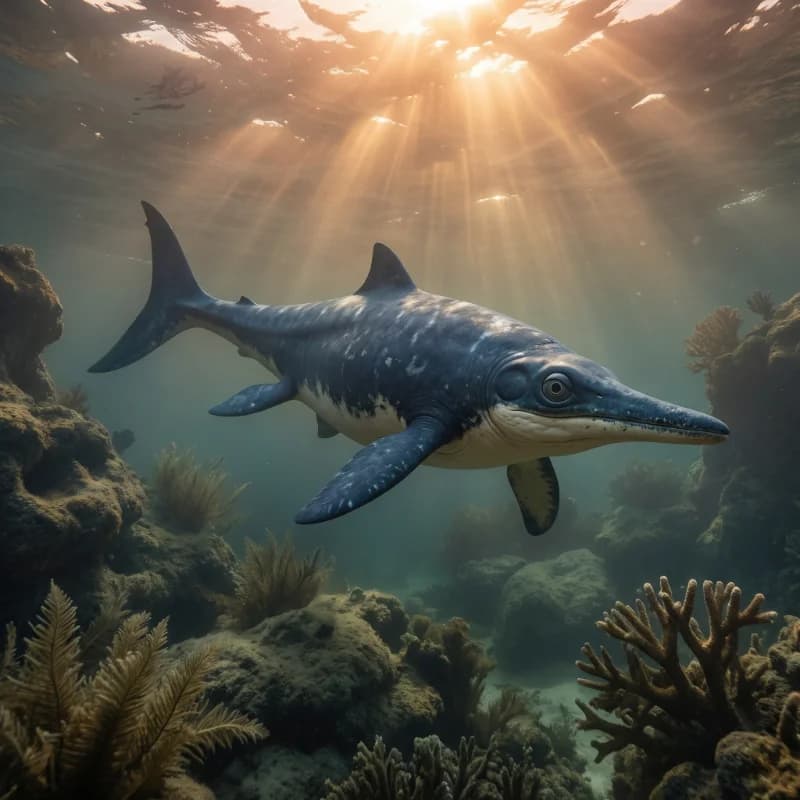
Temnodontosaurus
Temnodontosaurus
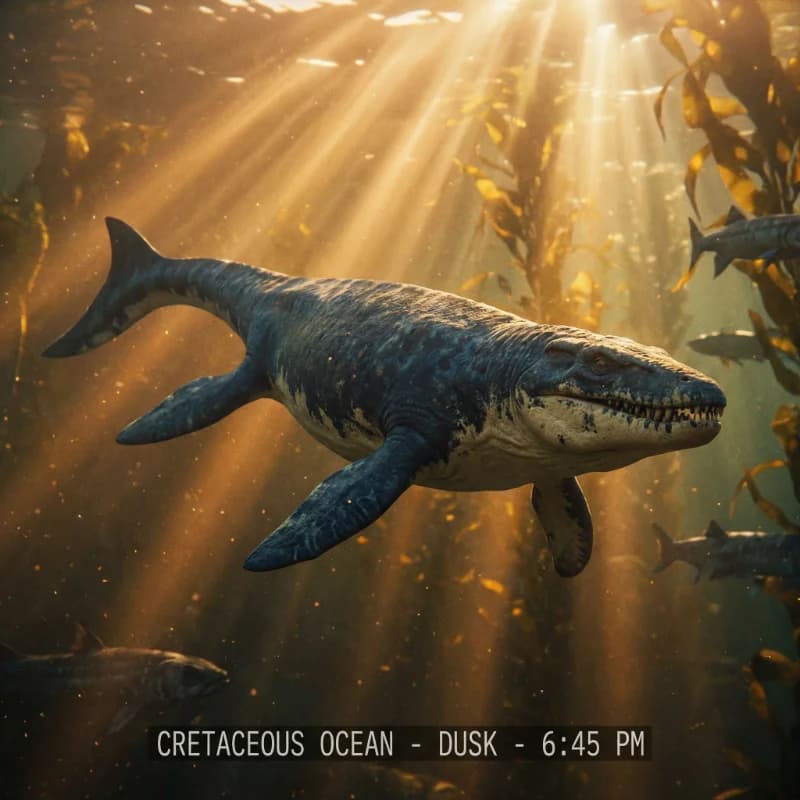
Prognathodon
Prognathodon
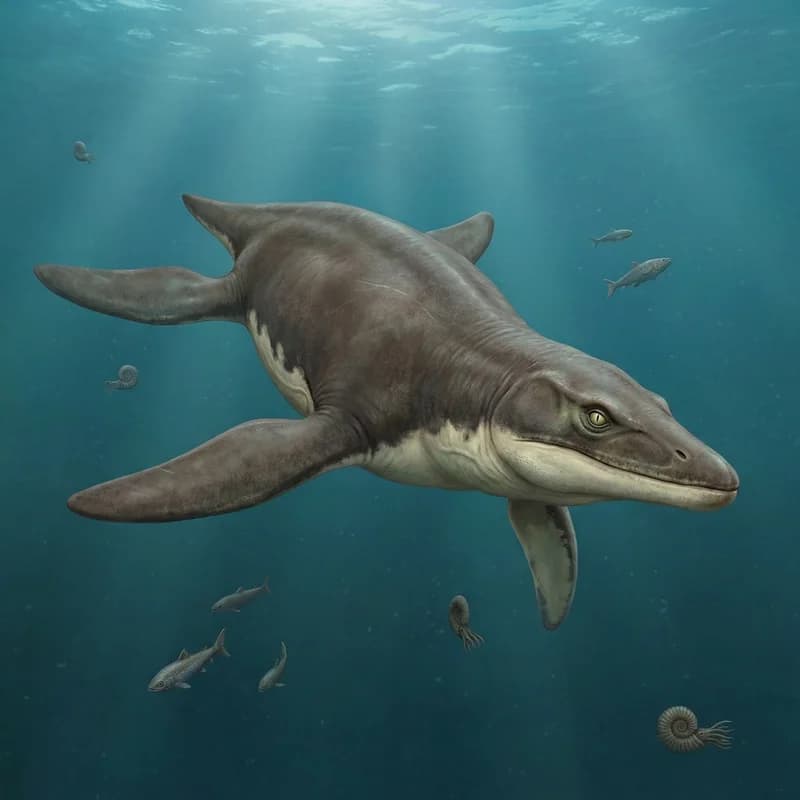
Liopleurodon
Liopleurodon ferox
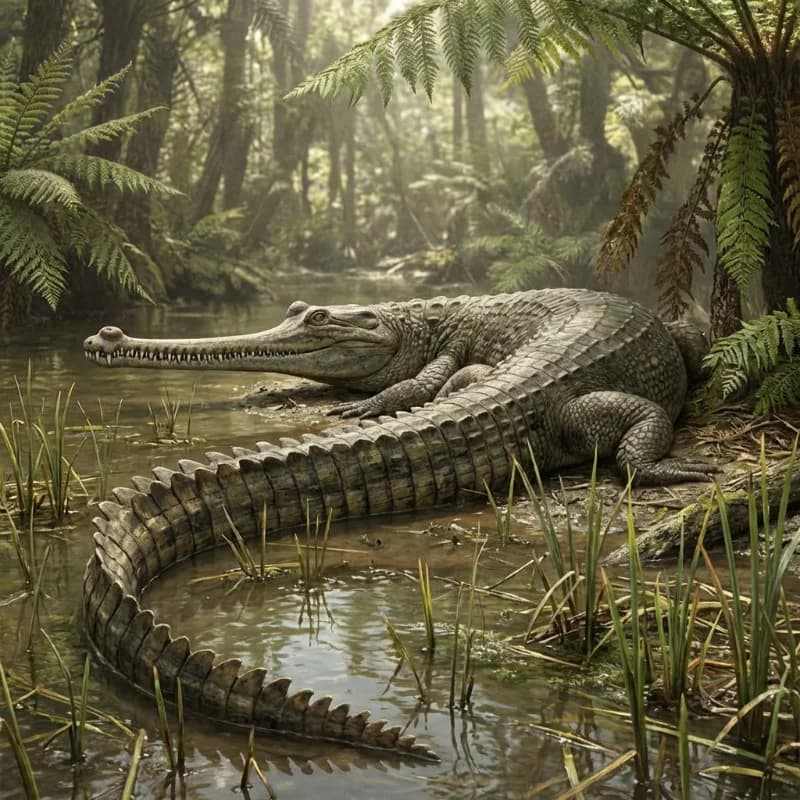
Mystriosuchus
Mystriosuchus planirostris
Tanystropheus
Tanystropheus longobardicus
Nothosaurus
Nothosaurus mirabilis