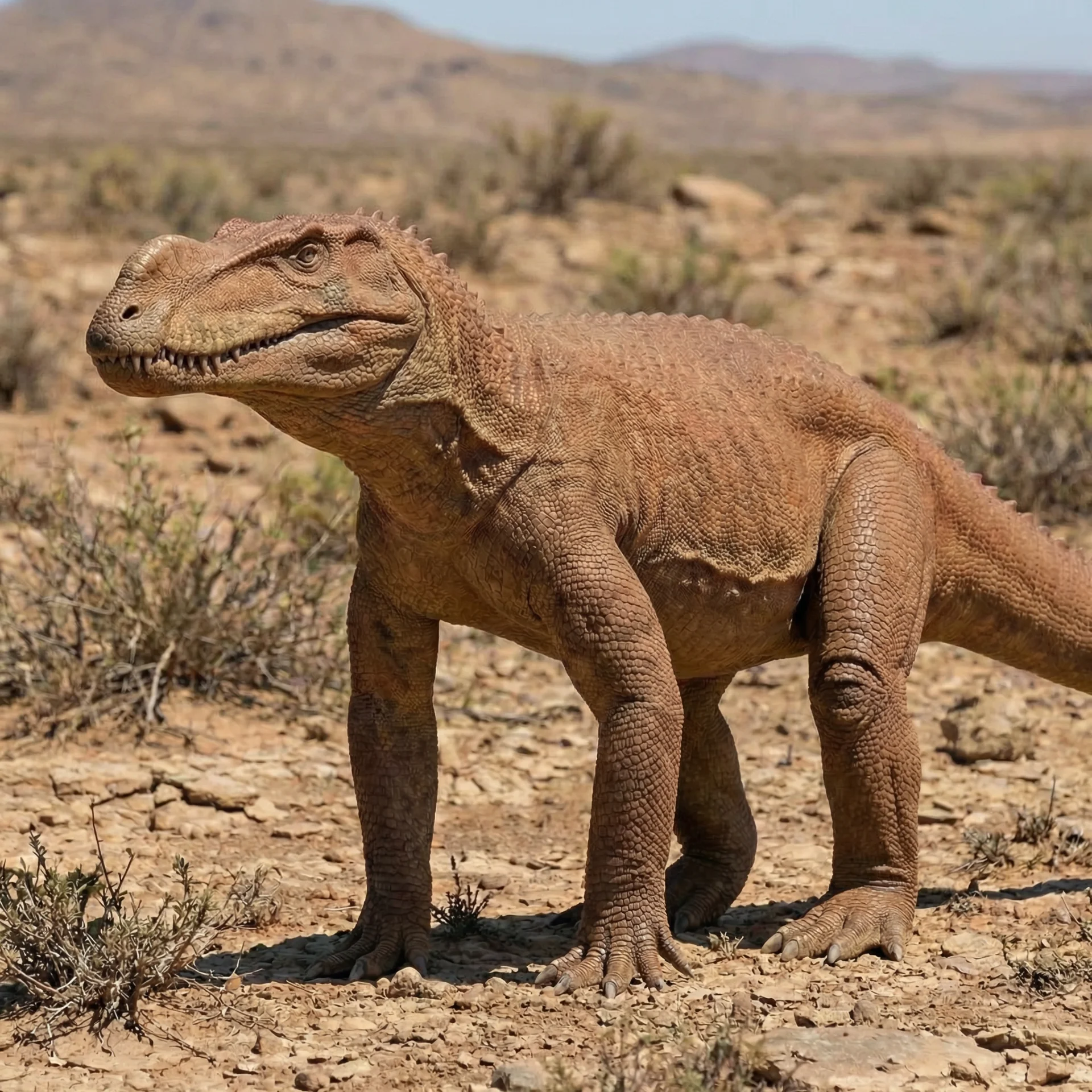
Luperosuchus
Luperosuchus fractus
⏳ Triassic Period🍽️ CarnivoreDinosaurs
Physical Characteristics
⏳
PeriodTriassic Period
🍽️
DietCarnivore
📏
Size3.7~4.4m
Classification
GEN
GenusLuperosuchus
SP
SpeciesL. fractus
Luperosuchus fractus
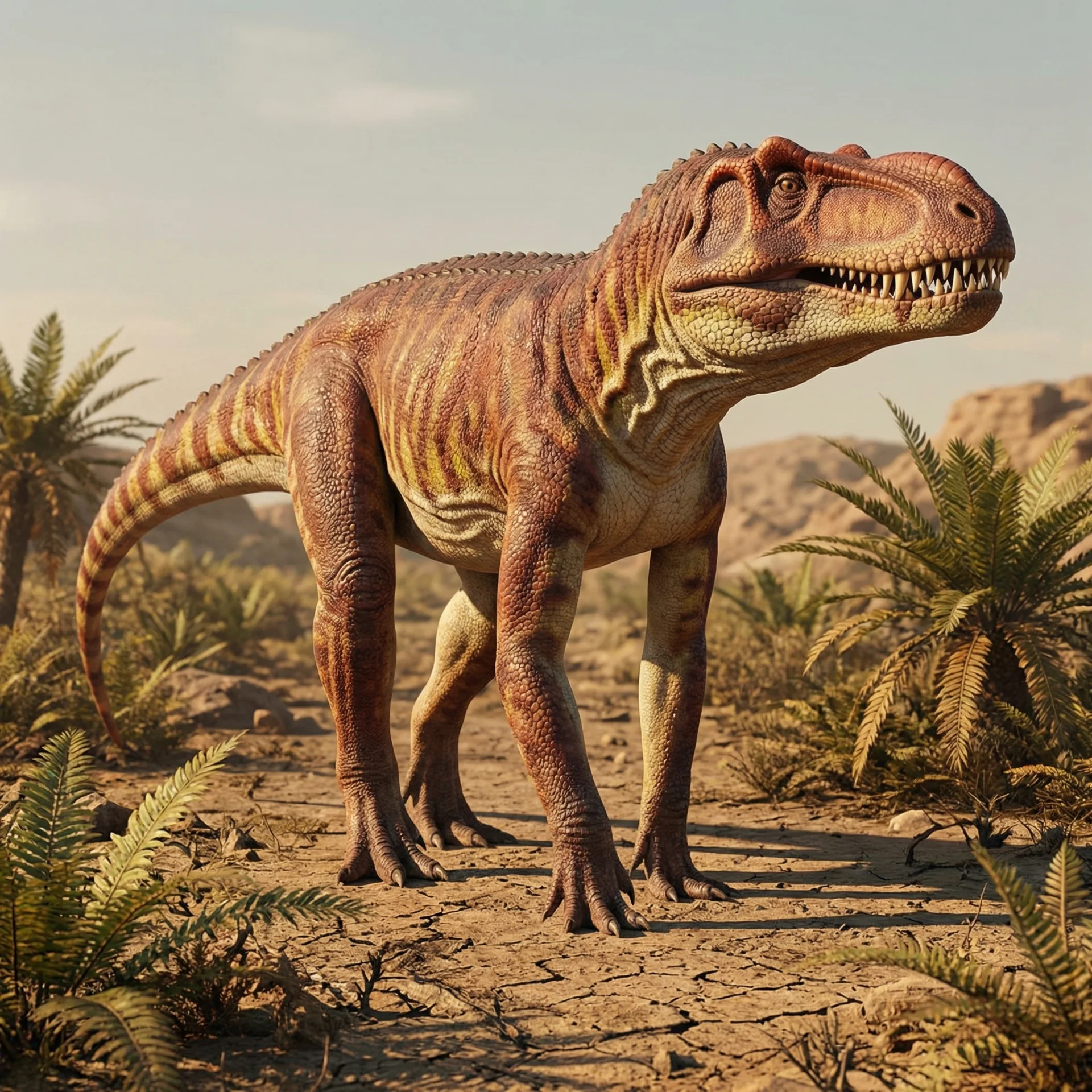
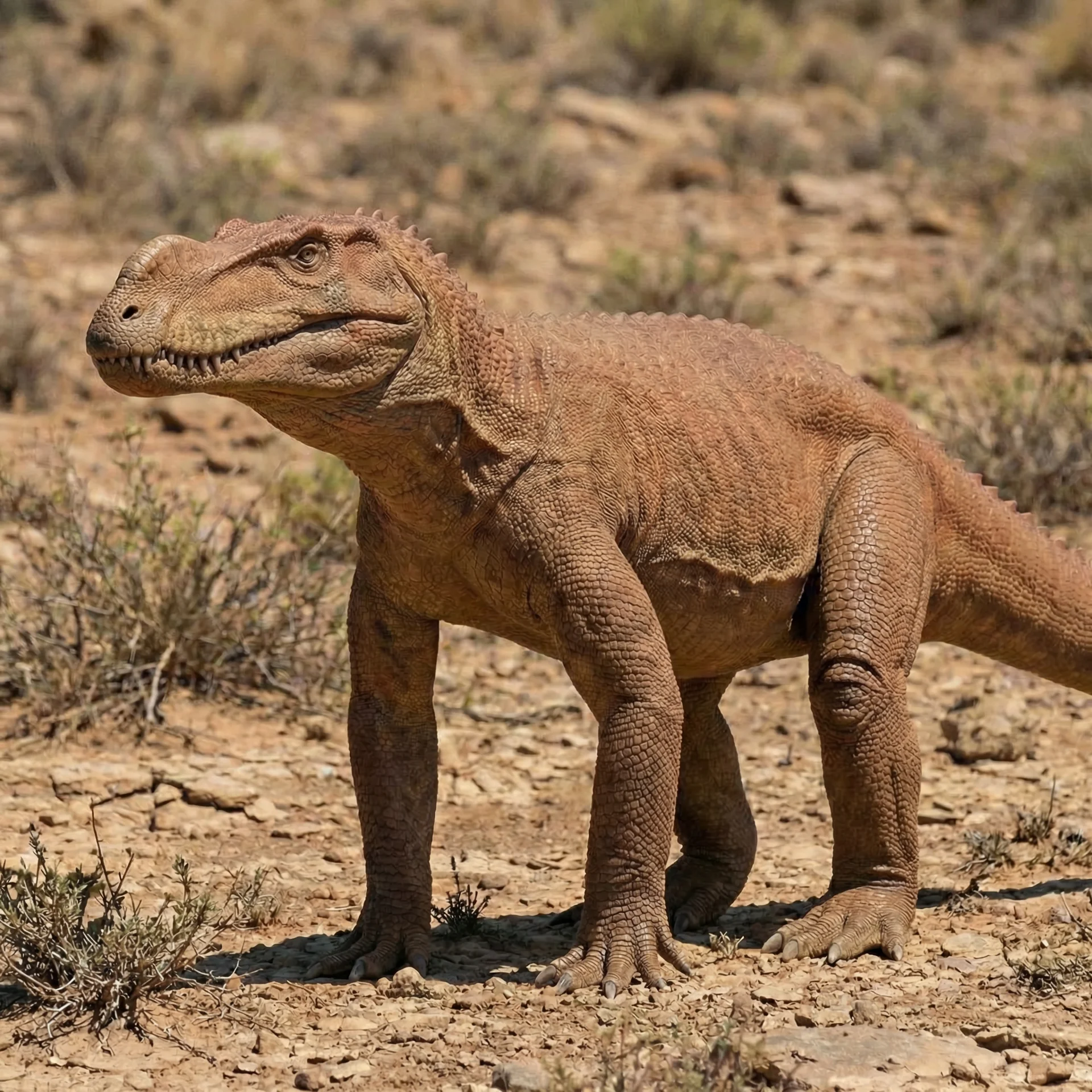
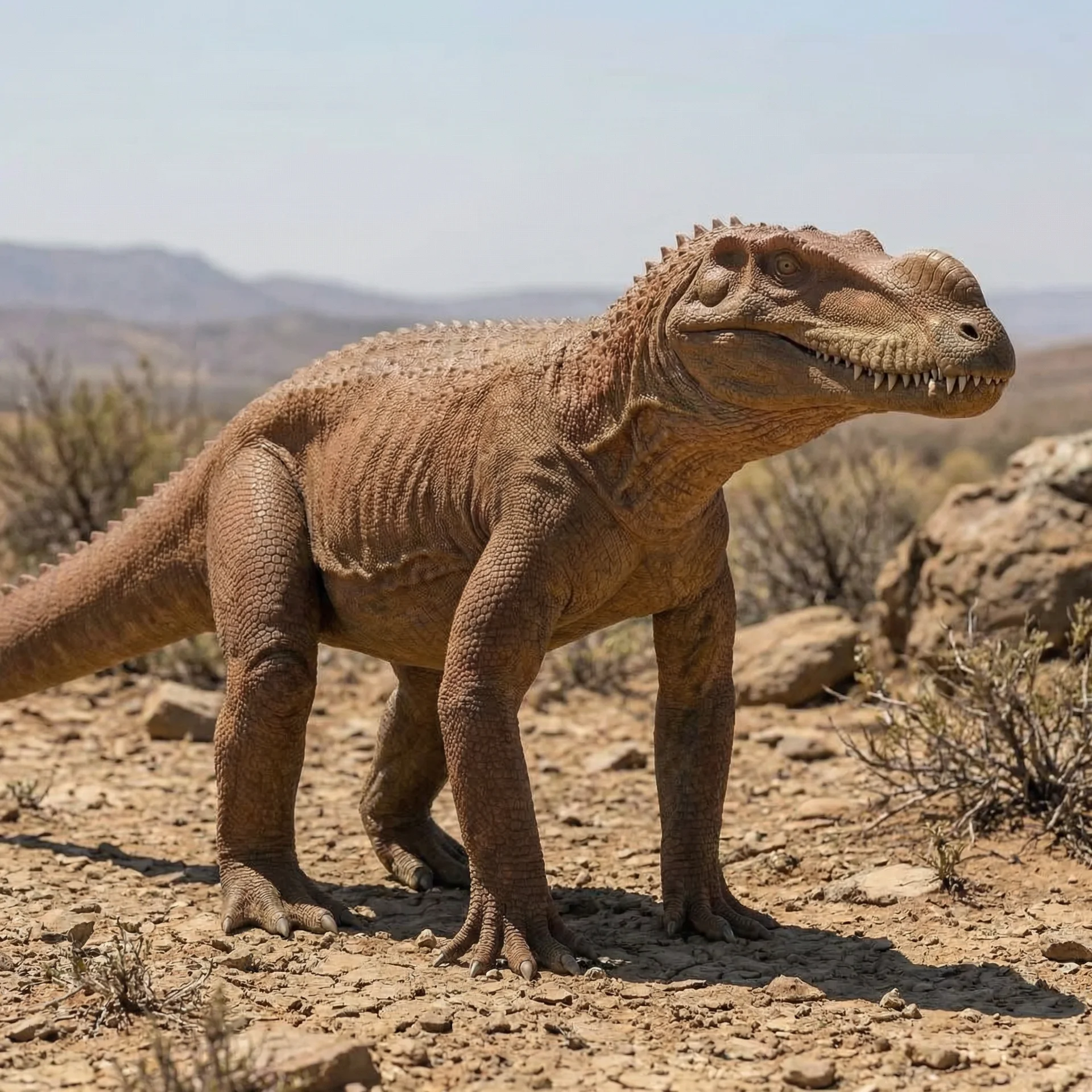
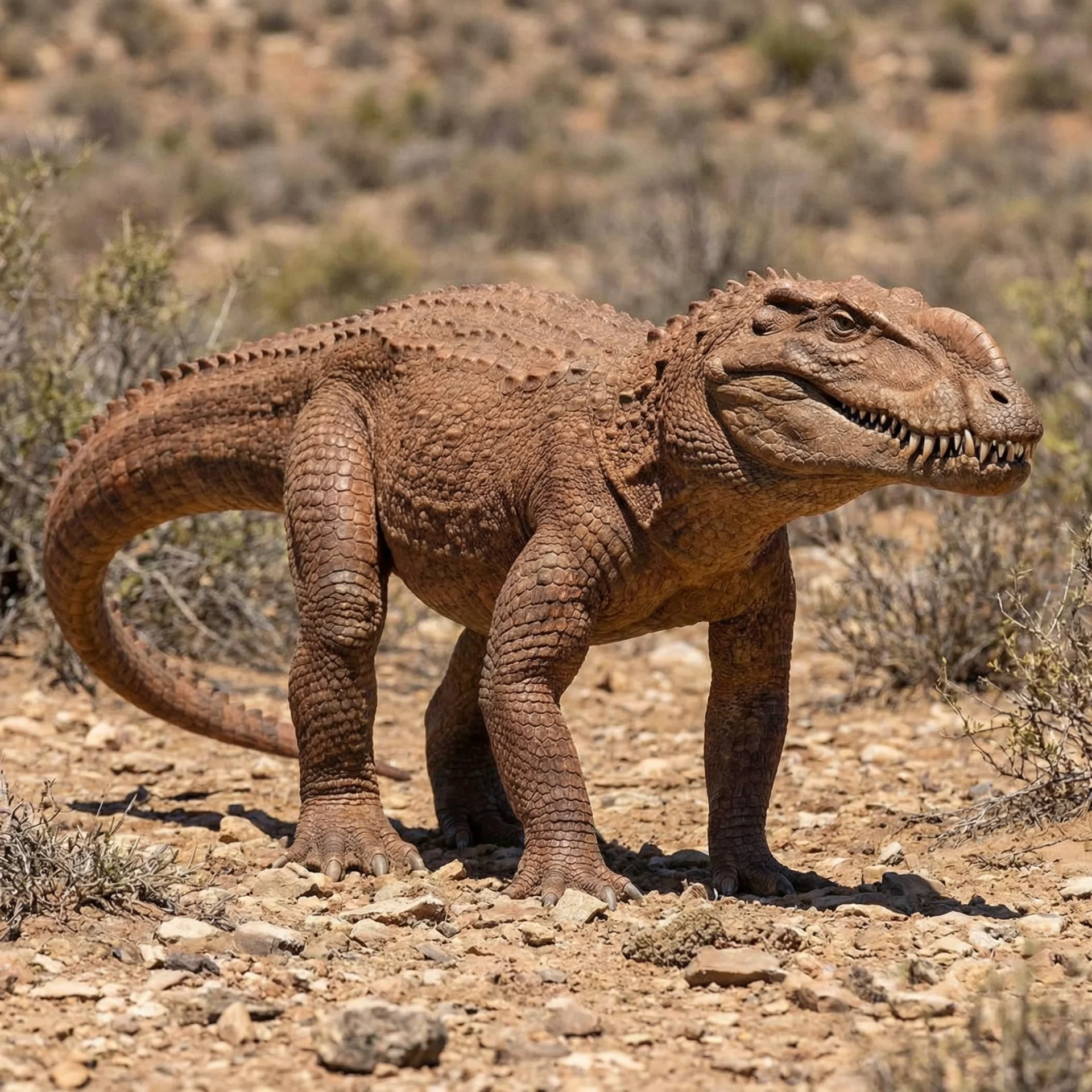
Luperosuchus (Luperosuchus fractus Romer, 1971) is a large pseudosuchian archosaur from the latest Middle to earliest Late Triassic (late Ladinian to early Carnian, approximately 236–235 Ma) of what is now northwestern Argentina. It belongs to the clade Loricata, a group traditionally known as 'rauisuchians.' The only species, L. fractus, is known from the Chañares Formation of La Rioja Province, and the holotype — an incomplete skull (specimen PULR 04) — remains the only material confidently assigned to this genus.
Luperosuchus was one of the largest carnivores in the Chañares Formation, with an estimated skull length of approximately 60 cm. However, the extremely fragmentary preservation of the skull delayed clarification of its taxonomic position for decades. The genus name Luperosuchus derives from the Greek lyperos ('vexing,' 'difficult') and souchos ('crocodile'), while the species name fractus is Latin for 'broken' — directly reflecting the fossil's fragmentary condition.
The most distinctive anatomical features of this genus are three autapomorphies identified by Nesbitt & Desojo (2017): a dorsally convex and mediolaterally compressed crest on the anterior nasal (the 'roman-nose'), a convex circular knob on the dorsolateral margin of the postorbital, and a long anterior process of the prefrontal that fails to reach the anterior end of the frontal. Phylogenetic analysis in 2017 confirmed Luperosuchus as a loricatan closely related to the other large South American forms Prestosuchus and Saurosuchus.
The genus name Luperosuchus is a combination of the Greek lyperos (λυπηρός, 'vexing,' 'difficult,' 'troublesome') and the Greco-Egyptian souchos (σοῦχος, 'crocodile'). The species epithet fractus is Latin for 'broken.' Romer (1971) chose this name because the holotype fossil was extremely fragmentary and difficult to interpret, effectively encoding his frustration into the formal binomial name — which translates in full to 'vexing crocodile, broken.'
Luperosuchus is currently recognized as a valid genus containing a single species, L. fractus. In his original description, Romer (1971) tentatively placed it in the family Rauisuchidae (or Prestosuchidae), but for the following decades it was largely excluded from formal phylogenetic analyses and treated as an indeterminate pseudosuchian. Nesbitt & Desojo (2017) provided the first detailed redescription and incorporated it into a quantitative cladistic analysis, confirming its position within Loricata. A second specimen, PULR-V 057, was referred to Luperosuchus by Desojo & Arcucci (2009) but was reinterpreted as a separate taxon in 2017, and was eventually named Telkaralura coniceti (Gracilisuchidae) by von Baczko et al. (2025).
Luperosuchus is a rare, large carnivorous pseudosuchian from the early phase of the archosaur radiation, and is inferred to have been one of the top predators in the Tarjadia Assemblage Zone of the Chañares Formation.
The holotype of Luperosuchus was recovered from the upper part of the lower member of the Chañares Formation. Ezcurra et al. (2017) assigned the specimen to the base of the formation, within the relatively fossil-poor Tarjadia Assemblage Zone. CA-TIMS U-Pb dating by Marsicano et al. (2016) yielded an age of 236.1 ± 0.6 Ma from a siltstone bed situated above the Luperosuchus locality, providing a minimum age for the specimen. The temporal range of Luperosuchus is therefore estimated at approximately 236.7–235.5 Ma (latest Ladinian to earliest Carnian), though the precise placement of the Ladinian-Carnian boundary within the lowermost Chañares Formation remains uncertain.
The Chañares Formation is the lowermost unit of the Agua de la Peña Group in the Ischigualasto-Villa Unión Basin. It unconformably overlies the red fluvial sediments of the Tarjados Formation (Paganzo Group) and is conformably overlain by the Los Rastros Formation. Its total thickness is approximately 70 m. The lithology is dominated by olive-grey to bluish-grey claystone, siltstone, and sandstone, with volcaniclastic material (tuff, volcanic ash, bentonite) increasing upsection (Rogers et al., 2001; Mancuso et al., 2014).
The lower olive-grey interval where Luperosuchus was found corresponds to a braided fluvial depositional system, characterized by alternating tabular flood deposits of sandstone and siltstone with weakly developed palaeosols.
The lower Chañares Formation records a semi-arid to temperate braided river floodplain environment. Palynological analysis indicates that the vegetation was dominated by umkomasialean seed fern pollen, with subsidiary podocarpacean and voltzialean conifer pollen, corresponding to the Dicroidium flora characteristic of other late Ladinian–early Carnian units (Pérez Loinaze et al., 2018). Higher in the section, the depositional environment shifted dramatically due to repeated volcanic events — lahars, ash falls, and pyroclastic flows — which transformed the system into a volcaniclastic-dominated floodplain. The Tarjadia Assemblage Zone, from which Luperosuchus is derived, predates these volcanic mass-mortality events and represents a comparatively fossil-poor interval.
| Item | Details |
|---|---|
| Formation | Chañares Formation, lower member, Tarjadia AZ |
| Age | Approximately 236.7–235.5 Ma (latest Ladinian to earliest Carnian; estimated) |
| Lithology | Olive-grey sandstone, siltstone, claystone (braided fluvial deposits) |
| Paleoenvironment | Semi-arid to temperate braided river floodplain with periodic flooding |
| Dating basis | Marsicano et al. (2016): 236.1 ± 0.6 Ma from overlying siltstone (U-Pb) |
The holotype and only confidently referred specimen of Luperosuchus is PULR 04, housed at the La Plata Museum (Museo de La Plata) in La Plata, Argentina. It was collected on January 17, 1965, by Ruth Romer, wife of palaeontologist Alfred S. Romer, from a locality approximately 5 km northeast of where the Chañares River emerges onto the Plano de Talampaya. The specimen was found adjacent to the remains of a large dicynodont (Jensen, 2001). Romer published the original description in 1971, and Nesbitt & Desojo (2017) later rediscovered and re-examined additional bone fragments from the original excavation, referring portions of the maxilla, quadrate, braincase fragments, and the atlas intercentrum — the only postcranial element — to the same individual.
| Specimen | Composition | Repository | Notes |
|---|---|---|---|
| PULR 04 (holotype) | Incomplete skull (skull roof, nasals, maxilla, partial premaxilla) + atlas intercentrum + braincase fragments | La Plata Museum, Argentina | Only confirmed specimen. Preserved length 54.5 cm; estimated complete length approximately 60 cm |
| PULR-V 057 (not referred) | Anterior portion of skull | PULR | Referred in 2009; removed in 2017; renamed Telkaralura coniceti in 2025 |
Nesbitt & Desojo (2017) identified three autapomorphies for Luperosuchus.
First, the anterior portion of the nasal is dorsally convex and mediolaterally compressed, forming a prominent crest. Romer (1971) described this structure as a 'roman-nose,' and while similar features occur in Prestosuchus and Batrachotomus, it is most pronounced in Luperosuchus.
Second, there is a convex, circular knob on the dorsolateral margin of the postorbital.
Third, the prefrontal has a long anterior process extending forward above the lacrimal, but this process fails to reach the anterior end of the frontal.
The primary limitation of Luperosuchus is that the holotype is restricted to a partial skull and a single atlas intercentrum. No postcranial skeleton is definitively known. Large osteoderms from the same region that Romer (1971) tentatively attributed to this genus were later reassigned to the contemporary erpetosuchid Tarjadia by Arcucci & Marsicano (1998). A limb bone (MCZ 4077) reported by Ricqlès et al. (2008) in a histological study as belonging to Luperosuchus was also found to lack a confident link to the holotype and was subsequently referred to Tarjadia ruthae (Ezcurra et al., 2017). The skull sutures are largely obliterated due to a combination of fusion in a mature individual and the application of consolidants to the specimen surface during preparation, which obscure finer anatomical detail.
The preserved portion of the holotype skull measures 54.5 cm in length. With the missing anterior and posterior regions restored, the complete skull length is estimated at approximately 60 cm (Romer, 1971; Nesbitt & Desojo, 2017). This made Luperosuchus one of the largest animals in the Chañares Formation, exceeded in size only by the dicynodonts.
Because no postcranial skeleton is known, body length estimates rely entirely on proportional comparisons with close relatives. Scaling based on generalized 'rauisuchian' proportions yields an estimate of approximately 4.1–4.4 m, while scaling based on Prestosuchus produces a smaller estimate of approximately 3.7 m. All of these figures are indirect estimates and carry substantial uncertainty. No formal body mass estimate has been published in the scientific literature.
Snout and nasal region: The snout is narrow and pointed, with a tall maxilla. The posterodorsal process of the premaxilla articulates with the nasal, excluding the maxilla from the external naris. The nasals rise sharply upward anteriorly, with the conjoined nasals forming a sharp, mediolaterally compressed ridge — the 'roman-nose.' A narrow slit between the premaxilla and maxilla was observed in the specimen, but Nesbitt & Desojo (2017) interpreted this as a postmortem artifact rather than a genuine anatomical opening.
Orbital and temporal region: The orbit is tall with smooth boundaries, lacking the 'keyhole' shape typical of many other loricatans. The upper part of the infratemporal fenestra was tall and narrow, though it may have widened near the unpreserved lower rear corner of the skull. A small palpebral bone is fused to the frontal and postfrontal above the orbit.
Antorbital fenestra: Only a small, rounded anterior portion of the antorbital fenestra is preserved, but based on the skull's height, it was likely triangular overall. The surrounding antorbital fossa was deeply excavated.
The absence of postcranial material precludes direct inference of locomotion. However, comparison with close loricatan relatives (Prestosuchus, Saurosuchus, Batrachotomus) suggests that Luperosuchus was a quadrupedal, semi-erect terrestrial predator (hypothesis). The functional role of the 'roman-nose' crest remains unclear; species recognition signaling, sexual dimorphism, and structural reinforcement have all been proposed, but none has been confirmed.
Luperosuchus is strongly inferred to have been carnivorous (well-supported inference), consistent with its close loricatan relatives. Romer (1971) noted that the anteroventral region of the maxilla was thickened and internally excavated, indicating the insertion site of a series of large, probably subthecodont anterior maxillary teeth. No direct dietary evidence — such as stomach contents, bite marks, or stable isotope data — is known, so the carnivorous diet is based on dental morphology and phylogenetic inference.
Within the Tarjadia Assemblage Zone of the Chañares Formation, Luperosuchus likely shared the apex predator niche with the large erpetosuchid Tarjadia. Potential prey included large herbivorous dicynodonts (kannemeyeriiforms), small burrowing cynodonts, and rhynchosaurs. The same assemblage zone also preserves a smaller loricatan represented by PULR-V 057 (now Telkaralura) and indeterminate specimens of very large paracrocodylomorphs, suggesting considerable predator diversity within the ecosystem (Ezcurra et al., 2017).
The major components of the Tarjadia Assemblage Zone include: large kannemeyeriiform dicynodonts (possibly referable to Dinodontosaurus), the large erpetosuchid Tarjadia ruthae, small non-massetognathine cynodonts (similar to Aleodon and Scalenodon), rhynchosaurs (Elorhynchus), and indeterminate large paracrocodylomorphs. The overlying and more famous Massetognathus-Chanaresuchus Assemblage Zone — which includes early ornithodirans such as Lagerpeton, Marasuchus, and Lewisuchus, as well as Gracilisuchus — is stratigraphically and temporally distinct from the interval that produced Luperosuchus.
Luperosuchus is known exclusively from a single locality within the Chañares Formation, La Rioja Province, Argentina. The site is located approximately 5 km northeast of where the Chañares River emerges onto the Plano de Talampaya, within the present-day Talampaya National Park (a UNESCO World Heritage Site).
The Triassic paleocoordinates of the Chañares Formation are estimated at approximately 49.9°S, 37.8°W. This places the locality within the southwestern sector of Pangaea, in the mid- to high-latitude zone of southern Gondwana. The Ischigualasto-Villa Unión Basin was a rift basin that formed along the western margin of the South American craton during the early stages of Pangaea's breakup.
In his original description, Romer (1971) tentatively assigned Luperosuchus to the Rauisuchidae (or Prestosuchidae), noting that the material was too fragmentary for extended discussion of relationships. For the following decades, the genus was excluded from nearly all formal phylogenetic analyses of Triassic pseudosuchians, likely due to its poor preservation and the paucity of diagnostic characters. It was typically assigned to 'Rauisuchia' on the basis of general similarities, without rigorous justification.
In 2017, Nesbitt & Desojo incorporated Luperosuchus into a quantitative cladistic analysis for the first time, using Nesbitt's (2011) comprehensive archosaur dataset. The analysis recovered Luperosuchus at the base of Loricata, forming a clade with two other South American loricatans: Saurosuchus galilei and Prestosuchus chiniquensis. Two equally parsimonious hypotheses were obtained for the precise position of Luperosuchus: (1) sister taxon to a Saurosuchus + Prestosuchus clade, and (2) sister taxon to Saurosuchus alone.
Ezcurra et al. (2017), in their study of the Chañares vertebrate fauna, used Ezcurra's (2016) archosauromorph dataset and recovered Luperosuchus as the sister taxon of Decuriasuchus from Brazil. This clade was united by a prominent vertical peg on the supraoccipital of the braincase. The Luperosuchus + Decuriasuchus clade was placed outside of a more restricted Paracrocodylomorpha, crownward of Ticinosuchus and stemward of Prestosuchus.
Da-Silva et al. (2018, Historical Biology) combined multiple phylogenetic datasets in their study of a new Prestosuchus specimen. Their most parsimonious tree did not fully support the Luperosuchus + Saurosuchus + Prestosuchus clade, although they noted that this grouping was only marginally less optimal than their MPT. In their preferred topology, the three taxa were arranged in a pectinate series leading to more crownward loricatans, with Prestosuchus at the base (stemward), Saurosuchus in the middle, and Luperosuchus at the top (crownward), just below Batrachotomus.
Desojo et al. (2020), in their detailed revision of the Prestosuchus type material, recovered a monophyletic Prestosuchidae that included Saurosuchus galilei, Luperosuchus fractus, Prestosuchus chiniquensis, and several additional specimens.
| Study | Phylogenetic Position of Luperosuchus | Key Result |
|---|---|---|
| Nesbitt & Desojo (2017) | Basal Loricata; sister to Saurosuchus + Prestosuchus | First formal analysis; two equally parsimonious hypotheses |
| Ezcurra et al. (2017) | Sister taxon to Decuriasuchus; outside restricted Paracrocodylomorpha | United by supraoccipital vertical peg synapomorphy |
| Da-Silva et al. (2018) | Just below Batrachotomus in a loricatan grade | Prestosuchus-Saurosuchus-Luperosuchus clade not fully supported |
| Desojo et al. (2020) | Within monophyletic Prestosuchidae | Prestosuchidae monophyly recovered |
The identification of Luperosuchus as a large pseudosuchian archosaur belonging to Loricata is well established following the redescription by Nesbitt & Desojo (2017). The three autapomorphies ('roman-nose,' postorbital knob, prefrontal process) are confirmed as diagnostic. The estimated skull length of approximately 60 cm and the provenance from the Tarjadia Assemblage Zone of the Chañares Formation are also established facts.
The close phylogenetic relationship with Prestosuchus and Saurosuchus within Loricata is consistently supported across multiple analyses, though the precise topology varies. The carnivorous diet is a well-supported inference based on dental morphology and phylogenetic bracketing.
The body length estimate of approximately 3.7–4.4 m is an indirect inference derived from proportional scaling with related taxa, and carries substantial uncertainty given the complete absence of postcranial material. No formal body mass estimate has been published. The function of the 'roman-nose' crest, the presence or absence of osteoderms, and the precise locomotor posture all remain uncertain.
Luperosuchus is a taxon with very low public recognition. Some non-academic sources occasionally misidentify it as a dinosaur or depict it with a complete skeleton, but in reality it is a pseudosuchian (crocodile-line archosaur) known only from a partial skull — it is not a dinosaur and belongs to the lineage leading to modern crocodilians, not to birds.
The table below compares Luperosuchus with closely related loricatan taxa.
| Taxon | Age | Locality | Estimated body length | Skull length | Key features |
|---|---|---|---|---|---|
| Luperosuchus fractus | Latest Ladinian–earliest Carnian | Argentina, Chañares Fm. | Approximately 3.7–4.4 m (estimated) | Approximately 60 cm (estimated) | Roman-nose crest; postorbital circular knob |
| Prestosuchus chiniquensis | Ladinian–Carnian | Brazil, Santa Maria Fm. | Approximately 5–7 m | Approximately 60–70 cm | Semi-erect posture; abundant postcranial material |
| Saurosuchus galilei | Carnian | Argentina, Ischigualasto Fm. | Approximately 5.5–7 m | Approximately 60+ cm | One of the largest basal loricatans |
| Batrachotomus kupferzellensis | Ladinian | Germany, Erfurt Fm. | Approximately 6 m | Approximately 45–50 cm | European; extensive skeletal material |
| Decuriasuchus quartacolonia | Ladinian | Brazil, Santa Maria Fm. | Approximately 2.5–3 m | Approximately 30–40 cm | Mass burial of 10+ individuals; sister taxon hypothesis with Luperosuchus |
| Item | Details |
|---|---|
| Binomial name | Luperosuchus fractus Romer, 1971 |
| Classification | Archosauria: Pseudosuchia: Loricata (Prestosuchidae) |
| Age | Latest Middle to earliest Late Triassic (approximately 236.7–235.5 Ma) |
| Formation | Chañares Formation, lower member, Tarjadia AZ |
| Locality | La Rioja Province, Argentina |
| Holotype | PULR 04 (incomplete skull + atlas intercentrum) |
| Repository | La Plata Museum (Museo de La Plata) |
| Namer | Alfred Sherwood Romer |
| Year named | 1971 |
| Estimated body length | Approximately 3.7–4.4 m (based on relative proportions; hypothesis) |
| Estimated skull length | Approximately 60 cm |
| Diet | Carnivorous (dental morphology and phylogenetic inference; well-supported) |
| Autapomorphies | Roman-nose crest; postorbital circular knob; prefrontal anterior process falling short of frontal |
The scientific name Luperosuchus fractus literally means 'vexing crocodile, broken' — the namer, Romer, encoded his frustration with the fragmentary fossil directly into the formal binomial.
The holotype was found right next to the skeleton of a large dicynodont (a mammal-relative), and Romer could not determine whether nearby bone scraps belonged to Luperosuchus or the dicynodont.
The 'roman-nose' crest formed by the nasal bones of Luperosuchus is the most extreme example of this structure known among loricatans.
The person who actually collected the holotype fossil in 1965 was Ruth Romer, the wife of palaeontologist Alfred S. Romer.
A specimen once attributed to Luperosuchus as a juvenile (PULR-V 057) was reclassified in 2025 as an entirely different family — the gracilisuchid Telkaralura coniceti.
Luperosuchus was not included in any quantitative phylogenetic analysis until 2017, a full 46 years after it was first named — a testament to how long fragmentary fossils can remain taxonomically unresolved.
Large osteoderms (bony armor plates) originally attributed to Luperosuchus were later reassigned to the erpetosuchid Tarjadia, leaving the question of whether Luperosuchus had body armor unresolved.
The Chañares Formation, where Luperosuchus was found, is one of the most important geological formations for understanding the origin of dinosaurs — it has yielded some of the oldest dinosauriforms, including Lagerpeton and Marasuchus.
Most skull sutures in the holotype are obliterated, and past conservation treatments with consolidants further obscured the bone surfaces, making anatomical study exceptionally challenging.
Despite often being lumped with dinosaurs in popular media, Luperosuchus is a crocodile-line archosaur — part of the group that dominated the top predator niche before dinosaurs rose to prominence in the Late Triassic.
No. Luperosuchus is a pseudosuchian — a crocodile-line archosaur — not a dinosaur. Dinosaurs belong to the bird-line archosaurs (Avemetatarsalia), while Luperosuchus belongs to Loricata, a group within Pseudosuchia that is more closely related to modern crocodilians than to dinosaurs.
Very incomplete. The only confidently referred specimen is the holotype PULR 04, which consists of portions of the skull roof, the left side of the 'face,' and a single atlas intercentrum. No postcranial skeleton (body, limbs, tail) is definitively known for this genus.
The estimated complete skull length is approximately 60 cm, making it one of the largest animals in the Chañares Formation aside from dicynodonts. Body length is estimated at approximately 3.7–4.4 m based on proportional comparisons with relatives, but this is an indirect estimate with substantial uncertainty due to the absence of postcranial material.
The most distinctive feature of Luperosuchus is a dorsally convex, mediolaterally compressed crest formed by the nasal bones on the front of the snout. Romer (1971) first described this structure, and Nesbitt & Desojo (2017) confirmed it as an autapomorphy. Similar structures are found in Prestosuchus and Batrachotomus, but it is most pronounced in Luperosuchus.
In the Tarjadia Assemblage Zone of the Chañares Formation, Luperosuchus coexisted with large kannemeyeriiform dicynodonts, the large erpetosuchid predator Tarjadia, small burrowing cynodonts, rhynchosaurs (Elorhynchus), and indeterminate large paracrocodylomorphs. The famous Massetognathus-Chanaresuchus Assemblage Zone — which includes early dinosauriforms such as Lagerpeton and Marasuchus — is from a slightly younger stratigraphic level.
In 2009, Desojo & Arcucci referred this specimen to Luperosuchus as a juvenile. However, Nesbitt & Desojo (2017) reinterpreted the size differences and less-developed 'roman-nose' as taxonomic rather than ontogenetic differences. The specimen was eventually named as a new genus, Telkaralura coniceti, belonging to the family Gracilisuchidae, by von Baczko et al. (2025).
Its placement within Loricata is consistently supported, but its exact sister-group relationships vary among analyses. Nesbitt & Desojo (2017) found it close to Saurosuchus and Prestosuchus; Ezcurra et al. (2017) recovered it as the sister taxon of Decuriasuchus; and Da-Silva et al. (2018) placed it just below Batrachotomus in a loricatan grade.
The holotype was collected on January 17, 1965, by Ruth Romer (wife of palaeontologist A. S. Romer) in La Rioja Province, Argentina. Alfred S. Romer published the original description in Breviora no. 373 in 1971, and Nesbitt & Desojo published a detailed redescription in Ameghiniana in 2017.
5images